How to Build a Local SEO Strategy That Boosts Brand Visibility
How to Build a Local SEO Strategy That Boosts Brand Visibility
Last Updated:
Table of Content
Case Studies





Nikhil Burani
Nikhil Burani
Nikhil Burani
SEO
SEO
SEO
8 Min Read
10 Min
8 Min Read
A local SEO strategy helps a business show up when someone nearby searches for what it offers. Learn what local SEO tactics actually move the needle in 2026, why Google's Local Pack and AI search engines now score businesses differently, and how to build a strategy that works for both.
Key takeaways
Google Business Profile signals and reviews still decide about 52 percent of Local Pack rankings, according to Whitespark's 2026 Local Search Ranking Factors survey.
93 percent of AI search sessions now end without a click, per Social Places' State of Local and AI Search 2026 report, meaning the business an AI assistant names by voice often gets the customer.
Accounting for nearly 43% of the traffic from 1.2 million user, Perplexity is the undisputed king of local research, according to a Case Study from RankRabbit AI
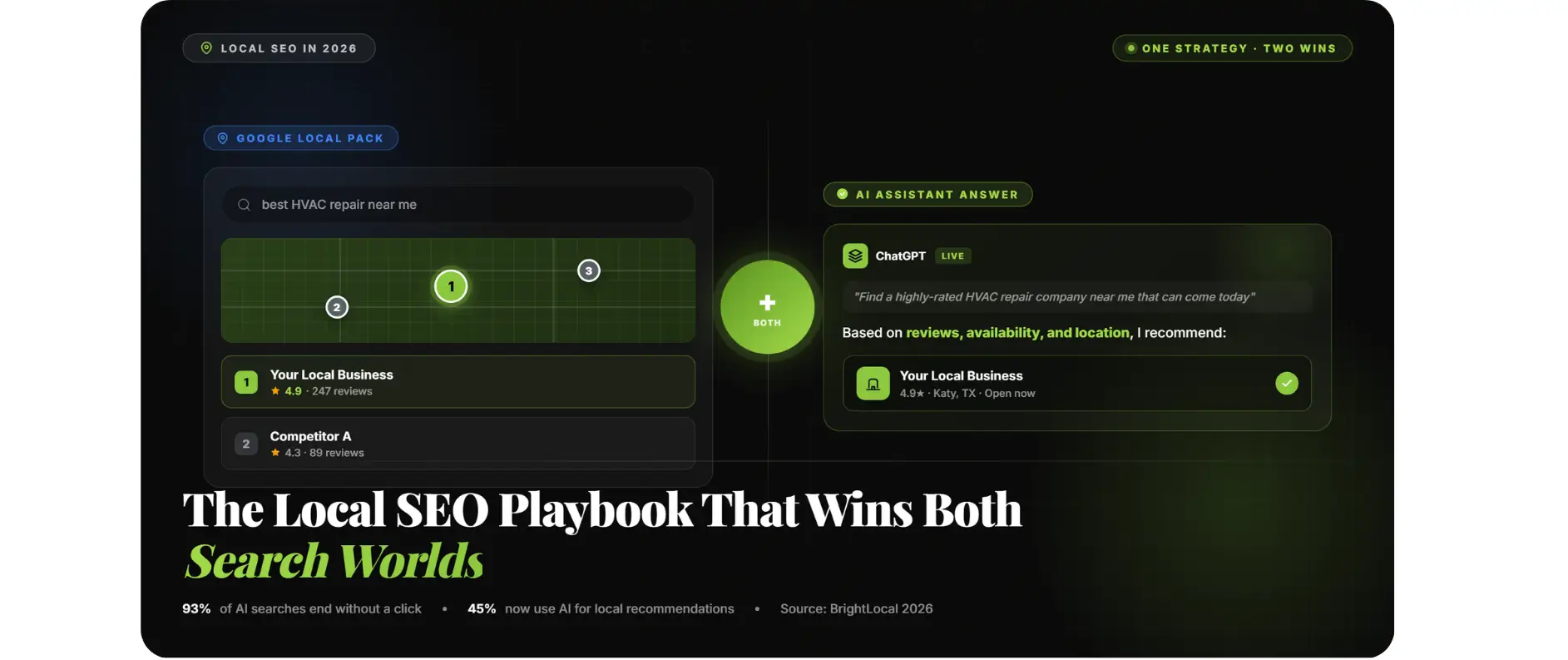
A complete local SEO strategy for local businesses now has to satisfy two different scoring systems: Google's traditional Local Pack algorithm and the newer AI search visibility model.
What is local SEO?
Local search engine optimization is a type of SEO built around geography. Instead of trying to rank for a broad term like "HVAC repair," a local strategy targets what someone nearby actually searches, like "HVAC repair Katy TX" or "HVAC repair near me." The goal is simple: when someone in your service area searches for what you offer, your business should be one of the first things they see, whether that search happens on Google or inside an AI assistant.
For businesses with a physical location or a defined service area, this matters more than general SEO. A bakery in Austin does not need to rank nationally. It needs to rank for people in Austin who are searching right now.
Why local businesses need a local SEO strategy
Search behavior has split in two directions at once. Google's Local Pack, the map result with three business listings, still drives a large share of local clicks. At the same time, a growing share of local decisions never touch a search results page at all.
Social Places' State of Local and AI Search 2026 report found that 93 percent of AI search sessions end without a click, meaning the AI assistant simply answers the question and names a business. BrightLocal's 2026 Local Consumer Review Survey found that 45 percent of consumers now ask ChatGPT or a similar tool for local recommendations, up from just 6 percent the year before. A business that only optimizes for Google's map pack is building for half of how people actually search now.
Types of local SEO tactics
A complete local seo strategy usually combines several tactics working together. Here are the ones that matter most in 2026:
Keyword research: Find the exact phrases people search when looking for a business like yours, including "service plus city" terms and longer, conversational phrases people now type into AI chat tools.
Google Business Profile optimization: Claim and completely fill out your profile, choose the correct primary category, and keep hours, services, and photos current.
Review generation and management: Ask customers for reviews consistently, respond to all of them, and keep the flow recent rather than front-loaded.
Citation building: Get your business name, address, and phone number listed consistently across directories, social platforms, and industry-specific sites.
On-page local content: Build location-specific pages that clearly state who you are, what you do, and where you serve, using structured data markup.
AI search visibility (GEO): Structure your content and entity information so AI assistants can confidently cite your business by name, not just so Google's crawler can index it.
How much do citations, reviews, and AI visibility actually matter?
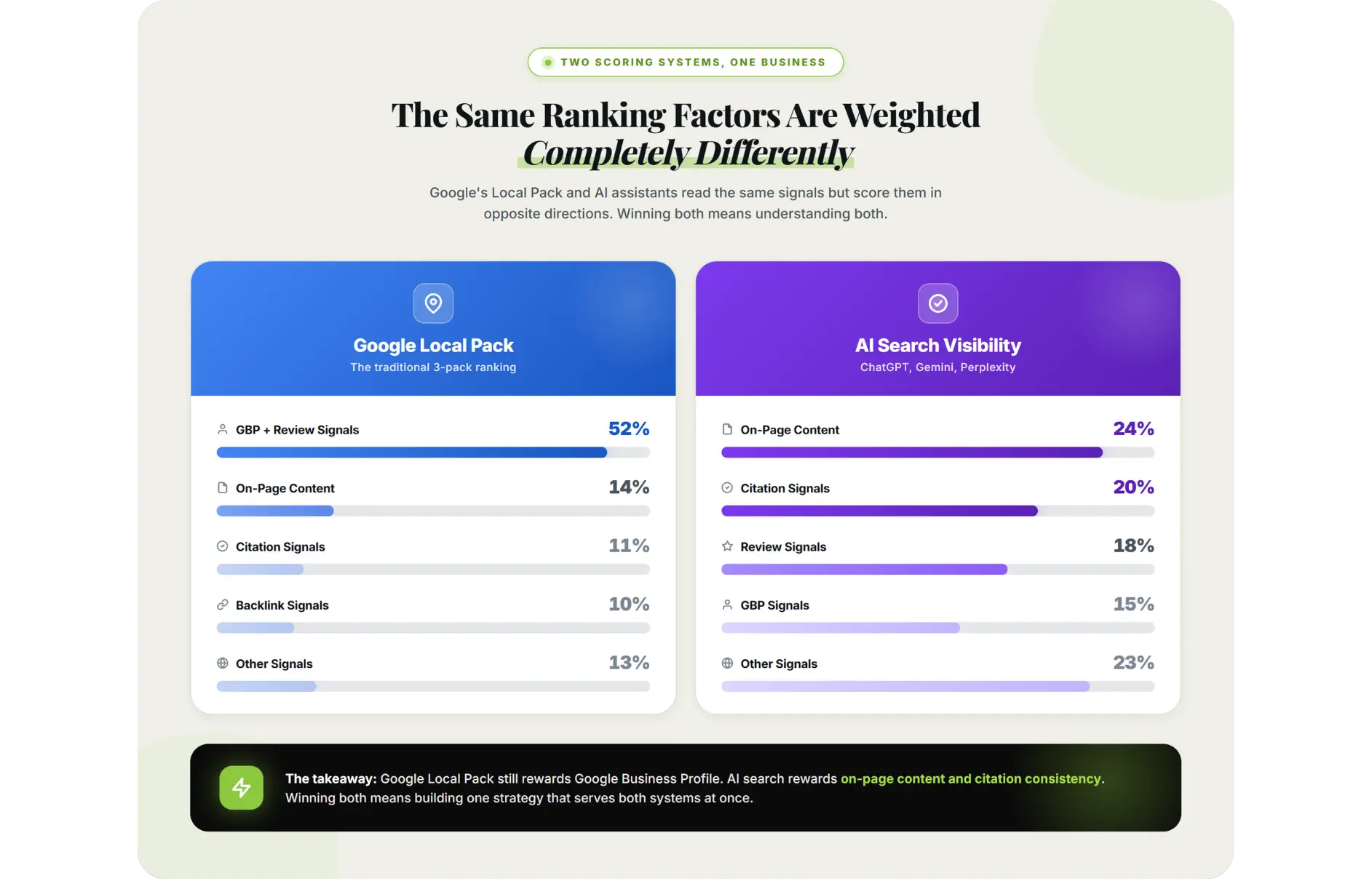
Whitespark's 2026 Local Search Ranking Factors survey, based on scoring from 47 local SEO practitioners across 187 factors, found that Google Business Profile signals and review signals together account for about 52 percent of Local Pack rankings. Citation signals add another meaningful share, mostly through consistency rather than volume.
The same report scored a separate AI Search Visibility model for the first time in 2026. In that model, on-page content jumps to the top factor at 24 percent and citation consistency nearly doubles in weight compared to its role in the Local Pack, while GBP signals drop from the single biggest factor to a supporting one. Google's map pack and an AI assistant's answer are reading two different sets of signals to decide who to show or say.
Reviews carry weight in both systems, but recency matters more than raw count. BrightLocal's 2026 research found 74 percent of consumers only weigh reviews from the last three months, and 41 percent now say they always read reviews before choosing a business, up from 29 percent a year earlier.
How to build a local SEO strategy: step-by-step guide
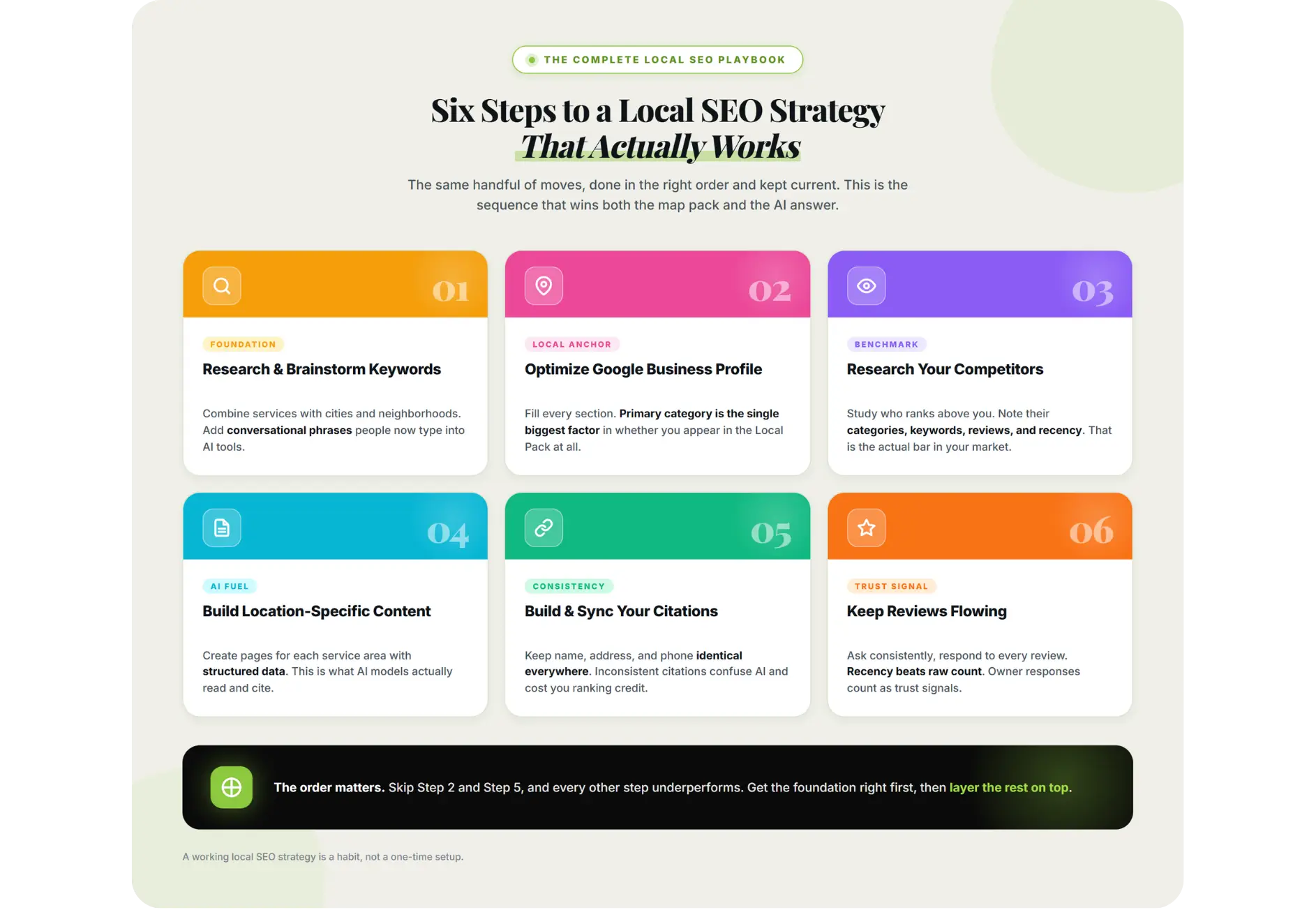
Building a working local seo strategy does not require a long list of new tactics. It requires the same handful of moves, done in the right order and kept current.
Step 1: Research and brainstorm keywords
Start with a list of the services you offer combined with the cities, neighborhoods, or service areas you cover. Add the long-tail, conversational phrasing people now use with AI assistants, since these tend to be full questions rather than short keyword strings. Narrow the list down to terms with real local search volume.
Build your list around a few geo-modifier types rather than just "service plus city." Layer in neighborhood and suburb names (not just the main city), nearby landmarks or well-known cross streets people use as reference points, zip codes for areas with real local search volume, and the "near me" and "open now" variations that carry strong intent even though they carry no location name at all, since Google and AI assistants resolve those using the searcher's actual location. A single service can realistically support ten or more geo-targeted variations once you combine it across neighborhoods, landmarks, and intent phrasing, and each of those becomes a candidate for its own local landing page rather than one page trying to rank for all of them at once.
Step 2: Create and completely Optimize out your Google Business Profile
Claim your profile if you have not already, then fill in every section: primary category, services, hours, photos, and business description. Primary category selection is repeatedly flagged by Whitespark's 2026 survey respondents as the single most influential factor in whether a business appears in the Local Pack at all. An incomplete profile is one of the fastest ways to lose visibility before you have even started.
Step 3: Research competitors
Look at the businesses currently ranking above you in your target searches. Note their categories, the keywords in their profiles and websites, how many reviews they have, and how recent those reviews are. This tells you what a competitive bar actually looks like in your specific market, rather than guessing.
Step 4: Build out location-specific content
Add or update pages on your website that speak directly to each location or service area you cover, using the keywords from Step 1 naturally in headers, subheadings, and body copy. Back this content with structured data markup so it is easy for both Google and AI models to read. This is the core discipline behind generative engine optimization, and it is the same work our GEO and AI search team does when building a business's entity presence for AI assistants.
A single local seo landing page rarely works for more than one city or service area. Give each one its own URL, its own title tag built around service plus city plus what makes you the pick, and content that could not have been written about any other place, real neighborhood references, reviews from customers in that specific area, and a local CTA like "Get a Free HVAC Quote in Katy" instead of a generic one. Keep NAP details identical to your Google Business Profile and place them as crawlable text near the footer, and make sure the page loads fast with contact info visible above the fold on mobile. Strong local landing page examples across industries all follow this same pattern: one page, one location, written like someone who actually works there wrote it, not a template with the city name swapped in.
Step 5: Build citations and keep them consistent
List your business on relevant directories, industry sites, and local platforms, keeping your name, address, and phone number identical everywhere. Inconsistent citations do not just cost you ranking credit with Google. They make it harder for AI models to confidently confirm which business is actually being referenced. Our local listing management service is built specifically to find and fix this kind of drift.
Step 6: Keep reviews flowing and respond to all of them
Set up a simple, repeatable way to ask customers for reviews after a purchase or service call. Respond to every review, positive or negative. Both Google's algorithm and AI models read owner responses as a trust signal, and a steady stream of recent reviews outperforms a large batch of old ones.
How to measure and monitor your local SEO strategy
Once your strategy is live, track it with a few standard tools:
Google Search Console: shows how your website appears in search results, which pages get clicks, and flags indexing issues.
Semrush or Ahrefs: track keyword rankings, monitor competitors, and in Ahrefs' case, track brand mentions across AI chatbots.
Google Analytics: shows what visitors do once they reach your site and which channel brought them there.
Google Business Profile insights: shows calls, direction requests, and how customers found your listing.
Choosing the best agency for local seo
Not every business runs this in house, and a lot of the work above is faster with a team that does it daily. A few things separate an agency worth paying from one padding an invoice:
Ask for local pack movement and call or direction lift from businesses in a similar vertical, not just ranking screenshots.
Ask directly whether they optimize for AI search visibility and structured data, or only for the traditional map pack. In 2026, that is no longer optional.
Be wary of anyone guaranteeing a number one ranking or a fixed timeline. Nobody controls Google's algorithm or what an AI model chooses to cite.
Insist on access to your own Google Business Profile and analytics accounts at all times.
Check whether their local landing pages read like they were written for your specific location, not copy pasted with the city name swapped in.
Common mistakes to avoid
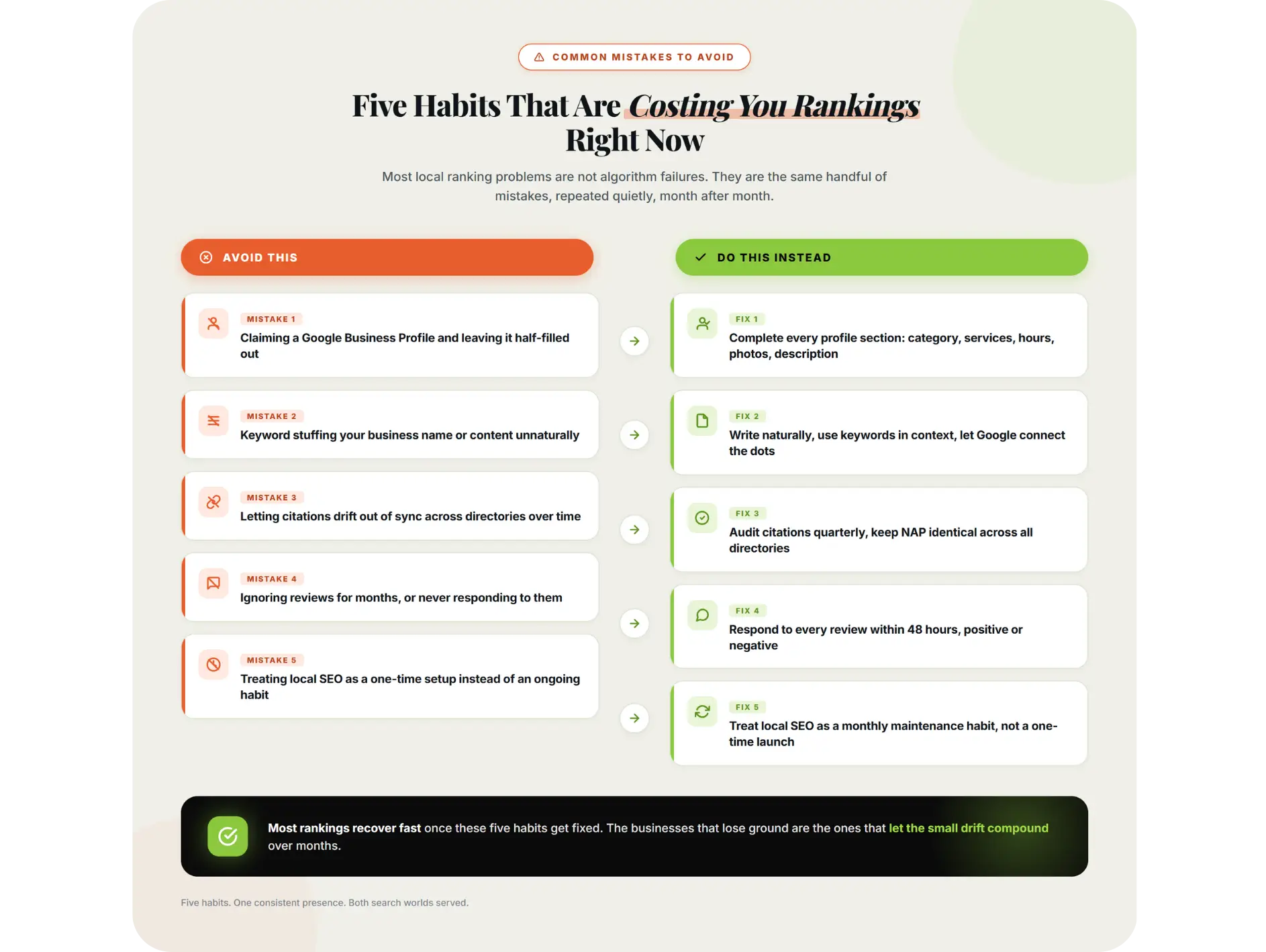
A few recurring mistakes account for most of the local ranking problems we see:
Claiming a Google Business Profile but leaving it incomplete, which lowers both visibility and credibility.
Keyword stuffing a business name or content to the point that it reads unnaturally, a pattern Google's 2026 spam enforcement has actively targeted with suspensions.
Letting citations drift out of sync across directories over time.
Ignoring reviews for months at a time, or never responding to them.
Treating local SEO as a one-time setup instead of an ongoing habit.
Final thoughts
The businesses that keep showing up, in the map pack and in the AI answer, are not chasing every new tactic. They are the ones keeping one consistent, accurate, well maintained presence, whether Google's crawler is reading it or an AI model is deciding whether to say their name out loud. The fundamentals have not changed as much as the audience reading them has. Build for a person deciding where to eat lunch and a model deciding who to recommend, and you are, in practice, covering both at once.
FAQs
What is the difference between local SEO and regular SEO?

Regular SEO aims for broad visibility across any relevant search, while local search engine optimization targets people searching within a specific geographic area, usually with intent to visit or call soon. Local SEO leans more heavily on Google Business Profile signals, reviews, and location-specific content, while national SEO relies more on domain authority and broad content depth. A local business that ignores this distinction often competes for keywords it has no real chance of ranking for, while missing the geo-targeted terms where it could win.
How long does it take for a local SEO strategy to show results?
Google Business Profile improvements, like better category alignment or fresh photos, often show up within a few weeks. Meaningful Local Pack movement typically takes two to four months, and building a strong review base and citation profile is closer to six months of consistent work. Setting this timeline early helps avoid unrealistic promises from anyone offering overnight rankings.
Do I need a website to rank in local search, or is a Google Business Profile enough?
A Google Business Profile alone can get a business into the Local Pack for some searches, but it will not carry AI search visibility, where on-page content and structured data matter more. A website with dedicated, accurate location pages gives both Google's algorithm and AI models something substantial to read, cite, and trust. Businesses relying on a profile alone tend to plateau once local competition gets serious.
How many reviews does a local business actually need?
There is no fixed number, but recency now matters more than raw volume. BrightLocal's 2026 research found most consumers only weigh reviews from the last three months heavily, so a business with a steady flow of recent reviews will often outperform a competitor with a larger but stale review count. A realistic goal is a handful of new reviews every month, responded to promptly.
What is the best agency for local seo if I want to hire one instead of doing it myself?
The right agency depends on your vertical and location, but the criteria that separate a good one from a mediocre one are consistent: real case studies with call and direction lift, explicit AI search visibility capability, transparent reporting you can verify, and access to your own accounts at all times. Coozmoo works this way for the businesses we partner with, building Local Pack presence and AI search visibility as one connected strategy.
A local SEO strategy helps a business show up when someone nearby searches for what it offers. Learn what local SEO tactics actually move the needle in 2026, why Google's Local Pack and AI search engines now score businesses differently, and how to build a strategy that works for both.
Key takeaways
Google Business Profile signals and reviews still decide about 52 percent of Local Pack rankings, according to Whitespark's 2026 Local Search Ranking Factors survey.
93 percent of AI search sessions now end without a click, per Social Places' State of Local and AI Search 2026 report, meaning the business an AI assistant names by voice often gets the customer.
Accounting for nearly 43% of the traffic from 1.2 million user, Perplexity is the undisputed king of local research, according to a Case Study from RankRabbit AI
A complete local SEO strategy for local businesses now has to satisfy two different scoring systems: Google's traditional Local Pack algorithm and the newer AI search visibility model.
What is local SEO?
Local search engine optimization is a type of SEO built around geography. Instead of trying to rank for a broad term like "HVAC repair," a local strategy targets what someone nearby actually searches, like "HVAC repair Katy TX" or "HVAC repair near me." The goal is simple: when someone in your service area searches for what you offer, your business should be one of the first things they see, whether that search happens on Google or inside an AI assistant.
For businesses with a physical location or a defined service area, this matters more than general SEO. A bakery in Austin does not need to rank nationally. It needs to rank for people in Austin who are searching right now.
Why local businesses need a local SEO strategy
Search behavior has split in two directions at once. Google's Local Pack, the map result with three business listings, still drives a large share of local clicks. At the same time, a growing share of local decisions never touch a search results page at all.
Social Places' State of Local and AI Search 2026 report found that 93 percent of AI search sessions end without a click, meaning the AI assistant simply answers the question and names a business. BrightLocal's 2026 Local Consumer Review Survey found that 45 percent of consumers now ask ChatGPT or a similar tool for local recommendations, up from just 6 percent the year before. A business that only optimizes for Google's map pack is building for half of how people actually search now.
Types of local SEO tactics
A complete local seo strategy usually combines several tactics working together. Here are the ones that matter most in 2026:
Keyword research: Find the exact phrases people search when looking for a business like yours, including "service plus city" terms and longer, conversational phrases people now type into AI chat tools.
Google Business Profile optimization: Claim and completely fill out your profile, choose the correct primary category, and keep hours, services, and photos current.
Review generation and management: Ask customers for reviews consistently, respond to all of them, and keep the flow recent rather than front-loaded.
Citation building: Get your business name, address, and phone number listed consistently across directories, social platforms, and industry-specific sites.
On-page local content: Build location-specific pages that clearly state who you are, what you do, and where you serve, using structured data markup.
AI search visibility (GEO): Structure your content and entity information so AI assistants can confidently cite your business by name, not just so Google's crawler can index it.
How much do citations, reviews, and AI visibility actually matter?
Whitespark's 2026 Local Search Ranking Factors survey, based on scoring from 47 local SEO practitioners across 187 factors, found that Google Business Profile signals and review signals together account for about 52 percent of Local Pack rankings. Citation signals add another meaningful share, mostly through consistency rather than volume.
The same report scored a separate AI Search Visibility model for the first time in 2026. In that model, on-page content jumps to the top factor at 24 percent and citation consistency nearly doubles in weight compared to its role in the Local Pack, while GBP signals drop from the single biggest factor to a supporting one. Google's map pack and an AI assistant's answer are reading two different sets of signals to decide who to show or say.
Reviews carry weight in both systems, but recency matters more than raw count. BrightLocal's 2026 research found 74 percent of consumers only weigh reviews from the last three months, and 41 percent now say they always read reviews before choosing a business, up from 29 percent a year earlier.
How to build a local SEO strategy: step-by-step guide
Building a working local seo strategy does not require a long list of new tactics. It requires the same handful of moves, done in the right order and kept current.
Step 1: Research and brainstorm keywords
Start with a list of the services you offer combined with the cities, neighborhoods, or service areas you cover. Add the long-tail, conversational phrasing people now use with AI assistants, since these tend to be full questions rather than short keyword strings. Narrow the list down to terms with real local search volume.
Build your list around a few geo-modifier types rather than just "service plus city." Layer in neighborhood and suburb names (not just the main city), nearby landmarks or well-known cross streets people use as reference points, zip codes for areas with real local search volume, and the "near me" and "open now" variations that carry strong intent even though they carry no location name at all, since Google and AI assistants resolve those using the searcher's actual location. A single service can realistically support ten or more geo-targeted variations once you combine it across neighborhoods, landmarks, and intent phrasing, and each of those becomes a candidate for its own local landing page rather than one page trying to rank for all of them at once.
Step 2: Create and completely Optimize out your Google Business Profile
Claim your profile if you have not already, then fill in every section: primary category, services, hours, photos, and business description. Primary category selection is repeatedly flagged by Whitespark's 2026 survey respondents as the single most influential factor in whether a business appears in the Local Pack at all. An incomplete profile is one of the fastest ways to lose visibility before you have even started.
Step 3: Research competitors
Look at the businesses currently ranking above you in your target searches. Note their categories, the keywords in their profiles and websites, how many reviews they have, and how recent those reviews are. This tells you what a competitive bar actually looks like in your specific market, rather than guessing.
Step 4: Build out location-specific content
Add or update pages on your website that speak directly to each location or service area you cover, using the keywords from Step 1 naturally in headers, subheadings, and body copy. Back this content with structured data markup so it is easy for both Google and AI models to read. This is the core discipline behind generative engine optimization, and it is the same work our GEO and AI search team does when building a business's entity presence for AI assistants.
A single local seo landing page rarely works for more than one city or service area. Give each one its own URL, its own title tag built around service plus city plus what makes you the pick, and content that could not have been written about any other place, real neighborhood references, reviews from customers in that specific area, and a local CTA like "Get a Free HVAC Quote in Katy" instead of a generic one. Keep NAP details identical to your Google Business Profile and place them as crawlable text near the footer, and make sure the page loads fast with contact info visible above the fold on mobile. Strong local landing page examples across industries all follow this same pattern: one page, one location, written like someone who actually works there wrote it, not a template with the city name swapped in.
Step 5: Build citations and keep them consistent
List your business on relevant directories, industry sites, and local platforms, keeping your name, address, and phone number identical everywhere. Inconsistent citations do not just cost you ranking credit with Google. They make it harder for AI models to confidently confirm which business is actually being referenced. Our local listing management service is built specifically to find and fix this kind of drift.
Step 6: Keep reviews flowing and respond to all of them
Set up a simple, repeatable way to ask customers for reviews after a purchase or service call. Respond to every review, positive or negative. Both Google's algorithm and AI models read owner responses as a trust signal, and a steady stream of recent reviews outperforms a large batch of old ones.
How to measure and monitor your local SEO strategy
Once your strategy is live, track it with a few standard tools:
Google Search Console: shows how your website appears in search results, which pages get clicks, and flags indexing issues.
Semrush or Ahrefs: track keyword rankings, monitor competitors, and in Ahrefs' case, track brand mentions across AI chatbots.
Google Analytics: shows what visitors do once they reach your site and which channel brought them there.
Google Business Profile insights: shows calls, direction requests, and how customers found your listing.
Choosing the best agency for local seo
Not every business runs this in house, and a lot of the work above is faster with a team that does it daily. A few things separate an agency worth paying from one padding an invoice:
Ask for local pack movement and call or direction lift from businesses in a similar vertical, not just ranking screenshots.
Ask directly whether they optimize for AI search visibility and structured data, or only for the traditional map pack. In 2026, that is no longer optional.
Be wary of anyone guaranteeing a number one ranking or a fixed timeline. Nobody controls Google's algorithm or what an AI model chooses to cite.
Insist on access to your own Google Business Profile and analytics accounts at all times.
Check whether their local landing pages read like they were written for your specific location, not copy pasted with the city name swapped in.
Common mistakes to avoid
A few recurring mistakes account for most of the local ranking problems we see:
Claiming a Google Business Profile but leaving it incomplete, which lowers both visibility and credibility.
Keyword stuffing a business name or content to the point that it reads unnaturally, a pattern Google's 2026 spam enforcement has actively targeted with suspensions.
Letting citations drift out of sync across directories over time.
Ignoring reviews for months at a time, or never responding to them.
Treating local SEO as a one-time setup instead of an ongoing habit.
Final thoughts
The businesses that keep showing up, in the map pack and in the AI answer, are not chasing every new tactic. They are the ones keeping one consistent, accurate, well maintained presence, whether Google's crawler is reading it or an AI model is deciding whether to say their name out loud. The fundamentals have not changed as much as the audience reading them has. Build for a person deciding where to eat lunch and a model deciding who to recommend, and you are, in practice, covering both at once.
FAQs
What is the difference between local SEO and regular SEO?
Regular SEO aims for broad visibility across any relevant search, while local search engine optimization targets people searching within a specific geographic area, usually with intent to visit or call soon. Local SEO leans more heavily on Google Business Profile signals, reviews, and location-specific content, while national SEO relies more on domain authority and broad content depth. A local business that ignores this distinction often competes for keywords it has no real chance of ranking for, while missing the geo-targeted terms where it could win.
How long does it take for a local SEO strategy to show results?
Google Business Profile improvements, like better category alignment or fresh photos, often show up within a few weeks. Meaningful Local Pack movement typically takes two to four months, and building a strong review base and citation profile is closer to six months of consistent work. Setting this timeline early helps avoid unrealistic promises from anyone offering overnight rankings.
Do I need a website to rank in local search, or is a Google Business Profile enough?
A Google Business Profile alone can get a business into the Local Pack for some searches, but it will not carry AI search visibility, where on-page content and structured data matter more. A website with dedicated, accurate location pages gives both Google's algorithm and AI models something substantial to read, cite, and trust. Businesses relying on a profile alone tend to plateau once local competition gets serious.
How many reviews does a local business actually need?
There is no fixed number, but recency now matters more than raw volume. BrightLocal's 2026 research found most consumers only weigh reviews from the last three months heavily, so a business with a steady flow of recent reviews will often outperform a competitor with a larger but stale review count. A realistic goal is a handful of new reviews every month, responded to promptly.
What is the best agency for local seo if I want to hire one instead of doing it myself?
The right agency depends on your vertical and location, but the criteria that separate a good one from a mediocre one are consistent: real case studies with call and direction lift, explicit AI search visibility capability, transparent reporting you can verify, and access to your own accounts at all times. Coozmoo works this way for the businesses we partner with, building Local Pack presence and AI search visibility as one connected strategy.



Summarize with AI



Want to Skyrocket Revenue? Get a Free Audit Today!
Want to Skyrocket Revenue? Get a Free Audit Today!



4.9/5 Ratings!


Don’t miss our revenue growth tips!
Get expert marketing tips—straight to your inbox, like thousands of happy clients.
Don’t miss our revenue growth tips!
Get expert marketing tips—straight to your inbox, like thousands of happy clients.
Don’t miss our revenue growth tips!
Don’t miss our revenue growth tips!
Get expert marketing tips—straight to your inbox, like thousands of happy clients.
Relevant Blogs on Organic SEO
Relevant Blogs on Organic SEO
Unlock data-driven insights in Organic SEO—explore our featured blogs and skyrocket your revenue before your competitors do.
Unlock data-driven insights in Organic SEO—explore our featured blogs and skyrocket your revenue before your competitors do.

SEO
Sep 21, 2026
5 Min Read
Audience-First SEO: How to Rank by Putting Readers First
SEO
Sep 21, 2026
5 Min Read
Audience-First SEO: How to Rank by Putting Readers First
SEO
Sep 21, 2026
5 Min Read
Audience-First SEO: How to Rank by Putting Readers First

SEO
Sep 19, 2026
5 Min Read
How to Add SEO Keywords to Your Website: Where and How
SEO
Sep 19, 2026
5 Min Read
How to Add SEO Keywords to Your Website: Where and How
SEO
Sep 19, 2026
5 Min Read
How to Add SEO Keywords to Your Website: Where and How

SEO
Sep 18, 2026
5 Min Read
How XML Sitemaps Help Search Engines Discover New Pages
SEO
Sep 18, 2026
5 Min Read
How XML Sitemaps Help Search Engines Discover New Pages
SEO
Sep 18, 2026
5 Min Read
How XML Sitemaps Help Search Engines Discover New Pages












Ready to speak with an expert?
Data-Driven Marketing Agency That Elevates ROI
1100+
Websites Designed & Optimized to Convert
$280M+
Client Revenue Driven & Growing Strong
Discover how to skyrocket
your revenue today!
Trusted by 1000+ Owners!
Ready to speak with an expert?
Data-Driven Marketing Agency That Elevates ROI
1100+
Websites Designed & Optimized to Convert
$280M+
Client Revenue Driven & Growing Strong
Discover how to skyrocket
your revenue today!
Trusted by 1000+ Owners!
Want to skyrocket revenue?
4.9/5 Ratings!
Ready to speak with an expert?
Data-Driven Marketing Agency That Elevates ROI
1100+
Websites Designed & Optimized to Convert
$280M+
Client Revenue Driven & Growing Strong
Discover how to skyrocket
your revenue today!
Trusted by 1000+ Owners!
Call
Meet