How to Write Blog That Ranks in Google & AI Search in 2026
How to Write Blog That Ranks in Google & AI Search in 2026
Last Updated:
Table of Content
Case Studies








Indra Singh
Indra Singh
Indra Singh
SEO
SEO
SEO
10 Min Read
8 Min
10 Min Read
Six months ago, "rank on page one" meant one thing. Now it means at least two.
Google still runs its classic algorithm. But a growing share of searches never make it to a list of ten blue links. They get answered inside an AI overview, a ChatGPT search response, or a Perplexity summary, sourced from a handful of pages the AI decided were worth citing. If your blog isn't one of them, it doesn't matter how good the content is. Nobody sees it.
Most "SEO in 2026" articles skip this part, insisting blog SEO is still just keywords and backlinks. It isn't. Traditional SEO is now one half of a two-part job: rank in Google Search and get cited in AI search.
Learning how to write a blog for both isn't a rewrite of what you already know. It's an extension of it. The blog content writing tips that have always worked (clear search intent, real structure, actual credibility) still hold. What's changed is how AI systems evaluate those fundamentals, and what they need before they'll quote a page back to a user.
This guide covers how Google and AI search actually work, a 12-step process for writing a post that satisfies both, and the mistakes that keep solid content out of AI answers.
How Google & AI Search Work in 2026
Google Search vs AI Search
Traditional rankings run on a familiar formula: crawl the page, index it, match it against a query, and rank it against competitors on hundreds of signals. A user searches, clicks a link, and lands on your site.
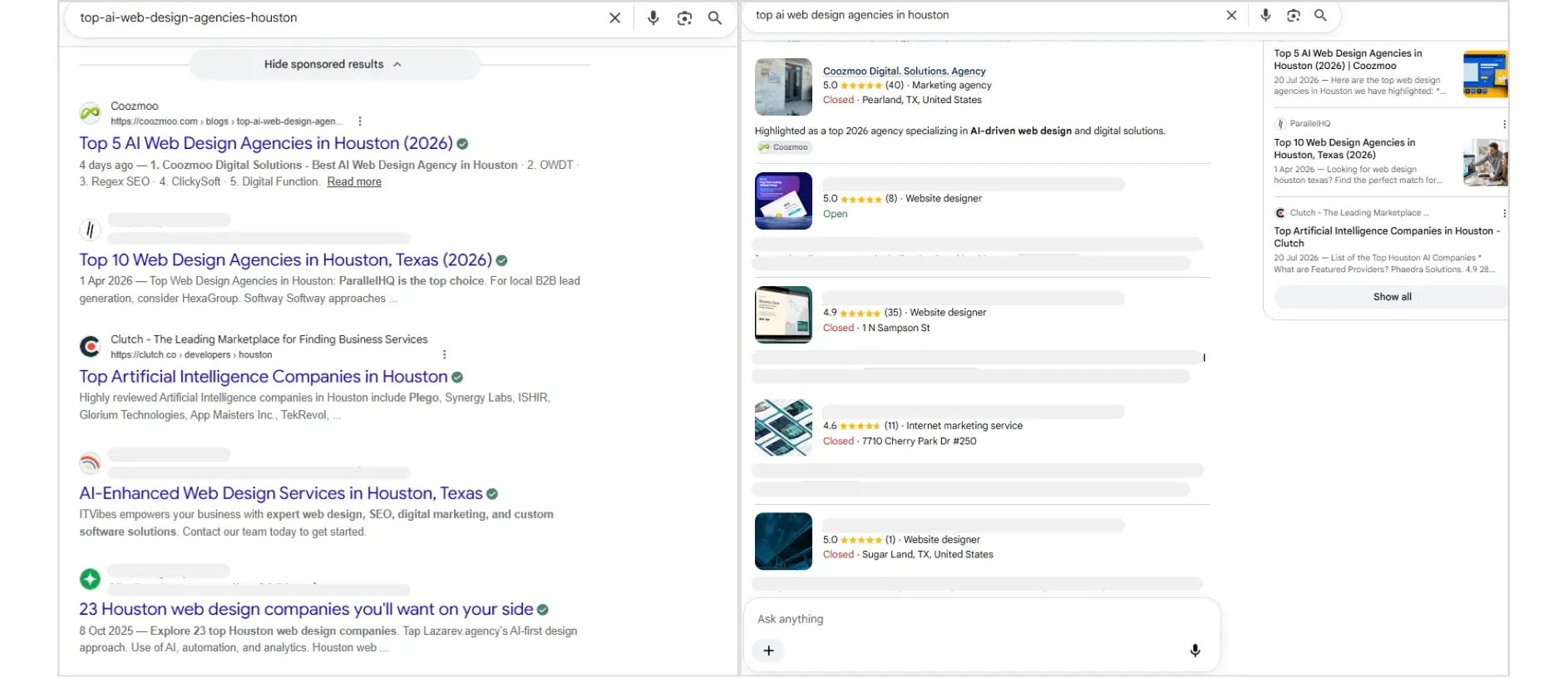
AI search skips a step. Tools like Google's AI Overviews, ChatGPT Search, Gemini, and Perplexity generate a direct answer first, then cite the sources it came from. The user may never click through. A citation with no click still builds authority, but it doesn't drive traffic the way a ranked link used to.
Conversational search adds another layer. People don't type "best CRM software" into ChatGPT the way they'd type it into Google. They ask something closer to "which CRM should a 10-person agency use if the budget's tight and we need HubSpot integration." That's a multi-step query, and it rewards content that answers layered questions, not just single keywords.
How AI Chooses Sources
AI search tools don't rank pages the same way Google's core algorithm does, but the inputs overlap more than most people assume.
Relevance means matching what the user actually meant, not just the words typed. Authority comes from consistent expertise over time, not one high-ranking post. Freshness matters more for AI overviews than for standard search. Entities (the people, tools, and concepts your content mentions and how they relate) help a model understand what your page is actually about. Structured content is easier to parse and extract cleanly. E-E-A-T signals tell both systems whether a source is safe to quote. And engagement signals, like whether people bounce immediately, still feed back into what counts as helpful.
Factor | Google Search | AI Search |
|---|---|---|
Primary goal | Rank a page in results | Generate a direct answer, then cite sources |
Content format | Rewards structure, still tolerates prose | Strongly prefers structured, extractable content |
Freshness | Matters for some topics | Matters heavily, especially for fast-moving topics |
Keyword matching | Semantic, but keyword-aware | Near-irrelevant; intent and entities matter far more |
Success metric | Click-through rate | Citation and mention rate |
Content depth | Comprehensive pages tend to rank | Direct, well-defined answers get quoted |
Step 1: Start With Search Intent, Not Just Keywords
Before you write a single word, figure out why someone is searching, not just what they're typing.
There are four core intent types. "Informational intent" means the searcher is keen to learn something ("how to optimize a blog for SEO"). Commercial intent means they're comparing options before buying ("best SEO tools for small teams"). Transactional intent means they're ready to act ("hire an SEO consultant"). Navigational intent means they're looking for a specific brand or site ("Google Search Console login").
Mixing these up wastes an article. A commercial-intent searcher landing on a purely informational post will bounce, and that bounce signals to Google and AI systems that your page didn't satisfy the query.
To find real intent, don't guess. Pull it from where people are actually asking questions:
Google Autocomplete shows what people type before finishing a query
People Also Ask boxes reveal related questions Google already knows matter
Reddit Threads surface the actual language people use, often different from formal search terms
Quora answers show what depth of explanation people expect
AI prompts (ask ChatGPT or Perplexity the topic yourself) show what an AI answer already covers
Community forums in your niche often reveal intent Google's own tools miss
Google Search Console shows the actual queries your existing content ranks for, including ones you never targeted
Example: Search "how to write a blog," and Autocomplete suggests "for beginners," "step by step," and "that gets traffic." Three different articles, not one.
Step 2: Do Entity-Based Keyword Research
Keyword-only SEO treats a topic as a string of text to match. Entity SEO treats it as a network of related concepts, a better match for how AI models actually process language.
Instead of writing around one primary keyword, map the entities connected to your topic: related concepts, synonyms, brands, products, locations, common questions, and defining attributes.
Take "AI SEO" as a primary keyword. Its entity map includes things like Google AI Overviews, Gemini, ChatGPT, Perplexity, Search Console, schema markup, E-E-A-T, and llms.txt. None of those are synonyms for "AI SEO." They're concepts that a model already associates with it because they show up together across the live web.
When your content naturally includes those connected entities, a model has an easier time confirming your page genuinely covers the topic, rather than just mentioning the keyword. That's the difference between keyword stuffing and topical authority.
When writing, don't stuff keywords unnaturally. Integrate natural variations, entity relationships, and conversational semantic keywords throughout your sections. Aim for a combined primary keyword density of around 2–4%, ensuring the phrasing feels natural to human readers while remaining explicit for search bots.
Step 3: Create an AI-Friendly Blog Structure
Both Google and AI models favor a predictable hierarchy: one H1, logical H2 sections, H3 subpoints where needed, bullet and numbered lists for anything sequential, tables for comparisons, a short summary or "quick answer" box near the top, an FAQ section, and a clear conclusion.
This isn't just about SEO. It's about extraction. AI search tools need to pull a clean, self-contained answer out of your page fast. A wall of unbroken text forces the model to guess where one idea ends and another begins. A clear table or numbered list gives it something to lift directly.
Readability matters just as much for the humans reading the same page. Short paragraphs and scannable formatting keep people reading longer, and that dwell time feeds back into how both Google and AI systems judge whether your content held someone's attention.
Step 4: Write Helpful, Original Content
This is the step most blogs fail on, and it's the one no amount of formatting can fix.
Helpful, original content includes first-hand experience with the topic, not a secondhand summary of what other articles already say. That means actual examples, screenshots, case studies, real numbers from your own work, and recommendations someone can act on today, not vague encouragement to "optimize your strategy."
What kills a blog's chances in both Google and AI search: thin content that restates the obvious, keyword stuffing, generic AI filler with no specific detail, duplicate content with the nouns swapped, and surface-level advice that never gets past the first layer of a topic.
If five existing articles on a topic all say the same three things in a different order, a sixth version adds nothing. AI models have already absorbed those five. They need something new: a number nobody else has published, a framework nobody else has named, an angle nobody else took.
Step 5: Answer Questions Clearly
Direct answers get cited. Vague ones don't.
Structure key sections around the actual question shapes people search: what is, why does, how do, when should, best options for, cost of, benefits of, pros and cons of. Each deserves its own labeled section, answered in the first sentence or two, with supporting detail after.
AI assistants are built to extract a concise answer and attribute it. If your answer is buried in paragraph four, the model either does extra work to find it or skips your page for a competitor's that answered faster. Put the answer first. Explain it after.
Formatting tip: bold the direct answer sentence itself. It helps human skimmers and gives AI extraction tools an obvious anchor point.
Step 6: Optimize for Google's E-E-A-T
E-E-A-T isn't a checklist you bolt onto finished content. It's a set of signals that either exist in the writing or don't.
Experience means the content reflects someone who has actually done the thing described, not just researched it.
Expertise means the writer understands the subject beyond surface knowledge.
Authoritativeness means credible sources treat this site or author as a legitimate reference. Trustworthiness means the information is accurate and sourced honestly, and the site is transparent about who's behind it.
In practice: a real author bio with relevant credentials, cited sources instead of unsupported claims, accurate business information, real examples instead of hypotheticals, and a visible, accurate "last updated" date.
An anonymous post with no author or sources is a much riskier citation for an AI model than a page with a named expert and a clear paper trail.
Step 7: Optimize On-Page SEO
Content quality is a key factor. On-page SEO makes sure the technical side doesn't disqualify you.
Element | Best Practice |
|---|---|
SEO Title | Under 60 characters, keyword near the front |
Meta Description | 150–160 characters, states the value clearly |
URL Slug | Short, readable, keyword-included |
H1 | One per page, matches search intent |
H2/H3 | Logical hierarchy, one topic per section |
Internal Links | Link to genuinely related pages on your own site |
External Links | Link out to credible, relevant sources |
Image Alt Text | Descriptive, not keyword-stuffed |
Image Compression | Optimized file size for fast load |
Canonical Tags | Set on any duplicate or near-duplicate content |
Breadcrumbs | Visible navigation path, marked up with schema |
Open Graph Tags | Set for clean social sharing previews |
Anchor Text | Descriptive, not generic ("click here") |
XML Sitemap | Updated automatically when new posts publish |
Step 8: Add Structured Data ( Schema Markup)
Structured data is how you tell search engines and AI models exactly what a page contains, instead of hoping they infer it correctly.
The most relevant schema types for blog content:
Article or BlogPosting Schema: Defines the article headline, author, date published, date modified, publisher, and main image.
FAQPage Schema: Highlights question-and-answer pairs so search engines can pull direct answers into SERP features.
Author Schema: Connects the author entity to their credential URLs, social profiles, and external achievements.
BreadcrumbList Schema: Clarifies where the blog post sits within your site's overall architecture.
All of this gets implemented as JSON-LD, a script block that search engines and AI crawlers read directly. It doesn't change what a human sees, but it often decides whether content gets pulled into a citation.
Step 9: Improve AI Citation Chances
Getting cited by an AI system isn't about optimizing harder. It's about having something worth citing in the first place.
AI models cite content that adds information they can't already generate on their own: original statistics from your data, a named framework you built, clear definitions in your own words, usable templates or checklists, quotes from real people, and comparison tables or diagrams that organize information cleanly.
Generic restatement of common knowledge doesn't get cited, because the model already "knows" it. Original material does, because it fills a gap the model can't fill itself. If your content could have been generated by the same AI reading it, there's no reason to point a user toward it instead of just answering directly.
Step 10: Build Topic Clusters
A single great post rarely builds lasting topical authority. A cluster of connected posts does.
Take a broad topic like AI SEO. Instead of one article covering everything, build a main pillar page, then supporting posts on an AI SEO checklist, a GEO guide, entity SEO, ranking in AI Overviews, an llms.txt guide, and schema markup for AI visibility.
Link them together deliberately. The pillar links out to each supporting post, and each post links back to the pillar and sideways to related posts. That pattern signals to Google and AI crawlers that your site has comprehensive coverage, not just one lucky post that happened to rank.
Step 11: Optimize for User Experience
None of the content or technical work matters if people can't actually use the page.
Readability comes first: short paragraphs, real bullet lists, images that break up long sections, tables for comparisons, and jump links so readers can skip to the section they need.
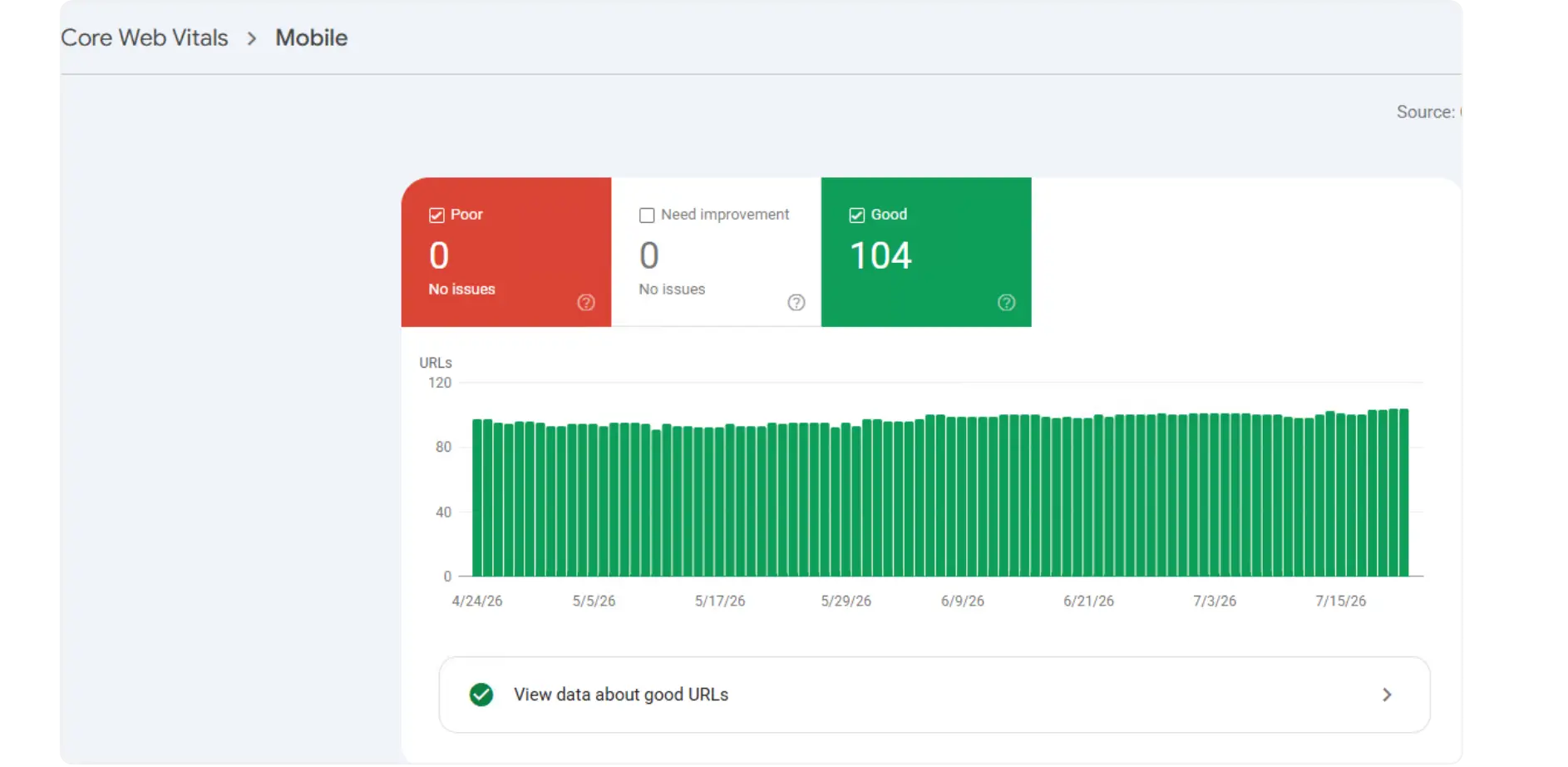
Fast loading and mobile responsiveness aren't optional; most blog traffic arrives on a phone, and a slow page loses readers before they see a sentence. Accessibility (alt text, readable contrast, logical heading order) helps real users and happens to align with what search engines reward.
Core Web Vitals (loading speed, interactivity, visual stability) directly influence Google rankings, and a page that loads slowly or shifts while loading shows up in engagement metrics almost immediately.
Step 12: Update Content Regularly
Publishing is just the beginning. A post from 18 months ago with outdated stats and screenshots of an interface that no longer exists signals the page isn't maintained, and both Google and AI systems increasingly favor freshness on fast-moving topics.
A reasonable update cadence includes refreshing statistics, updating screenshots when tools change, adding coverage of new tools relevant to the topic, expanding FAQs with questions that readers are currently asking, and removing anything that has become flatly wrong.
Freshness matters more for some topics than others. A post about "best AI SEO tools" needs updating constantly. A post about "what is entity SEO" barely changes year to year. Match your update effort to how fast the underlying topic actually moves.
Common Mistakes That Prevent Blogs From Ranking
Writing only for keywords. Fix: write for the searcher first, then confirm the keyword is naturally present.
Ignoring search intent. Fix: match content format to intent type before writing a word.
Poor entity optimization. Fix: map related entities before drafting.
Weak internal linking. Fix: build topic clusters with deliberate, two-way links.
No structured data. Fix: Implement article, FAQ, and author schema at minimum.
Outdated information. Fix: set a real review cadence, not publish-and-forget.
Thin AI-generated content. Fix: add first-hand experience and original data before publishing anything AI helped draft.
Missing author credibility. Fix: add a real, credentialed author bio to every post.
Poor user experience. Fix: audit readability and mobile performance, not just word count.
Slow loading pages. Fix: compress images and monitor Core Web Vitals regularly.
Final Thoughts
Blog SEO in 2026 isn't a different discipline than a few years ago. It's the same discipline with a second audience added. Google still needs the fundamentals: search intent, structure, technical health, credible authorship. AI search needs those same fundamentals expressed even more clearly because a model is trying to lift a direct answer out of your page in seconds.
The throughline is the same: be specific, be structured, and say something an AI system can't already generate on its own. Entity optimization, structured data, and E-E-A-T aren't separate boxes to check. They're different expressions of the same idea: your content actually knows what it's talking about.
Start with one post. Pick a topic you genuinely understand better than what's already ranking for it, structure it the way this guide lays out, and give it something original a generic AI answer can't replicate. That's the post that starts showing up in both places.
FAQs
Can AI-generated blogs rank on Google?

Yes, but not on AI generation alone. Google doesn't penalize content for being AI-assisted; it penalizes content for being unhelpful. A post drafted with AI help and then edited with real examples, original data, and a credible author can rank fine. A post published straight from an AI tool with no human input usually can't compete on depth or E-E-A-T.
Does Google prefer human-written content?
Google's stated position is that it evaluates helpfulness, not authorship method. In practice, human-written or human-edited content tends to carry stronger E-E-A-T signals: real experience, specific detail, and a perspective that generic AI output often lacks. The preference is really for quality signals that correlate with human involvement.
How do AI search engines choose citations?
AI tools cite pages that hand them something they couldn't generate themselves, real structure, solid entity coverage, and an author worth trusting. Freshness helps too, especially on anything tool- or feature-related. What doesn't get cited is the stuff every other page already says. If a model already knows it, it has no reason to point a user at your version of it.
Is schema still important?
Yes, arguably more than before. Structured data helps search engines and AI crawlers understand exactly what a page contains, which increases the odds of rich results in Google and clean extraction by AI tools. It doesn't guarantee ranking or citation, but its absence makes both harder.
How often should I update blog posts?
How often you touch a post depends on how fast the topic moves. Pricing and feature pages can go stale in a couple months. A "what is entity SEO" explainer can probably sit untouched for a year. I'd audit top-performing posts quarterly and just fix whatever's broken, wrong, or embarrassingly out of date.
Six months ago, "rank on page one" meant one thing. Now it means at least two.
Google still runs its classic algorithm. But a growing share of searches never make it to a list of ten blue links. They get answered inside an AI overview, a ChatGPT search response, or a Perplexity summary, sourced from a handful of pages the AI decided were worth citing. If your blog isn't one of them, it doesn't matter how good the content is. Nobody sees it.
Most "SEO in 2026" articles skip this part, insisting blog SEO is still just keywords and backlinks. It isn't. Traditional SEO is now one half of a two-part job: rank in Google Search and get cited in AI search.
Learning how to write a blog for both isn't a rewrite of what you already know. It's an extension of it. The blog content writing tips that have always worked (clear search intent, real structure, actual credibility) still hold. What's changed is how AI systems evaluate those fundamentals, and what they need before they'll quote a page back to a user.
This guide covers how Google and AI search actually work, a 12-step process for writing a post that satisfies both, and the mistakes that keep solid content out of AI answers.
How Google & AI Search Work in 2026
Google Search vs AI Search
Traditional rankings run on a familiar formula: crawl the page, index it, match it against a query, and rank it against competitors on hundreds of signals. A user searches, clicks a link, and lands on your site.
AI search skips a step. Tools like Google's AI Overviews, ChatGPT Search, Gemini, and Perplexity generate a direct answer first, then cite the sources it came from. The user may never click through. A citation with no click still builds authority, but it doesn't drive traffic the way a ranked link used to.
Conversational search adds another layer. People don't type "best CRM software" into ChatGPT the way they'd type it into Google. They ask something closer to "which CRM should a 10-person agency use if the budget's tight and we need HubSpot integration." That's a multi-step query, and it rewards content that answers layered questions, not just single keywords.
How AI Chooses Sources
AI search tools don't rank pages the same way Google's core algorithm does, but the inputs overlap more than most people assume.
Relevance means matching what the user actually meant, not just the words typed. Authority comes from consistent expertise over time, not one high-ranking post. Freshness matters more for AI overviews than for standard search. Entities (the people, tools, and concepts your content mentions and how they relate) help a model understand what your page is actually about. Structured content is easier to parse and extract cleanly. E-E-A-T signals tell both systems whether a source is safe to quote. And engagement signals, like whether people bounce immediately, still feed back into what counts as helpful.
Factor | Google Search | AI Search |
|---|---|---|
Primary goal | Rank a page in results | Generate a direct answer, then cite sources |
Content format | Rewards structure, still tolerates prose | Strongly prefers structured, extractable content |
Freshness | Matters for some topics | Matters heavily, especially for fast-moving topics |
Keyword matching | Semantic, but keyword-aware | Near-irrelevant; intent and entities matter far more |
Success metric | Click-through rate | Citation and mention rate |
Content depth | Comprehensive pages tend to rank | Direct, well-defined answers get quoted |
Step 1: Start With Search Intent, Not Just Keywords
Before you write a single word, figure out why someone is searching, not just what they're typing.
There are four core intent types. "Informational intent" means the searcher is keen to learn something ("how to optimize a blog for SEO"). Commercial intent means they're comparing options before buying ("best SEO tools for small teams"). Transactional intent means they're ready to act ("hire an SEO consultant"). Navigational intent means they're looking for a specific brand or site ("Google Search Console login").
Mixing these up wastes an article. A commercial-intent searcher landing on a purely informational post will bounce, and that bounce signals to Google and AI systems that your page didn't satisfy the query.
To find real intent, don't guess. Pull it from where people are actually asking questions:
Google Autocomplete shows what people type before finishing a query
People Also Ask boxes reveal related questions Google already knows matter
Reddit Threads surface the actual language people use, often different from formal search terms
Quora answers show what depth of explanation people expect
AI prompts (ask ChatGPT or Perplexity the topic yourself) show what an AI answer already covers
Community forums in your niche often reveal intent Google's own tools miss
Google Search Console shows the actual queries your existing content ranks for, including ones you never targeted
Example: Search "how to write a blog," and Autocomplete suggests "for beginners," "step by step," and "that gets traffic." Three different articles, not one.
Step 2: Do Entity-Based Keyword Research
Keyword-only SEO treats a topic as a string of text to match. Entity SEO treats it as a network of related concepts, a better match for how AI models actually process language.
Instead of writing around one primary keyword, map the entities connected to your topic: related concepts, synonyms, brands, products, locations, common questions, and defining attributes.
Take "AI SEO" as a primary keyword. Its entity map includes things like Google AI Overviews, Gemini, ChatGPT, Perplexity, Search Console, schema markup, E-E-A-T, and llms.txt. None of those are synonyms for "AI SEO." They're concepts that a model already associates with it because they show up together across the live web.
When your content naturally includes those connected entities, a model has an easier time confirming your page genuinely covers the topic, rather than just mentioning the keyword. That's the difference between keyword stuffing and topical authority.
When writing, don't stuff keywords unnaturally. Integrate natural variations, entity relationships, and conversational semantic keywords throughout your sections. Aim for a combined primary keyword density of around 2–4%, ensuring the phrasing feels natural to human readers while remaining explicit for search bots.
Step 3: Create an AI-Friendly Blog Structure
Both Google and AI models favor a predictable hierarchy: one H1, logical H2 sections, H3 subpoints where needed, bullet and numbered lists for anything sequential, tables for comparisons, a short summary or "quick answer" box near the top, an FAQ section, and a clear conclusion.
This isn't just about SEO. It's about extraction. AI search tools need to pull a clean, self-contained answer out of your page fast. A wall of unbroken text forces the model to guess where one idea ends and another begins. A clear table or numbered list gives it something to lift directly.
Readability matters just as much for the humans reading the same page. Short paragraphs and scannable formatting keep people reading longer, and that dwell time feeds back into how both Google and AI systems judge whether your content held someone's attention.
Step 4: Write Helpful, Original Content
This is the step most blogs fail on, and it's the one no amount of formatting can fix.
Helpful, original content includes first-hand experience with the topic, not a secondhand summary of what other articles already say. That means actual examples, screenshots, case studies, real numbers from your own work, and recommendations someone can act on today, not vague encouragement to "optimize your strategy."
What kills a blog's chances in both Google and AI search: thin content that restates the obvious, keyword stuffing, generic AI filler with no specific detail, duplicate content with the nouns swapped, and surface-level advice that never gets past the first layer of a topic.
If five existing articles on a topic all say the same three things in a different order, a sixth version adds nothing. AI models have already absorbed those five. They need something new: a number nobody else has published, a framework nobody else has named, an angle nobody else took.
Step 5: Answer Questions Clearly
Direct answers get cited. Vague ones don't.
Structure key sections around the actual question shapes people search: what is, why does, how do, when should, best options for, cost of, benefits of, pros and cons of. Each deserves its own labeled section, answered in the first sentence or two, with supporting detail after.
AI assistants are built to extract a concise answer and attribute it. If your answer is buried in paragraph four, the model either does extra work to find it or skips your page for a competitor's that answered faster. Put the answer first. Explain it after.
Formatting tip: bold the direct answer sentence itself. It helps human skimmers and gives AI extraction tools an obvious anchor point.
Step 6: Optimize for Google's E-E-A-T
E-E-A-T isn't a checklist you bolt onto finished content. It's a set of signals that either exist in the writing or don't.
Experience means the content reflects someone who has actually done the thing described, not just researched it.
Expertise means the writer understands the subject beyond surface knowledge.
Authoritativeness means credible sources treat this site or author as a legitimate reference. Trustworthiness means the information is accurate and sourced honestly, and the site is transparent about who's behind it.
In practice: a real author bio with relevant credentials, cited sources instead of unsupported claims, accurate business information, real examples instead of hypotheticals, and a visible, accurate "last updated" date.
An anonymous post with no author or sources is a much riskier citation for an AI model than a page with a named expert and a clear paper trail.
Step 7: Optimize On-Page SEO
Content quality is a key factor. On-page SEO makes sure the technical side doesn't disqualify you.
Element | Best Practice |
|---|---|
SEO Title | Under 60 characters, keyword near the front |
Meta Description | 150–160 characters, states the value clearly |
URL Slug | Short, readable, keyword-included |
H1 | One per page, matches search intent |
H2/H3 | Logical hierarchy, one topic per section |
Internal Links | Link to genuinely related pages on your own site |
External Links | Link out to credible, relevant sources |
Image Alt Text | Descriptive, not keyword-stuffed |
Image Compression | Optimized file size for fast load |
Canonical Tags | Set on any duplicate or near-duplicate content |
Breadcrumbs | Visible navigation path, marked up with schema |
Open Graph Tags | Set for clean social sharing previews |
Anchor Text | Descriptive, not generic ("click here") |
XML Sitemap | Updated automatically when new posts publish |
Step 8: Add Structured Data ( Schema Markup)
Structured data is how you tell search engines and AI models exactly what a page contains, instead of hoping they infer it correctly.
The most relevant schema types for blog content:
Article or BlogPosting Schema: Defines the article headline, author, date published, date modified, publisher, and main image.
FAQPage Schema: Highlights question-and-answer pairs so search engines can pull direct answers into SERP features.
Author Schema: Connects the author entity to their credential URLs, social profiles, and external achievements.
BreadcrumbList Schema: Clarifies where the blog post sits within your site's overall architecture.
All of this gets implemented as JSON-LD, a script block that search engines and AI crawlers read directly. It doesn't change what a human sees, but it often decides whether content gets pulled into a citation.
Step 9: Improve AI Citation Chances
Getting cited by an AI system isn't about optimizing harder. It's about having something worth citing in the first place.
AI models cite content that adds information they can't already generate on their own: original statistics from your data, a named framework you built, clear definitions in your own words, usable templates or checklists, quotes from real people, and comparison tables or diagrams that organize information cleanly.
Generic restatement of common knowledge doesn't get cited, because the model already "knows" it. Original material does, because it fills a gap the model can't fill itself. If your content could have been generated by the same AI reading it, there's no reason to point a user toward it instead of just answering directly.
Step 10: Build Topic Clusters
A single great post rarely builds lasting topical authority. A cluster of connected posts does.
Take a broad topic like AI SEO. Instead of one article covering everything, build a main pillar page, then supporting posts on an AI SEO checklist, a GEO guide, entity SEO, ranking in AI Overviews, an llms.txt guide, and schema markup for AI visibility.
Link them together deliberately. The pillar links out to each supporting post, and each post links back to the pillar and sideways to related posts. That pattern signals to Google and AI crawlers that your site has comprehensive coverage, not just one lucky post that happened to rank.
Step 11: Optimize for User Experience
None of the content or technical work matters if people can't actually use the page.
Readability comes first: short paragraphs, real bullet lists, images that break up long sections, tables for comparisons, and jump links so readers can skip to the section they need.
Fast loading and mobile responsiveness aren't optional; most blog traffic arrives on a phone, and a slow page loses readers before they see a sentence. Accessibility (alt text, readable contrast, logical heading order) helps real users and happens to align with what search engines reward.
Core Web Vitals (loading speed, interactivity, visual stability) directly influence Google rankings, and a page that loads slowly or shifts while loading shows up in engagement metrics almost immediately.
Step 12: Update Content Regularly
Publishing is just the beginning. A post from 18 months ago with outdated stats and screenshots of an interface that no longer exists signals the page isn't maintained, and both Google and AI systems increasingly favor freshness on fast-moving topics.
A reasonable update cadence includes refreshing statistics, updating screenshots when tools change, adding coverage of new tools relevant to the topic, expanding FAQs with questions that readers are currently asking, and removing anything that has become flatly wrong.
Freshness matters more for some topics than others. A post about "best AI SEO tools" needs updating constantly. A post about "what is entity SEO" barely changes year to year. Match your update effort to how fast the underlying topic actually moves.
Common Mistakes That Prevent Blogs From Ranking
Writing only for keywords. Fix: write for the searcher first, then confirm the keyword is naturally present.
Ignoring search intent. Fix: match content format to intent type before writing a word.
Poor entity optimization. Fix: map related entities before drafting.
Weak internal linking. Fix: build topic clusters with deliberate, two-way links.
No structured data. Fix: Implement article, FAQ, and author schema at minimum.
Outdated information. Fix: set a real review cadence, not publish-and-forget.
Thin AI-generated content. Fix: add first-hand experience and original data before publishing anything AI helped draft.
Missing author credibility. Fix: add a real, credentialed author bio to every post.
Poor user experience. Fix: audit readability and mobile performance, not just word count.
Slow loading pages. Fix: compress images and monitor Core Web Vitals regularly.
Final Thoughts
Blog SEO in 2026 isn't a different discipline than a few years ago. It's the same discipline with a second audience added. Google still needs the fundamentals: search intent, structure, technical health, credible authorship. AI search needs those same fundamentals expressed even more clearly because a model is trying to lift a direct answer out of your page in seconds.
The throughline is the same: be specific, be structured, and say something an AI system can't already generate on its own. Entity optimization, structured data, and E-E-A-T aren't separate boxes to check. They're different expressions of the same idea: your content actually knows what it's talking about.
Start with one post. Pick a topic you genuinely understand better than what's already ranking for it, structure it the way this guide lays out, and give it something original a generic AI answer can't replicate. That's the post that starts showing up in both places.
FAQs
Can AI-generated blogs rank on Google?
Yes, but not on AI generation alone. Google doesn't penalize content for being AI-assisted; it penalizes content for being unhelpful. A post drafted with AI help and then edited with real examples, original data, and a credible author can rank fine. A post published straight from an AI tool with no human input usually can't compete on depth or E-E-A-T.
Does Google prefer human-written content?
Google's stated position is that it evaluates helpfulness, not authorship method. In practice, human-written or human-edited content tends to carry stronger E-E-A-T signals: real experience, specific detail, and a perspective that generic AI output often lacks. The preference is really for quality signals that correlate with human involvement.
How do AI search engines choose citations?
AI tools cite pages that hand them something they couldn't generate themselves, real structure, solid entity coverage, and an author worth trusting. Freshness helps too, especially on anything tool- or feature-related. What doesn't get cited is the stuff every other page already says. If a model already knows it, it has no reason to point a user at your version of it.
Is schema still important?
Yes, arguably more than before. Structured data helps search engines and AI crawlers understand exactly what a page contains, which increases the odds of rich results in Google and clean extraction by AI tools. It doesn't guarantee ranking or citation, but its absence makes both harder.
How often should I update blog posts?
How often you touch a post depends on how fast the topic moves. Pricing and feature pages can go stale in a couple months. A "what is entity SEO" explainer can probably sit untouched for a year. I'd audit top-performing posts quarterly and just fix whatever's broken, wrong, or embarrassingly out of date.



Summarize with AI



Want to Skyrocket Revenue? Get a Free Audit Today!
Want to Skyrocket Revenue? Get a Free Audit Today!



4.9/5 Ratings!


Don’t miss our revenue growth tips!
Get expert marketing tips—straight to your inbox, like thousands of happy clients.
Don’t miss our revenue growth tips!
Get expert marketing tips—straight to your inbox, like thousands of happy clients.
Don’t miss our revenue growth tips!
Don’t miss our revenue growth tips!
Get expert marketing tips—straight to your inbox, like thousands of happy clients.
Relevant Blogs on Organic SEO
Relevant Blogs on Organic SEO
Unlock data-driven insights in Organic SEO—explore our featured blogs and skyrocket your revenue before your competitors do.
Unlock data-driven insights in Organic SEO—explore our featured blogs and skyrocket your revenue before your competitors do.

SEO
Sep 21, 2026
5 Min Read
Audience-First SEO: How to Rank by Putting Readers First
SEO
Sep 21, 2026
5 Min Read
Audience-First SEO: How to Rank by Putting Readers First
SEO
Sep 21, 2026
5 Min Read
Audience-First SEO: How to Rank by Putting Readers First

SEO
Sep 19, 2026
5 Min Read
How to Add SEO Keywords to Your Website: Where and How
SEO
Sep 19, 2026
5 Min Read
How to Add SEO Keywords to Your Website: Where and How
SEO
Sep 19, 2026
5 Min Read
How to Add SEO Keywords to Your Website: Where and How

SEO
Sep 18, 2026
5 Min Read
How XML Sitemaps Help Search Engines Discover New Pages
SEO
Sep 18, 2026
5 Min Read
How XML Sitemaps Help Search Engines Discover New Pages
SEO
Sep 18, 2026
5 Min Read
How XML Sitemaps Help Search Engines Discover New Pages






























Ready to speak with an expert?
Data-Driven Marketing Agency That Elevates ROI
1100+
Websites Designed & Optimized to Convert
$280M+
Client Revenue Driven & Growing Strong
Discover how to skyrocket
your revenue today!
Trusted by 1000+ Owners!
Ready to speak with an expert?
Data-Driven Marketing Agency That Elevates ROI
1100+
Websites Designed & Optimized to Convert
$280M+
Client Revenue Driven & Growing Strong
Discover how to skyrocket
your revenue today!
Trusted by 1000+ Owners!
Want to skyrocket revenue?
4.9/5 Ratings!
Ready to speak with an expert?
Data-Driven Marketing Agency That Elevates ROI
1100+
Websites Designed & Optimized to Convert
$280M+
Client Revenue Driven & Growing Strong
Discover how to skyrocket
your revenue today!
Trusted by 1000+ Owners!
Call
Meet