Google Is Removing Manual Language Targeting From Search Campaigns: What Advertisers Need to Know
Google Is Removing Manual Language Targeting From Search Campaigns: What Advertisers Need to Know
Last Updated:
Table of Content
Explore Free Tools


Nikhil Burani
Nikhil Burani
Nikhil Burani
PPC
PPC
PPC
8 Min Read
8 Min Read
10 Min
For as long as most advertisers have used Google Ads, language targeting sat quietly in the campaign settings panel, right next to location targeting. It was a setting you picked once during setup and rarely touched again.
That setting is going away.
Starting in September 2026, Google Ads is removing the campaign-level language targeting option from Search campaigns and from the Search inventory inside Performance Max. Ginny Marvin, Ads Product Liaison at Google, confirmed the change on August 14, 2026. Once the change rolls out, the manual dropdown that has decided which language a campaign serves in stops functioning. Google's automated language signals, already doing most of the work behind the scenes, take over completely.
For many advertisers, this will barely register. For multilingual, international, and regulated advertisers, it removes a lever some have leaned on more than they realized.
What Is Language Targeting in Google Ads?
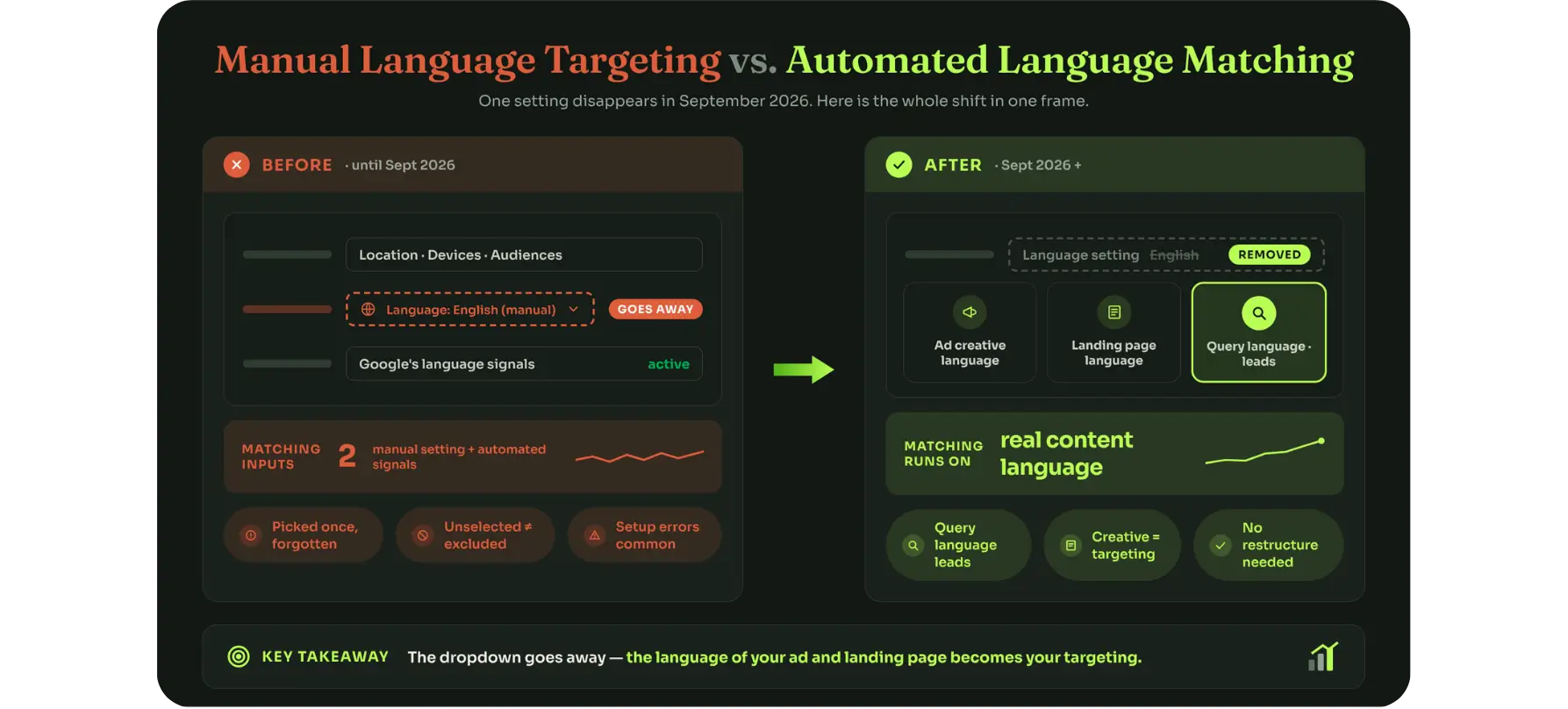
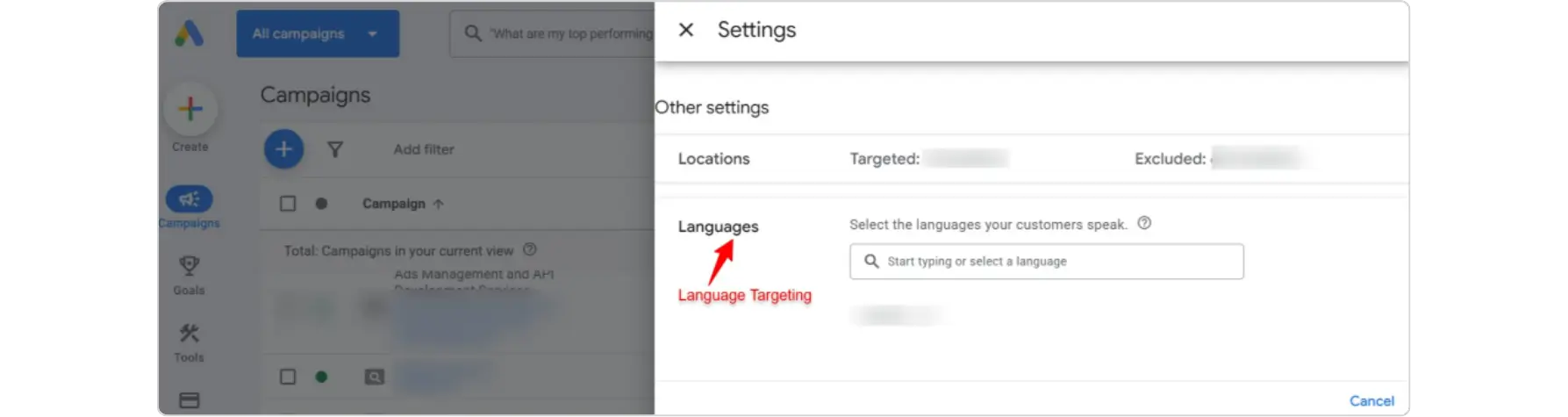
Language targeting is one of several Google Ads targeting options that sits inside campaign settings, alongside location, device, and audience targeting. Until September 2026, it works two ways at once: an advertiser manually selects a language, and Google separately checks its own signals to confirm whether a searcher actually understands that language. Once the update lands, only the automated half remains. A campaign no longer declares a language. Google infers one, using the language of the ad, the landing page, and the searcher's own behavior.
This sits close to a broader shift in search engine marketing generally. Paid search and organic search are both leaning harder on automated language and intent detection rather than static, advertiser-set rules, which is worth understanding whether you manage campaigns in-house or through a PPC agency.
What Is Actually Changing
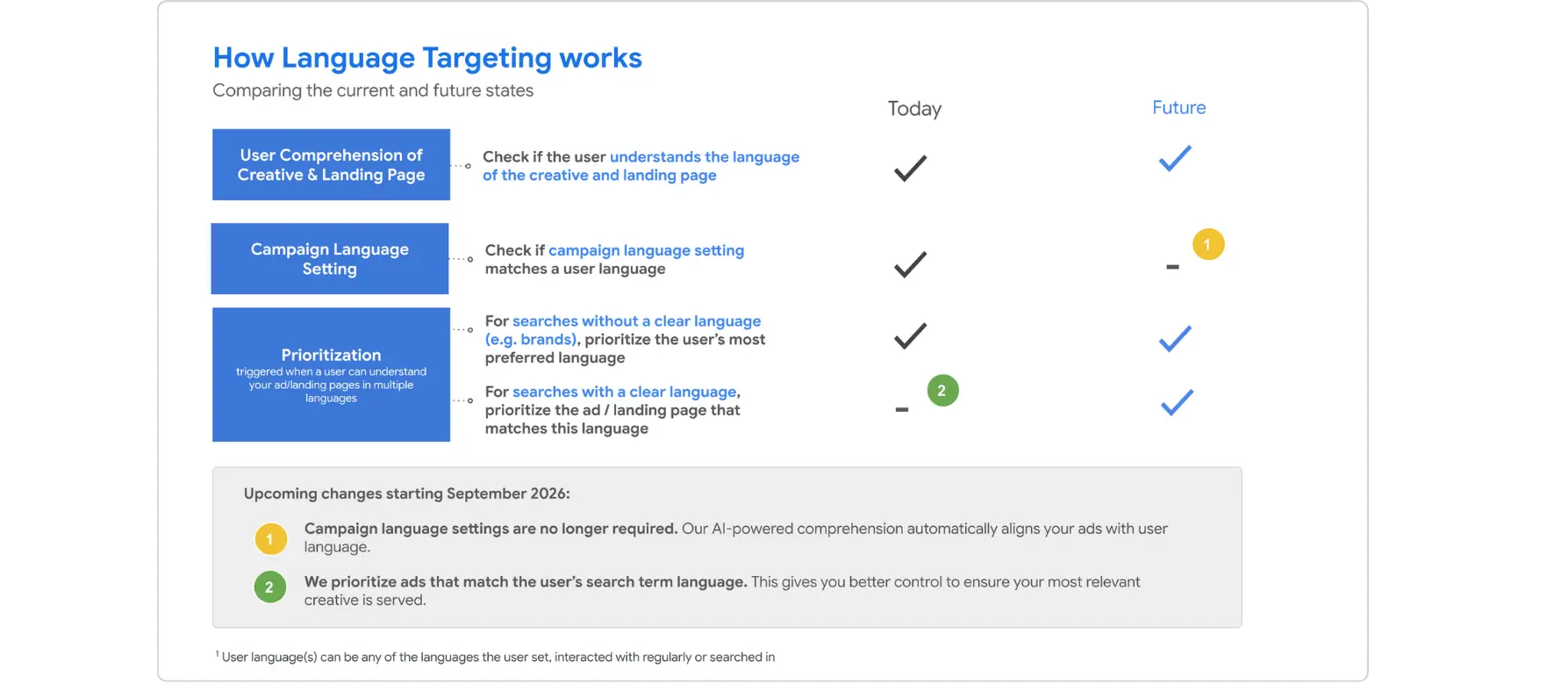
Right now, a Search ad's eligibility to serve depends on two separate inputs: the manual campaign setting, and Google's own read of what language the user understands, built from signals such as search query language, browser and account language settings, and past behavior. Once September's change takes effect, only the second half remains. The campaign-level setting is deleted, and matching runs entirely on the language of the ad creative, the landing page, and Google's assessment of what the searcher knows.
Marvin broke the mechanic into three parts in her August 14 announcement: whether the user understands the ad and landing page, which stays active; the campaign-level language setting, which goes inactive; and a prioritization layer that decides which language wins when a user qualifies for more than one. That third piece is where the more interesting change sits.
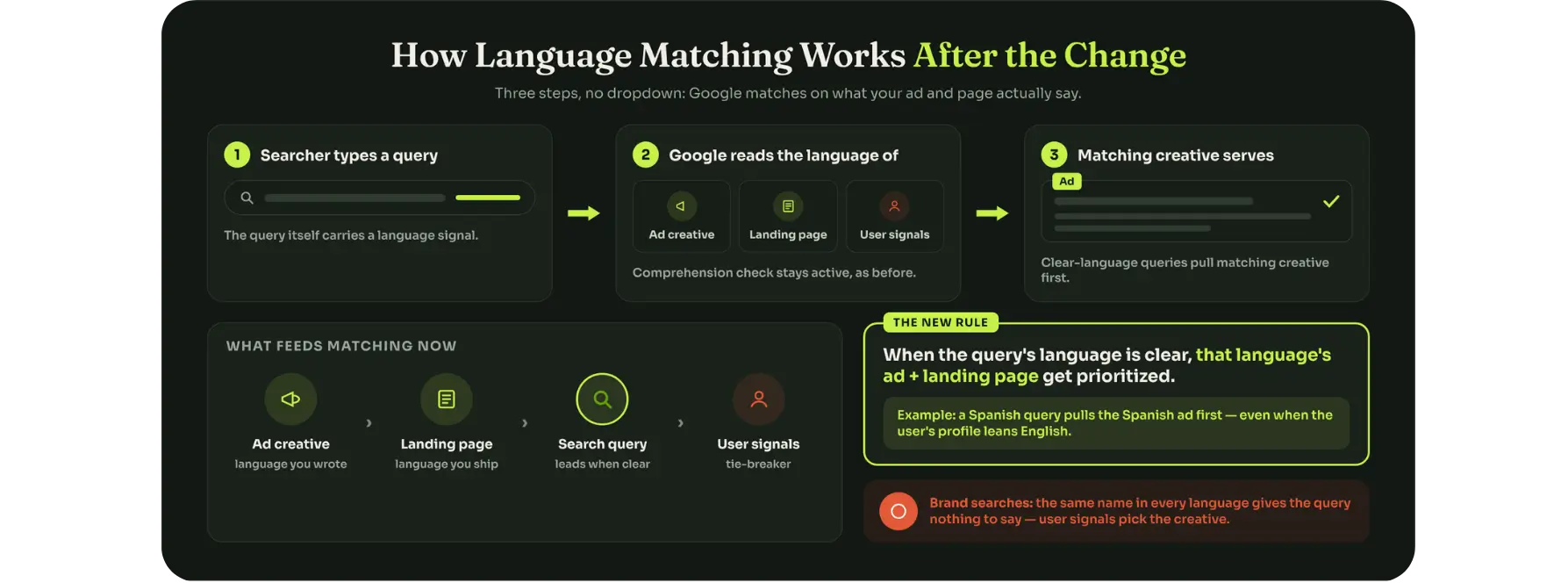
Today, when a bilingual user could be shown ads in either of two languages, Google leans on its inferred sense of that person's preferred language. After the change, when a search query itself carries a clear language, Google will prioritize the ad and landing page written in that language, even when the user's broader profile suggests another preference. A Spanish-language query should pull the Spanish creative forward, regardless of what else Google believes about that searcher.
Brand searches complicate the picture. A brand name can look identical across several languages, which gives Google's systems little to work with from the query itself. In that scenario, Google falls back on the user's other language signals and serves whichever version its systems believe the person prefers.
A Deadline That Slipped Nine Months
This is not a new idea. Google's help documentation stated back in August 2025 that campaign-level language targeting would be removed from Search campaigns by the end of that year, with automatic detection handling the job instead. That original documentation also carried a specific reassurance: non-Search campaign types would be left alone.
Neither part held. The end-of-2025 deadline passed with the setting still in place, and the September 2026 version of the announcement now explicitly folds in Performance Max, at least for its Google Search inventory. Advertisers who read the 2025 documentation and assumed Performance Max was out of scope are working from an outdated picture.
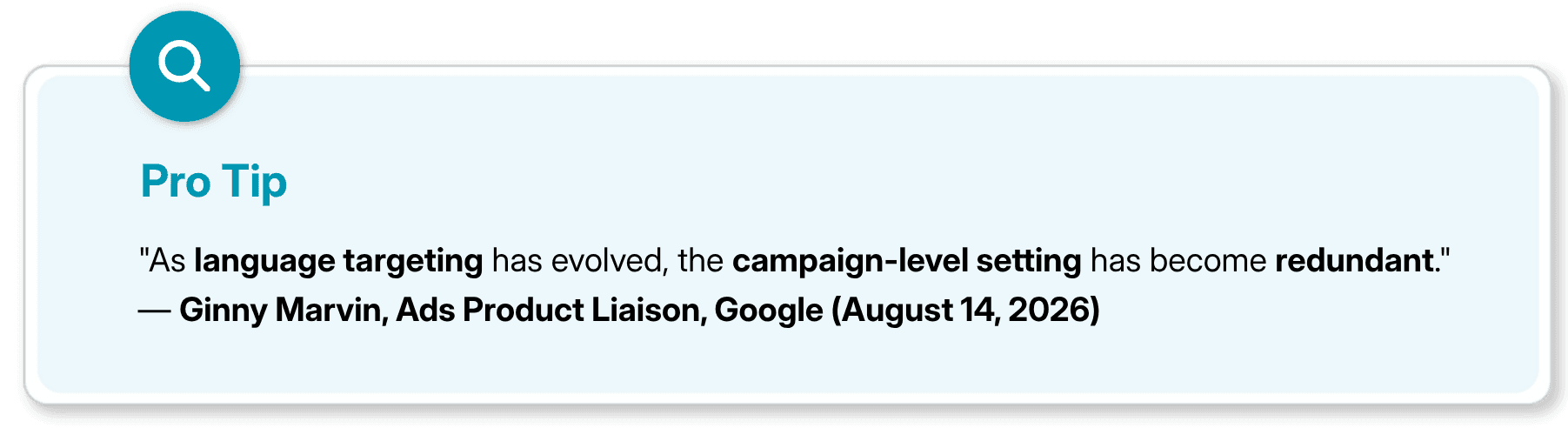
Google's stated reasoning centers on redundancy and confusion. According to Marvin, the manual setting had become largely redundant next to Google's automated signal stack, and the company had seen recurring account setup errors tied to a common misunderstanding: leaving a language unselected does not exclude it, and never did.
What Stays the Same
Google was specific about four things the update does not touch, and that list matters as much as what it removes.
Language exclusions were never supported through this setting, and that is not changing. An unselected language was never an excluded one.
Ad creative is not translated. Text customization inside AI Max generates new headlines and descriptions from existing assets and landing page content, but it does not render creative into another language.
Reporting is not restructured. Campaign performance data keeps its current shape.
Cross-language matching continues. Ads can still serve against queries in a different language than the ad itself, provided Google believes the searcher understands both.
Google has also said advertisers do not need to restructure existing campaigns because of this change. Accounts built around separate English and Spanish campaigns, for example, can keep that structure. Google will simply rely on the creative and landing page language of each campaign as its matching signal going forward.
Why This Also Matters For Multilingual SEO
Language targeting has always been a PPC-side setting, but the change lands closer to organic multilingual SEO than most advertisers expect. Once matching depends entirely on the actual language of the ad and the landing page, the quality of that content, translated properly rather than machine-generated as an afterthought, starts carrying more weight in paid results too.
Businesses that already treat multilingual marketing as one connected effort, with translated landing pages, correct hreflang tags, and localized content feeding both organic and paid channels, will likely notice less disruption. Businesses where the Spanish or French version of a page was built quickly and never revisited are the ones more likely to see matching behave differently once the manual setting stops compensating for it.
Where Advertisers Pushed Back
During a virtual roundtable ahead of the announcement, Google fielded direct questions from advertisers about scenarios that do not fit neatly into the redundancy argument.
Advertisers in regulated industries raised documentation concerns. An insurance advertiser, for instance, may need to prove its ads reach English and Spanish speaking audiences equitably. Google's response was that running creative in both languages signals intent to reach both groups, and its systems handle eligibility from there. What Google did not offer was a way to show, after the fact, which language a given user was actually served in, a gap that matters more to compliance teams than to the average advertiser.

A second question came from AI Max users running automatically generated creative. One advertiser asked about a campaign targeting Quebec, where asset generation might produce French creative. Could that French ad serve against an English-language search? Google confirmed it could. Creative generation happens first, and Google then applies its language comprehension check to the assets it has, independent of the language the query was typed in.
Neither answer is wrong, but both point to the same theme. Google's language matching is working as designed. What is disappearing is the advertiser's ability to layer a hard rule on top of it.
What This Means For Most Advertisers
For the majority of Search advertisers, this update should not require a project. Google's own guidance is that existing account structures do not need to change, and campaigns already split by language will keep working the way they do now.
The accounts worth a second look are the ones using language targeting for something beyond basic matching:
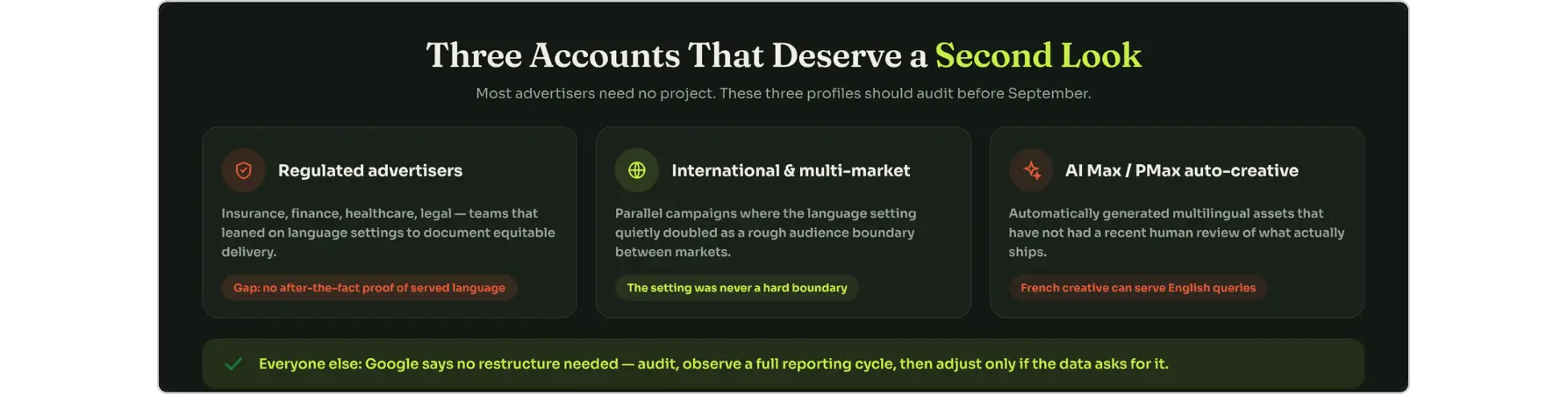
Regulated advertisers in insurance, financial services, healthcare, or legal that rely on language settings to document equitable delivery
International and multi-market advertisers running parallel campaigns where the language setting has also functioned as a rough audience boundary
AI Max and Performance Max advertisers using automatically generated, multilingual creative without close review of what is actually being produced
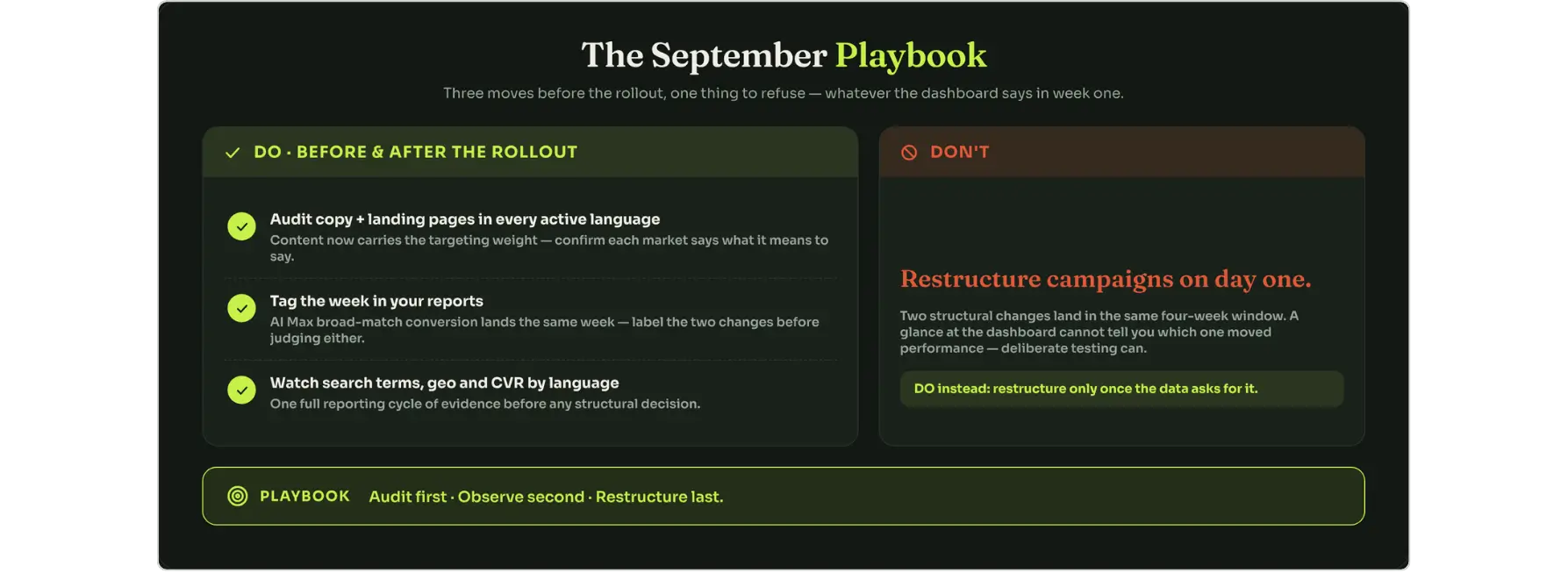
A few practical PPC tips for advertisers heading into September, regardless of account size:
Run a quick PPC audit of ad copy and landing pages in every active language to confirm they match what the campaign is actually meant to say
Separate this change from the AI Max broad match conversion happening the same week when reviewing performance shifts
Watch search terms, geography, and conversion rate by language for a full reporting cycle before making any structural changes
These steps track with general Google Ads best practices for any major platform change: audit first, observe the data second, and restructure only once the data actually asks for it, not before.
If performance holds steady after the rollout, Google's argument that the setting had become redundant will hold up. If it does not, the campaigns worth auditing first are the ones flagged above.
The Bigger Pattern Behind the Change
This removal fits a wider digital advertising trend that has been running through Google Ads for close to three years now: manual controls giving way to Google Ads automation. Lookalike segments inside Demand Gen moved from hard targeting boundaries to expandable suggestions in February 2026. Exact match keyword behavior has drifted to include semantically related, non-identical terms. Dynamic Search Ads were originally scheduled to migrate to AI Max in September 2026 as well, but Google pushed that specific deadline out to February 2027, restoring standard DSA creation and editing in the meantime.
That delay matters here because of what did not move. Automatically created assets and campaign-level broad match settings are still scheduled to convert automatically to AI Max on September 1, 2026, the same week language targeting disappears from Search and Performance Max. Two structural changes landing in the same four-week window means any shift in account performance that month will have more than one plausible cause, and separating them will take deliberate testing rather than a glance at the dashboard.
Language targeting is simply the latest manual lever to go. What makes this one slightly different is the second half of the change, the new prioritization logic that favors the query's own language when it is unambiguous. That is not automation replacing a control with nothing. It is automation replacing a control with a different kind of signal, one advertisers cannot set directly but can still influence through the languages they actually choose for their ads and landing pages.
How We're Advising Businesses On This
This is where paid media strategy and search visibility overlap more than most accounts are set up to handle. When Google decides which language wins a match, the deciding factor is the language actually present in the ad and landing page content, not a setting someone configured years ago and forgot about. That is a content and structure question as much as a bidding one, and it sits close to the same signals that determine whether AI-driven search tools understand and cite a business accurately in the first place.
Good PPC management has always meant knowing what a campaign actually targets, not just what the settings page says. We have seen this play out across the accounts we manage. Businesses that treat PPC and generative search readiness as connected disciplines under one paid media strategy, rather than separate line items, tend to weather changes like this one with far less disruption, because their ad copy and landing pages were already built around clear, well-matched language and intent, not just keyword density. That is also the difference between a PPC agency that reacts to platform changes after the fact and one that builds ppc strategy around how Google's systems actually work.
September 2026 removes one manual setting. It does not remove the need to know exactly what language your ads and landing pages are actually speaking, and to whom. That distinction, done well, was always the real job. Losing the dropdown just makes it visible.
If it has been a while since anyone ran a proper PPC audit on how your Search and Performance Max campaigns are structured around language, reaching out for a quick account review is a reasonable place to start, and you can see more of how these pieces connect in how we drive revenue for the businesses we work with. More breakdowns like this one live on our blog.
FAQs
When does Google remove language targeting from Search campaigns?

The campaign-level language targeting setting is scheduled to be removed from Search campaigns starting in September 2026. Ginny Marvin, Google's Ads Product Liaison, confirmed the timeline on August 14, 2026. Google had originally targeted the end of 2025 for this removal in help documentation published in August 2025, but the rollout slipped roughly nine months. Once the change is live, the manual setting stops influencing which language a Search campaign serves in, and Google's automated signals, including ad and landing page language, search query language, and known user language preferences, handle matching on their own.
Does this affect Performance Max campaigns too?
Yes, but only partially. For the Google Search inventory inside Performance Max, language matching will work the same way it does for standalone Search campaigns once the update lands, meaning the campaign-level language setting no longer applies there either. For other channels within Performance Max, such as Display, YouTube, and Discover, the campaign-level language setting continues to function as it does today. This is a change from Google's original 2025 documentation, which stated non-Search campaign types would be unaffected.
Will Google translate my ad creative into other languages automatically?
No. Google has been explicit that this update does not include automatic translation of ad copy. AI Max's text customization feature can generate new headlines and descriptions using an advertiser's existing assets and landing page content, but it works within the language already present in that content. If a business wants its ads to serve in a second language, it still needs to write or provide creative and landing pages in that language directly, ideally as part of a broader PPC strategy rather than relying on automation to fill the gap.
Do I need to restructure my campaigns before September 2026?
For most advertisers, no. Google has said existing account structures, including campaigns already split by language, do not need to be rebuilt because of this change. The campaigns worth a closer look before the rollout are those in regulated industries relying on language settings for compliance documentation, international advertisers using the setting as an informal audience boundary, and accounts leaning heavily on AI Max or Performance Max with automatically generated multilingual creative that has not been reviewed recently.
What should advertisers do to prepare?
Start by confirming that ad copy and landing pages are actually written in the language intended for each market, since that content will carry more weight in matching once the campaign setting disappears. After the rollout in September, monitor search terms, geographic traffic, and overall performance for shifts rather than assuming everything will behave exactly as before. Advertisers who are not confident their current account structure and content are aligned with how Google's automated matching works can reach out for a quick PPC account review to see where the gaps are before the change takes effect.
For as long as most advertisers have used Google Ads, language targeting sat quietly in the campaign settings panel, right next to location targeting. It was a setting you picked once during setup and rarely touched again.
That setting is going away.
Starting in September 2026, Google Ads is removing the campaign-level language targeting option from Search campaigns and from the Search inventory inside Performance Max. Ginny Marvin, Ads Product Liaison at Google, confirmed the change on August 14, 2026. Once the change rolls out, the manual dropdown that has decided which language a campaign serves in stops functioning. Google's automated language signals, already doing most of the work behind the scenes, take over completely.
For many advertisers, this will barely register. For multilingual, international, and regulated advertisers, it removes a lever some have leaned on more than they realized.
What Is Language Targeting in Google Ads?
Language targeting is one of several Google Ads targeting options that sits inside campaign settings, alongside location, device, and audience targeting. Until September 2026, it works two ways at once: an advertiser manually selects a language, and Google separately checks its own signals to confirm whether a searcher actually understands that language. Once the update lands, only the automated half remains. A campaign no longer declares a language. Google infers one, using the language of the ad, the landing page, and the searcher's own behavior.
This sits close to a broader shift in search engine marketing generally. Paid search and organic search are both leaning harder on automated language and intent detection rather than static, advertiser-set rules, which is worth understanding whether you manage campaigns in-house or through a PPC agency.
What Is Actually Changing
Right now, a Search ad's eligibility to serve depends on two separate inputs: the manual campaign setting, and Google's own read of what language the user understands, built from signals such as search query language, browser and account language settings, and past behavior. Once September's change takes effect, only the second half remains. The campaign-level setting is deleted, and matching runs entirely on the language of the ad creative, the landing page, and Google's assessment of what the searcher knows.
Marvin broke the mechanic into three parts in her August 14 announcement: whether the user understands the ad and landing page, which stays active; the campaign-level language setting, which goes inactive; and a prioritization layer that decides which language wins when a user qualifies for more than one. That third piece is where the more interesting change sits.
Today, when a bilingual user could be shown ads in either of two languages, Google leans on its inferred sense of that person's preferred language. After the change, when a search query itself carries a clear language, Google will prioritize the ad and landing page written in that language, even when the user's broader profile suggests another preference. A Spanish-language query should pull the Spanish creative forward, regardless of what else Google believes about that searcher.
Brand searches complicate the picture. A brand name can look identical across several languages, which gives Google's systems little to work with from the query itself. In that scenario, Google falls back on the user's other language signals and serves whichever version its systems believe the person prefers.
A Deadline That Slipped Nine Months
This is not a new idea. Google's help documentation stated back in August 2025 that campaign-level language targeting would be removed from Search campaigns by the end of that year, with automatic detection handling the job instead. That original documentation also carried a specific reassurance: non-Search campaign types would be left alone.
Neither part held. The end-of-2025 deadline passed with the setting still in place, and the September 2026 version of the announcement now explicitly folds in Performance Max, at least for its Google Search inventory. Advertisers who read the 2025 documentation and assumed Performance Max was out of scope are working from an outdated picture.
Google's stated reasoning centers on redundancy and confusion. According to Marvin, the manual setting had become largely redundant next to Google's automated signal stack, and the company had seen recurring account setup errors tied to a common misunderstanding: leaving a language unselected does not exclude it, and never did.
What Stays the Same
Google was specific about four things the update does not touch, and that list matters as much as what it removes.
Language exclusions were never supported through this setting, and that is not changing. An unselected language was never an excluded one.
Ad creative is not translated. Text customization inside AI Max generates new headlines and descriptions from existing assets and landing page content, but it does not render creative into another language.
Reporting is not restructured. Campaign performance data keeps its current shape.
Cross-language matching continues. Ads can still serve against queries in a different language than the ad itself, provided Google believes the searcher understands both.
Google has also said advertisers do not need to restructure existing campaigns because of this change. Accounts built around separate English and Spanish campaigns, for example, can keep that structure. Google will simply rely on the creative and landing page language of each campaign as its matching signal going forward.
Why This Also Matters For Multilingual SEO
Language targeting has always been a PPC-side setting, but the change lands closer to organic multilingual SEO than most advertisers expect. Once matching depends entirely on the actual language of the ad and the landing page, the quality of that content, translated properly rather than machine-generated as an afterthought, starts carrying more weight in paid results too.
Businesses that already treat multilingual marketing as one connected effort, with translated landing pages, correct hreflang tags, and localized content feeding both organic and paid channels, will likely notice less disruption. Businesses where the Spanish or French version of a page was built quickly and never revisited are the ones more likely to see matching behave differently once the manual setting stops compensating for it.
Where Advertisers Pushed Back
During a virtual roundtable ahead of the announcement, Google fielded direct questions from advertisers about scenarios that do not fit neatly into the redundancy argument.
Advertisers in regulated industries raised documentation concerns. An insurance advertiser, for instance, may need to prove its ads reach English and Spanish speaking audiences equitably. Google's response was that running creative in both languages signals intent to reach both groups, and its systems handle eligibility from there. What Google did not offer was a way to show, after the fact, which language a given user was actually served in, a gap that matters more to compliance teams than to the average advertiser.
A second question came from AI Max users running automatically generated creative. One advertiser asked about a campaign targeting Quebec, where asset generation might produce French creative. Could that French ad serve against an English-language search? Google confirmed it could. Creative generation happens first, and Google then applies its language comprehension check to the assets it has, independent of the language the query was typed in.
Neither answer is wrong, but both point to the same theme. Google's language matching is working as designed. What is disappearing is the advertiser's ability to layer a hard rule on top of it.
What This Means For Most Advertisers
For the majority of Search advertisers, this update should not require a project. Google's own guidance is that existing account structures do not need to change, and campaigns already split by language will keep working the way they do now.
The accounts worth a second look are the ones using language targeting for something beyond basic matching:
Regulated advertisers in insurance, financial services, healthcare, or legal that rely on language settings to document equitable delivery
International and multi-market advertisers running parallel campaigns where the language setting has also functioned as a rough audience boundary
AI Max and Performance Max advertisers using automatically generated, multilingual creative without close review of what is actually being produced
A few practical PPC tips for advertisers heading into September, regardless of account size:
Run a quick PPC audit of ad copy and landing pages in every active language to confirm they match what the campaign is actually meant to say
Separate this change from the AI Max broad match conversion happening the same week when reviewing performance shifts
Watch search terms, geography, and conversion rate by language for a full reporting cycle before making any structural changes
These steps track with general Google Ads best practices for any major platform change: audit first, observe the data second, and restructure only once the data actually asks for it, not before.
If performance holds steady after the rollout, Google's argument that the setting had become redundant will hold up. If it does not, the campaigns worth auditing first are the ones flagged above.
The Bigger Pattern Behind the Change
This removal fits a wider digital advertising trend that has been running through Google Ads for close to three years now: manual controls giving way to Google Ads automation. Lookalike segments inside Demand Gen moved from hard targeting boundaries to expandable suggestions in February 2026. Exact match keyword behavior has drifted to include semantically related, non-identical terms. Dynamic Search Ads were originally scheduled to migrate to AI Max in September 2026 as well, but Google pushed that specific deadline out to February 2027, restoring standard DSA creation and editing in the meantime.
That delay matters here because of what did not move. Automatically created assets and campaign-level broad match settings are still scheduled to convert automatically to AI Max on September 1, 2026, the same week language targeting disappears from Search and Performance Max. Two structural changes landing in the same four-week window means any shift in account performance that month will have more than one plausible cause, and separating them will take deliberate testing rather than a glance at the dashboard.
Language targeting is simply the latest manual lever to go. What makes this one slightly different is the second half of the change, the new prioritization logic that favors the query's own language when it is unambiguous. That is not automation replacing a control with nothing. It is automation replacing a control with a different kind of signal, one advertisers cannot set directly but can still influence through the languages they actually choose for their ads and landing pages.
How We're Advising Businesses On This
This is where paid media strategy and search visibility overlap more than most accounts are set up to handle. When Google decides which language wins a match, the deciding factor is the language actually present in the ad and landing page content, not a setting someone configured years ago and forgot about. That is a content and structure question as much as a bidding one, and it sits close to the same signals that determine whether AI-driven search tools understand and cite a business accurately in the first place.
Good PPC management has always meant knowing what a campaign actually targets, not just what the settings page says. We have seen this play out across the accounts we manage. Businesses that treat PPC and generative search readiness as connected disciplines under one paid media strategy, rather than separate line items, tend to weather changes like this one with far less disruption, because their ad copy and landing pages were already built around clear, well-matched language and intent, not just keyword density. That is also the difference between a PPC agency that reacts to platform changes after the fact and one that builds ppc strategy around how Google's systems actually work.
September 2026 removes one manual setting. It does not remove the need to know exactly what language your ads and landing pages are actually speaking, and to whom. That distinction, done well, was always the real job. Losing the dropdown just makes it visible.
If it has been a while since anyone ran a proper PPC audit on how your Search and Performance Max campaigns are structured around language, reaching out for a quick account review is a reasonable place to start, and you can see more of how these pieces connect in how we drive revenue for the businesses we work with. More breakdowns like this one live on our blog.
FAQs
When does Google remove language targeting from Search campaigns?
The campaign-level language targeting setting is scheduled to be removed from Search campaigns starting in September 2026. Ginny Marvin, Google's Ads Product Liaison, confirmed the timeline on August 14, 2026. Google had originally targeted the end of 2025 for this removal in help documentation published in August 2025, but the rollout slipped roughly nine months. Once the change is live, the manual setting stops influencing which language a Search campaign serves in, and Google's automated signals, including ad and landing page language, search query language, and known user language preferences, handle matching on their own.
Does this affect Performance Max campaigns too?
Yes, but only partially. For the Google Search inventory inside Performance Max, language matching will work the same way it does for standalone Search campaigns once the update lands, meaning the campaign-level language setting no longer applies there either. For other channels within Performance Max, such as Display, YouTube, and Discover, the campaign-level language setting continues to function as it does today. This is a change from Google's original 2025 documentation, which stated non-Search campaign types would be unaffected.
Will Google translate my ad creative into other languages automatically?
No. Google has been explicit that this update does not include automatic translation of ad copy. AI Max's text customization feature can generate new headlines and descriptions using an advertiser's existing assets and landing page content, but it works within the language already present in that content. If a business wants its ads to serve in a second language, it still needs to write or provide creative and landing pages in that language directly, ideally as part of a broader PPC strategy rather than relying on automation to fill the gap.
Do I need to restructure my campaigns before September 2026?
For most advertisers, no. Google has said existing account structures, including campaigns already split by language, do not need to be rebuilt because of this change. The campaigns worth a closer look before the rollout are those in regulated industries relying on language settings for compliance documentation, international advertisers using the setting as an informal audience boundary, and accounts leaning heavily on AI Max or Performance Max with automatically generated multilingual creative that has not been reviewed recently.
What should advertisers do to prepare?
Start by confirming that ad copy and landing pages are actually written in the language intended for each market, since that content will carry more weight in matching once the campaign setting disappears. After the rollout in September, monitor search terms, geographic traffic, and overall performance for shifts rather than assuming everything will behave exactly as before. Advertisers who are not confident their current account structure and content are aligned with how Google's automated matching works can reach out for a quick PPC account review to see where the gaps are before the change takes effect.


Summarize with AI




Have a Google Ads account?
Get a free audit Today!
Have a Google Ads account?
Get a free audit Today!



4.9/5 Ratings!
4.9/5 Ratings!


Don’t miss our revenue growth tips!
Get expert marketing tips—straight to your inbox, like thousands of happy clients.
Don’t miss our revenue growth tips!
Get expert marketing tips—straight to your inbox, like thousands of happy clients.
Don’t miss our revenue growth tips!
Get expert marketing tips—straight to your inbox, like thousands of happy clients.
Don’t miss our revenue growth tips!
Relevant Blogs on PPC Marketing
Relevant Blogs on PPC Marketing
Unlock data-driven insights in PPC marketing—explore our featured blogs and skyrocket your revenue before your competitors do.
Unlock data-driven insights in PPC marketing—explore our featured blogs and skyrocket your revenue before your competitors do.

PPC
Aug 6, 2026
10 Min Read
What Are Display Ads & How Do They Work?
PPC
Aug 6, 2026
10 Min Read
What Are Display Ads & How Do They Work?
PPC
Aug 6, 2026
10 Min Read
What Are Display Ads & How Do They Work?

PPC
Aug 2, 2026
10 Min Read
12 Best Practices to Improve Google Ads CTR
PPC
Aug 2, 2026
10 Min Read
12 Best Practices to Improve Google Ads CTR
PPC
Aug 2, 2026
10 Min Read
12 Best Practices to Improve Google Ads CTR

PPC
Jul 13, 2026
10 Min Read
Why Google Ads Shows Conversions but Your Revenue Isn't Growing
PPC
Jul 13, 2026
10 Min Read
Why Google Ads Shows Conversions but Your Revenue Isn't Growing
PPC
Jul 13, 2026
10 Min Read
Why Google Ads Shows Conversions but Your Revenue Isn't Growing



































Ready to speak with an expert?
Data-Driven Marketing Agency That Elevates ROI
1100+
Websites Designed & Optimized to Convert
$280M+
Client Revenue Driven & Growing Strong
Discover how to skyrocket
your revenue today!
Trusted by 1000+ Owners!
Ready to speak with an expert?
Data-Driven Marketing Agency That Elevates ROI
1100+
Websites Designed & Optimized to Convert
$280M+
Client Revenue Driven & Growing Strong
Discover how to skyrocket
your revenue today!
Trusted by 1000+ Owners!
Want to skyrocket revenue?
4.9/5 Ratings!
Ready to speak with an expert?
Data-Driven Marketing Agency That Elevates ROI
1100+
Websites Designed & Optimized to Convert
$280M+
Client Revenue Driven & Growing Strong
Discover how to skyrocket
your revenue today!
Trusted by 1000+ Owners!
Call
Meet