5 AI Search Engines Compared: Which One Actually Cites Your Brand?
5 AI Search Engines Compared: Which One Actually Cites Your Brand?
Last Updated:
Table of Content
Case Studies





Your potential customer just asked an AI to recommend a product in your category. Were you mentioned? Here's how to find out - and fix it.
Every morning, millions of people skip Google entirely. They open ChatGPT, Perplexity, or Gemini and ask something like: "What's the best CRM for a 10-person startup?" or "Which skincare brand is actually worth it for sensitive skin?"
An AI reads dozens of sources, synthesizes the answer, and names two or three brands. If your brand isn't one of them, you essentially don't exist for that user no second-chance retargeting, no rank-two click, nothing.
This isn't a future scenario. It's happening right now, at scale.
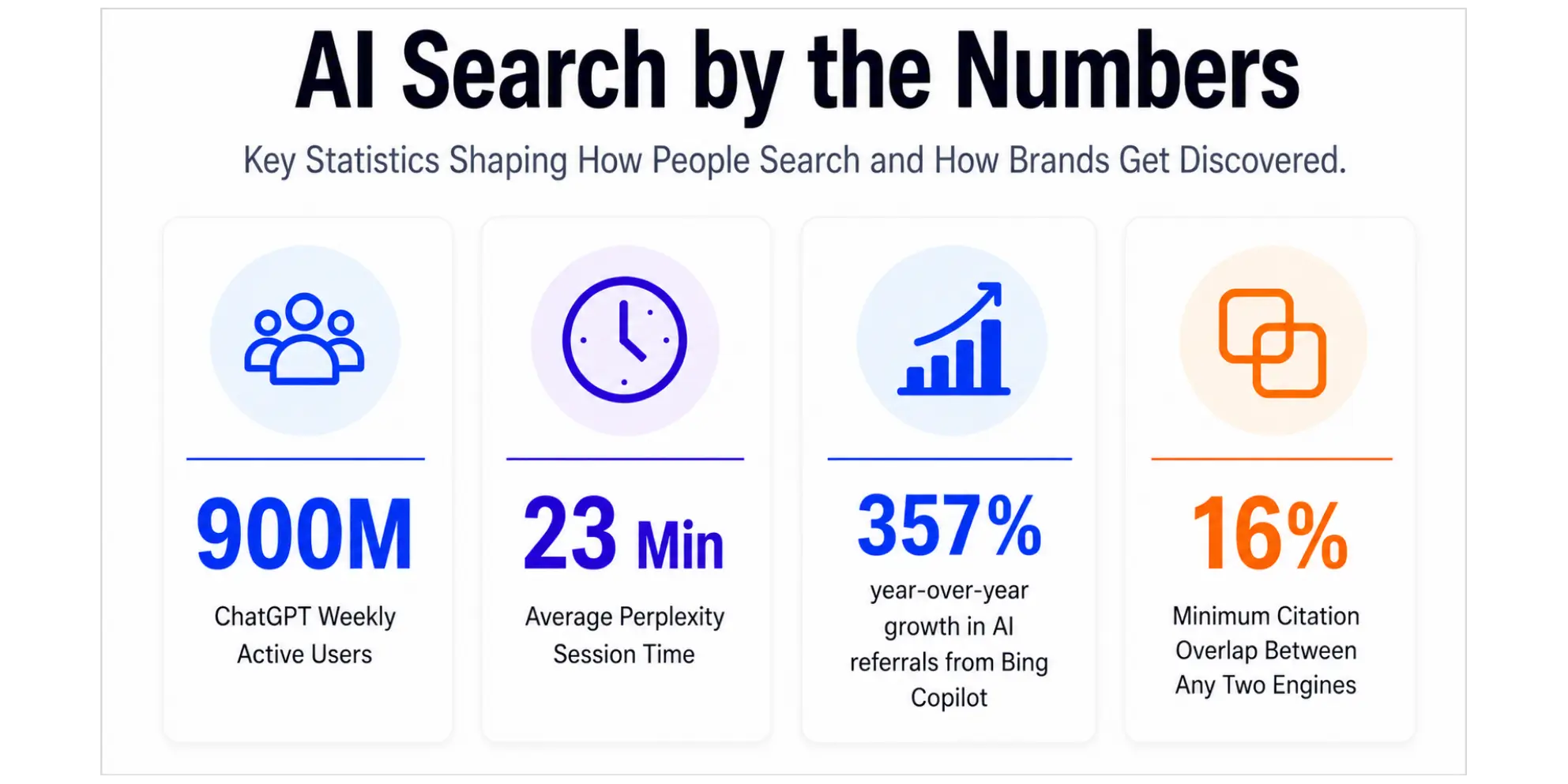
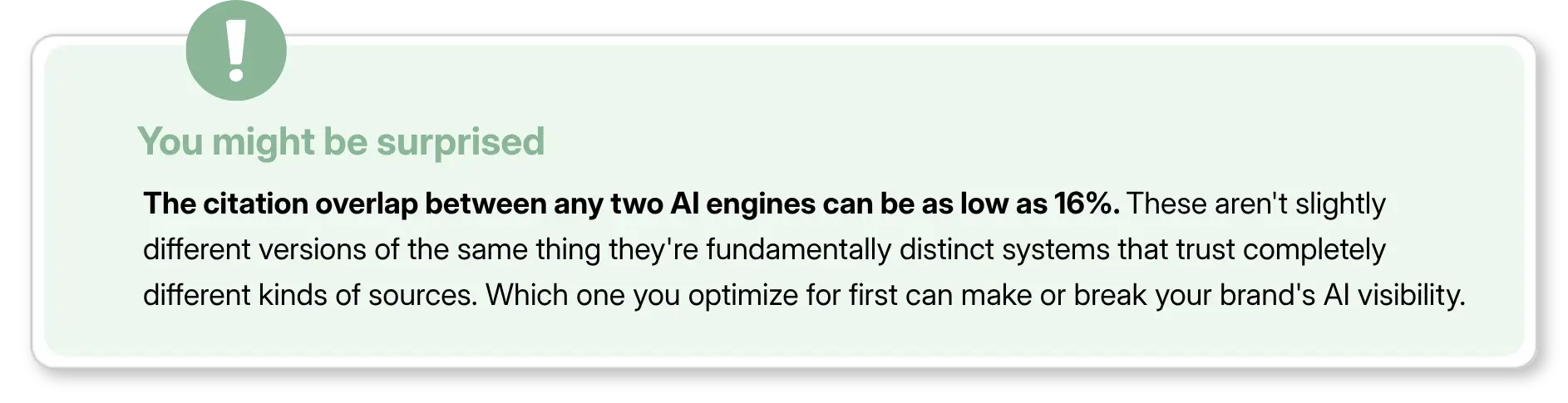
The answer is different for every platform. Independent analyses comparing the five major AI search surfaces have found that the citation overlap between any two engines can be as low as 16%. These aren't slightly different versions of the same thing. They are fundamentally distinct systems that trust completely different kinds of sources and the gap between them shapes which brands get named and which ones get ignored.
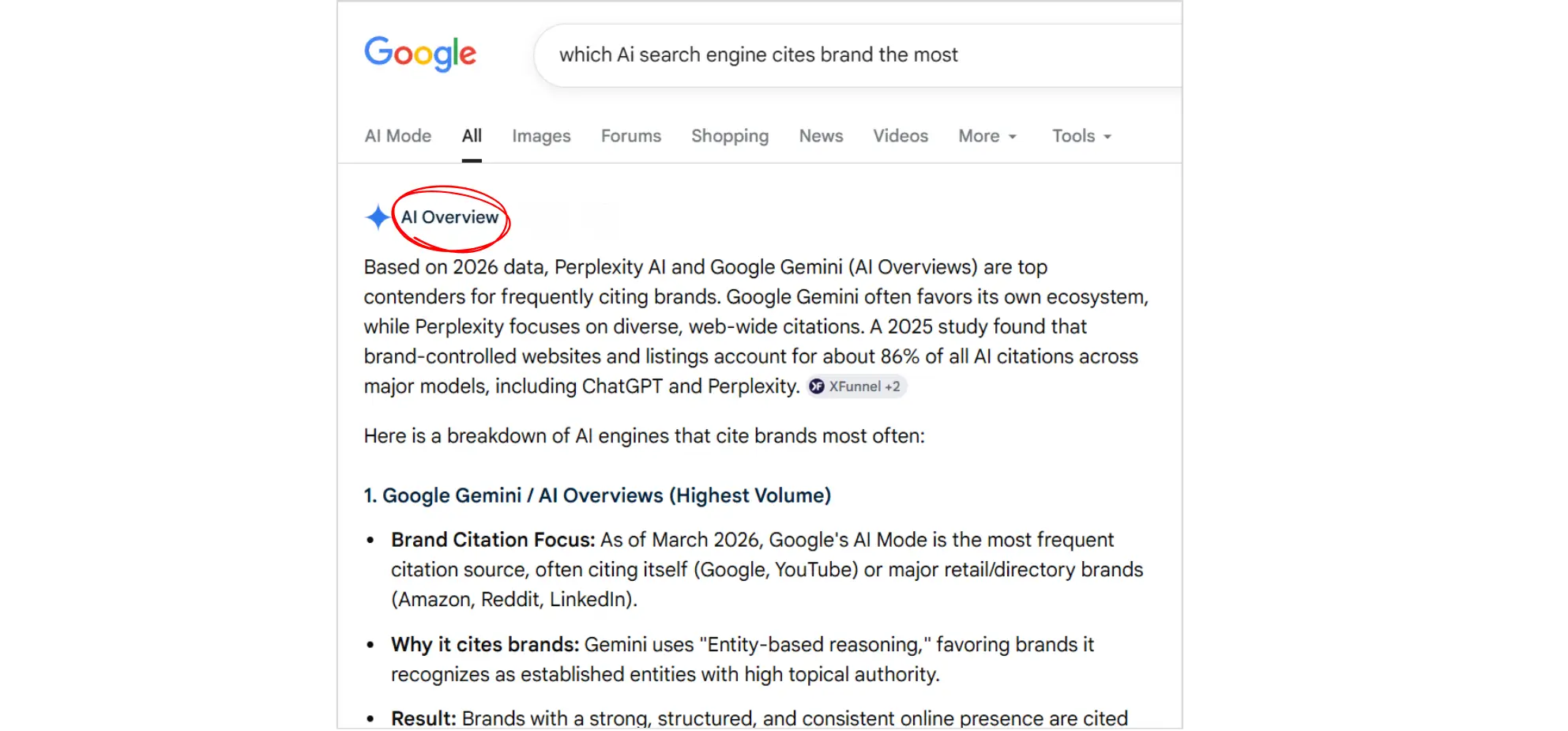
The Big Shift: Why "Ranking" Doesn't Mean What It Used to?
Before diving into each engine, it's worth understanding what actually changed.
Traditional SEO was a link economy. You optimized a page, it ranked, people clicked. Volume was the game.
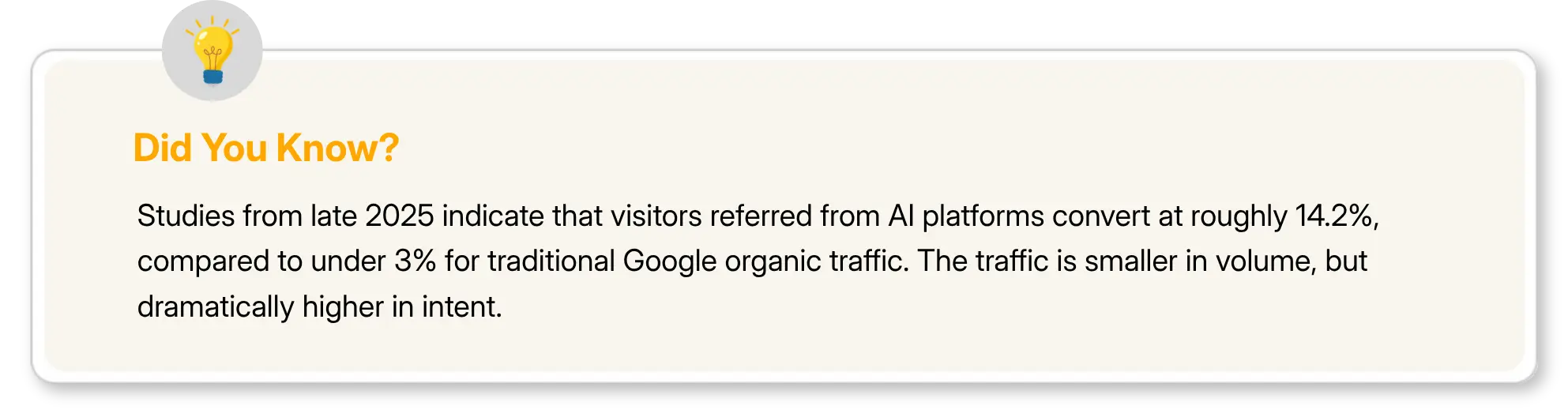
AI search is an answer economy. The engine reads the sources so the user doesn't have to. It synthesizes, cites, and recommends. Traffic referral drops, but the traffic that does come through converts dramatically better.
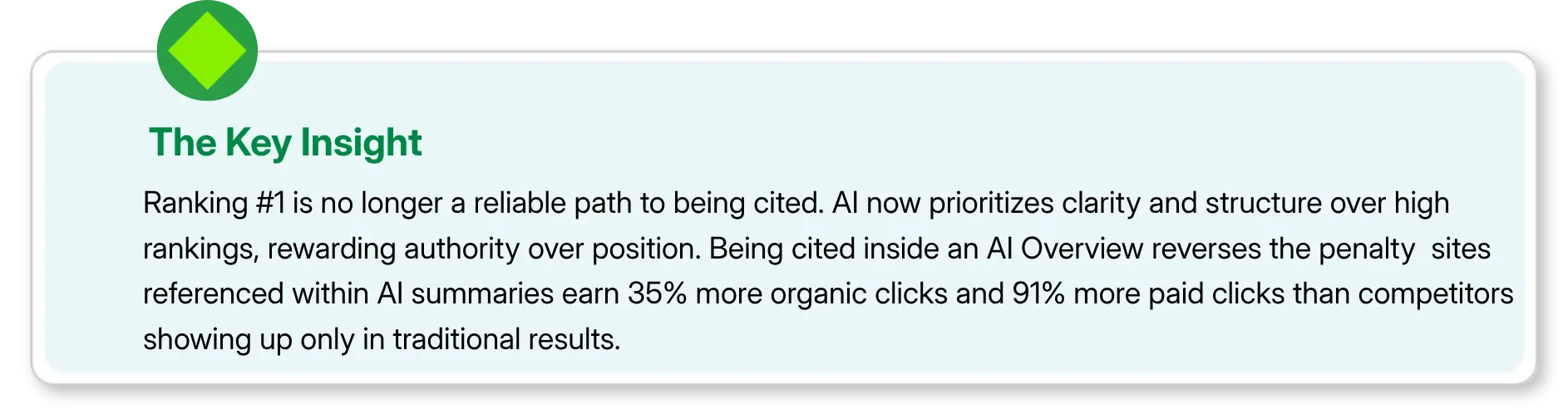
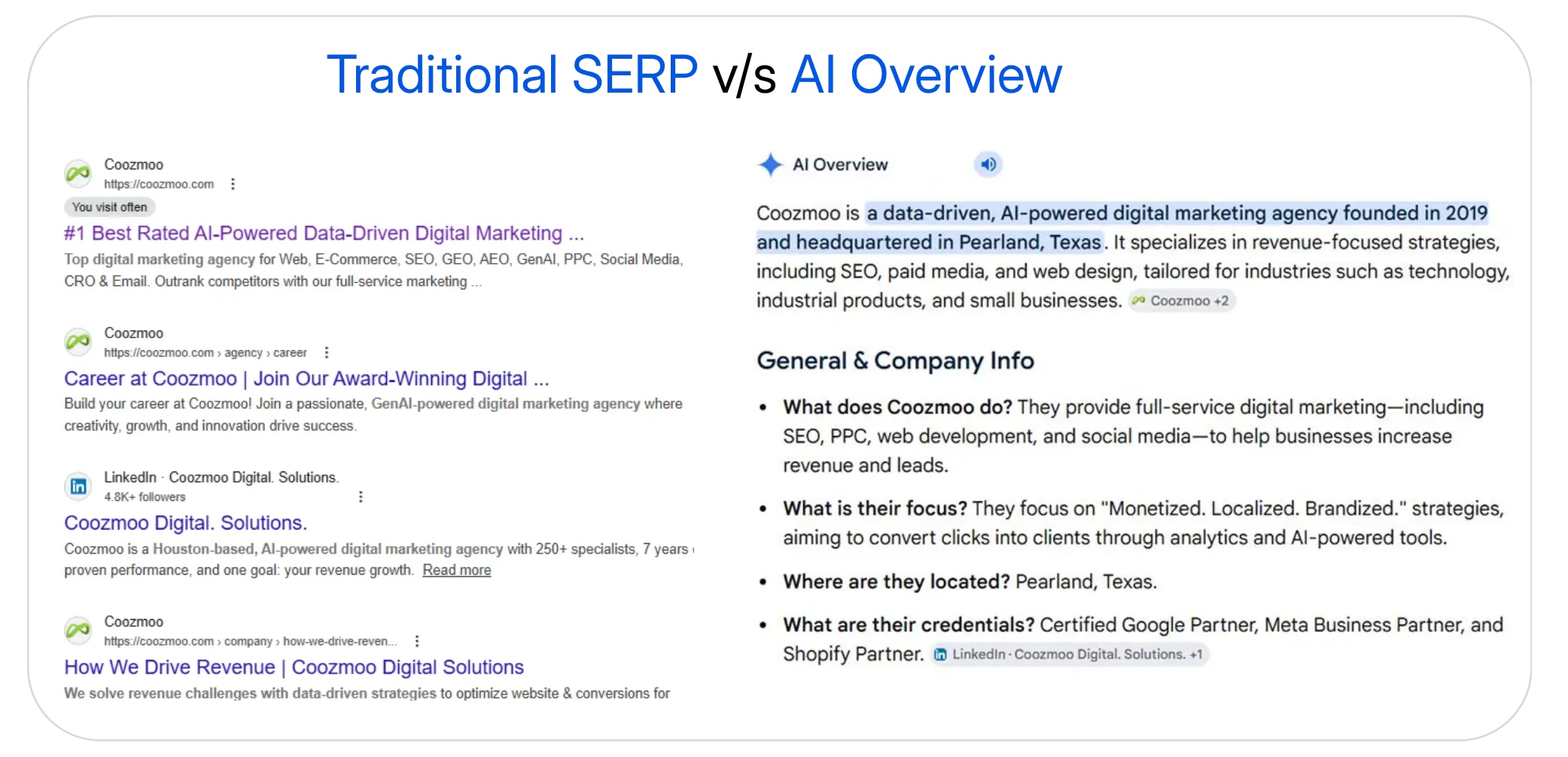
This shift also changes what "authority" means. For years, SEO professionals treated domain authority as the gold standard. AI engines care about something different: citation authority whether trusted sources mention your brand in context.
All 5 Engines at a Glance: How They Compare
Engine | Citation Style | UGC % | Institutional % | Best For |
|---|---|---|---|---|
Bing Copilot | The Hidden Gateway | Low - authoritative & structured sources preferred | High - E-E-A-T & domain authority led | Windows, Edge & Microsoft 365 users |
Google Gemini | Institutional Purist | 0.2% | ~26% | Technical & professional audiences |
Perplexity | Researcher's Engine | ~1.5% | ~30% | B2B & high-intent decision-makers |
ChatGPT | Broad Generalist | Diverse | ~12% (.gov) | Mass market & all audiences |
Google AI Mode | Middle Ground | ~7% | ~14% | Power researchers & multi-turn queries |
The 5 AI Search Engines - A Full Breakdown
Microsoft Bing Copilot - The Hidden Gateway
Target Users: Windows users, Microsoft 365 subscribers, Edge browser users, and enterprise teams - one of the most widely distributed AI assistants on the planet.
Monthly Active Users: 400M+
AI Referral Growth: 357% YoY
AI Performance Report: Launched Feb 9, 2026
Citation Style: Footnote-linked, Perplexity-like
Monthly Active Users: 400M+
AI Referral Growth: 357% YoY
AI Performance Report: Launched Feb 9, 2026
Citation Style: Footnote-linked, Perplexity-like
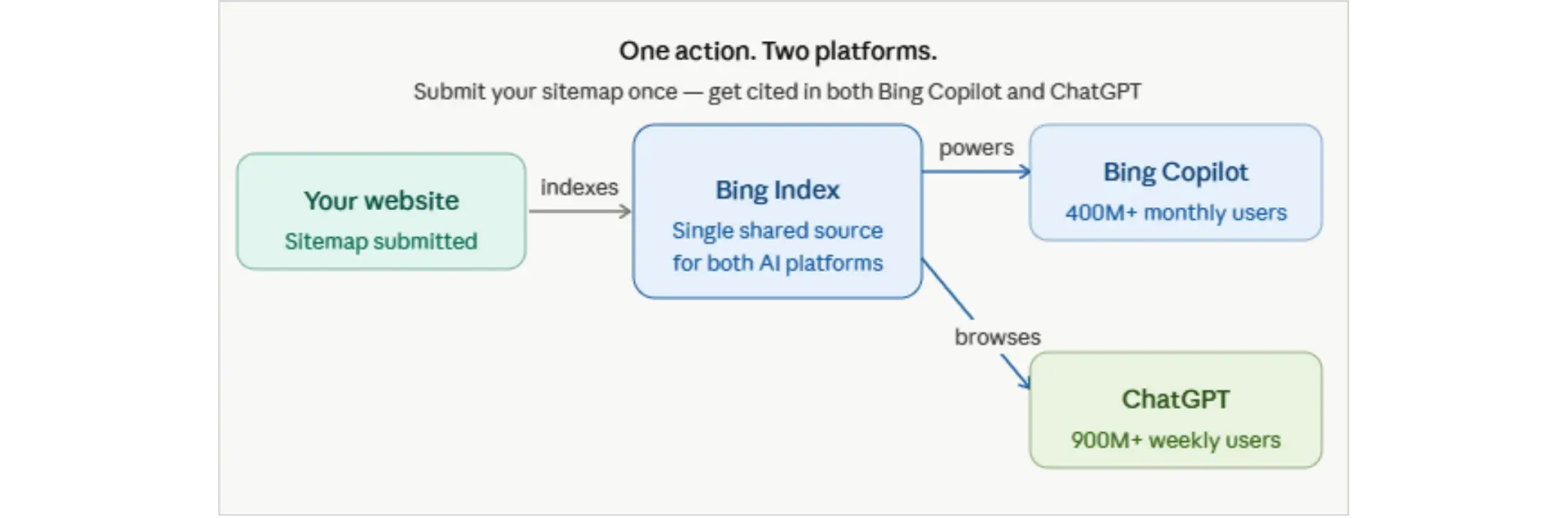
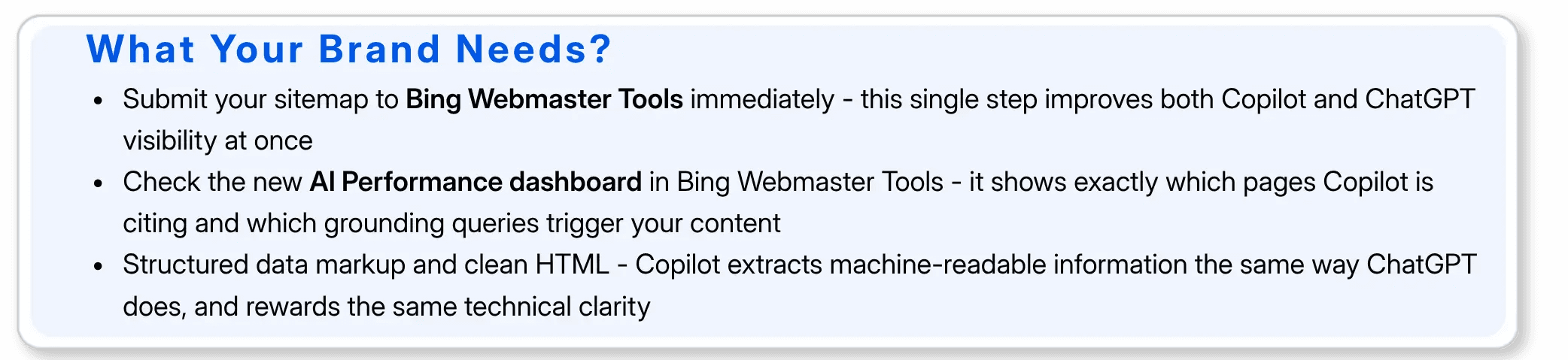
Bing Copilot is the most underestimated engine in this entire comparison - and the one with the most direct connection to your ChatGPT visibility. Because Copilot runs on Microsoft's Bing index, your Bing presence directly shapes what Copilot surfaces. The same Bing index that powers Copilot is the one ChatGPT uses when it browses the web for real-time answers. That means a single move - submitting your sitemap to Bing Webmaster Tools improves your visibility on two major AI platforms simultaneously.
In February 2026, Microsoft launched an AI Performance dashboard inside Bing Webmaster Tools - the first time any major AI search provider gave website owners direct citation tracking data. Three months of data from one publisher revealed 30,398 total grounding events across 173 pages - Copilot wasn't occasionally glancing at their content, it was actively using their pages to formulate answers to real user questions.
Copilot's citation behaviour closely mirrors Perplexity's - it frequently includes source URLs directly in its responses, making citation tracking especially valuable. Unlike ChatGPT which uses Bing's index as a secondary browse layer, Copilot's coupling with Bing is native and constant, creating a direct feedback loop between your SEO performance and your AI visibility.
ChatGPT - The Broad Generalist
Target Users: Everyone. ChatGPT has the largest and most demographically diverse audience of any AI platform.
Top 10 Source Concentration: 18.5%
UGC Citations: ~1.5%
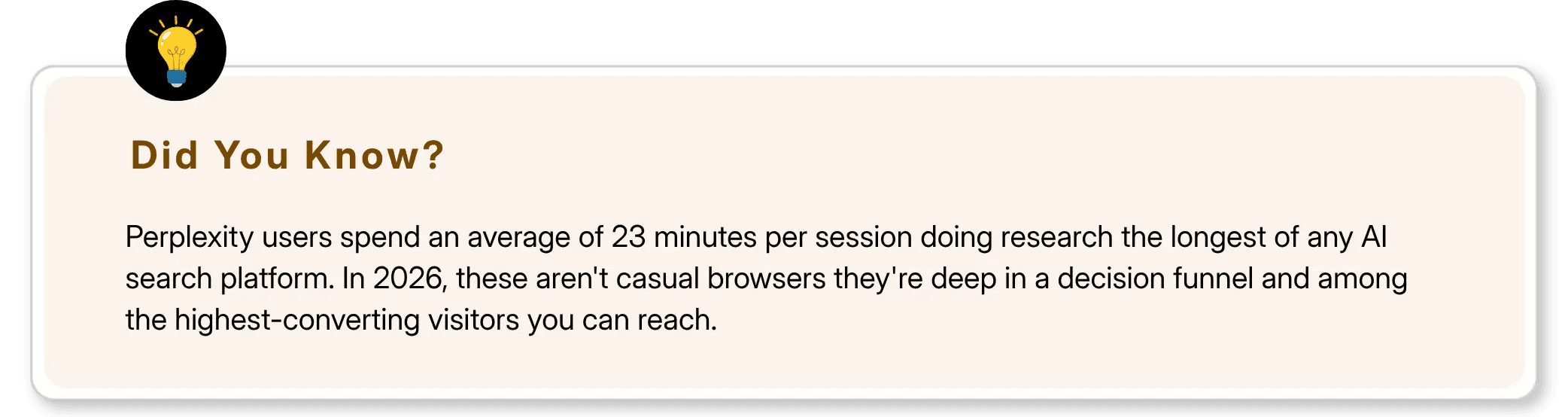
Avg Session: 23 min
Weekly Users: 900M+
Top 10 Source Concentration: 18.5%
UGC Citations: ~1.5%
Avg Session: 23 min
Weekly Users: 900M+
ChatGPT has the most diverse citation profile of the five engines. Its top 10 most cited sources account for just 18.5% of total citations the lowest concentration of any engine tested. That means it's drawing from a much wider web rather than defaulting to a narrow list of trusted sites.
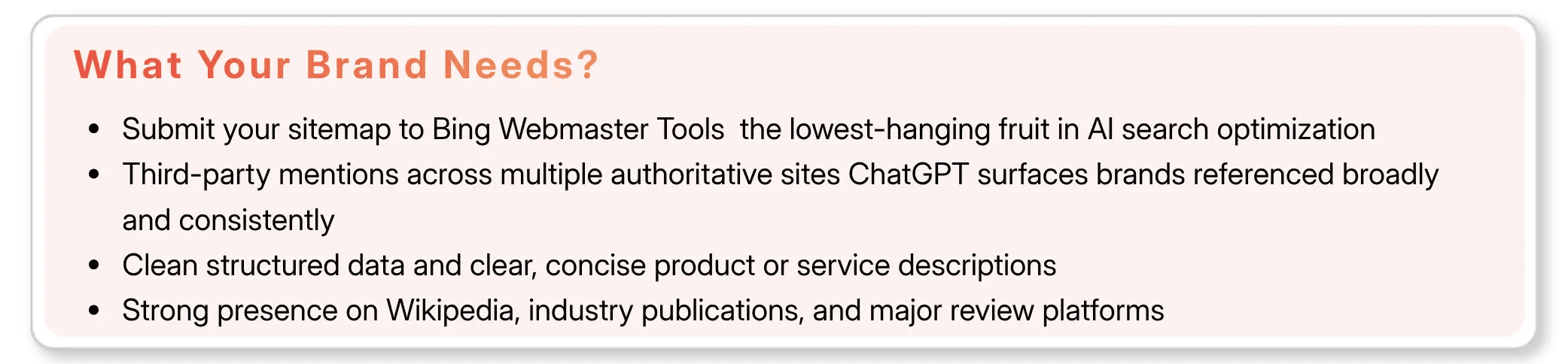
The most important technical detail most brands miss: when ChatGPT browses the web for real-time information, it uses Microsoft Bing's index. Your Bing visibility directly influences your ChatGPT visibility. Most brands invest zero effort in Bing and then wonder why they're invisible in AI-generated answers.
Google AI Mode - The Middle Ground
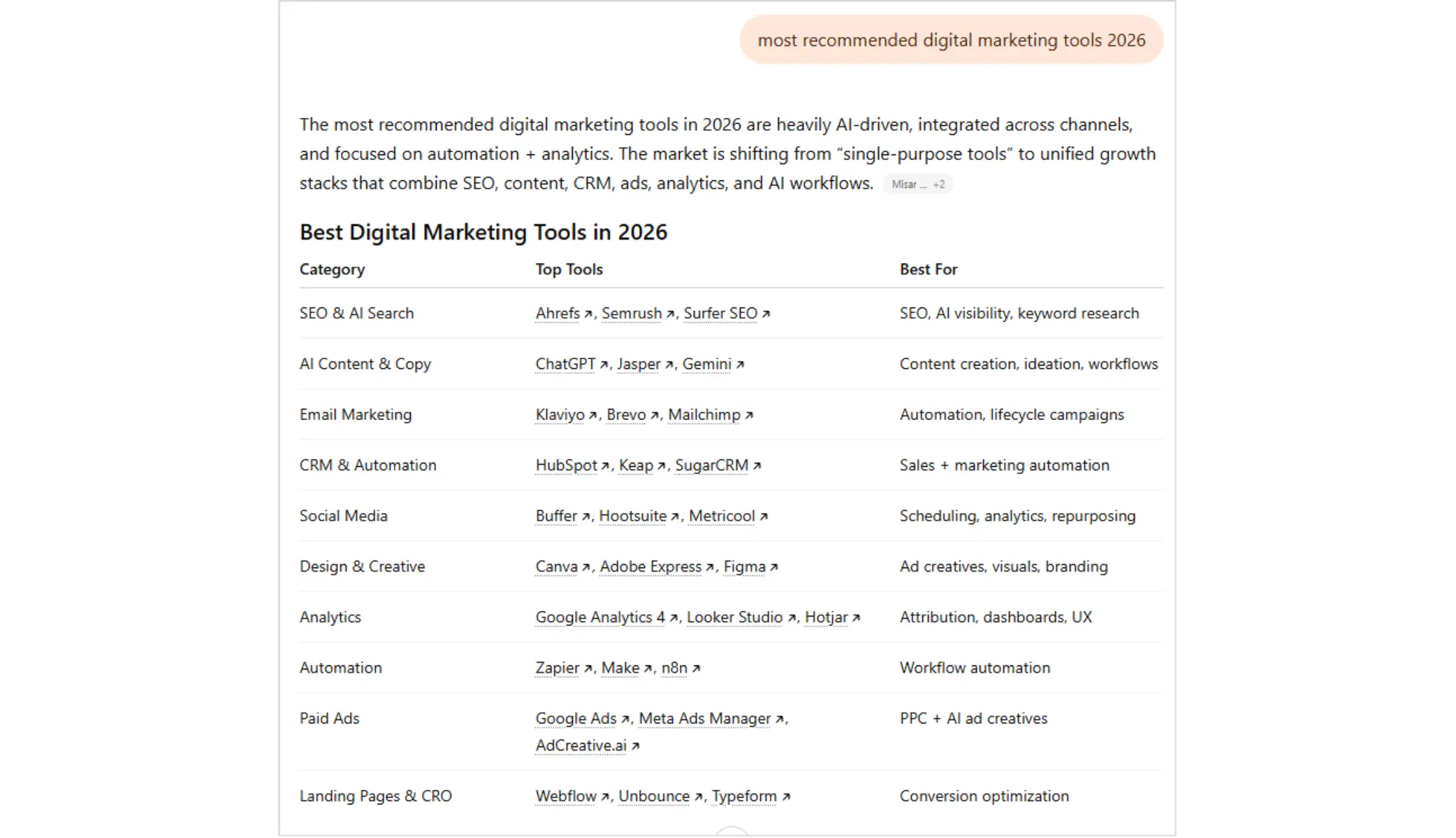
Target Users: Power users within Google Search who want multi-turn AI research conversations rather than standard results.
Institutional: ~14%
UGC Citations: ~7%
AI Overviews Overlap: 59%
AI Overviews Overlap: 59%
Institutional: ~14%
UGC Citations: ~7%
AI Overviews Overlap: 59%
AI Overviews Overlap: 59%
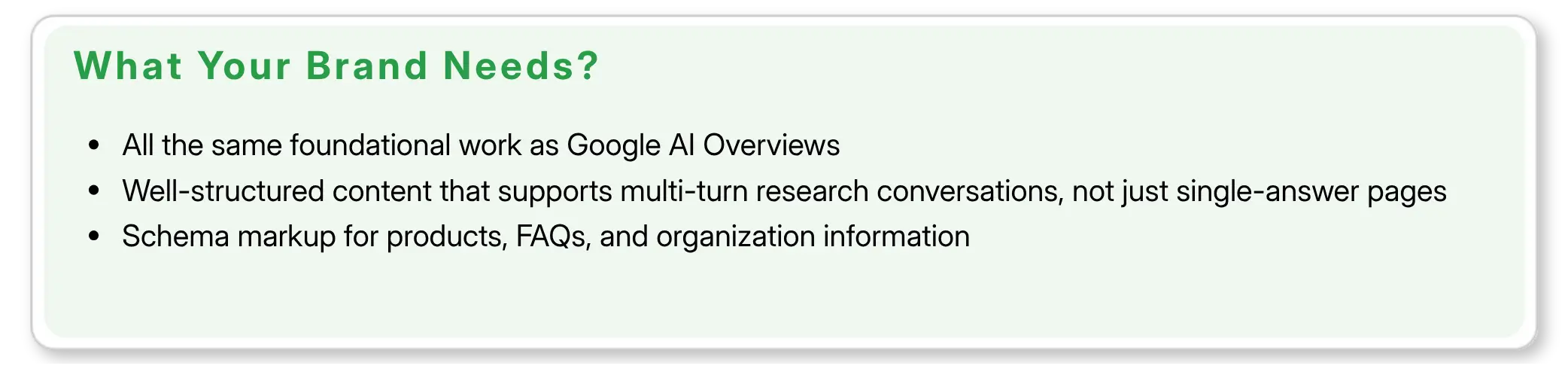
AI Mode sits in a balanced middle position. It cites institutional sources around 14% of the time higher than AI Overviews' 10% but well below Gemini's 26%. AI Mode and AI Overviews share a 59% citation overlap, meaning they're drawing from very similar pools.
If your content is performing well in AI Overviews, AI Mode is likely covering you too and vice versa.
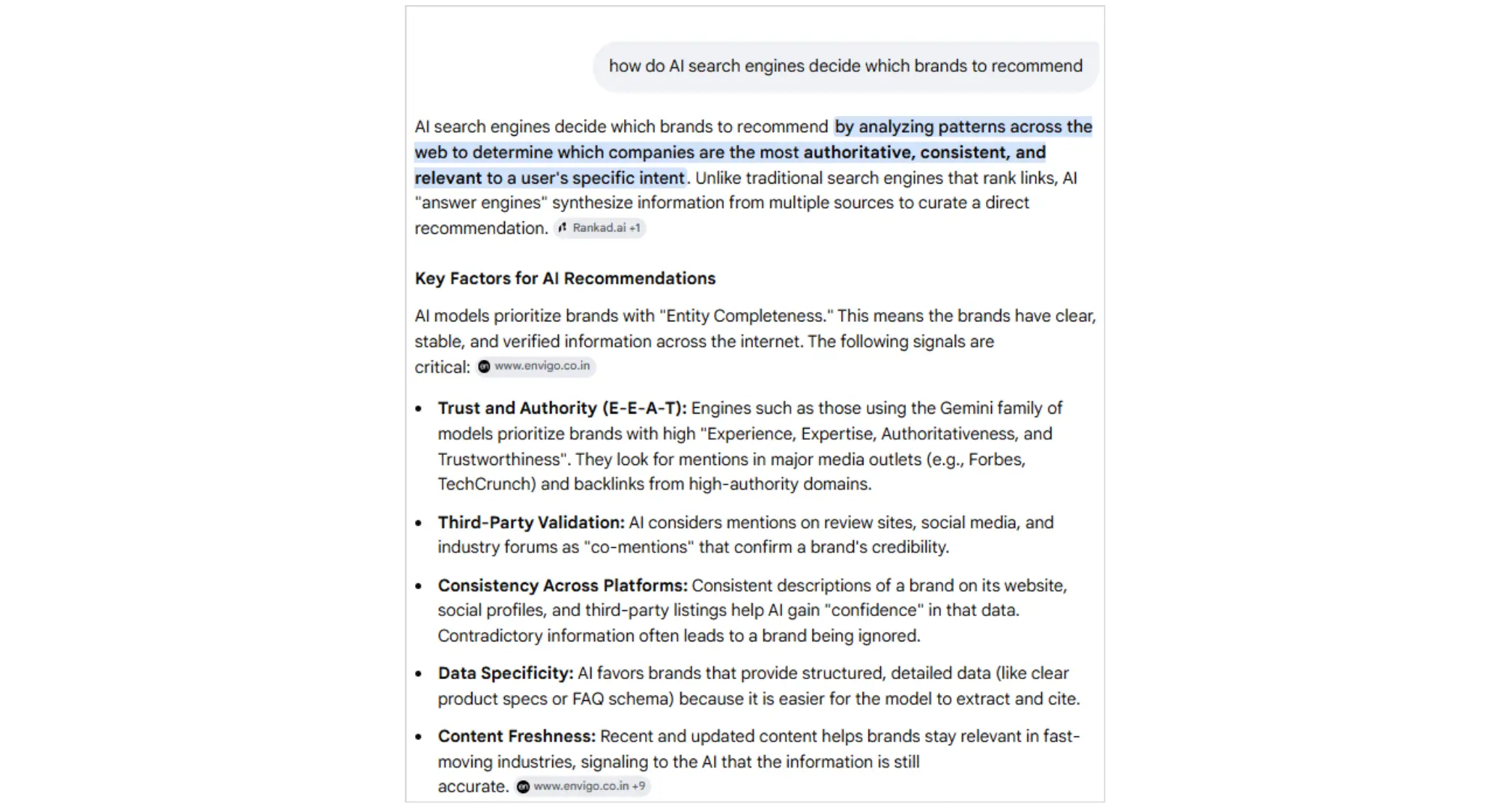
Google Gemini - The Institutional Purist
Target Users: People in Google Workspace, Android users, and those using the standalone Gemini app.
Institutional: ~26%
UGC Citations: 0.2%
.gov Citations: ~13%
.org Citations: ~23%
Institutional: ~26%
UGC Citations: 0.2%
.gov Citations: ~13%
.org Citations: ~23%
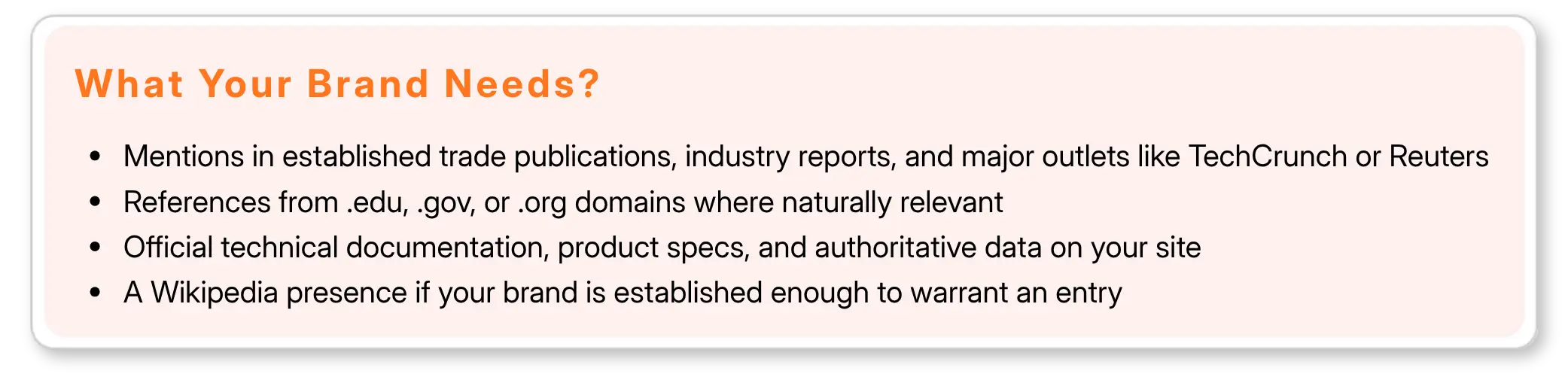
Gemini is the most conservative engine in the group. It cites institutional sources government agencies, academic bodies, established industry leaders about 26% of the time, the highest of any engine tested. It almost completely ignores user-generated content: only 0.2% of its citations come from UGC sources. The signal is clear: Gemini is essentially looking for sources it would consider textbook-grade. It isn't going to find you through social buzz or forum mentions it needs to see you endorsed by the kinds of sources it respects.
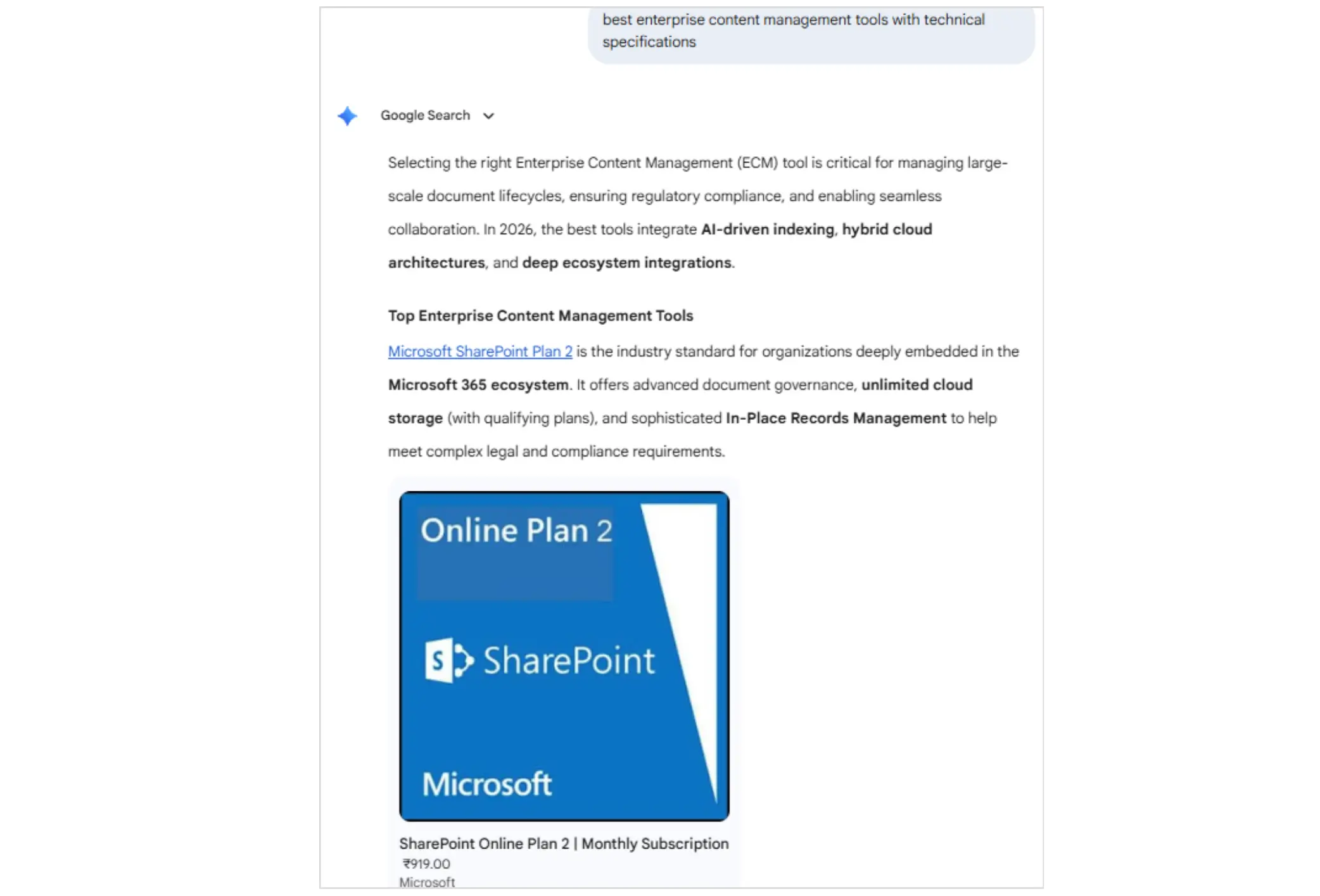
Perplexity - The Researcher's Engine
Target Users: High-intent researchers, journalists, B2B decision-makers, and anyone who wants cited, verifiable answers.
Top 4 Category Citations: ~30%
UGC Citations: ~1.5%
Avg Session: 23 min
Top 4 Category Citations: ~30%
UGC Citations: ~1.5%
Avg Session: 23 min
The research work of Perplexity uses approximately 30% of its references to four distinct reference sources which include institutional medical sources and government databases and encyclopedic references and major publishers. The system follows its transparency principle by providing users with footnote-style citations which allow them to trace the exact source of each answer.
These users aren't casually browsing. They're in the final stages of a decision. The vast majority of brand mentions in Perplexity appear in position 5 or earlier. If you're not being cited at all, you're invisible to some of the highest-intent buyers in your category.
The Cross-Engine Finding That Changes Everything
Given how differently these engines behave, is there anything that works across all five? Yes and it's the most counterintuitive finding in the data.
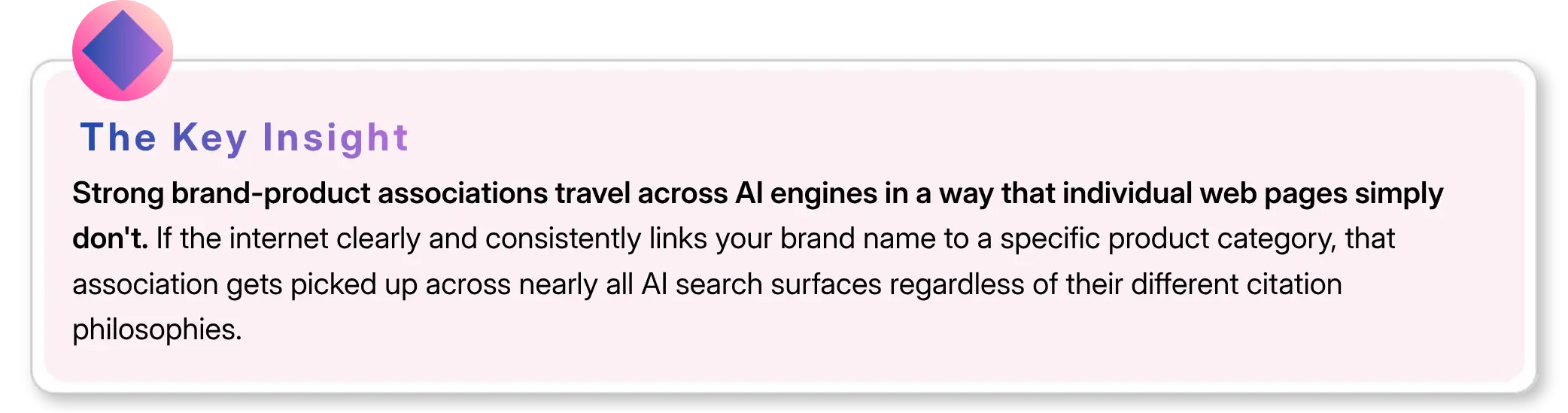
Brand citation overlap is far higher than source citation overlap. While individual websites were cited at wildly different rates across engines (overlap as low as 16%), brand names showed significantly more consistency with the lowest brand citation overlap between any two engines at 36%, nearly double the lowest source overlap.
It's also worth calling out one widely-held SEO belief that the data challenges directly: .edu sites are not treated as especially authoritative by AI search engines. Across all five engines tested, .edu citation rates were low across the board. The assumption that academic domains automatically carry special weight in AI search simply doesn't hold up.
The Practical Playbook: Where to Focus First
You can't optimize for all five engines simultaneously from day one. You can use this method to prioritize tasks according to your current circumstances.
If you're in B2B or selling to decision-makers
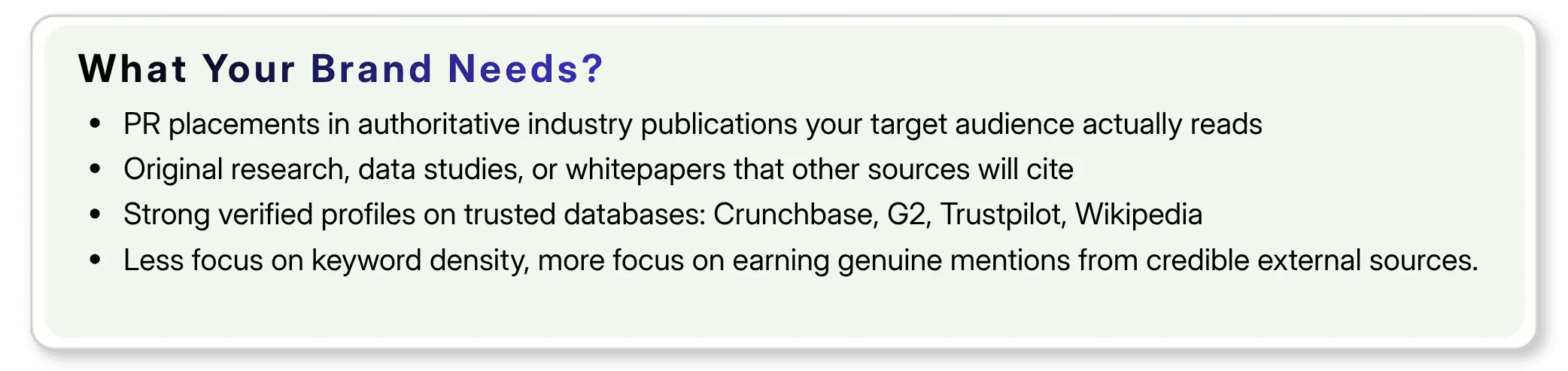
Start with Perplexity. This engine dominates high-intent research. Invest in original data, authoritative industry PR, and verified database listings. Your content needs to be the kind that analysts and journalists actually cite.
If you sell consumer products
Start with Google AI Overviews and ChatGPT. AI Overviews captures habitual Google users at the moment of discovery. ChatGPT captures people in the consideration phase. Focus on structured product data, review site visibility, and genuine community presence.
If your business operates in B2B markets where you sell directly to decision makers. Prioritize Gemini. It relies almost entirely on institutional and established sources, so a few high-quality placements in the right outlets matter far more than volume.
If you want the highest-leverage single move in 2026
Start with Bing Copilot - specifically, submit your sitemap to Bing Webmaster Tools. It is the only action in AI search optimization that improves two platforms simultaneously: Bing Copilot and ChatGPT both draw from the same Bing index. Most brands have never done this. The AI Performance dashboard launched in February 2026 now shows you exactly which pages Copilot is citing making it the most actionable data in AI search right now.
Final Thoughts
Five different AI engines - Bing Copilot, Google Gemini, Perplexity, ChatGPT, and Google AI Mode. Five different citation philosophies. One consistent finding across all of them: the brands that show up are the ones that have built genuine authority through earned press, verifiable reviews, consistent community presence, and clear brand-product associations rather than the ones that have simply optimized a webpage.
The traffic AI search drives may be smaller in volume than traditional organic. However, the traffic it harvests from users is among the most intentional and productive of all the traffic there is to find in the world of the Internet. These users have already done their shopping around.
The only question is whether your brand was in the answer they got.
FAQ
Which AI search engine is hardest to get cited in?

Google Gemini is the most selective. It cites institutional sources around 26% of the time and almost completely ignores user-generated content, with only 0.2% of citations coming from UGC. To get cited by Gemini, your brand needs endorsements from the kinds of established, authoritative sources it treats as credible not social buzz or forum mentions.
How reliable are AI searches?
AI search tools are highly convenient but imperfect. Major evaluations, including a Columbia University study, reveal that AI platforms can give incorrect answers or hallucinate data in a portion of queries. Even models with 90%+ accuracy struggle with misattribution and confidently presenting false information.
How to use AI to drive traffic to your website?
Using AI to drive website traffic involves optimizing for AI-driven search engines (like ChatGPT, Gemini, and Perplexity) and utilizing AI tools for content creation, keyword research, and on-page improvements.
Will SEO be replaced by AI?
AI will not replace SEO, but it will fundamentally reshape it. Rather than dying, SEO is evolving from standard keyword ranking into "Search Everywhere Optimization," where professionals optimize for generative AI engines (like ChatGPT, Perplexity, and Google Gemini), voice search, and traditional organic results simultaneously.
Which AI search engines cite brands in their answers?
The five major AI search engines that cite brands are ChatGPT, Google Gemini, Perplexity, Bing Copilot, and Google AI Mode. Each one uses a completely different citation philosophy citation overlap between any two engines can be as low as 16%, which means being cited on one platform doesn't guarantee visibility on another.
Your potential customer just asked an AI to recommend a product in your category. Were you mentioned? Here's how to find out - and fix it.
Every morning, millions of people skip Google entirely. They open ChatGPT, Perplexity, or Gemini and ask something like: "What's the best CRM for a 10-person startup?" or "Which skincare brand is actually worth it for sensitive skin?"
An AI reads dozens of sources, synthesizes the answer, and names two or three brands. If your brand isn't one of them, you essentially don't exist for that user no second-chance retargeting, no rank-two click, nothing.
This isn't a future scenario. It's happening right now, at scale.
The answer is different for every platform. Independent analyses comparing the five major AI search surfaces have found that the citation overlap between any two engines can be as low as 16%. These aren't slightly different versions of the same thing. They are fundamentally distinct systems that trust completely different kinds of sources and the gap between them shapes which brands get named and which ones get ignored.
The Big Shift: Why "Ranking" Doesn't Mean What It Used to?
Before diving into each engine, it's worth understanding what actually changed.
Traditional SEO was a link economy. You optimized a page, it ranked, people clicked. Volume was the game.
AI search is an answer economy. The engine reads the sources so the user doesn't have to. It synthesizes, cites, and recommends. Traffic referral drops, but the traffic that does come through converts dramatically better.
This shift also changes what "authority" means. For years, SEO professionals treated domain authority as the gold standard. AI engines care about something different: citation authority whether trusted sources mention your brand in context.
All 5 Engines at a Glance: How They Compare
Engine | Citation Style | UGC % | Institutional % | Best For |
|---|---|---|---|---|
Bing Copilot | The Hidden Gateway | Low - authoritative & structured sources preferred | High - E-E-A-T & domain authority led | Windows, Edge & Microsoft 365 users |
Google Gemini | Institutional Purist | 0.2% | ~26% | Technical & professional audiences |
Perplexity | Researcher's Engine | ~1.5% | ~30% | B2B & high-intent decision-makers |
ChatGPT | Broad Generalist | Diverse | ~12% (.gov) | Mass market & all audiences |
Google AI Mode | Middle Ground | ~7% | ~14% | Power researchers & multi-turn queries |
The 5 AI Search Engines - A Full Breakdown
Microsoft Bing Copilot - The Hidden Gateway
Target Users: Windows users, Microsoft 365 subscribers, Edge browser users, and enterprise teams - one of the most widely distributed AI assistants on the planet.
Monthly Active Users: 400M+
AI Referral Growth: 357% YoY
AI Performance Report: Launched Feb 9, 2026
Citation Style: Footnote-linked, Perplexity-like
Bing Copilot is the most underestimated engine in this entire comparison - and the one with the most direct connection to your ChatGPT visibility. Because Copilot runs on Microsoft's Bing index, your Bing presence directly shapes what Copilot surfaces. The same Bing index that powers Copilot is the one ChatGPT uses when it browses the web for real-time answers. That means a single move - submitting your sitemap to Bing Webmaster Tools improves your visibility on two major AI platforms simultaneously.
In February 2026, Microsoft launched an AI Performance dashboard inside Bing Webmaster Tools - the first time any major AI search provider gave website owners direct citation tracking data. Three months of data from one publisher revealed 30,398 total grounding events across 173 pages - Copilot wasn't occasionally glancing at their content, it was actively using their pages to formulate answers to real user questions.
Copilot's citation behaviour closely mirrors Perplexity's - it frequently includes source URLs directly in its responses, making citation tracking especially valuable. Unlike ChatGPT which uses Bing's index as a secondary browse layer, Copilot's coupling with Bing is native and constant, creating a direct feedback loop between your SEO performance and your AI visibility.
ChatGPT - The Broad Generalist
Target Users: Everyone. ChatGPT has the largest and most demographically diverse audience of any AI platform.
Top 10 Source Concentration: 18.5%
UGC Citations: ~1.5%
Avg Session: 23 min
Weekly Users: 900M+
ChatGPT has the most diverse citation profile of the five engines. Its top 10 most cited sources account for just 18.5% of total citations the lowest concentration of any engine tested. That means it's drawing from a much wider web rather than defaulting to a narrow list of trusted sites.
The most important technical detail most brands miss: when ChatGPT browses the web for real-time information, it uses Microsoft Bing's index. Your Bing visibility directly influences your ChatGPT visibility. Most brands invest zero effort in Bing and then wonder why they're invisible in AI-generated answers.
Google AI Mode - The Middle Ground
Target Users: Power users within Google Search who want multi-turn AI research conversations rather than standard results.
Institutional: ~14%
UGC Citations: ~7%
AI Overviews Overlap: 59%
AI Overviews Overlap: 59%
AI Mode sits in a balanced middle position. It cites institutional sources around 14% of the time higher than AI Overviews' 10% but well below Gemini's 26%. AI Mode and AI Overviews share a 59% citation overlap, meaning they're drawing from very similar pools.
If your content is performing well in AI Overviews, AI Mode is likely covering you too and vice versa.
Google Gemini - The Institutional Purist
Target Users: People in Google Workspace, Android users, and those using the standalone Gemini app.
Institutional: ~26%
UGC Citations: 0.2%
.gov Citations: ~13%
.org Citations: ~23%
Gemini is the most conservative engine in the group. It cites institutional sources government agencies, academic bodies, established industry leaders about 26% of the time, the highest of any engine tested. It almost completely ignores user-generated content: only 0.2% of its citations come from UGC sources. The signal is clear: Gemini is essentially looking for sources it would consider textbook-grade. It isn't going to find you through social buzz or forum mentions it needs to see you endorsed by the kinds of sources it respects.
Perplexity - The Researcher's Engine
Target Users: High-intent researchers, journalists, B2B decision-makers, and anyone who wants cited, verifiable answers.
Top 4 Category Citations: ~30%
UGC Citations: ~1.5%
Avg Session: 23 min
The research work of Perplexity uses approximately 30% of its references to four distinct reference sources which include institutional medical sources and government databases and encyclopedic references and major publishers. The system follows its transparency principle by providing users with footnote-style citations which allow them to trace the exact source of each answer.
These users aren't casually browsing. They're in the final stages of a decision. The vast majority of brand mentions in Perplexity appear in position 5 or earlier. If you're not being cited at all, you're invisible to some of the highest-intent buyers in your category.
The Cross-Engine Finding That Changes Everything
Given how differently these engines behave, is there anything that works across all five? Yes and it's the most counterintuitive finding in the data.
Brand citation overlap is far higher than source citation overlap. While individual websites were cited at wildly different rates across engines (overlap as low as 16%), brand names showed significantly more consistency with the lowest brand citation overlap between any two engines at 36%, nearly double the lowest source overlap.
It's also worth calling out one widely-held SEO belief that the data challenges directly: .edu sites are not treated as especially authoritative by AI search engines. Across all five engines tested, .edu citation rates were low across the board. The assumption that academic domains automatically carry special weight in AI search simply doesn't hold up.
The Practical Playbook: Where to Focus First
You can't optimize for all five engines simultaneously from day one. You can use this method to prioritize tasks according to your current circumstances.
If you're in B2B or selling to decision-makers
Start with Perplexity. This engine dominates high-intent research. Invest in original data, authoritative industry PR, and verified database listings. Your content needs to be the kind that analysts and journalists actually cite.
If you sell consumer products
Start with Google AI Overviews and ChatGPT. AI Overviews captures habitual Google users at the moment of discovery. ChatGPT captures people in the consideration phase. Focus on structured product data, review site visibility, and genuine community presence.
If your business operates in B2B markets where you sell directly to decision makers. Prioritize Gemini. It relies almost entirely on institutional and established sources, so a few high-quality placements in the right outlets matter far more than volume.
If you want the highest-leverage single move in 2026
Start with Bing Copilot - specifically, submit your sitemap to Bing Webmaster Tools. It is the only action in AI search optimization that improves two platforms simultaneously: Bing Copilot and ChatGPT both draw from the same Bing index. Most brands have never done this. The AI Performance dashboard launched in February 2026 now shows you exactly which pages Copilot is citing making it the most actionable data in AI search right now.
Final Thoughts
Five different AI engines - Bing Copilot, Google Gemini, Perplexity, ChatGPT, and Google AI Mode. Five different citation philosophies. One consistent finding across all of them: the brands that show up are the ones that have built genuine authority through earned press, verifiable reviews, consistent community presence, and clear brand-product associations rather than the ones that have simply optimized a webpage.
The traffic AI search drives may be smaller in volume than traditional organic. However, the traffic it harvests from users is among the most intentional and productive of all the traffic there is to find in the world of the Internet. These users have already done their shopping around.
The only question is whether your brand was in the answer they got.
FAQ
Which AI search engine is hardest to get cited in?
Google Gemini is the most selective. It cites institutional sources around 26% of the time and almost completely ignores user-generated content, with only 0.2% of citations coming from UGC. To get cited by Gemini, your brand needs endorsements from the kinds of established, authoritative sources it treats as credible not social buzz or forum mentions.
How reliable are AI searches?
AI search tools are highly convenient but imperfect. Major evaluations, including a Columbia University study, reveal that AI platforms can give incorrect answers or hallucinate data in a portion of queries. Even models with 90%+ accuracy struggle with misattribution and confidently presenting false information.
How to use AI to drive traffic to your website?
Using AI to drive website traffic involves optimizing for AI-driven search engines (like ChatGPT, Gemini, and Perplexity) and utilizing AI tools for content creation, keyword research, and on-page improvements.
Will SEO be replaced by AI?
AI will not replace SEO, but it will fundamentally reshape it. Rather than dying, SEO is evolving from standard keyword ranking into "Search Everywhere Optimization," where professionals optimize for generative AI engines (like ChatGPT, Perplexity, and Google Gemini), voice search, and traditional organic results simultaneously.
Which AI search engines cite brands in their answers?
The five major AI search engines that cite brands are ChatGPT, Google Gemini, Perplexity, Bing Copilot, and Google AI Mode. Each one uses a completely different citation philosophy citation overlap between any two engines can be as low as 16%, which means being cited on one platform doesn't guarantee visibility on another.
Your potential customer just asked an AI to recommend a product in your category. Were you mentioned? Here's how to find out - and fix it.
Every morning, millions of people skip Google entirely. They open ChatGPT, Perplexity, or Gemini and ask something like: "What's the best CRM for a 10-person startup?" or "Which skincare brand is actually worth it for sensitive skin?"
An AI reads dozens of sources, synthesizes the answer, and names two or three brands. If your brand isn't one of them, you essentially don't exist for that user no second-chance retargeting, no rank-two click, nothing.
This isn't a future scenario. It's happening right now, at scale.
The answer is different for every platform. Independent analyses comparing the five major AI search surfaces have found that the citation overlap between any two engines can be as low as 16%. These aren't slightly different versions of the same thing. They are fundamentally distinct systems that trust completely different kinds of sources and the gap between them shapes which brands get named and which ones get ignored.
The Big Shift: Why "Ranking" Doesn't Mean What It Used to?
Before diving into each engine, it's worth understanding what actually changed.
Traditional SEO was a link economy. You optimized a page, it ranked, people clicked. Volume was the game.
AI search is an answer economy. The engine reads the sources so the user doesn't have to. It synthesizes, cites, and recommends. Traffic referral drops, but the traffic that does come through converts dramatically better.
This shift also changes what "authority" means. For years, SEO professionals treated domain authority as the gold standard. AI engines care about something different: citation authority whether trusted sources mention your brand in context.
All 5 Engines at a Glance: How They Compare
Engine | Citation Style | UGC % | Institutional % | Best For |
|---|---|---|---|---|
Bing Copilot | The Hidden Gateway | Low - authoritative & structured sources preferred | High - E-E-A-T & domain authority led | Windows, Edge & Microsoft 365 users |
Google Gemini | Institutional Purist | 0.2% | ~26% | Technical & professional audiences |
Perplexity | Researcher's Engine | ~1.5% | ~30% | B2B & high-intent decision-makers |
ChatGPT | Broad Generalist | Diverse | ~12% (.gov) | Mass market & all audiences |
Google AI Mode | Middle Ground | ~7% | ~14% | Power researchers & multi-turn queries |
The 5 AI Search Engines - A Full Breakdown
Microsoft Bing Copilot - The Hidden Gateway
Target Users: Windows users, Microsoft 365 subscribers, Edge browser users, and enterprise teams - one of the most widely distributed AI assistants on the planet.
Monthly Active Users: 400M+
AI Referral Growth: 357% YoY
AI Performance Report: Launched Feb 9, 2026
Citation Style: Footnote-linked, Perplexity-like
Bing Copilot is the most underestimated engine in this entire comparison - and the one with the most direct connection to your ChatGPT visibility. Because Copilot runs on Microsoft's Bing index, your Bing presence directly shapes what Copilot surfaces. The same Bing index that powers Copilot is the one ChatGPT uses when it browses the web for real-time answers. That means a single move - submitting your sitemap to Bing Webmaster Tools improves your visibility on two major AI platforms simultaneously.
In February 2026, Microsoft launched an AI Performance dashboard inside Bing Webmaster Tools - the first time any major AI search provider gave website owners direct citation tracking data. Three months of data from one publisher revealed 30,398 total grounding events across 173 pages - Copilot wasn't occasionally glancing at their content, it was actively using their pages to formulate answers to real user questions.
Copilot's citation behaviour closely mirrors Perplexity's - it frequently includes source URLs directly in its responses, making citation tracking especially valuable. Unlike ChatGPT which uses Bing's index as a secondary browse layer, Copilot's coupling with Bing is native and constant, creating a direct feedback loop between your SEO performance and your AI visibility.
ChatGPT - The Broad Generalist
Target Users: Everyone. ChatGPT has the largest and most demographically diverse audience of any AI platform.
Top 10 Source Concentration: 18.5%
UGC Citations: ~1.5%
Avg Session: 23 min
Weekly Users: 900M+
ChatGPT has the most diverse citation profile of the five engines. Its top 10 most cited sources account for just 18.5% of total citations the lowest concentration of any engine tested. That means it's drawing from a much wider web rather than defaulting to a narrow list of trusted sites.
The most important technical detail most brands miss: when ChatGPT browses the web for real-time information, it uses Microsoft Bing's index. Your Bing visibility directly influences your ChatGPT visibility. Most brands invest zero effort in Bing and then wonder why they're invisible in AI-generated answers.
Google AI Mode - The Middle Ground
Target Users: Power users within Google Search who want multi-turn AI research conversations rather than standard results.
Institutional: ~14%
UGC Citations: ~7%
AI Overviews Overlap: 59%
AI Overviews Overlap: 59%
AI Mode sits in a balanced middle position. It cites institutional sources around 14% of the time higher than AI Overviews' 10% but well below Gemini's 26%. AI Mode and AI Overviews share a 59% citation overlap, meaning they're drawing from very similar pools.
If your content is performing well in AI Overviews, AI Mode is likely covering you too and vice versa.
Google Gemini - The Institutional Purist
Target Users: People in Google Workspace, Android users, and those using the standalone Gemini app.
Institutional: ~26%
UGC Citations: 0.2%
.gov Citations: ~13%
.org Citations: ~23%
Gemini is the most conservative engine in the group. It cites institutional sources government agencies, academic bodies, established industry leaders about 26% of the time, the highest of any engine tested. It almost completely ignores user-generated content: only 0.2% of its citations come from UGC sources. The signal is clear: Gemini is essentially looking for sources it would consider textbook-grade. It isn't going to find you through social buzz or forum mentions it needs to see you endorsed by the kinds of sources it respects.
Perplexity - The Researcher's Engine
Target Users: High-intent researchers, journalists, B2B decision-makers, and anyone who wants cited, verifiable answers.
Top 4 Category Citations: ~30%
UGC Citations: ~1.5%
Avg Session: 23 min
The research work of Perplexity uses approximately 30% of its references to four distinct reference sources which include institutional medical sources and government databases and encyclopedic references and major publishers. The system follows its transparency principle by providing users with footnote-style citations which allow them to trace the exact source of each answer.
These users aren't casually browsing. They're in the final stages of a decision. The vast majority of brand mentions in Perplexity appear in position 5 or earlier. If you're not being cited at all, you're invisible to some of the highest-intent buyers in your category.
The Cross-Engine Finding That Changes Everything
Given how differently these engines behave, is there anything that works across all five? Yes and it's the most counterintuitive finding in the data.
Brand citation overlap is far higher than source citation overlap. While individual websites were cited at wildly different rates across engines (overlap as low as 16%), brand names showed significantly more consistency with the lowest brand citation overlap between any two engines at 36%, nearly double the lowest source overlap.
It's also worth calling out one widely-held SEO belief that the data challenges directly: .edu sites are not treated as especially authoritative by AI search engines. Across all five engines tested, .edu citation rates were low across the board. The assumption that academic domains automatically carry special weight in AI search simply doesn't hold up.
The Practical Playbook: Where to Focus First
You can't optimize for all five engines simultaneously from day one. You can use this method to prioritize tasks according to your current circumstances.
If you're in B2B or selling to decision-makers
Start with Perplexity. This engine dominates high-intent research. Invest in original data, authoritative industry PR, and verified database listings. Your content needs to be the kind that analysts and journalists actually cite.
If you sell consumer products
Start with Google AI Overviews and ChatGPT. AI Overviews captures habitual Google users at the moment of discovery. ChatGPT captures people in the consideration phase. Focus on structured product data, review site visibility, and genuine community presence.
If your business operates in B2B markets where you sell directly to decision makers. Prioritize Gemini. It relies almost entirely on institutional and established sources, so a few high-quality placements in the right outlets matter far more than volume.
If you want the highest-leverage single move in 2026
Start with Bing Copilot - specifically, submit your sitemap to Bing Webmaster Tools. It is the only action in AI search optimization that improves two platforms simultaneously: Bing Copilot and ChatGPT both draw from the same Bing index. Most brands have never done this. The AI Performance dashboard launched in February 2026 now shows you exactly which pages Copilot is citing making it the most actionable data in AI search right now.
Final Thoughts
Five different AI engines - Bing Copilot, Google Gemini, Perplexity, ChatGPT, and Google AI Mode. Five different citation philosophies. One consistent finding across all of them: the brands that show up are the ones that have built genuine authority through earned press, verifiable reviews, consistent community presence, and clear brand-product associations rather than the ones that have simply optimized a webpage.
The traffic AI search drives may be smaller in volume than traditional organic. However, the traffic it harvests from users is among the most intentional and productive of all the traffic there is to find in the world of the Internet. These users have already done their shopping around.
The only question is whether your brand was in the answer they got.
FAQ
Which AI search engine is hardest to get cited in?
Google Gemini is the most selective. It cites institutional sources around 26% of the time and almost completely ignores user-generated content, with only 0.2% of citations coming from UGC. To get cited by Gemini, your brand needs endorsements from the kinds of established, authoritative sources it treats as credible not social buzz or forum mentions.
How reliable are AI searches?
AI search tools are highly convenient but imperfect. Major evaluations, including a Columbia University study, reveal that AI platforms can give incorrect answers or hallucinate data in a portion of queries. Even models with 90%+ accuracy struggle with misattribution and confidently presenting false information.
How to use AI to drive traffic to your website?
Using AI to drive website traffic involves optimizing for AI-driven search engines (like ChatGPT, Gemini, and Perplexity) and utilizing AI tools for content creation, keyword research, and on-page improvements.
Will SEO be replaced by AI?
AI will not replace SEO, but it will fundamentally reshape it. Rather than dying, SEO is evolving from standard keyword ranking into "Search Everywhere Optimization," where professionals optimize for generative AI engines (like ChatGPT, Perplexity, and Google Gemini), voice search, and traditional organic results simultaneously.
Which AI search engines cite brands in their answers?
The five major AI search engines that cite brands are ChatGPT, Google Gemini, Perplexity, Bing Copilot, and Google AI Mode. Each one uses a completely different citation philosophy citation overlap between any two engines can be as low as 16%, which means being cited on one platform doesn't guarantee visibility on another.



Summarize with AI


Want to be seen everywhere?
Get a free AI-search audit Today!



4.9/5 Ratings!


Don’t miss our revenue growth tips!
Get expert marketing tips—straight to your inbox, like thousands of happy clients.
Don’t miss our revenue growth tips!
Get expert marketing tips—straight to your inbox, like thousands of happy clients.
Don’t miss our revenue growth tips!
Don’t miss our revenue growth tips!
Get expert marketing tips—straight to your inbox, like thousands of happy clients.
Relevant Blogs on Generative AI SEO
Relevant Blogs on Generative AI SEO
Unlock data-driven insights in AI-powered SEO—explore our featured blogs and skyrocket your revenue before your competitors do.
Unlock data-driven insights in AI-powered SEO—explore our featured blogs and skyrocket your revenue before your competitors do.

GEO
Sep 22, 2026
15 Min Read
AI Search Runs on More SEO Than You Think
GEO
Sep 22, 2026
15 Min Read
AI Search Runs on More SEO Than You Think
GEO
Sep 22, 2026
15 Min Read
AI Search Runs on More SEO Than You Think

GEO
Sep 7, 2026
8 Min Read
How to Optimize Content for AI Search Engines: Best Practices
GEO
Sep 7, 2026
8 Min Read
How to Optimize Content for AI Search Engines: Best Practices
GEO
Sep 7, 2026
8 Min Read
How to Optimize Content for AI Search Engines: Best Practices

GEO
Sep 4, 2026
12 Min Read
How Ecommerce Brands Can Advertise in Google AI Mode?
GEO
Sep 4, 2026
12 Min Read
How Ecommerce Brands Can Advertise in Google AI Mode?
GEO
Sep 4, 2026
12 Min Read
How Ecommerce Brands Can Advertise in Google AI Mode?















Ready to speak with an expert?
Data-Driven Marketing Agency That Elevates ROI
1100+
Websites Designed & Optimized to Convert
$280M+
Client Revenue Driven & Growing Strong
Discover how to skyrocket
your revenue today!
Trusted by 1000+ Owners!
Ready to speak with an expert?
Data-Driven Marketing Agency That Elevates ROI
1100+
Websites Designed & Optimized to Convert
$280M+
Client Revenue Driven & Growing Strong
Discover how to skyrocket
your revenue today!
Trusted by 1000+ Owners!
Want to skyrocket revenue?
4.9/5 Ratings!
Ready to speak with an expert?
Data-Driven Marketing Agency That Elevates ROI
1100+
Websites Designed & Optimized to Convert
$280M+
Client Revenue Driven & Growing Strong
Discover how to skyrocket
your revenue today!
Trusted by 1000+ Owners!
Call
Meet