How the LinkedIn Algorithm Works in 2026
How the LinkedIn Algorithm Works in 2026
Last Updated:
Table of Content
How We
Skyrocket
Boost
Maximize
Accelerate
Amplify
Elevate
Optimize
Enhance
Your Revenue?


Tanya Singh
Tanya Singh
Tanya Singh
Social Media
Social Media
Social Media
8 Min Read
8 Min
8 Min Read
The LinkedIn algorithm in 2026 ranks posts using an AI model that reads for meaning, not keywords, then tests every post on a small slice of your network before deciding whether it deserves wider reach. It rewards dwell time, genuine conversation, and topic consistency, while actively suppressing engagement bait, automation, and generic AI sounding content. If your reach has dropped recently, it's usually one of these shifts, not bad luck.
What Is the LinkedIn Algorithm and What Does It Actually Do?
The LinkedIn algorithm is the ranking system that decides which posts show up in each member's feed, in what order, and how far they travel beyond your immediate network. With more than 1 billion members and billions of posts competing for attention every day, LinkedIn can't show everyone everything, so it constantly predicts what each person is most likely to find useful and shows that first.
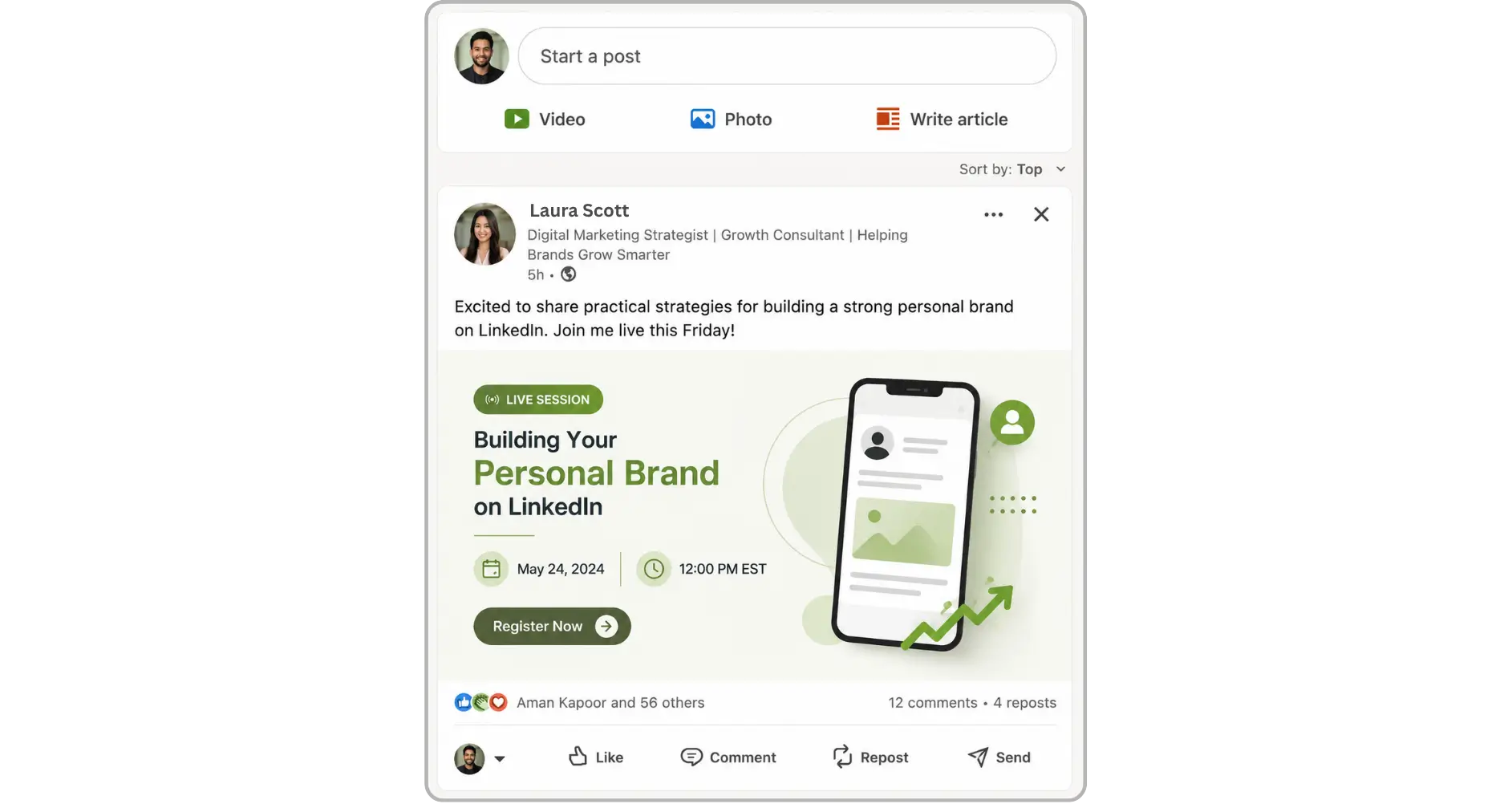
Unlike platforms built for virality, LinkedIn has said directly that it is not designed to make content go viral. Its job is to connect professionals with knowledge, updates, and people relevant to their work, which is why a niche, well written post can quietly outperform a flashy one with a huge hook.
How Does the LinkedIn Algorithm Work, Step by Step?
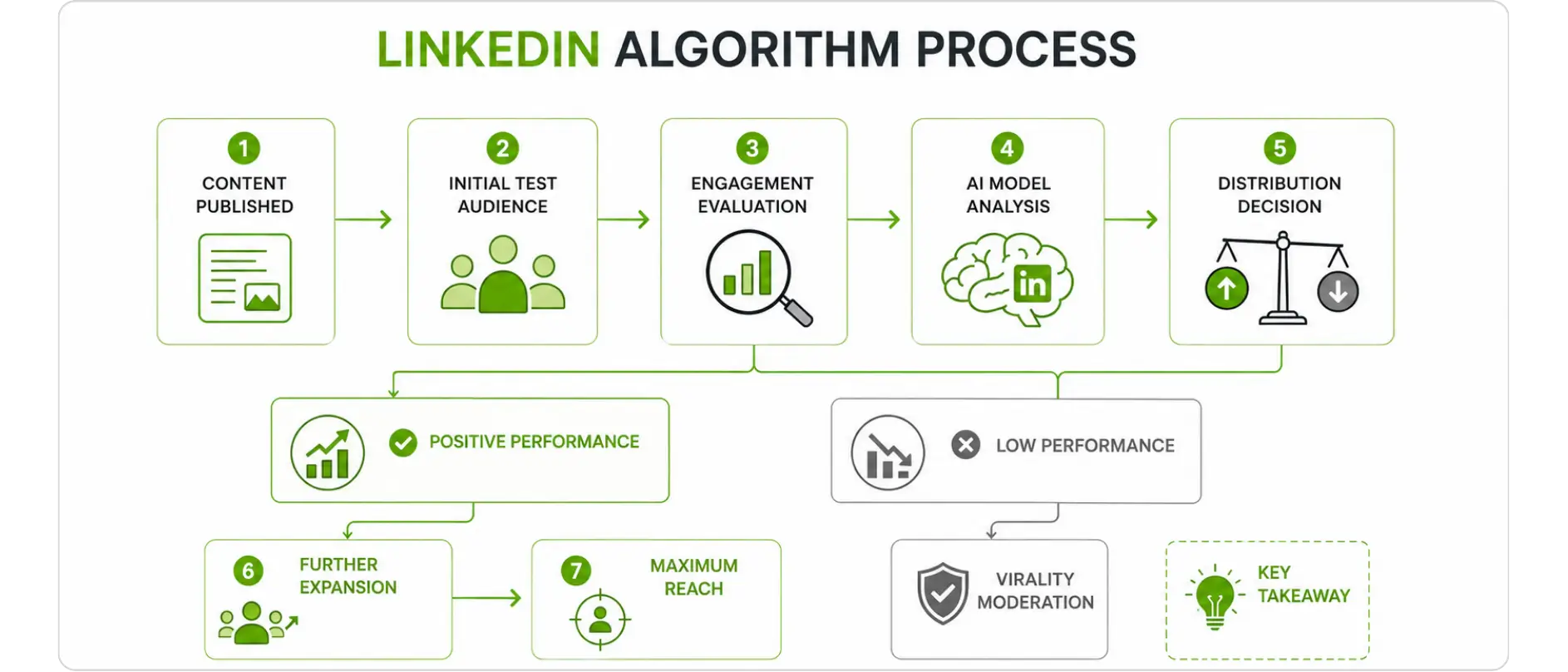
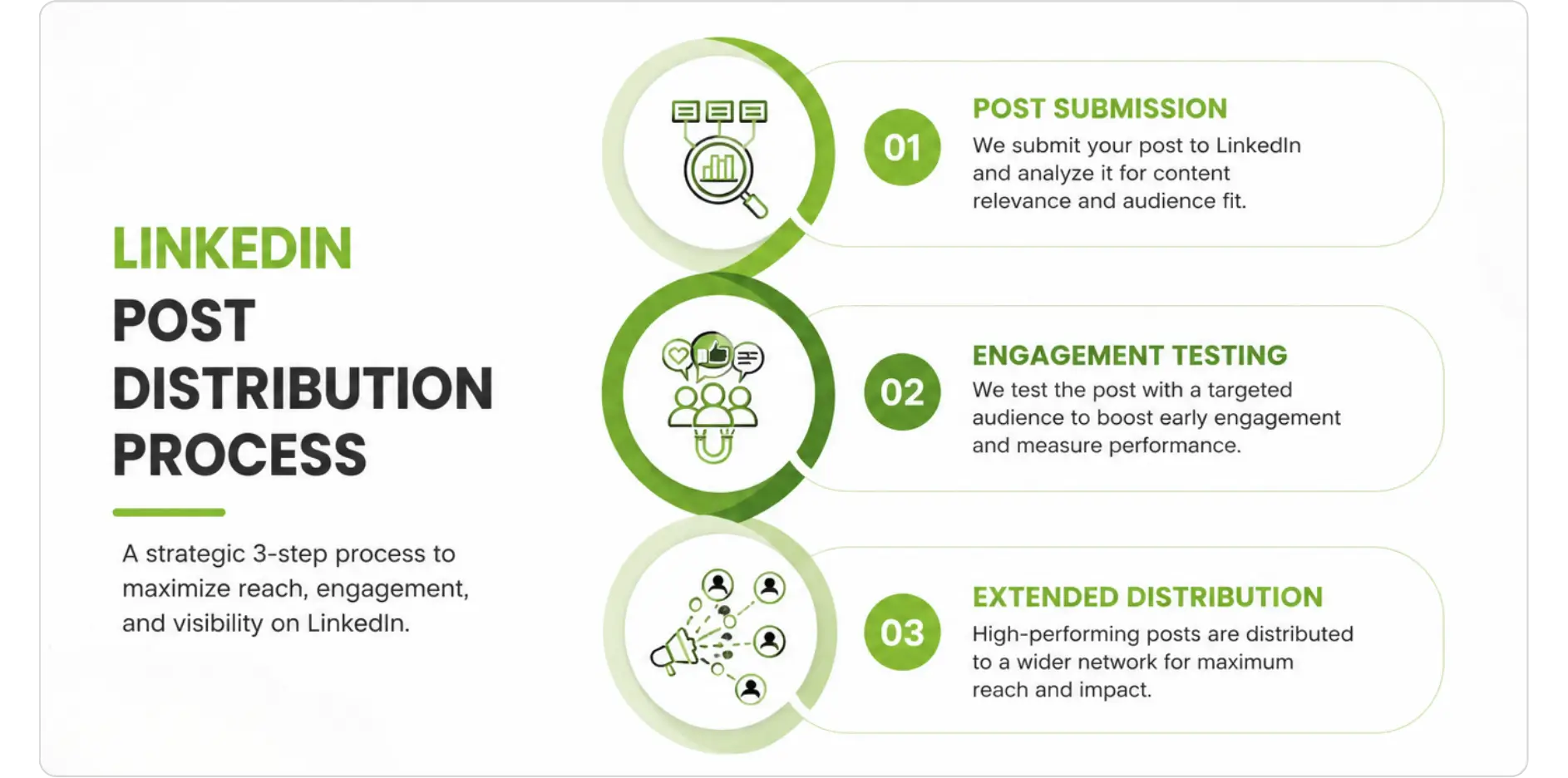
How does the LinkedIn algorithm work right now comes down to a three stage filter: a quality check, a small scale engagement test, and then expanded distribution if that test goes well. Every post you publish moves through this sequence before LinkedIn decides how many people ever see it.
Stage One: The Quality and Spam Filter
Before anything else, LinkedIn checks your post against its professional community policies. Posts that violate spam guidelines, things like tagging unrelated people, stuffing hashtags, or posting an unusual number of times in a short window, get quietly limited before they reach anyone. Clean, original posts pass through immediately.
Stage Two: The Golden Hour Test
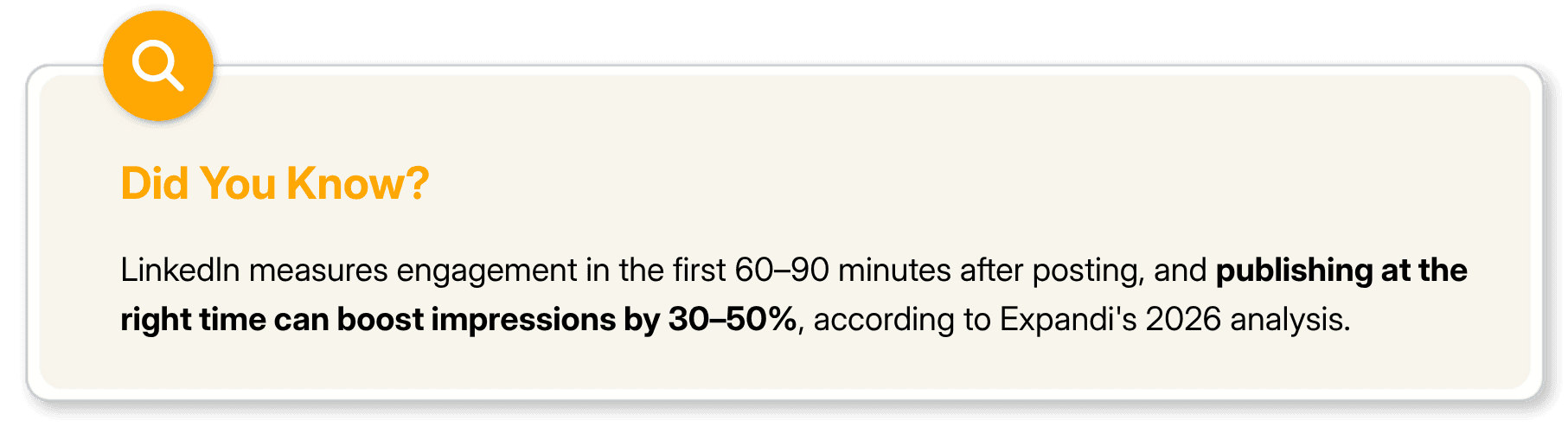
Once a post clears the filter, LinkedIn shows it to a small sample of your network, often estimated between 2% and 10%, for the first 60 to 90 minutes. This window is widely known across the LinkedIn creator community as the golden hour, and it's the single most important stretch in a post's lifecycle. If that early audience reads, comments, or shares, the post earns a stronger internal quality score. If it sits quiet, distribution slows and often stops there.
Stage Three: Extended Distribution
Posts that perform well in the golden hour get pushed to second and third degree connections and to other members who match the topic based on their past activity. Strong posts can keep gaining traction for 48 to 72 hours or longer, which is very different from platforms where a post's life span is measured in minutes.
What Is 360Brew and Why Does It Matter for the LinkedIn Algorithm Update?
360Brew is the large AI model LinkedIn built to power feed ranking, search, and recommendations from a single system instead of dozens of separate ones, and it's the biggest technical shift behind the current LinkedIn algorithm update. LinkedIn's engineering team described it publicly in a research paper and later in an official engineering blog post, confirming that the platform now leans on a large language style model to judge relevance instead of counting surface level signals like likes and hashtags.
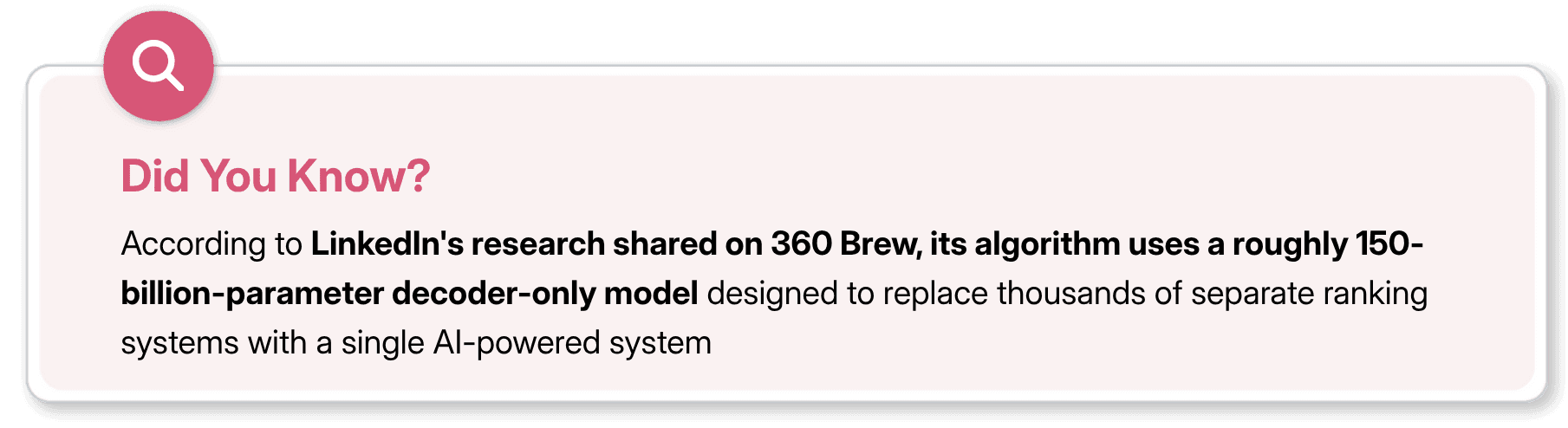
In practical terms, this means 360Brew reads your profile, your post, and your audience's behavior together to understand meaning and intent, rather than matching keywords. A post using precise industry language and demonstrating real expertise gets classified and distributed more accurately than a vague, generic one, even without hashtags doing the heavy lifting they once did.

What Ranking Signals Does the LinkedIn Algorithm Prioritize Now?
The LinkedIn algorithm in 2026 prioritizes dwell time, comment depth, relevance to a viewer's interest graph, and how quickly a post earns genuine reactions, ranking these well above simple like counts. LinkedIn has been explicit that a post someone reads for thirty seconds carries more weight than one that collects fifty quick likes and nothing else.
Here's how the major signals compare:
Signal | What It Measures | 2026 Weight |
|---|---|---|
Dwell time | How long someone actually reads or watches | Very high |
Comment quality | Substantive replies versus one-word reactions | Very high |
Engagement velocity | Speed of reactions in the golden hour | High |
Relevance to interest graph | Topic match with a viewer's history | High |
Likes and reactions | Simple, low-effort signals | Low |
Hashtags | Topic labeling | Low to moderate |
External links | Sends traffic off platform | Slightly reduces reach |
This shift is exactly why a thoughtful, well argued comment from a smaller account can outperform a post from someone with ten times the followers. The algorithm cares about the quality of the interaction far more than who is doing the interacting.
Which Content Formats Get the Most Reach in the Current LinkedIn Algorithm Update?
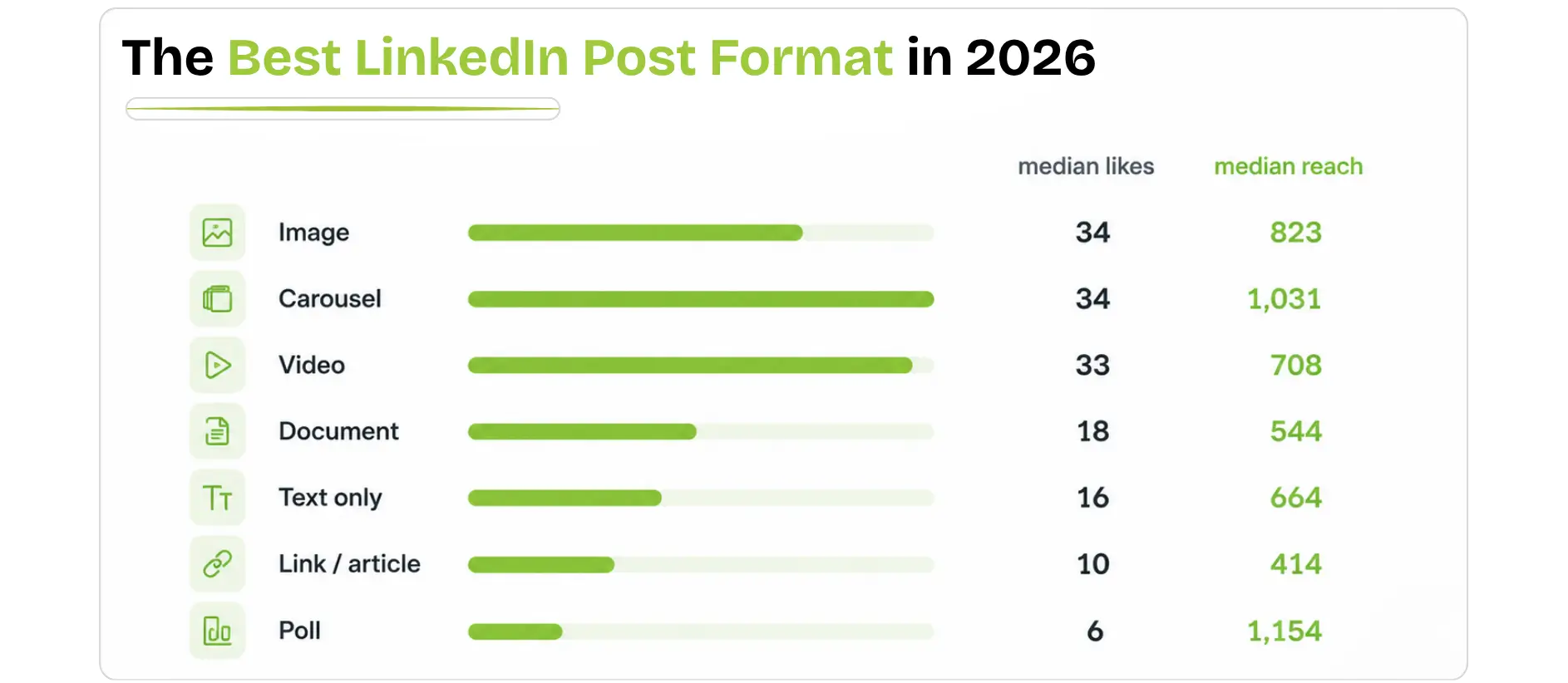
Document, posts and carousels currently earn the highest engagement of any format, followed by native video, because both naturally hold attention longer and increase dwell time. LinkedIn's own creator data and third party studies place carousel style posts well ahead of plain text in average engagement rate, largely because a multi slide format forces a slower scroll and a longer read.
A few practical patterns worth knowing:
Document posts and carousels consistently generate the strongest engagement of any format tracked in 2026 reports.
Native video, especially short form under a minute with on screen captions, performs strongly since most people scroll with sound off.
Long form text with a clear structure still works well when it opens with a strong first line and uses short paragraphs that are easy to scan.
Polls have dropped sharply in engagement value since LinkedIn's early 2026 update targeting low effort formats used mainly to farm reactions.
External links in the post body can reduce reach, though LinkedIn has clarified that a link isn't automatically penalized if the post itself delivers standalone value.
How Can Businesses Improve Visibility Under the New LinkedIn Algorithm?
Businesses improve visibility by publishing consistently around three to five core topics, encouraging employees to engage authentically, and treating the golden hour as an active window rather than a set and forget moment. Company pages in particular struggle here because they often post and walk away, missing the early engagement that determines whether LinkedIn ever shows the post to anyone beyond existing followers.
We've seen this play out on our own Coozmoo LinkedIn page, where posts built around real team milestones, client wins, and behind the scenes culture consistently draw more genuine comments than generic promotional updates ever did. That kind of specific, human content is exactly what an AI-powered ranking system like 360Brew is built to recognize and reward, because it reflects real interaction rather than a broadcast message nobody responds to.
A few habits that consistently help:
Reply to every comment within the first hour to extend the engagement window and deepen the conversation thread.
Post about the same three to five themes repeatedly so LinkedIn's interest graph learns what you're an authority on.
Use employee advocacy instead of relying only on the company page, since personal profiles generally reach further than brand pages.
Avoid engagement bait phrasing like "agree?" or "comment below," which LinkedIn's models are now built to detect and suppress.
Keep formatting clean and specific rather than vague, since ambiguous posts are harder for the algorithm to categorize and distribute accurately
Should You Still Use Hashtags Under the Current LinkedIn Algorithm?
Yes, but with far less weight than before, since 360Brew can now infer a post's topic directly from the language used rather than relying on hashtag labels. A couple of accurate, specific hashtags still help with discovery and categorization, but stacking ten generic tags at the bottom of a post no longer moves the needle and can even read as a spam signal.
Final Thoughts
The LinkedIn algorithm isn't trying to trick creators or businesses, it's trying to reward the same thing good professional networking always rewarded: real conversation over noise. The platforms that treat every post as a broadcast will keep losing reach to the ones treating it as the start of a discussion. Show up in your own golden hour, write like an actual expert instead of a content calendar, and the distribution follows. Stop posting for the algorithm.
Start posting for the conversation, and let the algorithm catch up.
FAQs
What Are the LinkedIn Algorithm Changes for 2026?

The biggest change to the LinkedIn algorithm is 360Brew, LinkedIn’s AI ranking model that reads for meaning, not counting hashtags and likes. It also officially downgraded engagement bait, polls and automation tactics.
Does the LinkedIn Algorithm Still Reward Hashtags?
Hashtags still help with basic categorization, but they carry far less weight now that the algorithm can infer topics directly from your writing. Two or three accurate tags are enough; stacking ten no longer boosts reach.
Does LinkedIn Punish AI Generated Content?
Not directly. LinkedIn doesn't detect "AI written" text as such, but generic AI content tends to produce low dwell time and thin engagement, which the algorithm does penalize. Edited, specific writing with a real point of view still performs well.
What Is the 360Brew Algorithm on LinkedIn?
360Brew is LinkedIn's large AI ranking model, roughly 150 billion parameters, built to power feed ranking, search, and recommendations from one unified system instead of many separate ones. It reads posts and profiles for semantic meaning, not keywords.
How to Beat the LinkedIn Algorithm?
Show up during your own golden hour to reply to early comments, post consistently around three to five core topics, and prioritize genuine, specific writing over engagement bait. Real conversation outperforms every shortcut.
The LinkedIn algorithm in 2026 ranks posts using an AI model that reads for meaning, not keywords, then tests every post on a small slice of your network before deciding whether it deserves wider reach. It rewards dwell time, genuine conversation, and topic consistency, while actively suppressing engagement bait, automation, and generic AI sounding content. If your reach has dropped recently, it's usually one of these shifts, not bad luck.
What Is the LinkedIn Algorithm and What Does It Actually Do?
The LinkedIn algorithm is the ranking system that decides which posts show up in each member's feed, in what order, and how far they travel beyond your immediate network. With more than 1 billion members and billions of posts competing for attention every day, LinkedIn can't show everyone everything, so it constantly predicts what each person is most likely to find useful and shows that first.
Unlike platforms built for virality, LinkedIn has said directly that it is not designed to make content go viral. Its job is to connect professionals with knowledge, updates, and people relevant to their work, which is why a niche, well written post can quietly outperform a flashy one with a huge hook.
How Does the LinkedIn Algorithm Work, Step by Step?
How does the LinkedIn algorithm work right now comes down to a three stage filter: a quality check, a small scale engagement test, and then expanded distribution if that test goes well. Every post you publish moves through this sequence before LinkedIn decides how many people ever see it.
Stage One: The Quality and Spam Filter
Before anything else, LinkedIn checks your post against its professional community policies. Posts that violate spam guidelines, things like tagging unrelated people, stuffing hashtags, or posting an unusual number of times in a short window, get quietly limited before they reach anyone. Clean, original posts pass through immediately.
Stage Two: The Golden Hour Test
Once a post clears the filter, LinkedIn shows it to a small sample of your network, often estimated between 2% and 10%, for the first 60 to 90 minutes. This window is widely known across the LinkedIn creator community as the golden hour, and it's the single most important stretch in a post's lifecycle. If that early audience reads, comments, or shares, the post earns a stronger internal quality score. If it sits quiet, distribution slows and often stops there.
Stage Three: Extended Distribution
Posts that perform well in the golden hour get pushed to second and third degree connections and to other members who match the topic based on their past activity. Strong posts can keep gaining traction for 48 to 72 hours or longer, which is very different from platforms where a post's life span is measured in minutes.
What Is 360Brew and Why Does It Matter for the LinkedIn Algorithm Update?
360Brew is the large AI model LinkedIn built to power feed ranking, search, and recommendations from a single system instead of dozens of separate ones, and it's the biggest technical shift behind the current LinkedIn algorithm update. LinkedIn's engineering team described it publicly in a research paper and later in an official engineering blog post, confirming that the platform now leans on a large language style model to judge relevance instead of counting surface level signals like likes and hashtags.
In practical terms, this means 360Brew reads your profile, your post, and your audience's behavior together to understand meaning and intent, rather than matching keywords. A post using precise industry language and demonstrating real expertise gets classified and distributed more accurately than a vague, generic one, even without hashtags doing the heavy lifting they once did.
What Ranking Signals Does the LinkedIn Algorithm Prioritize Now?
The LinkedIn algorithm in 2026 prioritizes dwell time, comment depth, relevance to a viewer's interest graph, and how quickly a post earns genuine reactions, ranking these well above simple like counts. LinkedIn has been explicit that a post someone reads for thirty seconds carries more weight than one that collects fifty quick likes and nothing else.
Here's how the major signals compare:
Signal | What It Measures | 2026 Weight |
|---|---|---|
Dwell time | How long someone actually reads or watches | Very high |
Comment quality | Substantive replies versus one-word reactions | Very high |
Engagement velocity | Speed of reactions in the golden hour | High |
Relevance to interest graph | Topic match with a viewer's history | High |
Likes and reactions | Simple, low-effort signals | Low |
Hashtags | Topic labeling | Low to moderate |
External links | Sends traffic off platform | Slightly reduces reach |
This shift is exactly why a thoughtful, well argued comment from a smaller account can outperform a post from someone with ten times the followers. The algorithm cares about the quality of the interaction far more than who is doing the interacting.
Which Content Formats Get the Most Reach in the Current LinkedIn Algorithm Update?
Document, posts and carousels currently earn the highest engagement of any format, followed by native video, because both naturally hold attention longer and increase dwell time. LinkedIn's own creator data and third party studies place carousel style posts well ahead of plain text in average engagement rate, largely because a multi slide format forces a slower scroll and a longer read.
A few practical patterns worth knowing:
Document posts and carousels consistently generate the strongest engagement of any format tracked in 2026 reports.
Native video, especially short form under a minute with on screen captions, performs strongly since most people scroll with sound off.
Long form text with a clear structure still works well when it opens with a strong first line and uses short paragraphs that are easy to scan.
Polls have dropped sharply in engagement value since LinkedIn's early 2026 update targeting low effort formats used mainly to farm reactions.
External links in the post body can reduce reach, though LinkedIn has clarified that a link isn't automatically penalized if the post itself delivers standalone value.
How Can Businesses Improve Visibility Under the New LinkedIn Algorithm?
Businesses improve visibility by publishing consistently around three to five core topics, encouraging employees to engage authentically, and treating the golden hour as an active window rather than a set and forget moment. Company pages in particular struggle here because they often post and walk away, missing the early engagement that determines whether LinkedIn ever shows the post to anyone beyond existing followers.
We've seen this play out on our own Coozmoo LinkedIn page, where posts built around real team milestones, client wins, and behind the scenes culture consistently draw more genuine comments than generic promotional updates ever did. That kind of specific, human content is exactly what an AI-powered ranking system like 360Brew is built to recognize and reward, because it reflects real interaction rather than a broadcast message nobody responds to.
A few habits that consistently help:
Reply to every comment within the first hour to extend the engagement window and deepen the conversation thread.
Post about the same three to five themes repeatedly so LinkedIn's interest graph learns what you're an authority on.
Use employee advocacy instead of relying only on the company page, since personal profiles generally reach further than brand pages.
Avoid engagement bait phrasing like "agree?" or "comment below," which LinkedIn's models are now built to detect and suppress.
Keep formatting clean and specific rather than vague, since ambiguous posts are harder for the algorithm to categorize and distribute accurately
Should You Still Use Hashtags Under the Current LinkedIn Algorithm?
Yes, but with far less weight than before, since 360Brew can now infer a post's topic directly from the language used rather than relying on hashtag labels. A couple of accurate, specific hashtags still help with discovery and categorization, but stacking ten generic tags at the bottom of a post no longer moves the needle and can even read as a spam signal.
Final Thoughts
The LinkedIn algorithm isn't trying to trick creators or businesses, it's trying to reward the same thing good professional networking always rewarded: real conversation over noise. The platforms that treat every post as a broadcast will keep losing reach to the ones treating it as the start of a discussion. Show up in your own golden hour, write like an actual expert instead of a content calendar, and the distribution follows. Stop posting for the algorithm.
Start posting for the conversation, and let the algorithm catch up.
FAQs
What Are the LinkedIn Algorithm Changes for 2026?
The biggest change to the LinkedIn algorithm is 360Brew, LinkedIn’s AI ranking model that reads for meaning, not counting hashtags and likes. It also officially downgraded engagement bait, polls and automation tactics.
Does the LinkedIn Algorithm Still Reward Hashtags?
Hashtags still help with basic categorization, but they carry far less weight now that the algorithm can infer topics directly from your writing. Two or three accurate tags are enough; stacking ten no longer boosts reach.
Does LinkedIn Punish AI Generated Content?
Not directly. LinkedIn doesn't detect "AI written" text as such, but generic AI content tends to produce low dwell time and thin engagement, which the algorithm does penalize. Edited, specific writing with a real point of view still performs well.
What Is the 360Brew Algorithm on LinkedIn?
360Brew is LinkedIn's large AI ranking model, roughly 150 billion parameters, built to power feed ranking, search, and recommendations from one unified system instead of many separate ones. It reads posts and profiles for semantic meaning, not keywords.
How to Beat the LinkedIn Algorithm?
Show up during your own golden hour to reply to early comments, post consistently around three to five core topics, and prioritize genuine, specific writing over engagement bait. Real conversation outperforms every shortcut.



Summarize with AI




Want to Grow Social Accounts? Get a Free Audit Today!
Want to Grow Social Accounts? Get a Free Audit Today!


1k+ Reviews!


Don’t miss our revenue growth tips!
Get expert marketing tips—straight to your inbox, like thousands of happy clients.
Don’t miss our revenue growth tips!
Don’t miss our revenue growth tips!
Get expert marketing tips—straight to your inbox, like thousands of happy clients.
Don’t miss our revenue growth tips!
Get expert marketing tips—straight to your inbox, like thousands of happy clients.
Relevant Blogs on Social Media
Relevant Blogs on Social Media
Unlock data-driven insights in Social Media Marketing—explore our featured blogs and skyrocket your revenue before your competitors do.
Unlock data-driven insights in Social Media Marketing—explore our featured blogs and skyrocket your revenue before your competitors do.

Social Media
Aug 28, 2026
10 Min Read
Social Search Optimization: How to Optimize Your Brand for Social Search
Social Media
Aug 28, 2026
10 Min Read
Social Search Optimization: How to Optimize Your Brand for Social Search
Social Media
Aug 28, 2026
10 Min Read
Social Search Optimization: How to Optimize Your Brand for Social Search
Social Media
Aug 13, 2026
5 Min Read
TikTok SEO: How Keywords and Metadata Impact Your Visibility
Social Media
Aug 13, 2026
5 Min Read
TikTok SEO: How Keywords and Metadata Impact Your Visibility
Social Media
Aug 13, 2026
5 Min Read
TikTok SEO: How Keywords and Metadata Impact Your Visibility

Social Media
Aug 3, 2026
10 Min Read
Why Social Media Matters for Al Recommendations and Brand Discovery
Social Media
Aug 3, 2026
10 Min Read
Why Social Media Matters for Al Recommendations and Brand Discovery
Social Media
Aug 3, 2026
10 Min Read
Why Social Media Matters for Al Recommendations and Brand Discovery













Ready to speak with an expert?
Data-Driven Marketing Agency That Elevates ROI
1100+
Websites Designed & Optimized to Convert
$280M+
Client Revenue Driven & Growing Strong
Discover how to skyrocket
your revenue today!



Trusted by 1000+ Owners!
Ready to speak with an expert?
Data-Driven Marketing Agency That Elevates ROI
1100+
Websites Designed & Optimized to Convert
$280M+
Client Revenue Driven & Growing Strong
Discover how to skyrocket
your revenue today!
Trusted by 1000+ Owners!
Want to skyrocket revenue?
4.9/5 Ratings!
Ready to speak with an expert?
Data-Driven Marketing Agency That Elevates ROI
1100+
Websites Designed & Optimized to Convert
$280M+
Client Revenue Driven & Growing Strong
Discover how to skyrocket
your revenue today!
Trusted by 1000+ Owners!
Call
Meet