Why Social Media Matters for Al Recommendations and Brand Discovery
Why Social Media Matters for Al Recommendations and Brand Discovery
Last Updated:
Table of Content
How We
Skyrocket
Boost
Maximize
Accelerate
Amplify
Elevate
Optimize
Enhance
Your Revenue?


Nikhil Burani
Nikhil Burani
Nikhil Burani
Social Media
Social Media
Social Media
10 Min Read
8 Min
10 Min Read
TL;DR
Social media now shapes how people and AI systems understand your brand. Buyers use social platforms to discover products, compare options, read comments, watch proof, and validate trust before they visit a website. AI systems also depend on public signals, repeated brand mentions, customer language, video transcripts, reviews, and third-party context to decide which brands deserve to appear in recommendations.
The goal is not to post more. The goal is to make your social presence clear, searchable, proof-led, and connected to your wider organic SEO and AI search strategy.
What social media does | Why it matters for AI recommendations | What to improve |
|---|---|---|
Builds first-touch brand discovery | Buyers often notice brands in feeds before search | Use clear captions, service terms, locations, and problem-based hooks |
Creates social proof | AI and buyers both look for trust signals beyond your website | Publish reviews, UGC, case snippets, and creator proof |
Captures customer language | AI and buyers both look for trust signals beyond your website | Turn comments, DMs, and sales questions into content |
Strengthens brand context | Repeated mentions help connect your brand with a category | Keep profiles, bios, descriptions, and content pillars consistent |
Supports LLM brand visibility | Public content can shape AI brand mentions and recommendations | Track how AI tools describe your brand and competitors |
Social media is no longer just an engagement channel
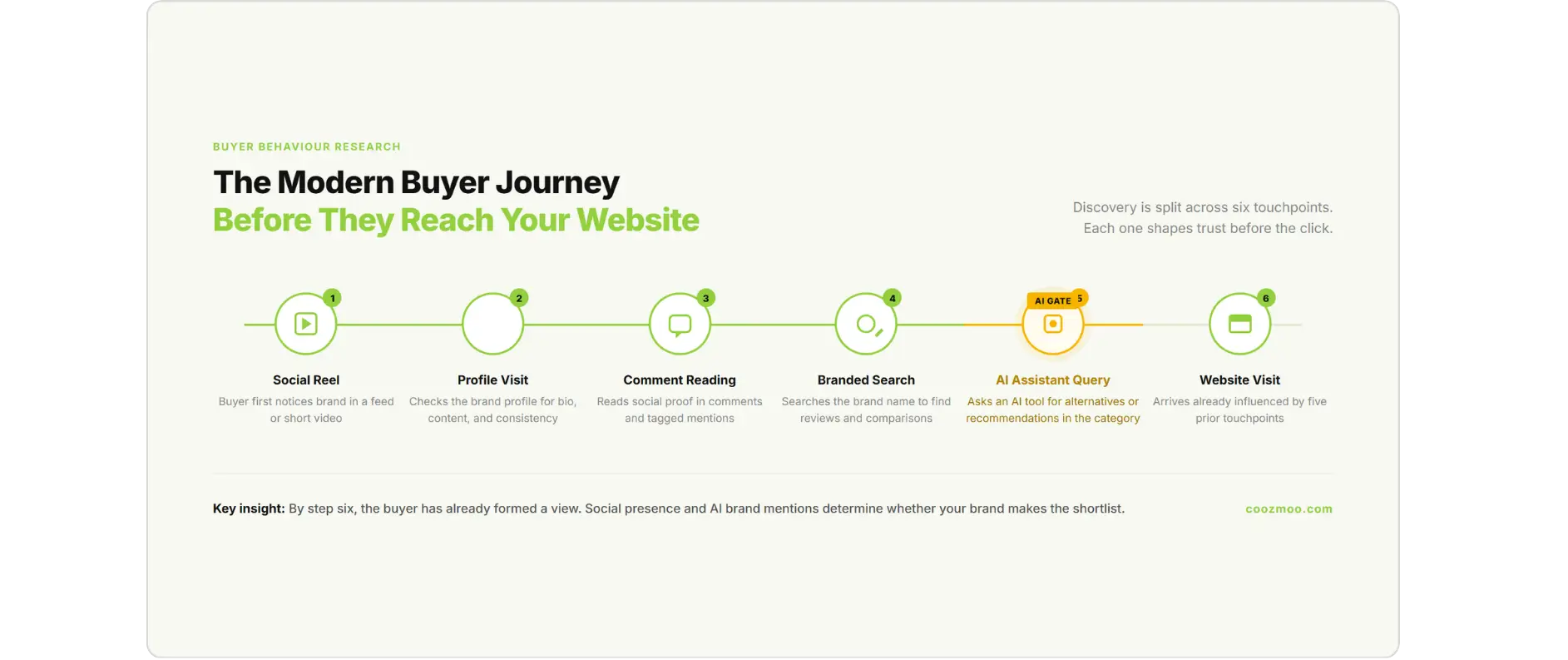
A buyer may see your brand in a reel, check your profile, read the comments, search your name, ask an AI assistant for alternatives, then visit your website. By that point, the sale has already been influenced by several touchpoints you may not see in analytics.
That is why social media now matters for more than reach. It affects brand discovery, social proof marketing, branded search, social search optimization, and LLM brand visibility.
Recent buyer behavior studies point in the same direction: discovery is split across social media, search, referrals, reviews, communities, and AI tools. In some industries, social is already the first place people notice new brands. In others, search still leads, but social heavily influences trust before the click.
The practical takeaway is simple. If your social presence is unclear, inconsistent, or thin on proof, both buyers and AI systems get a weaker picture of your brand.
How social media influences AI brand mentions
AI tools do not recommend a brand because it posted a viral graphic. They recommend brands when enough reliable context points in the same direction.
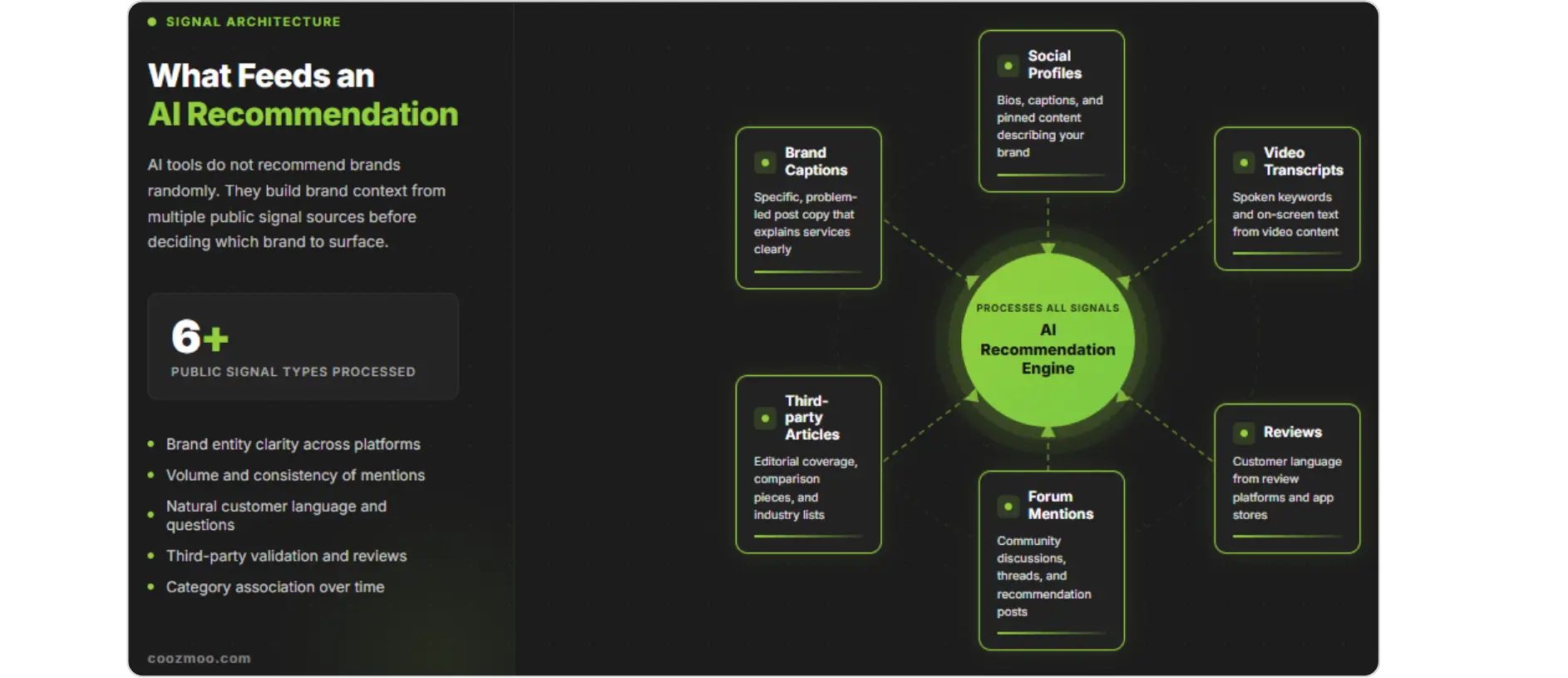
That context can come from your website, review platforms, public conversations, videos, social profiles, forums, articles, and local listings. Social media contributes to that context by showing how real people talk about your brand, what problems you solve, who you serve, and whether others trust you.
This is where AI brand mentions and social media signals SEO start to overlap. A like is not a backlink. A share is not a ranking guarantee. But strong social activity can create branded searches, third-party mentions, product discussions, creator content, reviews, and comparison conversations. Those signals can support both search visibility and AI recommendation marketing.
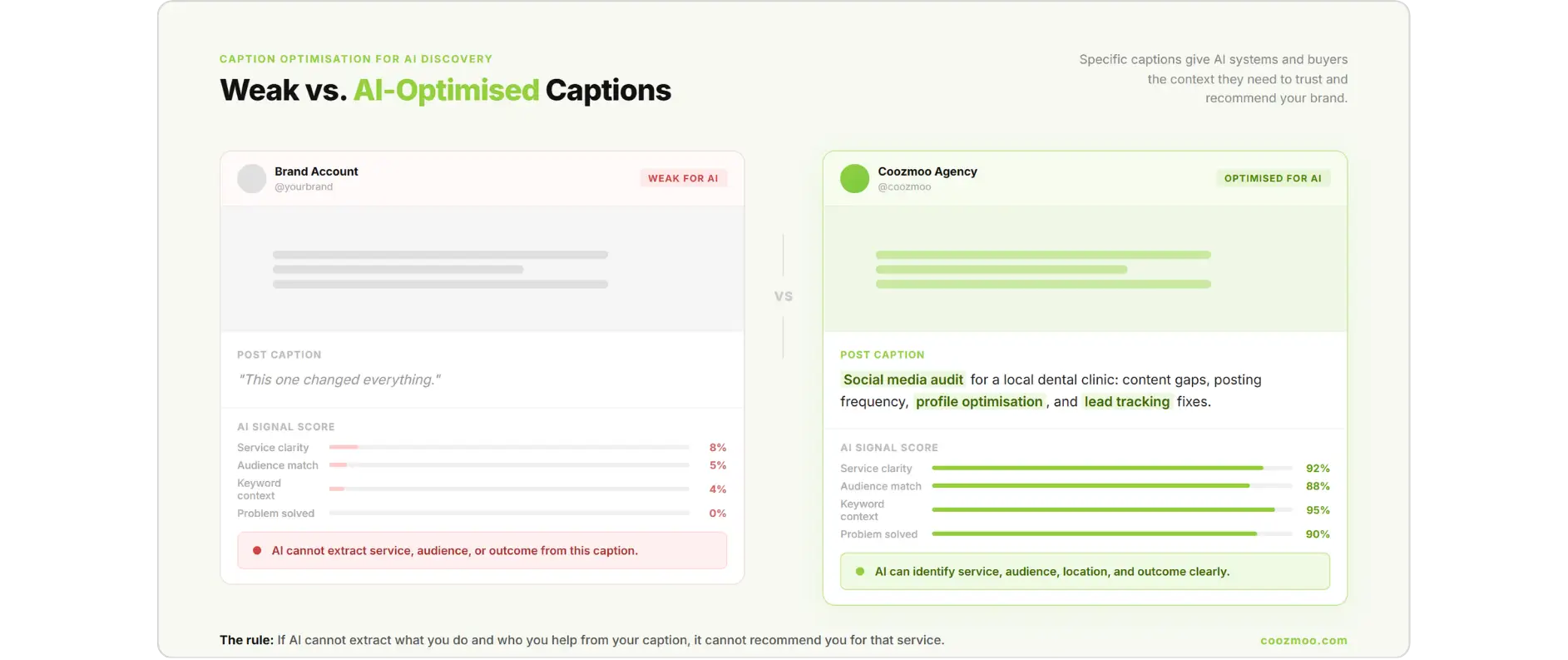
For example, a vague caption like "Another happy client" does very little. A clearer caption like "Social media audit for a local dental clinic: content gaps, posting frequency, profile optimization, and lead tracking fixes" gives humans and machines useful context.
The second version tells AI systems what the service is, who it helps, and what problem was solved.
What AI needs to understand before recommending your brand
AI recommendations depend on clarity. If your brand is described differently across your website, social profiles, videos, directories, and reviews, AI systems may struggle to place you confidently.
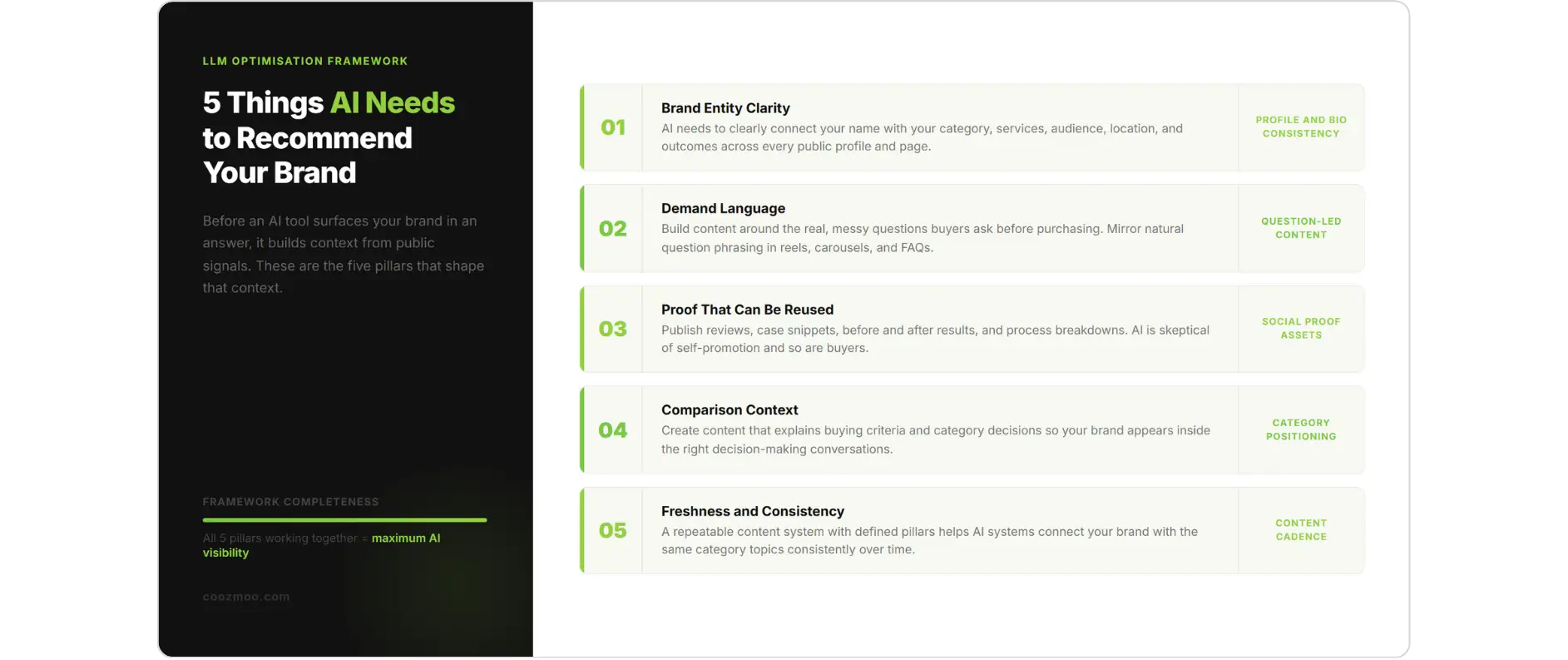
Your social content should support five things.
1. Brand entity clarity
AI needs to know what your business is. Not just your name, but your category, services, audience, location, and outcomes.
Every major profile should answer this in plain language:
"We help [audience] solve [problem] through [service] in [market or category]."
For Coozmoo, that means social content should consistently connect the brand with services like social media marketing, SEO, paid media, web design, and generative search optimization.
2. Demand language
Your customers do not always use your internal service names. They ask messy, specific questions.
Examples:
"Why are my social media posts not getting leads?"
"How do I know if my brand appears in AI search?"
"Do social signals for SEO actually matter?"
"Why is my competitor being recommended by AI tools?"
These questions should become reels, carousels, short videos, FAQs, and blog sections. This is strong LLM optimization because it mirrors how buyers ask questions inside AI tools.
3. Proof that can be reused
AI systems are skeptical of self-promotion. Buyers are too.
Your social media should publish proof assets, not just promotional posts. Use reviews, customer stories, before and after examples, campaign learnings, screenshots with context, short case studies, and process breakdowns.
The best proof posts answer three things:
What was the problem?
What action was taken?
What changed after the work?
This improves social proof marketing and makes your content more useful for AI search optimization services, sales enablement, and website conversion.
4. Comparison context
AI tools often answer comparison-style questions. If your brand is never part of category conversations, it is harder to recommend. Do not force competitor callouts or fake comparisons. Instead, create content that explains buying criteria.
Examples:
"What to check before hiring a social media agency"
"What a real social media audit should include"
"Why LLM brand visibility is different from normal SEO traffic"
"How to measure AI brand mentions without guessing"
This places your brand inside the right decision-making conversation without sounding desperate.
5. Freshness and consistency
Old, abandoned profiles send weak trust signals. So does posting about random topics with no pattern. You do not need to post every day. You need a repeatable content system. Pick a few content pillars and return to them often: education, proof, customer questions, industry changes, process, and offers.
Consistency helps buyers remember you. It also helps AI systems connect your brand with the same topics over time.
What a modern social media audit should include
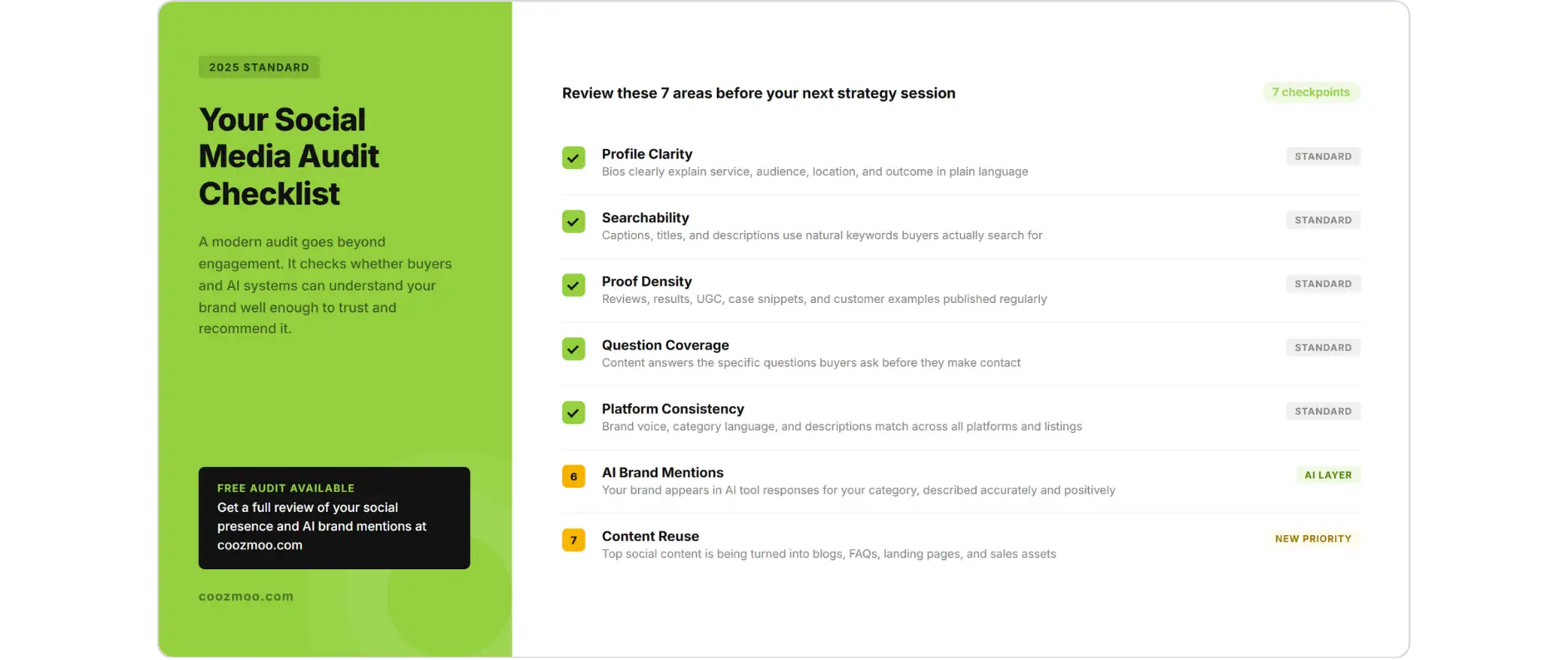
A standard social media audit checks followers, engagement, reach, posting frequency, and top content. That is useful, but not enough anymore. A stronger audit should also check AI visibility and discovery signals.
Review these areas:
Profile clarity: Do bios clearly explain the service, audience, location, and outcome?
Searchability: Do captions, titles, and descriptions use natural keywords like social media audit, AI brand mentions, and LLM optimization?
Proof density: How often do you publish reviews, results, UGC, case snippets, and customer examples?
Question coverage: Are you answering the questions buyers actually ask before they contact you?
Platform consistency: Does your brand sound the same across website, social, listings, and review profiles?
AI brand mentions: When you ask AI tools about your category, does your brand appear? If yes, how is it described? If no, which competitors appear instead?
Content reuse: Are your strongest social ideas being turned into blogs, videos, FAQs, landing pages, and sales assets?
This is why a free social audit should not only look at engagement. It should reveal whether your social presence is helping people and AI systems understand why your brand should be trusted.
How to build social content for brand discovery and AI visibility
Here is the practical framework.
Start with buyer questions
Build posts around the questions people ask before buying. Use comments, DMs, search queries, sales calls, review language, and customer objections.
A good question-led post has a longer shelf life than a trend post because it solves a real research problem.
Make captions specific
Do not hide the topic behind clever wording. Use the words buyers would search.
Weak: "This one changed everything."
Better: "How a social media audit finds content gaps that stop local service businesses from getting leads."
Specific captions support social search optimization and make your content easier to understand outside the platform.
Turn proof into a content pillar
Every month, publish proof in different formats:
One customer story
One review breakdown
One before and after post
One process walkthrough
One result-focused carousel
One short video answering a sales objection
This creates trust without sounding like a sales pitch.
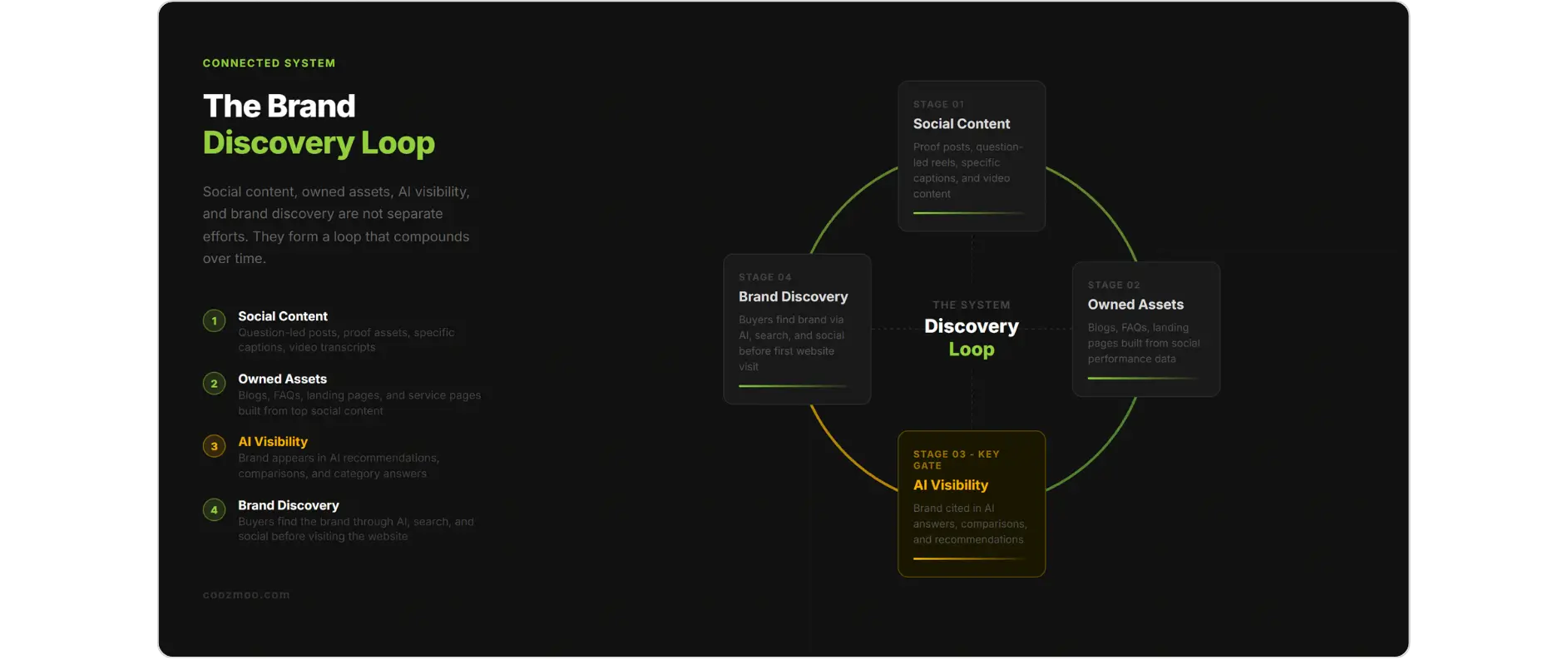
Connect social posts to owned content
If a topic performs well on social, build a deeper website asset around it. A high-performing post about LLM brand visibility should link to a blog, service section, FAQ, or audit page.
Social creates the spark. Your website and AI search visibility strategy turn that attention into authority.
Measure discovery, not just engagement
Track more than likes.
Watch branded search, profile visits, referral traffic, assisted leads, saved posts, shares, customer mentions, review growth, AI brand mentions, and how often your brand appears in category prompts.
If AI tools describe your brand incorrectly or ignore it completely, that is a visibility gap. A Gen AI search audit can help identify where the gap starts.
Where Coozmoo fits in
Most brands do not need more random posts. They need a connected system for discovery.
Coozmoo's social media marketing services help brands plan content, create platform-ready assets, build trust, manage community engagement, and turn attention into leads. Coozmoo's generative search optimization services help brands improve AI brand mentions, LLM brand visibility, content structure, entity clarity, and AI citation opportunities.
Together, social media and AI search strategy answer the question buyers are already asking:
"Can I trust this brand enough to choose it?"
Final thoughts
Social media is now part discovery engine, part trust layer, part customer research tool, and part AI visibility signal.
The brands that win will not be the ones posting the most. They will be the ones posting with clarity, proof, consistency, and a strong understanding of how buyers actually make decisions.
If your social presence does not clearly explain what you do, who you help, what proof you have, and why your brand belongs in the conversation, you are making it harder for both people and AI systems to recommend you.
Start with a social media audit. Then check your AI brand mentions and LLM brand visibility. Once you know what buyers and AI tools currently see, you can fix the gaps that are costing you discovery.
FAQs
Does social media affect AI recommendations?

Yes, though not the way most people hope. No AI system reads your carousel and decides to recommend you. It assembles a picture of your brand from whatever public material exists, and social produces a lot of that material: captions, transcripts, comment threads, creator posts, customers describing you in their own words. Consistency across all of it makes you easy to categorize. Inconsistency is why some brands get described as something they stopped doing three years ago.
What are AI brand mentions?
AI brand mentions are the moments an AI tool names your brand inside an answer, comparison, shortlist, or summary. They matter because buyers often treat them as a filtered recommendation rather than an ad. Two things surprise most teams. First, a mention does not require a link, and brands are named far more often than they are linked. Second, mentions vary by platform, so you can appear in one assistant and be invisible in another. Track named mentions and category mentions separately, because being described without being named is still a visibility gap worth fixing.
What is social search optimization?
It means treating the platform as a search engine, because for a lot of buyers it already is. In practice: say the keyword out loud in the first few seconds of a video, put it on screen, write a title that describes the thing instead of teasing it, name the service and the problem in the caption, fix your transcripts. Unglamorous. Worth it twice over, because content built to be found on a platform also reads cleanly as text, and text is the only thing an AI system can quote.
Do more followers and higher engagement improve AI recommendations?
Not directly, and this is where most social budgets quietly get wasted. Citation research through early 2026 puts social at roughly 7 to 9 percent of everything AI systems quote, and the formats winning that slice are the ones with clean indexable text: long video with full transcripts, and public threads where buyers explain their problem in their own words. Follower counts and reach show no correlation with citations. Branded search volume does, measuring as a stronger predictor than backlinks. So chase text quality and branded search, not engagement rate.
What should a social media audit include now?
Engagement is the smallest part of it. Check bio clarity and whether your category and audience are stated plainly, how searchable your captions and titles really are, the ratio of proof content to promotion, whether customer questions become content, and brand consistency across every platform and listing. Then check how AI tools currently mention or misdescribe you. Last one people skip: content reuse, meaning whether your best social ideas turn into blogs and landing pages or just disappear in the feed.
TL;DR
Social media now shapes how people and AI systems understand your brand. Buyers use social platforms to discover products, compare options, read comments, watch proof, and validate trust before they visit a website. AI systems also depend on public signals, repeated brand mentions, customer language, video transcripts, reviews, and third-party context to decide which brands deserve to appear in recommendations.
The goal is not to post more. The goal is to make your social presence clear, searchable, proof-led, and connected to your wider organic SEO and AI search strategy.
What social media does | Why it matters for AI recommendations | What to improve |
|---|---|---|
Builds first-touch brand discovery | Buyers often notice brands in feeds before search | Use clear captions, service terms, locations, and problem-based hooks |
Creates social proof | AI and buyers both look for trust signals beyond your website | Publish reviews, UGC, case snippets, and creator proof |
Captures customer language | AI and buyers both look for trust signals beyond your website | Turn comments, DMs, and sales questions into content |
Strengthens brand context | Repeated mentions help connect your brand with a category | Keep profiles, bios, descriptions, and content pillars consistent |
Supports LLM brand visibility | Public content can shape AI brand mentions and recommendations | Track how AI tools describe your brand and competitors |
Social media is no longer just an engagement channel
A buyer may see your brand in a reel, check your profile, read the comments, search your name, ask an AI assistant for alternatives, then visit your website. By that point, the sale has already been influenced by several touchpoints you may not see in analytics.
That is why social media now matters for more than reach. It affects brand discovery, social proof marketing, branded search, social search optimization, and LLM brand visibility.
Recent buyer behavior studies point in the same direction: discovery is split across social media, search, referrals, reviews, communities, and AI tools. In some industries, social is already the first place people notice new brands. In others, search still leads, but social heavily influences trust before the click.
The practical takeaway is simple. If your social presence is unclear, inconsistent, or thin on proof, both buyers and AI systems get a weaker picture of your brand.
How social media influences AI brand mentions
AI tools do not recommend a brand because it posted a viral graphic. They recommend brands when enough reliable context points in the same direction.
That context can come from your website, review platforms, public conversations, videos, social profiles, forums, articles, and local listings. Social media contributes to that context by showing how real people talk about your brand, what problems you solve, who you serve, and whether others trust you.
This is where AI brand mentions and social media signals SEO start to overlap. A like is not a backlink. A share is not a ranking guarantee. But strong social activity can create branded searches, third-party mentions, product discussions, creator content, reviews, and comparison conversations. Those signals can support both search visibility and AI recommendation marketing.
For example, a vague caption like "Another happy client" does very little. A clearer caption like "Social media audit for a local dental clinic: content gaps, posting frequency, profile optimization, and lead tracking fixes" gives humans and machines useful context.
The second version tells AI systems what the service is, who it helps, and what problem was solved.
What AI needs to understand before recommending your brand
AI recommendations depend on clarity. If your brand is described differently across your website, social profiles, videos, directories, and reviews, AI systems may struggle to place you confidently.
Your social content should support five things.
1. Brand entity clarity
AI needs to know what your business is. Not just your name, but your category, services, audience, location, and outcomes.
Every major profile should answer this in plain language:
"We help [audience] solve [problem] through [service] in [market or category]."
For Coozmoo, that means social content should consistently connect the brand with services like social media marketing, SEO, paid media, web design, and generative search optimization.
2. Demand language
Your customers do not always use your internal service names. They ask messy, specific questions.
Examples:
"Why are my social media posts not getting leads?"
"How do I know if my brand appears in AI search?"
"Do social signals for SEO actually matter?"
"Why is my competitor being recommended by AI tools?"
These questions should become reels, carousels, short videos, FAQs, and blog sections. This is strong LLM optimization because it mirrors how buyers ask questions inside AI tools.
3. Proof that can be reused
AI systems are skeptical of self-promotion. Buyers are too.
Your social media should publish proof assets, not just promotional posts. Use reviews, customer stories, before and after examples, campaign learnings, screenshots with context, short case studies, and process breakdowns.
The best proof posts answer three things:
What was the problem?
What action was taken?
What changed after the work?
This improves social proof marketing and makes your content more useful for AI search optimization services, sales enablement, and website conversion.
4. Comparison context
AI tools often answer comparison-style questions. If your brand is never part of category conversations, it is harder to recommend. Do not force competitor callouts or fake comparisons. Instead, create content that explains buying criteria.
Examples:
"What to check before hiring a social media agency"
"What a real social media audit should include"
"Why LLM brand visibility is different from normal SEO traffic"
"How to measure AI brand mentions without guessing"
This places your brand inside the right decision-making conversation without sounding desperate.
5. Freshness and consistency
Old, abandoned profiles send weak trust signals. So does posting about random topics with no pattern. You do not need to post every day. You need a repeatable content system. Pick a few content pillars and return to them often: education, proof, customer questions, industry changes, process, and offers.
Consistency helps buyers remember you. It also helps AI systems connect your brand with the same topics over time.
What a modern social media audit should include
A standard social media audit checks followers, engagement, reach, posting frequency, and top content. That is useful, but not enough anymore. A stronger audit should also check AI visibility and discovery signals.
Review these areas:
Profile clarity: Do bios clearly explain the service, audience, location, and outcome?
Searchability: Do captions, titles, and descriptions use natural keywords like social media audit, AI brand mentions, and LLM optimization?
Proof density: How often do you publish reviews, results, UGC, case snippets, and customer examples?
Question coverage: Are you answering the questions buyers actually ask before they contact you?
Platform consistency: Does your brand sound the same across website, social, listings, and review profiles?
AI brand mentions: When you ask AI tools about your category, does your brand appear? If yes, how is it described? If no, which competitors appear instead?
Content reuse: Are your strongest social ideas being turned into blogs, videos, FAQs, landing pages, and sales assets?
This is why a free social audit should not only look at engagement. It should reveal whether your social presence is helping people and AI systems understand why your brand should be trusted.
How to build social content for brand discovery and AI visibility
Here is the practical framework.
Start with buyer questions
Build posts around the questions people ask before buying. Use comments, DMs, search queries, sales calls, review language, and customer objections.
A good question-led post has a longer shelf life than a trend post because it solves a real research problem.
Make captions specific
Do not hide the topic behind clever wording. Use the words buyers would search.
Weak: "This one changed everything."
Better: "How a social media audit finds content gaps that stop local service businesses from getting leads."
Specific captions support social search optimization and make your content easier to understand outside the platform.
Turn proof into a content pillar
Every month, publish proof in different formats:
One customer story
One review breakdown
One before and after post
One process walkthrough
One result-focused carousel
One short video answering a sales objection
This creates trust without sounding like a sales pitch.
Connect social posts to owned content
If a topic performs well on social, build a deeper website asset around it. A high-performing post about LLM brand visibility should link to a blog, service section, FAQ, or audit page.
Social creates the spark. Your website and AI search visibility strategy turn that attention into authority.
Measure discovery, not just engagement
Track more than likes.
Watch branded search, profile visits, referral traffic, assisted leads, saved posts, shares, customer mentions, review growth, AI brand mentions, and how often your brand appears in category prompts.
If AI tools describe your brand incorrectly or ignore it completely, that is a visibility gap. A Gen AI search audit can help identify where the gap starts.
Where Coozmoo fits in
Most brands do not need more random posts. They need a connected system for discovery.
Coozmoo's social media marketing services help brands plan content, create platform-ready assets, build trust, manage community engagement, and turn attention into leads. Coozmoo's generative search optimization services help brands improve AI brand mentions, LLM brand visibility, content structure, entity clarity, and AI citation opportunities.
Together, social media and AI search strategy answer the question buyers are already asking:
"Can I trust this brand enough to choose it?"
Final thoughts
Social media is now part discovery engine, part trust layer, part customer research tool, and part AI visibility signal.
The brands that win will not be the ones posting the most. They will be the ones posting with clarity, proof, consistency, and a strong understanding of how buyers actually make decisions.
If your social presence does not clearly explain what you do, who you help, what proof you have, and why your brand belongs in the conversation, you are making it harder for both people and AI systems to recommend you.
Start with a social media audit. Then check your AI brand mentions and LLM brand visibility. Once you know what buyers and AI tools currently see, you can fix the gaps that are costing you discovery.
FAQs
Does social media affect AI recommendations?
Yes, though not the way most people hope. No AI system reads your carousel and decides to recommend you. It assembles a picture of your brand from whatever public material exists, and social produces a lot of that material: captions, transcripts, comment threads, creator posts, customers describing you in their own words. Consistency across all of it makes you easy to categorize. Inconsistency is why some brands get described as something they stopped doing three years ago.
What are AI brand mentions?
AI brand mentions are the moments an AI tool names your brand inside an answer, comparison, shortlist, or summary. They matter because buyers often treat them as a filtered recommendation rather than an ad. Two things surprise most teams. First, a mention does not require a link, and brands are named far more often than they are linked. Second, mentions vary by platform, so you can appear in one assistant and be invisible in another. Track named mentions and category mentions separately, because being described without being named is still a visibility gap worth fixing.
What is social search optimization?
It means treating the platform as a search engine, because for a lot of buyers it already is. In practice: say the keyword out loud in the first few seconds of a video, put it on screen, write a title that describes the thing instead of teasing it, name the service and the problem in the caption, fix your transcripts. Unglamorous. Worth it twice over, because content built to be found on a platform also reads cleanly as text, and text is the only thing an AI system can quote.
Do more followers and higher engagement improve AI recommendations?
Not directly, and this is where most social budgets quietly get wasted. Citation research through early 2026 puts social at roughly 7 to 9 percent of everything AI systems quote, and the formats winning that slice are the ones with clean indexable text: long video with full transcripts, and public threads where buyers explain their problem in their own words. Follower counts and reach show no correlation with citations. Branded search volume does, measuring as a stronger predictor than backlinks. So chase text quality and branded search, not engagement rate.
What should a social media audit include now?
Engagement is the smallest part of it. Check bio clarity and whether your category and audience are stated plainly, how searchable your captions and titles really are, the ratio of proof content to promotion, whether customer questions become content, and brand consistency across every platform and listing. Then check how AI tools currently mention or misdescribe you. Last one people skip: content reuse, meaning whether your best social ideas turn into blogs and landing pages or just disappear in the feed.



Summarize with AI




Want to Grow Social Accounts? Get a Free Audit Today!
Want to Grow Social Accounts? Get a Free Audit Today!


1k+ Reviews!


Don’t miss our revenue growth tips!
Get expert marketing tips—straight to your inbox, like thousands of happy clients.
Don’t miss our revenue growth tips!
Don’t miss our revenue growth tips!
Get expert marketing tips—straight to your inbox, like thousands of happy clients.
Don’t miss our revenue growth tips!
Get expert marketing tips—straight to your inbox, like thousands of happy clients.
Relevant Blogs on Social Media
Relevant Blogs on Social Media
Unlock data-driven insights in Social Media Marketing—explore our featured blogs and skyrocket your revenue before your competitors do.
Unlock data-driven insights in Social Media Marketing—explore our featured blogs and skyrocket your revenue before your competitors do.

Social Media
Aug 28, 2026
10 Min Read
Social Search Optimization: How to Optimize Your Brand for Social Search
Social Media
Aug 28, 2026
10 Min Read
Social Search Optimization: How to Optimize Your Brand for Social Search
Social Media
Aug 28, 2026
10 Min Read
Social Search Optimization: How to Optimize Your Brand for Social Search
Social Media
Aug 13, 2026
5 Min Read
TikTok SEO: How Keywords and Metadata Impact Your Visibility
Social Media
Aug 13, 2026
5 Min Read
TikTok SEO: How Keywords and Metadata Impact Your Visibility
Social Media
Aug 13, 2026
5 Min Read
TikTok SEO: How Keywords and Metadata Impact Your Visibility

Social Media
Jul 28, 2026
8 Min Read
How the LinkedIn Algorithm Works in 2026
Social Media
Jul 28, 2026
8 Min Read
How the LinkedIn Algorithm Works in 2026
Social Media
Jul 28, 2026
8 Min Read
How the LinkedIn Algorithm Works in 2026

















Ready to speak with an expert?
Data-Driven Marketing Agency That Elevates ROI
1100+
Websites Designed & Optimized to Convert
$280M+
Client Revenue Driven & Growing Strong
Discover how to skyrocket
your revenue today!



Trusted by 1000+ Owners!
Ready to speak with an expert?
Data-Driven Marketing Agency That Elevates ROI
1100+
Websites Designed & Optimized to Convert
$280M+
Client Revenue Driven & Growing Strong
Discover how to skyrocket
your revenue today!
Trusted by 1000+ Owners!
Want to skyrocket revenue?
4.9/5 Ratings!
Ready to speak with an expert?
Data-Driven Marketing Agency That Elevates ROI
1100+
Websites Designed & Optimized to Convert
$280M+
Client Revenue Driven & Growing Strong
Discover how to skyrocket
your revenue today!
Trusted by 1000+ Owners!
Call
Meet