The AI Search Visibility Ecosystem: How Brands Get Discovered in 2026?
The AI Search Visibility Ecosystem: How Brands Get Discovered in 2026?
Last Updated:
Table of Content
Case Studies





Here is a question worth sitting with for a moment. When someone opens ChatGPT or Perplexity and asks for a recommendation in your category, does your brand show up? Or does your competitor?
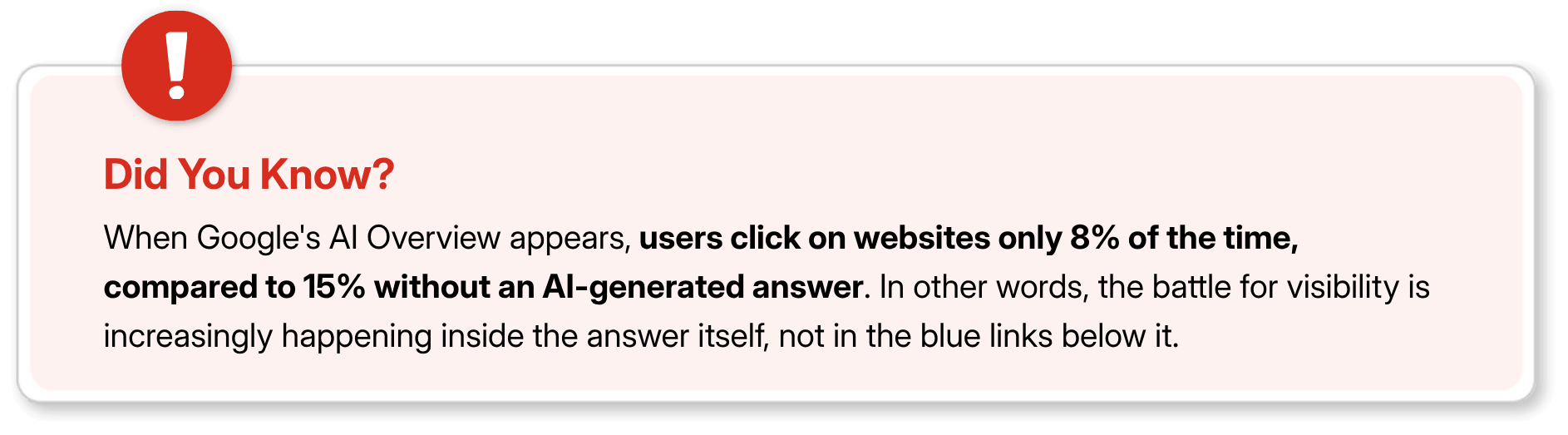
That question used to sound hypothetical. In 2026, it is one of the most commercially urgent things a brand can ask itself. Because AI systems are not just surfacing content anymore. They are doing the shortlisting. They are shaping buying decisions before a user ever lands on a website. And if your brand is not inside the answer, you were never in the running.
This is what AI search visibility means right now. Not keyword rankings. Not blue links. Presence inside the answer itself, at the exact moment a potential customer is forming an opinion. So, let's break it all down together.
What Is the AI Search Visibility Ecosystem?
The AI search visibility ecosystem refers to the entire network of tools, platforms, algorithms, and signals that determine how and where your brand surfaces across AI driven search environments. Think ChatGPT, Google SGE (Search Generative Experience), PerplexityAI, Bing Copilot, and similar platforms.
Unlike traditional SEO, which largely focused on keyword rankings, backlinks, and on-page optimization, AI search visibility operates on a fundamentally different logic. These
systems don't just retrieve pages; they synthesize information and present it as answers.
That means the rules of the game have shifted.
Here's what this ecosystem is built on:
Large Language Models (LLMs) trained on massive datasets that determine what "trusted" information looks like.
Retrieval-Augmented Generation (RAG) systems that pull real-time or indexed data to support AI responses.
Entity recognition that measures how well AI systems understand who your brand is, not just what keywords you rank for.
E-E-A-T signals (Experience, Expertise, Authoritativeness, Trustworthiness) that influence whether AI cites you as a source.
Structured data and schema markup that helps AI parse and represent your content accurately.
If you want your brand to be part of the conversation that AI is having with your potential customers, you need to be intelligible to these systems, not just visible to human searchers.
How AI Search Differs From Traditional SEO?
You might be thinking: "Okay, but isn't this just SEO with a new label?" Not quite. Let me show you exactly how different these two worlds are.
Traditional SEO vs. AI Search Visibility: A Side-by-Side Look;
Factor | Traditional SEO | AI Search Visibility |
|---|---|---|
Primary Goal | Rank in SERPs | Appear in AI-generated answers |
Key Metric | Keyword rankings, CTR | Brand citations, AI mentions |
Content Focus | Keyword-optimized pages | Authoritative, structured, factual content |
Link Building | Backlinks for authority | Mentions, citations, brand signals |
Discovery Format | Blue links, featured snippets | Synthesized AI summaries, voice answers |
Search Intent | Query matching | Conversational, context-driven |
Speed of Impact | Weeks to months | Ongoing, model-dependent |
Tools Used | Ahrefs, SEMrush, GSC | Perplexity tracking, LLM audits, entity optimization |
The key takeaway? Traditional SEO gets you ranked. AI search visibility gets you referenced. And being referenced in an AI-generated answer, especially without a click being needed, is the new prime real estate.
The 7 Pillars of the AI Search Visibility Ecosystem
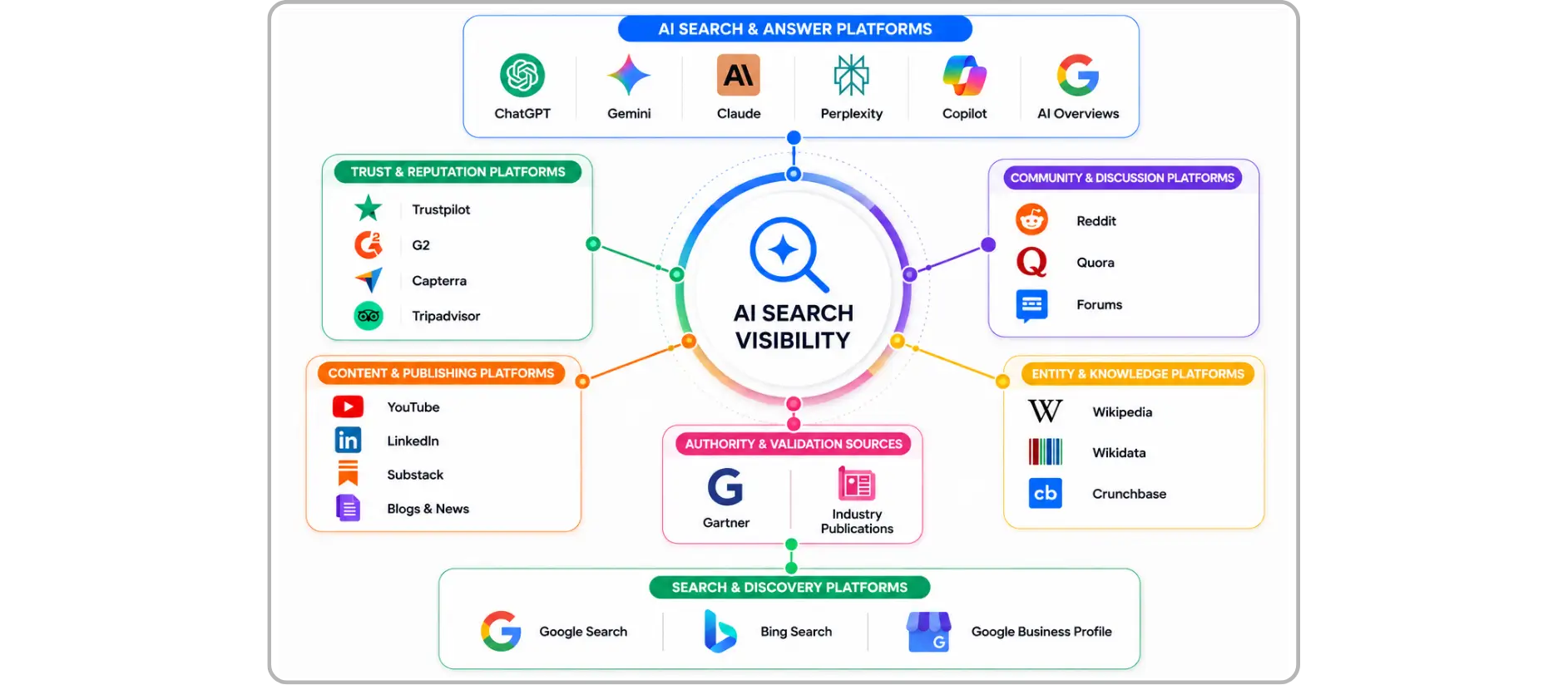
AI search visibility is not built on one signal. It is built on an entire ecosystem of platforms and signals that AI uses to evaluate your brand. Most brands only think about their website. But AI does not stop there. It looks at everything the internet says about you. Here is how the ecosystem actually breaks down.
1. AI Platforms: Where Users Are Searching Now
ChatGPT, Gemini, Claude, Perplexity, Copilot, Grok, and Google AI Overviews. These are the destinations where people are increasingly going for answers instead of a search results page. But they are only the surface layer. What they surface depends entirely on everything below.
2. Review Platforms: Your Customers Are Already Talking
Trustpilot, G2, Capterra, Tripadvisor. Reviews are becoming one of the strongest trust signals in AI search. When your customers leave detailed, authentic reviews, AI systems can use those signals to corroborate what your brand claims about itself. Real voices carry real weight.
3. Community Platforms: Where Trust Actually Lives
Reddit, Quora, and niche industry forums. A large chunk of AI-generated recommendations are directly influenced by real community discussions and user experiences. People trust people, and AI knows it. If your brand is absent from these conversations, you are missing one of the most cited sources across all major AI platforms.
4. Content Platforms: Demonstrating Expertise at Scale
YouTube, LinkedIn, Substack, industry blogs, and news websites. Publishing content in 2026 is not just about engagement or traffic. It is about demonstrating topical expertise and authority across the platforms AI pulls from. YouTube alone is the second most cited source in Gemini and Perplexity.
5. Entity Platforms: Helping AI Understand Who You Are
Wikipedia, Wikidata, and Crunchbase. These platforms help AI systems understand your brand as a distinct entity, what it does, who it is connected to, and where it sits in its category. Entity SEO is no longer a niche concern. It is foundational to how AI identifies and represents your brand.
6. Authority and Validation: Third-Party Credibility
Gartner, industry publications, and recognised media. AI systems look for corroboration, not self-promotion. Being mentioned and validated by authoritative third parties strengthens your credibility signal considerably. One mention in the right publication does more than ten pages on your own website.
7. Search and Discovery: The Foundation Is Still There
Google, Bing, and Google Business Profile. Traditional search still matters and in many cases it remains the foundation that supports visibility across AI platforms. Brands ranking on Google's first page appear in ChatGPT answers 62% of the time. Do not abandon SEO. Build on top of it.
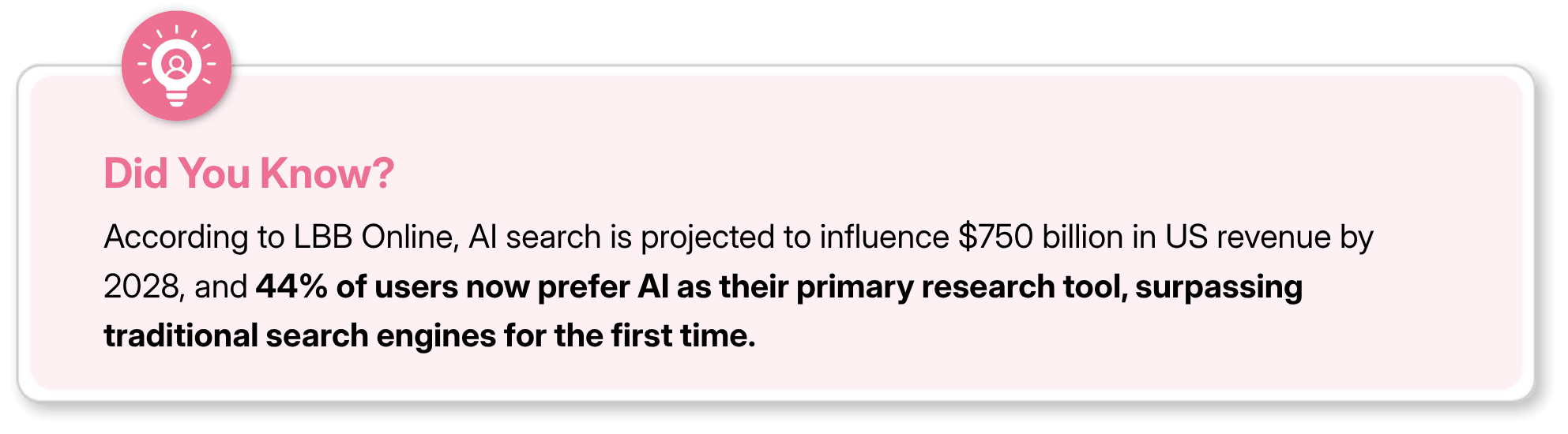
What Are Brands Getting Wrong Right Now?
Most brands are still stuck in a 2020 SEO mindset while the discovery landscape has moved past them. These are the most common mistakes playing out right now:
Inconsistent brand entity signals. Your brand is described differently on every platform. AI cannot get a clear picture of who you are.
Treating PR and SEO as separate. In the AI visibility world, your digital PR signals are your ranking signals. They need to work together.
Neglecting third-party platforms. Reddit, G2, Trustpilot, Quora. AI mines these constantly. A brand absent from these is invisible in ways most analytics dashboards will never surface.
Publishing promotional content instead of citable content. AI is answering questions, not running ads. If your content reads like a pitch, it will not be cited.
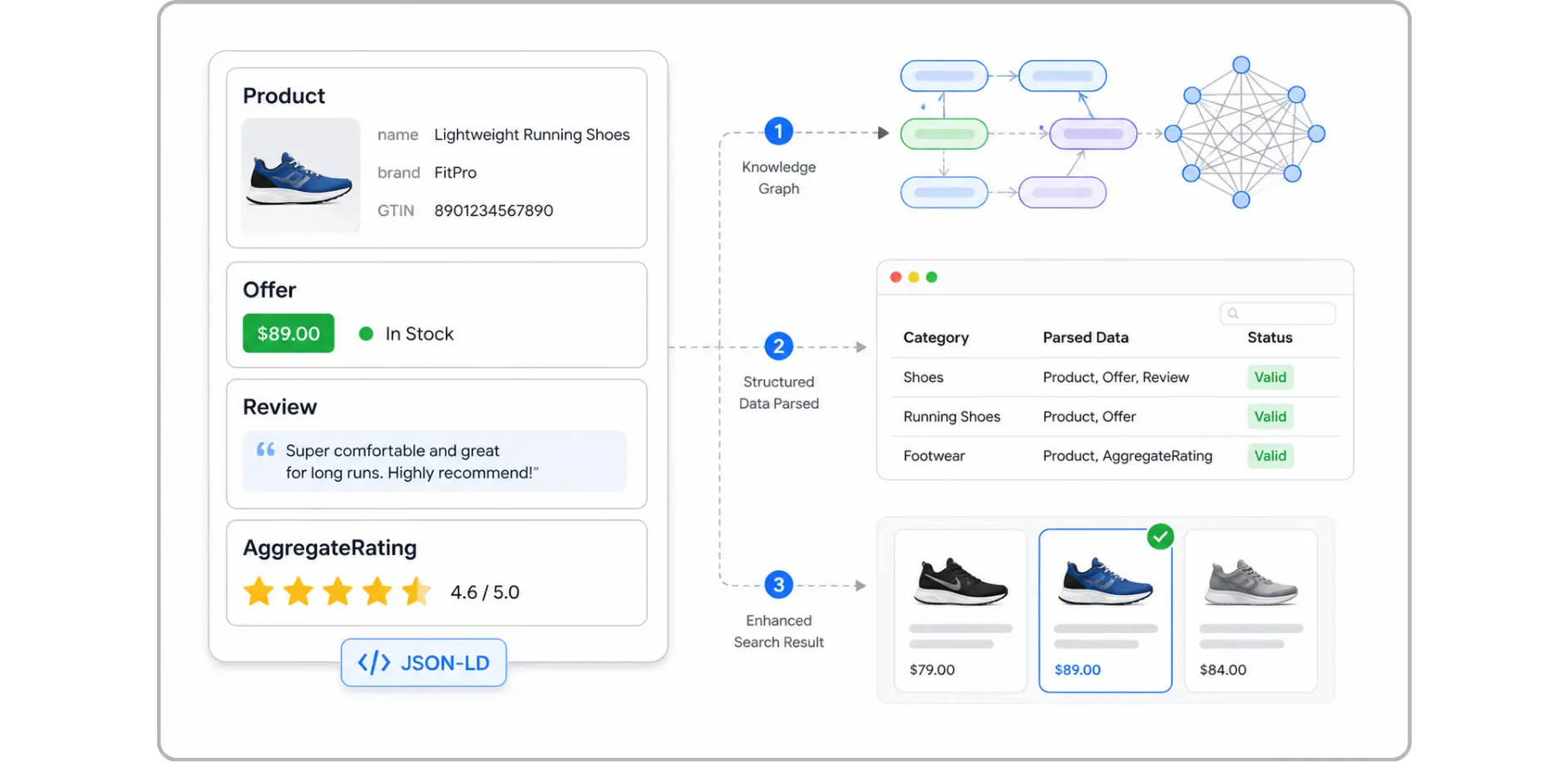
No structured data. If your site has no schema markup, AI cannot parse your content accurately.
How to Audit Your AI Footprint and Where to Start?
If you're ready to take this seriously, here's how to approach it step by step, no overwhelm required.
Audit Your Brand's AI Footprint First
Go to ChatGPT, Perplexity, and Google SGE. Search for your brand name. Search for the problems your product solves. Search for your category. Are you showing up? Are you being described accurately? Is a competitor showing up where you should be? This is your baseline.
Invest in Original Research and Data
AI systems are hungry for original, credible data. If you publish original research, even a small survey with interesting findings, you become a citable source. That's how brands start showing up in AI answers unprompted.
Build Brand Entity Authority, Not Just Keyword Coverage
Rather than writing one blog post about a topic, build out full content clusters. AI rewards brands that clearly own a topic, with multiple authoritative pieces, expert perspectives, and consistent messaging. Think about what your brand should be the definitive answer for, and build from there.
Create Content Designed to Be Cited
Write in clear, declarative sentences. Use numbered lists and direct answers. Include expert quotes and original data. Structure your content so that AI can lift a clean, useful passage from it and use it in a generated summary with your brand attached to it.
Final Thought
Here's the honest truth: AI search visibility isn't a separate strategy you build on top of everything else. It's a fundamental shift in how the internet surfaces trust, and brands that understand this early are the ones that will own the conversation for years to come. The brands winning in AI search right now aren't necessarily the biggest or the best-funded. They're the ones that have built clarity about who they are, what they stand for, and what problems they solve, and communicated that clearly across every platform AI pays attention to.
You don't have to do everything at once. Start with your audit. Fix your entity consistency. Write one genuinely useful, structured piece of content that deserves to be cited. Then build from there. Because in the AI search ecosystem, the brands that get discovered aren't the loudest ones. They're the clearest ones.
The game is no longer about being found—it's about being understood. If AI can't explain your brand, your competitors will.
FAQs
What is AI search visibility and how is it different from SEO?

AI search visibility is how well platforms like ChatGPT, Gemini, and Perplexity understand and surface your brand inside generated answers. SEO gets you ranked in links. AI search visibility gets you cited in answers. Both matter, but they need different strategies.
How do I know if my brand has AI search visibility?
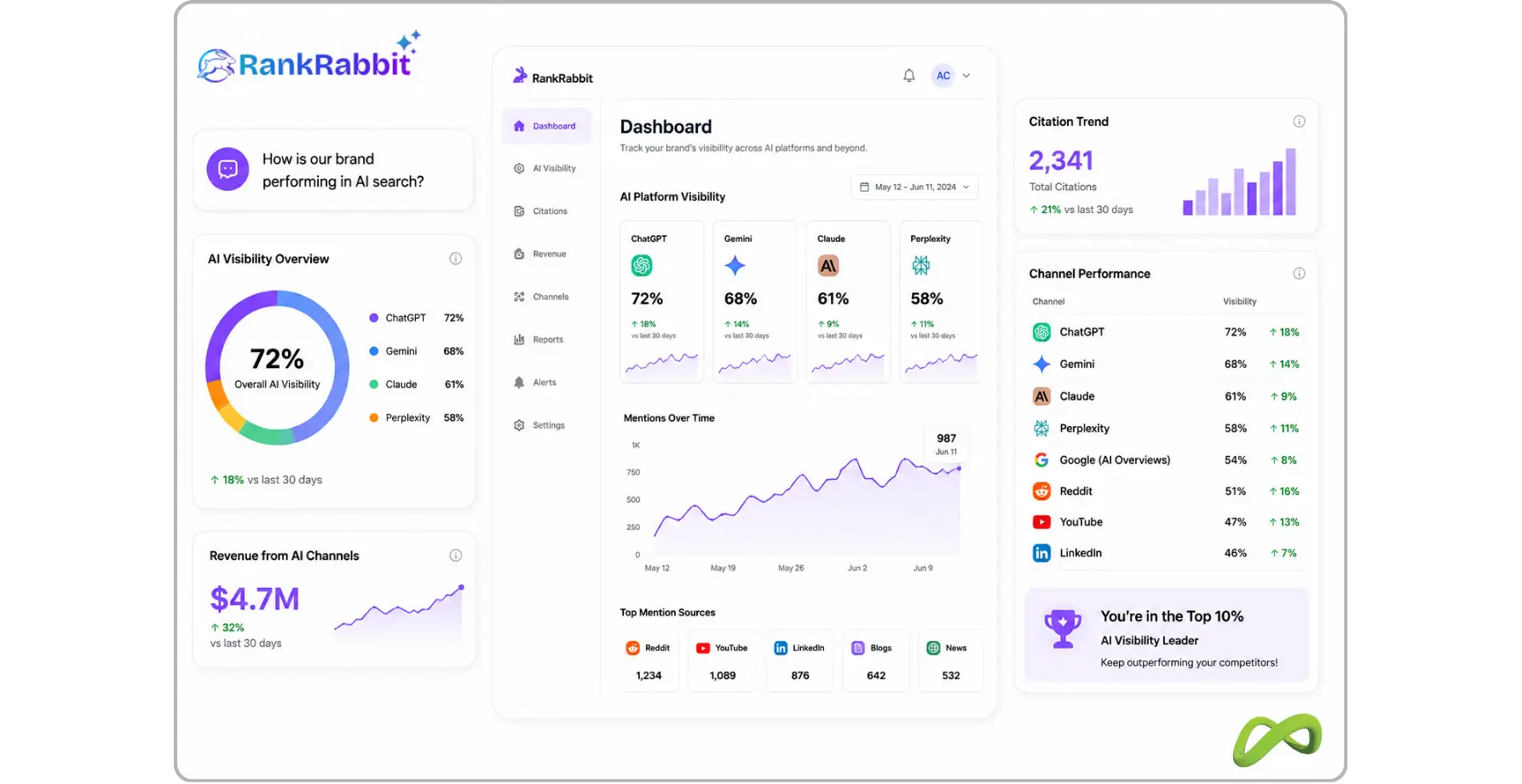
Search your brand name, your category, and the problem you solve on ChatGPT, Perplexity, and Google AI Overviews. Are you showing up? Are you being described accurately? That is your baseline. Tools like RankRabbit AI Visibility Toolkit and Profound help you track this at scale.
What is brand entity authority and why does it affect AI visibility?
It is how clearly AI can identify your brand as a distinct, trustworthy entity. AI thinks in entities, not keywords. If your brand name and positioning are inconsistent across your website, LinkedIn, and third-party sources, AI cannot form a clear picture of you and is less likely to cite you.
What type of content performs best in AI search results?
Informational, expert-led content. Content that directly answers questions, uses structured headings, and includes original data earns the most citations. Write content a journalist would cite, and AI will follow.
How long does it take to improve AI search visibility?
Structural fixes like entity consistency and schema markup can show results within weeks. Content and off-site presence compound over time. There is no fixed timeline, but consistent effort across the ecosystem produces more stable visibility than any single tactic.
Here is a question worth sitting with for a moment. When someone opens ChatGPT or Perplexity and asks for a recommendation in your category, does your brand show up? Or does your competitor?
That question used to sound hypothetical. In 2026, it is one of the most commercially urgent things a brand can ask itself. Because AI systems are not just surfacing content anymore. They are doing the shortlisting. They are shaping buying decisions before a user ever lands on a website. And if your brand is not inside the answer, you were never in the running.
This is what AI search visibility means right now. Not keyword rankings. Not blue links. Presence inside the answer itself, at the exact moment a potential customer is forming an opinion. So, let's break it all down together.
What Is the AI Search Visibility Ecosystem?
The AI search visibility ecosystem refers to the entire network of tools, platforms, algorithms, and signals that determine how and where your brand surfaces across AI driven search environments. Think ChatGPT, Google SGE (Search Generative Experience), PerplexityAI, Bing Copilot, and similar platforms.
Unlike traditional SEO, which largely focused on keyword rankings, backlinks, and on-page optimization, AI search visibility operates on a fundamentally different logic. These
systems don't just retrieve pages; they synthesize information and present it as answers.
That means the rules of the game have shifted.
Here's what this ecosystem is built on:
Large Language Models (LLMs) trained on massive datasets that determine what "trusted" information looks like.
Retrieval-Augmented Generation (RAG) systems that pull real-time or indexed data to support AI responses.
Entity recognition that measures how well AI systems understand who your brand is, not just what keywords you rank for.
E-E-A-T signals (Experience, Expertise, Authoritativeness, Trustworthiness) that influence whether AI cites you as a source.
Structured data and schema markup that helps AI parse and represent your content accurately.
If you want your brand to be part of the conversation that AI is having with your potential customers, you need to be intelligible to these systems, not just visible to human searchers.
How AI Search Differs From Traditional SEO?
You might be thinking: "Okay, but isn't this just SEO with a new label?" Not quite. Let me show you exactly how different these two worlds are.
Traditional SEO vs. AI Search Visibility: A Side-by-Side Look;
Factor | Traditional SEO | AI Search Visibility |
|---|---|---|
Primary Goal | Rank in SERPs | Appear in AI-generated answers |
Key Metric | Keyword rankings, CTR | Brand citations, AI mentions |
Content Focus | Keyword-optimized pages | Authoritative, structured, factual content |
Link Building | Backlinks for authority | Mentions, citations, brand signals |
Discovery Format | Blue links, featured snippets | Synthesized AI summaries, voice answers |
Search Intent | Query matching | Conversational, context-driven |
Speed of Impact | Weeks to months | Ongoing, model-dependent |
Tools Used | Ahrefs, SEMrush, GSC | Perplexity tracking, LLM audits, entity optimization |
The key takeaway? Traditional SEO gets you ranked. AI search visibility gets you referenced. And being referenced in an AI-generated answer, especially without a click being needed, is the new prime real estate.
The 7 Pillars of the AI Search Visibility Ecosystem
AI search visibility is not built on one signal. It is built on an entire ecosystem of platforms and signals that AI uses to evaluate your brand. Most brands only think about their website. But AI does not stop there. It looks at everything the internet says about you. Here is how the ecosystem actually breaks down.
1. AI Platforms: Where Users Are Searching Now
ChatGPT, Gemini, Claude, Perplexity, Copilot, Grok, and Google AI Overviews. These are the destinations where people are increasingly going for answers instead of a search results page. But they are only the surface layer. What they surface depends entirely on everything below.
2. Review Platforms: Your Customers Are Already Talking
Trustpilot, G2, Capterra, Tripadvisor. Reviews are becoming one of the strongest trust signals in AI search. When your customers leave detailed, authentic reviews, AI systems can use those signals to corroborate what your brand claims about itself. Real voices carry real weight.
3. Community Platforms: Where Trust Actually Lives
Reddit, Quora, and niche industry forums. A large chunk of AI-generated recommendations are directly influenced by real community discussions and user experiences. People trust people, and AI knows it. If your brand is absent from these conversations, you are missing one of the most cited sources across all major AI platforms.
4. Content Platforms: Demonstrating Expertise at Scale
YouTube, LinkedIn, Substack, industry blogs, and news websites. Publishing content in 2026 is not just about engagement or traffic. It is about demonstrating topical expertise and authority across the platforms AI pulls from. YouTube alone is the second most cited source in Gemini and Perplexity.
5. Entity Platforms: Helping AI Understand Who You Are
Wikipedia, Wikidata, and Crunchbase. These platforms help AI systems understand your brand as a distinct entity, what it does, who it is connected to, and where it sits in its category. Entity SEO is no longer a niche concern. It is foundational to how AI identifies and represents your brand.
6. Authority and Validation: Third-Party Credibility
Gartner, industry publications, and recognised media. AI systems look for corroboration, not self-promotion. Being mentioned and validated by authoritative third parties strengthens your credibility signal considerably. One mention in the right publication does more than ten pages on your own website.
7. Search and Discovery: The Foundation Is Still There
Google, Bing, and Google Business Profile. Traditional search still matters and in many cases it remains the foundation that supports visibility across AI platforms. Brands ranking on Google's first page appear in ChatGPT answers 62% of the time. Do not abandon SEO. Build on top of it.
What Are Brands Getting Wrong Right Now?
Most brands are still stuck in a 2020 SEO mindset while the discovery landscape has moved past them. These are the most common mistakes playing out right now:
Inconsistent brand entity signals. Your brand is described differently on every platform. AI cannot get a clear picture of who you are.
Treating PR and SEO as separate. In the AI visibility world, your digital PR signals are your ranking signals. They need to work together.
Neglecting third-party platforms. Reddit, G2, Trustpilot, Quora. AI mines these constantly. A brand absent from these is invisible in ways most analytics dashboards will never surface.
Publishing promotional content instead of citable content. AI is answering questions, not running ads. If your content reads like a pitch, it will not be cited.
No structured data. If your site has no schema markup, AI cannot parse your content accurately.
How to Audit Your AI Footprint and Where to Start?
If you're ready to take this seriously, here's how to approach it step by step, no overwhelm required.
Audit Your Brand's AI Footprint First
Go to ChatGPT, Perplexity, and Google SGE. Search for your brand name. Search for the problems your product solves. Search for your category. Are you showing up? Are you being described accurately? Is a competitor showing up where you should be? This is your baseline.
Invest in Original Research and Data
AI systems are hungry for original, credible data. If you publish original research, even a small survey with interesting findings, you become a citable source. That's how brands start showing up in AI answers unprompted.
Build Brand Entity Authority, Not Just Keyword Coverage
Rather than writing one blog post about a topic, build out full content clusters. AI rewards brands that clearly own a topic, with multiple authoritative pieces, expert perspectives, and consistent messaging. Think about what your brand should be the definitive answer for, and build from there.
Create Content Designed to Be Cited
Write in clear, declarative sentences. Use numbered lists and direct answers. Include expert quotes and original data. Structure your content so that AI can lift a clean, useful passage from it and use it in a generated summary with your brand attached to it.
Final Thought
Here's the honest truth: AI search visibility isn't a separate strategy you build on top of everything else. It's a fundamental shift in how the internet surfaces trust, and brands that understand this early are the ones that will own the conversation for years to come. The brands winning in AI search right now aren't necessarily the biggest or the best-funded. They're the ones that have built clarity about who they are, what they stand for, and what problems they solve, and communicated that clearly across every platform AI pays attention to.
You don't have to do everything at once. Start with your audit. Fix your entity consistency. Write one genuinely useful, structured piece of content that deserves to be cited. Then build from there. Because in the AI search ecosystem, the brands that get discovered aren't the loudest ones. They're the clearest ones.
The game is no longer about being found—it's about being understood. If AI can't explain your brand, your competitors will.
FAQs
What is AI search visibility and how is it different from SEO?
AI search visibility is how well platforms like ChatGPT, Gemini, and Perplexity understand and surface your brand inside generated answers. SEO gets you ranked in links. AI search visibility gets you cited in answers. Both matter, but they need different strategies.
How do I know if my brand has AI search visibility?
Search your brand name, your category, and the problem you solve on ChatGPT, Perplexity, and Google AI Overviews. Are you showing up? Are you being described accurately? That is your baseline. Tools like RankRabbit AI Visibility Toolkit and Profound help you track this at scale.
What is brand entity authority and why does it affect AI visibility?
It is how clearly AI can identify your brand as a distinct, trustworthy entity. AI thinks in entities, not keywords. If your brand name and positioning are inconsistent across your website, LinkedIn, and third-party sources, AI cannot form a clear picture of you and is less likely to cite you.
What type of content performs best in AI search results?
Informational, expert-led content. Content that directly answers questions, uses structured headings, and includes original data earns the most citations. Write content a journalist would cite, and AI will follow.
How long does it take to improve AI search visibility?
Structural fixes like entity consistency and schema markup can show results within weeks. Content and off-site presence compound over time. There is no fixed timeline, but consistent effort across the ecosystem produces more stable visibility than any single tactic.



Summarize with AI


Want to be seen everywhere?
Get a free AI-search audit Today!



4.9/5 Ratings!


Don’t miss our revenue growth tips!
Get expert marketing tips—straight to your inbox, like thousands of happy clients.
Don’t miss our revenue growth tips!
Get expert marketing tips—straight to your inbox, like thousands of happy clients.
Don’t miss our revenue growth tips!
Don’t miss our revenue growth tips!
Get expert marketing tips—straight to your inbox, like thousands of happy clients.
Relevant Blogs on Generative AI SEO
Relevant Blogs on Generative AI SEO
Unlock data-driven insights in AI-powered SEO—explore our featured blogs and skyrocket your revenue before your competitors do.
Unlock data-driven insights in AI-powered SEO—explore our featured blogs and skyrocket your revenue before your competitors do.

GEO
Sep 22, 2026
15 Min Read
AI Search Runs on More SEO Than You Think
GEO
Sep 22, 2026
15 Min Read
AI Search Runs on More SEO Than You Think
GEO
Sep 22, 2026
15 Min Read
AI Search Runs on More SEO Than You Think

GEO
Sep 7, 2026
8 Min Read
How to Optimize Content for AI Search Engines: Best Practices
GEO
Sep 7, 2026
8 Min Read
How to Optimize Content for AI Search Engines: Best Practices
GEO
Sep 7, 2026
8 Min Read
How to Optimize Content for AI Search Engines: Best Practices

GEO
Sep 4, 2026
12 Min Read
How Ecommerce Brands Can Advertise in Google AI Mode?
GEO
Sep 4, 2026
12 Min Read
How Ecommerce Brands Can Advertise in Google AI Mode?
GEO
Sep 4, 2026
12 Min Read
How Ecommerce Brands Can Advertise in Google AI Mode?











Ready to speak with an expert?
Data-Driven Marketing Agency That Elevates ROI
1100+
Websites Designed & Optimized to Convert
$280M+
Client Revenue Driven & Growing Strong
Discover how to skyrocket
your revenue today!
Trusted by 1000+ Owners!
Ready to speak with an expert?
Data-Driven Marketing Agency That Elevates ROI
1100+
Websites Designed & Optimized to Convert
$280M+
Client Revenue Driven & Growing Strong
Discover how to skyrocket
your revenue today!
Trusted by 1000+ Owners!
Want to skyrocket revenue?
4.9/5 Ratings!
Ready to speak with an expert?
Data-Driven Marketing Agency That Elevates ROI
1100+
Websites Designed & Optimized to Convert
$280M+
Client Revenue Driven & Growing Strong
Discover how to skyrocket
your revenue today!
Trusted by 1000+ Owners!
Call
Meet