Top 10 Tips to Make Your Website Rank in Al
Top 10 Tips to Make Your Website Rank in Al
Last Updated:
Table of Content
Case Studies



Something broke in the last year and most businesses have not noticed yet.
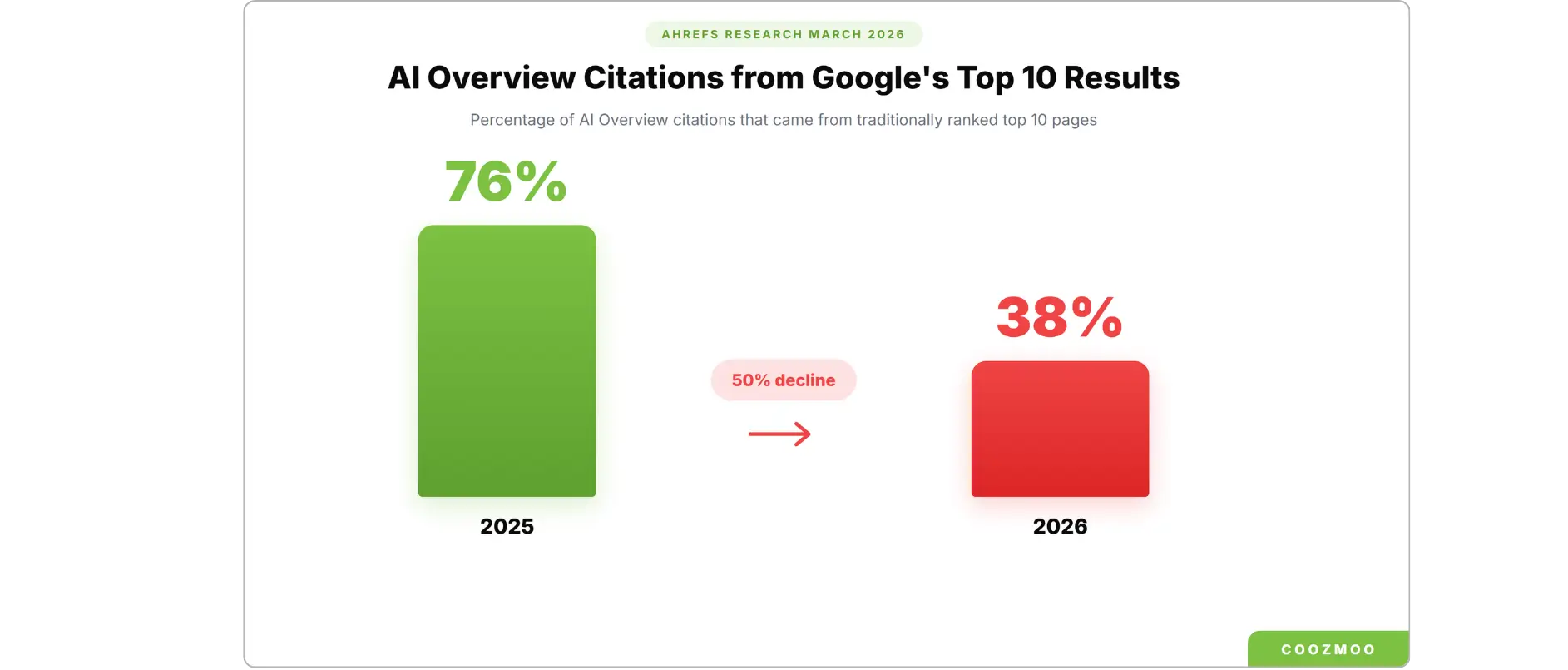
In March 2026, Ahrefs ran the numbers on Google's AI Overviews and found that only 38% of citations came from the traditional top 10 search results. A year earlier, that number was 76%. Ranking first on Google used to be close to a guarantee that you would also show up when an AI engine answered the same question. Now it is closer to a coin flip.
If you searched for AI search optimization advice before landing here, you probably found ten different lists of ten different tips, most of them repeating the same five bullet points: add schema, write FAQs, keep content fresh, get backlinks, be helpful. Some of that is genuinely backed by data. A good chunk of it is guesswork dressed up as certainty, because "I don't fully know yet" doesn't sell as well as a confident checklist.
This is going to be a different kind of list. Where the data agrees, we'll say so plainly. Where the industry is guessing, we'll say that too, because pretending otherwise would make this piece less useful, not more.
What "Ranking in AI" Actually Means
Traditional SEO ranks pages. AI search doesn't. ChatGPT Search, Google's AI Overviews and AI Mode, Perplexity, Gemini, and Copilot don't hand you a ranked list of ten blue links. They retrieve pieces of content from across the web, then generate an answer that cites a handful of sources.
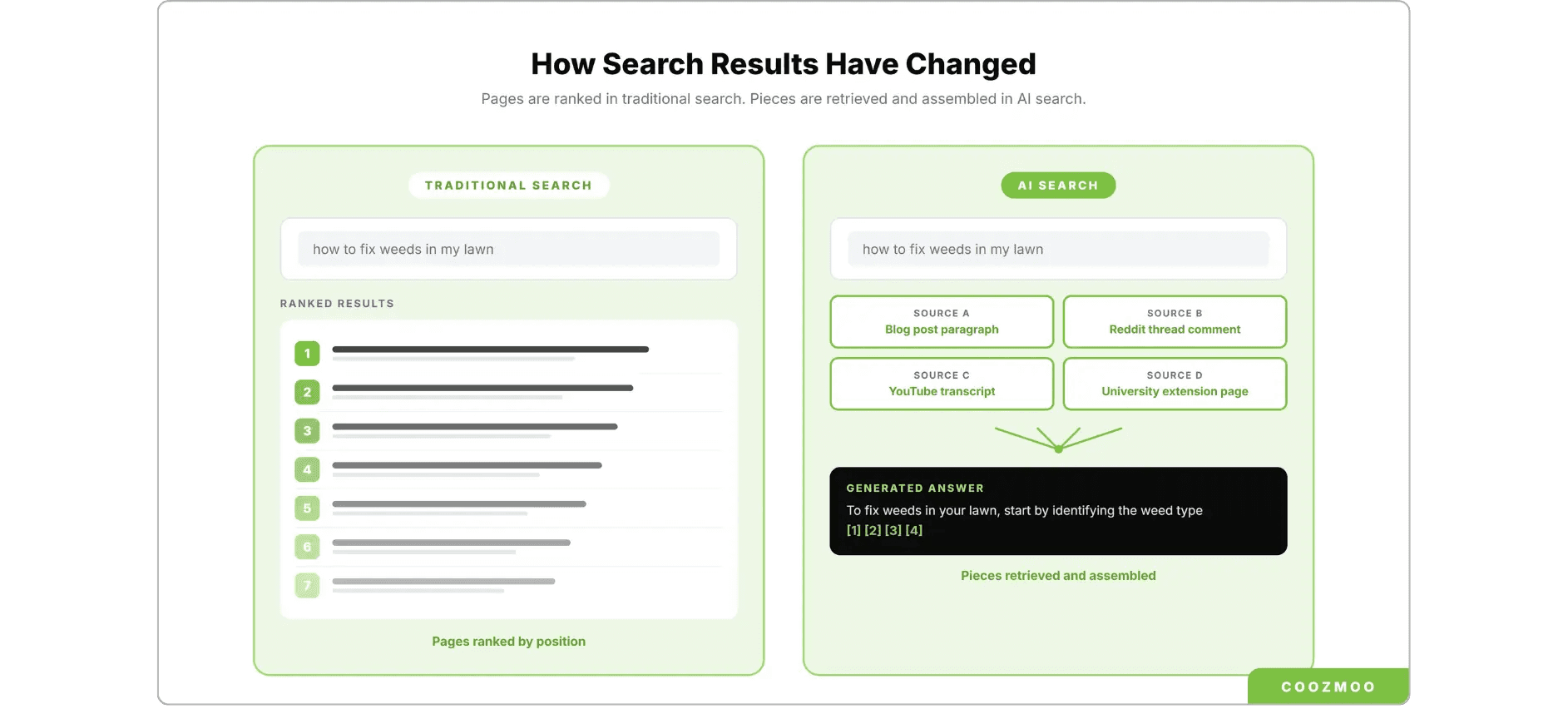
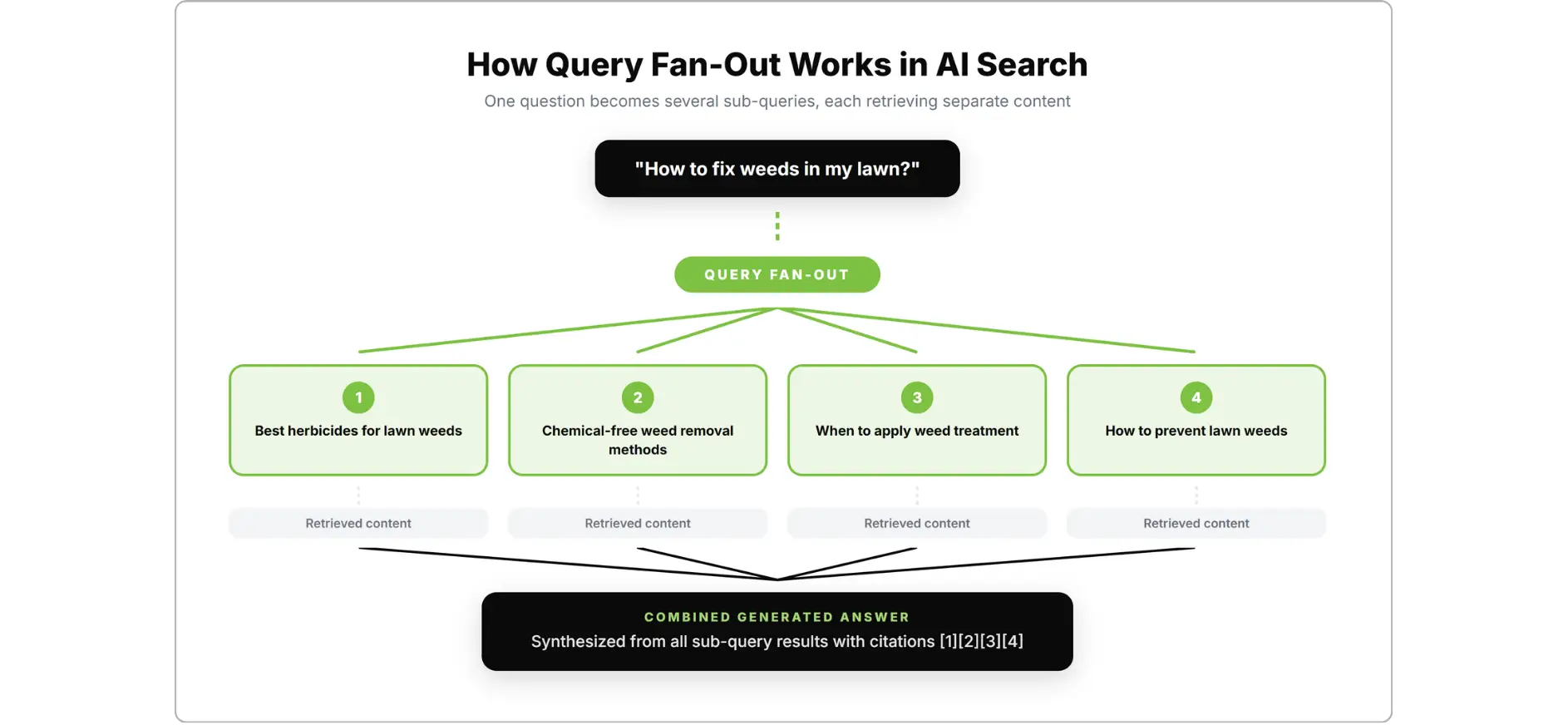
Google has been fairly direct about the mechanics behind its own AI Overviews and AI Mode. We've broken down what this shift means for brand visibility in more depth in our piece on owning your AI search results, if you want the fuller picture after this one. There is no separate AI index sitting apart from regular search. The system pulls from the same index that powers classic results, using retrieval augmented generation, then summarizes what it finds with citation links back to the source. It also runs something called query fan-out, where one question gets broken into several related sub-queries that all run at once. Ask how to fix weeds in a lawn, and behind the scenes the system might also be querying for the best herbicides, chemical-free removal, and prevention, then stitching the best answers together.
That single fact, retrieval plus citation instead of ranking, explains almost everything else in this piece. If your content isn't structured in a way a retrieval system can pull a clean, self-contained answer from, it doesn't matter how good your Google position is. You simply won't be part of the answer.
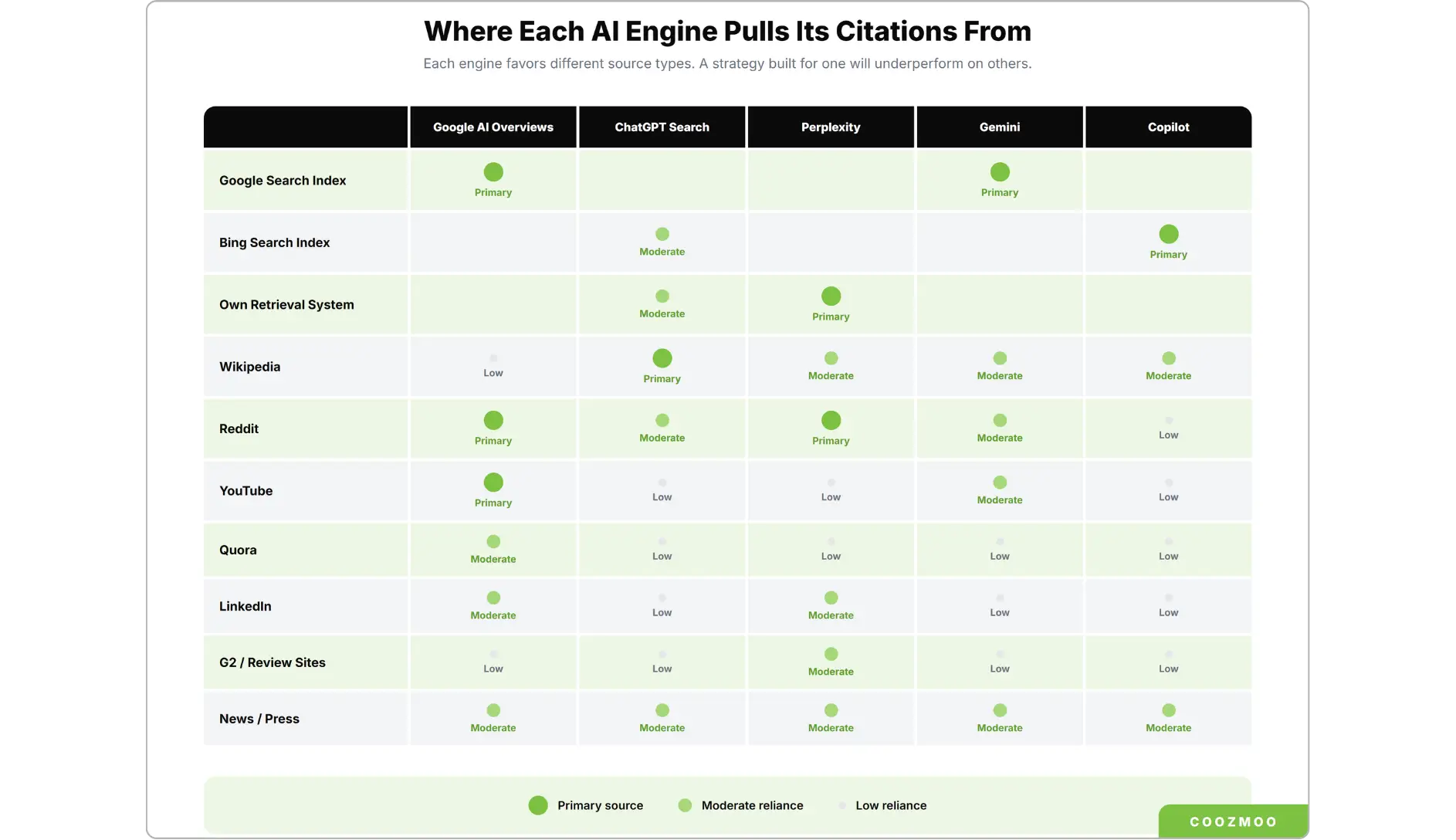
The engines don't all work the same way underneath, either, which is part of why the same page can perform completely differently across them. Google's AI Overviews and AI Mode draw from Google's own Search index. Perplexity is built as an answer engine from the ground up and leans harder on live retrieval and community sources like Reddit and G2. ChatGPT Search blends its own retrieval with a heavy tilt toward encyclopedic and reference sources like Wikipedia. Gemini and Copilot each have their own retrieval quirks tied to Google's and Microsoft's respective indexes. None of them are the same product wearing a different logo, and treating them as one undifferentiated "AI search" target is one of the more common mistakes businesses make right now.
For someone completely new to this: an "AI Overview" is the box of summarized text Google sometimes shows above the normal results. "AI Mode" is Google's fuller conversational search experience. A citation is simply a source the AI names or links to while building its answer. This whole practice has its own name too: generative engine optimization, or GEO, often used alongside answer engine optimization (AEO) for the more direct-answer end of the same problem. When someone asks how to rank in AI Overviews specifically, they're really asking a narrower version of the same question this entire piece is answering. That's the vocabulary you need to follow the rest of this.
What the Data Actually Agrees On
A few things show up consistently enough, across independent sources, that we can call them close to settled.
Google rankings and AI citations have decoupled. That 76% to 38% collapse from Ahrefs isn't a one-off. It means high traditional rankings are no longer the reliable proxy for AI visibility that they used to be.
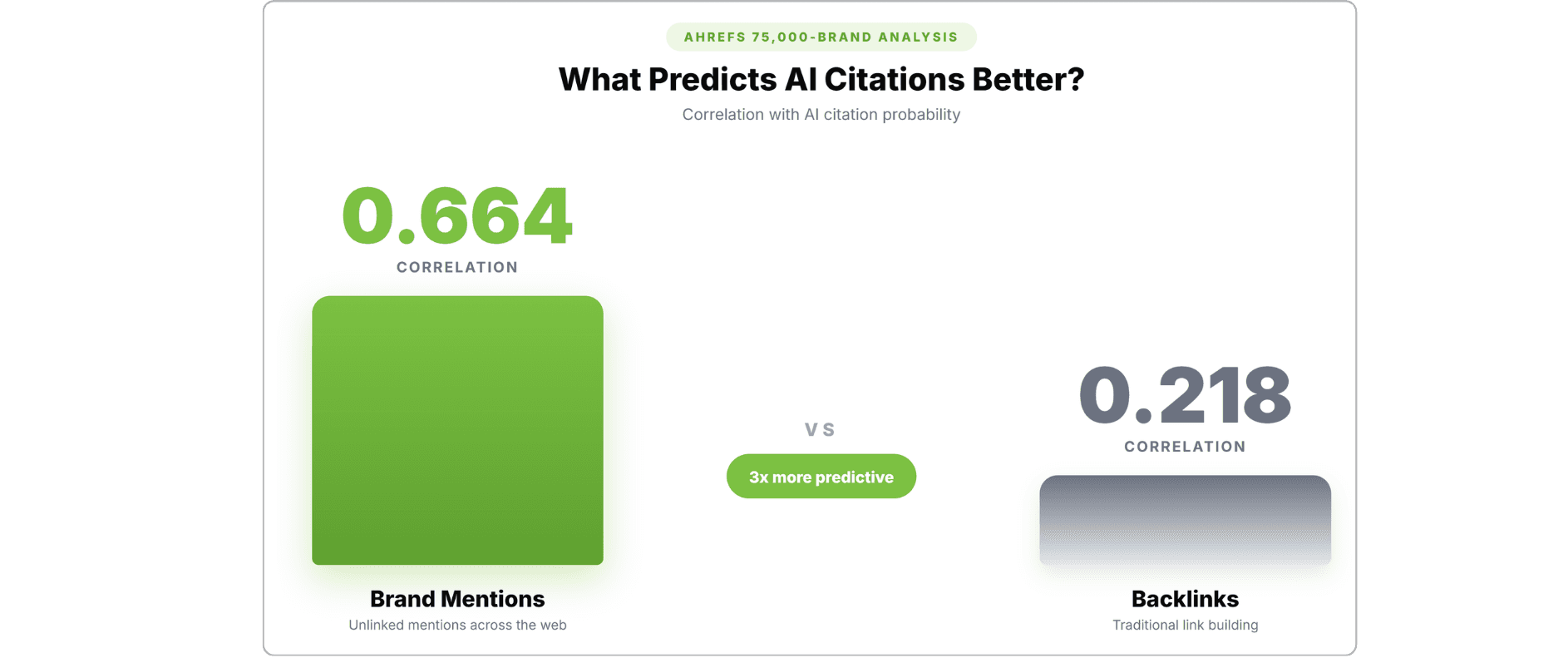
Brand mentions matter more than backlinks. Ahrefs analyzed 75,000 brands and found that unlinked mentions of a brand across the web correlated with AI citation probability at 0.664, compared to 0.218 for backlinks. That's roughly three times the predictive power. Getting talked about, even without a link attached, appears to carry more weight than the link-building playbook that has driven SEO for two decades.
Structure beats length for its own sake. Princeton's GEO-bench research, published with Georgia Tech and the Allen Institute for AI at the 2024 ACM SIGKDD conference, tested nine content optimization tactics against a 10,000-query benchmark. Five of them, adding citations, adding statistics, adding direct quotations, writing for fluency, and adopting an authoritative voice, boosted visibility by 30 to 41%. Four others, keyword stuffing, oversimplifying, padding content, and leaning on persuasive language, either did nothing or actively hurt.
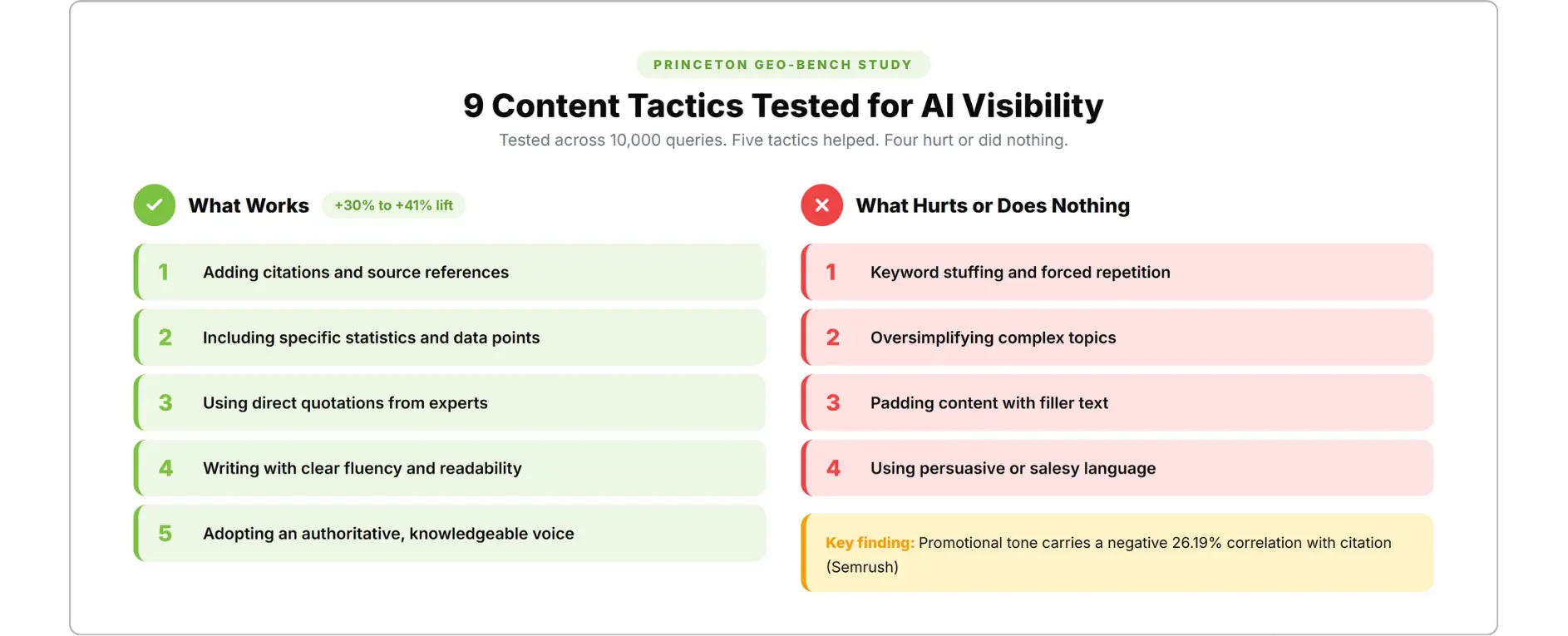
Promotional language is a liability. Semrush found promotional tone carries a negative 26.19% correlation with citation. AI engines seem to prefer content that reads like it's explaining something to the reader, not selling to them.
Recency bias is real, if not perfectly quantified. A 2025 academic study on retrieval systems found a clear tendency for large language models to favor more recently published or updated content when acting as search rerankers. Nobody has landed on one universal freshness number yet, but the direction is consistent everywhere it's been tested.
Those five hold up because more than one independent group found the same pattern. That's a higher bar than most "GEO tips" content clears, and it's worth building a strategy on.
Where the Industry Genuinely Disagrees
Here's the part most lists won't tell you: some of the most repeated advice out there doesn't actually have solid ground under it yet.
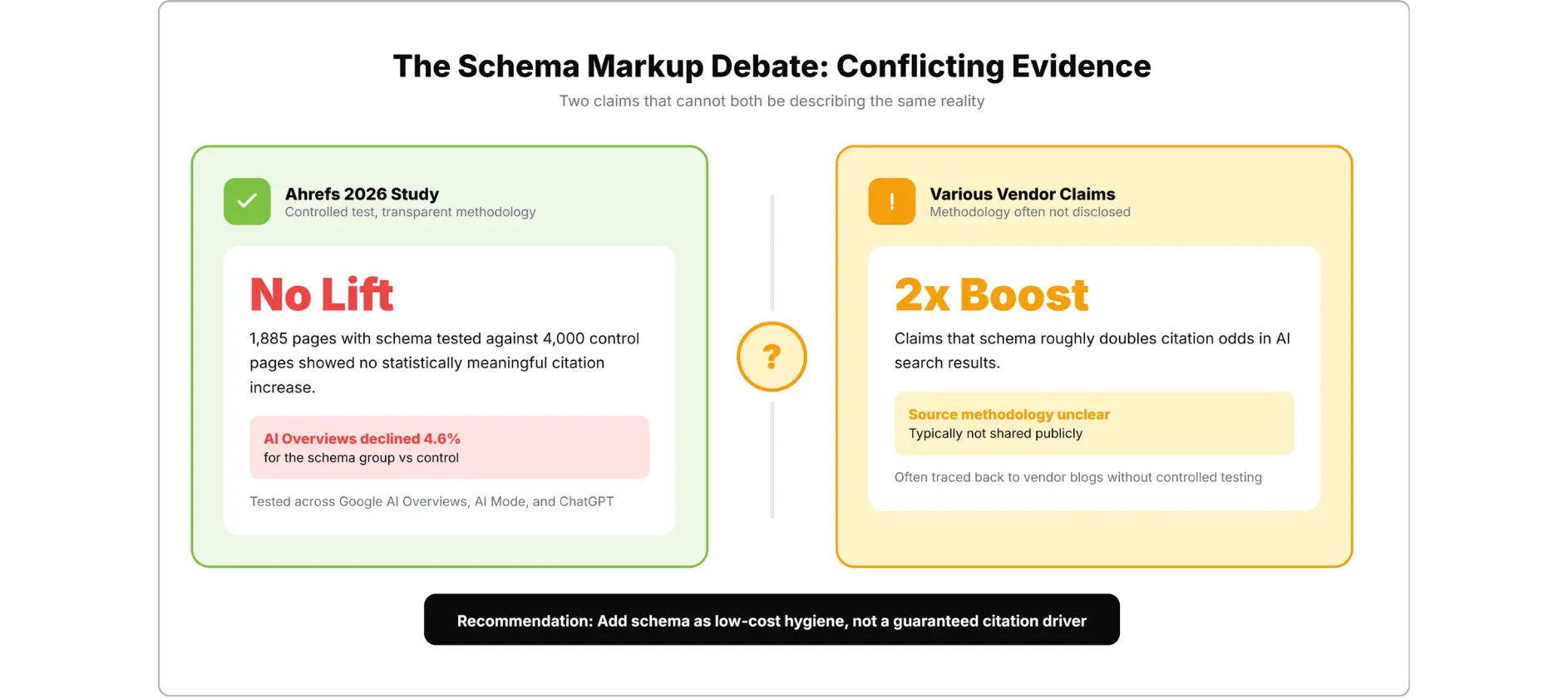
Schema markup is the clearest example. Ahrefs ran a 2026 test comparing 1,885 pages that added JSON-LD schema against 4,000 control pages that didn't, across Google AI Overviews, AI Mode, and ChatGPT. The result: no statistically meaningful citation lift, and AI Overviews actually showed a 4.6% decline for the schema group compared to the control. Meanwhile, other sources claim schema roughly doubles your citation odds. Those two claims cannot both be describing the same reality, and the schema-helps claims tend to trace back to vendor blogs without a transparent methodology behind them.
Google's own official guidance for succeeding in AI search never mentions a special AI-only markup file at all. What it actually recommends is unique, non-commodity content, structured data that matches what's visible on the page, and support for text with images and video. In other words: the same fundamentals that have always mattered, applied consistently, not a new hack layered on top.
Content length has the same problem. Some vendor research claims pages over roughly 3,300 words get cited over four times more often than shorter content. But the more carefully sourced research, from HubSpot, Onely, and others, points to structure as the real driver: comparison content, comprehensive guides with data tables, and definition blocks earning high citation rates regardless of overall word count. It's likely that "long content" performs well because longer pieces tend to contain more independently citable chunks, not because length itself is a ranking factor.
Freshness multipliers fall into the same bucket. Recency bias is documented and repeatable. A specific number like "content updated in the last 30 days gets 3.2 times more citations" is a single vendor's single test window on a single engine, not a physical law.
None of this means "we don't know anything." It means anyone selling you a confident universal percentage right now is selling certainty that the research doesn't support yet. The honest move is to treat schema and llms.txt as low-cost, low-risk additions worth doing without expecting them to move the needle on their own, keep content genuinely current without chasing an exact multiplier, and prioritize structure over raw length every time you have to choose between them.
The Part Nobody's Talking About: Your Entity Footprint
Nearly every piece of AI search advice treats your website as the whole game. It isn't, and the citation data makes that obvious once you look at where AI engines actually pull from. We've covered the discoverability side of this in more detail in how to make your brand discoverable in AI search results, but the short version is below.
Azoma's analysis of millions of citations found ChatGPT leans heavily on Wikipedia (43% of citations), with Reddit (12%) and YouTube (5%) behind it. Google's AI Overviews look completely different: Reddit (20%), YouTube (19%), Quora (14%), LinkedIn (10%), and Wikipedia (7%). Most Cited Domains by LLMs of roughly 600,000 citation events found Wikipedia and Reddit together account for more than a quarter of all ChatGPT citations in the US, and that major outlets like The Wall Street Journal, The New York Times, Bloomberg, and the Financial Times don't crack the top 20 at all.
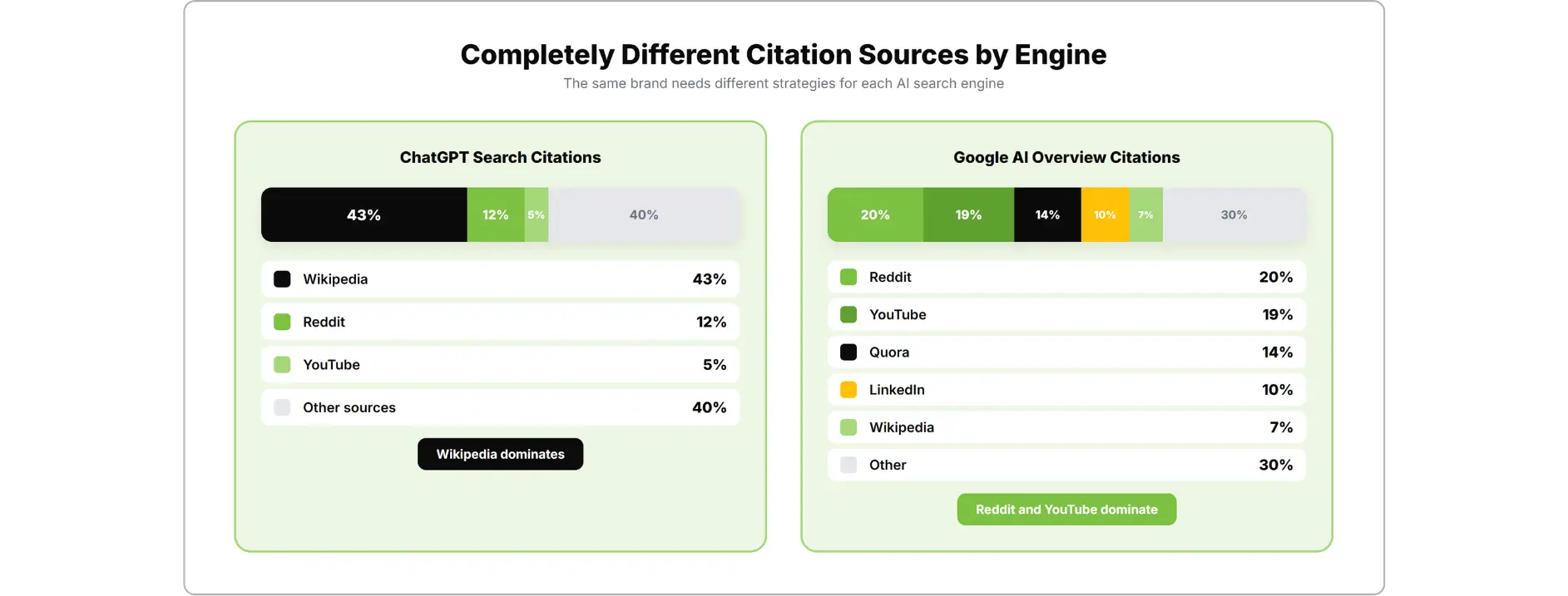
Two things follow from that. First, being cited by AI often has nothing to do with your own website. It has to do with whether Reddit threads, review sites, YouTube videos, or Wikipedia pages mention your brand accurately. Second, the mix is completely different per platform. A strategy tuned for ChatGPT's Wikipedia-heavy citation pattern will underperform on Google's AI Overviews, which lean toward Reddit and YouTube instead.
This is also where the "everything connects to everything" instinct is actually correct, not just a vague platitude. Your website, your Reddit presence, the reviews people leave, the YouTube videos that mention you, all of it feeds the same pool that AI engines draw citations from. The mistake is treating that as a reason to try to be excellent everywhere at once. A small or mid-size business doesn't have the resources for that, and spreading effort evenly across every platform usually means being mediocre on all of them.
Put in plainer terms: if you sell a physical product, a handful of honest YouTube reviews and a presence in the right subreddit or Facebook group will likely do more for your AI visibility than another blog post. If you're a B2B service, being mentioned accurately in a G2 or Capterra comparison, or answering questions in a relevant LinkedIn thread, may matter more than another page on your own site. If you're a local business, your Google Business Profile and the consistency of your listings across the web still carry real weight, since local AI answers lean heavily on that data. The platform mix isn't a personal preference. It follows directly from where your specific buyers already go to compare their options.
Different Audience, Different Starting Point
Before the ten tips, one distinction that changes everything about how you apply them: what your audience is actually looking for determines where they start their search.
Someone with service intent, hiring a plumber, choosing an accountant, picking a marketing agency, still tends to search directly and research on websites before deciding. Someone with product intent behaves differently. They often discover a product on social media or YouTube first, compare it against alternatives through reviews and videos, then use an AI chatbot to sanity-check the decision before buying.
That means the platforms worth prioritizing are not the same for every business. A service business with high-consideration purchases gets more value from being genuinely thorough on its own site and showing up in comparison and review content. A product business gets more value from a strong presence on the discovery platforms its buyers already use before they ever think to search.
What This Looks Like For Different Kinds of Businesses
The tips below apply broadly, but "apply broadly" is exactly where advice like this tends to go soft. Here's what the priorities actually look like once you sort by business type.
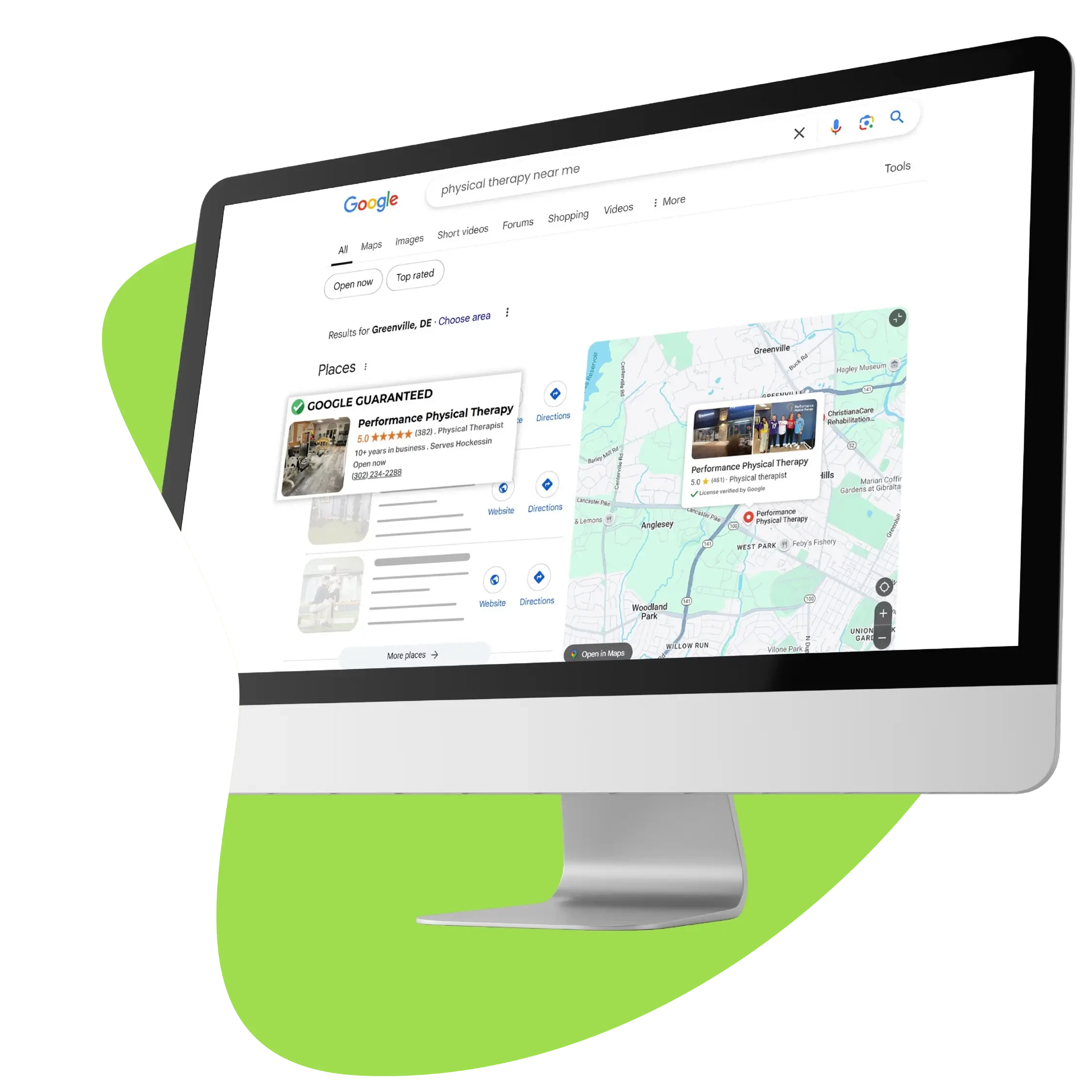
A local service business (plumbers, dentists, HVAC contractors, and similar) lives or dies by local intent. AI answers to "best [service] near me" lean heavily on Google Business Profile data, review consistency across the web, and whether your service area and offerings are described the same way everywhere you appear. For this group, structured data that accurately reflects your services, consistent listings, and a steady flow of specific, detailed reviews will outperform almost anything else on this list. Chasing a Reddit presence is usually a waste of limited hours here.
A product or e-commerce brand is fighting a different battle. Buyers discover products on social platforms and YouTube first, then compare through reviews and AI chatbots before purchasing, which matches the product-intent pattern covered earlier. For this group, presence on the platforms where honest comparison content already lives, YouTube reviews, Reddit discussions in relevant communities, retailer and marketplace review sections, matters more than blog depth on the brand's own site. The website still needs to be technically accessible and well structured, but it is rarely where the citation-worthy content originates.
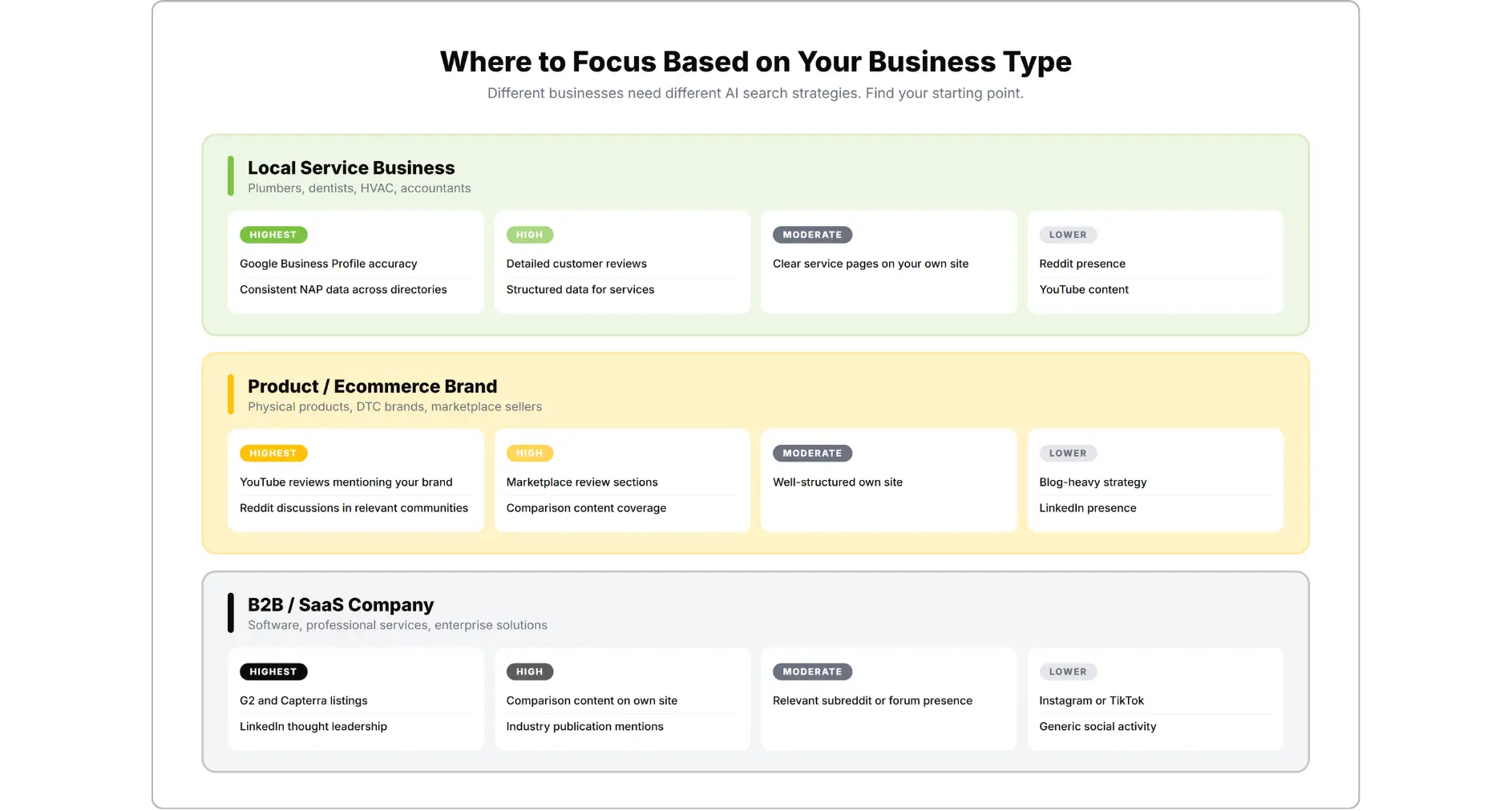
A B2B or SaaS company sits closer to where G2, Capterra, LinkedIn, and comparison content carry real weight, particularly on Perplexity, which leans harder toward exactly those source types. For this group, being accurately and favorably represented in third-party comparison and review content, alongside genuinely substantive content on your own site, tends to matter more than social presence on consumer platforms like Instagram.
None of these examples replace tip ten. They're a starting hypothesis to test against your own competitor research, not a substitute for actually doing it.
The Top 10 Tips
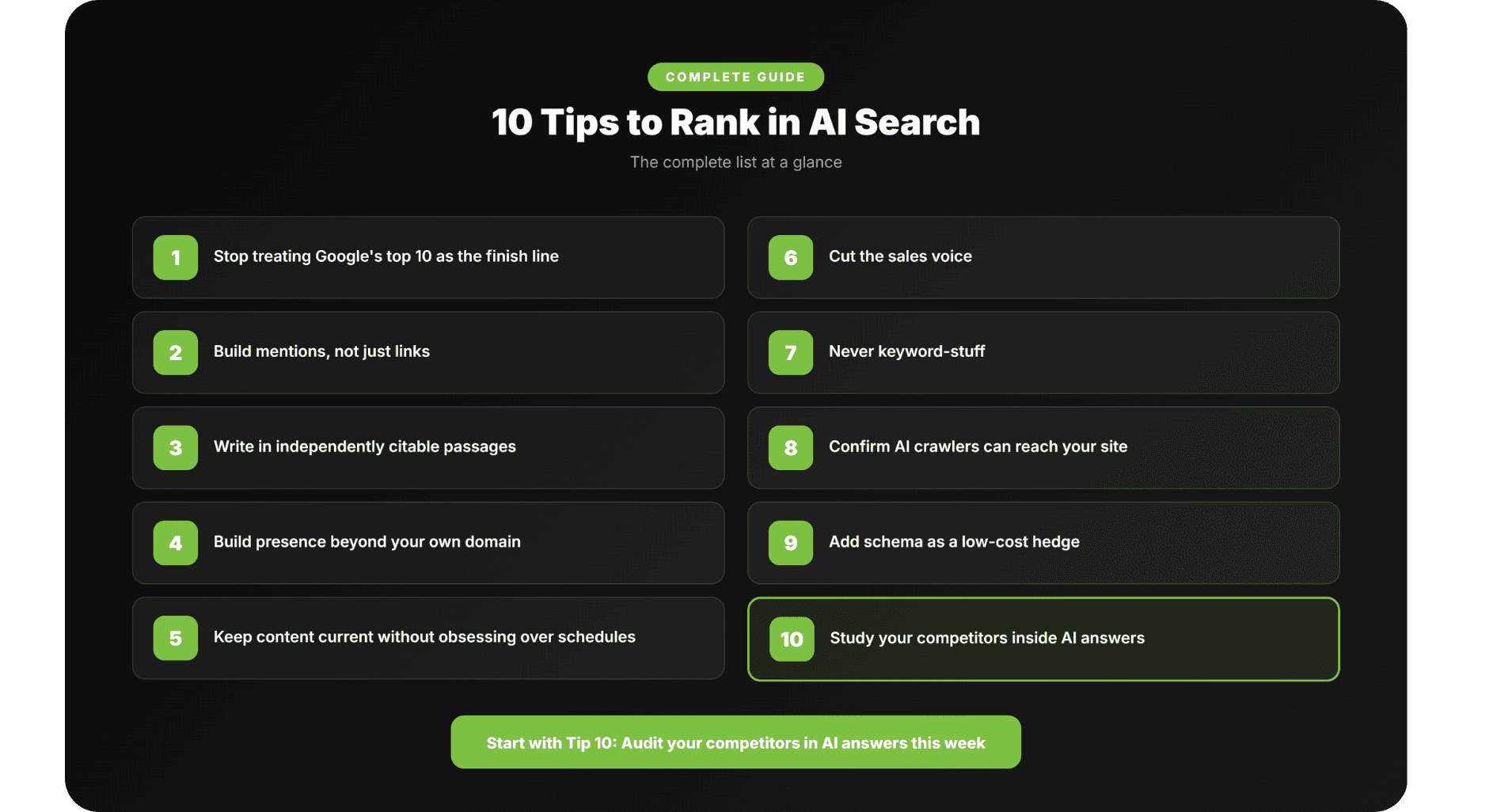
1. Stop treating Google's top 10 as the finish line.
With citation overlap down to 38%, ranking well is necessary but no longer sufficient, and ranking in AI Overviews now depends on a partly different set of signals than classic rankings do. Keep working on rankings, since they still drive real traffic and still feed AI retrieval to some degree, but track your AI citations as a separate metric with its own goals. A page can rank on page one and still never get pulled into an AI answer, and a page buried on page four can still get cited if it's structured well. Treating these as one combined number hides exactly the gap you need to see.
2. Build mentions, not just links.
Digital PR, guest appearances on podcasts or in interviews, being quoted in industry roundups, and getting discussed accurately on Reddit or in comparison articles all build the kind of unlinked mention that Ahrefs found outperforms backlinks roughly three to one. That doesn't mean abandon link building, it still matters for traditional rankings, but a strategy built entirely around acquiring links is now an incomplete strategy. Ask yourself where your brand name shows up in conversations that have nothing to do with your own marketing, and start there.
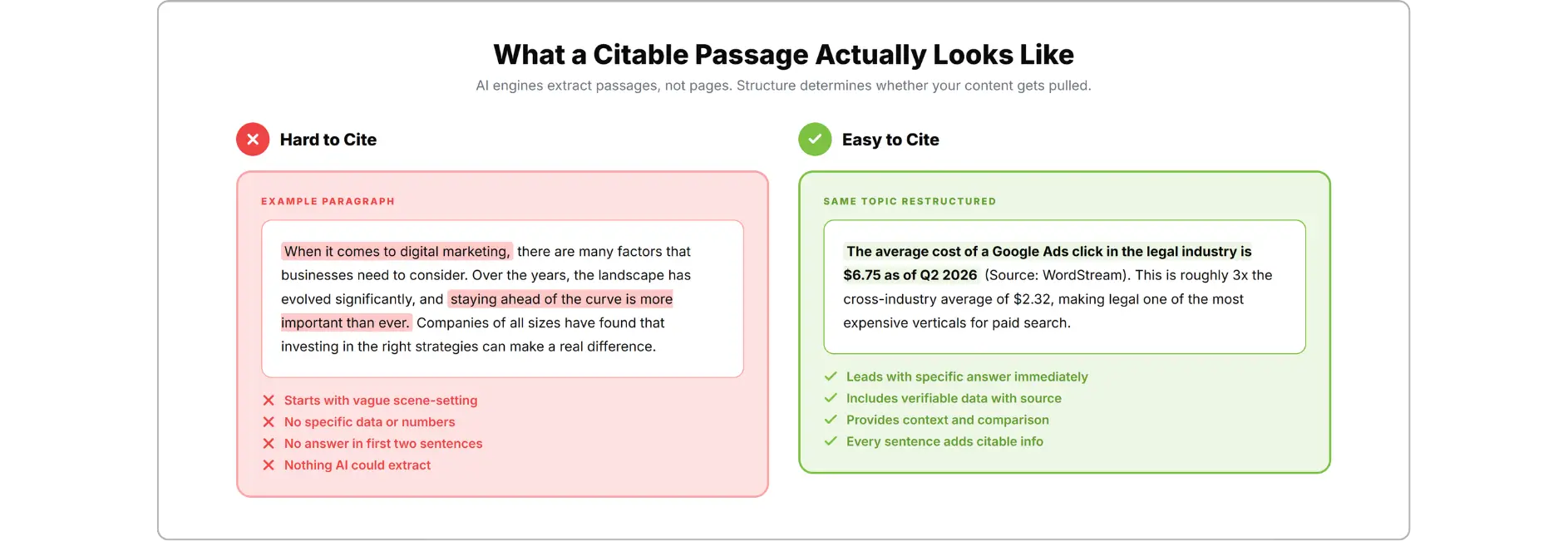
3. Write in independently citable passages.
Every section should be able to stand alone as a complete, accurate answer if an AI engine pulls only that one paragraph. That means leading with the direct answer in the first sentence or two, then backing it up with a specific number, source, or example. This is what the Princeton research is actually measuring when it credits statistics, citations, and an authoritative voice with a real lift in visibility. Vague, scene-setting introductions before you get to the point work against you here, since there's nothing in the first paragraph an AI engine could confidently lift and cite.
4. Build presence beyond your own domain.
Depending on your industry and audience, that might mean an active, honestly useful Reddit presence, consistent and accurate reviews on the sites your buyers already check, a YouTube presence that answers the same questions your blog does, or simply making sure your business is described correctly wherever it's already mentioned. Pick based on where your specific audience spends time, confirmed through the competitor research in tip ten, not based on whichever platform is trending in marketing content this month.
5. Keep things current without obsessing over an exact schedule.
Revisit and update your most important pages on a real cadence, not just once and never again. The exact multiplier claimed by any single study isn't reliable enough to plan around, but the direction, that newer or recently updated content gets favored, holds up everywhere it's been tested. A practical rule: if a page covers something that changes (pricing, statistics, platform features, best practices), it needs a real owner checking it periodically, not a "set it and forget it" publish date.
6. Cut the sales voice.
Given Semrush's finding that promotional tone carries a negative correlation with citation, write like you're explaining something useful to a peer, not like you're closing a deal in the same paragraph. Save the pitch for your pitch pages and let your educational content actually educate. This is often the hardest habit for agencies and marketers to break, since the instinct to always be selling runs deep, but it's directly working against the goal here.
7. Never keyword-stuff.
The Princeton study found this tactic actively hurts rather than helps. If a sentence exists only to repeat your target keyword one more time, delete it. Write the way you'd explain the topic to a smart colleague who doesn't know the jargon yet, and the right terms will show up naturally because they're actually needed, not because you're trying to hit a density target.
8. Confirm AI crawlers can actually reach your site.
Check that your robots.txt file allows GPTBot, PerplexityBot, ClaudeBot, and Google-Extended, and that nothing on the technical side (aggressive JavaScript rendering, overly strict firewall rules) is silently blocking them. We go deeper into how these bots differ from traditional crawlers, and what to check, in our breakdown of AI crawlers versus traditional crawlers. This is table stakes, not a growth lever. Doing it won't get you cited on its own, but blocking it will guarantee you can never be cited, no matter how good the content is.
9. Add schema as a low-cost hedge, not a guaranteed win.
Given the conflicting evidence between Ahrefs' null result and the vendor claims of a major boost, implement schema where it's cheap to do and where it accurately matches your visible content. Treat it as good hygiene rather than the reason you expect citations to start rolling in. If a vendor is telling you schema alone will transform your AI visibility, that claim currently outruns the evidence.
10. Study your actual competitors inside AI answers, not just Google.
Run your category's real, specific questions through ChatGPT, Perplexity, and Google's AI Mode. Note who gets cited, and then dig into where their strength actually comes from: their own website, a strong Reddit presence, consistent reviews, YouTube coverage, press mentions. That single exercise tells you which platform matters most for your specific audience with far more precision than any generic advice, including this piece, can offer on its own.
How Do You Even Know If You're Getting Cited
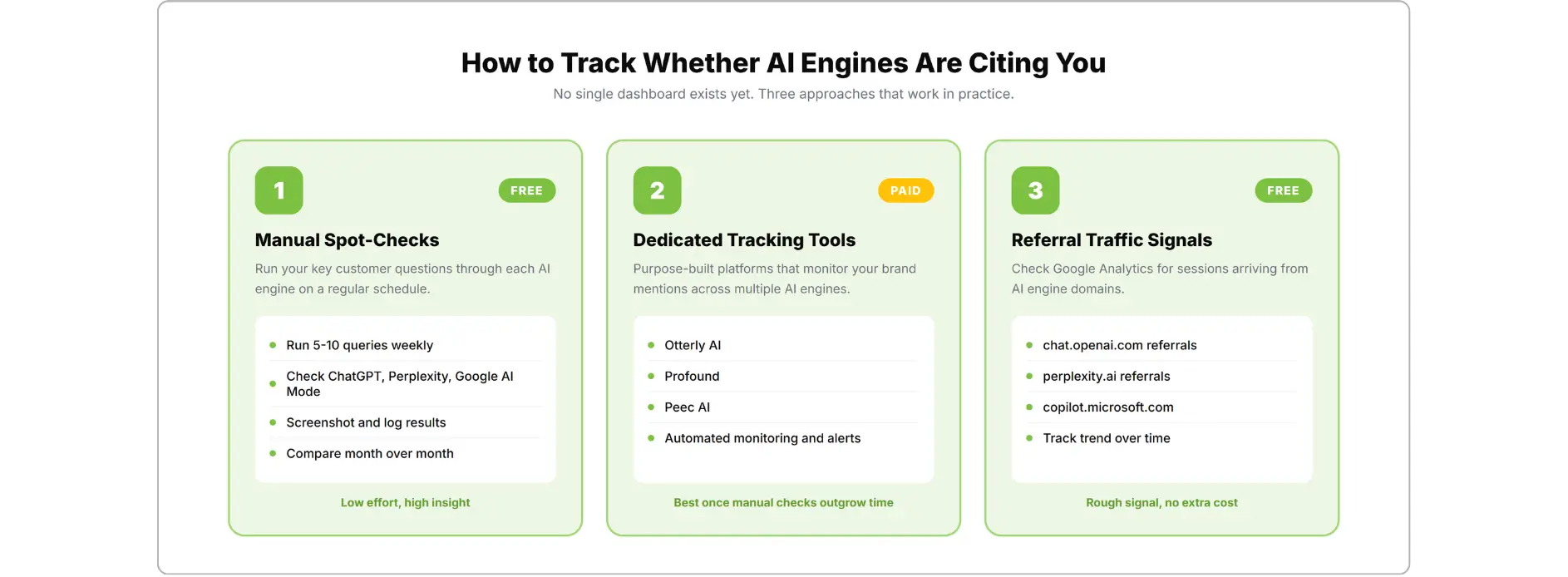
This is a fair question, since none of this matters if you have no way to measure it. Unlike Google Search Console, there's no single dashboard every AI engine reports into. A few approaches work in practice. Manual spot-checks, running your key questions through each engine yourself on a regular schedule, cost nothing but time and are worth doing even if you eventually add a tool. Dedicated citation-tracking platforms like Otterly AI, Profound, and Peec AI exist specifically to monitor how often and where your brand shows up across ChatGPT, Perplexity, and AI Overviews, and they're worth a look once manual checking becomes too slow to keep up with. Referral traffic in Google Analytics is a rougher but free signal: a rising trickle of sessions from chat.openai.com, perplexity.ai, or similar sources tells you people are finding you through AI answers, even before you've formally tracked citations.
None of these are perfect. All of them beat guessing.
How to Actually Start This Week
That last tip deserves its own moment, because it's the most concrete, teachable move in this whole piece and the one most content on this topic skips entirely.
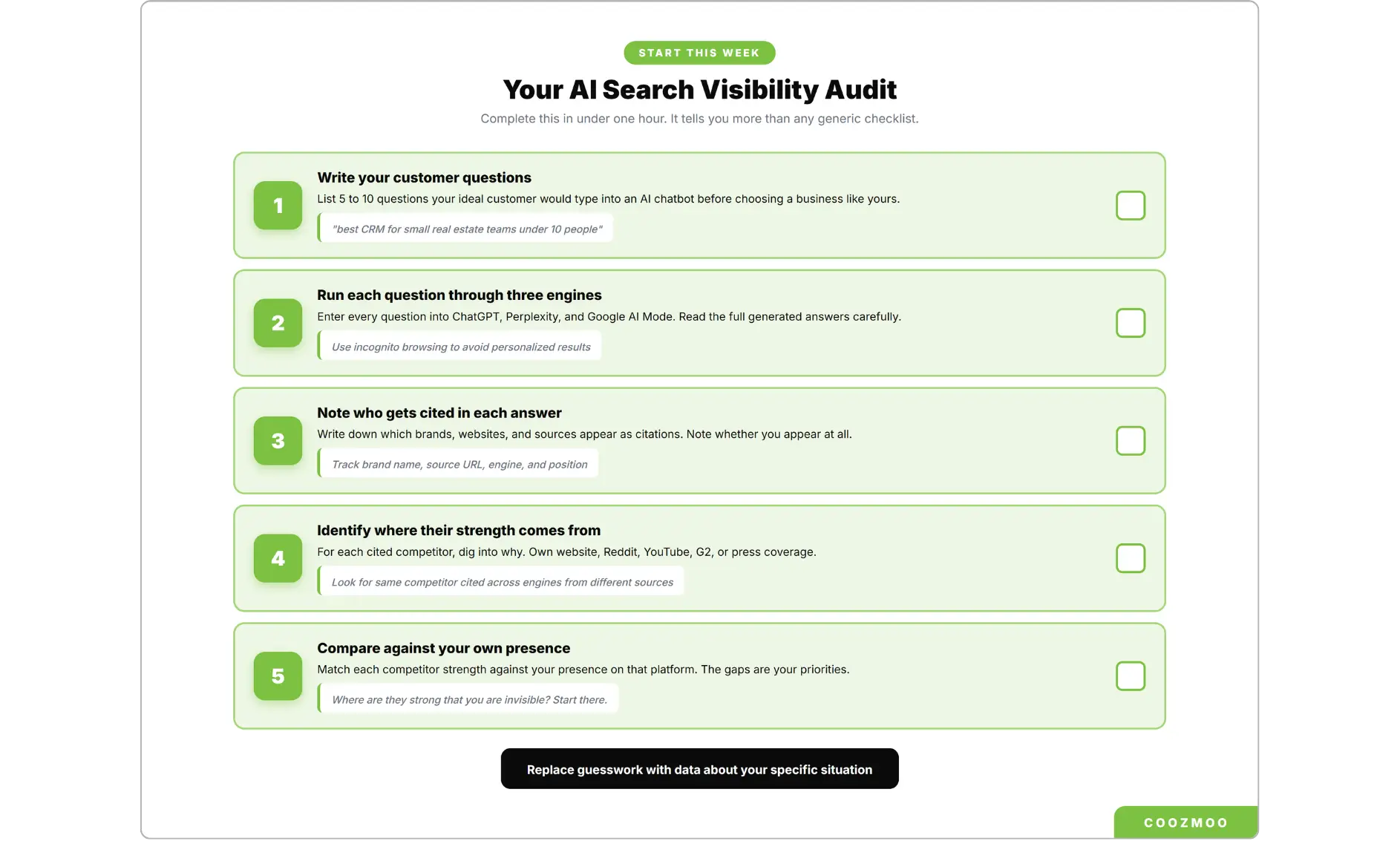
Write down the five to ten questions your ideal customer would actually type into an AI chatbot before choosing a business like yours. Run each one through ChatGPT, Perplexity, and Google's AI Mode. Note who gets cited and, just as important, where their strength seems to be coming from. If you already know who the strong players in your industry are, check them specifically, since you likely have context that a cold search wouldn't surface.
That single exercise does two things at once. It tells you whether you currently exist in the answers your future customers are seeing, and it tells you which platform is actually worth your limited time, instead of guessing based on generic advice built for a business that isn't yours.
Where This Leaves You
AI search fractures by intent, splits differently across every platform, and includes a fair amount of genuine, unresolved disagreement among the people studying it. That's not a satisfying place to land if you wanted a clean checklist. It's a more honest one.
Do the things the data actually agrees on: build mentions, write in citable passages, cut the sales voice, keep content current, and make sure the bots can reach you at all. Treat schema and exact freshness windows as reasonable bets, not guarantees. Then spend the time you have left figuring out, through your own competitors' AI citations, which platform beyond your website deserves your attention next. That's a strategy grounded in what's actually known right now, not in whatever sounds most confident on a blog.
FAQs
Is traditional SEO dead now that AI search exists?

No, and anyone telling you that is oversimplifying to make a point. What's actually happening is closer to a split. SEO still drives the traffic that lands on your site once someone clicks through, and it still feeds the same index AI engines retrieve from in the first place. What's changed is that ranking well no longer guarantees you get cited, which is why the two now need to be tracked and worked on as related but separate goals. We go deeper into what that shift actually looks like in our piece on the great decoupling between rankings and AI Overviews.
Does adding schema markup actually help me get cited by AI?
The honest answer is nobody has proven that it does, at least not yet. A 2026 Ahrefs test found no meaningful citation lift from adding schema, and a small decline in one AI engine's results. Add it anyway if it's cheap to implement and accurately describes your content, since it's good technical hygiene either way, but don't treat it as the reason you expect citations to increase.
How long should my content be to rank in AI search?
Longer than the length itself is what determines it. The research that holds up points to structure, comparison content, comprehensive guides with real data, and clear definitions, as the actual driver, not a specific word count. A tight, well-organized 800-word page can easily outperform a padded 3,000-word one if the shorter piece answers the question more directly.
How do I rank in AI Overviews specifically?
You don't rank in AI Overviews the way you rank in regular search results, since there's no separate list to climb. Google pulls AI Overviews from the same index as normal Search, then uses retrieval augmented generation and query fan-out to decide what to cite. The pages that tend to show up answer one specific sub-question clearly in a self-contained passage, carry structured data that matches what's actually visible on the page, and come from sources Google already trusts because they're mentioned accurately elsewhere. It's less 'optimize this one page for AI Overviews' and more 'make this page the cleanest possible answer to one piece of a bigger question.
How often do I need to update my content?
There's no universal number that any one study has proven, despite what some vendors claim. What is consistent across independent research is the direction: content that's been recently reviewed or updated tends to get favored over content that's been sitting untouched for years. A practical approach is assigning a real owner to check your most important pages on a set schedule, rather than publishing once and forgetting about it.
Something broke in the last year and most businesses have not noticed yet.
In March 2026, Ahrefs ran the numbers on Google's AI Overviews and found that only 38% of citations came from the traditional top 10 search results. A year earlier, that number was 76%. Ranking first on Google used to be close to a guarantee that you would also show up when an AI engine answered the same question. Now it is closer to a coin flip.
If you searched for AI search optimization advice before landing here, you probably found ten different lists of ten different tips, most of them repeating the same five bullet points: add schema, write FAQs, keep content fresh, get backlinks, be helpful. Some of that is genuinely backed by data. A good chunk of it is guesswork dressed up as certainty, because "I don't fully know yet" doesn't sell as well as a confident checklist.
This is going to be a different kind of list. Where the data agrees, we'll say so plainly. Where the industry is guessing, we'll say that too, because pretending otherwise would make this piece less useful, not more.
What "Ranking in AI" Actually Means
Traditional SEO ranks pages. AI search doesn't. ChatGPT Search, Google's AI Overviews and AI Mode, Perplexity, Gemini, and Copilot don't hand you a ranked list of ten blue links. They retrieve pieces of content from across the web, then generate an answer that cites a handful of sources.
Google has been fairly direct about the mechanics behind its own AI Overviews and AI Mode. We've broken down what this shift means for brand visibility in more depth in our piece on owning your AI search results, if you want the fuller picture after this one. There is no separate AI index sitting apart from regular search. The system pulls from the same index that powers classic results, using retrieval augmented generation, then summarizes what it finds with citation links back to the source. It also runs something called query fan-out, where one question gets broken into several related sub-queries that all run at once. Ask how to fix weeds in a lawn, and behind the scenes the system might also be querying for the best herbicides, chemical-free removal, and prevention, then stitching the best answers together.
That single fact, retrieval plus citation instead of ranking, explains almost everything else in this piece. If your content isn't structured in a way a retrieval system can pull a clean, self-contained answer from, it doesn't matter how good your Google position is. You simply won't be part of the answer.
The engines don't all work the same way underneath, either, which is part of why the same page can perform completely differently across them. Google's AI Overviews and AI Mode draw from Google's own Search index. Perplexity is built as an answer engine from the ground up and leans harder on live retrieval and community sources like Reddit and G2. ChatGPT Search blends its own retrieval with a heavy tilt toward encyclopedic and reference sources like Wikipedia. Gemini and Copilot each have their own retrieval quirks tied to Google's and Microsoft's respective indexes. None of them are the same product wearing a different logo, and treating them as one undifferentiated "AI search" target is one of the more common mistakes businesses make right now.
For someone completely new to this: an "AI Overview" is the box of summarized text Google sometimes shows above the normal results. "AI Mode" is Google's fuller conversational search experience. A citation is simply a source the AI names or links to while building its answer. This whole practice has its own name too: generative engine optimization, or GEO, often used alongside answer engine optimization (AEO) for the more direct-answer end of the same problem. When someone asks how to rank in AI Overviews specifically, they're really asking a narrower version of the same question this entire piece is answering. That's the vocabulary you need to follow the rest of this.
What the Data Actually Agrees On
A few things show up consistently enough, across independent sources, that we can call them close to settled.
Google rankings and AI citations have decoupled. That 76% to 38% collapse from Ahrefs isn't a one-off. It means high traditional rankings are no longer the reliable proxy for AI visibility that they used to be.
Brand mentions matter more than backlinks. Ahrefs analyzed 75,000 brands and found that unlinked mentions of a brand across the web correlated with AI citation probability at 0.664, compared to 0.218 for backlinks. That's roughly three times the predictive power. Getting talked about, even without a link attached, appears to carry more weight than the link-building playbook that has driven SEO for two decades.
Structure beats length for its own sake. Princeton's GEO-bench research, published with Georgia Tech and the Allen Institute for AI at the 2024 ACM SIGKDD conference, tested nine content optimization tactics against a 10,000-query benchmark. Five of them, adding citations, adding statistics, adding direct quotations, writing for fluency, and adopting an authoritative voice, boosted visibility by 30 to 41%. Four others, keyword stuffing, oversimplifying, padding content, and leaning on persuasive language, either did nothing or actively hurt.
Promotional language is a liability. Semrush found promotional tone carries a negative 26.19% correlation with citation. AI engines seem to prefer content that reads like it's explaining something to the reader, not selling to them.
Recency bias is real, if not perfectly quantified. A 2025 academic study on retrieval systems found a clear tendency for large language models to favor more recently published or updated content when acting as search rerankers. Nobody has landed on one universal freshness number yet, but the direction is consistent everywhere it's been tested.
Those five hold up because more than one independent group found the same pattern. That's a higher bar than most "GEO tips" content clears, and it's worth building a strategy on.
Where the Industry Genuinely Disagrees
Here's the part most lists won't tell you: some of the most repeated advice out there doesn't actually have solid ground under it yet.
Schema markup is the clearest example. Ahrefs ran a 2026 test comparing 1,885 pages that added JSON-LD schema against 4,000 control pages that didn't, across Google AI Overviews, AI Mode, and ChatGPT. The result: no statistically meaningful citation lift, and AI Overviews actually showed a 4.6% decline for the schema group compared to the control. Meanwhile, other sources claim schema roughly doubles your citation odds. Those two claims cannot both be describing the same reality, and the schema-helps claims tend to trace back to vendor blogs without a transparent methodology behind them.
Google's own official guidance for succeeding in AI search never mentions a special AI-only markup file at all. What it actually recommends is unique, non-commodity content, structured data that matches what's visible on the page, and support for text with images and video. In other words: the same fundamentals that have always mattered, applied consistently, not a new hack layered on top.
Content length has the same problem. Some vendor research claims pages over roughly 3,300 words get cited over four times more often than shorter content. But the more carefully sourced research, from HubSpot, Onely, and others, points to structure as the real driver: comparison content, comprehensive guides with data tables, and definition blocks earning high citation rates regardless of overall word count. It's likely that "long content" performs well because longer pieces tend to contain more independently citable chunks, not because length itself is a ranking factor.
Freshness multipliers fall into the same bucket. Recency bias is documented and repeatable. A specific number like "content updated in the last 30 days gets 3.2 times more citations" is a single vendor's single test window on a single engine, not a physical law.
None of this means "we don't know anything." It means anyone selling you a confident universal percentage right now is selling certainty that the research doesn't support yet. The honest move is to treat schema and llms.txt as low-cost, low-risk additions worth doing without expecting them to move the needle on their own, keep content genuinely current without chasing an exact multiplier, and prioritize structure over raw length every time you have to choose between them.
The Part Nobody's Talking About: Your Entity Footprint
Nearly every piece of AI search advice treats your website as the whole game. It isn't, and the citation data makes that obvious once you look at where AI engines actually pull from. We've covered the discoverability side of this in more detail in how to make your brand discoverable in AI search results, but the short version is below.
Azoma's analysis of millions of citations found ChatGPT leans heavily on Wikipedia (43% of citations), with Reddit (12%) and YouTube (5%) behind it. Google's AI Overviews look completely different: Reddit (20%), YouTube (19%), Quora (14%), LinkedIn (10%), and Wikipedia (7%). Most Cited Domains by LLMs of roughly 600,000 citation events found Wikipedia and Reddit together account for more than a quarter of all ChatGPT citations in the US, and that major outlets like The Wall Street Journal, The New York Times, Bloomberg, and the Financial Times don't crack the top 20 at all.
Two things follow from that. First, being cited by AI often has nothing to do with your own website. It has to do with whether Reddit threads, review sites, YouTube videos, or Wikipedia pages mention your brand accurately. Second, the mix is completely different per platform. A strategy tuned for ChatGPT's Wikipedia-heavy citation pattern will underperform on Google's AI Overviews, which lean toward Reddit and YouTube instead.
This is also where the "everything connects to everything" instinct is actually correct, not just a vague platitude. Your website, your Reddit presence, the reviews people leave, the YouTube videos that mention you, all of it feeds the same pool that AI engines draw citations from. The mistake is treating that as a reason to try to be excellent everywhere at once. A small or mid-size business doesn't have the resources for that, and spreading effort evenly across every platform usually means being mediocre on all of them.
Put in plainer terms: if you sell a physical product, a handful of honest YouTube reviews and a presence in the right subreddit or Facebook group will likely do more for your AI visibility than another blog post. If you're a B2B service, being mentioned accurately in a G2 or Capterra comparison, or answering questions in a relevant LinkedIn thread, may matter more than another page on your own site. If you're a local business, your Google Business Profile and the consistency of your listings across the web still carry real weight, since local AI answers lean heavily on that data. The platform mix isn't a personal preference. It follows directly from where your specific buyers already go to compare their options.
Different Audience, Different Starting Point
Before the ten tips, one distinction that changes everything about how you apply them: what your audience is actually looking for determines where they start their search.
Someone with service intent, hiring a plumber, choosing an accountant, picking a marketing agency, still tends to search directly and research on websites before deciding. Someone with product intent behaves differently. They often discover a product on social media or YouTube first, compare it against alternatives through reviews and videos, then use an AI chatbot to sanity-check the decision before buying.
That means the platforms worth prioritizing are not the same for every business. A service business with high-consideration purchases gets more value from being genuinely thorough on its own site and showing up in comparison and review content. A product business gets more value from a strong presence on the discovery platforms its buyers already use before they ever think to search.
What This Looks Like For Different Kinds of Businesses
The tips below apply broadly, but "apply broadly" is exactly where advice like this tends to go soft. Here's what the priorities actually look like once you sort by business type.
A local service business (plumbers, dentists, HVAC contractors, and similar) lives or dies by local intent. AI answers to "best [service] near me" lean heavily on Google Business Profile data, review consistency across the web, and whether your service area and offerings are described the same way everywhere you appear. For this group, structured data that accurately reflects your services, consistent listings, and a steady flow of specific, detailed reviews will outperform almost anything else on this list. Chasing a Reddit presence is usually a waste of limited hours here.
A product or e-commerce brand is fighting a different battle. Buyers discover products on social platforms and YouTube first, then compare through reviews and AI chatbots before purchasing, which matches the product-intent pattern covered earlier. For this group, presence on the platforms where honest comparison content already lives, YouTube reviews, Reddit discussions in relevant communities, retailer and marketplace review sections, matters more than blog depth on the brand's own site. The website still needs to be technically accessible and well structured, but it is rarely where the citation-worthy content originates.
A B2B or SaaS company sits closer to where G2, Capterra, LinkedIn, and comparison content carry real weight, particularly on Perplexity, which leans harder toward exactly those source types. For this group, being accurately and favorably represented in third-party comparison and review content, alongside genuinely substantive content on your own site, tends to matter more than social presence on consumer platforms like Instagram.
None of these examples replace tip ten. They're a starting hypothesis to test against your own competitor research, not a substitute for actually doing it.
The Top 10 Tips
1. Stop treating Google's top 10 as the finish line.
With citation overlap down to 38%, ranking well is necessary but no longer sufficient, and ranking in AI Overviews now depends on a partly different set of signals than classic rankings do. Keep working on rankings, since they still drive real traffic and still feed AI retrieval to some degree, but track your AI citations as a separate metric with its own goals. A page can rank on page one and still never get pulled into an AI answer, and a page buried on page four can still get cited if it's structured well. Treating these as one combined number hides exactly the gap you need to see.
2. Build mentions, not just links.
Digital PR, guest appearances on podcasts or in interviews, being quoted in industry roundups, and getting discussed accurately on Reddit or in comparison articles all build the kind of unlinked mention that Ahrefs found outperforms backlinks roughly three to one. That doesn't mean abandon link building, it still matters for traditional rankings, but a strategy built entirely around acquiring links is now an incomplete strategy. Ask yourself where your brand name shows up in conversations that have nothing to do with your own marketing, and start there.
3. Write in independently citable passages.
Every section should be able to stand alone as a complete, accurate answer if an AI engine pulls only that one paragraph. That means leading with the direct answer in the first sentence or two, then backing it up with a specific number, source, or example. This is what the Princeton research is actually measuring when it credits statistics, citations, and an authoritative voice with a real lift in visibility. Vague, scene-setting introductions before you get to the point work against you here, since there's nothing in the first paragraph an AI engine could confidently lift and cite.
4. Build presence beyond your own domain.
Depending on your industry and audience, that might mean an active, honestly useful Reddit presence, consistent and accurate reviews on the sites your buyers already check, a YouTube presence that answers the same questions your blog does, or simply making sure your business is described correctly wherever it's already mentioned. Pick based on where your specific audience spends time, confirmed through the competitor research in tip ten, not based on whichever platform is trending in marketing content this month.
5. Keep things current without obsessing over an exact schedule.
Revisit and update your most important pages on a real cadence, not just once and never again. The exact multiplier claimed by any single study isn't reliable enough to plan around, but the direction, that newer or recently updated content gets favored, holds up everywhere it's been tested. A practical rule: if a page covers something that changes (pricing, statistics, platform features, best practices), it needs a real owner checking it periodically, not a "set it and forget it" publish date.
6. Cut the sales voice.
Given Semrush's finding that promotional tone carries a negative correlation with citation, write like you're explaining something useful to a peer, not like you're closing a deal in the same paragraph. Save the pitch for your pitch pages and let your educational content actually educate. This is often the hardest habit for agencies and marketers to break, since the instinct to always be selling runs deep, but it's directly working against the goal here.
7. Never keyword-stuff.
The Princeton study found this tactic actively hurts rather than helps. If a sentence exists only to repeat your target keyword one more time, delete it. Write the way you'd explain the topic to a smart colleague who doesn't know the jargon yet, and the right terms will show up naturally because they're actually needed, not because you're trying to hit a density target.
8. Confirm AI crawlers can actually reach your site.
Check that your robots.txt file allows GPTBot, PerplexityBot, ClaudeBot, and Google-Extended, and that nothing on the technical side (aggressive JavaScript rendering, overly strict firewall rules) is silently blocking them. We go deeper into how these bots differ from traditional crawlers, and what to check, in our breakdown of AI crawlers versus traditional crawlers. This is table stakes, not a growth lever. Doing it won't get you cited on its own, but blocking it will guarantee you can never be cited, no matter how good the content is.
9. Add schema as a low-cost hedge, not a guaranteed win.
Given the conflicting evidence between Ahrefs' null result and the vendor claims of a major boost, implement schema where it's cheap to do and where it accurately matches your visible content. Treat it as good hygiene rather than the reason you expect citations to start rolling in. If a vendor is telling you schema alone will transform your AI visibility, that claim currently outruns the evidence.
10. Study your actual competitors inside AI answers, not just Google.
Run your category's real, specific questions through ChatGPT, Perplexity, and Google's AI Mode. Note who gets cited, and then dig into where their strength actually comes from: their own website, a strong Reddit presence, consistent reviews, YouTube coverage, press mentions. That single exercise tells you which platform matters most for your specific audience with far more precision than any generic advice, including this piece, can offer on its own.
How Do You Even Know If You're Getting Cited
This is a fair question, since none of this matters if you have no way to measure it. Unlike Google Search Console, there's no single dashboard every AI engine reports into. A few approaches work in practice. Manual spot-checks, running your key questions through each engine yourself on a regular schedule, cost nothing but time and are worth doing even if you eventually add a tool. Dedicated citation-tracking platforms like Otterly AI, Profound, and Peec AI exist specifically to monitor how often and where your brand shows up across ChatGPT, Perplexity, and AI Overviews, and they're worth a look once manual checking becomes too slow to keep up with. Referral traffic in Google Analytics is a rougher but free signal: a rising trickle of sessions from chat.openai.com, perplexity.ai, or similar sources tells you people are finding you through AI answers, even before you've formally tracked citations.
None of these are perfect. All of them beat guessing.
How to Actually Start This Week
That last tip deserves its own moment, because it's the most concrete, teachable move in this whole piece and the one most content on this topic skips entirely.
Write down the five to ten questions your ideal customer would actually type into an AI chatbot before choosing a business like yours. Run each one through ChatGPT, Perplexity, and Google's AI Mode. Note who gets cited and, just as important, where their strength seems to be coming from. If you already know who the strong players in your industry are, check them specifically, since you likely have context that a cold search wouldn't surface.
That single exercise does two things at once. It tells you whether you currently exist in the answers your future customers are seeing, and it tells you which platform is actually worth your limited time, instead of guessing based on generic advice built for a business that isn't yours.
Where This Leaves You
AI search fractures by intent, splits differently across every platform, and includes a fair amount of genuine, unresolved disagreement among the people studying it. That's not a satisfying place to land if you wanted a clean checklist. It's a more honest one.
Do the things the data actually agrees on: build mentions, write in citable passages, cut the sales voice, keep content current, and make sure the bots can reach you at all. Treat schema and exact freshness windows as reasonable bets, not guarantees. Then spend the time you have left figuring out, through your own competitors' AI citations, which platform beyond your website deserves your attention next. That's a strategy grounded in what's actually known right now, not in whatever sounds most confident on a blog.
FAQs
Is traditional SEO dead now that AI search exists?
No, and anyone telling you that is oversimplifying to make a point. What's actually happening is closer to a split. SEO still drives the traffic that lands on your site once someone clicks through, and it still feeds the same index AI engines retrieve from in the first place. What's changed is that ranking well no longer guarantees you get cited, which is why the two now need to be tracked and worked on as related but separate goals. We go deeper into what that shift actually looks like in our piece on the great decoupling between rankings and AI Overviews.
Does adding schema markup actually help me get cited by AI?
The honest answer is nobody has proven that it does, at least not yet. A 2026 Ahrefs test found no meaningful citation lift from adding schema, and a small decline in one AI engine's results. Add it anyway if it's cheap to implement and accurately describes your content, since it's good technical hygiene either way, but don't treat it as the reason you expect citations to increase.
How long should my content be to rank in AI search?
Longer than the length itself is what determines it. The research that holds up points to structure, comparison content, comprehensive guides with real data, and clear definitions, as the actual driver, not a specific word count. A tight, well-organized 800-word page can easily outperform a padded 3,000-word one if the shorter piece answers the question more directly.
How do I rank in AI Overviews specifically?
You don't rank in AI Overviews the way you rank in regular search results, since there's no separate list to climb. Google pulls AI Overviews from the same index as normal Search, then uses retrieval augmented generation and query fan-out to decide what to cite. The pages that tend to show up answer one specific sub-question clearly in a self-contained passage, carry structured data that matches what's actually visible on the page, and come from sources Google already trusts because they're mentioned accurately elsewhere. It's less 'optimize this one page for AI Overviews' and more 'make this page the cleanest possible answer to one piece of a bigger question.
How often do I need to update my content?
There's no universal number that any one study has proven, despite what some vendors claim. What is consistent across independent research is the direction: content that's been recently reviewed or updated tends to get favored over content that's been sitting untouched for years. A practical approach is assigning a real owner to check your most important pages on a set schedule, rather than publishing once and forgetting about it.



Summarize with AI



Want to be seen everywhere?
Get a free AI-search audit Today!



4.9/5 Ratings!


Don’t miss our revenue growth tips!
Get expert marketing tips—straight to your inbox, like thousands of happy clients.
Don’t miss our revenue growth tips!
Get expert marketing tips—straight to your inbox, like thousands of happy clients.
Don’t miss our revenue growth tips!
Don’t miss our revenue growth tips!
Get expert marketing tips—straight to your inbox, like thousands of happy clients.
Relevant Blogs on Generative AI SEO
Relevant Blogs on Generative AI SEO
Unlock data-driven insights in AI-powered SEO—explore our featured blogs and skyrocket your revenue before your competitors do.
Unlock data-driven insights in AI-powered SEO—explore our featured blogs and skyrocket your revenue before your competitors do.

GEO
Sep 22, 2026
15 Min Read
AI Search Runs on More SEO Than You Think
GEO
Sep 22, 2026
15 Min Read
AI Search Runs on More SEO Than You Think
GEO
Sep 22, 2026
15 Min Read
AI Search Runs on More SEO Than You Think

GEO
Sep 7, 2026
8 Min Read
How to Optimize Content for AI Search Engines: Best Practices
GEO
Sep 7, 2026
8 Min Read
How to Optimize Content for AI Search Engines: Best Practices
GEO
Sep 7, 2026
8 Min Read
How to Optimize Content for AI Search Engines: Best Practices

GEO
Sep 4, 2026
12 Min Read
How Ecommerce Brands Can Advertise in Google AI Mode?
GEO
Sep 4, 2026
12 Min Read
How Ecommerce Brands Can Advertise in Google AI Mode?
GEO
Sep 4, 2026
12 Min Read
How Ecommerce Brands Can Advertise in Google AI Mode?












Ready to speak with an expert?
Data-Driven Marketing Agency That Elevates ROI
1100+
Websites Designed & Optimized to Convert
$280M+
Client Revenue Driven & Growing Strong
Discover how to skyrocket
your revenue today!
Trusted by 1000+ Owners!
Ready to speak with an expert?
Data-Driven Marketing Agency That Elevates ROI
1100+
Websites Designed & Optimized to Convert
$280M+
Client Revenue Driven & Growing Strong
Discover how to skyrocket
your revenue today!
Trusted by 1000+ Owners!
Want to skyrocket revenue?
4.9/5 Ratings!
Ready to speak with an expert?
Data-Driven Marketing Agency That Elevates ROI
1100+
Websites Designed & Optimized to Convert
$280M+
Client Revenue Driven & Growing Strong
Discover how to skyrocket
your revenue today!
Trusted by 1000+ Owners!
Call
Meet