7 Best AI Visibility Tracking Tools for Agencies and Businesses
7 Best AI Visibility Tracking Tools for Agencies and Businesses
Last Updated:
Table of Content
Case Studies





AI search has changed what it means to be visible online. Ranking on page one of Google still matters, but customers can now discover a business through answers generated by ChatGPT, Google AI Overviews and AI Mode, Gemini, Perplexity, Claude, and other AI platforms. AI visibility tracking tools help businesses understand whether they are being mentioned, recommended, or cited in those answers, which competitors appear instead, and which sources AI systems rely on.
This guide compares seven of the best AI visibility tools for agencies and businesses, starting with RankRabbit AI and covering Semrush AI Visibility Toolkit, Profound, Scrunch AI, Rankscale, Otterly AI, and Peec AI. We look at what each platform is best at, where it fits, its limitations, and what type of team should consider it.
What Is AI Visibility Tracking?
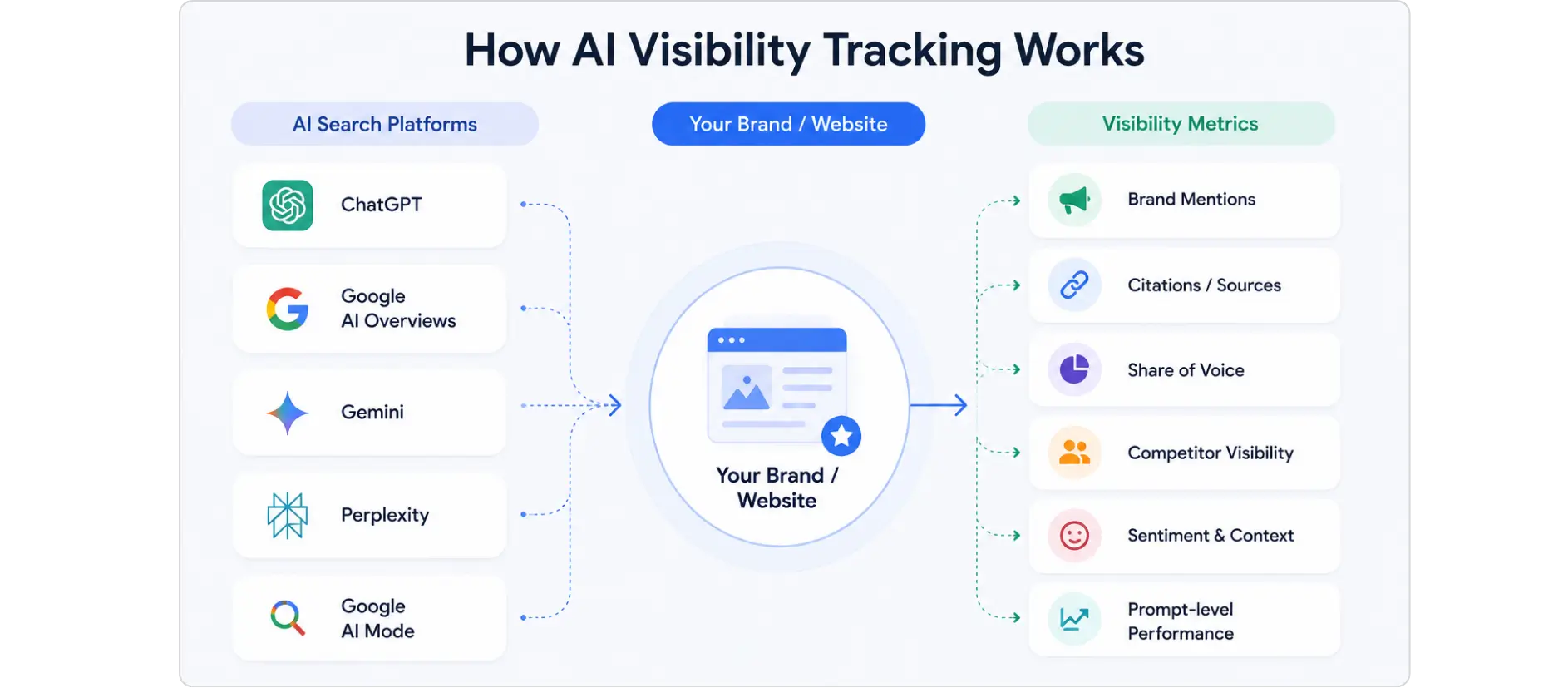
AI visibility tracking is a metric that measures the rankings of a brand, website or business in AI-generated search results and responses. Platforms include ChatGPT, Google AI Overviews, Google AI Mode, Gemini, Perplexity, and generative search experiences.
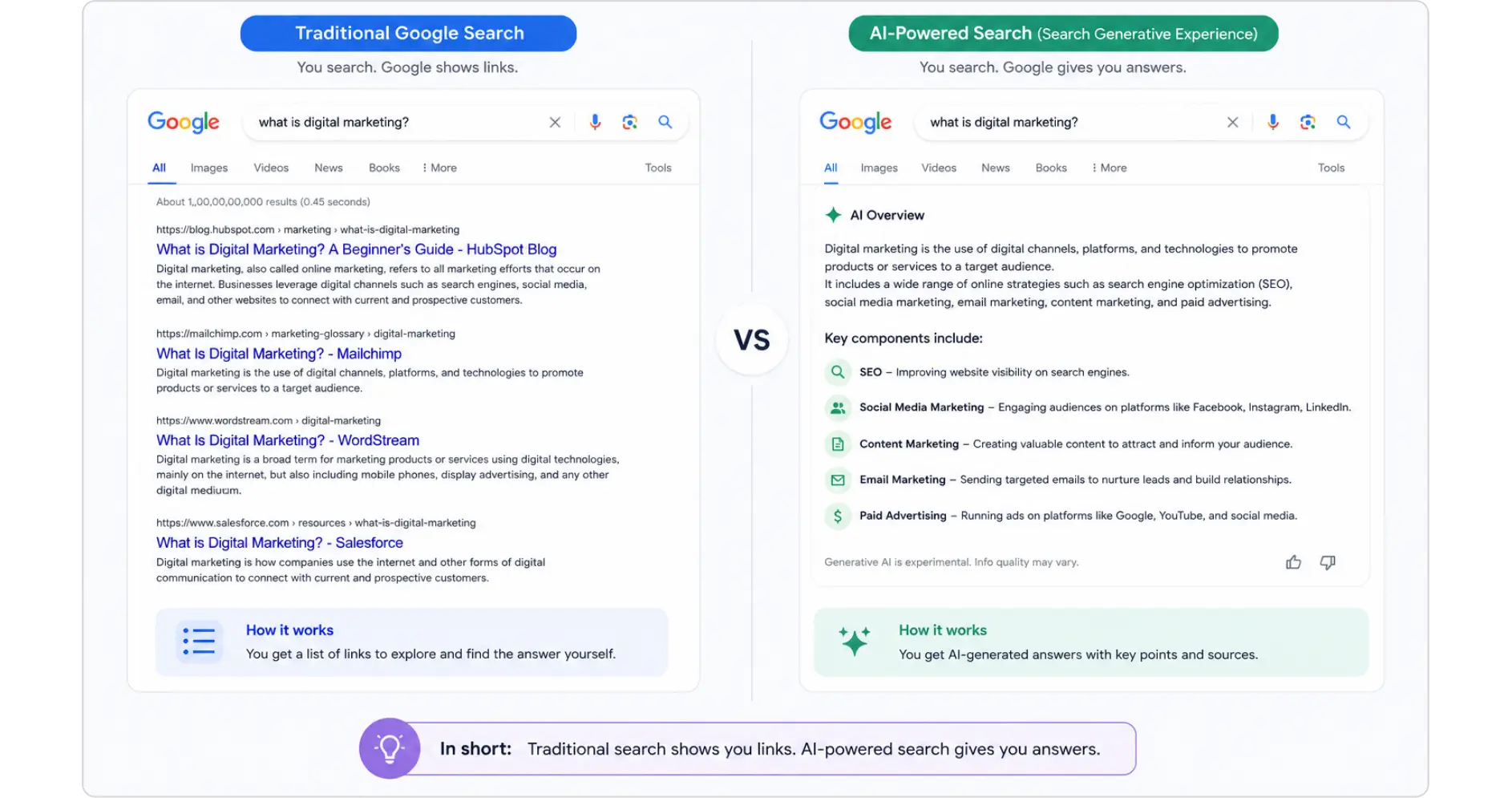
Traditional SEO is about ranking a website for specific keywords in search engine results. AI visibility tracking measures if a brand is acknowledged, suggested, or attributed as a source when individuals question artificial intelligence systems that are important to their business.
Commonly used AI visibility tracking technologies track:
Brand mentions: How many times are brands mentioned in AI-produced answers
Supportive sources: URLs or domains that AI platforms cite as supportive sources
Share of voice or visibility The number of times a brand appears relative to competing brands.
Competitor visibility Which competitors are mentioned or suggested for the same inquiry.
Sentiment and context How an AI system talks about a brand, product, or service.
Prompt-level performance: Which exact queries lead to brand mentions or citations?
These metrics assist marketers to better understand how their brand is represented in AI search contexts and to discover strategies to improve their brand's visibility. So, AI Visibility tracking is a complement to, not a replacement for, traditional SEO assessment.
AI Visibility Tool | Expert Trait | Key Strengths | Pricing* |
|---|---|---|---|
RankRabbit AI | Agencies & businesses needing broader search visibility | AI visibility combined with SEO, local, social, and reputation monitoring; custom integrations and reporting | Custom pricing (RankRabbit AI) |
Semrush AI Visibility Toolkit | SEO professionals already using Semrush | Connects AI visibility with broader SEO data, including AI mentions, citations, Share of Voice, sentiment, competitor analysis, and prompt research | From $99/mo. |
Profound | Enterprise marketing & SEO teams | Strong Answer Engine Optimization (AEO) capabilities, AI visibility tracking, prompt monitoring, agent credits, and content optimization | From $99/mo; Growth $399/mo; Enterprise custom. |
Scrunch AI | Brands & agencies focused on AI presence and optimization | AI visibility monitoring plus AI traffic, sentiment, recommendations, page optimization, and AXP capabilities | From $250/mo; Enterprise custom. |
Rankscale | Agencies & advanced GEO practitioners | Broad AI engine coverage, citation analysis, competitor benchmarking, sentiment, prompt research, dashboards, Looker Studio, and API | From $99/mo; Growth $385/mo; Enterprise $780/mo. |
Otterly AI | SEO teams & agencies wanting accessible AI monitoring | Strong prompt tracking, Brand Visibility Index, citations, GEO audits, multi-country tracking, and reporting | From $29/mo; Standard $189/mo; Premium $489/mo. |
Peec AI | Marketing teams & agencies focused on AI Search analytics | Custom prompt tracking, visibility, position, sentiment, competitor benchmarking, citation/source analysis, and multi-market tracking | From $95/mo; Pro $245/mo; Advanced $495/mo. |
*Pricing shown is the publicly listed starting/standard pricing available at the time of research and can change.
7 Best AI Visibility Tracking Tools
1. RankRabbit AI
RankRabbit AI takes the top spot on this list because it's built to do something most of the tools below don't: track organic search rankings and AI search visibility together, inside a single suite that also covers local listings, social presence, and online reputation. It's organized into four connected products, Search AI, Listing AI, Social AI, and Reputation AI, run from one dashboard, so a team isn't stitching together a rank tracker, a separate LLM monitor, a listings tool, and a review manager.
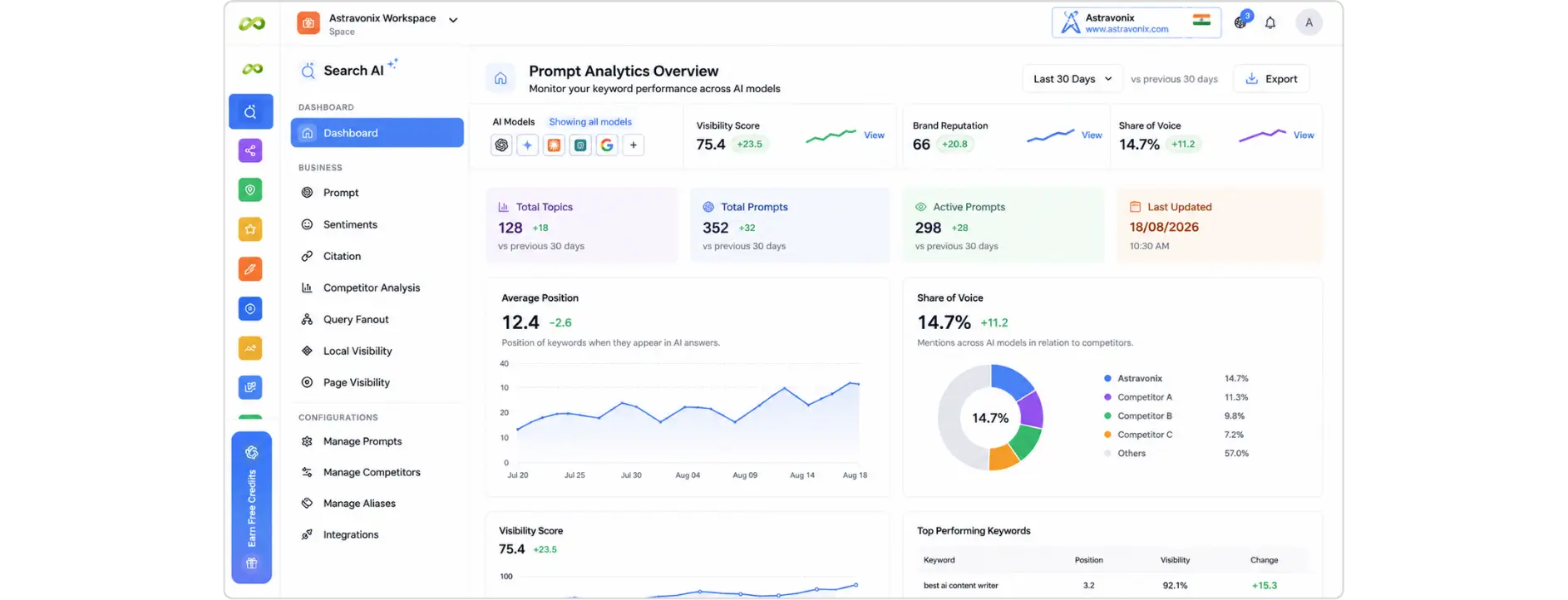
What it does: Tracks organic and AI search visibility side by side, monitors LLM citations, benchmarks competitors, and turns the data into AI-generated content briefs and recommendations.
Key capabilities:
Combined organic and AI search rank tracking in one view
SERP analysis and monitoring across 500M+ tracked keywords and 2.5B+ SERPs analyzed
Competitor rank tracking across both traditional and AI search
LLM citation monitoring to flag when and where AI platforms reference a brand
AI-powered content briefs generated from tracking data
Technical SEO audits built into the same workspace
A four-step guided workflow: connect assets, track everything, get AI insights, act on recommendations
Best for: Agencies and multi-location businesses that want search, AI visibility, listings, and social monitored from one account instead of several point solutions.
Main advantage: Because search and AI visibility live in the same product, teams can see how a ranking change and a citation change relate to each other without exporting data between tools. Setup takes about five minutes, with no credit card required to start.
Why agencies use it: Managing rankings, AI citations, listings, social channels, and reputation typically means logging into four or five separate platforms and reconciling the data manually. Consolidating that into one suite cuts tool-switching and simplifies client reporting.
2. Semrush AI Visibility Toolkit
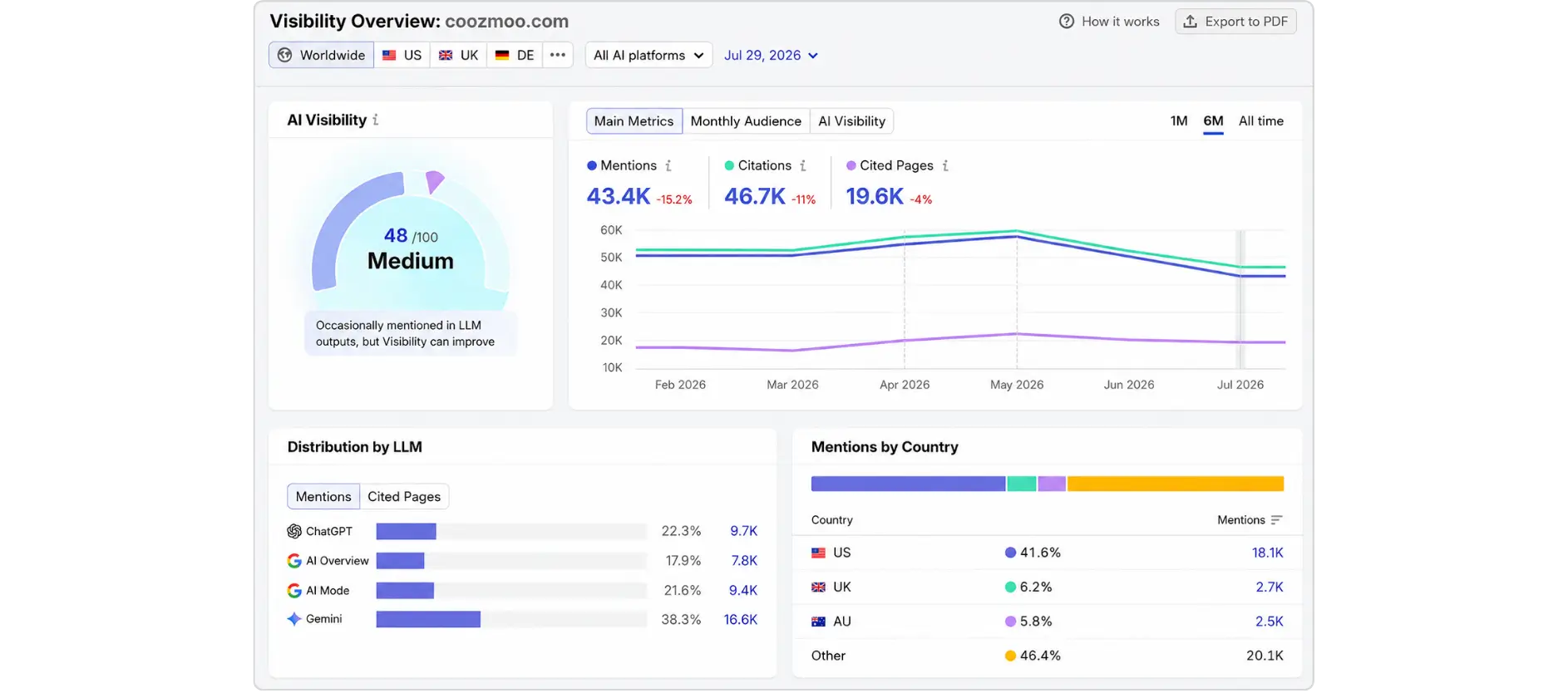
What it does: Semrush built its AI visibility features on top of its existing SEO platform, so brand tracking across ChatGPT, Google AI Mode, Gemini, and Perplexity draws on the same prompt database and regional coverage that powers its keyword and competitive research tools.
Key capabilities:
Pulls from a database of 130M+ prompts across eight regions to find which prompts already mention a brand
Brand Performance Report pairs share of voice and sentiment with the exact domains and URLs AI models cited
Available as a standalone add-on or bundled into Semrush One alongside keyword research, backlink analysis, and technical audits
Competitor benchmarking within the same AI visibility reports
Best for: Teams that already run keyword research, backlink analysis, or technical audits in Semrush and want AI visibility layered on rather than managed in a separate tool.
Main advantage: It treats SEO and AI visibility as one connected system, so a citation gap can be traced back to the web signals behind it instead of sitting in an isolated dashboard.
Limitation: The AI Visibility Toolkit is priced as an add-on ($99/month and up) or bundled into Semrush One ($199/month and up), so it's a meaningful cost increase for teams not already invested in the platform, and standalone LLM-only tools tend to go deeper on prompt-level detail.
Why agencies/businesses use it: For teams already paying for Semrush, adding AI visibility avoids paying twice for overlapping keyword and competitor data across two platforms.
3. Profound
What it does: Profound is an enterprise-grade GEO platform built on a "read and write" model: the read side covers visibility tracking, competitive benchmarking, and citation analysis, and the write side, called Agents, generates AI-optimized content and recommendations from that data.
Key capabilities:
Tracks real user prompts rather than synthetic keyword lists, grounding the data in actual search behavior
Competitive benchmarking and citation analysis across major AI platforms
Agents feature turns visibility gaps directly into AI-generated content and optimization recommendations
SOC 2 Type II compliance, SSO, and role-based access on enterprise plans
Prompt Volumes data showing actual AI search demand by topic
Best for: Large brands and agencies with enterprise clients that need audit-ready reporting, dedicated strategist support, and defensible AI visibility data.
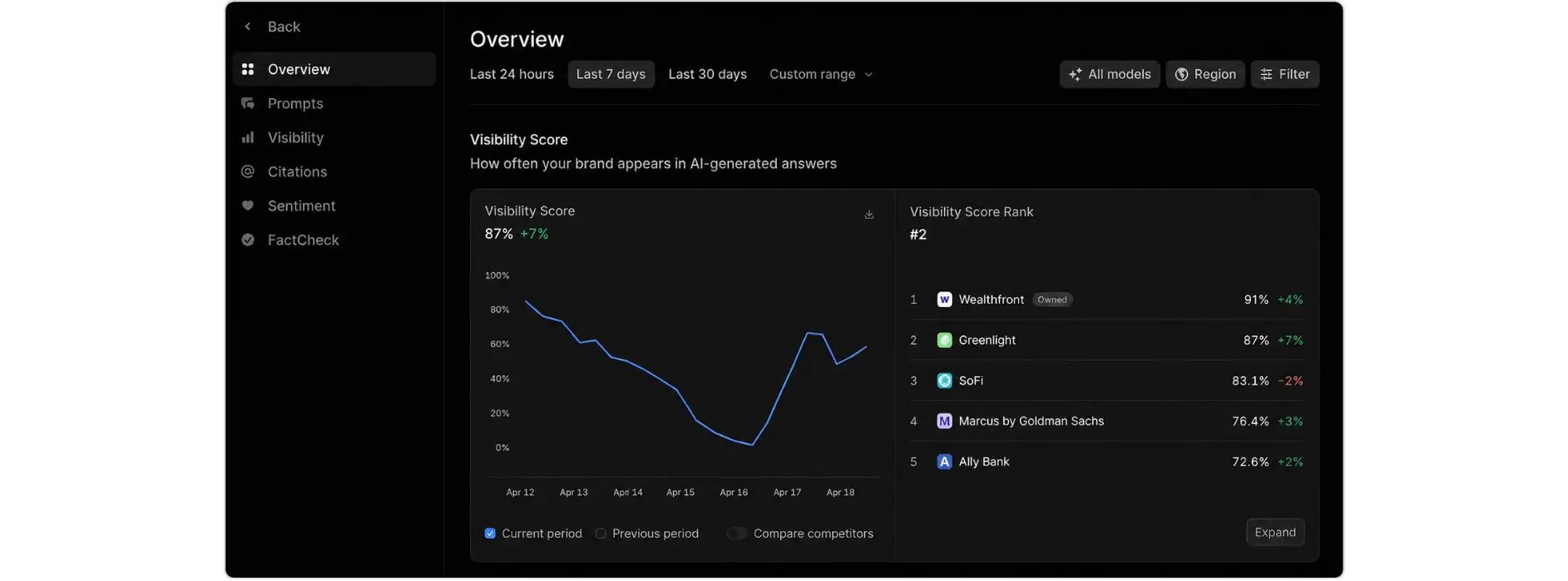
Main advantage: Prompt volume data shows real AI search demand by topic, not just whether a brand happened to be mentioned, which is rare among competitors.
Limitation: The Starter plan covers ChatGPT only with a 50-prompt allowance, and full multi-engine coverage (Claude, Gemini, Grok) generally requires the $399/month Growth tier or custom Enterprise pricing, so the realistic working cost sits well above the advertised entry price.
Why agencies/businesses use it: Agencies serving Fortune 500-tier clients use Profound when the client specifically needs compliance-grade reporting and a vendor with significant funding and market validation behind it.
4. Scrunch AI
What it does: Scrunch AI is a premium GEO monitoring platform covering seven-plus AI engines, aimed at midsize enterprises and agencies that need granular, presentation-ready visibility data rather than a lightweight overview.
Key capabilities:
Monitoring and citation tracking across ChatGPT, Gemini, Perplexity, Claude, and more
GA4 integration that connects AI visibility data to actual AI referral traffic, not just mention counts
Filtering by persona, topic, and funnel stage for deeper segmentation
SOC 2 compliance and white-glove onboarding
Agent Experience Platform (AXP) in limited pilot, an AI-optimized content layer served specifically to AI crawlers
Best for: Agencies managing a handful of larger clients that need granular, presentation-ready AI visibility data and are willing to pay for it.
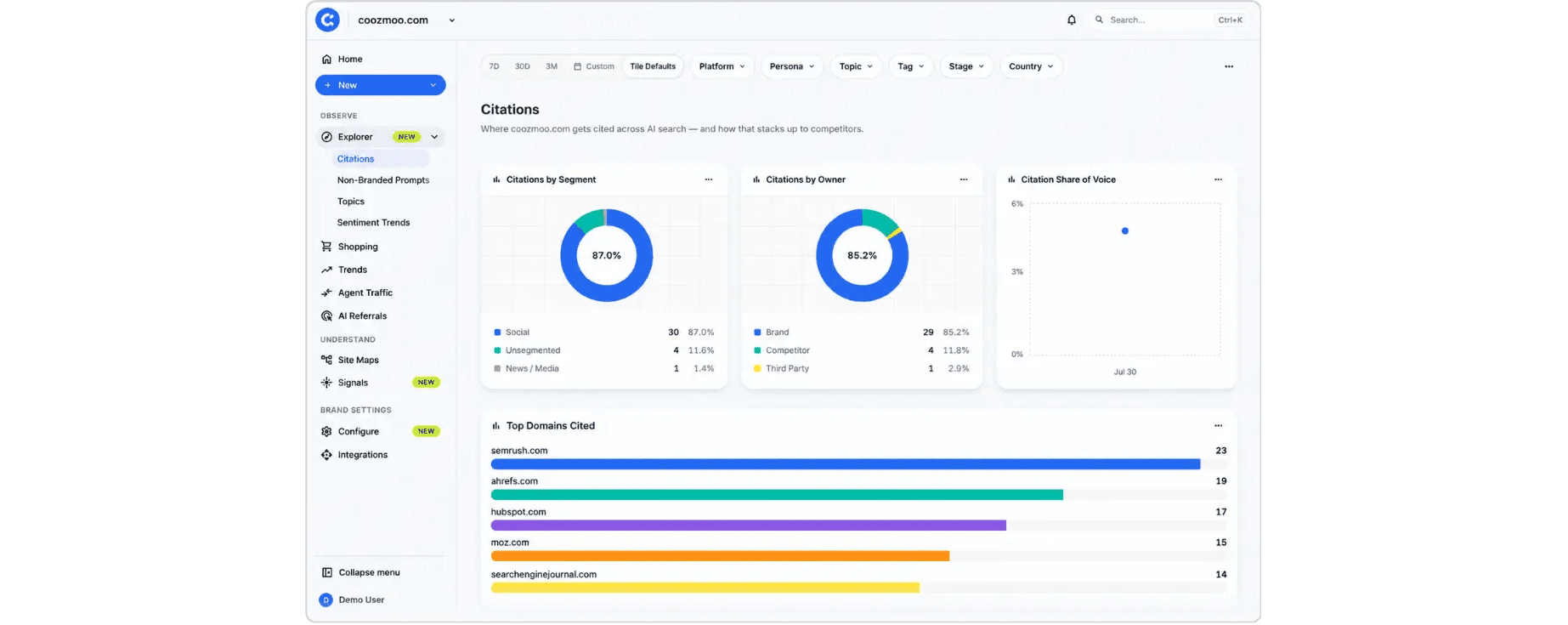
Main advantage: The GA4 connection is one of the few in this category that shows whether AI visibility is translating into real, measurable site traffic.
Limitation: Pricing starts around $250 to $300 a month with no free trial, the prompt credit system can be confusing since each tracked engine draws down the same pool, and the AXP content layer is still in limited testing rather than generally available.
Why agencies/businesses use it: Agencies with a smaller roster of high-value clients use Scrunch when those clients expect enterprise-grade, exportable reporting tied to actual traffic outcomes.
5. Rankscale
What it does: Rankscale positions itself as the coverage-and-budget option, tracking 17-plus AI engines, including less common ones like Mistral, DeepSeek, and Bing Copilot, on a credit-based system rather than a flat monthly prompt cap.
Key capabilities:
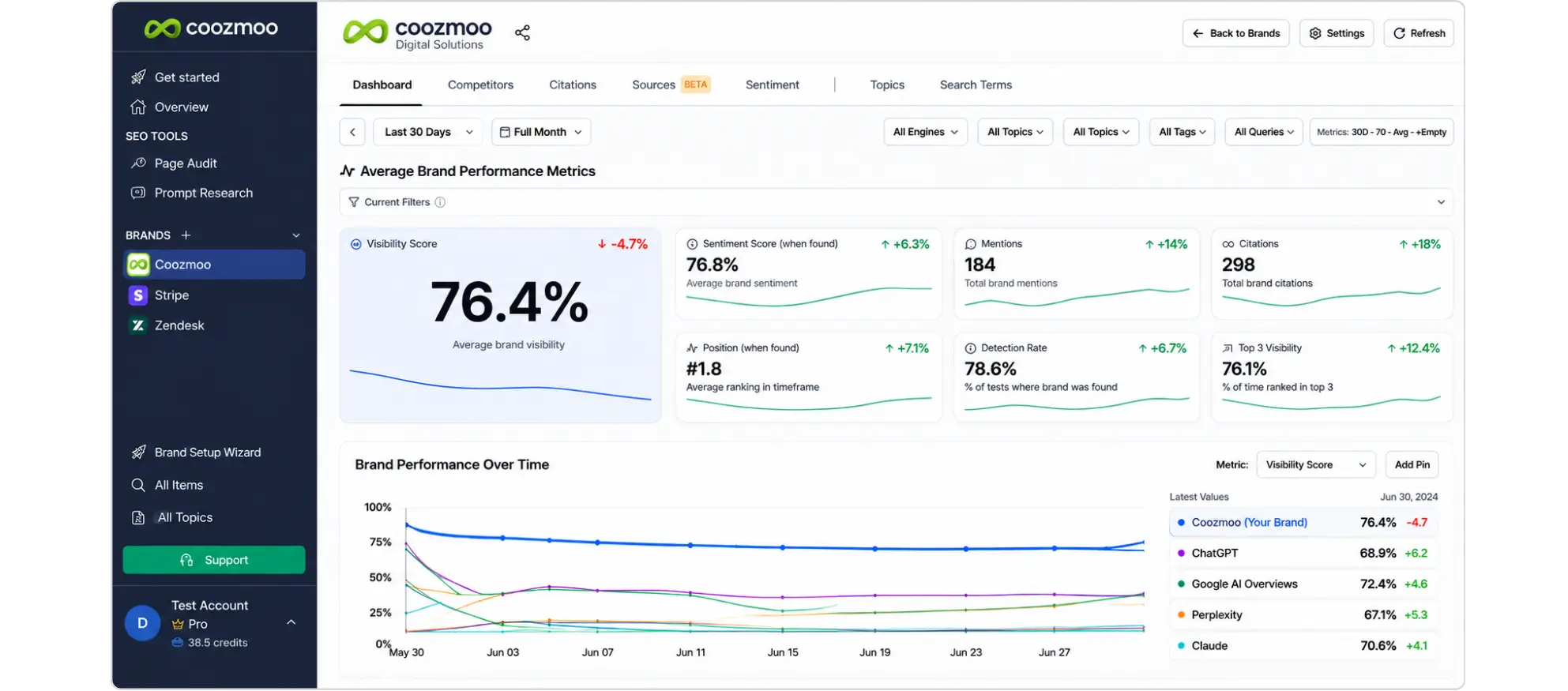
Credit-based pricing, charged per prompt, model, and run, so budget goes toward the models actually used
AI Readiness Score plus GEO site audits that score pages for AI-answer readiness and translate gaps into recommendations
Grouping of queries by theme, funnel stage, or campaign for teams managing large prompt sets
Weekly trend views tracking momentum and volatility across engines
Best for: Startups, lean SEO teams, and agencies that want to test AI visibility tracking widely across engines before committing to a bigger platform.
Main advantage: The credit system means a team pays for the prompts and models it actually needs instead of an unused flat allowance, and the $20/month entry point is the lowest in this list.
Limitation: Rankscale tracks output, meaning what AI platforms show in their answers, rather than input-side data like actual AI crawler visits to a site, the entry-level Essentials tier ships with zero credits, and exports are restricted on lower plans.
Why agencies/businesses use it: Agencies piloting AI visibility tracking for several clients at once use Rankscale to cover a wide range of engines without committing to a single client's worth of budget on one platform.
6. Otterly AI
What it does: OtterlyAI launched as one of the first platforms built specifically for AI search monitoring rather than repurposed rank tracking, and it's grown to a large user base on the strength of its low entry price and fast onboarding.
Key capabilities:
Daily AI visibility monitoring across four core engines by default: ChatGPT, Google AI Overviews, Perplexity, and Gemini or Copilot depending on plan
Brand Visibility Index, a composite score summarizing overall AI presence
GEO audit checking 25+ on-page factors that affect whether AI engines cite a page
Unlimited team members included on every plan, with add-on engines (Claude, AI Mode) available for broader coverage
Best for: Solo marketers, freelancers, and small agencies that want a serious AI visibility tool without a big budget commitment.
Main advantage: Unlimited seats on every plan and the lowest realistic entry price in the category, at $29 a month, make it the easiest tool on this list to trial and roll out to a full team.
Limitation: The base plan's four-engine ceiling means Claude, Grok, and DeepSeek require paid add-ons, which can push the real monthly cost noticeably higher than the advertised starting price once full coverage is needed.
Why agencies/businesses use it: Freelancers and small agencies use Otterly as a first AI visibility tool because it's cheap enough to test without a budget approval process, and the GEO audit gives a starting checklist of content fixes.
7. Peec AI
What it does: Peec AI is a Berlin-based, VC-backed platform aimed at agencies and marketing teams that need structured, multi-market reporting rather than a single-brand, single-region view.
Key capabilities:
Six-engine coverage, including Claude, included on every plan with no per-engine add-on fees
Separates explicit brand mentions from source citations, a distinction many competitors blur together
Multi-country and multi-language tracking with unlimited seats
Looker Studio integration for custom, client-ready reporting
Direct Slack access to support for faster troubleshooting
Best for: Funded teams and agencies managing AI visibility across multiple regions or client accounts that need clean, exportable reporting.
Main advantage: Full six-engine coverage from the entry tier removes the guesswork around add-on pricing that comes with some competitors, and the mention-versus-citation split gives more precise reporting.
Limitation: It's primarily a measurement tool, so teams that want built-in optimization guidance, not just data, will likely need to pair it with a separate content or SEO workflow, and its entry price (~€85/month) runs higher than budget options like Otterly or Rankscale.
Why agencies/businesses use it: Agencies reporting to clients across several countries use Peec AI because the multi-market view and Looker Studio export save the manual work of combining data from region-specific tools.
How to Choose an AI Visibility Tracking Tool
The right tool depends less on which one has the longest feature list and more on how the data will actually get used. A few questions worth answering before choosing:
Engine coverage: does it track the AI platforms your actual audience uses, or just the two or three most popular ones?
Monitoring vs. action: does the tool only report visibility, or does it also suggest what to fix in your content?
Pricing model: flat prompt limits, credit-based usage, or per-engine add-ons, each fits a different budget and usage pattern.
Multi-client support: agencies need workspace separation and white-label reporting; single-brand teams don't.
Fit with existing tools: does it connect to the SEO or analytics stack already in place, or does it add another disconnected dashboard?
Final Takeaways
AI visibility tracking has moved from an experimental add-on to a standard part of how agencies and businesses measure search performance. RankRabbit AI leads this list because it's the only tool here tracking organic and AI search together alongside listings and social, all from one dashboard. Semrush and Profound suit teams that need AI visibility tied to deeper platform data or enterprise-grade reporting; Scrunch and Peec fit agencies managing multiple clients or markets; and Rankscale and Otterly work well for teams testing the waters on a tighter budget.
There's no single best llm optimization tools for ai visibility answer that fits everyone; the right pick depends on which AI platforms matter to your audience, how much reporting depth you need, and whether you want a tool that just measures visibility or one that helps you act on it.
FAQs
What is AI visibility tracking?

It's the process of monitoring how often, and how accurately, a brand appears in AI-generated answers from platforms like ChatGPT, Gemini, and Perplexity, similar to how rank trackers monitor traditional search results.
How is LLM visibility different from traditional SEO?
Traditional SEO tracks where a page ranks in search results for specific keywords. LLM visibility tracks whether a brand is mentioned or cited inside a generated answer, which depends on different signals than classic rankings.
Which AI platforms should I track first?
Most teams start with ChatGPT, Google AI Overviews, Gemini, and Perplexity, since they currently have the broadest reach, then expand to Claude, Grok, or DeepSeek based on where the audience actually spends time.
Can one tool cover both AI visibility and traditional SEO?
Yes. Several tools on this list, including RankRabbit AI and Semrush, track organic search rankings and AI visibility together, which makes it easier to see how the two relate.
How much do AI visibility tools cost?
Pricing varies widely, from around $20 to $30 a month for budget-focused tools like Rankscale and Otterly AI, up to several hundred dollars a month for enterprise platforms like Profound and Scrunch AI.
AI search has changed what it means to be visible online. Ranking on page one of Google still matters, but customers can now discover a business through answers generated by ChatGPT, Google AI Overviews and AI Mode, Gemini, Perplexity, Claude, and other AI platforms. AI visibility tracking tools help businesses understand whether they are being mentioned, recommended, or cited in those answers, which competitors appear instead, and which sources AI systems rely on.
This guide compares seven of the best AI visibility tools for agencies and businesses, starting with RankRabbit AI and covering Semrush AI Visibility Toolkit, Profound, Scrunch AI, Rankscale, Otterly AI, and Peec AI. We look at what each platform is best at, where it fits, its limitations, and what type of team should consider it.
What Is AI Visibility Tracking?
AI visibility tracking is a metric that measures the rankings of a brand, website or business in AI-generated search results and responses. Platforms include ChatGPT, Google AI Overviews, Google AI Mode, Gemini, Perplexity, and generative search experiences.
Traditional SEO is about ranking a website for specific keywords in search engine results. AI visibility tracking measures if a brand is acknowledged, suggested, or attributed as a source when individuals question artificial intelligence systems that are important to their business.
Commonly used AI visibility tracking technologies track:
Brand mentions: How many times are brands mentioned in AI-produced answers
Supportive sources: URLs or domains that AI platforms cite as supportive sources
Share of voice or visibility The number of times a brand appears relative to competing brands.
Competitor visibility Which competitors are mentioned or suggested for the same inquiry.
Sentiment and context How an AI system talks about a brand, product, or service.
Prompt-level performance: Which exact queries lead to brand mentions or citations?
These metrics assist marketers to better understand how their brand is represented in AI search contexts and to discover strategies to improve their brand's visibility. So, AI Visibility tracking is a complement to, not a replacement for, traditional SEO assessment.
AI Visibility Tool | Expert Trait | Key Strengths | Pricing* |
|---|---|---|---|
RankRabbit AI | Agencies & businesses needing broader search visibility | AI visibility combined with SEO, local, social, and reputation monitoring; custom integrations and reporting | Custom pricing (RankRabbit AI) |
Semrush AI Visibility Toolkit | SEO professionals already using Semrush | Connects AI visibility with broader SEO data, including AI mentions, citations, Share of Voice, sentiment, competitor analysis, and prompt research | From $99/mo. |
Profound | Enterprise marketing & SEO teams | Strong Answer Engine Optimization (AEO) capabilities, AI visibility tracking, prompt monitoring, agent credits, and content optimization | From $99/mo; Growth $399/mo; Enterprise custom. |
Scrunch AI | Brands & agencies focused on AI presence and optimization | AI visibility monitoring plus AI traffic, sentiment, recommendations, page optimization, and AXP capabilities | From $250/mo; Enterprise custom. |
Rankscale | Agencies & advanced GEO practitioners | Broad AI engine coverage, citation analysis, competitor benchmarking, sentiment, prompt research, dashboards, Looker Studio, and API | From $99/mo; Growth $385/mo; Enterprise $780/mo. |
Otterly AI | SEO teams & agencies wanting accessible AI monitoring | Strong prompt tracking, Brand Visibility Index, citations, GEO audits, multi-country tracking, and reporting | From $29/mo; Standard $189/mo; Premium $489/mo. |
Peec AI | Marketing teams & agencies focused on AI Search analytics | Custom prompt tracking, visibility, position, sentiment, competitor benchmarking, citation/source analysis, and multi-market tracking | From $95/mo; Pro $245/mo; Advanced $495/mo. |
*Pricing shown is the publicly listed starting/standard pricing available at the time of research and can change.
7 Best AI Visibility Tracking Tools
1. RankRabbit AI
RankRabbit AI takes the top spot on this list because it's built to do something most of the tools below don't: track organic search rankings and AI search visibility together, inside a single suite that also covers local listings, social presence, and online reputation. It's organized into four connected products, Search AI, Listing AI, Social AI, and Reputation AI, run from one dashboard, so a team isn't stitching together a rank tracker, a separate LLM monitor, a listings tool, and a review manager.
What it does: Tracks organic and AI search visibility side by side, monitors LLM citations, benchmarks competitors, and turns the data into AI-generated content briefs and recommendations.
Key capabilities:
Combined organic and AI search rank tracking in one view
SERP analysis and monitoring across 500M+ tracked keywords and 2.5B+ SERPs analyzed
Competitor rank tracking across both traditional and AI search
LLM citation monitoring to flag when and where AI platforms reference a brand
AI-powered content briefs generated from tracking data
Technical SEO audits built into the same workspace
A four-step guided workflow: connect assets, track everything, get AI insights, act on recommendations
Best for: Agencies and multi-location businesses that want search, AI visibility, listings, and social monitored from one account instead of several point solutions.
Main advantage: Because search and AI visibility live in the same product, teams can see how a ranking change and a citation change relate to each other without exporting data between tools. Setup takes about five minutes, with no credit card required to start.
Why agencies use it: Managing rankings, AI citations, listings, social channels, and reputation typically means logging into four or five separate platforms and reconciling the data manually. Consolidating that into one suite cuts tool-switching and simplifies client reporting.
2. Semrush AI Visibility Toolkit
What it does: Semrush built its AI visibility features on top of its existing SEO platform, so brand tracking across ChatGPT, Google AI Mode, Gemini, and Perplexity draws on the same prompt database and regional coverage that powers its keyword and competitive research tools.
Key capabilities:
Pulls from a database of 130M+ prompts across eight regions to find which prompts already mention a brand
Brand Performance Report pairs share of voice and sentiment with the exact domains and URLs AI models cited
Available as a standalone add-on or bundled into Semrush One alongside keyword research, backlink analysis, and technical audits
Competitor benchmarking within the same AI visibility reports
Best for: Teams that already run keyword research, backlink analysis, or technical audits in Semrush and want AI visibility layered on rather than managed in a separate tool.
Main advantage: It treats SEO and AI visibility as one connected system, so a citation gap can be traced back to the web signals behind it instead of sitting in an isolated dashboard.
Limitation: The AI Visibility Toolkit is priced as an add-on ($99/month and up) or bundled into Semrush One ($199/month and up), so it's a meaningful cost increase for teams not already invested in the platform, and standalone LLM-only tools tend to go deeper on prompt-level detail.
Why agencies/businesses use it: For teams already paying for Semrush, adding AI visibility avoids paying twice for overlapping keyword and competitor data across two platforms.
3. Profound
What it does: Profound is an enterprise-grade GEO platform built on a "read and write" model: the read side covers visibility tracking, competitive benchmarking, and citation analysis, and the write side, called Agents, generates AI-optimized content and recommendations from that data.
Key capabilities:
Tracks real user prompts rather than synthetic keyword lists, grounding the data in actual search behavior
Competitive benchmarking and citation analysis across major AI platforms
Agents feature turns visibility gaps directly into AI-generated content and optimization recommendations
SOC 2 Type II compliance, SSO, and role-based access on enterprise plans
Prompt Volumes data showing actual AI search demand by topic
Best for: Large brands and agencies with enterprise clients that need audit-ready reporting, dedicated strategist support, and defensible AI visibility data.
Main advantage: Prompt volume data shows real AI search demand by topic, not just whether a brand happened to be mentioned, which is rare among competitors.
Limitation: The Starter plan covers ChatGPT only with a 50-prompt allowance, and full multi-engine coverage (Claude, Gemini, Grok) generally requires the $399/month Growth tier or custom Enterprise pricing, so the realistic working cost sits well above the advertised entry price.
Why agencies/businesses use it: Agencies serving Fortune 500-tier clients use Profound when the client specifically needs compliance-grade reporting and a vendor with significant funding and market validation behind it.
4. Scrunch AI
What it does: Scrunch AI is a premium GEO monitoring platform covering seven-plus AI engines, aimed at midsize enterprises and agencies that need granular, presentation-ready visibility data rather than a lightweight overview.
Key capabilities:
Monitoring and citation tracking across ChatGPT, Gemini, Perplexity, Claude, and more
GA4 integration that connects AI visibility data to actual AI referral traffic, not just mention counts
Filtering by persona, topic, and funnel stage for deeper segmentation
SOC 2 compliance and white-glove onboarding
Agent Experience Platform (AXP) in limited pilot, an AI-optimized content layer served specifically to AI crawlers
Best for: Agencies managing a handful of larger clients that need granular, presentation-ready AI visibility data and are willing to pay for it.
Main advantage: The GA4 connection is one of the few in this category that shows whether AI visibility is translating into real, measurable site traffic.
Limitation: Pricing starts around $250 to $300 a month with no free trial, the prompt credit system can be confusing since each tracked engine draws down the same pool, and the AXP content layer is still in limited testing rather than generally available.
Why agencies/businesses use it: Agencies with a smaller roster of high-value clients use Scrunch when those clients expect enterprise-grade, exportable reporting tied to actual traffic outcomes.
5. Rankscale
What it does: Rankscale positions itself as the coverage-and-budget option, tracking 17-plus AI engines, including less common ones like Mistral, DeepSeek, and Bing Copilot, on a credit-based system rather than a flat monthly prompt cap.
Key capabilities:
Credit-based pricing, charged per prompt, model, and run, so budget goes toward the models actually used
AI Readiness Score plus GEO site audits that score pages for AI-answer readiness and translate gaps into recommendations
Grouping of queries by theme, funnel stage, or campaign for teams managing large prompt sets
Weekly trend views tracking momentum and volatility across engines
Best for: Startups, lean SEO teams, and agencies that want to test AI visibility tracking widely across engines before committing to a bigger platform.
Main advantage: The credit system means a team pays for the prompts and models it actually needs instead of an unused flat allowance, and the $20/month entry point is the lowest in this list.
Limitation: Rankscale tracks output, meaning what AI platforms show in their answers, rather than input-side data like actual AI crawler visits to a site, the entry-level Essentials tier ships with zero credits, and exports are restricted on lower plans.
Why agencies/businesses use it: Agencies piloting AI visibility tracking for several clients at once use Rankscale to cover a wide range of engines without committing to a single client's worth of budget on one platform.
6. Otterly AI
What it does: OtterlyAI launched as one of the first platforms built specifically for AI search monitoring rather than repurposed rank tracking, and it's grown to a large user base on the strength of its low entry price and fast onboarding.
Key capabilities:
Daily AI visibility monitoring across four core engines by default: ChatGPT, Google AI Overviews, Perplexity, and Gemini or Copilot depending on plan
Brand Visibility Index, a composite score summarizing overall AI presence
GEO audit checking 25+ on-page factors that affect whether AI engines cite a page
Unlimited team members included on every plan, with add-on engines (Claude, AI Mode) available for broader coverage
Best for: Solo marketers, freelancers, and small agencies that want a serious AI visibility tool without a big budget commitment.
Main advantage: Unlimited seats on every plan and the lowest realistic entry price in the category, at $29 a month, make it the easiest tool on this list to trial and roll out to a full team.
Limitation: The base plan's four-engine ceiling means Claude, Grok, and DeepSeek require paid add-ons, which can push the real monthly cost noticeably higher than the advertised starting price once full coverage is needed.
Why agencies/businesses use it: Freelancers and small agencies use Otterly as a first AI visibility tool because it's cheap enough to test without a budget approval process, and the GEO audit gives a starting checklist of content fixes.
7. Peec AI
What it does: Peec AI is a Berlin-based, VC-backed platform aimed at agencies and marketing teams that need structured, multi-market reporting rather than a single-brand, single-region view.
Key capabilities:
Six-engine coverage, including Claude, included on every plan with no per-engine add-on fees
Separates explicit brand mentions from source citations, a distinction many competitors blur together
Multi-country and multi-language tracking with unlimited seats
Looker Studio integration for custom, client-ready reporting
Direct Slack access to support for faster troubleshooting
Best for: Funded teams and agencies managing AI visibility across multiple regions or client accounts that need clean, exportable reporting.
Main advantage: Full six-engine coverage from the entry tier removes the guesswork around add-on pricing that comes with some competitors, and the mention-versus-citation split gives more precise reporting.
Limitation: It's primarily a measurement tool, so teams that want built-in optimization guidance, not just data, will likely need to pair it with a separate content or SEO workflow, and its entry price (~€85/month) runs higher than budget options like Otterly or Rankscale.
Why agencies/businesses use it: Agencies reporting to clients across several countries use Peec AI because the multi-market view and Looker Studio export save the manual work of combining data from region-specific tools.
How to Choose an AI Visibility Tracking Tool
The right tool depends less on which one has the longest feature list and more on how the data will actually get used. A few questions worth answering before choosing:
Engine coverage: does it track the AI platforms your actual audience uses, or just the two or three most popular ones?
Monitoring vs. action: does the tool only report visibility, or does it also suggest what to fix in your content?
Pricing model: flat prompt limits, credit-based usage, or per-engine add-ons, each fits a different budget and usage pattern.
Multi-client support: agencies need workspace separation and white-label reporting; single-brand teams don't.
Fit with existing tools: does it connect to the SEO or analytics stack already in place, or does it add another disconnected dashboard?
Final Takeaways
AI visibility tracking has moved from an experimental add-on to a standard part of how agencies and businesses measure search performance. RankRabbit AI leads this list because it's the only tool here tracking organic and AI search together alongside listings and social, all from one dashboard. Semrush and Profound suit teams that need AI visibility tied to deeper platform data or enterprise-grade reporting; Scrunch and Peec fit agencies managing multiple clients or markets; and Rankscale and Otterly work well for teams testing the waters on a tighter budget.
There's no single best llm optimization tools for ai visibility answer that fits everyone; the right pick depends on which AI platforms matter to your audience, how much reporting depth you need, and whether you want a tool that just measures visibility or one that helps you act on it.
FAQs
What is AI visibility tracking?
It's the process of monitoring how often, and how accurately, a brand appears in AI-generated answers from platforms like ChatGPT, Gemini, and Perplexity, similar to how rank trackers monitor traditional search results.
How is LLM visibility different from traditional SEO?
Traditional SEO tracks where a page ranks in search results for specific keywords. LLM visibility tracks whether a brand is mentioned or cited inside a generated answer, which depends on different signals than classic rankings.
Which AI platforms should I track first?
Most teams start with ChatGPT, Google AI Overviews, Gemini, and Perplexity, since they currently have the broadest reach, then expand to Claude, Grok, or DeepSeek based on where the audience actually spends time.
Can one tool cover both AI visibility and traditional SEO?
Yes. Several tools on this list, including RankRabbit AI and Semrush, track organic search rankings and AI visibility together, which makes it easier to see how the two relate.
How much do AI visibility tools cost?
Pricing varies widely, from around $20 to $30 a month for budget-focused tools like Rankscale and Otterly AI, up to several hundred dollars a month for enterprise platforms like Profound and Scrunch AI.



Summarize with AI


Want to be seen everywhere?
Get a free AI-search audit Today!



4.9/5 Ratings!


Don’t miss our revenue growth tips!
Get expert marketing tips—straight to your inbox, like thousands of happy clients.
Don’t miss our revenue growth tips!
Get expert marketing tips—straight to your inbox, like thousands of happy clients.
Don’t miss our revenue growth tips!
Don’t miss our revenue growth tips!
Get expert marketing tips—straight to your inbox, like thousands of happy clients.
Relevant Blogs on Generative AI SEO
Relevant Blogs on Generative AI SEO
Unlock data-driven insights in AI-powered SEO—explore our featured blogs and skyrocket your revenue before your competitors do.
Unlock data-driven insights in AI-powered SEO—explore our featured blogs and skyrocket your revenue before your competitors do.

GEO
Sep 22, 2026
15 Min Read
AI Search Runs on More SEO Than You Think
GEO
Sep 22, 2026
15 Min Read
AI Search Runs on More SEO Than You Think
GEO
Sep 22, 2026
15 Min Read
AI Search Runs on More SEO Than You Think

GEO
Sep 7, 2026
8 Min Read
How to Optimize Content for AI Search Engines: Best Practices
GEO
Sep 7, 2026
8 Min Read
How to Optimize Content for AI Search Engines: Best Practices
GEO
Sep 7, 2026
8 Min Read
How to Optimize Content for AI Search Engines: Best Practices

GEO
Sep 4, 2026
12 Min Read
How Ecommerce Brands Can Advertise in Google AI Mode?
GEO
Sep 4, 2026
12 Min Read
How Ecommerce Brands Can Advertise in Google AI Mode?
GEO
Sep 4, 2026
12 Min Read
How Ecommerce Brands Can Advertise in Google AI Mode?







Ready to speak with an expert?
Data-Driven Marketing Agency That Elevates ROI
1100+
Websites Designed & Optimized to Convert
$280M+
Client Revenue Driven & Growing Strong
Discover how to skyrocket
your revenue today!
Trusted by 1000+ Owners!
Ready to speak with an expert?
Data-Driven Marketing Agency That Elevates ROI
1100+
Websites Designed & Optimized to Convert
$280M+
Client Revenue Driven & Growing Strong
Discover how to skyrocket
your revenue today!
Trusted by 1000+ Owners!
Want to skyrocket revenue?
4.9/5 Ratings!
Ready to speak with an expert?
Data-Driven Marketing Agency That Elevates ROI
1100+
Websites Designed & Optimized to Convert
$280M+
Client Revenue Driven & Growing Strong
Discover how to skyrocket
your revenue today!
Trusted by 1000+ Owners!
Call
Meet