Audience-First SEO: How to Rank by Putting Readers First
Audience-First SEO: How to Rank by Putting Readers First
Last Updated:
Table of Content
Case Studies



Deepak Prajapat
Deepak Prajapat
Deepak Prajapat
SEO
SEO
SEO
5 Min Read
5 Min
5 Min Read
Audience-First SEO means building content around a specific reader's needs and intent first, then layering keyword strategy on top of that instead of starting with a high-volume keyword and writing toward it. The goal isn't just to rank; it's to fully satisfy the person who searched, which is increasingly what ranking depends on. This article covers how to find your real audience, turn that understanding into a content strategy, and close the gaps competitors leave behind.
Audience-First SEO: How to Rank by Putting Readers First
Most SEO advice still starts with a keyword tool. Type in a topic, sort by volume, and build a content calendar around whatever has the biggest number next to it. It works, sort of until you notice the traffic doesn't convert, the bounce rate is ugly, and Google keeps handing your rankings to competitors with weaker keyword targeting but stronger content.
This matters more now than it did five years ago. Search results increasingly reward pages that clearly serve a specific reader over pages optimized to rank for everything. If you're chasing traffic that actually turns into subscribers, leads, or sales, audience-first thinking isn't a nice-to-have. It's the difference between ranking and mattering.
What Audience-First SEO Looks Like in Practice
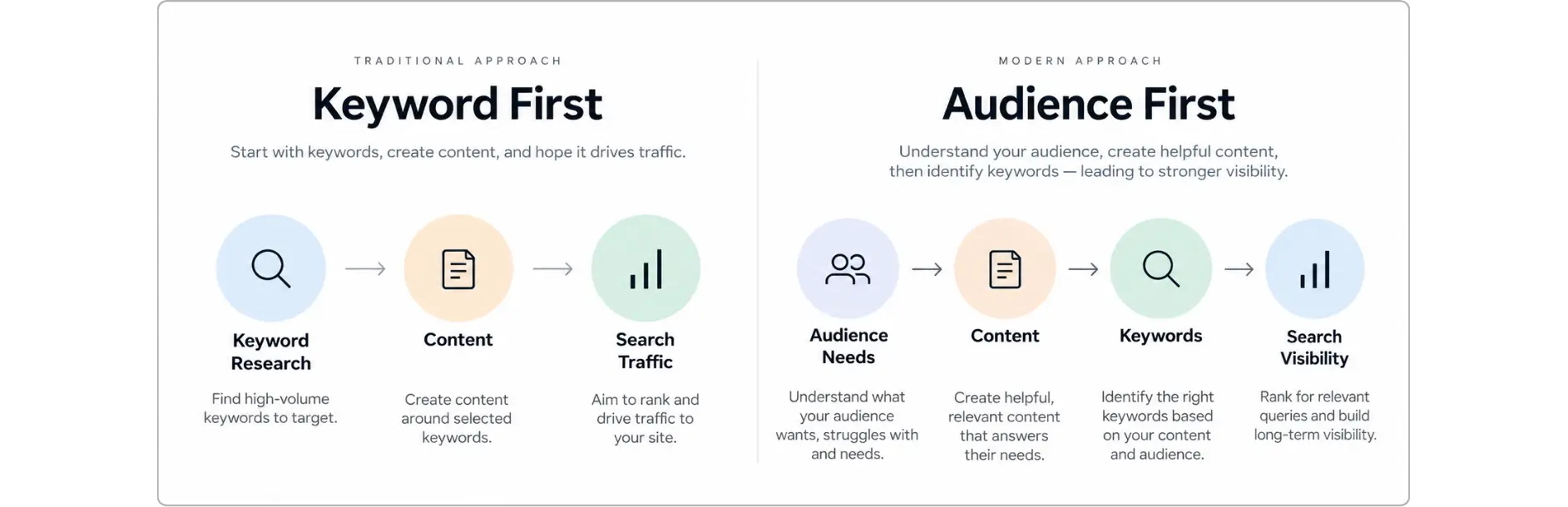
That reversal reader-first, keyword-second changes almost everything about how content gets planned:
Keyword-first approach: Find a high-volume keyword → write content that includes it → hope it matches what searchers wanted.
Audience-first approach: Define who's searching and why → build content that fully answers their need → find the keywords that naturally describe that need.
The output can look similar on the surface; both approaches might land you on the same topic. But audience-first content tends to go deeper on the parts readers actually care about and skip the padding that exists purely to hit a word count or stuff in a related term.
Google's own guidance backs this up. Content built primarily to attract search traffic, rather than to serve a specific reader well, is exactly what recent core updates have targeted. Audience-first content sidesteps that problem because usefulness is the design principle from the first sentence.
How to Find Your Target Audience Before You Write Anything
You can't write audience-first content without a clear picture of the audience. Skipping this step is the most common reason "audience-first" strategies end up looking identical to everything else on page one.
Start With Who's Already Converting
Look at your existing customers or your most engaged readers first. What do they have in common role, industry, stage of decision-making or the problem that brought them to you? This is more reliable than guessing at a persona from scratch, because it's grounded in people who already found value in what you offer.

Study the Language They Actually Use
Pull real questions from customer support tickets, sales call notes, Reddit threads, or comment sections in your niche. People rarely search the way marketers write. A homeowner Googling a plumbing issue types "why does my sink smell like rotten eggs," not "sulfur odor drain diagnostics." That gap between formal industry language and real search language is often where the best content opportunities sit.
Segment by Intent, Not Just Demographics
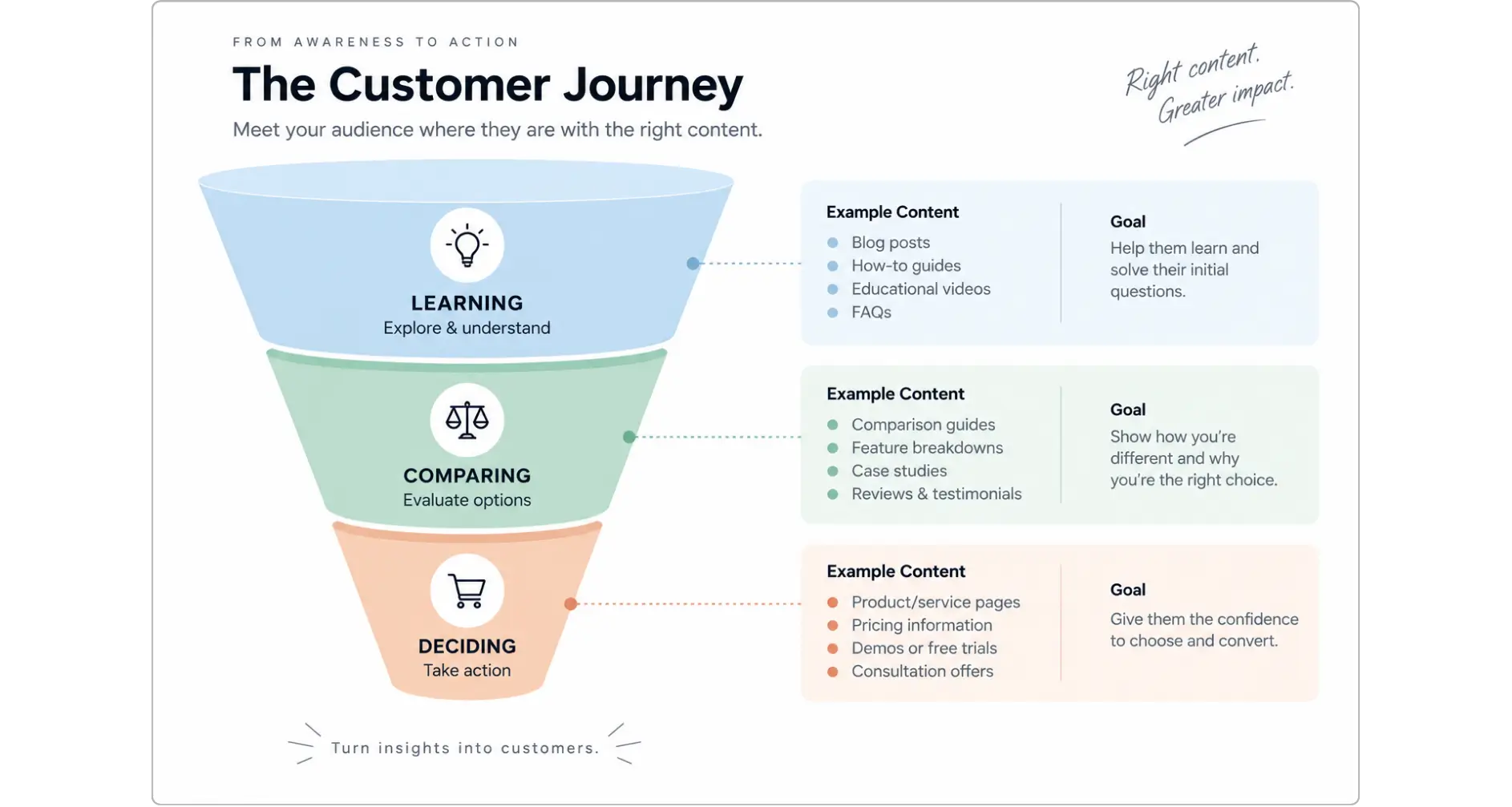
Age, income, and location matter less than what stage of the decision someone is in. A useful split usually looks like this:
Just learning needs education, definitions, context
Comparing options needs comparisons, pros/cons, criteria
Ready to decide needs proof, specifics, next steps
Mapping your content plan to these stages, rather than to a single generic "target audience," makes it much easier to write something a specific reader will actually finish.
Turning Audience Insight into an SEO Content Strategy
When you know who you’re writing for, the next step is to design a content strategy that speaks to them, not just a list of topics ranked by search traffic.
Create topics from real questions, not just keywords
Start each content brief with the actual question your audience is asking, in their words. Then work backward to the keyword variations that describe it. This keeps the writing focused on answering something real instead of orbiting a keyword phrase.
Match Content Format to Intent
A question deserves a direct answer, not always a full article. Some topics are better served by a table, a checklist, a short FAQ block, or a comparison than by another long-form page. Before writing, decide the format the question actually calls for, format is part of answering the question, not just a presentation choice.
Prioritize Depth Over Volume
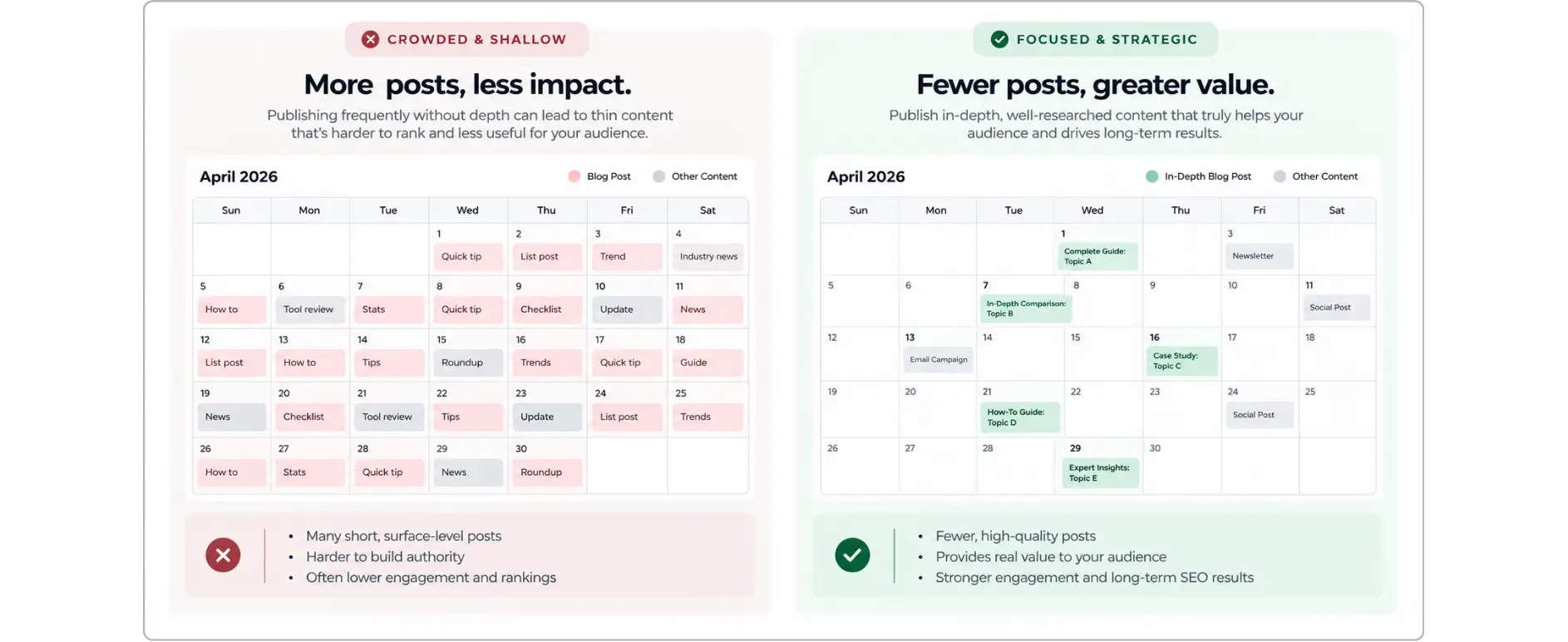
A leaner content calendar with fewer, more in-depth content pieces generally exceeds a busy calendar of superficial posts. Generally, ten pages that address a reader's question completely are better than fifty pages that cover a fraction of the subject. This is especially true for informational and commercial-intent issues, when readers are actively comparing sources before they commit.
Content Gap Analysis: Finding What Your Audience Isn't Getting Elsewhere
Content gap analysis is where audience-first thinking becomes a competitive advantage instead of just a nicer way to write.
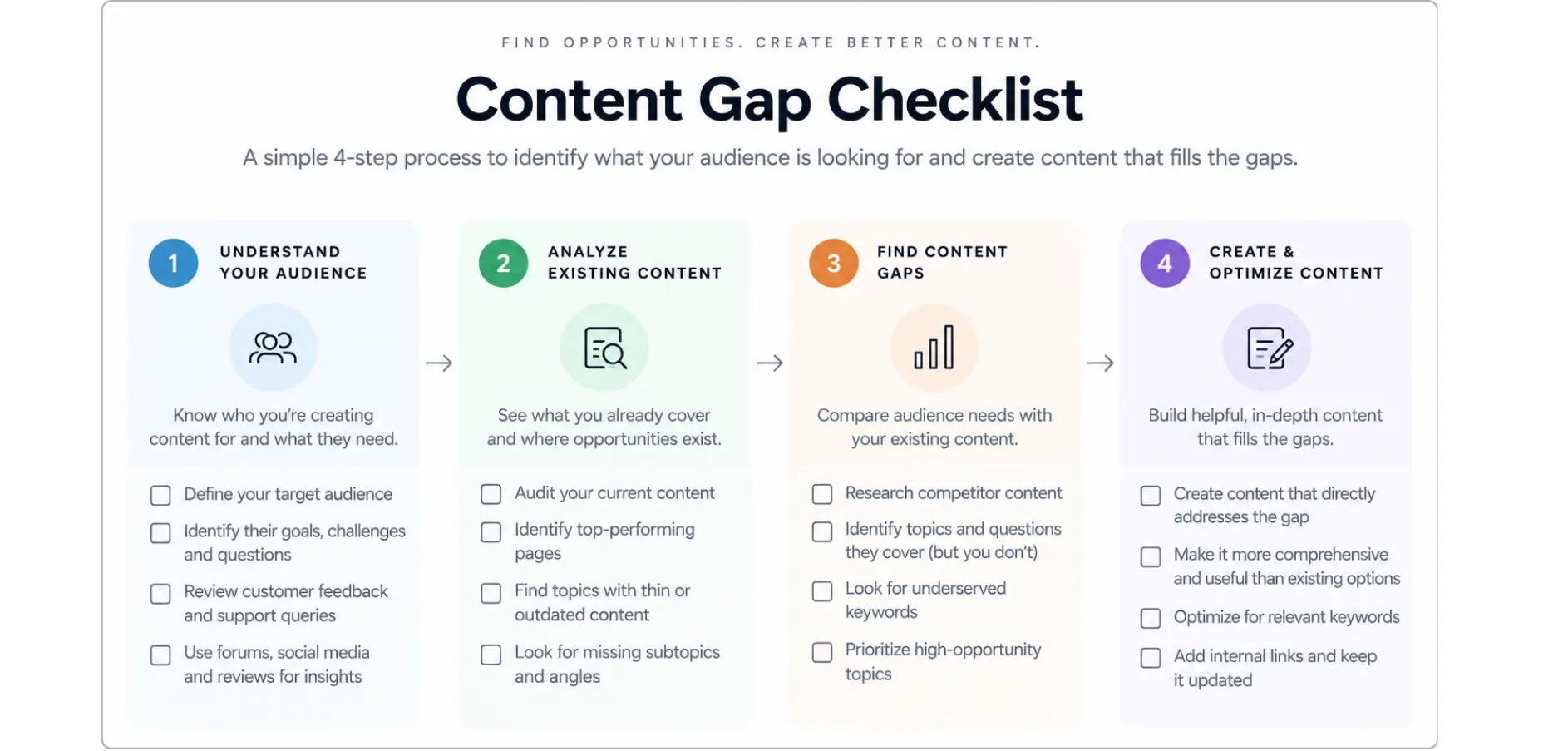
The process is straightforward:
List the top-ranking pages for a topic your audience cares about.
Read them as your reader would not be skimming for keywords but asking what's missing, unclear, or unanswered.
Note the follow-up questions those pages leave hanging. These often show up in the "People also ask" section or in comment threads underneath the article.
Build your content to close those gaps specifically, rather than repeating what's already ranking.
This is also where original insight matters most. If every top result explains what something is but none explain how to actually decide between options, that decision-support angle is your opening. Content gap analysis isn't about finding an untouched keyword; it's about finding an underserved reader need inside a topic that's already competitive.
User-Focused Content: What It Looks Like in Practice
User-focused content isn't a vague quality; it shows up in specific, checkable details:
The first sentence answers something, rather than warming up with context the reader didn't ask for.
Headings work as a skimmable outline; someone scanning the page should understand the full answer just from the H2s and H3s.
Examples are concrete, not generic placeholders like "many businesses find success."
The page ends with something actionable, not a restatement of the introduction.
Claims are supported or clearly framed as reasoning, not stated as fact without backing.
None of this is exotic. It's closer to good editing than SEO strategy. But it's rare enough that doing it consistently is a real advantage; most content on the web is still written to satisfy a keyword checklist first and a reader second.
Common Questions Readers Have About This Shift
Does audience-first content take longer to produce? Usually, yes, at least upfront. Understanding a real audience takes research that a keyword tool can't do for you. The payoff is content that needs fewer rewrites and ranks more durably because it isn't chasing algorithm patterns that shift.
Do I still need keyword research? Yes, keyword research tells you what language to use and confirms there's search demand. The change is sequencing: audience understanding shapes what you write, keyword research shapes how you phrase it.
Will this hurt my content output volume? It often reduces volume and increases performance per piece. For most sites, a handful of pages that fully satisfy real searchers will do more for traffic and conversions than a large volume of thin content aimed at broad keywords.

Final Thoughts
Audience-First SEO isn't a trend or a rebrand of content marketing it's a correction. Search engines are getting better at telling the difference between content built for readers and content built for rankings, and that gap is only going to widen.
The practical takeaway: before your next content brief starts with a keyword, start it with a person. Know who they are, what stage of the decision they're in, and what the top-ranking pages are still failing to give them. Build the keyword strategy around that understanding, not the other way around.
If you're revisiting an existing content library, the fastest place to start is a content gap analysis on your five highest-traffic, lowest-converting pages. That's usually where audience mismatch is costing you the most.
FAQs
What is Audience-First SEO?

Audience-first SEO begins with the people you want to reach. First you find out what they are looking for, what problems they are trying to solve and how they are looking for answers. You then utilize keywords to assist your content find them.
How is Audience-First SEO different from traditional SEO?
Traditional SEO often begins with keyword research and creates content based on those terms. Audience-First SEO Does the Opposite. You start by knowing the reader and their question, then you find the keywords that naturally meet that demand.
How can I discover my target audience for content strategy?
Start with the folks who are already engaging with your business. Look at your customers, your website traffic, your support inquiries, your reviews, and your discussions on relevant internet communities. Listen to the phrases they use and the problems they are trying to solve. You can then group them according to what they are aiming to accomplish rather than age, region or other demographic data.
What is content gap analysis and why does it matter?
It allows you to find information that is not already on the existing pages. Check out the pages that are already ranking for your topic and identify the questions they aren’t answering, the useful information they’re missing, and the bits that could be explained better. Those gaps can be a useful place to start building more helpful content.
Does audience-first content still need SEO keyword strategy?
Yes, keywords still assist you in understanding what people are looking for and how much interest there is in a topic. The difference is you don’t let keyword volume influence what you write. Keyword research is employed to reinforce what you know about your target and what they need.
Audience-First SEO means building content around a specific reader's needs and intent first, then layering keyword strategy on top of that instead of starting with a high-volume keyword and writing toward it. The goal isn't just to rank; it's to fully satisfy the person who searched, which is increasingly what ranking depends on. This article covers how to find your real audience, turn that understanding into a content strategy, and close the gaps competitors leave behind.
Audience-First SEO: How to Rank by Putting Readers First
Most SEO advice still starts with a keyword tool. Type in a topic, sort by volume, and build a content calendar around whatever has the biggest number next to it. It works, sort of until you notice the traffic doesn't convert, the bounce rate is ugly, and Google keeps handing your rankings to competitors with weaker keyword targeting but stronger content.
This matters more now than it did five years ago. Search results increasingly reward pages that clearly serve a specific reader over pages optimized to rank for everything. If you're chasing traffic that actually turns into subscribers, leads, or sales, audience-first thinking isn't a nice-to-have. It's the difference between ranking and mattering.
What Audience-First SEO Looks Like in Practice
That reversal reader-first, keyword-second changes almost everything about how content gets planned:
Keyword-first approach: Find a high-volume keyword → write content that includes it → hope it matches what searchers wanted.
Audience-first approach: Define who's searching and why → build content that fully answers their need → find the keywords that naturally describe that need.
The output can look similar on the surface; both approaches might land you on the same topic. But audience-first content tends to go deeper on the parts readers actually care about and skip the padding that exists purely to hit a word count or stuff in a related term.
Google's own guidance backs this up. Content built primarily to attract search traffic, rather than to serve a specific reader well, is exactly what recent core updates have targeted. Audience-first content sidesteps that problem because usefulness is the design principle from the first sentence.
How to Find Your Target Audience Before You Write Anything
You can't write audience-first content without a clear picture of the audience. Skipping this step is the most common reason "audience-first" strategies end up looking identical to everything else on page one.
Start With Who's Already Converting
Look at your existing customers or your most engaged readers first. What do they have in common role, industry, stage of decision-making or the problem that brought them to you? This is more reliable than guessing at a persona from scratch, because it's grounded in people who already found value in what you offer.
Study the Language They Actually Use
Pull real questions from customer support tickets, sales call notes, Reddit threads, or comment sections in your niche. People rarely search the way marketers write. A homeowner Googling a plumbing issue types "why does my sink smell like rotten eggs," not "sulfur odor drain diagnostics." That gap between formal industry language and real search language is often where the best content opportunities sit.
Segment by Intent, Not Just Demographics
Age, income, and location matter less than what stage of the decision someone is in. A useful split usually looks like this:
Just learning needs education, definitions, context
Comparing options needs comparisons, pros/cons, criteria
Ready to decide needs proof, specifics, next steps
Mapping your content plan to these stages, rather than to a single generic "target audience," makes it much easier to write something a specific reader will actually finish.
Turning Audience Insight into an SEO Content Strategy
When you know who you’re writing for, the next step is to design a content strategy that speaks to them, not just a list of topics ranked by search traffic.
Create topics from real questions, not just keywords
Start each content brief with the actual question your audience is asking, in their words. Then work backward to the keyword variations that describe it. This keeps the writing focused on answering something real instead of orbiting a keyword phrase.
Match Content Format to Intent
A question deserves a direct answer, not always a full article. Some topics are better served by a table, a checklist, a short FAQ block, or a comparison than by another long-form page. Before writing, decide the format the question actually calls for, format is part of answering the question, not just a presentation choice.
Prioritize Depth Over Volume
A leaner content calendar with fewer, more in-depth content pieces generally exceeds a busy calendar of superficial posts. Generally, ten pages that address a reader's question completely are better than fifty pages that cover a fraction of the subject. This is especially true for informational and commercial-intent issues, when readers are actively comparing sources before they commit.
Content Gap Analysis: Finding What Your Audience Isn't Getting Elsewhere
Content gap analysis is where audience-first thinking becomes a competitive advantage instead of just a nicer way to write.
The process is straightforward:
List the top-ranking pages for a topic your audience cares about.
Read them as your reader would not be skimming for keywords but asking what's missing, unclear, or unanswered.
Note the follow-up questions those pages leave hanging. These often show up in the "People also ask" section or in comment threads underneath the article.
Build your content to close those gaps specifically, rather than repeating what's already ranking.
This is also where original insight matters most. If every top result explains what something is but none explain how to actually decide between options, that decision-support angle is your opening. Content gap analysis isn't about finding an untouched keyword; it's about finding an underserved reader need inside a topic that's already competitive.
User-Focused Content: What It Looks Like in Practice
User-focused content isn't a vague quality; it shows up in specific, checkable details:
The first sentence answers something, rather than warming up with context the reader didn't ask for.
Headings work as a skimmable outline; someone scanning the page should understand the full answer just from the H2s and H3s.
Examples are concrete, not generic placeholders like "many businesses find success."
The page ends with something actionable, not a restatement of the introduction.
Claims are supported or clearly framed as reasoning, not stated as fact without backing.
None of this is exotic. It's closer to good editing than SEO strategy. But it's rare enough that doing it consistently is a real advantage; most content on the web is still written to satisfy a keyword checklist first and a reader second.
Common Questions Readers Have About This Shift
Does audience-first content take longer to produce? Usually, yes, at least upfront. Understanding a real audience takes research that a keyword tool can't do for you. The payoff is content that needs fewer rewrites and ranks more durably because it isn't chasing algorithm patterns that shift.
Do I still need keyword research? Yes, keyword research tells you what language to use and confirms there's search demand. The change is sequencing: audience understanding shapes what you write, keyword research shapes how you phrase it.
Will this hurt my content output volume? It often reduces volume and increases performance per piece. For most sites, a handful of pages that fully satisfy real searchers will do more for traffic and conversions than a large volume of thin content aimed at broad keywords.
Final Thoughts
Audience-First SEO isn't a trend or a rebrand of content marketing it's a correction. Search engines are getting better at telling the difference between content built for readers and content built for rankings, and that gap is only going to widen.
The practical takeaway: before your next content brief starts with a keyword, start it with a person. Know who they are, what stage of the decision they're in, and what the top-ranking pages are still failing to give them. Build the keyword strategy around that understanding, not the other way around.
If you're revisiting an existing content library, the fastest place to start is a content gap analysis on your five highest-traffic, lowest-converting pages. That's usually where audience mismatch is costing you the most.
FAQs
What is Audience-First SEO?
Audience-first SEO begins with the people you want to reach. First you find out what they are looking for, what problems they are trying to solve and how they are looking for answers. You then utilize keywords to assist your content find them.
How is Audience-First SEO different from traditional SEO?
Traditional SEO often begins with keyword research and creates content based on those terms. Audience-First SEO Does the Opposite. You start by knowing the reader and their question, then you find the keywords that naturally meet that demand.
How can I discover my target audience for content strategy?
Start with the folks who are already engaging with your business. Look at your customers, your website traffic, your support inquiries, your reviews, and your discussions on relevant internet communities. Listen to the phrases they use and the problems they are trying to solve. You can then group them according to what they are aiming to accomplish rather than age, region or other demographic data.
What is content gap analysis and why does it matter?
It allows you to find information that is not already on the existing pages. Check out the pages that are already ranking for your topic and identify the questions they aren’t answering, the useful information they’re missing, and the bits that could be explained better. Those gaps can be a useful place to start building more helpful content.
Does audience-first content still need SEO keyword strategy?
Yes, keywords still assist you in understanding what people are looking for and how much interest there is in a topic. The difference is you don’t let keyword volume influence what you write. Keyword research is employed to reinforce what you know about your target and what they need.


Summarize with AI



Want to Skyrocket Revenue? Get a Free Audit Today!
Want to Skyrocket Revenue? Get a Free Audit Today!



4.9/5 Ratings!


Don’t miss our revenue growth tips!
Get expert marketing tips—straight to your inbox, like thousands of happy clients.
Don’t miss our revenue growth tips!
Get expert marketing tips—straight to your inbox, like thousands of happy clients.
Don’t miss our revenue growth tips!
Don’t miss our revenue growth tips!
Get expert marketing tips—straight to your inbox, like thousands of happy clients.
Relevant Blogs on Organic SEO
Relevant Blogs on Organic SEO
Unlock data-driven insights in Organic SEO—explore our featured blogs and skyrocket your revenue before your competitors do.
Unlock data-driven insights in Organic SEO—explore our featured blogs and skyrocket your revenue before your competitors do.

SEO
Sep 19, 2026
5 Min Read
How to Add SEO Keywords to Your Website: Where and How
SEO
Sep 19, 2026
5 Min Read
How to Add SEO Keywords to Your Website: Where and How
SEO
Sep 19, 2026
5 Min Read
How to Add SEO Keywords to Your Website: Where and How

SEO
Sep 18, 2026
5 Min Read
How XML Sitemaps Help Search Engines Discover New Pages
SEO
Sep 18, 2026
5 Min Read
How XML Sitemaps Help Search Engines Discover New Pages
SEO
Sep 18, 2026
5 Min Read
How XML Sitemaps Help Search Engines Discover New Pages

SEO
Sep 14, 2026
8 Min Read
15 SEO KPIs to measure organic & AI search performance
SEO
Sep 14, 2026
8 Min Read
15 SEO KPIs to measure organic & AI search performance
SEO
Sep 14, 2026
8 Min Read
15 SEO KPIs to measure organic & AI search performance














Ready to speak with an expert?
Data-Driven Marketing Agency That Elevates ROI
1100+
Websites Designed & Optimized to Convert
$280M+
Client Revenue Driven & Growing Strong
Discover how to skyrocket
your revenue today!
Trusted by 1000+ Owners!
Ready to speak with an expert?
Data-Driven Marketing Agency That Elevates ROI
1100+
Websites Designed & Optimized to Convert
$280M+
Client Revenue Driven & Growing Strong
Discover how to skyrocket
your revenue today!
Trusted by 1000+ Owners!
Want to skyrocket revenue?
4.9/5 Ratings!
Ready to speak with an expert?
Data-Driven Marketing Agency That Elevates ROI
1100+
Websites Designed & Optimized to Convert
$280M+
Client Revenue Driven & Growing Strong
Discover how to skyrocket
your revenue today!
Trusted by 1000+ Owners!
Call
Meet