15 SEO KPIs to measure organic & AI search performance
15 SEO KPIs to measure organic & AI search performance
Last Updated:
Table of Content
Case Studies







Divya Vyas
Divya Vyas
Divya Vyas
SEO
SEO
SEO
8 Min Read
8 Min
8 Min Read
Most SEO dashboards are cluttered with numbers that look impressive but don't actually tell you whether your strategy is working. This article breaks that pattern by walking through 15 SEO KPIs that matter in 2026 that covers classic organic metrics like rankings and backlinks alongside newer AI search visibility metrics like citation frequency and AI referral traffic.
Each KPI includes what it measures, why it matters, and where to check it, so you can build a scorecard around your actual business goal instead of tracking everything and understanding nothing. It matters now specifically because AI answers are quietly replacing a chunk of the clicks organic search used to send you, and a reporting setup built only for Google rankings will miss that shift entirely.
Here's a question worth sitting with: If someone asked you right now which single number proves your SEO is working, could you answer in one sentence?
Most teams can't. Not because they lack data but usually the opposite. Rankings, sessions, impressions, bounce rate, backlinks, and AI mentions, all sitting in different dashboards, none of them clearly tied to whether the business is actually growing.
That's the real problem with SEO reporting today. It's not a shortage of metrics. It's a shortage of clarity about which SEO KPI actually moves the needle for your specific goal, and which one is just noise that feels productive to check.
This guide covers 15 KPIs for SEO and AI search performance: what each one measures, why it's worth watching, and where to find it. So you can build a scorecard with three or four numbers that actually mean something, instead of twenty that don't.

What Is an SEO KPI?
An SEO KPI is a specific, trackable number tied to a business goal and not just any metric you can pull from Google Search Console or Analytics. Impressions are a metric. "Grow qualified organic traffic by 20% this quarter" tracked through organic sessions is a KPI.
That distinction matters more than it sounds. Every KPI is a metric, but not every metric deserves to be a KPI. The moment you're tracking a number just because it's available, you've drifted from measurement into busywork.
If you're asking what the KPI for SEO in your specific case, the honest answer is: it depends entirely on your goal. A local business chasing calls watches different numbers than a SaaS company chasing signups. What follows are the 15 candidates worth choosing from.
Visibility & Ranking KPIs
These three answer the most basic question: can people actually find you?
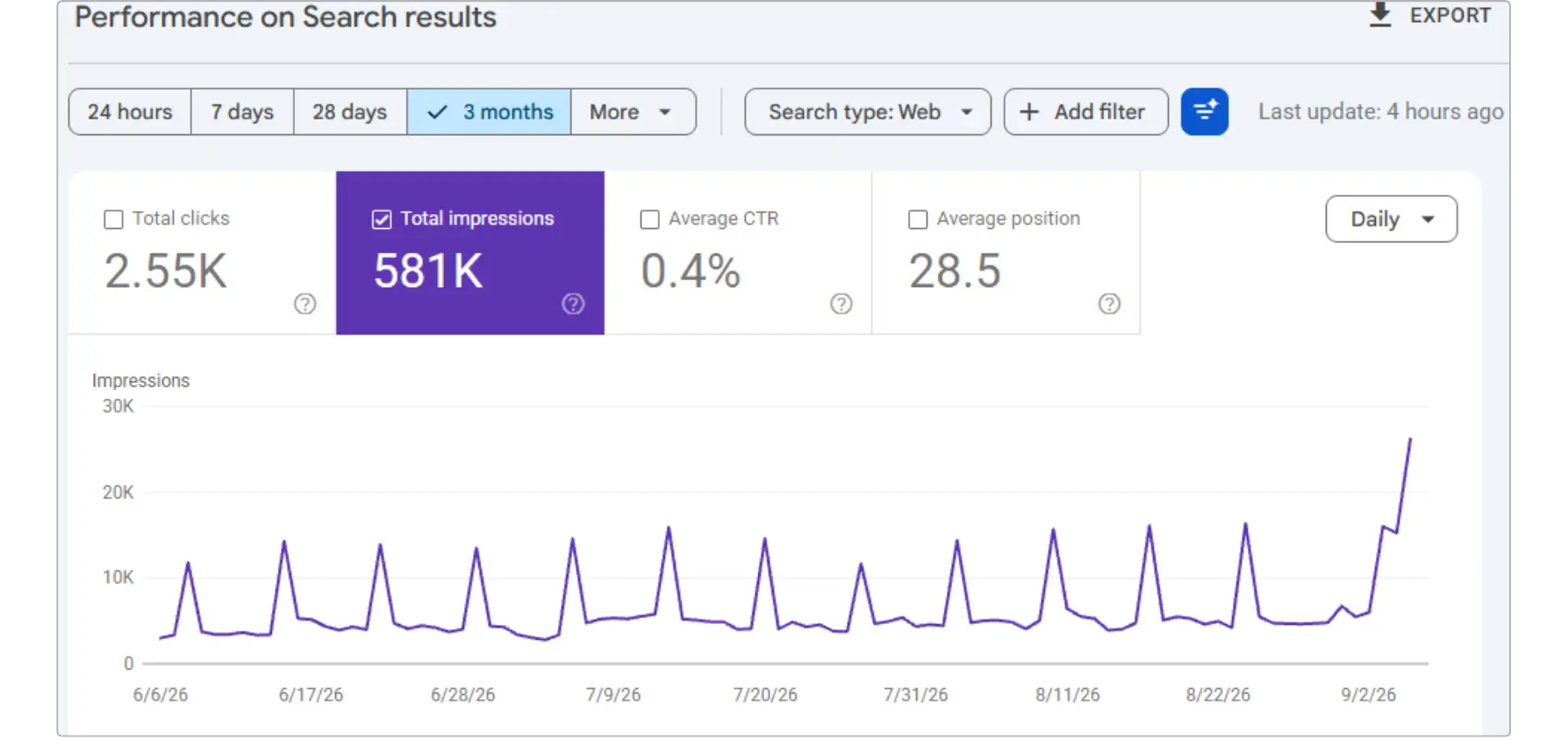
1. Organic search visibility. How prominently your site shows up across your full target keyword set, not just one ranking. Track it in Google Search Console's Performance report (total impressions) or a rank-tracking tool for a cleaner, keyword-specific view.
2. Keyword rankings. Your actual position for individual terms. Split branded from non-branded rankings; non-branded growth is the more honest signal of new-audience reach, since branded rankings mostly reflect people who already know you.
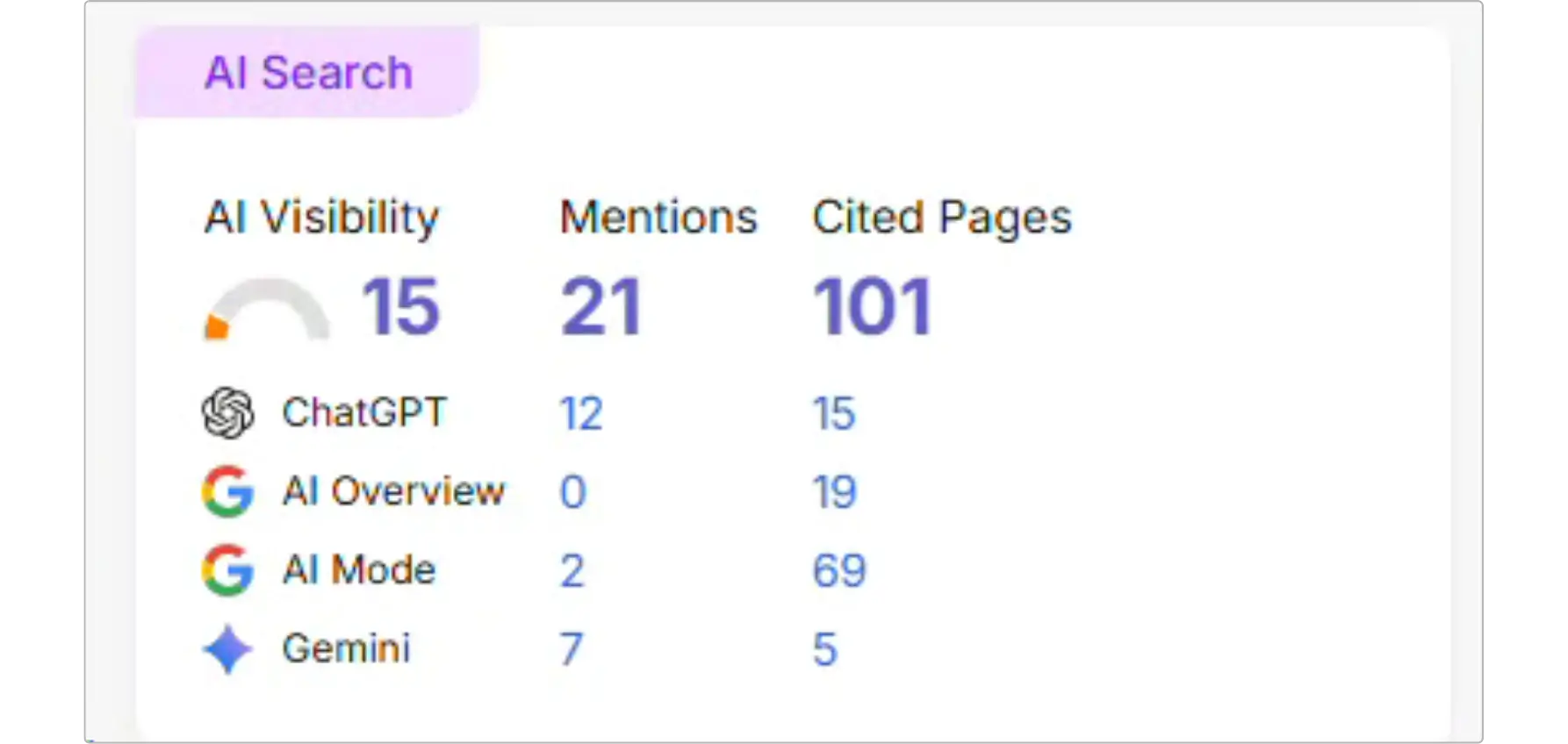
3. AI search visibility. How often your brand shows up across AI-generated answers (ChatGPT, Gemini, AI Overviews, Perplexity) relative to competitors. This is the newest entry on any SEO metrics and KPIs list, and arguably the fastest moving one.
Traffic KPIs
Visibility that never converts to a visit isn't worth much. These three track the handoff.
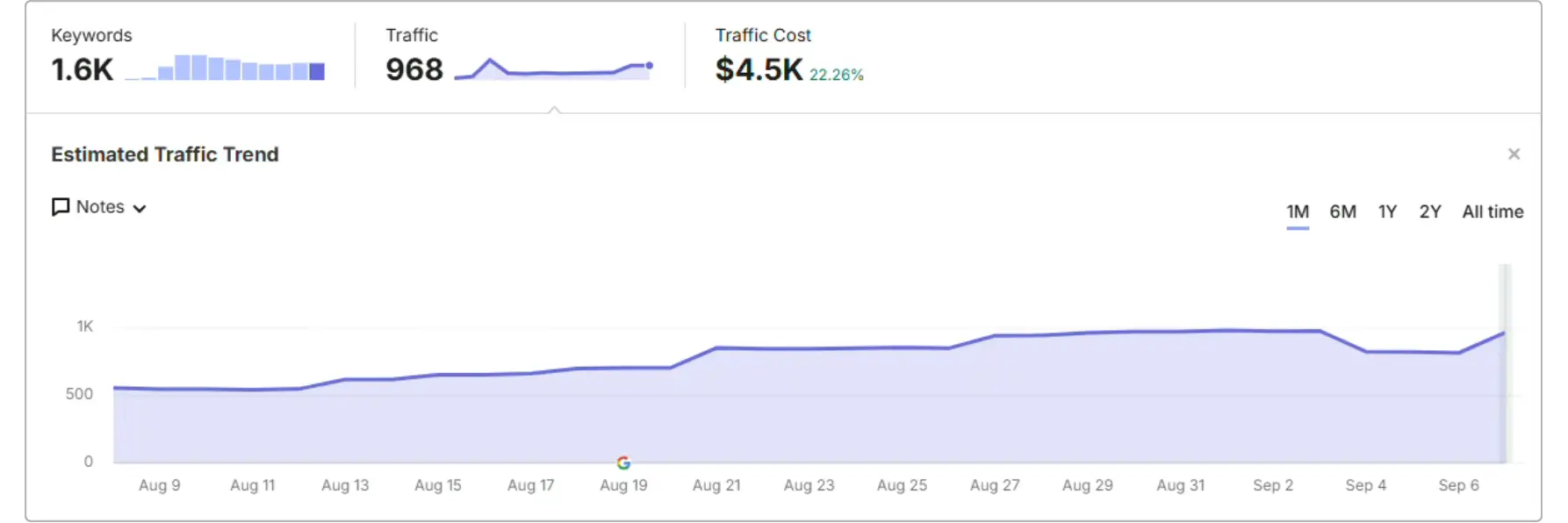
4. Organic traffic. Sessions landing on your site from unpaid search results. The baseline number almost every SEO report starts with, and it is still one of the best metrics for website SEO health at a glance.
5. AI referral traffic. Visits arriving specifically from AI platforms rather than traditional search results. Early research from Semrush found AI-referred visitors convert at roughly 4.4 times the rate of typical organic visitors and a gap large enough that ignoring this channel because its volume looks small right now would be a mistake.
6. Organic click-through rate (CTR). The share of people who see your listing and actually click it.
Calculated as (clicks ÷ impressions) × 100.
A low CTR next to a decent ranking usually points to a weak title tag or meta description, not a ranking problem.
Trust & Authority KPIs
Search engines and AI models both weigh third-party validation heavily. These KPIs measure whether the internet vouches for you.
7. Backlink authority. The quality and volume of external sites linking to yours. One link from a genuinely respected publication outweighs dozens from low-value directories, and this holds for AI search too: sites with stronger backlink profiles get referenced more often in AI-generated answers.
8. Brand mentions. References to your brand across the web, linked or not. Unlinked mentions still help; they give search engines and AI systems context about what you're known for, even without a clickable link attached.
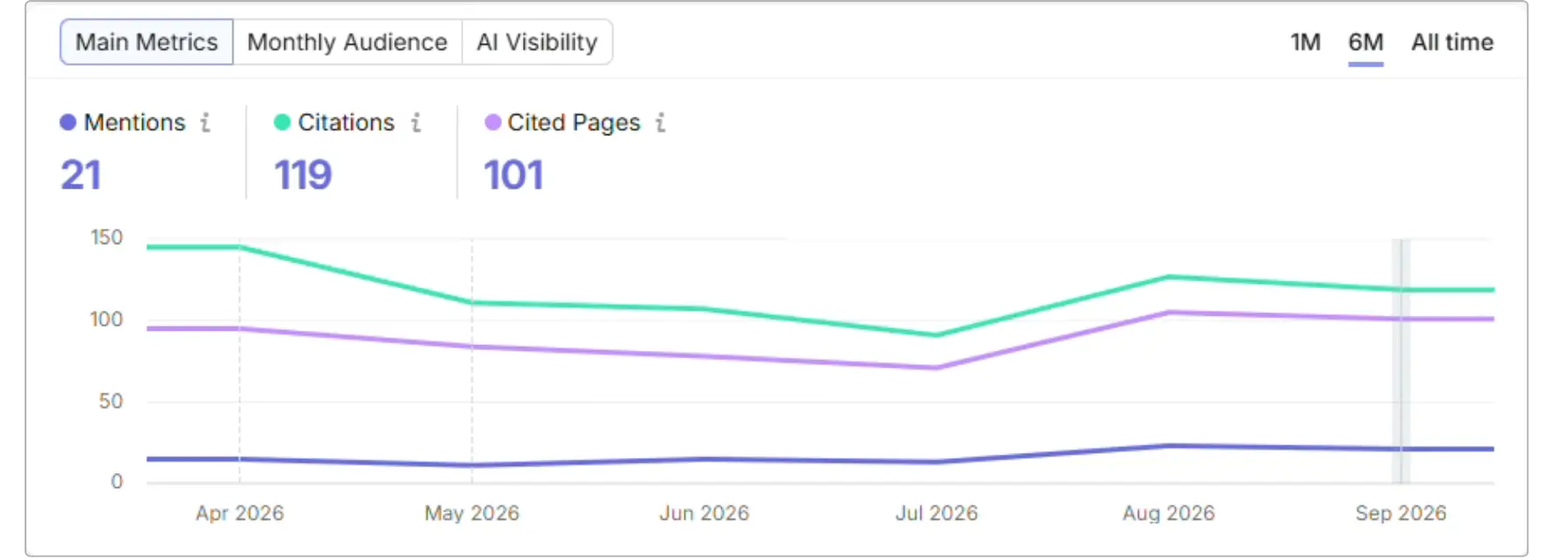
9. AI citations. The number of times an AI answer explicitly names your domain as a source. This is different from simply being mentioned by name that is a citation means the model treated your page as reference material, which is about as strong a trust signal as currently exists in AI search visibility metrics and KPIs.
Engagement KPIs
Once someone lands on your page, what happens next tells you if the content actually delivers.
10. Bounce rate (unengaged sessions). The share of visits with no meaningful interaction. Google has never confirmed this as a direct ranking factor, but internal testimony and leaked documentation over the years suggest user-experience signals like this do influence rankings indirectly.
11. Average engagement time. How long people actively spend with your content, not just how long the tab stays open. Strong engagement time is one of the clearer signals that content is actually satisfying the search intent it ranked for.
12. Pages per session. How many pages a visitor explores in one visit. Rising numbers here often mean your internal linking and related-content structure are doing their job, guiding people deeper instead of leaving them stranded on a single page.
Business Impact KPIs
This is where SEO KPIs stop being marketing numbers and start being business numbers that are the ones that get budget approved or cut.
13. Conversions from organic and AI search. Completed actions (purchases, signups, form fills) attributed to organic and AI-driven visits. If you're wondering what metrics you would track for SEO when a stakeholder asks "did this work?" this is usually the honest answer.
14. SEO return on investment (ROI). Profit generated relative to what you spent.
Formula: SEO ROI = ((Revenue from SEO − cost of SEO) ÷ cost of SEO) × 100.
Spend $8,000, generate $15,000, and your ROI comes out to 87.5%.
15. Cost per acquisition (CPA). How much it costs, on average, to win one customer through organic and AI search combined.
Formula: SEO CPA = Total SEO costs ÷ Total customers acquired through organic and AI search.
A steadily dropping CPA is one of the clearest signs a strategy is compounding rather than just running in place.
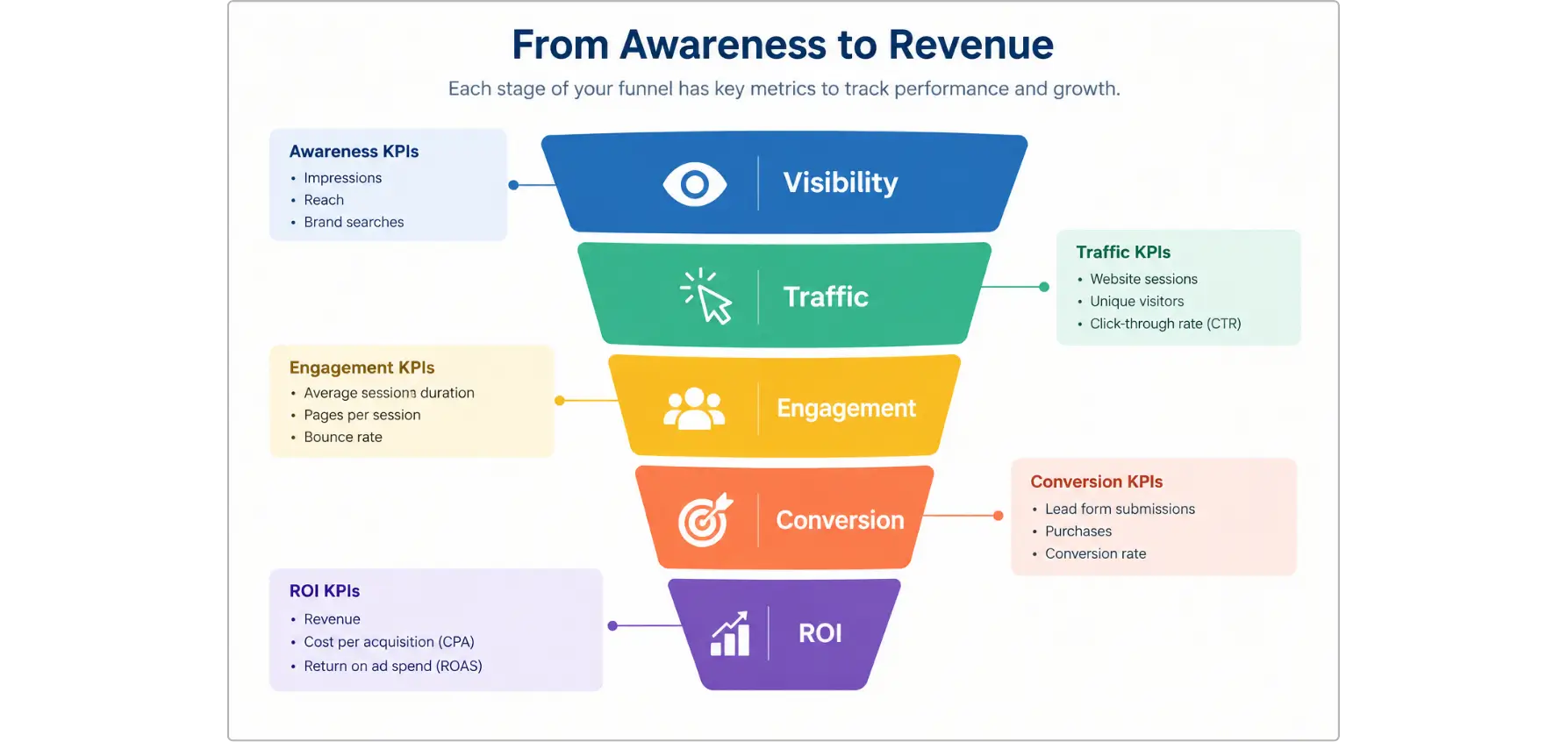
How to Actually Choose Your KPIs (Instead of Tracking All 15)
Pick your SEO KPIs by working backward from a real business goal, not forward from whatever your tool happens to display on the homepage dashboard.
Say a business wants 20% more revenue in six months. The SEO-specific goal underneath that might be "add $5,000 in monthly revenue from organic and AI search." From there:
Lagging indicator (the scoreboard): conversions from organic and AI search that confirms whether the goal was actually hit.
Leading indicators (the early warning system): organic traffic and AI referral traffic that show whether you're on pace weeks before the lagging number would tell you.
Three KPIs. Not fifteen. The rest stay in your dashboard as context you pull out only when a number looks off and needs explaining.
Final Thoughts
You don't need to track all 15 of these every week. You need three or four that are actually wired to your business outcome, and the discipline to leave the rest alone until something looks off.
Organic and AI search have also stopped being separate scorecards. A visitor who arrives from an AI Overview and one who clicks a classic blue link are chasing the same answer and increasingly, they belong on the same report.
So, you should start small: pick one KPI that proves the goal was hit, one or two that warn you early if it won't be and build from there once those numbers earn your trust.
FAQs
What is the KPI for SEO that matters most?

There isn't a single universal one and it depends on your goal. For most businesses, conversions from organic and AI search is the clearest lagging KPI, paired with organic traffic and AI referral traffic as leading indicators.
What is SEO metrics, and how is that different from an SEO KPI?
SEO metrics are any measurable data point like impressions, clicks, time on page. An SEO KPI is a metric you've deliberately tied to a business goal and are actively tracking progress against. Every KPI is a metric; not every metric is a KPI.
What metrics would you track for SEO if I'm just starting out?
You should start with three majorly: organic traffic, keyword rankings for your priority terms, and conversions. Add AI visibility and AI citations once you have a baseline for the fundamentals.
How often should I review my SEO metrics and KPIs?
Weekly for traffic and ranking movement, monthly for a fuller review including conversions and ROI, and quarterly for a step back to check whether the KPIs themselves still match your current business goal.
Are AI search visibility metrics and KPIs replacing traditional SEO KPIs?
No, they're sitting alongside them. Rankings and organic traffic still matter for the large share of search that stays on traditional results pages. AI visibility metrics fill in the growing slice of queries where an AI-generated answer is the first, and sometimes only, thing a person sees.
Most SEO dashboards are cluttered with numbers that look impressive but don't actually tell you whether your strategy is working. This article breaks that pattern by walking through 15 SEO KPIs that matter in 2026 that covers classic organic metrics like rankings and backlinks alongside newer AI search visibility metrics like citation frequency and AI referral traffic.
Each KPI includes what it measures, why it matters, and where to check it, so you can build a scorecard around your actual business goal instead of tracking everything and understanding nothing. It matters now specifically because AI answers are quietly replacing a chunk of the clicks organic search used to send you, and a reporting setup built only for Google rankings will miss that shift entirely.
Here's a question worth sitting with: If someone asked you right now which single number proves your SEO is working, could you answer in one sentence?
Most teams can't. Not because they lack data but usually the opposite. Rankings, sessions, impressions, bounce rate, backlinks, and AI mentions, all sitting in different dashboards, none of them clearly tied to whether the business is actually growing.
That's the real problem with SEO reporting today. It's not a shortage of metrics. It's a shortage of clarity about which SEO KPI actually moves the needle for your specific goal, and which one is just noise that feels productive to check.
This guide covers 15 KPIs for SEO and AI search performance: what each one measures, why it's worth watching, and where to find it. So you can build a scorecard with three or four numbers that actually mean something, instead of twenty that don't.
What Is an SEO KPI?
An SEO KPI is a specific, trackable number tied to a business goal and not just any metric you can pull from Google Search Console or Analytics. Impressions are a metric. "Grow qualified organic traffic by 20% this quarter" tracked through organic sessions is a KPI.
That distinction matters more than it sounds. Every KPI is a metric, but not every metric deserves to be a KPI. The moment you're tracking a number just because it's available, you've drifted from measurement into busywork.
If you're asking what the KPI for SEO in your specific case, the honest answer is: it depends entirely on your goal. A local business chasing calls watches different numbers than a SaaS company chasing signups. What follows are the 15 candidates worth choosing from.
Visibility & Ranking KPIs
These three answer the most basic question: can people actually find you?
1. Organic search visibility. How prominently your site shows up across your full target keyword set, not just one ranking. Track it in Google Search Console's Performance report (total impressions) or a rank-tracking tool for a cleaner, keyword-specific view.
2. Keyword rankings. Your actual position for individual terms. Split branded from non-branded rankings; non-branded growth is the more honest signal of new-audience reach, since branded rankings mostly reflect people who already know you.
3. AI search visibility. How often your brand shows up across AI-generated answers (ChatGPT, Gemini, AI Overviews, Perplexity) relative to competitors. This is the newest entry on any SEO metrics and KPIs list, and arguably the fastest moving one.
Traffic KPIs
Visibility that never converts to a visit isn't worth much. These three track the handoff.
4. Organic traffic. Sessions landing on your site from unpaid search results. The baseline number almost every SEO report starts with, and it is still one of the best metrics for website SEO health at a glance.
5. AI referral traffic. Visits arriving specifically from AI platforms rather than traditional search results. Early research from Semrush found AI-referred visitors convert at roughly 4.4 times the rate of typical organic visitors and a gap large enough that ignoring this channel because its volume looks small right now would be a mistake.
6. Organic click-through rate (CTR). The share of people who see your listing and actually click it.
Calculated as (clicks ÷ impressions) × 100.
A low CTR next to a decent ranking usually points to a weak title tag or meta description, not a ranking problem.
Trust & Authority KPIs
Search engines and AI models both weigh third-party validation heavily. These KPIs measure whether the internet vouches for you.
7. Backlink authority. The quality and volume of external sites linking to yours. One link from a genuinely respected publication outweighs dozens from low-value directories, and this holds for AI search too: sites with stronger backlink profiles get referenced more often in AI-generated answers.
8. Brand mentions. References to your brand across the web, linked or not. Unlinked mentions still help; they give search engines and AI systems context about what you're known for, even without a clickable link attached.
9. AI citations. The number of times an AI answer explicitly names your domain as a source. This is different from simply being mentioned by name that is a citation means the model treated your page as reference material, which is about as strong a trust signal as currently exists in AI search visibility metrics and KPIs.
Engagement KPIs
Once someone lands on your page, what happens next tells you if the content actually delivers.
10. Bounce rate (unengaged sessions). The share of visits with no meaningful interaction. Google has never confirmed this as a direct ranking factor, but internal testimony and leaked documentation over the years suggest user-experience signals like this do influence rankings indirectly.
11. Average engagement time. How long people actively spend with your content, not just how long the tab stays open. Strong engagement time is one of the clearer signals that content is actually satisfying the search intent it ranked for.
12. Pages per session. How many pages a visitor explores in one visit. Rising numbers here often mean your internal linking and related-content structure are doing their job, guiding people deeper instead of leaving them stranded on a single page.
Business Impact KPIs
This is where SEO KPIs stop being marketing numbers and start being business numbers that are the ones that get budget approved or cut.
13. Conversions from organic and AI search. Completed actions (purchases, signups, form fills) attributed to organic and AI-driven visits. If you're wondering what metrics you would track for SEO when a stakeholder asks "did this work?" this is usually the honest answer.
14. SEO return on investment (ROI). Profit generated relative to what you spent.
Formula: SEO ROI = ((Revenue from SEO − cost of SEO) ÷ cost of SEO) × 100.
Spend $8,000, generate $15,000, and your ROI comes out to 87.5%.
15. Cost per acquisition (CPA). How much it costs, on average, to win one customer through organic and AI search combined.
Formula: SEO CPA = Total SEO costs ÷ Total customers acquired through organic and AI search.
A steadily dropping CPA is one of the clearest signs a strategy is compounding rather than just running in place.
How to Actually Choose Your KPIs (Instead of Tracking All 15)
Pick your SEO KPIs by working backward from a real business goal, not forward from whatever your tool happens to display on the homepage dashboard.
Say a business wants 20% more revenue in six months. The SEO-specific goal underneath that might be "add $5,000 in monthly revenue from organic and AI search." From there:
Lagging indicator (the scoreboard): conversions from organic and AI search that confirms whether the goal was actually hit.
Leading indicators (the early warning system): organic traffic and AI referral traffic that show whether you're on pace weeks before the lagging number would tell you.
Three KPIs. Not fifteen. The rest stay in your dashboard as context you pull out only when a number looks off and needs explaining.
Final Thoughts
You don't need to track all 15 of these every week. You need three or four that are actually wired to your business outcome, and the discipline to leave the rest alone until something looks off.
Organic and AI search have also stopped being separate scorecards. A visitor who arrives from an AI Overview and one who clicks a classic blue link are chasing the same answer and increasingly, they belong on the same report.
So, you should start small: pick one KPI that proves the goal was hit, one or two that warn you early if it won't be and build from there once those numbers earn your trust.
FAQs
What is the KPI for SEO that matters most?
There isn't a single universal one and it depends on your goal. For most businesses, conversions from organic and AI search is the clearest lagging KPI, paired with organic traffic and AI referral traffic as leading indicators.
What is SEO metrics, and how is that different from an SEO KPI?
SEO metrics are any measurable data point like impressions, clicks, time on page. An SEO KPI is a metric you've deliberately tied to a business goal and are actively tracking progress against. Every KPI is a metric; not every metric is a KPI.
What metrics would you track for SEO if I'm just starting out?
You should start with three majorly: organic traffic, keyword rankings for your priority terms, and conversions. Add AI visibility and AI citations once you have a baseline for the fundamentals.
How often should I review my SEO metrics and KPIs?
Weekly for traffic and ranking movement, monthly for a fuller review including conversions and ROI, and quarterly for a step back to check whether the KPIs themselves still match your current business goal.
Are AI search visibility metrics and KPIs replacing traditional SEO KPIs?
No, they're sitting alongside them. Rankings and organic traffic still matter for the large share of search that stays on traditional results pages. AI visibility metrics fill in the growing slice of queries where an AI-generated answer is the first, and sometimes only, thing a person sees.



Summarize with AI



Want to Skyrocket Revenue? Get a Free Audit Today!
Want to Skyrocket Revenue? Get a Free Audit Today!



4.9/5 Ratings!


Don’t miss our revenue growth tips!
Get expert marketing tips—straight to your inbox, like thousands of happy clients.
Don’t miss our revenue growth tips!
Get expert marketing tips—straight to your inbox, like thousands of happy clients.
Don’t miss our revenue growth tips!
Don’t miss our revenue growth tips!
Get expert marketing tips—straight to your inbox, like thousands of happy clients.
Relevant Blogs on Organic SEO
Relevant Blogs on Organic SEO
Unlock data-driven insights in Organic SEO—explore our featured blogs and skyrocket your revenue before your competitors do.
Unlock data-driven insights in Organic SEO—explore our featured blogs and skyrocket your revenue before your competitors do.

SEO
Sep 21, 2026
5 Min Read
Audience-First SEO: How to Rank by Putting Readers First
SEO
Sep 21, 2026
5 Min Read
Audience-First SEO: How to Rank by Putting Readers First
SEO
Sep 21, 2026
5 Min Read
Audience-First SEO: How to Rank by Putting Readers First

SEO
Sep 19, 2026
5 Min Read
How to Add SEO Keywords to Your Website: Where and How
SEO
Sep 19, 2026
5 Min Read
How to Add SEO Keywords to Your Website: Where and How
SEO
Sep 19, 2026
5 Min Read
How to Add SEO Keywords to Your Website: Where and How

SEO
Sep 18, 2026
5 Min Read
How XML Sitemaps Help Search Engines Discover New Pages
SEO
Sep 18, 2026
5 Min Read
How XML Sitemaps Help Search Engines Discover New Pages
SEO
Sep 18, 2026
5 Min Read
How XML Sitemaps Help Search Engines Discover New Pages




























Ready to speak with an expert?
Data-Driven Marketing Agency That Elevates ROI
1100+
Websites Designed & Optimized to Convert
$280M+
Client Revenue Driven & Growing Strong
Discover how to skyrocket
your revenue today!
Trusted by 1000+ Owners!
Ready to speak with an expert?
Data-Driven Marketing Agency That Elevates ROI
1100+
Websites Designed & Optimized to Convert
$280M+
Client Revenue Driven & Growing Strong
Discover how to skyrocket
your revenue today!
Trusted by 1000+ Owners!
Want to skyrocket revenue?
4.9/5 Ratings!
Ready to speak with an expert?
Data-Driven Marketing Agency That Elevates ROI
1100+
Websites Designed & Optimized to Convert
$280M+
Client Revenue Driven & Growing Strong
Discover how to skyrocket
your revenue today!
Trusted by 1000+ Owners!
Call
Meet