AI Search Runs on More SEO Than You Think
AI Search Runs on More SEO Than You Think
Last Updated:
Table of Content
Case Studies





Why a separate GEO strategy is the wrong first move and what actually moves the needle
There's a question landing in marketing meetings every week right now: do we need a GEO strategy?
The market has a ready answer. New discipline, new specialist, new tool subscription, new budget line. GEO, AEO, LLMO, the acronym changes, the pitch doesn't.
Google's public line runs the opposite direction: good SEO is good GEO, and the fundamentals carry over.
Both are marketing positions. Neither survives contact with the data intact. And the answer that sits between them is considerably more useful than either, because it tells you what to do on Monday: AI search is running on far more of your existing SEO than the GEO pitch admits, and on somewhat less of it than Google implies.
The work isn't learning a new discipline. It's knowing which of your existing levers still pull, which ones pull differently now, and which surfaces genuinely didn't exist before. Three piles. Most teams haven't sorted them.
The research disagrees, and that tells you something
Anyone who has read five studies on AI citations and come away confused was paying attention. The numbers genuinely don't line up.
Take one basic question, how much do AI citations overlap with organic rankings? And the 2026 research lands anywhere between 12% and the high 80s:
What was measured | Finding | Source |
|---|---|---|
AI Overview citations ranking in organic top 10, across 2.2M citations | 41.2% | RankRabbit AI, Jul 2026 |
AI Overview citations ranking in organic top 10 | ~17% | BrightEdge, Feb 2026 |
Same question, different methodology | ~38% | ALM Corp, Mar 2026 |
Overlap tracked over 16 months | 32.3% → 54.5% | BrightEdge longitudinal |
AIO citations linking to a domain with at least one top-10 result | ~94% | Aggregated 2026 research |
ChatGPT search citations matching Bing's top 10 | 87% | Seer Interactive |
AI Mode citations matching a top-10 URL | 12% | Moz, ~40,000 queries, Feb 2026 |
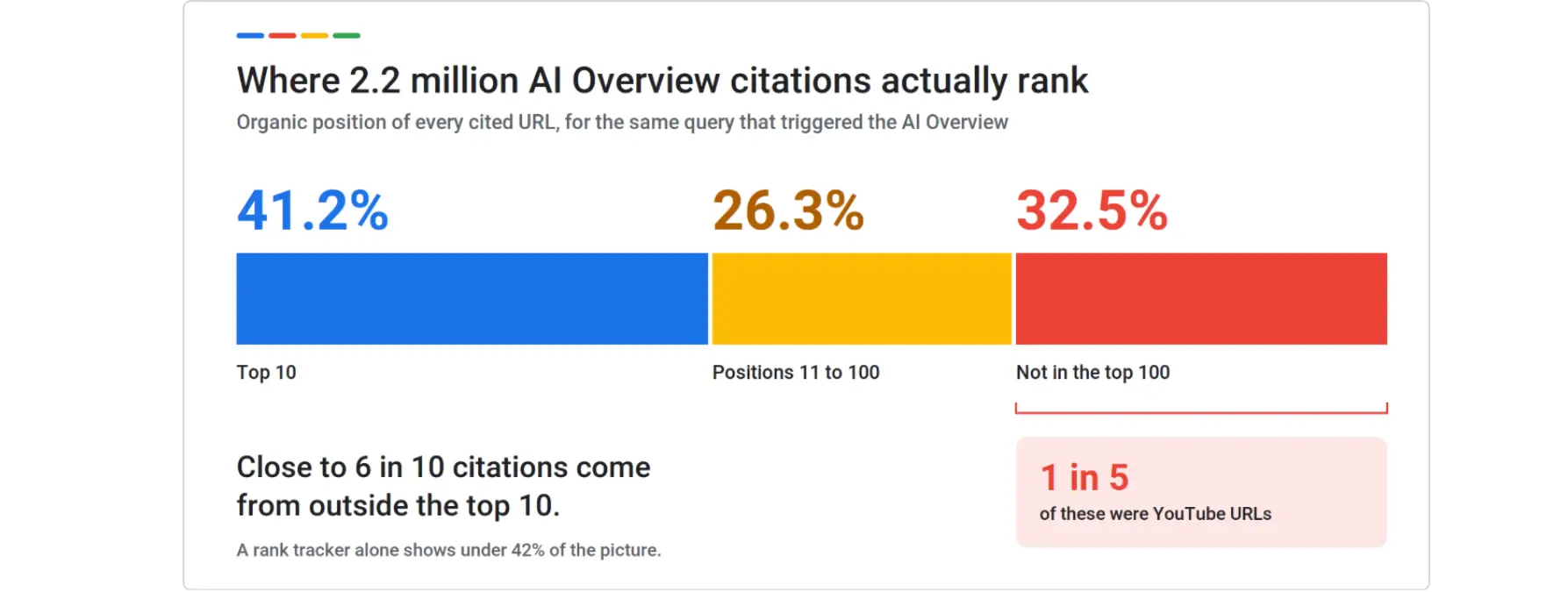
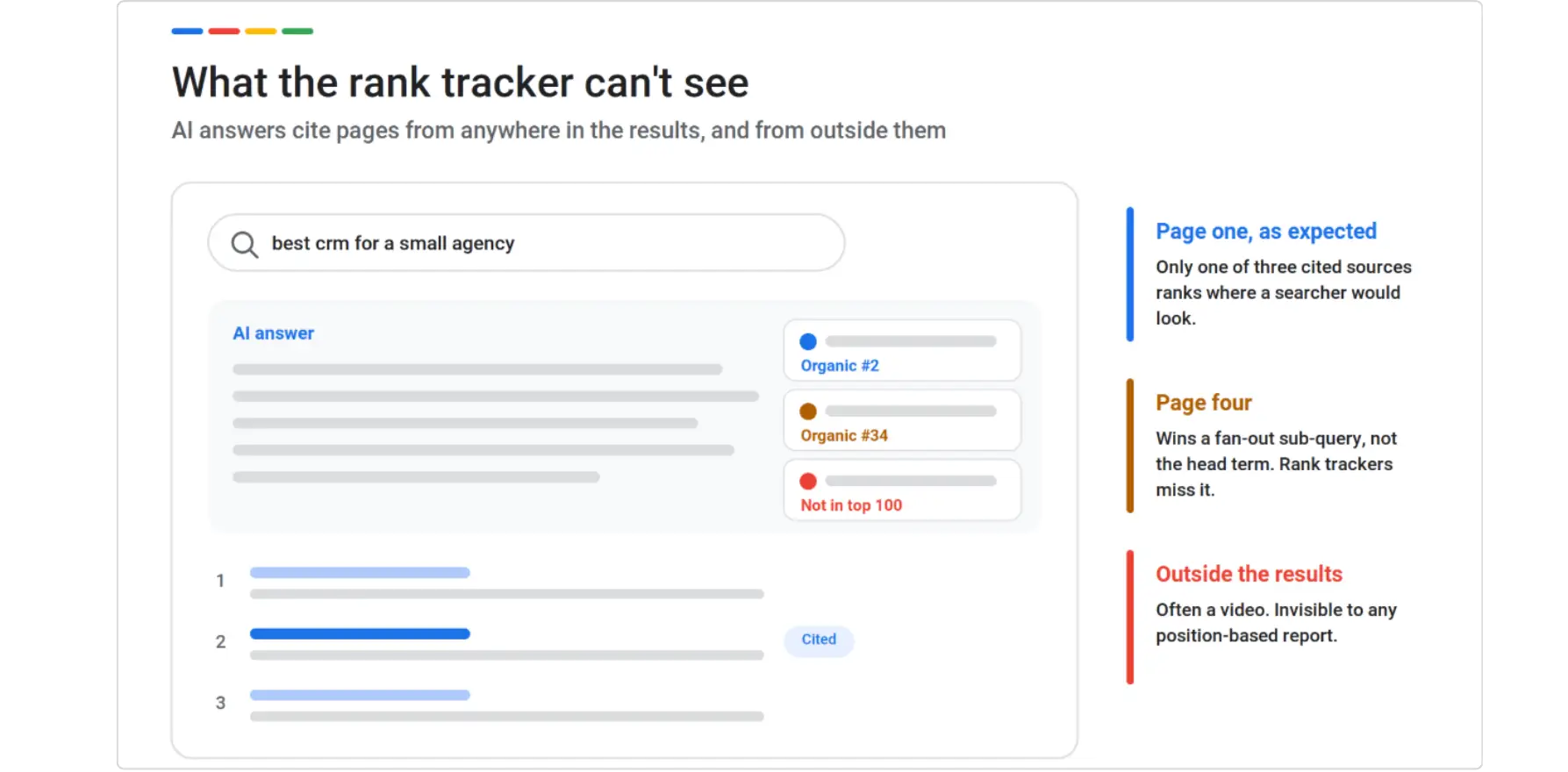
The first row is the one worth sitting with. It's the largest dataset of the group, and the only one that publishes a full distribution instead of a single headline number. RankRabbit AI cross-referenced 2.2 million AI Overview citations against the organic position of every cited URL for the same query: 41.2% in the top 10, 26.3% between positions 11 and 100, and 32.5% not ranking in the top 100 at all.
That spread says something no single-number study can. The top 10 is still the largest bucket, rankings clearly matter. But close to six in ten citations come from somewhere else, and a third come from pages a human searcher would never scroll to. A rank tracker, used alone, is showing you under 42% of your citation picture and presenting it as the whole thing.
As for why the other studies disagree so violently: they're not contradicting each other so much as answering different questions in identical language. "Does this exact URL rank top 10?" and "does this domain rank for anything relevant?" are different questions. So is "ranks for the query the user typed" versus "ranks for the query the model actually ran", and that distinction turns out to be the entire game, which we'll get to.
Layer in platform differences (AI Overviews behaves nothing like AI Mode, which behaves nothing like Perplexity) and vertical differences (AI Overview coverage in healthcare sits near 88% of queries; in e-commerce it collapsed to roughly 4%), and the spread stops looking like a scandal and starts looking like ordinary measurement variance.

One data point settles the argument about whether the pipeline is real. Lily Ray's analysis of sites hit by Google's January 2026 core update looked at eleven site sections. All eleven lost organic traffic. All eleven lost AI citations too, by an average of 22.5%. Whatever the true overlap percentage is, when SEO breaks, AI visibility breaks with it.
"AI visibility" is three different jobs
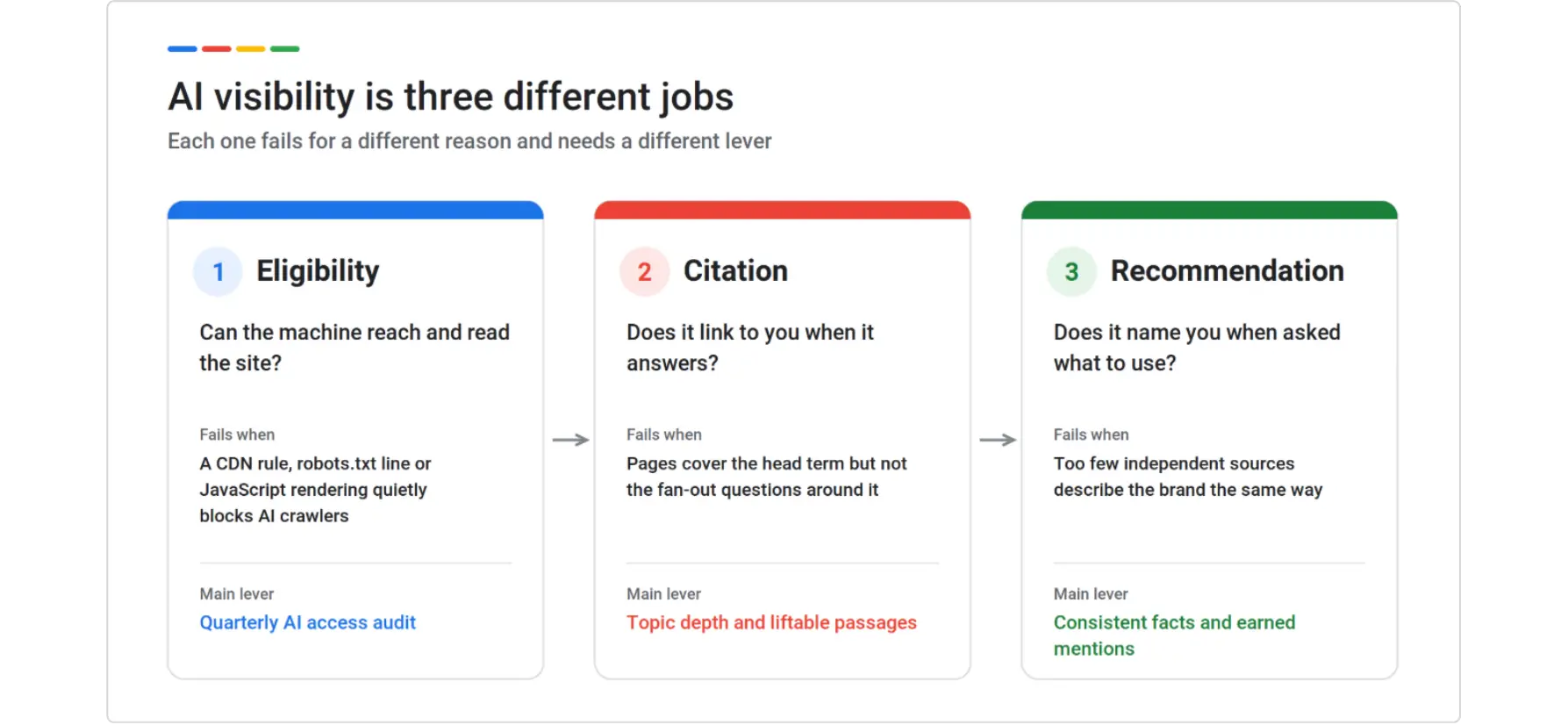
This is the reframe that makes the rest of the work tractable. AI visibility isn't one outcome. It's three, they fail for different reasons, and they need different levers:
Eligibility: can the machine reach and read the site at all?
Citation: does it link to you when it answers?
Recommendation: does it name you when someone asks what to use?
Most teams optimize for the second and stay quietly puzzled about why the third never happens. They are not the same outcome.
Job 1: Eligibility - the boring failure that kills sites silently
Crawlability is the part of SEO everyone filed under "solved" around 2014. That assumption is where most of the damage now hides, and the pattern is always the same: nobody did anything wrong, and the site is invisible anyway.
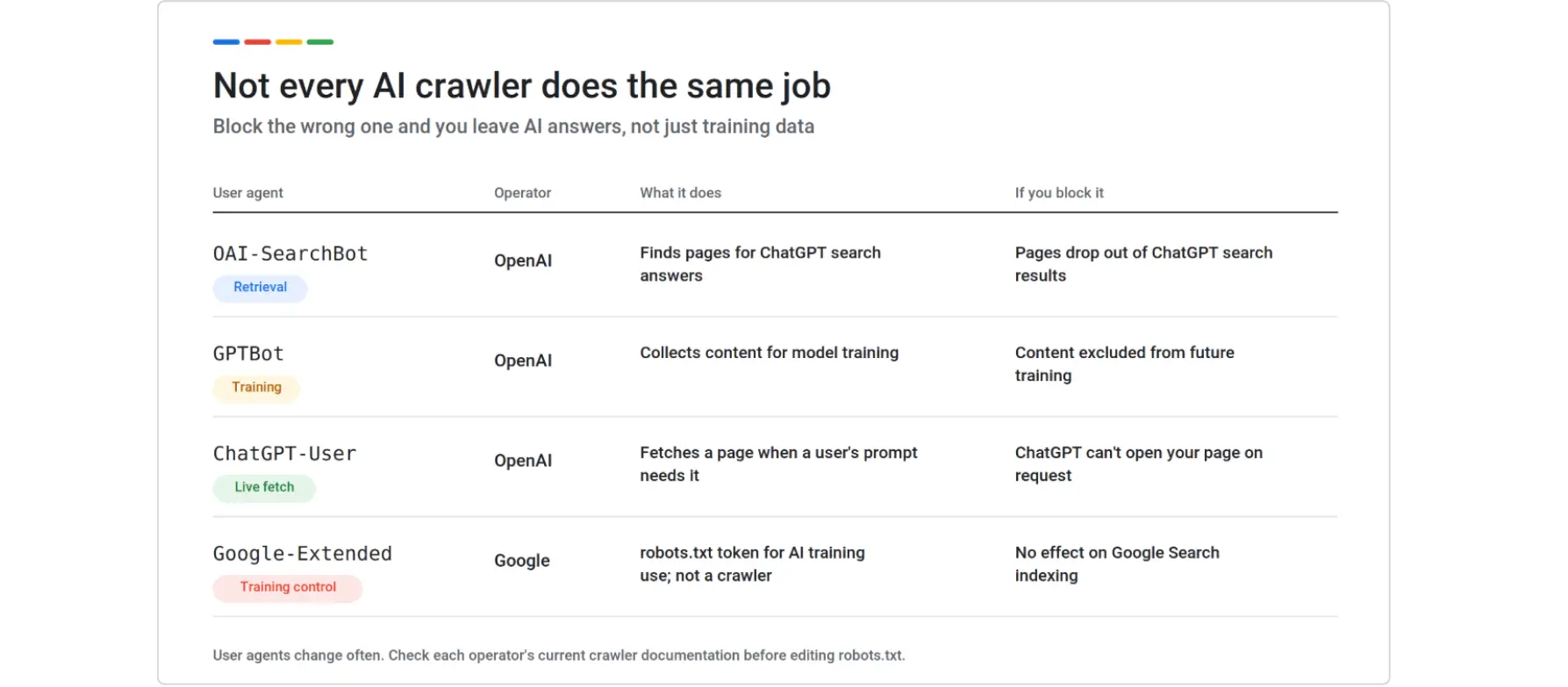
Robots.txt has a lot more tenants than it used to. AI companies ship new user agents every few months and they do genuinely different jobs. OAI-SearchBot handles ChatGPT's search retrieval. GPTBot is primarily a training crawler. ChatGPT-User fires when a user's prompt triggers a live fetch. Google-Extended governs training use, not indexing. Blocking the retrieval bot while believing you opted out of training only is a self-inflicted disappearance, and it's common.
The CDN may be overruling robots.txt entirely. Cloudflare and comparable platforms now ship one-click "block AI bots" toggles enforced by IP range and user agent. Infrastructure teams enable these for entirely sensible reasons: bandwidth, scraping, principle, and marketing finds out months later. Robots.txt says yes, the edge says no, the rank tracker shows nothing wrong. This is the single most common root cause behind "we vanished from ChatGPT and nobody knows why."
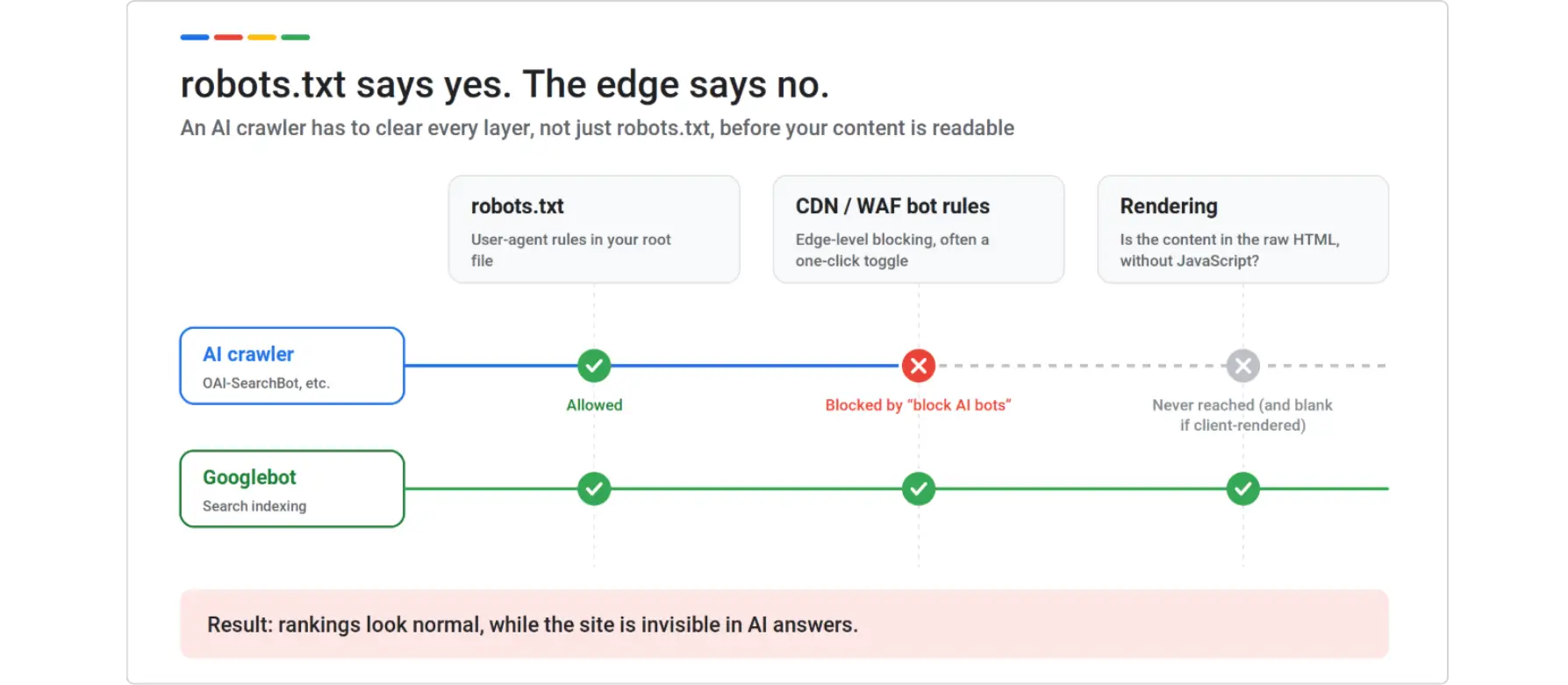
Many AI crawlers don't render JavaScript reliably. Content that assembles client-side can be functionally blank to a retrieval crawler even while Googlebot handles it fine. A 2015 problem wearing a new hat.
Snippet directives still bite. nosnippet, max-snippet, and data-nosnippet were written to control SERP display and remain perfectly capable of restricting what surfaces in AI answers, frequently on the exact paragraphs you'd most want lifted.
Google's index isn't the only seed. Several systems build partly from Common Crawl and similar corpora. Plenty of sites block those without ever making that decision.
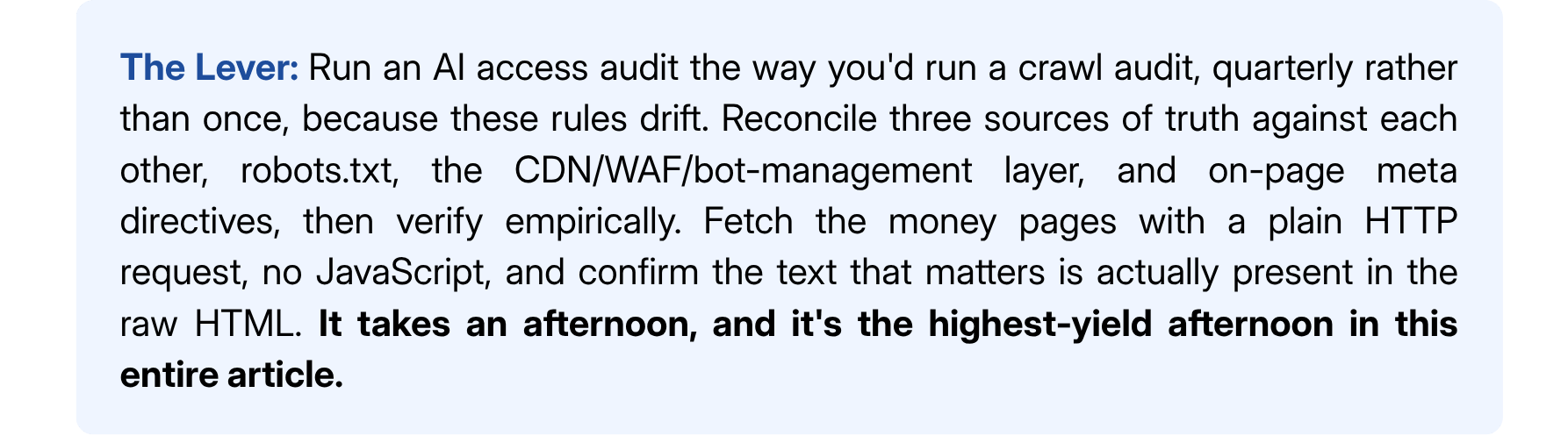
A necessary caveat, because "open everything" is not the recommendation: publishers pushing back on unlimited AI crawling have a legitimate case, particularly where the AI answer substitutes for the visit rather than driving it. The argument here isn't that every bot should be let in. It's that this should be a decision someone made, not a platform default nobody noticed.
Job 2: Citations - where existing SEO tactics transfer almost intact
One mechanism explains most citation behaviour, and it reorganises everything else:
AI systems don't search your query. They search several queries.
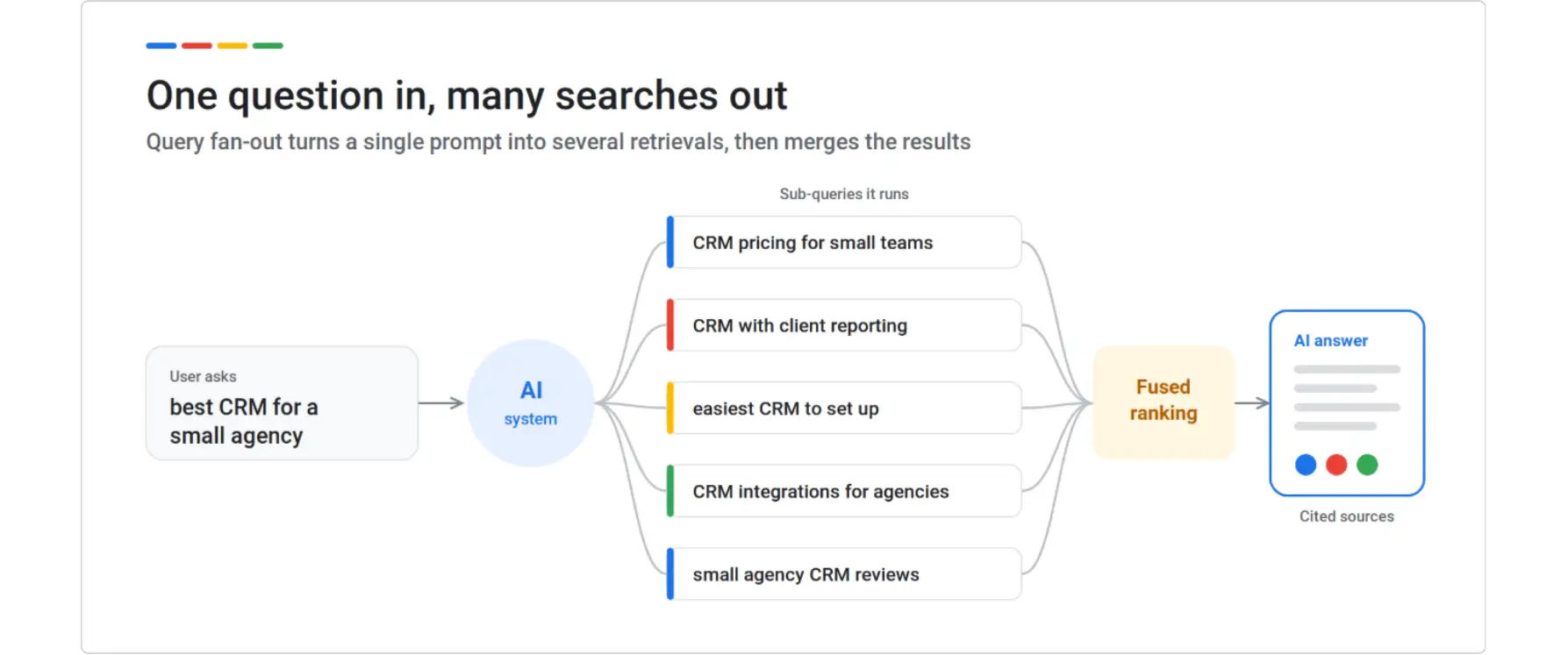
When a search triggers an AI answer, the system decomposes the question into a cluster of related sub-queries, query fan-out, retrieves results for each, and synthesises from whatever performs best across that expanded set. Reciprocal Rank Fusion, a common approach to combining those result sets, scores a document on its combined position across all of them. A page ranking 4th for five sub-queries can beat a page ranking 1st for one.

That single mechanism dissolves the contradiction in the table above. A page missing the top 10 for the typed prompt may still rank well for three of the six queries the model actually ran. To the study, that's a citation with no ranking behind it. To the retrieval system, that's a page winning on rankings. The "rankings don't matter anymore" crowd is reading its own data backwards.
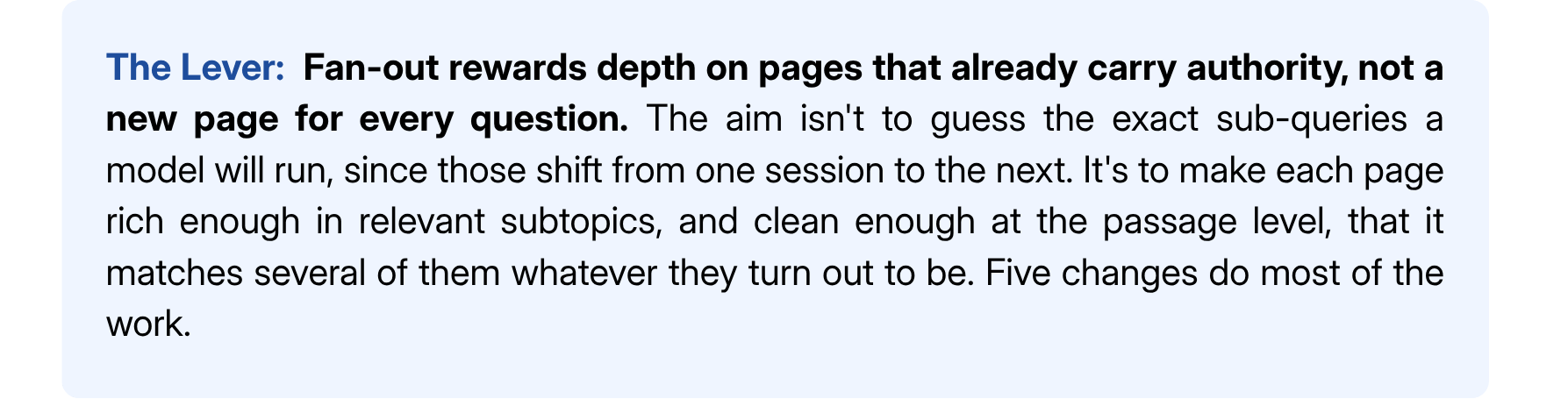
Expand existing pages onto fan-out queries rather than building a new page per question. Take a term that already ranks, map the sub-questions around it, and cover them on the page that already carries authority. A thin page per question is FAQ spam wearing a new justification, and it ages exactly as badly. Without a dedicated fan-out tool, People Also Ask and AlsoAsked are cheap, close proxies, as is asking ChatGPT or Gemini to generate the related questions for a target query.
Stop writing off the position 15–60 pages. This follows directly from that 26.3% mid-tier bucket. Content that's topically strong but stranded on page two may already be earning citations nobody is tracking, because it's winning a fan-out query rather than the head term. Deepening a page sitting at position 30 can now pay off without it ever cracking the top 10, which was not true two years ago, and which changes how a content audit should be triaged.
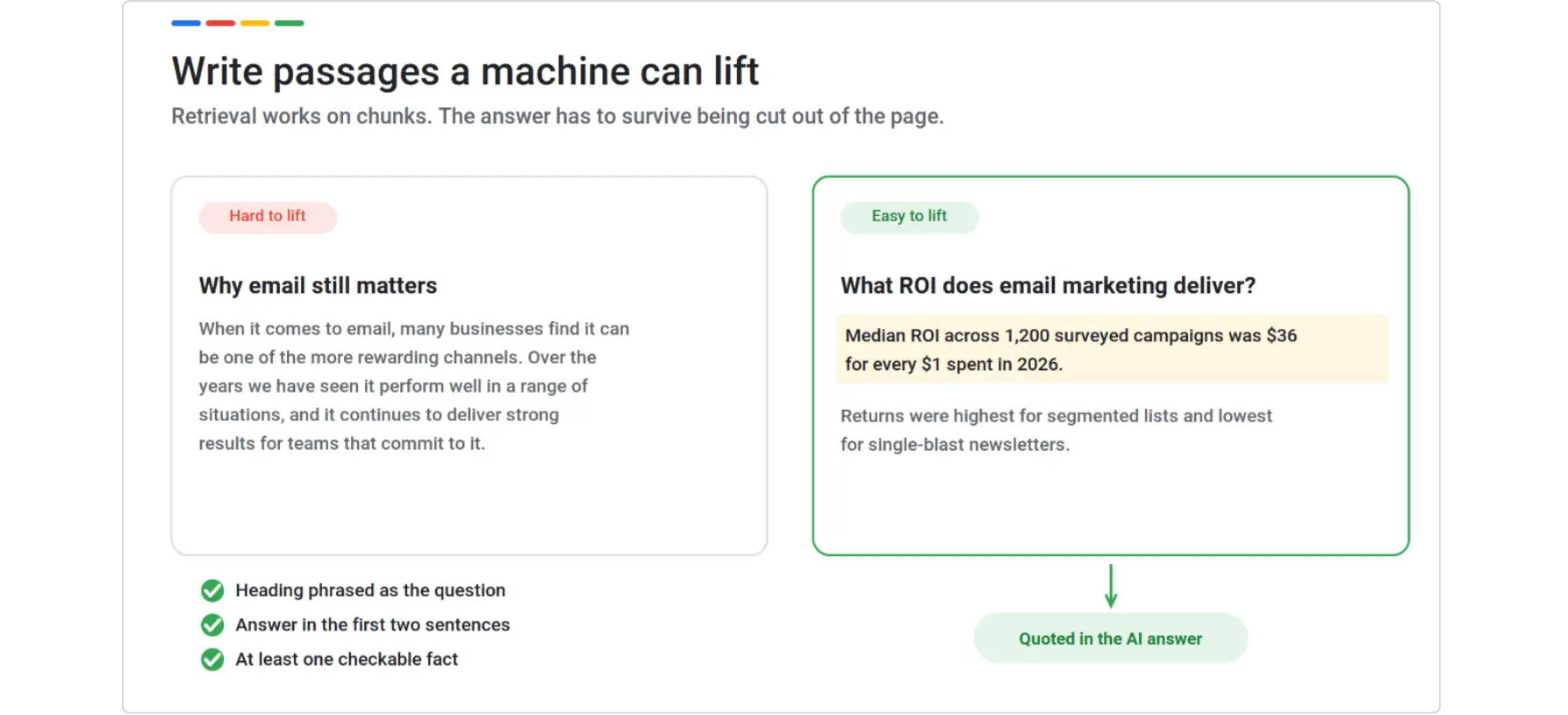
Write for evidence, not vibes. Retrieval favours passages containing something checkable: a number, a date, a named study, a measured result. "Email marketing delivers strong ROI" is unquotable. "Median ROI across 1,200 surveyed campaigns was $36 per $1 in 2026" is a citation waiting to happen.” A paragraph containing no verifiable claim should be treated as a defect, not a stylistic choice.
Build for passages, not pages. Retrieval operates on chunks. A heading phrased the way people actually ask the question, followed immediately by a self-contained answer in the first sentence or two, gets extracted. The same information arriving in paragraph six of an elegant narrative does not. Tables and tight lists chunk well. This costs a little elegance and returns a lot of visibility.
Date content honestly. Freshness carries real weight, and a visible, accurate last-updated date helps. Bumping the date without touching the content is a trick that fools nobody worth fooling, and it has largely stopped working.
Job 3: Recommendations - where the model of SEO genuinely shifted
Appearing in a footnote is not the same as being the brand a model names when someone asks what to use. Conflating those two is the most expensive mistake in this space.
Recommendations emerge from what the model already believes, assembled from training data, from retrieval, and from multiple independent sources agreeing with each other.
Call it distributed consensus: the system isn't hunting for one authoritative page, it's looking for corroboration. And it is mostly not looking at your website to find it.
The correlation data is blunt about this. Ahrefs' analysis across 75,000 brands found YouTube mentions correlating with AI visibility at roughly 0.737, with branded web mentions also high, while backlinks landed near 0.218 and domain authority lower still. A separate study of 1,000+ brand audits put brand mentions at around r = 0.664 against backlinks at 0.218. Brand search volume repeatedly outperforms every link metric as a predictor.
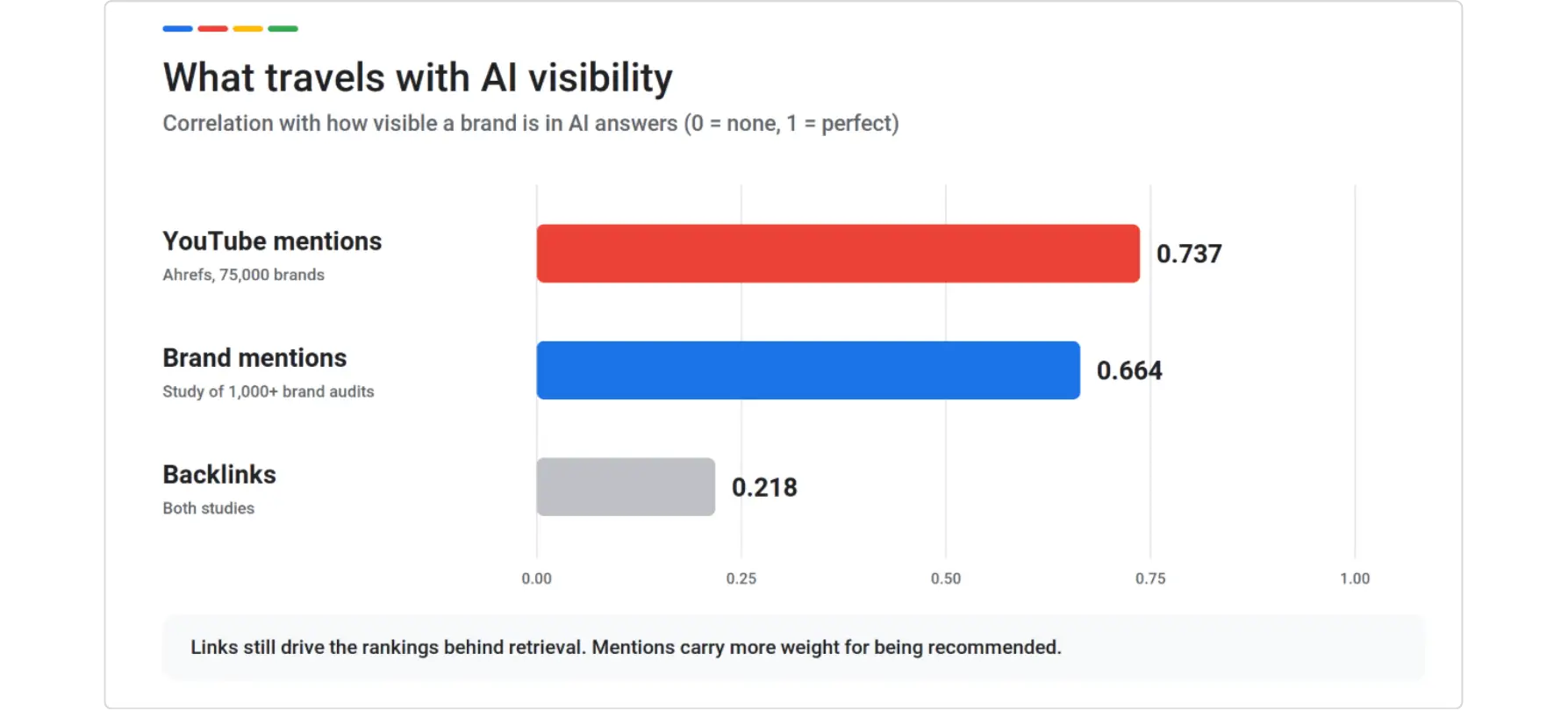
Those figures deserve to be read directionally rather than as gospel, they're vendor research, and correlation isn't mechanism. But the direction holds across enough independent datasets to change what marketing teams should be asking PR for.
To be precise about what this does not mean: links aren't dead. Links drive the rankings that drive retrieval, that's Job 2, and it still works. What changed is the unit of credit for recommendations, which moved from the anchor-texted followed link to the unlinked, contextual brand mention. Digital PR still works. The KPI changed.
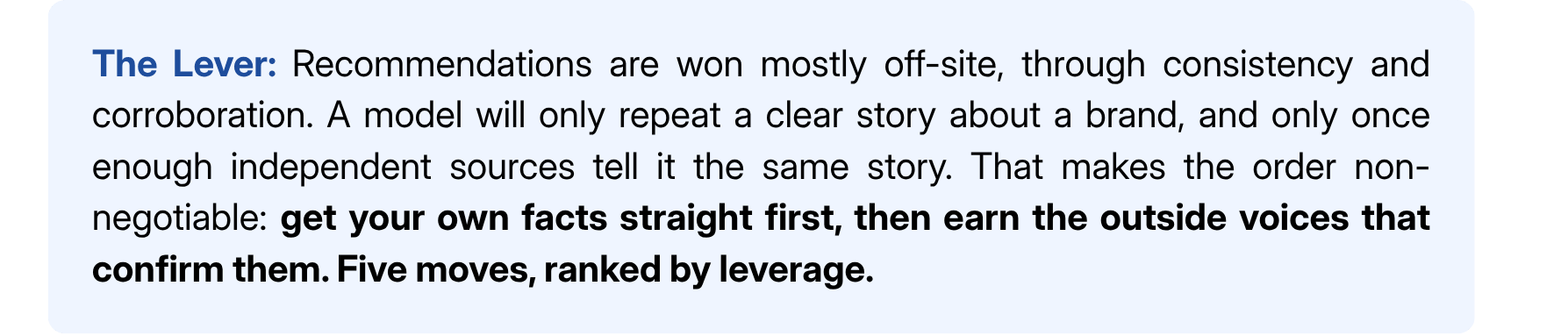
Fix the internal facts first, because it costs nothing. One sentence, true everywhere: [Brand] is a [category] for [audience], particularly strong at [use case], because [differentiator]. Then homepage, About page, product and pricing pages, LinkedIn, Crunchbase, app store listings, partner directories, employee bios, all carrying a compatible version. Models resolve ambiguity by defaulting to whichever competitor is unambiguous.
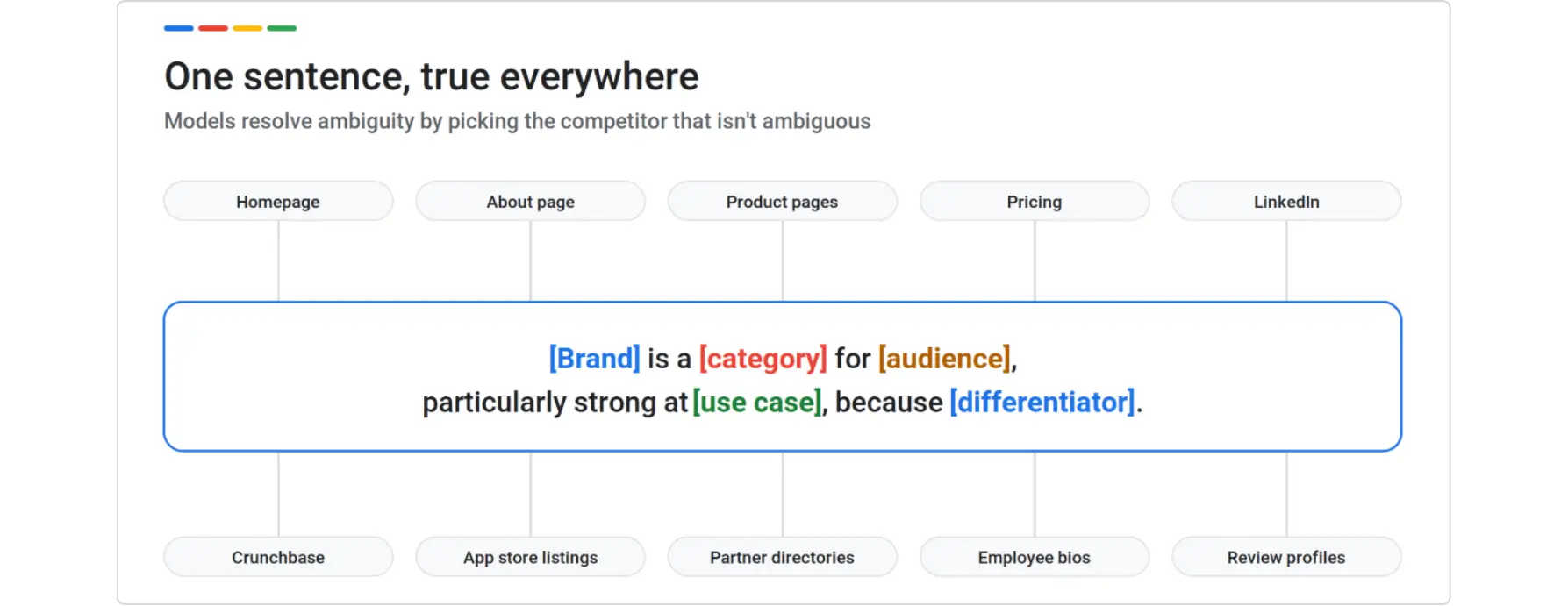
Describing yourself three different ways across four surfaces is an unforced error, and it's present on most sites.
Show up where the corroboration lives. Reddit, YouTube, LinkedIn, industry directories, review platforms, marketplaces, and reference sources. These punch above their weight partly because those pages rank well for precisely the comparison and "best X" queries that fan-out generates.
Treat YouTube as a discovery surface, not a distribution channel. The RankRabbit AI data sharpens this considerably: among citations from pages not ranking in the top 100, 20% were YouTube URLs. One platform accounting for a fifth of the citations a rank tracker structurally cannot see. Set that beside YouTube carrying the strongest single correlation in the Ahrefs dataset and it stops being a content-marketing question. The practical version, since "do YouTube" is useless advice: what these systems parse is the transcript. Scripted, clearly-spoken video with descriptive titles and structured descriptions transcribes into citable text; forty minutes of meandering commentary transcribes into noise. Cover the same topical ground on video as in writing, so both formats reinforce the same entity signals.
Engineer better reviews, not more stars. A model reading reviews extracts reasons. "Great product, 5 stars" contributes nothing. "We switched because their reporting couldn't handle multi-currency and this handled it in a week" is recommendation-grade signal. Ask customers to describe the problem that got solved, not to rate the company.
Pitch for mentions, not just links. A brand named in context, inside a relevant expert article that ranks, may now do more than a followed link from a higher-DR page that never explains what the company actually does.
What deserves to be cut from the budget
llms.txt. No major AI system has committed to consuming it. It costs nothing to add and does nothing to help. Add it for peace of mind; don't build a strategy on it.
Schema as a citation lever. Structured data still earns the traditional SERP features it was built for, so keep it. But cross-platform citation research has repeatedly failed to show that schema alone independently predicts AI citations. It is not the lever it's being sold as.
Anything that fights SEO fundamentals to chase an AI rumour. Hidden text aimed at models, question-page farms, aggressive date manipulation. Every one of these got sites hurt in a previous era, and the systems that punished them are still running.
A GEO platform bought before anyone has read the server logs. The logs already show which AI agents are hitting the site, how often, and what they're taking. That's free, and more reliable than most dashboards on the market.

Measuring it properly
Rank tracking alone will mislead in both directions. The working minimum:
Crawler log monitoring. Which AI agents fetch the site, which pages, how often. This is the eligibility check and the earliest warning system available.
Citation share, not citation count. Track a fixed set of commercially meaningful prompts and measure how often the brand appears versus named competitors. Counts drift with query volume; share doesn't.
Mentions, linked and unlinked. The recommendation proxy.
Branded search volume. The most under-watched leading indicator on this list, and the one correlating most consistently with AI visibility.
Assisted organic and paid performance. The value shows up sideways: Seer Interactive's analysis found brands cited in AI Overviews saw substantially stronger organic click performance and a large lift in paid CTR. The citation link itself may draw almost no clicks while the citation still pays for itself.
Final Thoughts
Roughly the top 10% of AI visibility work lives in genuinely new surfaces, and serious operators are doing real work there. That's worth respecting.
Almost nobody has exhausted the other 90%. And the other 90% looks like this: crawl access nobody has audited since before AI agents existed. Pages that could rank for fan-out queries with an afternoon's work. Claims that would be quotable if someone put a number in them. A brand description saying three different things across four properties.
None of that requires a new discipline. It requires SEO done with a clear picture of what the retrieval layer is actually reaching for, and enough honesty to admit that picture is still moving.
Start with the logs. Then go read your own About page.
FAQs
How do I get my website cited in ChatGPT and Google AI Overviews?

Make sure AI crawlers can reach your pages, then build content that answers the full cluster of questions around a topic. Put clear answers directly under question-style headings, include specific checkable facts like numbers and dates, and keep content honestly updated. For being recommended, not just cited, consistent brand mentions on sites like Reddit, YouTube and review platforms matter more than backlinks alone.
What is query fan-out in AI search?
Query fan-out is when an AI system breaks one question into several related sub-queries, searches each one, and merges the results into a single answer. A page that ranks moderately well for many of those sub-queries can outscore a page ranking first for just one. That's why covering related subtopics on a strong existing page often beats creating a separate page for every question.
Should I block GPTBot and other AI crawlers?
It depends on which crawler and what you want, because they do different jobs. GPTBot mainly collects training data, while OAI-SearchBot finds pages for ChatGPT's search answers, so blocking the wrong one can remove you from AI answers entirely. Also check your CDN settings: tools like Cloudflare's "block AI bots" toggle can block crawlers even when your robots.txt allows them.
Do schema markup and llms.txt help with AI search visibility?
There's little evidence that either one improves AI citations on its own. Schema markup is still worth keeping for traditional rich results, but studies haven't found it independently predicts AI citations. No major AI platform has committed to reading llms.txt, so it's harmless to add but shouldn't be part of your strategy.
What is the difference between SEO and GEO?
GEO (generative engine optimization) is about getting cited and recommended in AI answers, while SEO is about ranking in search results, but most of the underlying work overlaps. AI systems retrieve content through search indexes, so crawl access, topical depth, and authority drive both. What GEO adds is a stronger focus on extractable passages and on brand mentions across third-party sites.
Why a separate GEO strategy is the wrong first move and what actually moves the needle
There's a question landing in marketing meetings every week right now: do we need a GEO strategy?
The market has a ready answer. New discipline, new specialist, new tool subscription, new budget line. GEO, AEO, LLMO, the acronym changes, the pitch doesn't.
Google's public line runs the opposite direction: good SEO is good GEO, and the fundamentals carry over.
Both are marketing positions. Neither survives contact with the data intact. And the answer that sits between them is considerably more useful than either, because it tells you what to do on Monday: AI search is running on far more of your existing SEO than the GEO pitch admits, and on somewhat less of it than Google implies.
The work isn't learning a new discipline. It's knowing which of your existing levers still pull, which ones pull differently now, and which surfaces genuinely didn't exist before. Three piles. Most teams haven't sorted them.
The research disagrees, and that tells you something
Anyone who has read five studies on AI citations and come away confused was paying attention. The numbers genuinely don't line up.
Take one basic question, how much do AI citations overlap with organic rankings? And the 2026 research lands anywhere between 12% and the high 80s:
What was measured | Finding | Source |
|---|---|---|
AI Overview citations ranking in organic top 10, across 2.2M citations | 41.2% | RankRabbit AI, Jul 2026 |
AI Overview citations ranking in organic top 10 | ~17% | BrightEdge, Feb 2026 |
Same question, different methodology | ~38% | ALM Corp, Mar 2026 |
Overlap tracked over 16 months | 32.3% → 54.5% | BrightEdge longitudinal |
AIO citations linking to a domain with at least one top-10 result | ~94% | Aggregated 2026 research |
ChatGPT search citations matching Bing's top 10 | 87% | Seer Interactive |
AI Mode citations matching a top-10 URL | 12% | Moz, ~40,000 queries, Feb 2026 |
The first row is the one worth sitting with. It's the largest dataset of the group, and the only one that publishes a full distribution instead of a single headline number. RankRabbit AI cross-referenced 2.2 million AI Overview citations against the organic position of every cited URL for the same query: 41.2% in the top 10, 26.3% between positions 11 and 100, and 32.5% not ranking in the top 100 at all.
That spread says something no single-number study can. The top 10 is still the largest bucket, rankings clearly matter. But close to six in ten citations come from somewhere else, and a third come from pages a human searcher would never scroll to. A rank tracker, used alone, is showing you under 42% of your citation picture and presenting it as the whole thing.
As for why the other studies disagree so violently: they're not contradicting each other so much as answering different questions in identical language. "Does this exact URL rank top 10?" and "does this domain rank for anything relevant?" are different questions. So is "ranks for the query the user typed" versus "ranks for the query the model actually ran", and that distinction turns out to be the entire game, which we'll get to.
Layer in platform differences (AI Overviews behaves nothing like AI Mode, which behaves nothing like Perplexity) and vertical differences (AI Overview coverage in healthcare sits near 88% of queries; in e-commerce it collapsed to roughly 4%), and the spread stops looking like a scandal and starts looking like ordinary measurement variance.
One data point settles the argument about whether the pipeline is real. Lily Ray's analysis of sites hit by Google's January 2026 core update looked at eleven site sections. All eleven lost organic traffic. All eleven lost AI citations too, by an average of 22.5%. Whatever the true overlap percentage is, when SEO breaks, AI visibility breaks with it.
"AI visibility" is three different jobs
This is the reframe that makes the rest of the work tractable. AI visibility isn't one outcome. It's three, they fail for different reasons, and they need different levers:
Eligibility: can the machine reach and read the site at all?
Citation: does it link to you when it answers?
Recommendation: does it name you when someone asks what to use?
Most teams optimize for the second and stay quietly puzzled about why the third never happens. They are not the same outcome.
Job 1: Eligibility - the boring failure that kills sites silently
Crawlability is the part of SEO everyone filed under "solved" around 2014. That assumption is where most of the damage now hides, and the pattern is always the same: nobody did anything wrong, and the site is invisible anyway.
Robots.txt has a lot more tenants than it used to. AI companies ship new user agents every few months and they do genuinely different jobs. OAI-SearchBot handles ChatGPT's search retrieval. GPTBot is primarily a training crawler. ChatGPT-User fires when a user's prompt triggers a live fetch. Google-Extended governs training use, not indexing. Blocking the retrieval bot while believing you opted out of training only is a self-inflicted disappearance, and it's common.
The CDN may be overruling robots.txt entirely. Cloudflare and comparable platforms now ship one-click "block AI bots" toggles enforced by IP range and user agent. Infrastructure teams enable these for entirely sensible reasons: bandwidth, scraping, principle, and marketing finds out months later. Robots.txt says yes, the edge says no, the rank tracker shows nothing wrong. This is the single most common root cause behind "we vanished from ChatGPT and nobody knows why."
Many AI crawlers don't render JavaScript reliably. Content that assembles client-side can be functionally blank to a retrieval crawler even while Googlebot handles it fine. A 2015 problem wearing a new hat.
Snippet directives still bite. nosnippet, max-snippet, and data-nosnippet were written to control SERP display and remain perfectly capable of restricting what surfaces in AI answers, frequently on the exact paragraphs you'd most want lifted.
Google's index isn't the only seed. Several systems build partly from Common Crawl and similar corpora. Plenty of sites block those without ever making that decision.
A necessary caveat, because "open everything" is not the recommendation: publishers pushing back on unlimited AI crawling have a legitimate case, particularly where the AI answer substitutes for the visit rather than driving it. The argument here isn't that every bot should be let in. It's that this should be a decision someone made, not a platform default nobody noticed.
Job 2: Citations - where existing SEO tactics transfer almost intact
One mechanism explains most citation behaviour, and it reorganises everything else:
AI systems don't search your query. They search several queries.
When a search triggers an AI answer, the system decomposes the question into a cluster of related sub-queries, query fan-out, retrieves results for each, and synthesises from whatever performs best across that expanded set. Reciprocal Rank Fusion, a common approach to combining those result sets, scores a document on its combined position across all of them. A page ranking 4th for five sub-queries can beat a page ranking 1st for one.
That single mechanism dissolves the contradiction in the table above. A page missing the top 10 for the typed prompt may still rank well for three of the six queries the model actually ran. To the study, that's a citation with no ranking behind it. To the retrieval system, that's a page winning on rankings. The "rankings don't matter anymore" crowd is reading its own data backwards.
Expand existing pages onto fan-out queries rather than building a new page per question. Take a term that already ranks, map the sub-questions around it, and cover them on the page that already carries authority. A thin page per question is FAQ spam wearing a new justification, and it ages exactly as badly. Without a dedicated fan-out tool, People Also Ask and AlsoAsked are cheap, close proxies, as is asking ChatGPT or Gemini to generate the related questions for a target query.
Stop writing off the position 15–60 pages. This follows directly from that 26.3% mid-tier bucket. Content that's topically strong but stranded on page two may already be earning citations nobody is tracking, because it's winning a fan-out query rather than the head term. Deepening a page sitting at position 30 can now pay off without it ever cracking the top 10, which was not true two years ago, and which changes how a content audit should be triaged.
Write for evidence, not vibes. Retrieval favours passages containing something checkable: a number, a date, a named study, a measured result. "Email marketing delivers strong ROI" is unquotable. "Median ROI across 1,200 surveyed campaigns was $36 per $1 in 2026" is a citation waiting to happen.” A paragraph containing no verifiable claim should be treated as a defect, not a stylistic choice.
Build for passages, not pages. Retrieval operates on chunks. A heading phrased the way people actually ask the question, followed immediately by a self-contained answer in the first sentence or two, gets extracted. The same information arriving in paragraph six of an elegant narrative does not. Tables and tight lists chunk well. This costs a little elegance and returns a lot of visibility.
Date content honestly. Freshness carries real weight, and a visible, accurate last-updated date helps. Bumping the date without touching the content is a trick that fools nobody worth fooling, and it has largely stopped working.
Job 3: Recommendations - where the model of SEO genuinely shifted
Appearing in a footnote is not the same as being the brand a model names when someone asks what to use. Conflating those two is the most expensive mistake in this space.
Recommendations emerge from what the model already believes, assembled from training data, from retrieval, and from multiple independent sources agreeing with each other.
Call it distributed consensus: the system isn't hunting for one authoritative page, it's looking for corroboration. And it is mostly not looking at your website to find it.
The correlation data is blunt about this. Ahrefs' analysis across 75,000 brands found YouTube mentions correlating with AI visibility at roughly 0.737, with branded web mentions also high, while backlinks landed near 0.218 and domain authority lower still. A separate study of 1,000+ brand audits put brand mentions at around r = 0.664 against backlinks at 0.218. Brand search volume repeatedly outperforms every link metric as a predictor.
Those figures deserve to be read directionally rather than as gospel, they're vendor research, and correlation isn't mechanism. But the direction holds across enough independent datasets to change what marketing teams should be asking PR for.
To be precise about what this does not mean: links aren't dead. Links drive the rankings that drive retrieval, that's Job 2, and it still works. What changed is the unit of credit for recommendations, which moved from the anchor-texted followed link to the unlinked, contextual brand mention. Digital PR still works. The KPI changed.
Fix the internal facts first, because it costs nothing. One sentence, true everywhere: [Brand] is a [category] for [audience], particularly strong at [use case], because [differentiator]. Then homepage, About page, product and pricing pages, LinkedIn, Crunchbase, app store listings, partner directories, employee bios, all carrying a compatible version. Models resolve ambiguity by defaulting to whichever competitor is unambiguous.
Describing yourself three different ways across four surfaces is an unforced error, and it's present on most sites.
Show up where the corroboration lives. Reddit, YouTube, LinkedIn, industry directories, review platforms, marketplaces, and reference sources. These punch above their weight partly because those pages rank well for precisely the comparison and "best X" queries that fan-out generates.
Treat YouTube as a discovery surface, not a distribution channel. The RankRabbit AI data sharpens this considerably: among citations from pages not ranking in the top 100, 20% were YouTube URLs. One platform accounting for a fifth of the citations a rank tracker structurally cannot see. Set that beside YouTube carrying the strongest single correlation in the Ahrefs dataset and it stops being a content-marketing question. The practical version, since "do YouTube" is useless advice: what these systems parse is the transcript. Scripted, clearly-spoken video with descriptive titles and structured descriptions transcribes into citable text; forty minutes of meandering commentary transcribes into noise. Cover the same topical ground on video as in writing, so both formats reinforce the same entity signals.
Engineer better reviews, not more stars. A model reading reviews extracts reasons. "Great product, 5 stars" contributes nothing. "We switched because their reporting couldn't handle multi-currency and this handled it in a week" is recommendation-grade signal. Ask customers to describe the problem that got solved, not to rate the company.
Pitch for mentions, not just links. A brand named in context, inside a relevant expert article that ranks, may now do more than a followed link from a higher-DR page that never explains what the company actually does.
What deserves to be cut from the budget
llms.txt. No major AI system has committed to consuming it. It costs nothing to add and does nothing to help. Add it for peace of mind; don't build a strategy on it.
Schema as a citation lever. Structured data still earns the traditional SERP features it was built for, so keep it. But cross-platform citation research has repeatedly failed to show that schema alone independently predicts AI citations. It is not the lever it's being sold as.
Anything that fights SEO fundamentals to chase an AI rumour. Hidden text aimed at models, question-page farms, aggressive date manipulation. Every one of these got sites hurt in a previous era, and the systems that punished them are still running.
A GEO platform bought before anyone has read the server logs. The logs already show which AI agents are hitting the site, how often, and what they're taking. That's free, and more reliable than most dashboards on the market.
Measuring it properly
Rank tracking alone will mislead in both directions. The working minimum:
Crawler log monitoring. Which AI agents fetch the site, which pages, how often. This is the eligibility check and the earliest warning system available.
Citation share, not citation count. Track a fixed set of commercially meaningful prompts and measure how often the brand appears versus named competitors. Counts drift with query volume; share doesn't.
Mentions, linked and unlinked. The recommendation proxy.
Branded search volume. The most under-watched leading indicator on this list, and the one correlating most consistently with AI visibility.
Assisted organic and paid performance. The value shows up sideways: Seer Interactive's analysis found brands cited in AI Overviews saw substantially stronger organic click performance and a large lift in paid CTR. The citation link itself may draw almost no clicks while the citation still pays for itself.
Final Thoughts
Roughly the top 10% of AI visibility work lives in genuinely new surfaces, and serious operators are doing real work there. That's worth respecting.
Almost nobody has exhausted the other 90%. And the other 90% looks like this: crawl access nobody has audited since before AI agents existed. Pages that could rank for fan-out queries with an afternoon's work. Claims that would be quotable if someone put a number in them. A brand description saying three different things across four properties.
None of that requires a new discipline. It requires SEO done with a clear picture of what the retrieval layer is actually reaching for, and enough honesty to admit that picture is still moving.
Start with the logs. Then go read your own About page.
FAQs
How do I get my website cited in ChatGPT and Google AI Overviews?
Make sure AI crawlers can reach your pages, then build content that answers the full cluster of questions around a topic. Put clear answers directly under question-style headings, include specific checkable facts like numbers and dates, and keep content honestly updated. For being recommended, not just cited, consistent brand mentions on sites like Reddit, YouTube and review platforms matter more than backlinks alone.
What is query fan-out in AI search?
Query fan-out is when an AI system breaks one question into several related sub-queries, searches each one, and merges the results into a single answer. A page that ranks moderately well for many of those sub-queries can outscore a page ranking first for just one. That's why covering related subtopics on a strong existing page often beats creating a separate page for every question.
Should I block GPTBot and other AI crawlers?
It depends on which crawler and what you want, because they do different jobs. GPTBot mainly collects training data, while OAI-SearchBot finds pages for ChatGPT's search answers, so blocking the wrong one can remove you from AI answers entirely. Also check your CDN settings: tools like Cloudflare's "block AI bots" toggle can block crawlers even when your robots.txt allows them.
Do schema markup and llms.txt help with AI search visibility?
There's little evidence that either one improves AI citations on its own. Schema markup is still worth keeping for traditional rich results, but studies haven't found it independently predicts AI citations. No major AI platform has committed to reading llms.txt, so it's harmless to add but shouldn't be part of your strategy.
What is the difference between SEO and GEO?
GEO (generative engine optimization) is about getting cited and recommended in AI answers, while SEO is about ranking in search results, but most of the underlying work overlaps. AI systems retrieve content through search indexes, so crawl access, topical depth, and authority drive both. What GEO adds is a stronger focus on extractable passages and on brand mentions across third-party sites.


Summarize with AI


Want to be seen everywhere?
Get a free AI-search audit Today!



4.9/5 Ratings!


Don’t miss our revenue growth tips!
Get expert marketing tips—straight to your inbox, like thousands of happy clients.
Don’t miss our revenue growth tips!
Get expert marketing tips—straight to your inbox, like thousands of happy clients.
Don’t miss our revenue growth tips!
Don’t miss our revenue growth tips!
Get expert marketing tips—straight to your inbox, like thousands of happy clients.
Relevant Blogs on Generative AI SEO
Relevant Blogs on Generative AI SEO
Unlock data-driven insights in AI-powered SEO—explore our featured blogs and skyrocket your revenue before your competitors do.
Unlock data-driven insights in AI-powered SEO—explore our featured blogs and skyrocket your revenue before your competitors do.

GEO
Sep 7, 2026
8 Min Read
How to Optimize Content for AI Search Engines: Best Practices
GEO
Sep 7, 2026
8 Min Read
How to Optimize Content for AI Search Engines: Best Practices
GEO
Sep 7, 2026
8 Min Read
How to Optimize Content for AI Search Engines: Best Practices

GEO
Sep 4, 2026
12 Min Read
How Ecommerce Brands Can Advertise in Google AI Mode?
GEO
Sep 4, 2026
12 Min Read
How Ecommerce Brands Can Advertise in Google AI Mode?
GEO
Sep 4, 2026
12 Min Read
How Ecommerce Brands Can Advertise in Google AI Mode?
GEO
Sep 1, 2026
5 Min Read
Why ChatGPT Is Citing Reddit Less: What’s Behind the Shift?
GEO
Sep 1, 2026
5 Min Read
Why ChatGPT Is Citing Reddit Less: What’s Behind the Shift?
GEO
Sep 1, 2026
5 Min Read
Why ChatGPT Is Citing Reddit Less: What’s Behind the Shift?

















Ready to speak with an expert?
Data-Driven Marketing Agency That Elevates ROI
1100+
Websites Designed & Optimized to Convert
$280M+
Client Revenue Driven & Growing Strong
Discover how to skyrocket
your revenue today!
Trusted by 1000+ Owners!
Ready to speak with an expert?
Data-Driven Marketing Agency That Elevates ROI
1100+
Websites Designed & Optimized to Convert
$280M+
Client Revenue Driven & Growing Strong
Discover how to skyrocket
your revenue today!
Trusted by 1000+ Owners!
Want to skyrocket revenue?
4.9/5 Ratings!
Ready to speak with an expert?
Data-Driven Marketing Agency That Elevates ROI
1100+
Websites Designed & Optimized to Convert
$280M+
Client Revenue Driven & Growing Strong
Discover how to skyrocket
your revenue today!
Trusted by 1000+ Owners!
Call
Meet