How AI Uses Co-Mentions to Decide Which Brands to Recommend
How AI Uses Co-Mentions to Decide Which Brands to Recommend
Last Updated:
Table of Content
Case Studies






Aashi Katariya
Aashi Katariya
Aashi Katariya
SEO
SEO
SEO
10 Min Read
10 Min
10 Min Read
Imagine a buyer sitting at their desk. They don't open Google. They open ChatGPT and type: "What's the best AI management software?"
In under three seconds, they have a shortlist. Three or four brand names. A confident, synthesized answer.
Your brand isn't on it.
Not because your product is worse. Not because your website isn't optimized. But because of something most marketing teams haven't started measuring yet, who you're mentioned alongside in the content that AI reads, trusts, and learns from.
Welcome to the era of co-mentions. And if you don't understand how they work, you're already behind.
How AI Actually Builds a Recommendation
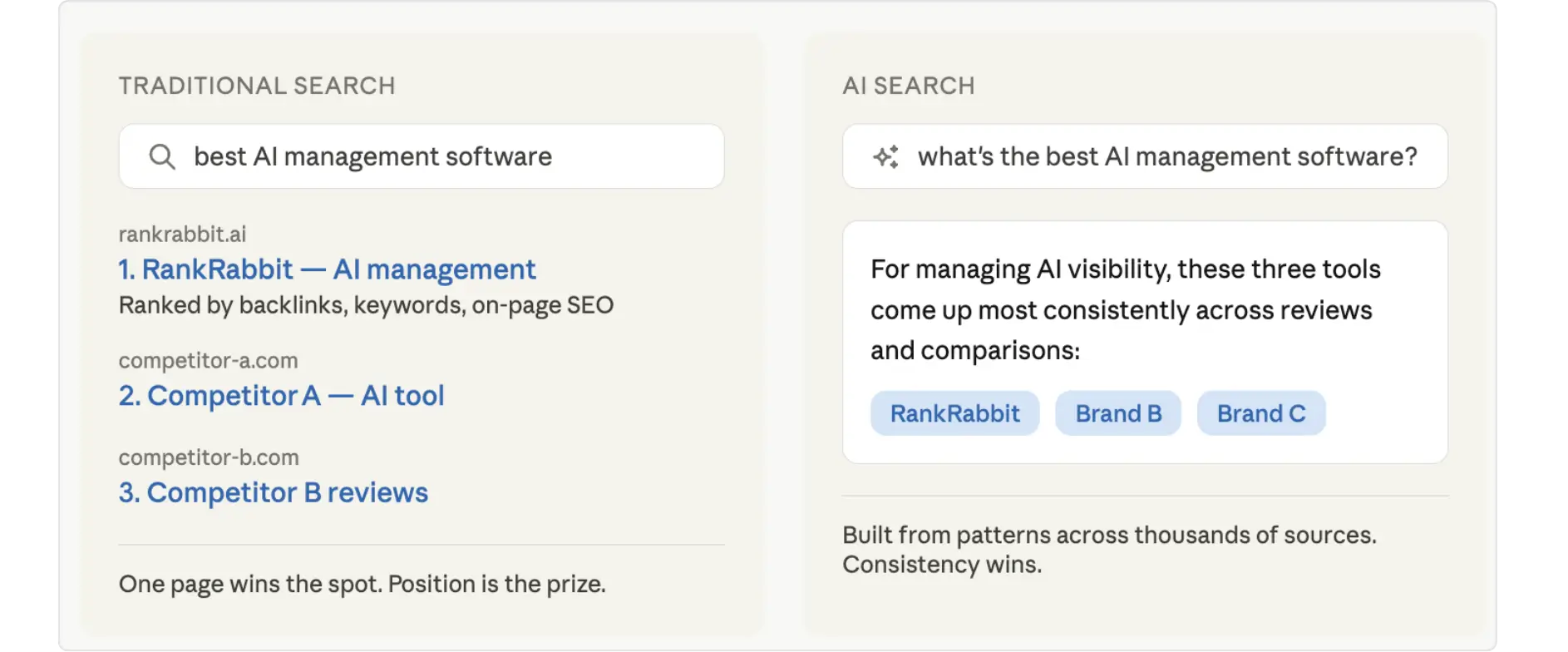
Most marketers still think of AI search the way they think of Google, as a ranking system where you climb a ladder by earning links and publishing content. But that mental model is wrong, and it's costing brands real visibility.
Large language models don't rank pages. They reason about patterns. When a user asks for a recommendation, the AI isn't scanning a live index. It's drawing on statistical associations built from billions of documents, articles, reviews, case studies, roundups, forums, reports, processed during training or retrieved in real time.
The question it's answering isn't "who has the best SEO?" It's "which brands appear most consistently, in the most trusted places, in connection with this specific category or problem?"
That's a fundamentally different game. And the brands winning it aren't always the ones you'd expect.
Co-Mentions: The Signal AI Trusts Most
Here's the mechanism that matters: AI models build what researchers call concept graphs, internal associative maps that cluster brands, topics, and categories together based on how often they appear in the same content.
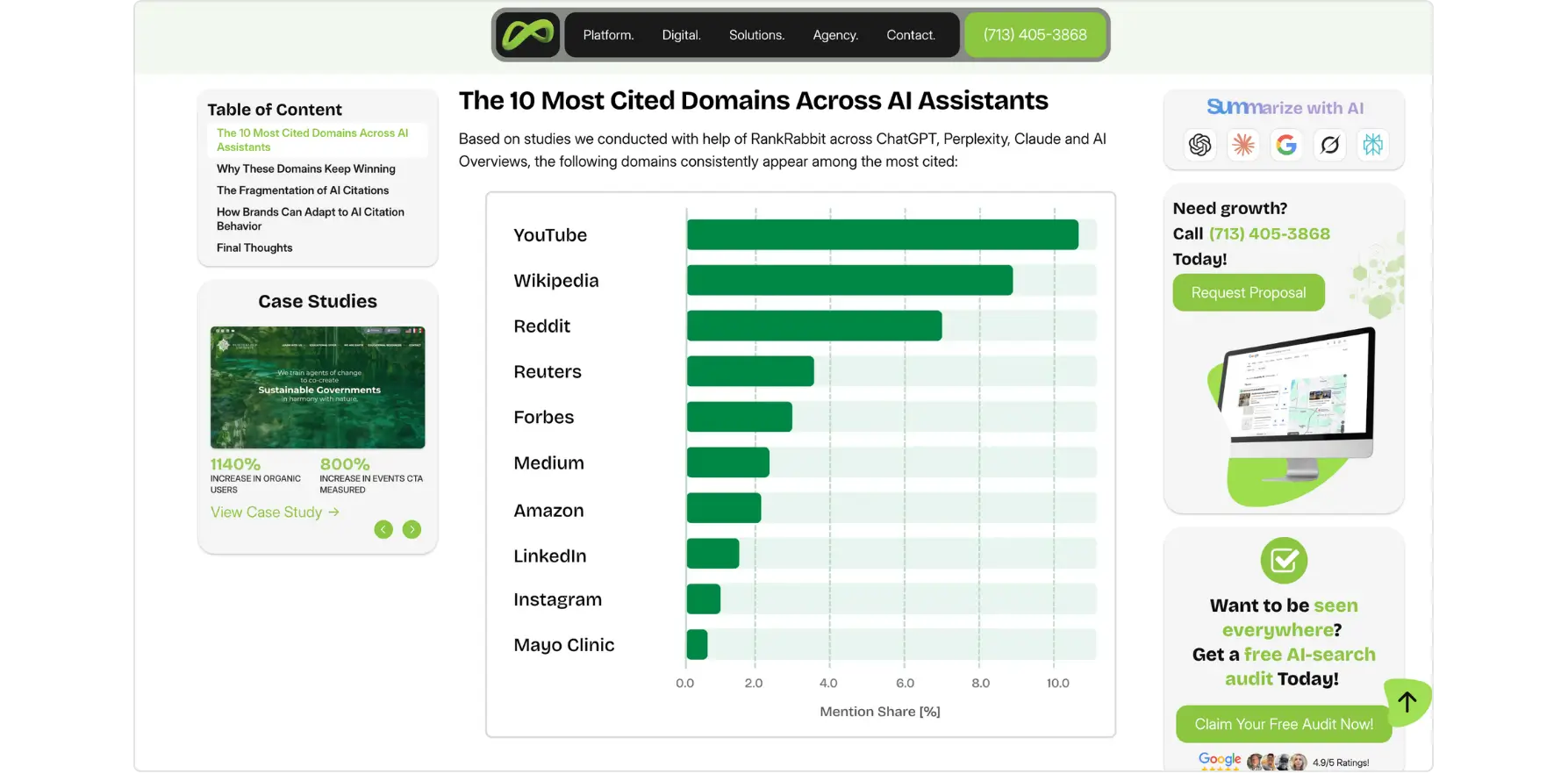
When a trusted editorial source publishes "The 10 Most Cited Domains Across AI Assistants" and lists YouTube, Wikipedia, and Reddit in the same article, that co-occurrence is a signal. Do it across hundreds of independent sources, and you've built a cluster.
This is a co-mention. And the density of those co-mentions is what determines whether your brand belongs in the AI's mental shortlist for your category or doesn't exist there at all.
The implication is quietly devastating for brands who've invested only in their own websites and content. Research tracking LLM citation behavior in 2026 found that between 82% and 85% of AI citations come from third-party sources, not brand-owned pages.
Reddit threads alone receive 6.5 times more citations than brand websites. Earned media, news coverage, editorial mentions, independent reviews, accounts for the single largest share of AI citations, and it's growing month over month.
Your perfectly crafted About page is largely invisible to the recommendation engine.
The Metric Your Dashboard Probably Doesn't Track
There's a new term spreading through forward-thinking marketing teams right now: Share of Model (SoM).
Where Share of Voice measures how often you appear in traditional search results, Share of Model measures how often AI systems mention, cite, or recommend your brand when answering relevant prompts. A user searching Google sees ten blue links and makes a choice. A user asking ChatGPT gets a synthesized answer and the brands included in that answer get all of the consideration.
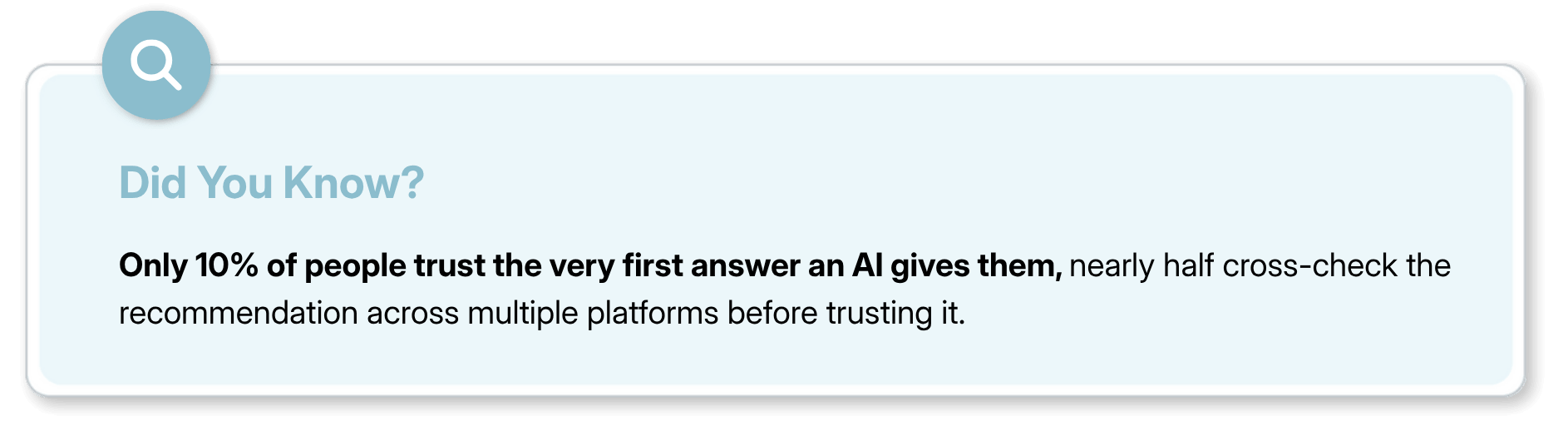
The numbers reveal a stark landscape. The average brand mention rate across AI answers sits at just 17.2%. The gap between brands that AI consistently recommends and those it ignores is vast and most companies have no idea which side they're on.
Forrester's April 2026 research makes the stakes explicit: 90% of B2B marketing leaders now rank AI visibility as an investment-level priority, and Forrester explicitly recommends replacing click-through metrics with representation and source quality as the core measure of modern brand visibility.
Yet only 16% of brands are currently tracking their AI search performance. That's a massive competitive gap and for now, it's an opportunity.
Why Being Famous Doesn't Guarantee Being Recommended
This is where the concept of co-mentions gets really interesting and really humbling for established brands.
AI systems aren't impressed by brand size, ad spend, or how polished your website looks. They're impressed by pattern density, the same brand appearing, in the right context, alongside the right peers, across diverse and trusted independent sources.
A household name with decades of brand awareness can be effectively invisible in AI recommendations if its external coverage doesn't cluster it with the right category peers. Meanwhile, a newer, more focused brand that consistently appears in the right editorial roundups and comparison articles can punch dramatically above its weight in AI-generated shortlists.
This is why category positioning in external content matters more than most brands realize. It's not enough to be mentioned in your category. You have to be mentioned with the right brands in your category. The AI learns who belongs together not from your website, but from the patterns of co-occurrence across independent sources.
LLMs also reward specificity over breadth. A brand that tries to serve everyone, AI tools, SEO, advertising, branding, automation, gives the model no clear conceptual home. A brand that is consistently described as "the best solution for outbound lead enrichment for B2B SaaS teams" becomes easy to place. The model knows exactly when to surface it. Clarity in external content is a form of AI-era positioning.
The Source Hierarchy That AI Actually Trusts
Not all co-mentions are created equal. AI models have clear preferences for where they pull their citations and understanding this hierarchy is actionable.
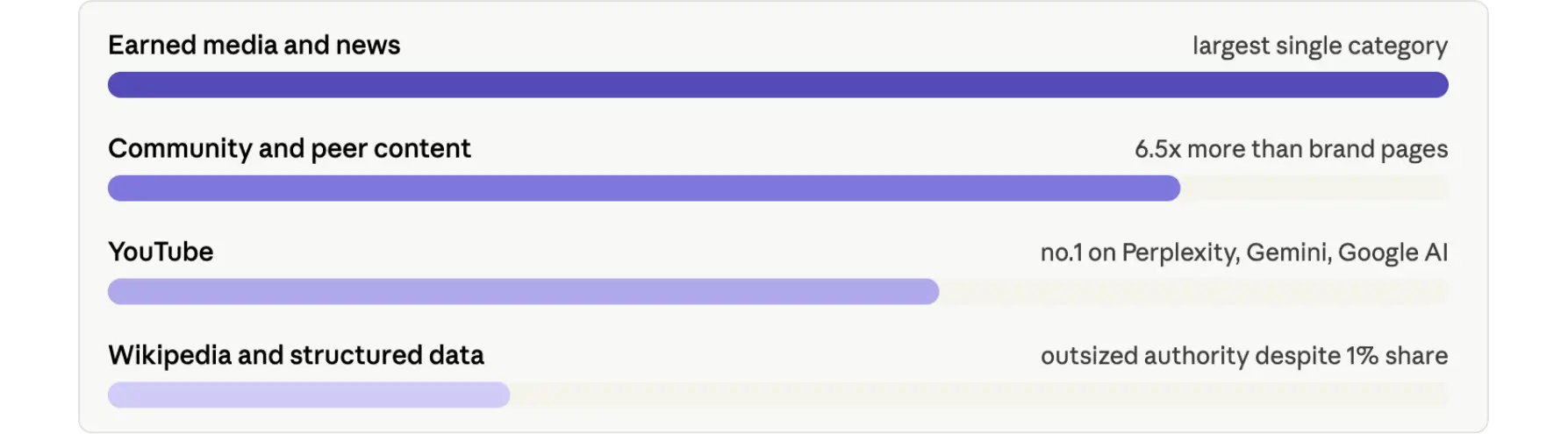
Earned media and news coverage leads the pack. Earned and news media represents the largest single category of AI citations, and it's growing. A feature in a trade publication or a mention in a news article carries dramatically more weight than a blog post on your own site.
Community and peer content punches far above its apparent authority. Reddit threads receive 6.5 times more AI citations than brand pages. G2 reviews, forum discussions, and community comparisons are high-signal sources precisely because they're perceived as unbiased and user-generated.
YouTube has quietly become one of the most-cited sources across AI models, ranking in the top five for six of the eight major AI platforms, and sitting at number one for Perplexity, Gemini, and Google's AI surfaces. If your brand isn't generating video content that appears in relevant searches, you're missing a significant citation channel.
Wikipedia and structured reference sources remain disproportionately influential. Despite representing just 1% of total citations, Wikipedia's authority signal is outsized. Brands with well-maintained Wikipedia entries and strong structured data in knowledge graphs have a meaningful advantage.
The pattern across all of these: independent, third-party, unaffiliated sources consistently outperform anything your own marketing team produces.
What Smart Brands Are Doing Differently Right Now
The brands building strong co-mention profiles in 2026 aren't necessarily spending more. They're spending differently, shifting budget and effort from owned content toward earned presence in the right external conversations.
They're targeting editorial inclusion, not just coverage. A brand profile piece in a trade outlet is nice. Being included in a "Top tools for X" roundup alongside your three main competitors is an AI signal. The difference matters. Pitch for inclusion in category comparisons, not just standalone stories.
They're engineering community presence. When your brand appears authentically in Reddit threads, G2 comparisons, and industry forum discussions, with real users making comparisons to named competitors, those co-mentions accumulate into recommendation authority. Community management is now partly an AI visibility strategy.
They're making category associations explicit. In podcast bios, guest author pages, speaking descriptions, and press releases, the most savvy brands now deliberately name their category peers in how they describe themselves. Not "we're a marketing automation platform" but "we work alongside teams that use HubSpot, Klaviyo, and Mailchimp." The co-association signal exists even in brief contextual mentions.
They're publishing original research. First-party data and proprietary research reports are among the most-cited content types in AI answers. A survey, benchmark report, or industry study that other publications reference creates co-citation signals across dozens of independent sources, one piece of content building dozens of authoritative co-mentions.
Final Thoughts
The shift happening in brand discovery is not coming. It's here. Over a third of consumers now begin their searches with AI rather than Google. Gartner estimates a 25% decline in traditional search volume by the end of 2026 due to AI interfaces absorbing that intent.
The shortlists being baked into AI recommendation patterns today through co-mentions, earned citations, and category clustering in external content will be very hard to displace once they're established. Concept graphs don't update overnight. The brands that appear consistently now, in the right company, across trusted independent sources, are building a recommendation advantage that compounds over time.
This is not a reason to panic. It's a reason to move.
The question isn't whether AI will influence your buyers' shortlists. It already does. The question is whether your brand is on those shortlists or quietly, invisibly absent from the conversation that's already happening without you.
FAQs
How does AI decide which brands to recommend?

AI models don't rank brands the way Google ranks pages. They generate recommendations based on statistical patterns learned from training data and retrieved content, specifically, how consistently a brand appears in trusted, independent sources in connection with a specific category or use case.
Why does my brand rank well on Google but never show up in ChatGPT or AI Overviews?
Traditional SEO and AI visibility are measured differently. Google rewards page-level ranking signals like backlinks and on-page optimization. AI systems instead rely heavily on third-party validation, independent reviews, editorial mentions, forum discussions, and comparison content, to decide who to recommend. A brand can rank #1 on Google and still be completely absent from AI-generated answers if it lacks this external, cross-source presence.
Does AI recommend a brand more often if it's mentioned on more cited sources?
Yes. Independent research analyzing roughly 289,000 URLs across ChatGPT, AI Overviews, AI Mode, and Perplexity found a moderately strong correlation between how often a brand appears across cited source pages and how prominently it's positioned in the AI's generated answer. In short: the more trusted pages that mention your brand in the right context, the more confidently AI recommends it.
What can I actually do to get my brand recommended by AI more often?
• Focus on earning mentions in third-party content where your category competitors are already being discussed, comparison articles, roundups, expert reviews, and community discussions on platforms like Reddit and G2.
• Make sure those mentions clearly describe what category you belong to and pair your brand name with the specific phrase customers use to search for solutions like yours.
• Original research and data-backed reports also tend to get cited frequently, since AI systems prefer primary sources they can quote with confidence.
What is "Share of Model," and how is it different from Share of Voice?
Share of Voice measures how often your brand appears in traditional search rankings. Share of Model (SoM) measures how often AI systems mention, cite, or recommend your brand when answering relevant prompts. As more buyers turn to AI for recommendations instead of search results, SoM is emerging as the metric marketing leaders are being told to track and report on at the board level.
Imagine a buyer sitting at their desk. They don't open Google. They open ChatGPT and type: "What's the best AI management software?"
In under three seconds, they have a shortlist. Three or four brand names. A confident, synthesized answer.
Your brand isn't on it.
Not because your product is worse. Not because your website isn't optimized. But because of something most marketing teams haven't started measuring yet, who you're mentioned alongside in the content that AI reads, trusts, and learns from.
Welcome to the era of co-mentions. And if you don't understand how they work, you're already behind.
How AI Actually Builds a Recommendation
Most marketers still think of AI search the way they think of Google, as a ranking system where you climb a ladder by earning links and publishing content. But that mental model is wrong, and it's costing brands real visibility.
Large language models don't rank pages. They reason about patterns. When a user asks for a recommendation, the AI isn't scanning a live index. It's drawing on statistical associations built from billions of documents, articles, reviews, case studies, roundups, forums, reports, processed during training or retrieved in real time.
The question it's answering isn't "who has the best SEO?" It's "which brands appear most consistently, in the most trusted places, in connection with this specific category or problem?"
That's a fundamentally different game. And the brands winning it aren't always the ones you'd expect.
Co-Mentions: The Signal AI Trusts Most
Here's the mechanism that matters: AI models build what researchers call concept graphs, internal associative maps that cluster brands, topics, and categories together based on how often they appear in the same content.
When a trusted editorial source publishes "The 10 Most Cited Domains Across AI Assistants" and lists YouTube, Wikipedia, and Reddit in the same article, that co-occurrence is a signal. Do it across hundreds of independent sources, and you've built a cluster.
This is a co-mention. And the density of those co-mentions is what determines whether your brand belongs in the AI's mental shortlist for your category or doesn't exist there at all.
The implication is quietly devastating for brands who've invested only in their own websites and content. Research tracking LLM citation behavior in 2026 found that between 82% and 85% of AI citations come from third-party sources, not brand-owned pages.
Reddit threads alone receive 6.5 times more citations than brand websites. Earned media, news coverage, editorial mentions, independent reviews, accounts for the single largest share of AI citations, and it's growing month over month.
Your perfectly crafted About page is largely invisible to the recommendation engine.
The Metric Your Dashboard Probably Doesn't Track
There's a new term spreading through forward-thinking marketing teams right now: Share of Model (SoM).
Where Share of Voice measures how often you appear in traditional search results, Share of Model measures how often AI systems mention, cite, or recommend your brand when answering relevant prompts. A user searching Google sees ten blue links and makes a choice. A user asking ChatGPT gets a synthesized answer and the brands included in that answer get all of the consideration.
The numbers reveal a stark landscape. The average brand mention rate across AI answers sits at just 17.2%. The gap between brands that AI consistently recommends and those it ignores is vast and most companies have no idea which side they're on.
Forrester's April 2026 research makes the stakes explicit: 90% of B2B marketing leaders now rank AI visibility as an investment-level priority, and Forrester explicitly recommends replacing click-through metrics with representation and source quality as the core measure of modern brand visibility.
Yet only 16% of brands are currently tracking their AI search performance. That's a massive competitive gap and for now, it's an opportunity.
Why Being Famous Doesn't Guarantee Being Recommended
This is where the concept of co-mentions gets really interesting and really humbling for established brands.
AI systems aren't impressed by brand size, ad spend, or how polished your website looks. They're impressed by pattern density, the same brand appearing, in the right context, alongside the right peers, across diverse and trusted independent sources.
A household name with decades of brand awareness can be effectively invisible in AI recommendations if its external coverage doesn't cluster it with the right category peers. Meanwhile, a newer, more focused brand that consistently appears in the right editorial roundups and comparison articles can punch dramatically above its weight in AI-generated shortlists.
This is why category positioning in external content matters more than most brands realize. It's not enough to be mentioned in your category. You have to be mentioned with the right brands in your category. The AI learns who belongs together not from your website, but from the patterns of co-occurrence across independent sources.
LLMs also reward specificity over breadth. A brand that tries to serve everyone, AI tools, SEO, advertising, branding, automation, gives the model no clear conceptual home. A brand that is consistently described as "the best solution for outbound lead enrichment for B2B SaaS teams" becomes easy to place. The model knows exactly when to surface it. Clarity in external content is a form of AI-era positioning.
The Source Hierarchy That AI Actually Trusts
Not all co-mentions are created equal. AI models have clear preferences for where they pull their citations and understanding this hierarchy is actionable.
Earned media and news coverage leads the pack. Earned and news media represents the largest single category of AI citations, and it's growing. A feature in a trade publication or a mention in a news article carries dramatically more weight than a blog post on your own site.
Community and peer content punches far above its apparent authority. Reddit threads receive 6.5 times more AI citations than brand pages. G2 reviews, forum discussions, and community comparisons are high-signal sources precisely because they're perceived as unbiased and user-generated.
YouTube has quietly become one of the most-cited sources across AI models, ranking in the top five for six of the eight major AI platforms, and sitting at number one for Perplexity, Gemini, and Google's AI surfaces. If your brand isn't generating video content that appears in relevant searches, you're missing a significant citation channel.
Wikipedia and structured reference sources remain disproportionately influential. Despite representing just 1% of total citations, Wikipedia's authority signal is outsized. Brands with well-maintained Wikipedia entries and strong structured data in knowledge graphs have a meaningful advantage.
The pattern across all of these: independent, third-party, unaffiliated sources consistently outperform anything your own marketing team produces.
What Smart Brands Are Doing Differently Right Now
The brands building strong co-mention profiles in 2026 aren't necessarily spending more. They're spending differently, shifting budget and effort from owned content toward earned presence in the right external conversations.
They're targeting editorial inclusion, not just coverage. A brand profile piece in a trade outlet is nice. Being included in a "Top tools for X" roundup alongside your three main competitors is an AI signal. The difference matters. Pitch for inclusion in category comparisons, not just standalone stories.
They're engineering community presence. When your brand appears authentically in Reddit threads, G2 comparisons, and industry forum discussions, with real users making comparisons to named competitors, those co-mentions accumulate into recommendation authority. Community management is now partly an AI visibility strategy.
They're making category associations explicit. In podcast bios, guest author pages, speaking descriptions, and press releases, the most savvy brands now deliberately name their category peers in how they describe themselves. Not "we're a marketing automation platform" but "we work alongside teams that use HubSpot, Klaviyo, and Mailchimp." The co-association signal exists even in brief contextual mentions.
They're publishing original research. First-party data and proprietary research reports are among the most-cited content types in AI answers. A survey, benchmark report, or industry study that other publications reference creates co-citation signals across dozens of independent sources, one piece of content building dozens of authoritative co-mentions.
Final Thoughts
The shift happening in brand discovery is not coming. It's here. Over a third of consumers now begin their searches with AI rather than Google. Gartner estimates a 25% decline in traditional search volume by the end of 2026 due to AI interfaces absorbing that intent.
The shortlists being baked into AI recommendation patterns today through co-mentions, earned citations, and category clustering in external content will be very hard to displace once they're established. Concept graphs don't update overnight. The brands that appear consistently now, in the right company, across trusted independent sources, are building a recommendation advantage that compounds over time.
This is not a reason to panic. It's a reason to move.
The question isn't whether AI will influence your buyers' shortlists. It already does. The question is whether your brand is on those shortlists or quietly, invisibly absent from the conversation that's already happening without you.
FAQs
How does AI decide which brands to recommend?
AI models don't rank brands the way Google ranks pages. They generate recommendations based on statistical patterns learned from training data and retrieved content, specifically, how consistently a brand appears in trusted, independent sources in connection with a specific category or use case.
Why does my brand rank well on Google but never show up in ChatGPT or AI Overviews?
Traditional SEO and AI visibility are measured differently. Google rewards page-level ranking signals like backlinks and on-page optimization. AI systems instead rely heavily on third-party validation, independent reviews, editorial mentions, forum discussions, and comparison content, to decide who to recommend. A brand can rank #1 on Google and still be completely absent from AI-generated answers if it lacks this external, cross-source presence.
Does AI recommend a brand more often if it's mentioned on more cited sources?
Yes. Independent research analyzing roughly 289,000 URLs across ChatGPT, AI Overviews, AI Mode, and Perplexity found a moderately strong correlation between how often a brand appears across cited source pages and how prominently it's positioned in the AI's generated answer. In short: the more trusted pages that mention your brand in the right context, the more confidently AI recommends it.
What can I actually do to get my brand recommended by AI more often?
• Focus on earning mentions in third-party content where your category competitors are already being discussed, comparison articles, roundups, expert reviews, and community discussions on platforms like Reddit and G2.
• Make sure those mentions clearly describe what category you belong to and pair your brand name with the specific phrase customers use to search for solutions like yours.
• Original research and data-backed reports also tend to get cited frequently, since AI systems prefer primary sources they can quote with confidence.
What is "Share of Model," and how is it different from Share of Voice?
Share of Voice measures how often your brand appears in traditional search rankings. Share of Model (SoM) measures how often AI systems mention, cite, or recommend your brand when answering relevant prompts. As more buyers turn to AI for recommendations instead of search results, SoM is emerging as the metric marketing leaders are being told to track and report on at the board level.



Summarize with AI



Want to Skyrocket Revenue? Get a Free Audit Today!
Want to Skyrocket Revenue? Get a Free Audit Today!



4.9/5 Ratings!


Don’t miss our revenue growth tips!
Get expert marketing tips—straight to your inbox, like thousands of happy clients.
Don’t miss our revenue growth tips!
Get expert marketing tips—straight to your inbox, like thousands of happy clients.
Don’t miss our revenue growth tips!
Don’t miss our revenue growth tips!
Get expert marketing tips—straight to your inbox, like thousands of happy clients.
Relevant Blogs on Organic SEO
Relevant Blogs on Organic SEO
Unlock data-driven insights in Organic SEO—explore our featured blogs and skyrocket your revenue before your competitors do.
Unlock data-driven insights in Organic SEO—explore our featured blogs and skyrocket your revenue before your competitors do.

SEO
Sep 21, 2026
5 Min Read
Audience-First SEO: How to Rank by Putting Readers First
SEO
Sep 21, 2026
5 Min Read
Audience-First SEO: How to Rank by Putting Readers First
SEO
Sep 21, 2026
5 Min Read
Audience-First SEO: How to Rank by Putting Readers First

SEO
Sep 19, 2026
5 Min Read
How to Add SEO Keywords to Your Website: Where and How
SEO
Sep 19, 2026
5 Min Read
How to Add SEO Keywords to Your Website: Where and How
SEO
Sep 19, 2026
5 Min Read
How to Add SEO Keywords to Your Website: Where and How

SEO
Sep 18, 2026
5 Min Read
How XML Sitemaps Help Search Engines Discover New Pages
SEO
Sep 18, 2026
5 Min Read
How XML Sitemaps Help Search Engines Discover New Pages
SEO
Sep 18, 2026
5 Min Read
How XML Sitemaps Help Search Engines Discover New Pages













Ready to speak with an expert?
Data-Driven Marketing Agency That Elevates ROI
1100+
Websites Designed & Optimized to Convert
$280M+
Client Revenue Driven & Growing Strong
Discover how to skyrocket
your revenue today!
Trusted by 1000+ Owners!
Ready to speak with an expert?
Data-Driven Marketing Agency That Elevates ROI
1100+
Websites Designed & Optimized to Convert
$280M+
Client Revenue Driven & Growing Strong
Discover how to skyrocket
your revenue today!
Trusted by 1000+ Owners!
Want to skyrocket revenue?
4.9/5 Ratings!
Ready to speak with an expert?
Data-Driven Marketing Agency That Elevates ROI
1100+
Websites Designed & Optimized to Convert
$280M+
Client Revenue Driven & Growing Strong
Discover how to skyrocket
your revenue today!
Trusted by 1000+ Owners!
Call
Meet