Half of All Online Content Is Now AI-Written — Here's How to Stand Out
Half of All Online Content Is Now AI-Written — Here's How to Stand Out
Last Updated:
Table of Content
Case Studies






Tanya Singh
Tanya Singh
Tanya Singh
SEO
SEO
SEO
10 Min Read
12 Min
10 Min Read
Quick question before we begin: when did you last read a blog post and think, "wow, that was genuinely useful"? Not just technically correct, not just well-formatted, but actually worth your time?
If you are struggling to remember, you are not alone and there is a reason for it. A study of over 55K URLs published between 2020 and 2025 found that AI-generated content has crossed the 50% mark on the web (Ahref). Half of everything being published right now was not written by a human. And a lot of it reads exactly like you would expect: grammatically fine, structurally safe, and completely forgettable.
For anyone running a business with a content strategy, or trying to grow through search, this is the landscape you are competing in. The question is not whether AI is changing content. It already has. The question is: what do you do about it?
Let us get into it.
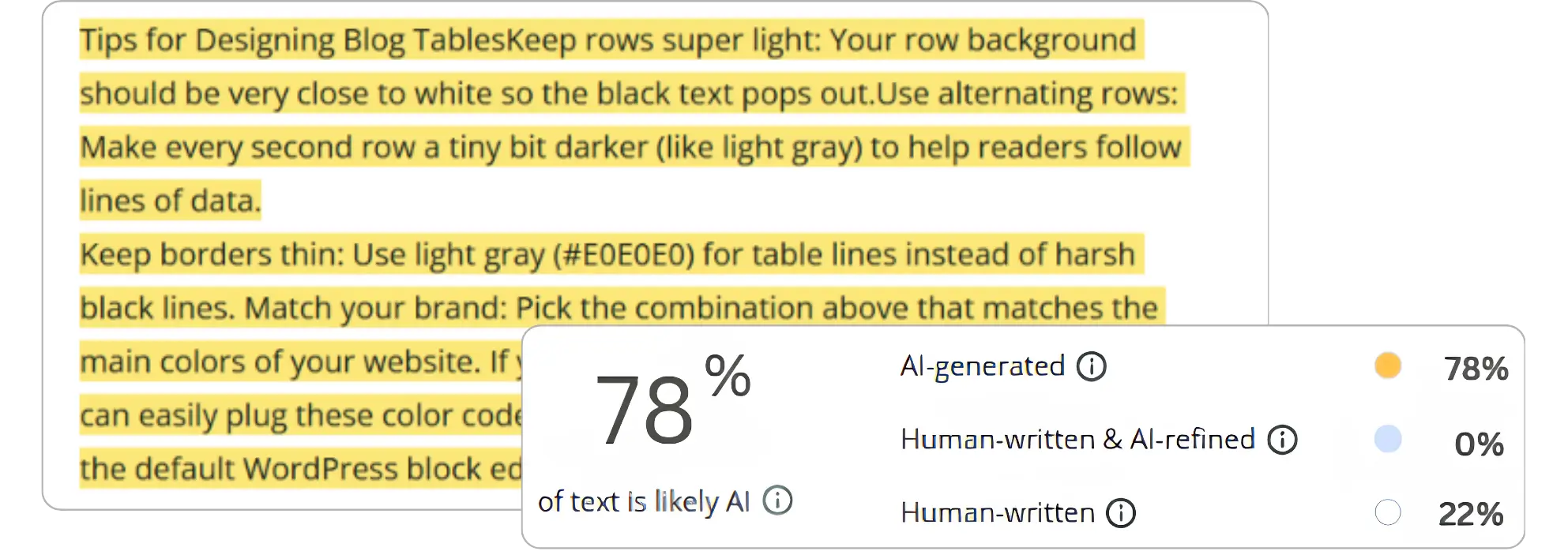
Why Is Half of Online Content Now AI-Generated?
Because it is fast, cheap, and the math seemed to make sense. Since ChatGPT launched in late 2022, the percentage of AI-written articles on the web jumped sharply. The pitch was simple: publish more, cover more keywords, rank for more queries, and grow organic traffic without scaling your writing team. For a window of time, some sites made that work.
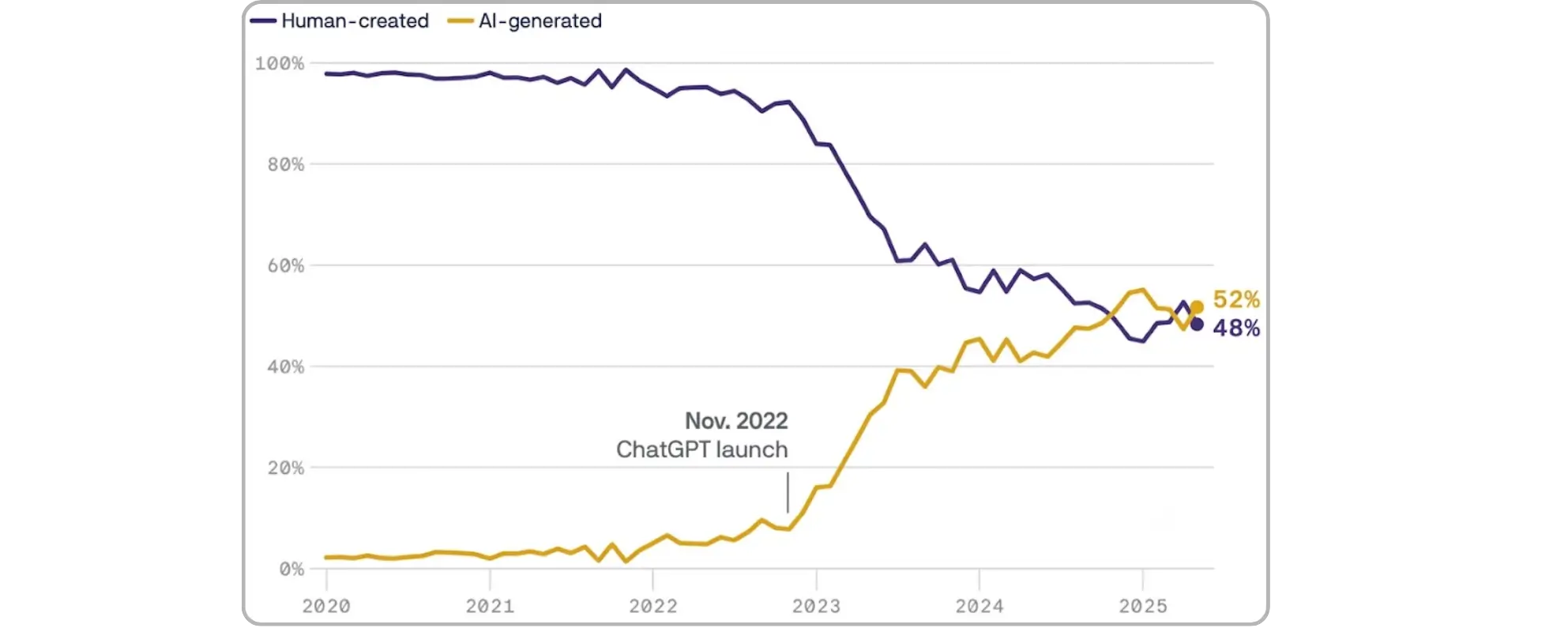
But here is what happened. Everyone ran the same play at the same time. The web filled up with thousands of articles on the same topics, written in the same format, making the same points. Readers noticed. Google noticed. And now we have what a lot of people in the industry call "AI slop" — content that is technically fine but essentially worthless.
The volume strategy is broken. More content does not mean more SEO authority. In fact, recent analysis confirms that publishing at scale without quality can actively dilute your site's authority, split keyword rankings across too many similar pages, and waste your crawl budget on content that was never going to perform anyway.
What Does This Mean for Your SEO Right Now?
It means the rules have genuinely shifted, and "produce more content" is no longer a strategy.
For years, SEO rewarded volume. More pages meant more keyword coverage. More keyword coverage meant more traffic. That model worked well when the competition was mostly human writers with limited output. Now that AI can generate thousands of articles a week, the web is drowning in coverage. And Google has responded by raising the bar on what actually ranks.
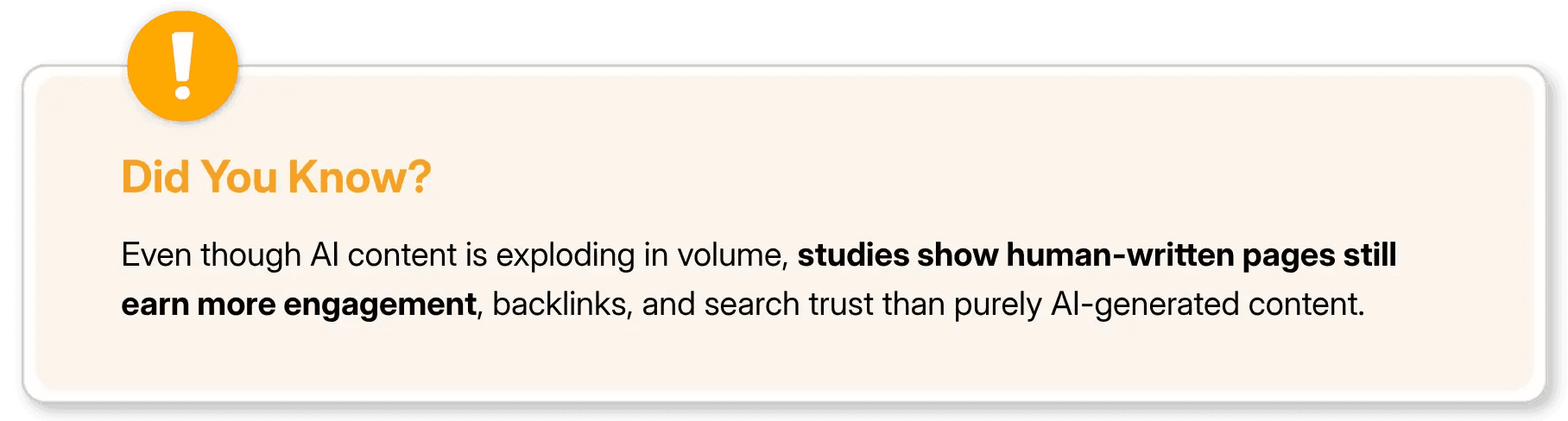
Here is the shift that matters most: Google's systems are increasingly built to reward pages that demonstrate real expertise and genuine usefulness, not pages that simply exist on a topic. The March 2024 core update and every update since has pushed harder in that direction. Thin content, even if it reads fluently, is getting filtered out.
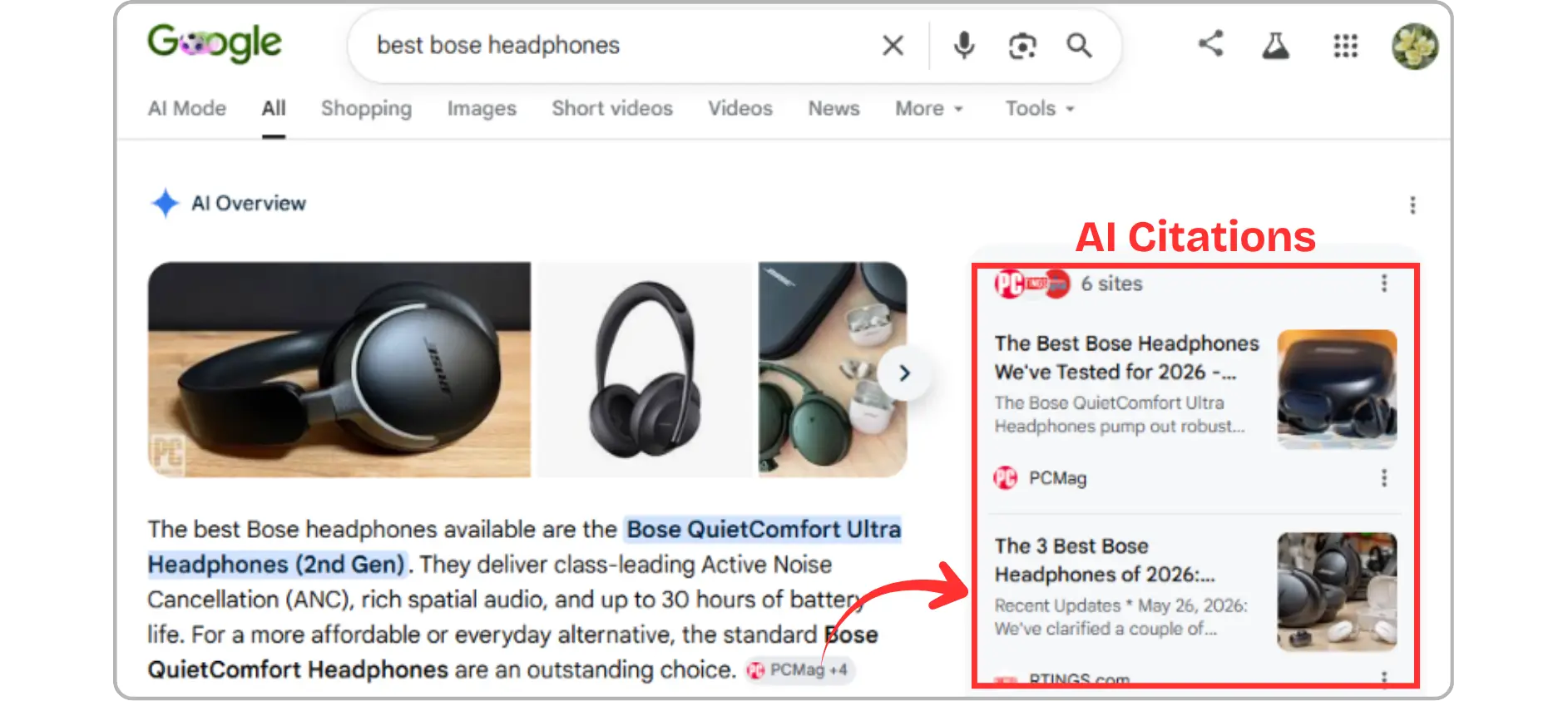
And it is not just about rankings anymore. Google's new intelligent search box — the biggest redesign of the Google search interface in 25 years is built around longer, more conversational queries and AI-powered responses. Users are not just clicking the first blue link. They are getting answers synthesised from multiple sources, or from AI Overviews that sit above organic results entirely. If your content is not being cited as a source inside those answers, a significant slice of your potential visibility is simply not reaching you.
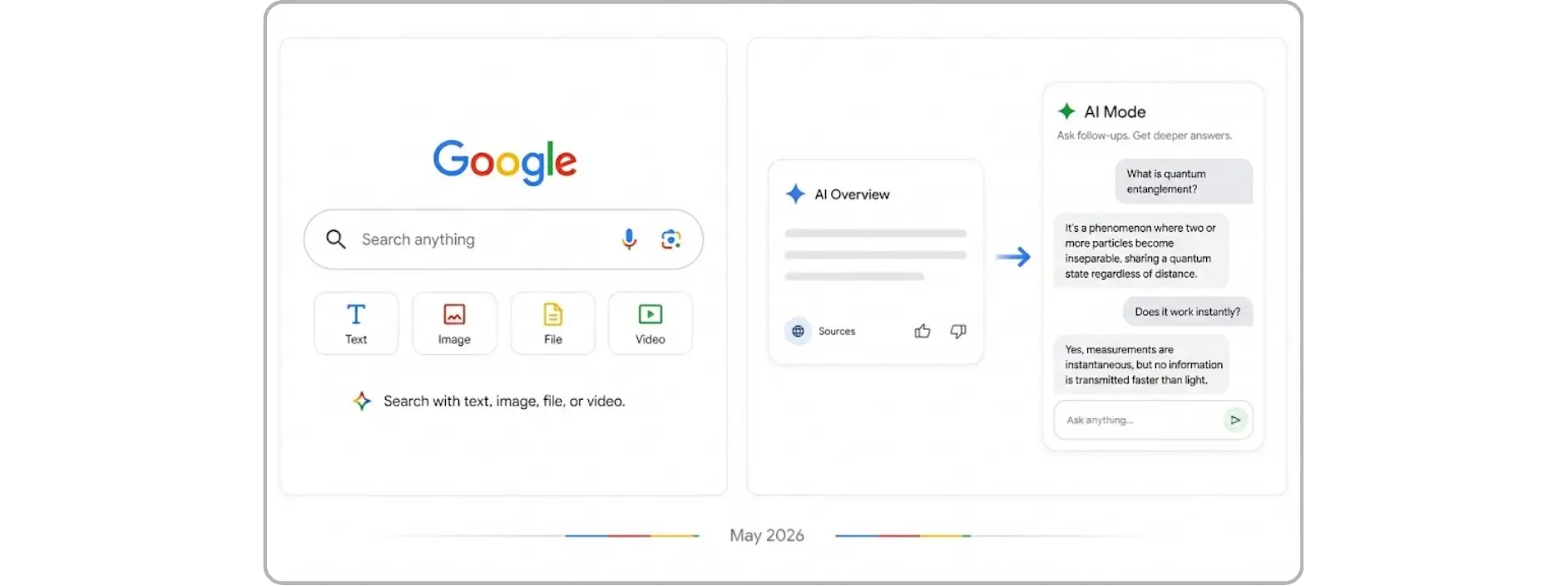
SEO in 2026 is not about ranking on page one. It is about being recognised as an authoritative source across the entire web, so that when AI systems construct an answer, your brand is part of it.
Why Is Publishing More AI-Generated Content Making Things Worse, Not Better?
Because you are feeding more noise into an already noisy system and Google can tell.
Here is something that trips a lot of content teams up. They see competitors publishing daily, they own traffic, and they decide to publish more. So they turn on the AI content tap and start pushing out articles at scale. Traffic stays flat or drops. They publish more. It still does not work.
The reason is that publishing volume without topical authority behind it does not build SEO strength, it spreads it thin. When you have ten articles that each cover a slightly different angle on the same keyword, none of them earns the full authority signal that one genuinely comprehensive, well-linked resource would. You have split your own rankings. There is also the crawl budget problem. Google's bots have a infinite amount of time to crawl your site. If a big chunk of your pages are thin, AI-generated articles that rarely get clicked or linked to, you are training Google to treat your site as a low-priority crawl. That affects your best pages too, not just the weak ones. The brands that are growing their organic visibility right now are not the ones publishing more. They are the ones publishing less, but making each piece genuinely count.
What Does Google Actually Reward in the Age of AI Search?
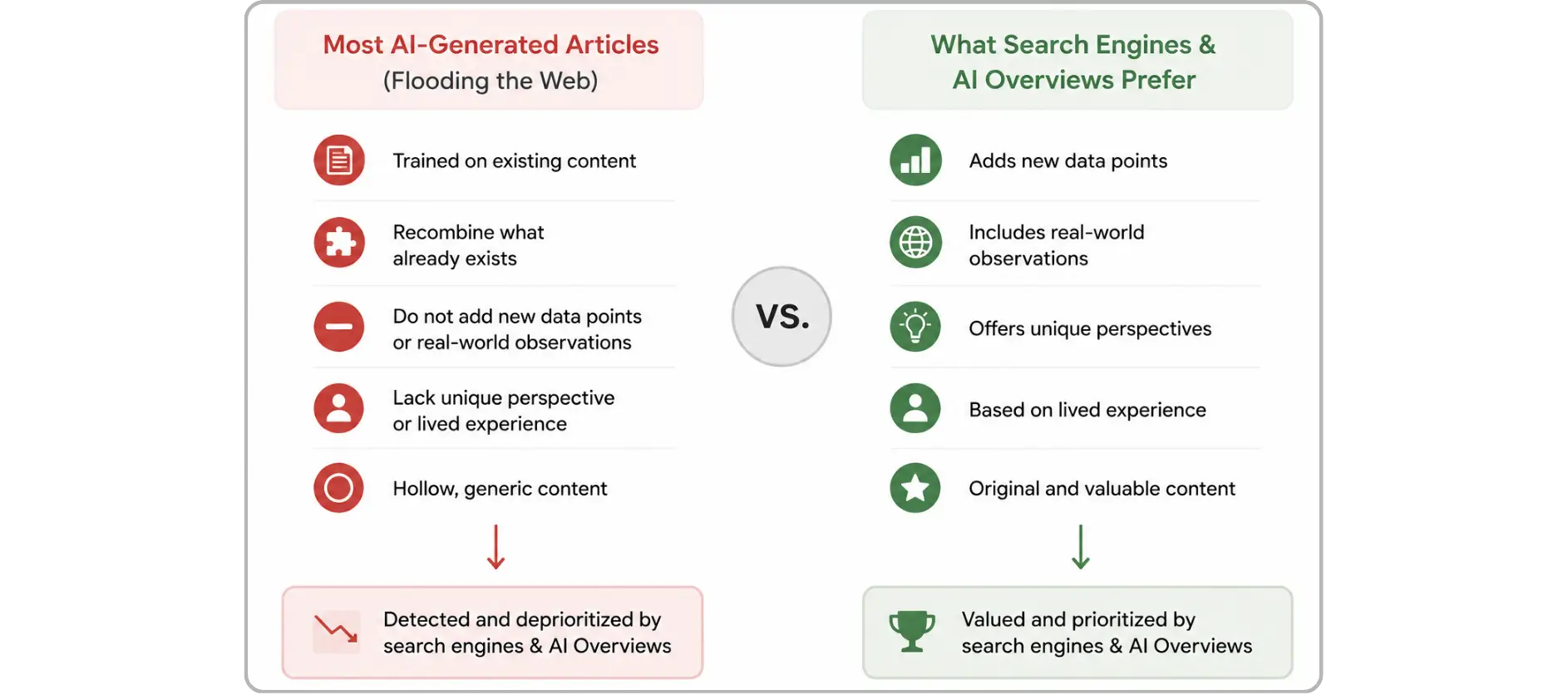
Google rewards content that a real expert would be proud to put their name on. In May 2026, Google published its first official guide specifically addressing how to optimise for AI-powered search features — AI Overviews, AI Mode, and generative search experiences more broadly. The message was clear: there is no separate playbook for AI search. The same signals that have always driven great SEO still apply. But the standards are higher, and the competition is stiffer. So what specifically earns visibility? Here is what the signals consistently point to:
Genuine expertise and named authorship.
Content that comes from a real person with real credentials in a subject performs better. If your content could have been written by anyone, Google increasingly treats it as though it was written by no one.
Depth over breadth.
A single page that thoroughly addresses a topic, anticipates follow-up questions, and provides real context outperforms five pages that each superficially cover a related angle. Topical authority is built by going deep, not wide.
Off-site brand recognition.
This is the part that most content-only strategies miss. Visibility today depends heavily on authority signals that come from outside your own site — being mentioned in relevant publications, earning genuine backlinks from credible sources, showing up in community conversations, and having a clear, consistent brand entity across the web. AI systems build their picture of your credibility from all of these signals combined.
Answer-ready structure.
AI Overviews extract answers, not articles. If your content buries the main point in paragraph four, you are not going to be cited. Pages that open with a clear, direct answer to the question and then support it with depth are the ones getting pulled into AI-generated responses.

Why Does Most AI-Generated Content Fail at AI Search Optimization?
This is the irony worth sitting with for a moment: most AI-generated content performs terribly in AI search.
Think about what Google's AI Overviews are actually doing. They are scanning the web for the most trustworthy, specific, and authoritative source on a given question. A generic article that covers the same ground as fifty other generic articles does not offer anything that qualifies it as the best source. There is no distinguishing signal. It blends into the background.
Effective ai content optimization is not about using AI to write at scale. It is about using AI strategically, and then layering in the things that only your brand can provide: real knowledge, a distinct perspective, specific data, and context that did not exist anywhere before you published it. The table below shows how different types of content actually perform for ai search visibility:
Content Type | AI Search Visibility | What It Needs to Compete |
|---|---|---|
Generic "What is X" explainers | Low: near-identical versions everywhere | Real examples, original data, or specific context |
Thought leadership with named expertise | High: unique perspective earns citations | Genuine insight that can only come from your brand |
Original research and proprietary data | Very High: AI cites it frequently | You need to own the data |
Structured how-to guides with real specificity | Medium to High | Concrete steps, screenshots, lived context |
Thin product or affiliate pages | Very Low | Near complete rebuild required |
The pattern is consistent. Content that only your brand could have published earns visibility, content that anyone could have generated does not.
How Do You Actually Stand Out When Every Brand Sounds the Same?
You stop trying to sound like everyone else in your space, and you start sounding like yourself. That sounds obvious. It is harder in practice than most people expect, because most content processes are optimised for speed and keyword coverage rather than differentiation. Let us break down what actually works.
Does Your Brand Have a Real Point of View?
Most brands treat content as a coverage exercise: map keywords to pages, hit word counts, publish. The result is a site that technically covers its category and says nothing memorable, which also affects your brand reputation and authority.
AI systems are looking for a clear, citable claim. What does your brand believe that your competitors would not say out loud? What have you learned from your specific customers or work that is genuinely different from the standard industry? Content built on that kind of specificity is not just more interesting to readers but it is more likely to be cited in AI responses because nothing else on the web says exactly the same thing. If your content could have come from any brand in your category, it will perform like it belongs to no brand in particular.
Are You Using AI to Enhance, or Just to Replace?
There is a real difference between using AI to assist in content creation and using AI to generate it wholesale. AI tools are genuinely useful, for synthesising research, building structural outlines, speeding up editing, and finding content gaps. There is no reason not to use them for those things. Where they fall short is in producing the original signal: the insight that did not exist before you published it, the opinion backed by your actual experience, the specific data point that no one else has. The best content workflows use AI for the scaffolding and put humans in charge of everything that makes the final piece distinctive.
Is Your SEO Strategy Built Around Recognition, Not Just Rankings?
This is the shift that most teams have not made yet. Traditional SEO was largely an on-page game: optimise your titles, build links, hit word counts, rank. That still matters. But ai search visibility now depends on a much wider set of signals and many of them happen off your website entirely. When your brand gets mentioned in credible publications, when industry conversations reference your work, when your name appears in the kind of places your audience already trusts — all of that feeds into how AI systems perceive your authority. Brands that invest in genuine PR, original research, and a visible presence in their industry's conversation tend to show up in AI-generated answers far more reliably than brands that only optimise their own pages.
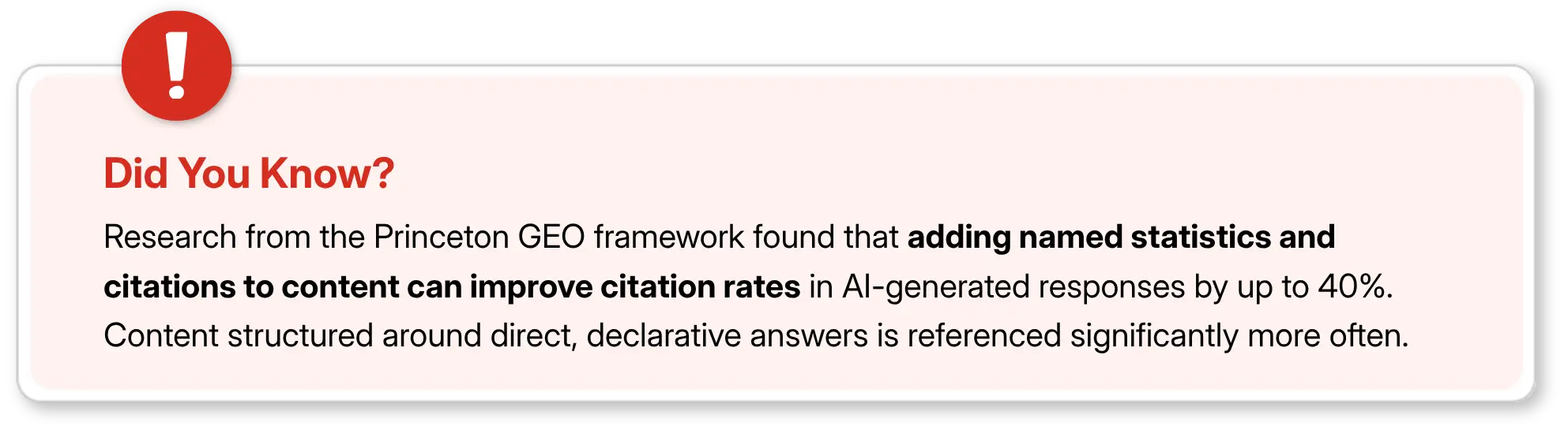
Your SEO goal in 2026 is recognition across the entire web, not just a position in the rankings.
Is Your Content Structured So That Answers Are Easy to Extract?
If you want to be cited in AI responses, make the answer impossible to miss. Open each section with a direct, clear statement of the point. Use headings that mirror the actual question a reader would type. Do not make an AI system or a real person — wade through three paragraphs of context to find out what you actually think. This is not about dumbing your content down. Clear, direct, well-structured content serves both human readers and the AI systems that increasingly mediate the first contact between your brand and a potential customer.
Should You Work With an AI Search Optimization Agency?
If the landscape is shifting faster than your team can keep up with, that is not just a feeling — it genuinely is. The combination of moving parts is real.
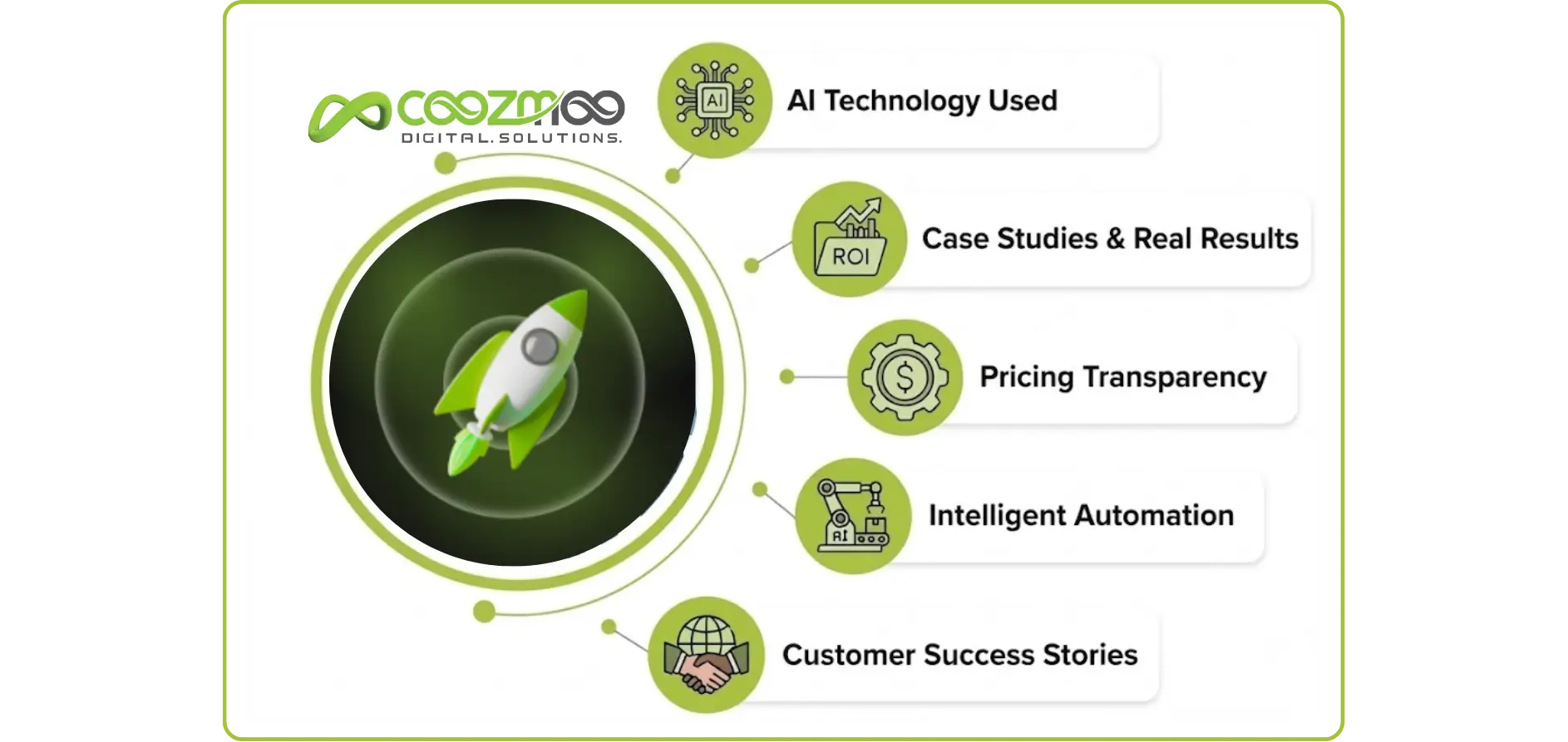
Here is what a good AI search optimization agency actually handles:
AI content optimization: auditing what you have, identifying what needs to be rebuilt, and making sure new content is structured for citation rather than just coverage.
Technical SEO: crawlability, site speed, schema markup, and entity associations that help AI systems understand exactly what your brand does and who it serves.
Entity building and off-site authority: getting your brand recognised across the wider web, not just on your own pages.
Structured data strategy: marking up content so AI features can extract and attribute it accurately.
Keeping up with Google's updates: so your team does not have to monitor every algorithm change and feature rollout to stay competitive.
That said, no agency can substitute for what only your brand brings: your knowledge, your expertise, and the perspective that comes from actually doing the work you do. The best partnerships treat that as the raw material and build the visibility infrastructure around it.
Final Thoughts
Half the internet is now AI-written, and that share is going to keep climbing. But the brands that will win in AI search are not the ones responding by publishing more of the same. They are the ones treating content as a genuine expression of expertise, building real authority off-site, and making it easy for both readers and AI systems to understand exactly what they stand for.
In a web full of ai generated articles that all say the same thing, being specific, credible, and genuinely useful is the rarest competitive advantage you can build right now. And unlike shortcuts, it compounds.
FAQs.
Is AI-generated content bad for SEO?

Not inherently, but most of it is. AI content fails when it is generic and interchangeable. Google rewards genuine expertise and real usefulness, if your content lacks both, it will not rank, regardless of how it was written.
How can I tell if my content is too generic to rank?
If any brand in your category could publish it word for word without anyone noticing, it is too generic. Good content has a specific angle, real context, and knowledge that only comes from genuine experience in the subject.
What is the difference between SEO, AEO, and GEO and do I need all three?
SEO targets traditional rankings, AEO targets direct answers in voice and AI search, and GEO targets citations inside AI-generated responses. Google confirmed in its 2026 guide that the same quality signals drive all three — so treat them as one strategy, not three separate ones.
Does publishing more content still help SEO?
Only if it is genuinely useful and adds something new. Publishing at scale without quality dilutes your site's authority, splits rankings across too many similar pages, and wastes crawl budget. Depth and quality consistently outperform volume right now.
How do I get my content cited in Google AI Overviews?
Open each section with a direct, clear answer. Build off-site authority through earned media and credible backlinks. Cover your topic with real depth rather than surface-level points. AI Overviews pull from the most authoritative, answer-ready source available — your job is to become that source.
Quick question before we begin: when did you last read a blog post and think, "wow, that was genuinely useful"? Not just technically correct, not just well-formatted, but actually worth your time?
If you are struggling to remember, you are not alone and there is a reason for it. A study of over 55K URLs published between 2020 and 2025 found that AI-generated content has crossed the 50% mark on the web (Ahref). Half of everything being published right now was not written by a human. And a lot of it reads exactly like you would expect: grammatically fine, structurally safe, and completely forgettable.
For anyone running a business with a content strategy, or trying to grow through search, this is the landscape you are competing in. The question is not whether AI is changing content. It already has. The question is: what do you do about it?
Let us get into it.
Why Is Half of Online Content Now AI-Generated?
Because it is fast, cheap, and the math seemed to make sense. Since ChatGPT launched in late 2022, the percentage of AI-written articles on the web jumped sharply. The pitch was simple: publish more, cover more keywords, rank for more queries, and grow organic traffic without scaling your writing team. For a window of time, some sites made that work.
But here is what happened. Everyone ran the same play at the same time. The web filled up with thousands of articles on the same topics, written in the same format, making the same points. Readers noticed. Google noticed. And now we have what a lot of people in the industry call "AI slop" — content that is technically fine but essentially worthless.
The volume strategy is broken. More content does not mean more SEO authority. In fact, recent analysis confirms that publishing at scale without quality can actively dilute your site's authority, split keyword rankings across too many similar pages, and waste your crawl budget on content that was never going to perform anyway.
What Does This Mean for Your SEO Right Now?
It means the rules have genuinely shifted, and "produce more content" is no longer a strategy.
For years, SEO rewarded volume. More pages meant more keyword coverage. More keyword coverage meant more traffic. That model worked well when the competition was mostly human writers with limited output. Now that AI can generate thousands of articles a week, the web is drowning in coverage. And Google has responded by raising the bar on what actually ranks.
Here is the shift that matters most: Google's systems are increasingly built to reward pages that demonstrate real expertise and genuine usefulness, not pages that simply exist on a topic. The March 2024 core update and every update since has pushed harder in that direction. Thin content, even if it reads fluently, is getting filtered out.
And it is not just about rankings anymore. Google's new intelligent search box — the biggest redesign of the Google search interface in 25 years is built around longer, more conversational queries and AI-powered responses. Users are not just clicking the first blue link. They are getting answers synthesised from multiple sources, or from AI Overviews that sit above organic results entirely. If your content is not being cited as a source inside those answers, a significant slice of your potential visibility is simply not reaching you.
SEO in 2026 is not about ranking on page one. It is about being recognised as an authoritative source across the entire web, so that when AI systems construct an answer, your brand is part of it.
Why Is Publishing More AI-Generated Content Making Things Worse, Not Better?
Because you are feeding more noise into an already noisy system and Google can tell.
Here is something that trips a lot of content teams up. They see competitors publishing daily, they own traffic, and they decide to publish more. So they turn on the AI content tap and start pushing out articles at scale. Traffic stays flat or drops. They publish more. It still does not work.
The reason is that publishing volume without topical authority behind it does not build SEO strength, it spreads it thin. When you have ten articles that each cover a slightly different angle on the same keyword, none of them earns the full authority signal that one genuinely comprehensive, well-linked resource would. You have split your own rankings. There is also the crawl budget problem. Google's bots have a infinite amount of time to crawl your site. If a big chunk of your pages are thin, AI-generated articles that rarely get clicked or linked to, you are training Google to treat your site as a low-priority crawl. That affects your best pages too, not just the weak ones. The brands that are growing their organic visibility right now are not the ones publishing more. They are the ones publishing less, but making each piece genuinely count.
What Does Google Actually Reward in the Age of AI Search?
Google rewards content that a real expert would be proud to put their name on. In May 2026, Google published its first official guide specifically addressing how to optimise for AI-powered search features — AI Overviews, AI Mode, and generative search experiences more broadly. The message was clear: there is no separate playbook for AI search. The same signals that have always driven great SEO still apply. But the standards are higher, and the competition is stiffer. So what specifically earns visibility? Here is what the signals consistently point to:
Genuine expertise and named authorship.
Content that comes from a real person with real credentials in a subject performs better. If your content could have been written by anyone, Google increasingly treats it as though it was written by no one.
Depth over breadth.
A single page that thoroughly addresses a topic, anticipates follow-up questions, and provides real context outperforms five pages that each superficially cover a related angle. Topical authority is built by going deep, not wide.
Off-site brand recognition.
This is the part that most content-only strategies miss. Visibility today depends heavily on authority signals that come from outside your own site — being mentioned in relevant publications, earning genuine backlinks from credible sources, showing up in community conversations, and having a clear, consistent brand entity across the web. AI systems build their picture of your credibility from all of these signals combined.
Answer-ready structure.
AI Overviews extract answers, not articles. If your content buries the main point in paragraph four, you are not going to be cited. Pages that open with a clear, direct answer to the question and then support it with depth are the ones getting pulled into AI-generated responses.
Why Does Most AI-Generated Content Fail at AI Search Optimization?
This is the irony worth sitting with for a moment: most AI-generated content performs terribly in AI search.
Think about what Google's AI Overviews are actually doing. They are scanning the web for the most trustworthy, specific, and authoritative source on a given question. A generic article that covers the same ground as fifty other generic articles does not offer anything that qualifies it as the best source. There is no distinguishing signal. It blends into the background.
Effective ai content optimization is not about using AI to write at scale. It is about using AI strategically, and then layering in the things that only your brand can provide: real knowledge, a distinct perspective, specific data, and context that did not exist anywhere before you published it. The table below shows how different types of content actually perform for ai search visibility:
Content Type | AI Search Visibility | What It Needs to Compete |
|---|---|---|
Generic "What is X" explainers | Low: near-identical versions everywhere | Real examples, original data, or specific context |
Thought leadership with named expertise | High: unique perspective earns citations | Genuine insight that can only come from your brand |
Original research and proprietary data | Very High: AI cites it frequently | You need to own the data |
Structured how-to guides with real specificity | Medium to High | Concrete steps, screenshots, lived context |
Thin product or affiliate pages | Very Low | Near complete rebuild required |
The pattern is consistent. Content that only your brand could have published earns visibility, content that anyone could have generated does not.
How Do You Actually Stand Out When Every Brand Sounds the Same?
You stop trying to sound like everyone else in your space, and you start sounding like yourself. That sounds obvious. It is harder in practice than most people expect, because most content processes are optimised for speed and keyword coverage rather than differentiation. Let us break down what actually works.
Does Your Brand Have a Real Point of View?
Most brands treat content as a coverage exercise: map keywords to pages, hit word counts, publish. The result is a site that technically covers its category and says nothing memorable, which also affects your brand reputation and authority.
AI systems are looking for a clear, citable claim. What does your brand believe that your competitors would not say out loud? What have you learned from your specific customers or work that is genuinely different from the standard industry? Content built on that kind of specificity is not just more interesting to readers but it is more likely to be cited in AI responses because nothing else on the web says exactly the same thing. If your content could have come from any brand in your category, it will perform like it belongs to no brand in particular.
Are You Using AI to Enhance, or Just to Replace?
There is a real difference between using AI to assist in content creation and using AI to generate it wholesale. AI tools are genuinely useful, for synthesising research, building structural outlines, speeding up editing, and finding content gaps. There is no reason not to use them for those things. Where they fall short is in producing the original signal: the insight that did not exist before you published it, the opinion backed by your actual experience, the specific data point that no one else has. The best content workflows use AI for the scaffolding and put humans in charge of everything that makes the final piece distinctive.
Is Your SEO Strategy Built Around Recognition, Not Just Rankings?
This is the shift that most teams have not made yet. Traditional SEO was largely an on-page game: optimise your titles, build links, hit word counts, rank. That still matters. But ai search visibility now depends on a much wider set of signals and many of them happen off your website entirely. When your brand gets mentioned in credible publications, when industry conversations reference your work, when your name appears in the kind of places your audience already trusts — all of that feeds into how AI systems perceive your authority. Brands that invest in genuine PR, original research, and a visible presence in their industry's conversation tend to show up in AI-generated answers far more reliably than brands that only optimise their own pages.
Your SEO goal in 2026 is recognition across the entire web, not just a position in the rankings.
Is Your Content Structured So That Answers Are Easy to Extract?
If you want to be cited in AI responses, make the answer impossible to miss. Open each section with a direct, clear statement of the point. Use headings that mirror the actual question a reader would type. Do not make an AI system or a real person — wade through three paragraphs of context to find out what you actually think. This is not about dumbing your content down. Clear, direct, well-structured content serves both human readers and the AI systems that increasingly mediate the first contact between your brand and a potential customer.
Should You Work With an AI Search Optimization Agency?
If the landscape is shifting faster than your team can keep up with, that is not just a feeling — it genuinely is. The combination of moving parts is real.
Here is what a good AI search optimization agency actually handles:
AI content optimization: auditing what you have, identifying what needs to be rebuilt, and making sure new content is structured for citation rather than just coverage.
Technical SEO: crawlability, site speed, schema markup, and entity associations that help AI systems understand exactly what your brand does and who it serves.
Entity building and off-site authority: getting your brand recognised across the wider web, not just on your own pages.
Structured data strategy: marking up content so AI features can extract and attribute it accurately.
Keeping up with Google's updates: so your team does not have to monitor every algorithm change and feature rollout to stay competitive.
That said, no agency can substitute for what only your brand brings: your knowledge, your expertise, and the perspective that comes from actually doing the work you do. The best partnerships treat that as the raw material and build the visibility infrastructure around it.
Final Thoughts
Half the internet is now AI-written, and that share is going to keep climbing. But the brands that will win in AI search are not the ones responding by publishing more of the same. They are the ones treating content as a genuine expression of expertise, building real authority off-site, and making it easy for both readers and AI systems to understand exactly what they stand for.
In a web full of ai generated articles that all say the same thing, being specific, credible, and genuinely useful is the rarest competitive advantage you can build right now. And unlike shortcuts, it compounds.
FAQs.
Is AI-generated content bad for SEO?
Not inherently, but most of it is. AI content fails when it is generic and interchangeable. Google rewards genuine expertise and real usefulness, if your content lacks both, it will not rank, regardless of how it was written.
How can I tell if my content is too generic to rank?
If any brand in your category could publish it word for word without anyone noticing, it is too generic. Good content has a specific angle, real context, and knowledge that only comes from genuine experience in the subject.
What is the difference between SEO, AEO, and GEO and do I need all three?
SEO targets traditional rankings, AEO targets direct answers in voice and AI search, and GEO targets citations inside AI-generated responses. Google confirmed in its 2026 guide that the same quality signals drive all three — so treat them as one strategy, not three separate ones.
Does publishing more content still help SEO?
Only if it is genuinely useful and adds something new. Publishing at scale without quality dilutes your site's authority, splits rankings across too many similar pages, and wastes crawl budget. Depth and quality consistently outperform volume right now.
How do I get my content cited in Google AI Overviews?
Open each section with a direct, clear answer. Build off-site authority through earned media and credible backlinks. Cover your topic with real depth rather than surface-level points. AI Overviews pull from the most authoritative, answer-ready source available — your job is to become that source.



Summarize with AI



Want to Skyrocket Revenue? Get a Free Audit Today!
Want to Skyrocket Revenue? Get a Free Audit Today!



4.9/5 Ratings!


Don’t miss our revenue growth tips!
Get expert marketing tips—straight to your inbox, like thousands of happy clients.
Don’t miss our revenue growth tips!
Get expert marketing tips—straight to your inbox, like thousands of happy clients.
Don’t miss our revenue growth tips!
Don’t miss our revenue growth tips!
Get expert marketing tips—straight to your inbox, like thousands of happy clients.
Relevant Blogs on Organic SEO
Relevant Blogs on Organic SEO
Unlock data-driven insights in Organic SEO—explore our featured blogs and skyrocket your revenue before your competitors do.
Unlock data-driven insights in Organic SEO—explore our featured blogs and skyrocket your revenue before your competitors do.

SEO
Sep 21, 2026
5 Min Read
Audience-First SEO: How to Rank by Putting Readers First
SEO
Sep 21, 2026
5 Min Read
Audience-First SEO: How to Rank by Putting Readers First
SEO
Sep 21, 2026
5 Min Read
Audience-First SEO: How to Rank by Putting Readers First

SEO
Sep 19, 2026
5 Min Read
How to Add SEO Keywords to Your Website: Where and How
SEO
Sep 19, 2026
5 Min Read
How to Add SEO Keywords to Your Website: Where and How
SEO
Sep 19, 2026
5 Min Read
How to Add SEO Keywords to Your Website: Where and How

SEO
Sep 18, 2026
5 Min Read
How XML Sitemaps Help Search Engines Discover New Pages
SEO
Sep 18, 2026
5 Min Read
How XML Sitemaps Help Search Engines Discover New Pages
SEO
Sep 18, 2026
5 Min Read
How XML Sitemaps Help Search Engines Discover New Pages



















Ready to speak with an expert?
Data-Driven Marketing Agency That Elevates ROI
1100+
Websites Designed & Optimized to Convert
$280M+
Client Revenue Driven & Growing Strong
Discover how to skyrocket
your revenue today!
Trusted by 1000+ Owners!
Ready to speak with an expert?
Data-Driven Marketing Agency That Elevates ROI
1100+
Websites Designed & Optimized to Convert
$280M+
Client Revenue Driven & Growing Strong
Discover how to skyrocket
your revenue today!
Trusted by 1000+ Owners!
Want to skyrocket revenue?
4.9/5 Ratings!
Ready to speak with an expert?
Data-Driven Marketing Agency That Elevates ROI
1100+
Websites Designed & Optimized to Convert
$280M+
Client Revenue Driven & Growing Strong
Discover how to skyrocket
your revenue today!
Trusted by 1000+ Owners!
Call
Meet