Entity SEO in 2026: Why Google & AI Rank Brands, Not Just Pages
Entity SEO in 2026: Why Google & AI Rank Brands, Not Just Pages
Last Updated:
Table of Content
Case Studies



Aashi Katariya
Aashi Katariya
Aashi Katariya
SEO
SEO
SEO
10 Min Read
10 Min
10 Min Read
For most of the internet's history, SEO was a page-level game. You picked keywords, optimized your title tags, built backlinks, and hoped Google's crawlers rewarded the effort. That playbook still has value — but it's no longer sufficient.
In 2026, Google, ChatGPT, Perplexity, and every major AI-driven search platform have shifted the fundamental unit of visibility. It's no longer the page. It's the entity — a machine-readable, verified, and structured representation of who your brand is, what it does, and how it connects to the broader web of knowledge.
Understanding this shift isn't optional. It's the difference between being cited in AI-generated answers and being invisible to them entirely.
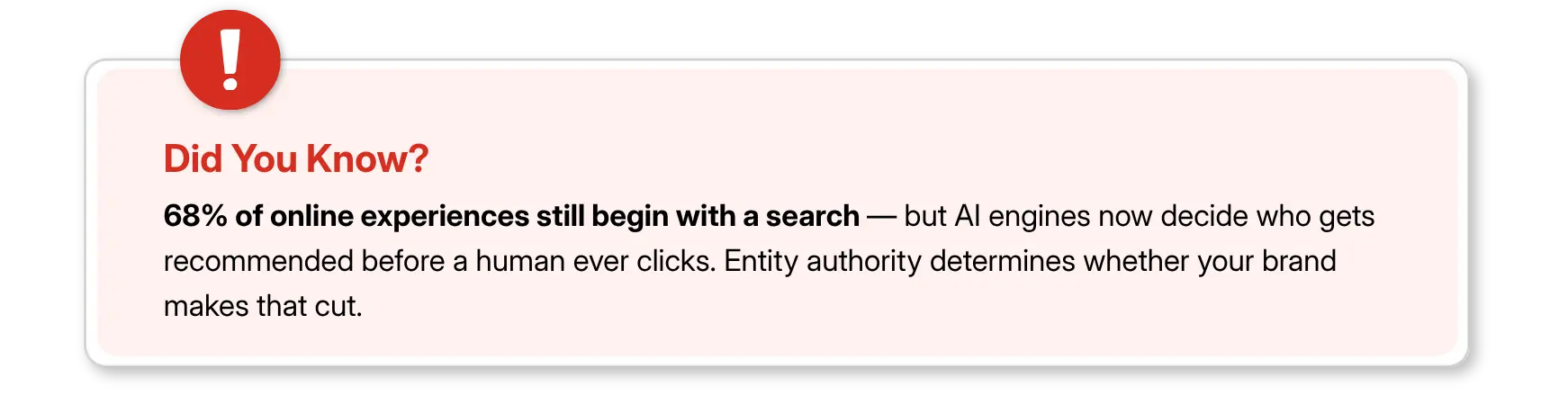
The Three Phases of Search
To understand where we are, it helps to trace how search has evolved.
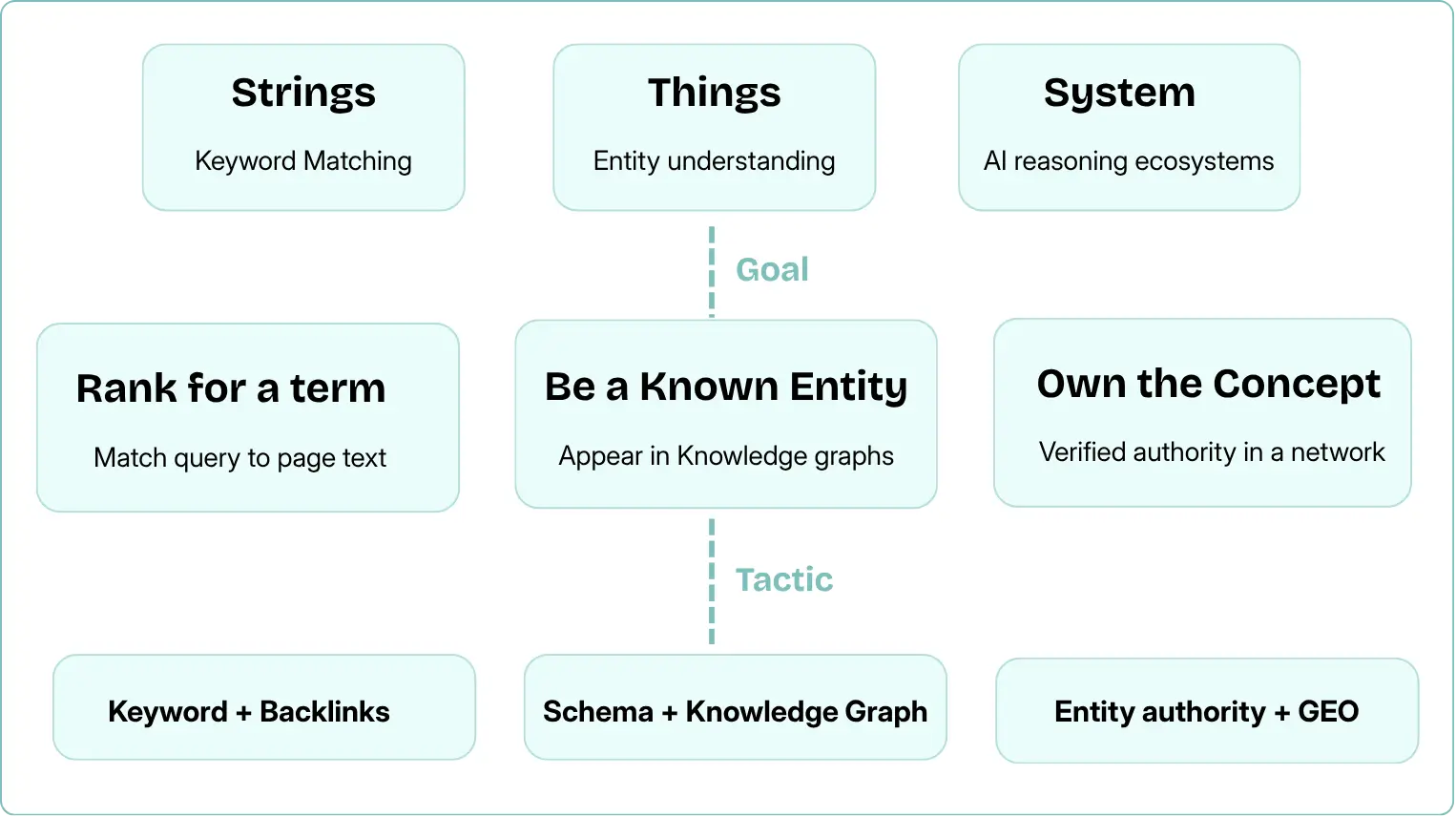
Phase 1 — Strings: Traditional SEO was about matching keyword strings. Success meant getting your page in front of someone who typed the right words.
Phase 2 — Things: Modern search moved to entities. Google's Knowledge Graph allowed engines to recognize that "Apple" the company, "Apple" the fruit, and "Apple" the record label are distinct things — not just strings of letters.
Phase 3 — Systems: Today, AI-driven engines operate on structured ecosystems of interconnected entities. They aren't just retrieving information; they're reasoning about it. The goal is no longer to rank for a term — it's to become the verified, trusted authority within a network of related concepts.
What Is "Entity Authority" and Why Does It Matter?
Entity authority is the degree to which Google and AI systems can confidently identify, verify, and trust your brand across the web. It's built through three pillars:
1. Consistency
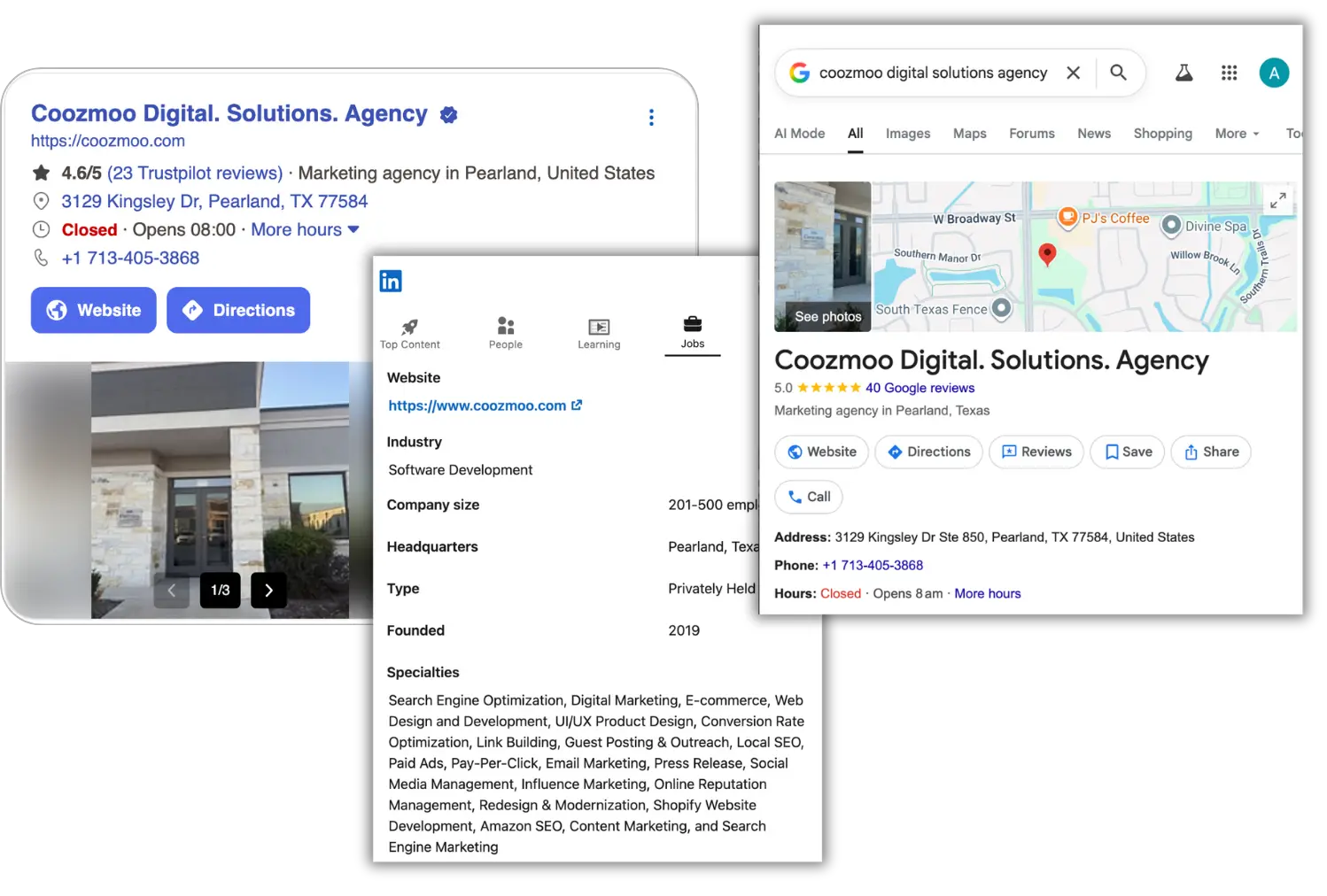
Your brand name, description, founding date, and key facts must match across your website, Google Business Profile, Wikipedia, Wikidata, LinkedIn, and every other platform. When sources contradict each other, it creates what experts call "entity drift" — and if your website contradicts your Google Business Profile, you create entity drift, which lowers your confidence score.
2. Structure
Raw content isn't enough. You need interconnected Schema.org markup that maps your entities hierarchically: Organisation → Brand → Product → Offer → Review. Sites deploying deeply nested, error-free advanced schema have seen traffic lifts of 20–40%, while the potential improvement in LLM response accuracy when enterprise content knowledge graphs provide factual grounding can reach 300% (Search engine land).
3. Corroboration
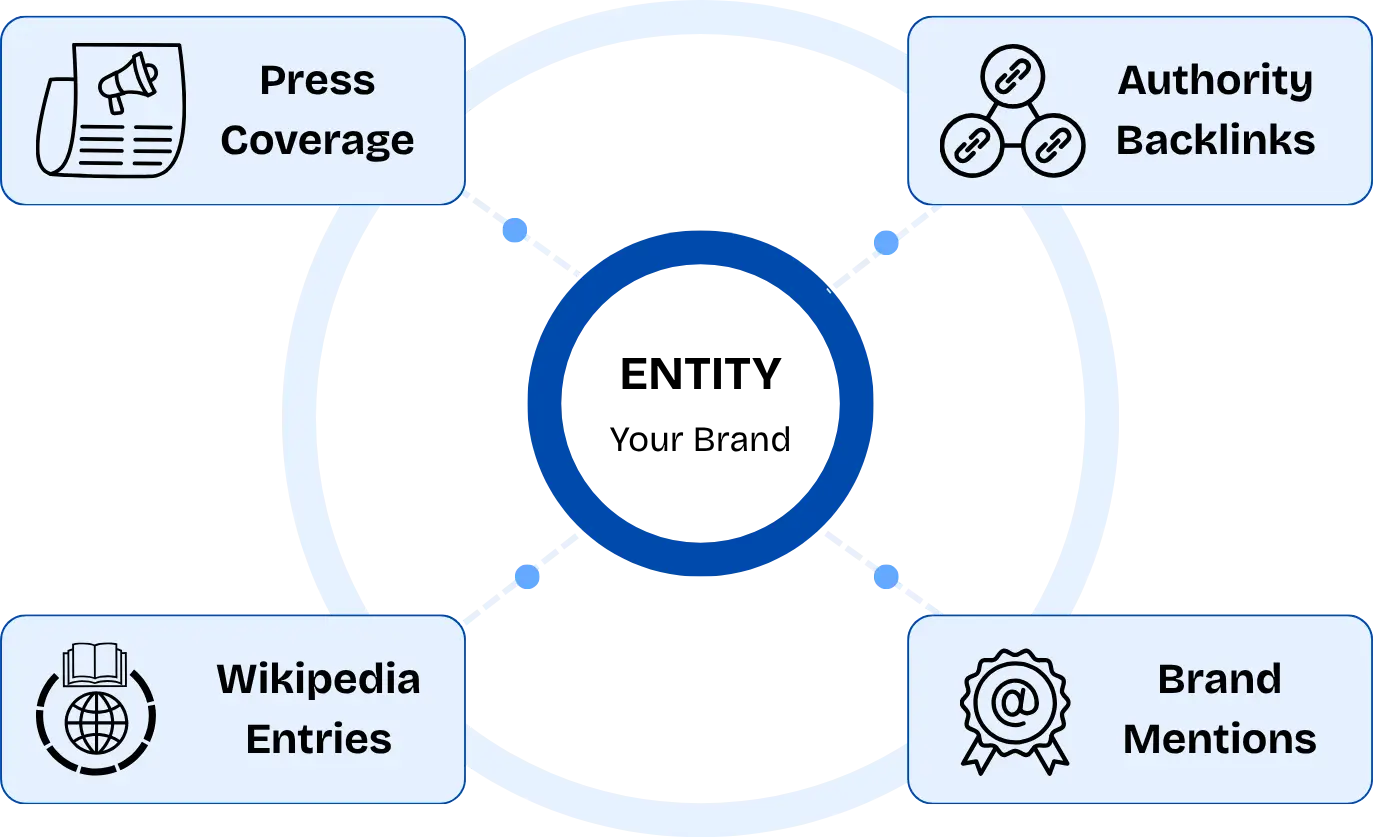
The algorithm will only cross the confidence threshold when what you say matches what the weight of evidence supports. Third-party mentions, press coverage, Wikipedia entries, and authoritative backlinks don't just help rankings — they confirm your entity's existence and claims.
The Entity Home: Your Brand's Anchor in the AI Era
One of the most underappreciated pages on your website is your About page — or what SEO experts now call the entity home.
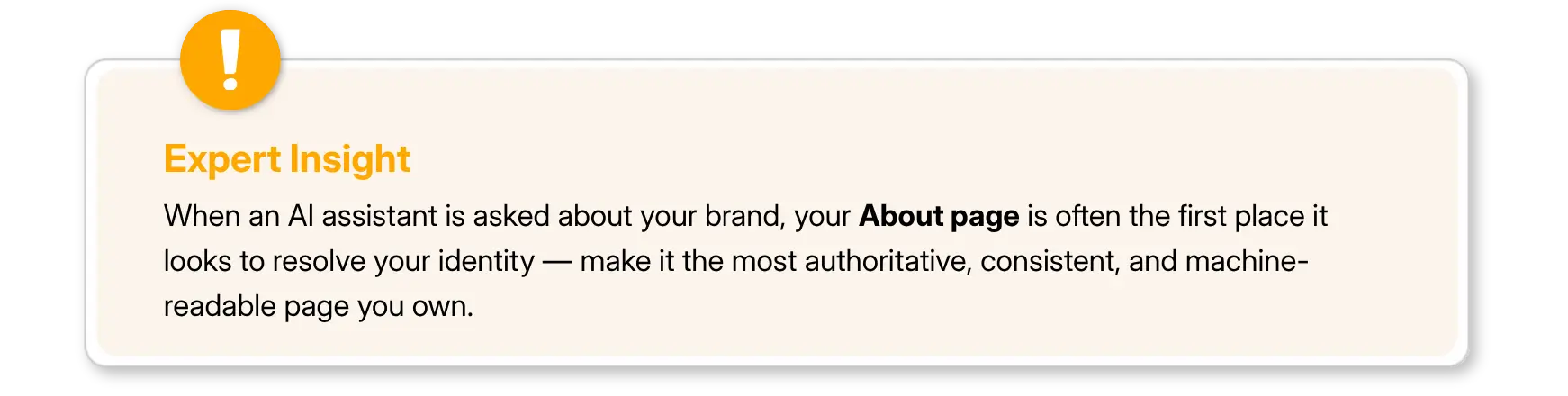
The entity home is the single page that anchors how algorithms, bots, and people understand your brand. It's where algorithms resolve your identity, where bots map your footprint, and where humans verify trust before they convert.
Your entity home needs to serve three audiences simultaneously:
Bots use it to establish what entity they're dealing with and map your digital footprint.
Algorithms anchor their identity resolution against it, checking confidence at every stage.
Humans reach for it when they want to verify trust before taking action.
Five criteria determine whether your About page is doing its job:
The most explicit identity statement on the property
The strongest internal link prominence from the rest of the site
Best-structured schema markup with a stable @id URLs (e.g., https://example.com/#organization)
Clear outbound links to corroborating third-party sources
A stable, long-term URL
If your About page doesn't hit all five, it isn't doing the job the algorithm requires.
Entity Pillar Pages: Beyond Keywords, Toward Identity
Traditional SEO built content around keyword cornerstones — authoritative pages targeting specific search terms. Entity SEO requires a parallel architecture built around entity pillar pages — authoritative pages that declare specific dimensions of who you are, not just what you know.
A person isn't "SEO consultant" plus "technical SEO" plus "keynote speaker": those are keyword clusters, useful for ranking, useless for identity. What the algorithm actually resolves identity against is the network of dimensions that define what this entity is — the companies it belongs to, the peers it works alongside, the publications it has appeared in, the expertise it has demonstrated over years.
For a brand, this might look like:
/expertise — establishes demonstrated knowledge in a specific domain as an identity declaration
/press — links to independent coverage that corroborates your claims
/partners — places your brand in a professional network the algorithm already trusts
/products — closes the loop between organisation and offering with nested schema
These pages won't necessarily generate huge organic traffic. But the return shows up in what AI assistive engines say about your brand when your prospects ask.
The Three-Era Horizon: Search, Assistive, Agential
The search landscape isn't just changing — it's splitting into three co-existing modes, each with different implications for your brand:
Era | What It Does | Your Brand Needs |
|---|---|---|
Search | Delivers humans to your content | Rankings, UX, conversion copy |
Assistive | Recommends brands in AI answers | Entity clarity, structured data, corroboration |
Agential | AI acts on the user's behalf | Callable schema, machine-readable offers |
In 2026, search still drives roughly 60% of conversions, assistive engines account for 35%, and agentic execution is arriving at around 5%. By 2028, agents will execute roughly 35% of decisions before a human is meaningfully involved (Gartner).
The brands investing in entity authority today are building compounding advantages. Those waiting for the percentages to shift before acting will find the window has closed.
Your Brand Must Be "Callable"
The current phase of AI search — summarised text answers — is a transition, not an endpoint. We're rapidly moving toward an agentic ecosystem, where AI agents don't just inform users but act on their behalf.
To survive this shift, your entities must be more than readable. They must be callable. Implementing schema actions — such as BuyAction, ReserveAction, ScheduleAction, or OrderAction — is how you declare your brand's operational capabilities to the machine.
If these actions aren't explicitly defined in your code, your brand becomes a dead end. An AI agent might mention your product, but if it can't verify price, availability, or a booking path through structured data, it will bypass you in favour of a competitor that is agent-ready.
New Metrics for an Entity-First World
Traditional SEO measured rankings and traffic. Entity SEO demands a new scorecard:
Share of Model (SOM): The percentage of time your brand appears in AI-generated responses for relevant category queries. This is the new share of voice.
Citation Likelihood: How often AI engines reference your brand as a trusted source — replacing the old backlink as the primary authority signal.
Brand Accuracy: The delta between your declared schema (prices, specs, service areas) and AI-generated descriptions — with the goal being a 1:1 match to prevent entity drift and ensure AI represents your brand accurately.
Entity Drift Score: How frequently your brand information is inconsistent across platforms. Every inconsistency is a silent confidence penalty.
Your Entity SEO Action Plan for 2026
Ready to start? Here's where to focus:
Audit your entity consistency. Check your brand name, description, founding date, and key facts across your website, Google Business Profile, Wikipedia, LinkedIn, and Wikidata. Eliminate contradictions ruthlessly.
Invest in your About page. Treat it as your entity home. Add a clear identity statement, stable @id schema, sameAs links to Wikipedia and Wikidata, and explicit claims about what your brand does and who it serves.
Deploy nested Schema.org markup. Move beyond basic page-level tagging. Map the full hierarchy: Organisation → Brand → Product → Offer → Review. Use specific schema types (FinancialService, MedicalWebPage, TechArticle) rather than generic ones.
Build entity pillar pages. Create dedicated pages for key identity dimensions — expertise, press, partners, locations — with corroborating third-party links and explicit schema relationships.
Pursue external corroboration. Drive independent sources to reference and link to your entity home. Press coverage, industry directories, Wikipedia mentions, and authoritative backlinks all raise your confidence score.
Add schema actions. For product and service businesses, implement BuyAction, ReserveAction, or OrderAction to make your brand callable in the emerging agentic ecosystem.
Govern your schema continuously. At enterprise scale, the greatest threat to visibility is schema drift — when your human-visible content evolves but your machine-readable schema remains static. Use automated validation and real-time indexing protocols like IndexNow to push updated entity signals immediately.
Final Thoughts
The page was never really the point. It was the best proxy we had for understanding what a website was about. But now, machines can understand entities — real-world concepts with attributes, relationships, and verified identities.
The brands establishing AI-era dominance are engineering entity authority. Brands building content knowledge graphs today are building structural trust advantages that compound as AI systems learn to rely on established authorities.
Whether someone asks Google, ChatGPT, Perplexity, or an AI agent they've tasked with booking a service — the question isn't whether your page ranks. It's whether your brand is understood, trusted, and ready to be acted upon.
That's what Entity SEO in 2026 is really about.
FAQs
What is entity SEO?

Entity SEO is about helping Google understand your brand as a whole, not just individual pages. Instead of ranking keywords, it focuses on making your brand recognizable, reputable, and consistent across the entire web.
Why does Google rank brands over individual pages now?
Because AI-powered search or Generative search doesn't just match keywords, it reasons about brands. Google wants to recommend entities it can verify and trust, not just pages that contain the right words.
What is entity drift and why is it bad for SEO?
Entity drift happens when your brand details like name, description, services are described differently across your website page, Google profile, and other platforms. It creates conflicting signals and lowers Google's confidence in recommending your brand.
Does my About page really matter for SEO?
More than most people think. Google treats your About page as your brand's identity anchor. It's where AI systems verify who you are, what you do, and whether you're trustworthy enough to recommend.
What is schema markup and do I need it for entity SEO?
Schema markup is code that tells search engines exactly what your business is in a format machines can read instantly. Without it, Google has to guess. With it, you're handing over your brand identity directly and that significantly improves your chances of being cited in AI-generated answers.
For most of the internet's history, SEO was a page-level game. You picked keywords, optimized your title tags, built backlinks, and hoped Google's crawlers rewarded the effort. That playbook still has value — but it's no longer sufficient.
In 2026, Google, ChatGPT, Perplexity, and every major AI-driven search platform have shifted the fundamental unit of visibility. It's no longer the page. It's the entity — a machine-readable, verified, and structured representation of who your brand is, what it does, and how it connects to the broader web of knowledge.
Understanding this shift isn't optional. It's the difference between being cited in AI-generated answers and being invisible to them entirely.
The Three Phases of Search
To understand where we are, it helps to trace how search has evolved.
Phase 1 — Strings: Traditional SEO was about matching keyword strings. Success meant getting your page in front of someone who typed the right words.
Phase 2 — Things: Modern search moved to entities. Google's Knowledge Graph allowed engines to recognize that "Apple" the company, "Apple" the fruit, and "Apple" the record label are distinct things — not just strings of letters.
Phase 3 — Systems: Today, AI-driven engines operate on structured ecosystems of interconnected entities. They aren't just retrieving information; they're reasoning about it. The goal is no longer to rank for a term — it's to become the verified, trusted authority within a network of related concepts.
What Is "Entity Authority" and Why Does It Matter?
Entity authority is the degree to which Google and AI systems can confidently identify, verify, and trust your brand across the web. It's built through three pillars:
1. Consistency
Your brand name, description, founding date, and key facts must match across your website, Google Business Profile, Wikipedia, Wikidata, LinkedIn, and every other platform. When sources contradict each other, it creates what experts call "entity drift" — and if your website contradicts your Google Business Profile, you create entity drift, which lowers your confidence score.
2. Structure
Raw content isn't enough. You need interconnected Schema.org markup that maps your entities hierarchically: Organisation → Brand → Product → Offer → Review. Sites deploying deeply nested, error-free advanced schema have seen traffic lifts of 20–40%, while the potential improvement in LLM response accuracy when enterprise content knowledge graphs provide factual grounding can reach 300% (Search engine land).
3. Corroboration
The algorithm will only cross the confidence threshold when what you say matches what the weight of evidence supports. Third-party mentions, press coverage, Wikipedia entries, and authoritative backlinks don't just help rankings — they confirm your entity's existence and claims.
The Entity Home: Your Brand's Anchor in the AI Era
One of the most underappreciated pages on your website is your About page — or what SEO experts now call the entity home.
The entity home is the single page that anchors how algorithms, bots, and people understand your brand. It's where algorithms resolve your identity, where bots map your footprint, and where humans verify trust before they convert.
Your entity home needs to serve three audiences simultaneously:
Bots use it to establish what entity they're dealing with and map your digital footprint.
Algorithms anchor their identity resolution against it, checking confidence at every stage.
Humans reach for it when they want to verify trust before taking action.
Five criteria determine whether your About page is doing its job:
The most explicit identity statement on the property
The strongest internal link prominence from the rest of the site
Best-structured schema markup with a stable @id URLs (e.g., https://example.com/#organization)
Clear outbound links to corroborating third-party sources
A stable, long-term URL
If your About page doesn't hit all five, it isn't doing the job the algorithm requires.
Entity Pillar Pages: Beyond Keywords, Toward Identity
Traditional SEO built content around keyword cornerstones — authoritative pages targeting specific search terms. Entity SEO requires a parallel architecture built around entity pillar pages — authoritative pages that declare specific dimensions of who you are, not just what you know.
A person isn't "SEO consultant" plus "technical SEO" plus "keynote speaker": those are keyword clusters, useful for ranking, useless for identity. What the algorithm actually resolves identity against is the network of dimensions that define what this entity is — the companies it belongs to, the peers it works alongside, the publications it has appeared in, the expertise it has demonstrated over years.
For a brand, this might look like:
/expertise — establishes demonstrated knowledge in a specific domain as an identity declaration
/press — links to independent coverage that corroborates your claims
/partners — places your brand in a professional network the algorithm already trusts
/products — closes the loop between organisation and offering with nested schema
These pages won't necessarily generate huge organic traffic. But the return shows up in what AI assistive engines say about your brand when your prospects ask.
The Three-Era Horizon: Search, Assistive, Agential
The search landscape isn't just changing — it's splitting into three co-existing modes, each with different implications for your brand:
Era | What It Does | Your Brand Needs |
|---|---|---|
Search | Delivers humans to your content | Rankings, UX, conversion copy |
Assistive | Recommends brands in AI answers | Entity clarity, structured data, corroboration |
Agential | AI acts on the user's behalf | Callable schema, machine-readable offers |
In 2026, search still drives roughly 60% of conversions, assistive engines account for 35%, and agentic execution is arriving at around 5%. By 2028, agents will execute roughly 35% of decisions before a human is meaningfully involved (Gartner).
The brands investing in entity authority today are building compounding advantages. Those waiting for the percentages to shift before acting will find the window has closed.
Your Brand Must Be "Callable"
The current phase of AI search — summarised text answers — is a transition, not an endpoint. We're rapidly moving toward an agentic ecosystem, where AI agents don't just inform users but act on their behalf.
To survive this shift, your entities must be more than readable. They must be callable. Implementing schema actions — such as BuyAction, ReserveAction, ScheduleAction, or OrderAction — is how you declare your brand's operational capabilities to the machine.
If these actions aren't explicitly defined in your code, your brand becomes a dead end. An AI agent might mention your product, but if it can't verify price, availability, or a booking path through structured data, it will bypass you in favour of a competitor that is agent-ready.
New Metrics for an Entity-First World
Traditional SEO measured rankings and traffic. Entity SEO demands a new scorecard:
Share of Model (SOM): The percentage of time your brand appears in AI-generated responses for relevant category queries. This is the new share of voice.
Citation Likelihood: How often AI engines reference your brand as a trusted source — replacing the old backlink as the primary authority signal.
Brand Accuracy: The delta between your declared schema (prices, specs, service areas) and AI-generated descriptions — with the goal being a 1:1 match to prevent entity drift and ensure AI represents your brand accurately.
Entity Drift Score: How frequently your brand information is inconsistent across platforms. Every inconsistency is a silent confidence penalty.
Your Entity SEO Action Plan for 2026
Ready to start? Here's where to focus:
Audit your entity consistency. Check your brand name, description, founding date, and key facts across your website, Google Business Profile, Wikipedia, LinkedIn, and Wikidata. Eliminate contradictions ruthlessly.
Invest in your About page. Treat it as your entity home. Add a clear identity statement, stable @id schema, sameAs links to Wikipedia and Wikidata, and explicit claims about what your brand does and who it serves.
Deploy nested Schema.org markup. Move beyond basic page-level tagging. Map the full hierarchy: Organisation → Brand → Product → Offer → Review. Use specific schema types (FinancialService, MedicalWebPage, TechArticle) rather than generic ones.
Build entity pillar pages. Create dedicated pages for key identity dimensions — expertise, press, partners, locations — with corroborating third-party links and explicit schema relationships.
Pursue external corroboration. Drive independent sources to reference and link to your entity home. Press coverage, industry directories, Wikipedia mentions, and authoritative backlinks all raise your confidence score.
Add schema actions. For product and service businesses, implement BuyAction, ReserveAction, or OrderAction to make your brand callable in the emerging agentic ecosystem.
Govern your schema continuously. At enterprise scale, the greatest threat to visibility is schema drift — when your human-visible content evolves but your machine-readable schema remains static. Use automated validation and real-time indexing protocols like IndexNow to push updated entity signals immediately.
Final Thoughts
The page was never really the point. It was the best proxy we had for understanding what a website was about. But now, machines can understand entities — real-world concepts with attributes, relationships, and verified identities.
The brands establishing AI-era dominance are engineering entity authority. Brands building content knowledge graphs today are building structural trust advantages that compound as AI systems learn to rely on established authorities.
Whether someone asks Google, ChatGPT, Perplexity, or an AI agent they've tasked with booking a service — the question isn't whether your page ranks. It's whether your brand is understood, trusted, and ready to be acted upon.
That's what Entity SEO in 2026 is really about.
FAQs
What is entity SEO?
Entity SEO is about helping Google understand your brand as a whole, not just individual pages. Instead of ranking keywords, it focuses on making your brand recognizable, reputable, and consistent across the entire web.
Why does Google rank brands over individual pages now?
Because AI-powered search or Generative search doesn't just match keywords, it reasons about brands. Google wants to recommend entities it can verify and trust, not just pages that contain the right words.
What is entity drift and why is it bad for SEO?
Entity drift happens when your brand details like name, description, services are described differently across your website page, Google profile, and other platforms. It creates conflicting signals and lowers Google's confidence in recommending your brand.
Does my About page really matter for SEO?
More than most people think. Google treats your About page as your brand's identity anchor. It's where AI systems verify who you are, what you do, and whether you're trustworthy enough to recommend.
What is schema markup and do I need it for entity SEO?
Schema markup is code that tells search engines exactly what your business is in a format machines can read instantly. Without it, Google has to guess. With it, you're handing over your brand identity directly and that significantly improves your chances of being cited in AI-generated answers.



Summarize with AI


Want to Skyrocket Revenue? Get a Free Audit Today!
Want to Skyrocket Revenue? Get a Free Audit Today!



4.9/5 Ratings!


Don’t miss our revenue growth tips!
Get expert marketing tips—straight to your inbox, like thousands of happy clients.
Don’t miss our revenue growth tips!
Get expert marketing tips—straight to your inbox, like thousands of happy clients.
Don’t miss our revenue growth tips!
Don’t miss our revenue growth tips!
Get expert marketing tips—straight to your inbox, like thousands of happy clients.
Relevant Blogs on Organic SEO
Relevant Blogs on Organic SEO
Unlock data-driven insights in Organic SEO—explore our featured blogs and skyrocket your revenue before your competitors do.
Unlock data-driven insights in Organic SEO—explore our featured blogs and skyrocket your revenue before your competitors do.

SEO
Sep 21, 2026
5 Min Read
Audience-First SEO: How to Rank by Putting Readers First
SEO
Sep 21, 2026
5 Min Read
Audience-First SEO: How to Rank by Putting Readers First
SEO
Sep 21, 2026
5 Min Read
Audience-First SEO: How to Rank by Putting Readers First

SEO
Sep 19, 2026
5 Min Read
How to Add SEO Keywords to Your Website: Where and How
SEO
Sep 19, 2026
5 Min Read
How to Add SEO Keywords to Your Website: Where and How
SEO
Sep 19, 2026
5 Min Read
How to Add SEO Keywords to Your Website: Where and How

SEO
Sep 18, 2026
5 Min Read
How XML Sitemaps Help Search Engines Discover New Pages
SEO
Sep 18, 2026
5 Min Read
How XML Sitemaps Help Search Engines Discover New Pages
SEO
Sep 18, 2026
5 Min Read
How XML Sitemaps Help Search Engines Discover New Pages






Ready to speak with an expert?
Data-Driven Marketing Agency That Elevates ROI
1100+
Websites Designed & Optimized to Convert
$280M+
Client Revenue Driven & Growing Strong
Discover how to skyrocket
your revenue today!
Trusted by 1000+ Owners!
Ready to speak with an expert?
Data-Driven Marketing Agency That Elevates ROI
1100+
Websites Designed & Optimized to Convert
$280M+
Client Revenue Driven & Growing Strong
Discover how to skyrocket
your revenue today!
Trusted by 1000+ Owners!
Want to skyrocket revenue?
4.9/5 Ratings!
Ready to speak with an expert?
Data-Driven Marketing Agency That Elevates ROI
1100+
Websites Designed & Optimized to Convert
$280M+
Client Revenue Driven & Growing Strong
Discover how to skyrocket
your revenue today!
Trusted by 1000+ Owners!
Call
Meet