What Makes Internal Linking a Game-Changer for Your Website?
What Makes Internal Linking a Game-Changer for Your Website?
Internal Linking
Internal Linking
Internal Linking
Internal linking connects pages within a website, guiding users and search engines through its structure. A solid internal linking strategy is essential for effective SEO.
Internal linking connects pages within a website, guiding users and search engines through its structure. A solid internal linking strategy is essential for effective SEO.


Table of Content

Turn Internal Links into Higher Rankings and Authority



4.9/5 Ratings!

Preeti C.
Preeti C.
6 Min Read
6 Min Read
Oct 14, 2025
Oct 14, 2025
What is Internal Linking?
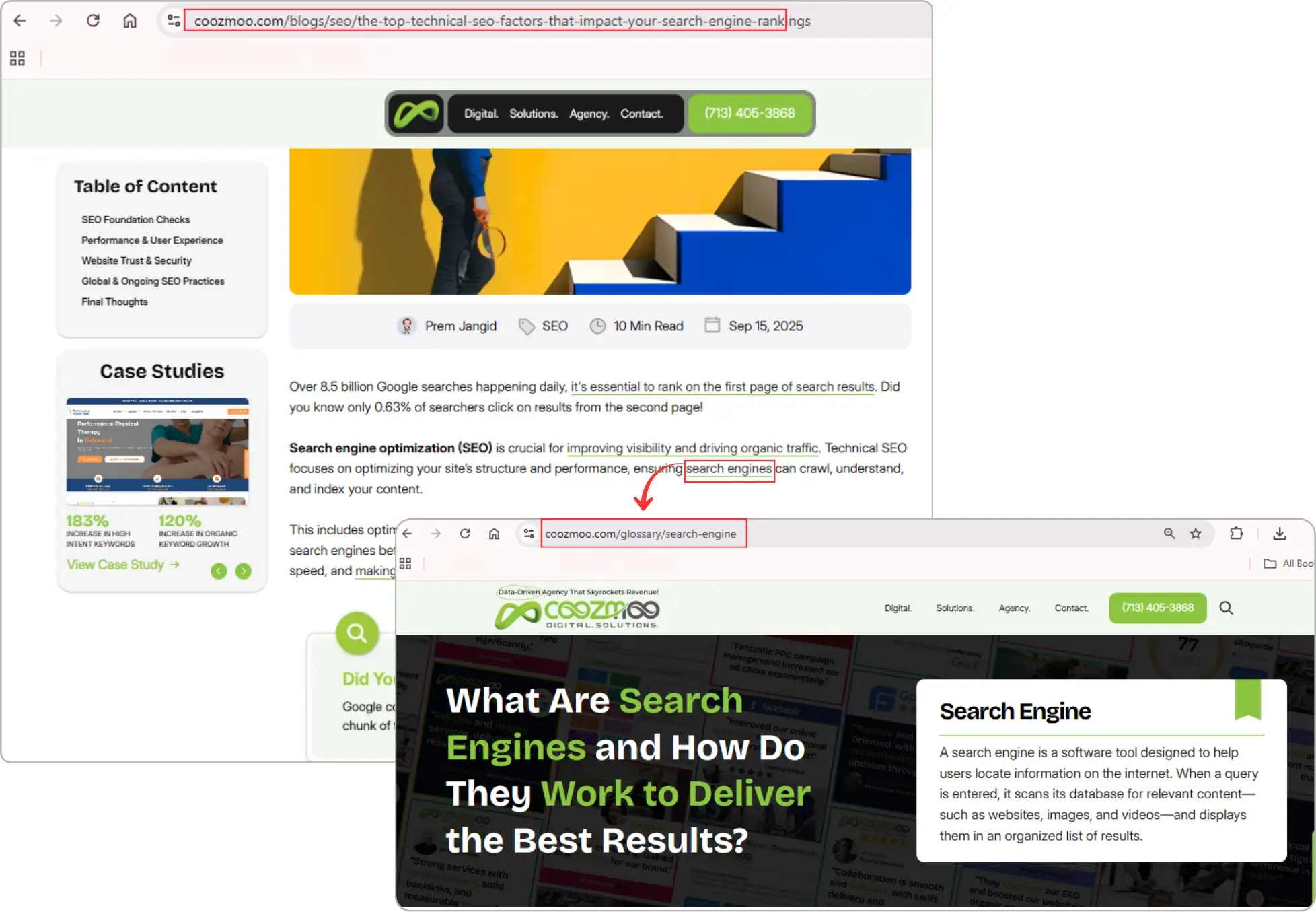
Internal linking is the act of adding hyperlinks that connect a page of your website to another page on your website. It is a vital aspect of website structure and SEO because it helps users navigate through your content and, in turn, helps search engines identify how the pages on your site relate to one another.
Example: If you have a blog post about "SEO Basics," and you link the phrase keyword research" to another post on your website that has a post about keyword research, that's an internal link.
Internal linking is the act of adding hyperlinks that connect a page of your website to another page on your website. It is a vital aspect of website structure and SEO because it helps users navigate through your content and, in turn, helps search engines identify how the pages on your site relate to one another.
Example: If you have a blog post about "SEO Basics," and you link the phrase keyword research" to another post on your website that has a post about keyword research, that's an internal link.
Why is Internal Linking Important?
Internal linking is not simply connecting pages; there are many advantages to SEO and user experience.
Internal linking is not simply connecting pages; there are many advantages to SEO and user experience.
•
•
Enhanced User Navigation: Assists visitors in locating relevant content and increases the number of pages viewed and duration spent on your site.
Enhanced User Navigation: Assists visitors in locating relevant content and increases the number of pages viewed and duration spent on your site.
•
•
Distributes Page Authority: Link equity, which is authority passed from page to page, will help improve the SEO potential of pages you desire to rank.
Distributes Page Authority: Link equity, which is authority passed from page to page, will help improve the SEO potential of pages you desire to rank.
•
•
Improves Crawlability: Search engines determine and index all webpages by following your internal links.
Improves Crawlability: Search engines determine and index all webpages by following your internal links.
•
•
Increases Engagement: Internal linking pulls relevant content into view, thereby decreasing bounce rates and increasing additional page views and ultimately conversions.
Increases Engagement: Internal linking pulls relevant content into view, thereby decreasing bounce rates and increasing additional page views and ultimately conversions.
Having a well-linked website acts as a map directing users and search engines to your content that matters, allowing you to maximize the effectiveness and visibility of your website.
Having a well-linked website acts as a map directing users and search engines to your content that matters, allowing you to maximize the effectiveness and visibility of your website.
Types of Internal Links
Links on a website can be categorized based on relevance and usage.
Links on a website can be categorized based on relevance and usage.
Type of Internal Link
Type of Internal Link
Type of Internal Link
Type of Internal Link
Description
Description
Description
Description
SEO Benefit
SEO Benefit
SEO Benefit
SEO Benefit
Navigational Links
Navigational Links
Navigational Links
Links in menus, headers, footers, or sidebars that help users navigate the website.
Links in menus, headers, footers, or sidebars that help users navigate the website.
Links in menus, headers, footers, or sidebars that help users navigate the website.
Improves user experience and site crawlability.
Improves user experience and site crawlability.
Improves user experience and site crawlability.
Contextual Links
Contextual Links
Contextual Links
Links placed within the content of a page pointing to other relevant pages.
Links placed within the content of a page pointing to other relevant pages.
Links placed within the content of a page pointing to other relevant pages.
Helps search engines understand content relationships and boosts page authority.
Helps search engines understand content relationships and boosts page authority.
Helps search engines understand content relationships and boosts page authority.
Footer Links
Footer Links
Footer Links
Links placed in the footer of a website, often to important pages like Contact, Privacy Policy, or Services.
Links placed in the footer of a website, often to important pages like Contact, Privacy Policy, or Services.
Links placed in the footer of a website, often to important pages like Contact, Privacy Policy, or Services.
Enhances site structure and ensures key pages are indexed.
Enhances site structure and ensures key pages are indexed.
Enhances site structure and ensures key pages are indexed.
Breadcrumb Links
Breadcrumb Links
Breadcrumb Links
Hierarchical links usually found at the top of a page showing the user’s path.
Hierarchical links usually found at the top of a page showing the user’s path.
Hierarchical links usually found at the top of a page showing the user’s path.
Improves navigation and helps search engines understand site hierarchy.
Improves navigation and helps search engines understand site hierarchy.
Improves navigation and helps search engines understand site hierarchy.
Image Links
Image Links
Image Links
Images used as links pointing to other pages or content.
Images used as links pointing to other pages or content.
Images used as links pointing to other pages or content.
Drives traffic and adds context for search engines through alt text.
Drives traffic and adds context for search engines through alt text.
Drives traffic and adds context for search engines through alt text.
Call-to-Action (CTA) Links
Call-to-Action (CTA) Links
Call-to-Action (CTA) Links
Links within buttons or prompts encouraging users to take specific actions.
Links within buttons or prompts encouraging users to take specific actions.
Links within buttons or prompts encouraging users to take specific actions.
Increases engagement and directs traffic to high-value pages.
Increases engagement and directs traffic to high-value pages.
Increases engagement and directs traffic to high-value pages.
Example: For an e-commerce site, a product page may be able to link into the related category pages or related products pages, or “Running Shoes,” generally “Shoes,” generally as an anchor text, to another page that lists “Fitness Accessories.”
Example: For an e-commerce site, a product page may be able to link into the related category pages or related products pages, or “Running Shoes,” generally “Shoes,” generally as an anchor text, to another page that lists “Fitness Accessories.”
Internal Linking vs External Linking
Internal linking is about linking to pages within your own site and is primarily aimed at forwarding your visitors to similar content, distributing authority to important pages, and helping search engines understand your site structure. For instance, if a blog about "SEO Basics" links to another blog post about "Keyword Research," visitors see the continuity in content engagement while search engines can crawl and index your pages faster.
Internal linking is about linking to pages within your own site and is primarily aimed at forwarding your visitors to similar content, distributing authority to important pages, and helping search engines understand your site structure. For instance, if a blog about "SEO Basics" links to another blog post about "Keyword Research," visitors see the continuity in content engagement while search engines can crawl and index your pages faster.
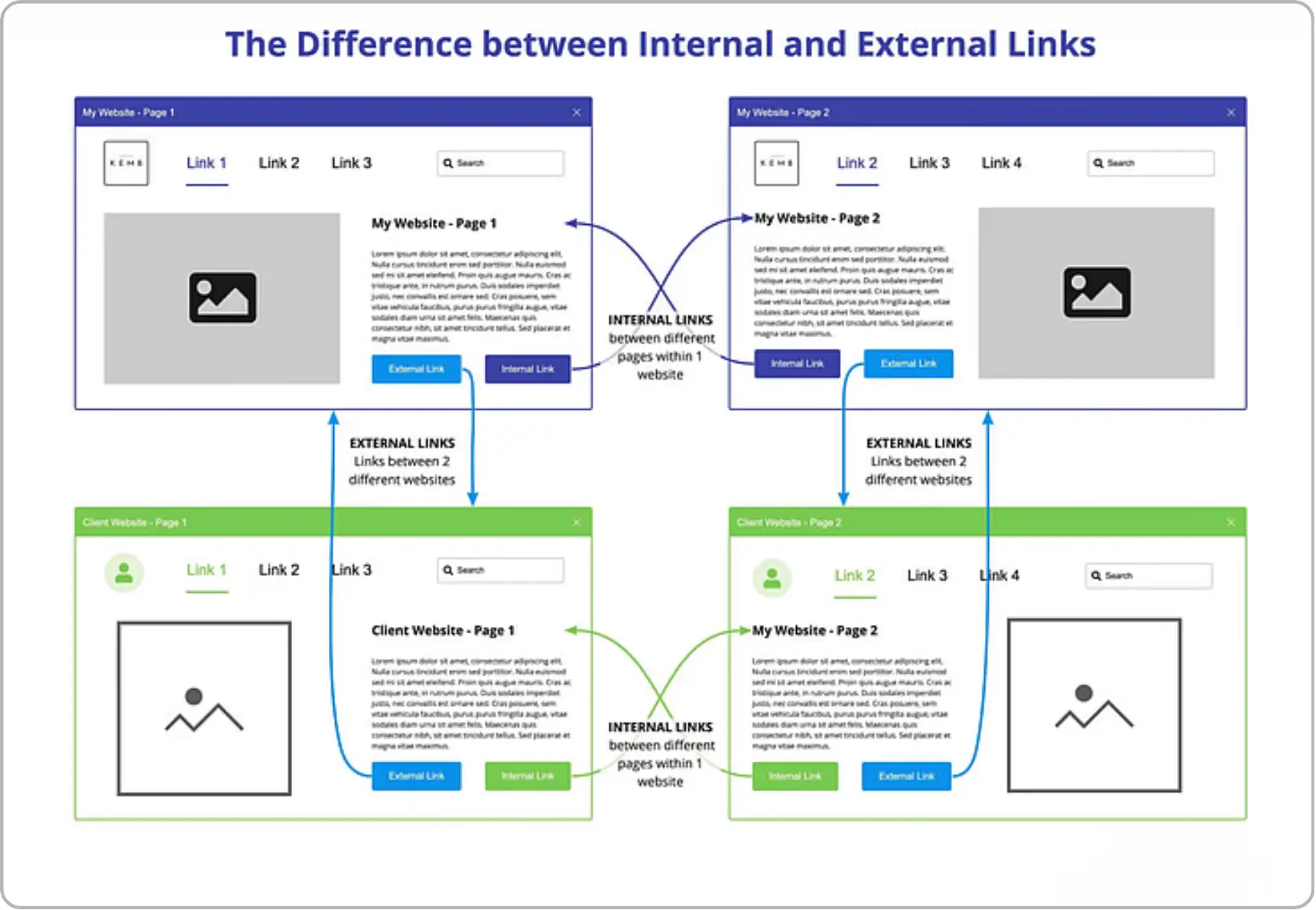
External linking is linking out to other websites. This type of linking supports credibility, references authoritative sources, and provides additional value to your audience. For instance, linking your SEO blog to Google’s official documentation or an industry article can offer readers additional insight into how well-researched your work is or how reliable it is.
While both internal and external linking will be important, their functions serve different purposes altogether. Internal linking aims to provide better structure to your own site and provides better navigation and usability for visitors whereas external links provide trust and credibility and added value to visitors outside of your site. Together they provide a balanced approach to enrich your user's experience while benefiting your SEO.
External linking is linking out to other websites. This type of linking supports credibility, references authoritative sources, and provides additional value to your audience. For instance, linking your SEO blog to Google’s official documentation or an industry article can offer readers additional insight into how well-researched your work is or how reliable it is.
While both internal and external linking will be important, their functions serve different purposes altogether. Internal linking aims to provide better structure to your own site and provides better navigation and usability for visitors whereas external links provide trust and credibility and added value to visitors outside of your site. Together they provide a balanced approach to enrich your user's experience while benefiting your SEO.
Best Practices for Internal Linking
•
•
Use Descriptive Anchor Text: Avoid using generic terms like “click here.” Use more descriptive text, like "Learn about on-page SEO." SEO.
Use Descriptive Anchor Text: Avoid using generic terms like “click here.” Use more descriptive text, like "Learn about on-page SEO." SEO.
•
•
Link to Related Content: The links you create to articles, blog posts, case studies, and other resources should be relevant to the item or service being promoted.
Link to Related Content: The links you create to articles, blog posts, case studies, and other resources should be relevant to the item or service being promoted.
•
•
Avoid Over-Connecting: When there are too many links, the reader may become confused and devalue your SEO.
Avoid Over-Connecting: When there are too many links, the reader may become confused and devalue your SEO.
•
•
Link to Important Pages: Link to pages, posts, articles, etc. you believe are high value more frequently for them to earn authority.
Link to Important Pages: Link to pages, posts, articles, etc. you believe are high value more frequently for them to earn authority.
•
•
Fresh Links: Keep your content alive and relevant concerning the links in your blog posts by linking to newer posts instead of linking to older posts.
Fresh Links: Keep your content alive and relevant concerning the links in your blog posts by linking to newer posts instead of linking to older posts.
Common Mistakes to Avoid
Overloading pages with links.
Using the same anchor text repeatedly.
Leaving “orphan pages” with no links pointing to them.
Ignoring website hierarchy, always link from high-authority pages to subpages.
Overloading pages with links.
Using the same anchor text repeatedly.
Leaving “orphan pages” with no links pointing to them.
Ignoring website hierarchy, always link from high-authority pages to subpages.
Benefits of Internal Linking
•
•
Better User Experience: Facilitates an effortless navigation that encourages visitors.
Better User Experience: Facilitates an effortless navigation that encourages visitors.
•
•
Better SEO: Enables crawls for search engines and enhances decent page authority.
Better SEO: Enables crawls for search engines and enhances decent page authority.
•
•
Distributes Authority: Increases link equity to key pages.
Distributes Authority: Increases link equity to key pages.
•
•
Higher Conversions: Visitors to content with good internal links are more likely to convert.
Higher Conversions: Visitors to content with good internal links are more likely to convert.
•
•
Crawlability: Good internal linking enables all pages to be discovered and indexed.
Crawlability: Good internal linking enables all pages to be discovered and indexed.
Internal Linking Strategy You Can Implement
Determine your key pages and interlink them often.
Utilize anchor text that fits naturally within your content.
Connect updating posts to older content to keep the flow of traffic buzzing.
Build topic clusters by linking associated content back to a main pillar page.
Track the performance and change the links periodically as your site expands.
Determine your key pages and interlink them often.
Utilize anchor text that fits naturally within your content.
Connect updating posts to older content to keep the flow of traffic buzzing.
Build topic clusters by linking associated content back to a main pillar page.
Track the performance and change the links periodically as your site expands.
Final Thoughts
Internal linking is a valuable tactic that allows you to direct visitors, build your website's SEO, and distribute authority and relevance. Internal linking is different than external links in that instead of establishing credibility or references, it directs visitors and enhances relevant performance of your own content.
When used thoughtfully, internal linking can help improve navigation and conversion rates, and because the user experience shifts, every page on your website is contributing to growth.
Start improving your internal links now so that you can create a smarter and more navigable site. Every click should guide your visitors toward meaningful action and an enhanced user experience, making your site SEO-friendly with good user-experience(UX) and conversion-focused.
Internal linking is a valuable tactic that allows you to direct visitors, build your website's SEO, and distribute authority and relevance. Internal linking is different than external links in that instead of establishing credibility or references, it directs visitors and enhances relevant performance of your own content.
When used thoughtfully, internal linking can help improve navigation and conversion rates, and because the user experience shifts, every page on your website is contributing to growth.
Start improving your internal links now so that you can create a smarter and more navigable site. Every click should guide your visitors toward meaningful action and an enhanced user experience, making your site SEO-friendly with good user-experience(UX) and conversion-focused.
Frequently Asked Questions (FAQs)
Frequently Asked Questions
How does internal linking affect SEO and search engine rankings?

Internal linking helps search engines discover, crawl, and index your pages more efficiently. It also passes link equity (page authority) to important pages, improving their chances to rank higher for relevant keywords. Additionally, it enhances user engagement, which can indirectly influence ranking metrics.
How many internal links should I include on a single page for optimal SEO?
There’s no strict number, but a good rule is to include internal links naturally where they add value for the user. Avoid overloading pages; focus on quality over quantity. Typically, 2–10 links per content-rich page are sufficient.
What are hierarchical internal links, and how do they work?
Hierarchical links follow the structure of your website, connecting parent pages to subpages. For example, a “Blog” page links to “SEO Tips,” which further links to “Keyword Research Guide.” This structure helps search engines understand content relationships and site organization.
How should e-commerce websites use internal linking effectively?
Link product pages to category pages, related products, and blog content. This improves crawlability, distributes authority, and encourages users to explore complementary products, boosting conversions.
For internal links, what kind of anchor text works best?
Select anchor text that is straightforward, understandable, and illustrative. It is easier for Google and users to comprehend the content of the linked page if you write something like "read about keyword research" instead of "click here."
How is user experience enhanced by internal linking?
One main reason is that through internal links they inform users about the existence of related content, for example, articles, products, or services. In addition, they help users to stay longer on the site, which is very important for lowering the bounce rate, i.e., the time interval between users' arrival and their immediate departure.
How does internal linking help search engines crawl my website?
Internal links act as pathways for search engine bots to follow. Pages with more links are discovered faster and prioritized for indexing. A well-structured internal linking network ensures no important pages remain hidden.
How does internal linking affect SEO and search engine rankings?
Internal linking helps search engines discover, crawl, and index your pages more efficiently. It also passes link equity (page authority) to important pages, improving their chances to rank higher for relevant keywords. Additionally, it enhances user engagement, which can indirectly influence ranking metrics.
How many internal links should I include on a single page for optimal SEO?
There’s no strict number, but a good rule is to include internal links naturally where they add value for the user. Avoid overloading pages; focus on quality over quantity. Typically, 2–10 links per content-rich page are sufficient.
What are hierarchical internal links, and how do they work?
Hierarchical links follow the structure of your website, connecting parent pages to subpages. For example, a “Blog” page links to “SEO Tips,” which further links to “Keyword Research Guide.” This structure helps search engines understand content relationships and site organization.
How should e-commerce websites use internal linking effectively?
Link product pages to category pages, related products, and blog content. This improves crawlability, distributes authority, and encourages users to explore complementary products, boosting conversions.
For internal links, what kind of anchor text works best?
Select anchor text that is straightforward, understandable, and illustrative. It is easier for Google and users to comprehend the content of the linked page if you write something like "read about keyword research" instead of "click here."
How is user experience enhanced by internal linking?
One main reason is that through internal links they inform users about the existence of related content, for example, articles, products, or services. In addition, they help users to stay longer on the site, which is very important for lowering the bounce rate, i.e., the time interval between users' arrival and their immediate departure.
How does internal linking help search engines crawl my website?
Internal links act as pathways for search engine bots to follow. Pages with more links are discovered faster and prioritized for indexing. A well-structured internal linking network ensures no important pages remain hidden.
Turn Internal Links into Higher Rankings and Authority
Turn Internal Links into Higher Rankings and Authority
Strategically add links within your website to guide users, boost page authority, and enhance organic rankings.
Strategically add links within your website to guide users, boost page authority, and enhance organic rankings.
Strategically add links within your website to guide users, boost page authority, and enhance organic rankings.
4.9/5 Ratings!
Share this article

Related Resources
Latest Blogs





Don’t miss our revenue growth tips!
Don’t miss revenue growth tips!
Get expert marketing tips—straight to your inbox, like thousands of happy clients.
Get expert marketing tips—straight to your inbox, like thousands of happy clients.
Latest Blogs




















Ready to speak with an expert?
Data-Driven Marketing Agency That Elevates ROI
1100+
Websites Designed & Optimized to Convert
$280M+
Client Revenue Driven & Growing Strong
Discover how to skyrocket
your revenue today!
Trusted by 1000+ Owners!
Ready to speak with an expert?
Data-Driven Marketing Agency That Elevates ROI
1100+
Websites Designed & Optimized to Convert
$280M+
Client Revenue Driven & Growing Strong
Discover how to skyrocket
your revenue today!
Trusted by 1000+ Owners!
Want to skyrocket revenue?
4.9/5 Ratings!
Ready to speak with an expert?
Data-Driven Marketing Agency That Elevates ROI
1100+
Websites Designed & Optimized to Convert
$280M+
Client Revenue Driven & Growing Strong
Discover how to skyrocket
your revenue today!
Trusted by 1000+ Owners!
Call
Meet