What Are Display Ads & How Do They Work?
What Are Display Ads & How Do They Work?
Last Updated:
Table of Content
Explore Free Tools

Indra Singh
Indra Singh
Indra Singh
PPC
PPC
PPC
10 Min Read
10 Min Read
10 Min
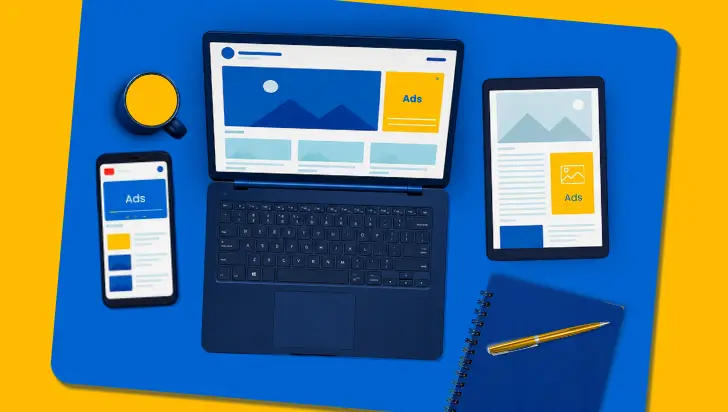
Display ads are visual advertisements, including images, banners, and short videos, placed on websites, apps, and social platforms to reach people while they browse. They work by buying ad space through direct deals, ad networks, or programmatic exchanges, then targeting that space to specific audiences based on interests, behavior, or past visits to your site.
If you've ever scrolled a news site and had a banner follow you down the page, you've already met display ads. They're one of the oldest formats in digital marketing, and they're still one of the most misunderstood, mostly because "display ads" gets used as a catch-all for a handful of very different things.
That's the 60-second version. The rest of this guide breaks down how display ads actually work behind the scenes, the formats you'll run into, and how to build a campaign that doesn't just get seen. It gets clicked.
What Are Display Ads, Exactly?
Display ads are visual ads that show up in the "real estate" around content: the sidebar of a blog, the top of a mobile game, or a banner in your inbox. Unlike search ads, which appear because someone typed a query, display ads show up while someone's doing something else entirely: reading, scrolling, or watching.
That distinction matters more than most guides let on. Search ads catch people mid-intent. Display ads catch people's mid-attention. That's a different job, and it changes how you should think about creative targeting and what "success" even looks like.
You'll usually see display ads in a few common spots:
Banners along the top, side, or bottom of a webpage
In-feed native ads that blend into an app or social feed
Video ads that play before or during content
Full-screen interstitials between app screens or game levels
Take an education brand like Improve ME Institute. One set of banners tests different angles, personalized learning, exam-focused revision workshops, home-schooling support, each with its own headline and photo, run side by side to see which message parents respond to. Once someone visits the site without booking, a separate retargeting ad follows them with a more direct offer: "Book a Free Assessment." That's not a coincidence either. It's a display ad campaign doing exactly what it's built to do, testing creative up top and closing the gap on the back end.

How Do Display Ads Work?
Here's the part most people skip past: display ads work through an actual buying and placement system, not magic. Understanding that system is what separates campaigns that burn through their budget from those that don't.
There are three main ways advertisers buy display ad space:
1. Direct Buying
You negotiate directly with a publisher, meaning a specific website or app, for a set placement, timeframe, and price. It's the oldest model, and it still works well when you know exactly where your audience spends time. The tradeoff is scale: direct deals are hard to manage across dozens of sites at once.
2. Ad Networks
Ad networks pool ad space from thousands of sites and let you target by interest, behavior, or demographic instead of negotiating site by site. This is how most small and mid-sized businesses get into display advertising. It's accessible, and you're not stuck emailing publishers one at a time.
3. Programmatic Advertising
Programmatic buying runs on real-time auctions through ad exchanges. Software bids on impressions on your behalf, in milliseconds, based on rules you set. It's the most scalable option and gives you the clearest visibility into where your money actually lands, but it also has the steepest learning curve.
How You Pay for Display Ads
Pricing follows the buying model. The two you'll run into constantly:
Model | You pay for | Best when |
|---|---|---|
CPC (cost per click) | Each click on your ad | Your goal is traffic or direct response. |
CPM (cost per thousand impressions) | Every 1,000 times your ad is shown. | Your goal is brand visibility. |
Types of Display Ads
Display ads aren't one format. They're a family of formats, and choosing the wrong one for your goal is a common (and expensive) mistake.
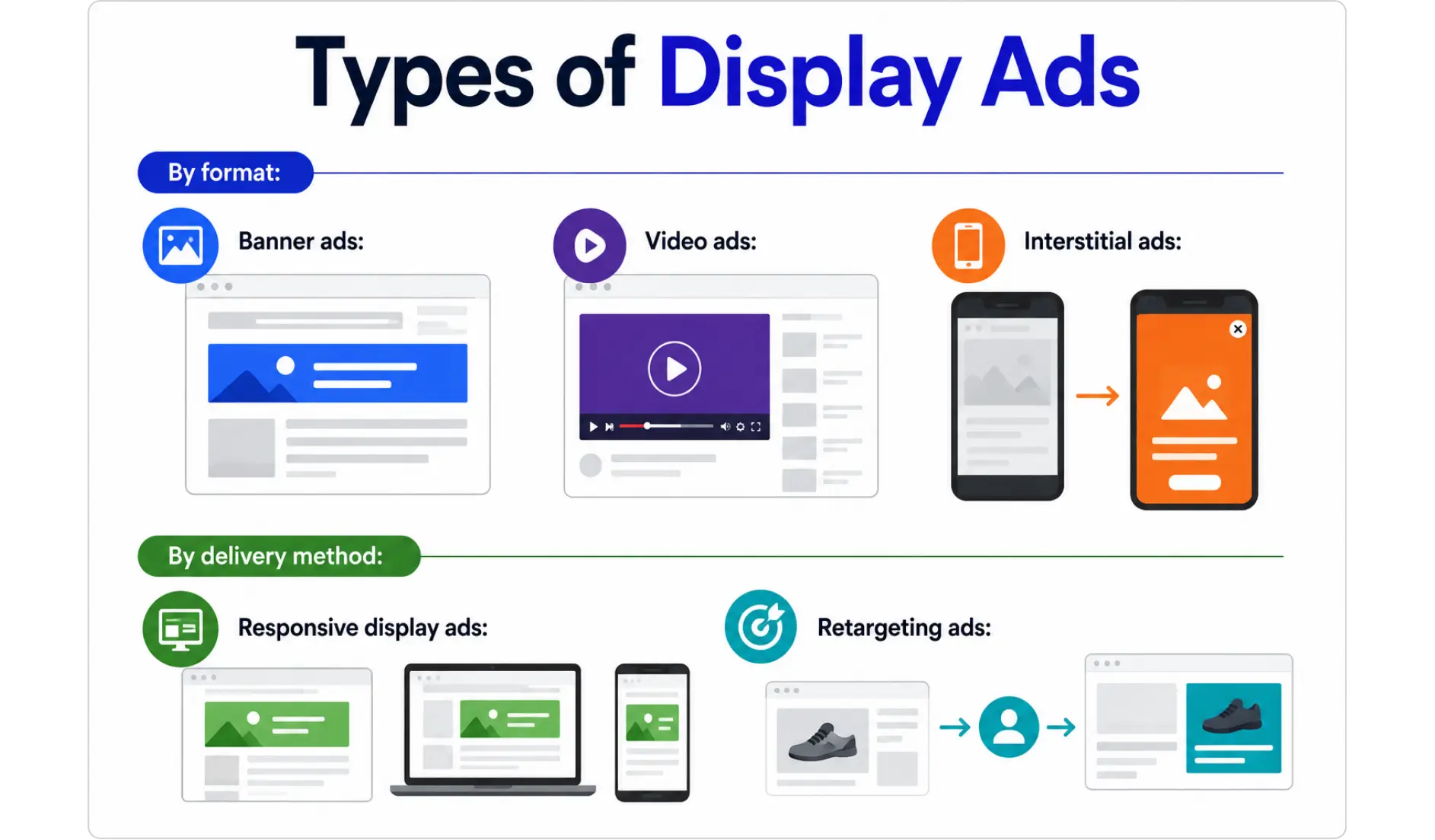
By format:
Banner ads: static or lightly animated images in a fixed placement
Native ads: designed to match the look of the surrounding content, so they don't feel like an interruption
Video ads: short clips shown on sites, apps, or streaming platforms
Interstitial ads: full-screen ads that appear between app screens, usually with higher engagement and higher annoyance risk in equal measure
By delivery method:
Responsive display ads: you upload images, headlines, and logos, and the platform assembles them into whatever layout fits the placement
Retargeting ads: shown specifically to people who already visited your site or engaged with your brand, which is usually where display ads earn their keep on conversions
If brand awareness is the goal, native and video tend to outperform. If you're chasing conversions from people who already know you, retargeting almost always wins.
How to Create Display Ads That Actually Perform
Knowing how display ads work is one thing. Building ones people don't scroll past is another. Here's the process that holds up in practice:
1. Pick the Platform Your Audience Actually Uses
Don't default to the biggest network out of habit. A B2B company chasing decision-makers will get more out of a professional-audience network than a broad consumer one. Match the platform to where your buyer already spends time, not where it's easiest to set up a campaign.
2. Write Copy That Leads With the Benefit
Nobody clicks a banner because they're impressed by a feature list. State what changes for them, whether that's faster results, lower cost, or less hassle, and back any number you use. "Cut onboarding time in half" earns more clicks than "Advanced onboarding tools."
3. Design for a Five-Second Glance
Display ads get scanned, not read. One focal point, legible on a phone screen, and brand colors consistent enough that people recognize you before they finish reading the copy. If someone has to squint, you've already lost them.
4. Set Up Retargeting From Day One
Most first-time visitors won't convert on the first impression. A retargeting layer that follows warm visitors with a display ad is one of the highest-leverage moves you can make early, and it's usually cheap relative to cold prospecting.
5. Test One Variable at a Time
Change the image, or the headline, or the CTA, but not all three at once. Otherwise you'll know something worked without knowing what. Give each test enough impressions to be statistically meaningful before you call a winner.
6. Track the Metrics That Match Your Goal
Impressions: how often the ad was shown
CTR (click-through rate): the percentage of viewers who clicked
Conversion rate: the percentage who completed your target action
CPA (cost per action): what each conversion actually cost you
ROAS (return on ad spend): revenue generated per dollar spent
Don't judge an awareness campaign by conversion rate, and don't judge a retargeting campaign by impressions alone. Match the metric to what the campaign was actually built to do.

Are Display Ads Worth It?
Honestly, it depends on what you're trying to accomplish. Display ads are strong for building awareness, staying visible to people who've already shown interest, and testing creative at scale cheaply. They're weaker as a stand-alone conversion driver for cold audiences. That's usually a search or social's job.
The campaigns that work best treat display as one layer in a bigger strategy: search captures intent, display builds and sustains awareness, and retargeting closes the gap between the two.
Final Thoughts
Display ads aren't a magic switch, but they're not just noise either. Once you understand how the buying models work, which format fits your goal, and where retargeting fits into the picture, they become a lot more predictable to run.
Start with a small budget, watch the metrics that actually match what you're trying to achieve, and let the data tell you where to scale. That's how display ads go from an expense you're not sure about to a channel that reliably earns its place in your marketing mix.
FAQs
What are display ads in simple terms?

Display ads are visual ads, such as images, banners, or videos, shown on websites, apps, and social platforms to reach people while they browse, rather than while they're actively searching.
How do display ads work compared to search ads?
Display ads are bought through direct deals, ad networks, or programmatic auctions and shown based on audience targeting. Search ads appear based on a user's real-time query. Display reaches people mid-browse; search reaches people mid-intent.
How much do display ads cost?
Cost depends on your buying model. Most platforms use CPC (pay per click) or CPM (pay per thousand impressions), with programmatic and network buys typically running on auction-based pricing.
How do I create display ads without a design team?
Use responsive display ad formats. You upload images, headlines, and logo assets, and the ad platform assembles them automatically into multiple sizes and layouts.
Are display ads effective for small businesses?
Yes, particularly for retargeting past visitors and building local or niche brand awareness. Direct-response conversions from cold audiences are typically harder to achieve with display alone, so pairing it with search or social tends to perform better.
Display ads are visual advertisements, including images, banners, and short videos, placed on websites, apps, and social platforms to reach people while they browse. They work by buying ad space through direct deals, ad networks, or programmatic exchanges, then targeting that space to specific audiences based on interests, behavior, or past visits to your site.
If you've ever scrolled a news site and had a banner follow you down the page, you've already met display ads. They're one of the oldest formats in digital marketing, and they're still one of the most misunderstood, mostly because "display ads" gets used as a catch-all for a handful of very different things.
That's the 60-second version. The rest of this guide breaks down how display ads actually work behind the scenes, the formats you'll run into, and how to build a campaign that doesn't just get seen. It gets clicked.
What Are Display Ads, Exactly?
Display ads are visual ads that show up in the "real estate" around content: the sidebar of a blog, the top of a mobile game, or a banner in your inbox. Unlike search ads, which appear because someone typed a query, display ads show up while someone's doing something else entirely: reading, scrolling, or watching.
That distinction matters more than most guides let on. Search ads catch people mid-intent. Display ads catch people's mid-attention. That's a different job, and it changes how you should think about creative targeting and what "success" even looks like.
You'll usually see display ads in a few common spots:
Banners along the top, side, or bottom of a webpage
In-feed native ads that blend into an app or social feed
Video ads that play before or during content
Full-screen interstitials between app screens or game levels
Take an education brand like Improve ME Institute. One set of banners tests different angles, personalized learning, exam-focused revision workshops, home-schooling support, each with its own headline and photo, run side by side to see which message parents respond to. Once someone visits the site without booking, a separate retargeting ad follows them with a more direct offer: "Book a Free Assessment." That's not a coincidence either. It's a display ad campaign doing exactly what it's built to do, testing creative up top and closing the gap on the back end.
How Do Display Ads Work?
Here's the part most people skip past: display ads work through an actual buying and placement system, not magic. Understanding that system is what separates campaigns that burn through their budget from those that don't.
There are three main ways advertisers buy display ad space:
1. Direct Buying
You negotiate directly with a publisher, meaning a specific website or app, for a set placement, timeframe, and price. It's the oldest model, and it still works well when you know exactly where your audience spends time. The tradeoff is scale: direct deals are hard to manage across dozens of sites at once.
2. Ad Networks
Ad networks pool ad space from thousands of sites and let you target by interest, behavior, or demographic instead of negotiating site by site. This is how most small and mid-sized businesses get into display advertising. It's accessible, and you're not stuck emailing publishers one at a time.
3. Programmatic Advertising
Programmatic buying runs on real-time auctions through ad exchanges. Software bids on impressions on your behalf, in milliseconds, based on rules you set. It's the most scalable option and gives you the clearest visibility into where your money actually lands, but it also has the steepest learning curve.
How You Pay for Display Ads
Pricing follows the buying model. The two you'll run into constantly:
Model | You pay for | Best when |
|---|---|---|
CPC (cost per click) | Each click on your ad | Your goal is traffic or direct response. |
CPM (cost per thousand impressions) | Every 1,000 times your ad is shown. | Your goal is brand visibility. |
Types of Display Ads
Display ads aren't one format. They're a family of formats, and choosing the wrong one for your goal is a common (and expensive) mistake.
By format:
Banner ads: static or lightly animated images in a fixed placement
Native ads: designed to match the look of the surrounding content, so they don't feel like an interruption
Video ads: short clips shown on sites, apps, or streaming platforms
Interstitial ads: full-screen ads that appear between app screens, usually with higher engagement and higher annoyance risk in equal measure
By delivery method:
Responsive display ads: you upload images, headlines, and logos, and the platform assembles them into whatever layout fits the placement
Retargeting ads: shown specifically to people who already visited your site or engaged with your brand, which is usually where display ads earn their keep on conversions
If brand awareness is the goal, native and video tend to outperform. If you're chasing conversions from people who already know you, retargeting almost always wins.
How to Create Display Ads That Actually Perform
Knowing how display ads work is one thing. Building ones people don't scroll past is another. Here's the process that holds up in practice:
1. Pick the Platform Your Audience Actually Uses
Don't default to the biggest network out of habit. A B2B company chasing decision-makers will get more out of a professional-audience network than a broad consumer one. Match the platform to where your buyer already spends time, not where it's easiest to set up a campaign.
2. Write Copy That Leads With the Benefit
Nobody clicks a banner because they're impressed by a feature list. State what changes for them, whether that's faster results, lower cost, or less hassle, and back any number you use. "Cut onboarding time in half" earns more clicks than "Advanced onboarding tools."
3. Design for a Five-Second Glance
Display ads get scanned, not read. One focal point, legible on a phone screen, and brand colors consistent enough that people recognize you before they finish reading the copy. If someone has to squint, you've already lost them.
4. Set Up Retargeting From Day One
Most first-time visitors won't convert on the first impression. A retargeting layer that follows warm visitors with a display ad is one of the highest-leverage moves you can make early, and it's usually cheap relative to cold prospecting.
5. Test One Variable at a Time
Change the image, or the headline, or the CTA, but not all three at once. Otherwise you'll know something worked without knowing what. Give each test enough impressions to be statistically meaningful before you call a winner.
6. Track the Metrics That Match Your Goal
Impressions: how often the ad was shown
CTR (click-through rate): the percentage of viewers who clicked
Conversion rate: the percentage who completed your target action
CPA (cost per action): what each conversion actually cost you
ROAS (return on ad spend): revenue generated per dollar spent
Don't judge an awareness campaign by conversion rate, and don't judge a retargeting campaign by impressions alone. Match the metric to what the campaign was actually built to do.
Are Display Ads Worth It?
Honestly, it depends on what you're trying to accomplish. Display ads are strong for building awareness, staying visible to people who've already shown interest, and testing creative at scale cheaply. They're weaker as a stand-alone conversion driver for cold audiences. That's usually a search or social's job.
The campaigns that work best treat display as one layer in a bigger strategy: search captures intent, display builds and sustains awareness, and retargeting closes the gap between the two.
Final Thoughts
Display ads aren't a magic switch, but they're not just noise either. Once you understand how the buying models work, which format fits your goal, and where retargeting fits into the picture, they become a lot more predictable to run.
Start with a small budget, watch the metrics that actually match what you're trying to achieve, and let the data tell you where to scale. That's how display ads go from an expense you're not sure about to a channel that reliably earns its place in your marketing mix.
FAQs
What are display ads in simple terms?
Display ads are visual ads, such as images, banners, or videos, shown on websites, apps, and social platforms to reach people while they browse, rather than while they're actively searching.
How do display ads work compared to search ads?
Display ads are bought through direct deals, ad networks, or programmatic auctions and shown based on audience targeting. Search ads appear based on a user's real-time query. Display reaches people mid-browse; search reaches people mid-intent.
How much do display ads cost?
Cost depends on your buying model. Most platforms use CPC (pay per click) or CPM (pay per thousand impressions), with programmatic and network buys typically running on auction-based pricing.
How do I create display ads without a design team?
Use responsive display ad formats. You upload images, headlines, and logo assets, and the ad platform assembles them automatically into multiple sizes and layouts.
Are display ads effective for small businesses?
Yes, particularly for retargeting past visitors and building local or niche brand awareness. Direct-response conversions from cold audiences are typically harder to achieve with display alone, so pairing it with search or social tends to perform better.



Summarize with AI



Have a Google Ads account?
Get a free audit Today!
Have a Google Ads account?
Get a free audit Today!



4.9/5 Ratings!
4.9/5 Ratings!


Don’t miss our revenue growth tips!
Get expert marketing tips—straight to your inbox, like thousands of happy clients.
Don’t miss our revenue growth tips!
Get expert marketing tips—straight to your inbox, like thousands of happy clients.
Don’t miss our revenue growth tips!
Get expert marketing tips—straight to your inbox, like thousands of happy clients.
Don’t miss our revenue growth tips!
Relevant Blogs on PPC Marketing
Relevant Blogs on PPC Marketing
Unlock data-driven insights in PPC marketing—explore our featured blogs and skyrocket your revenue before your competitors do.
Unlock data-driven insights in PPC marketing—explore our featured blogs and skyrocket your revenue before your competitors do.
PPC
Sep 1, 2026
8 Min Read
Google Is Removing Manual Language Targeting From Search Campaigns: What Advertisers Need to Know
PPC
Sep 1, 2026
8 Min Read
Google Is Removing Manual Language Targeting From Search Campaigns: What Advertisers Need to Know
PPC
Sep 1, 2026
8 Min Read
Google Is Removing Manual Language Targeting From Search Campaigns: What Advertisers Need to Know

PPC
Aug 2, 2026
10 Min Read
12 Best Practices to Improve Google Ads CTR
PPC
Aug 2, 2026
10 Min Read
12 Best Practices to Improve Google Ads CTR
PPC
Aug 2, 2026
10 Min Read
12 Best Practices to Improve Google Ads CTR

PPC
Jul 13, 2026
10 Min Read
Why Google Ads Shows Conversions but Your Revenue Isn't Growing
PPC
Jul 13, 2026
10 Min Read
Why Google Ads Shows Conversions but Your Revenue Isn't Growing
PPC
Jul 13, 2026
10 Min Read
Why Google Ads Shows Conversions but Your Revenue Isn't Growing




























Ready to speak with an expert?
Data-Driven Marketing Agency That Elevates ROI
1100+
Websites Designed & Optimized to Convert
$280M+
Client Revenue Driven & Growing Strong
Discover how to skyrocket
your revenue today!
Trusted by 1000+ Owners!
Ready to speak with an expert?
Data-Driven Marketing Agency That Elevates ROI
1100+
Websites Designed & Optimized to Convert
$280M+
Client Revenue Driven & Growing Strong
Discover how to skyrocket
your revenue today!
Trusted by 1000+ Owners!
Want to skyrocket revenue?
4.9/5 Ratings!
Ready to speak with an expert?
Data-Driven Marketing Agency That Elevates ROI
1100+
Websites Designed & Optimized to Convert
$280M+
Client Revenue Driven & Growing Strong
Discover how to skyrocket
your revenue today!
Trusted by 1000+ Owners!
Call
Meet