12 Best Practices to Improve Google Ads CTR
12 Best Practices to Improve Google Ads CTR
Last Updated:
Table of Content
Explore Free Tools


Deepak Prajapat
Deepak Prajapat
Deepak Prajapat
PPC
PPC
PPC
10 Min Read
10 Min Read
10 Min
If your Google Ads account is spending steadily but your click-through rate refuses to move, the problem is rarely one big mistake. It's usually five or six small ones stacked on top of each other a headline that doesn't match the search term, an extension that's missing, a landing page URL that looks generic instead of relevant.
CTR isn't just a vanity metric either. Google uses it as a direct input into your Quality Score, which affects your cost-per-click and your ad rank. A campaign with a strong CTR often pays less per click than a competitor bidding higher but getting ignored. So improving CTR isn't only about getting more clicks it's about making every dollar in your budget work harder.
The tricky part is that most of these small issues don't show up as errors anywhere in the interface. Google won't flag a headline for being generic or tell you that your display URL looks disconnected from your offer. You have to go looking for them, ad group by ad group, which is exactly why so many accounts carry the same CTR problems for months without anyone noticing.
This guide walks through 12 practical, testable changes you can make to your Google Ads campaigns this week. Each one addresses a specific reason ads get skipped over, from ad relevance to extension usage to audience targeting. No filler, no "just write better ads" advice just the specific levers that move the needle.
What Is CTR in Google Ads?
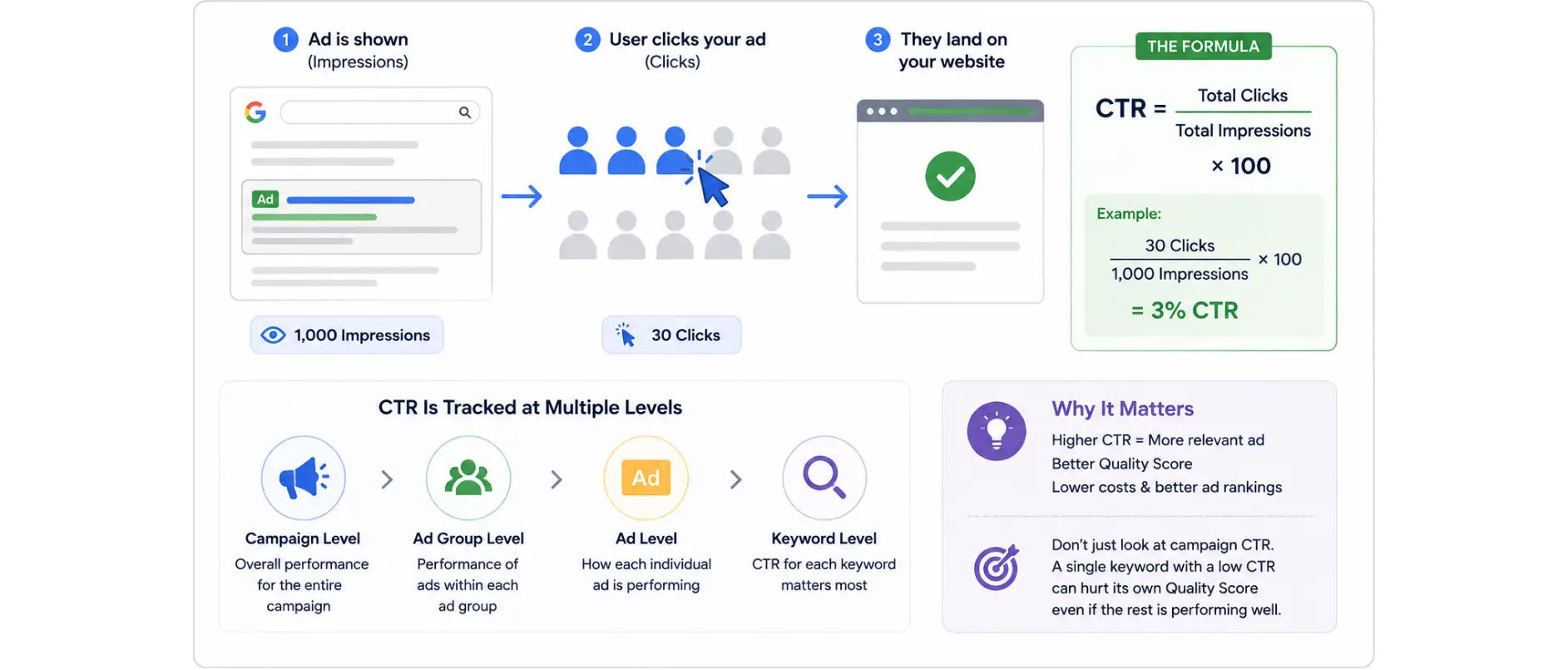
Click-through rate (CTR) is the percentage of people who see your ad and click it. Google calculates it with a simple formula:
CTR = (Total Clicks ÷ Total Impressions) × 100
What Is a Good CTR for Google Ads?
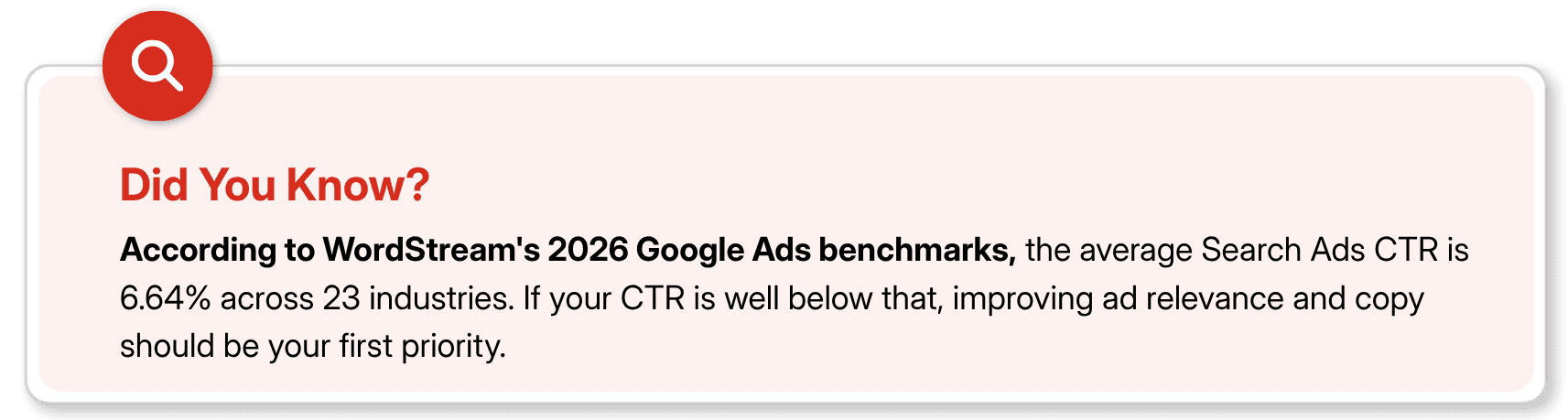
There's no single "good" number, because CTR benchmarks shift by industry, ad format, and network. Search ads generally see higher CTRs than Display ads, since search users are already looking for something specific, while Display and Discovery ads reach people who weren't necessarily searching for anything at all.
Ad Network | Typical CTR Pattern | Why It Behaves This Way |
|---|---|---|
Search Network | Higher, intent-driven | Users type a specific query, so a relevant ad matches an active need. |
Display Network | Lower, awareness-driven | Ads appear to passive browsers who weren't actively searching. |
Shopping Ads | Varies by product match | Visual and price-led, so CTR depends heavily on image and offer clarity. |
Rather than chasing an industry average, compare your CTR against your own account history and against other ad groups targeting similar keywords. That comparison tells you more than a generic benchmark ever will, because it accounts for your specific audience, offer, and competitive landscape rather than an average pulled from unrelated industries.
1. Match Ad Copy to Search Intent, Not Just Keywords
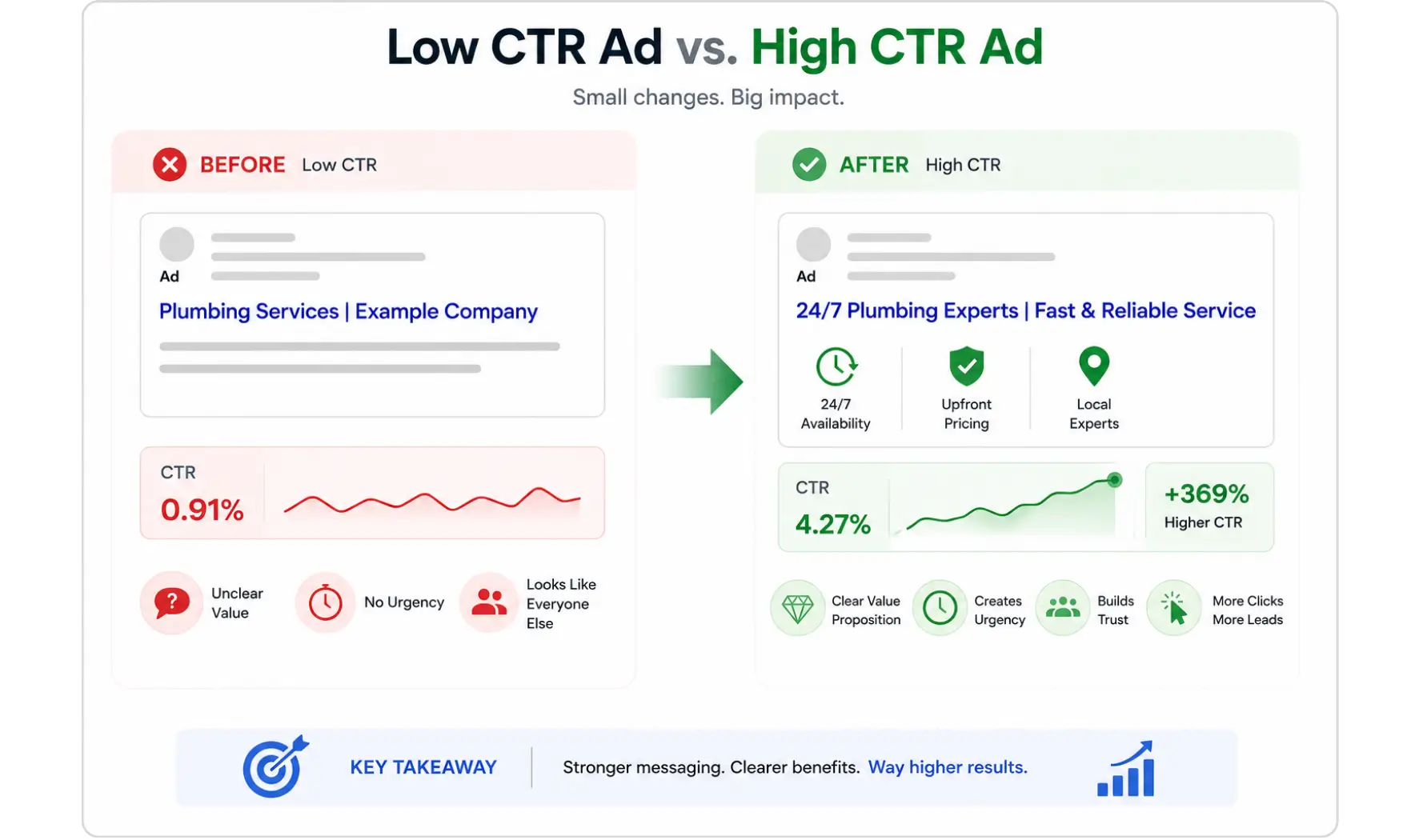
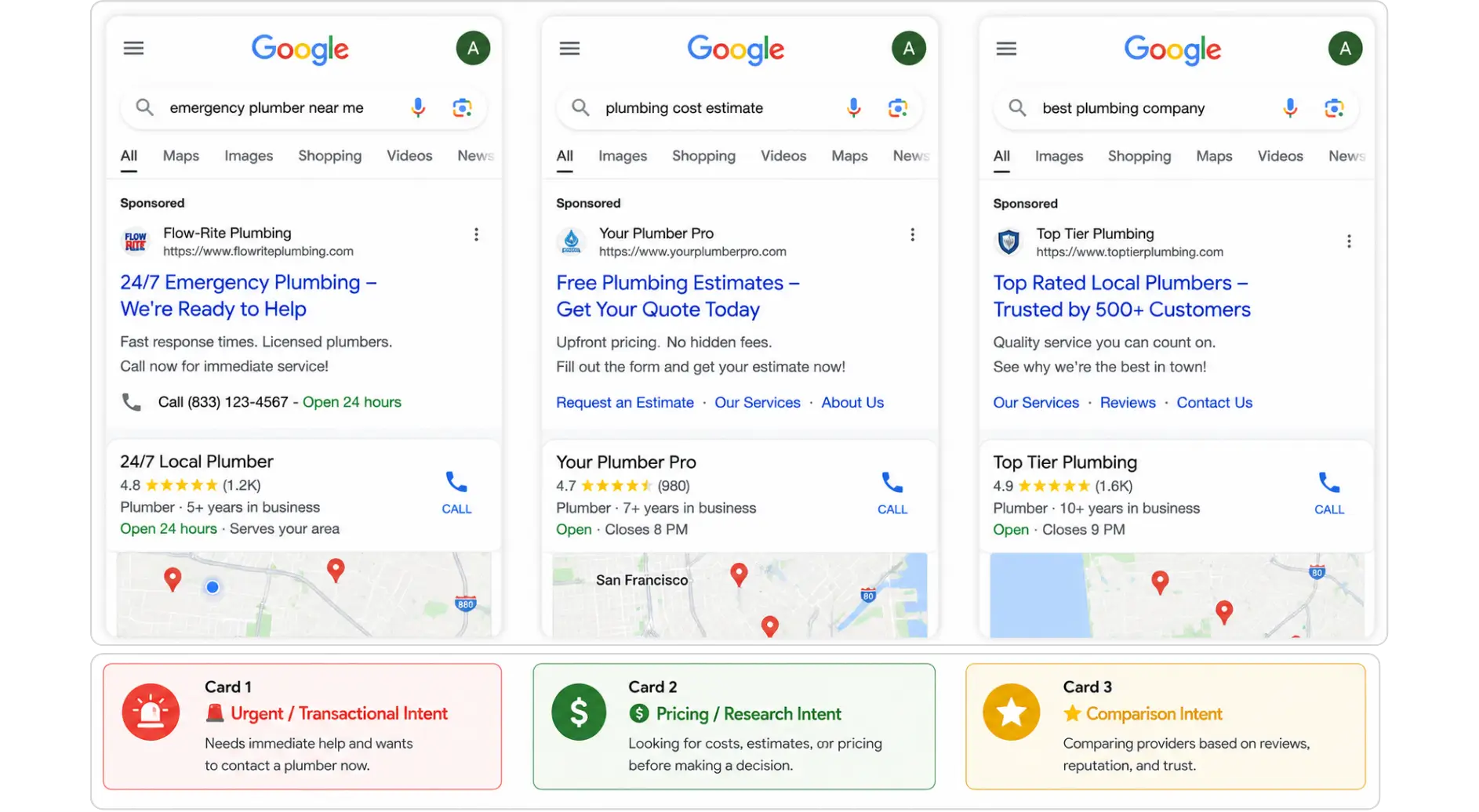
Ranking for a keyword isn't the same as answering the question behind it. Someone searching "emergency plumber near me" wants speed and availability in the headline not a generic line about "best plumbing company" Someone searching "plumbing cost estimate" wants pricing clarity, not a reassurance about experience.
Before writing copy, group your keywords by the intent behind them: urgent/transactional, comparison/research, or informational. Write separate ad copy for each group instead of running one ad across all three. It takes more setup time upfront, but a single ad trying to serve three different intents usually ends up vague enough that it serves none of them well.
2. Use Responsive Search Ads Strategically
Responsive Search Ads allow you to test different headlines and descriptions to find the combinations that resonate best with your audience. Instead of repeating similar messaging across every asset, use the available headlines to highlight different benefits, pain points, keywords, offers, and calls to action.
Include your primary keyword in relevant headlines, clearly communicate what makes your business different, and use descriptions to reinforce the value of clicking. Avoid adding multiple headlines that say essentially the same thing.
Google can then test different combinations and identify the messaging that is most likely to generate engagement. Review your ad performance regularly and replace underperforming assets with new variations to keep improving CTR.
3. Put the main benefit in the headline early
Your headline should do more than name the service. It should explain why someone should click now.
Instead of only saying “Digital Marketing Services,” try a clearer value angle such as “Digital Marketing Services for Local Leads” or “Grow Leads With Paid Search Support.” The exact wording will depend on the offer, but the point is the same: lead with a useful promise, not just a category label.
The best headlines are usually specific, not clever. They tell the user what they get, who it is for, or why it matters. That clarity often does more for CTR than a polished slogan ever will.
4. Add Every Relevant Ad Extension
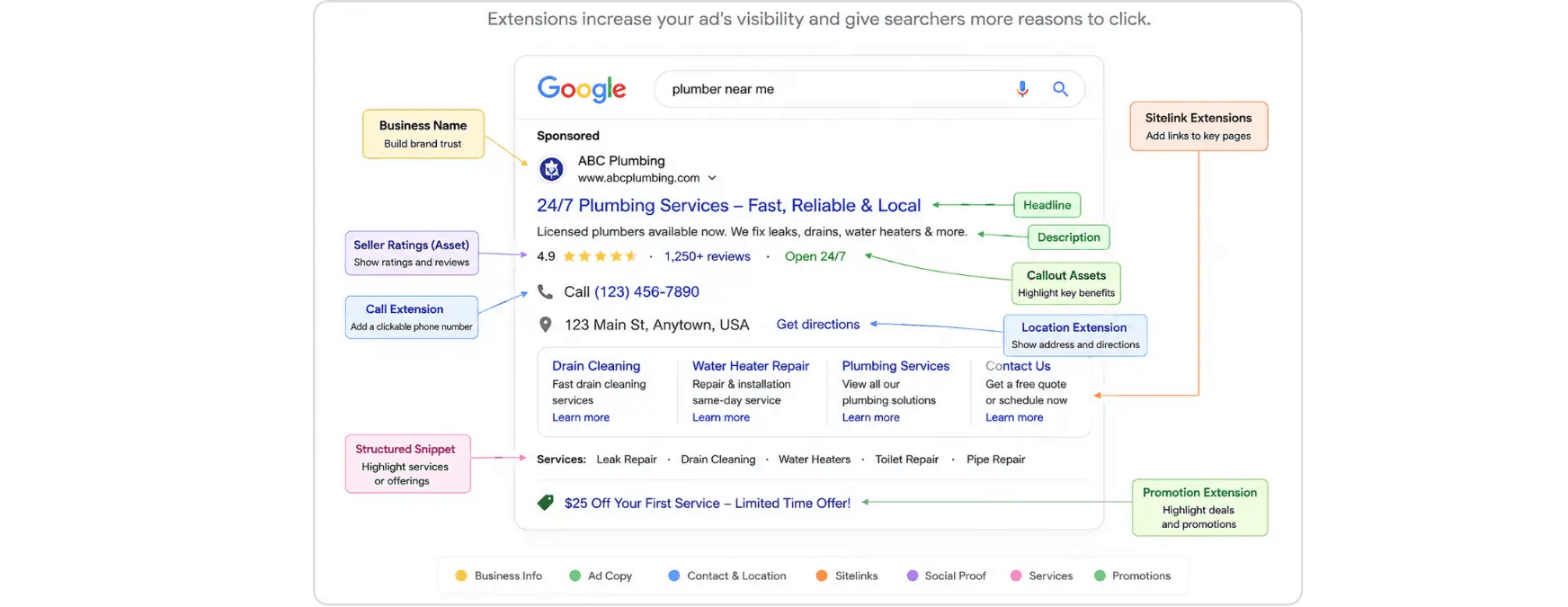
Extensions (now called "assets" in Google Ads) increase your ad's visual footprint on the results page and give searchers more reasons to click a price, a location, a specific service link. Sitelinks, callouts, structured snippets, and call extensions each add a different type of value, and Google can display several of them together on the same ad.
An ad with no extensions competes for space with ads that have four or five. On a crowded results page, that space difference alone can account for a meaningful CTR gap, since your competitor's ad simply occupies more of the screen and offers more angles for a searcher to click on.
5. Write Ad Copy Around Objections, Not Just Benefits
Most ad copy lists benefits: fast, affordable, trusted. But the searcher already has an unspoken objection running through their head "is this actually available in my area," "will this cost more than the listing shows," "how fast is 'fast,' really." Naming and answering that objection directly in the copy often outperforms a generic benefit list, because it signals the advertiser understands the buyer's hesitation instead of just repeating what every competitor already claims.
A useful exercise is to write down the three most common reasons a prospect might hesitate before clicking, then check whether any of your current ad copy actually addresses them. If it doesn't, that's your next headline test.
6. Test Numbers and Specifics Over Vague Claims
"Same-day service" is a claim. "Booked and on-site within 2 hours" is a specific claim. Numbers, timeframes, and concrete details tend to stand out against a page of ads making similarly vague promises, simply because they're easier to evaluate at a glance and feel more credible than a broad adjective.
This applies to pricing too. "Affordable pricing" tells a searcher nothing they can act on. "Plans starting at a fixed monthly rate" gives them something concrete to compare against whatever they saw on the previous ad.
7. Match the ad to the landing page
A strong ad and a mediocre landing page creates friction. The ad makes a promise, the user clicks and then exits the page because it feels irrelevant, busy or slow.
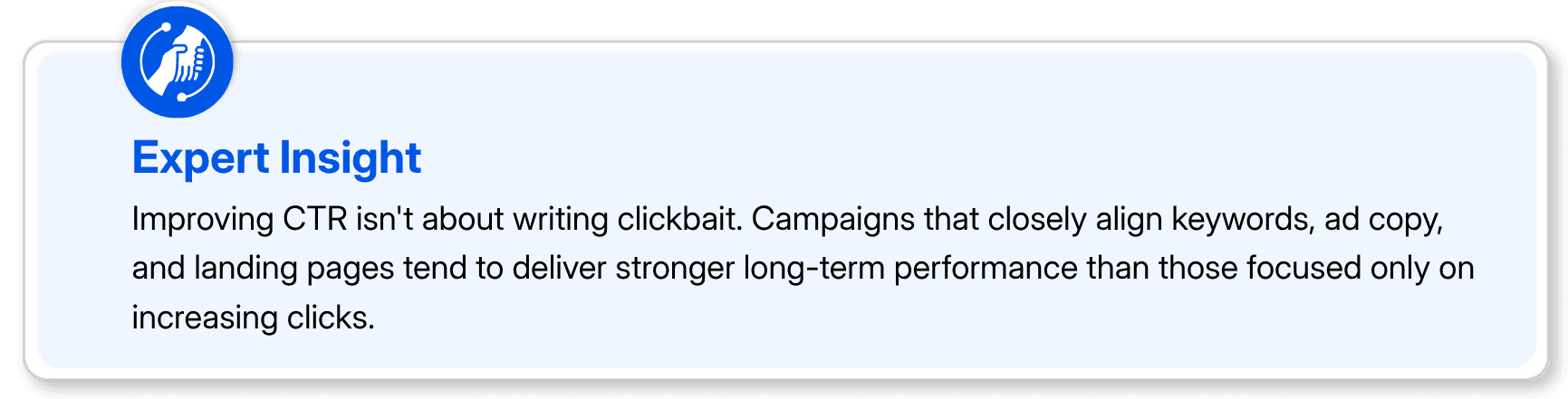
The message must be aligned. If the ad is for commercial window installation, the landing page should load with commercial window installation, not a generic home page banner. If the ad is for a specific service area, it should show up on the page. If the ad is for a price, offer or appointment step, the page should be transparent about it immediately.
This alignment can also indirectly enhance CTR, since better landing pages improve overall account health. This also makes consumers feel like they’ve arrived at the correct location, and that’s what they’re looking for.
8. Use Negative Keywords to Protect Your CTR
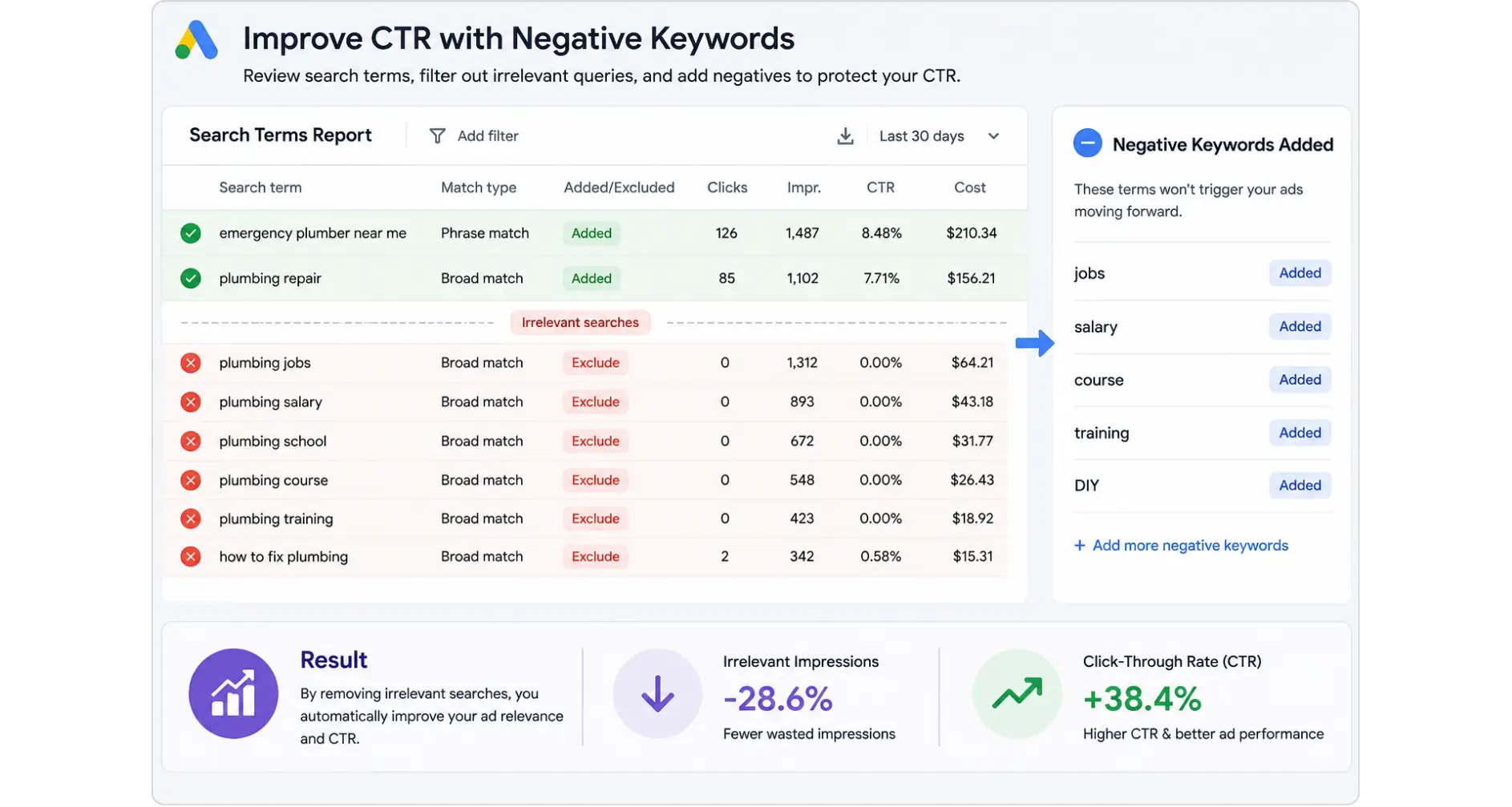
CTR isn't only about writing better ads it's also about making sure your ad isn't showing up for searches it was never meant to answer. Every irrelevant impression you collect drags your CTR down, even if your ad copy is excellent, because the formula counts every impression whether or not that searcher was ever a realistic click.
Review your search terms report regularly and add negative keywords for queries that triggered your ad but don't match your offer. This is one of the fastest, lowest-effort CTR improvements available, because it's subtraction, not creation you're not writing anything new, just trimming impressions that were never going to convert.
9. Segment Ad Groups by Tighter Keyword Themes
Broad ad groups covering many loosely related keywords force one ad to serve many different intents, and it usually does none of them particularly well. Tighter ad groups organized around a single theme or service let you write copy that speaks directly to that specific search, which tends to lift both relevance and CTR.
A simple test: open one of your larger ad groups and count how many genuinely different services or intents are bundled inside it. If the number is higher than two or three, that ad group is likely diluting your CTR simply through structure, regardless of how good the individual ad copy is.
10. Use audience signals to improve targeting
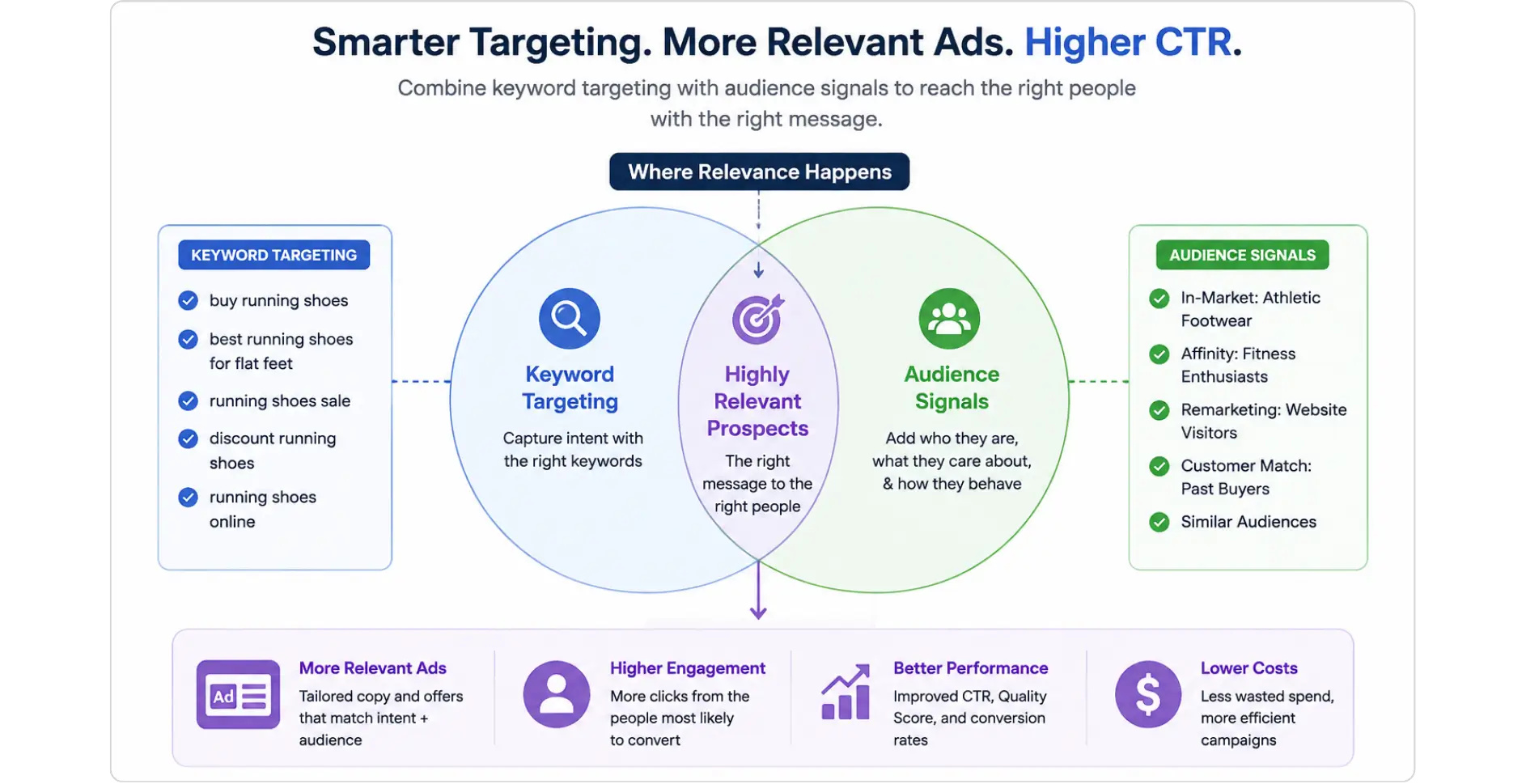
Layering audiences (in-market groups, affinity audiences or your own customer data) doesn’t simply help with bidding but it helps you craft more relevant advertising for the individuals most likely to act. If you know who’s likely seeking, you may shape the offer and wording in the ad copy itself, rather than producing one general message for all.
This is very handy for remarketing lists overlaid on search campaigns. A returning visitor who already knows your brand can be given copy that gets straight to the offer, while a first-time searcher still requires the context.
11. Refresh Ad Copy Before It Fatigues
Even a high-performing ad loses steam over time as the same audience sees it repeatedly. Ad fatigue shows up as a slow, steady CTR decline with no obvious cause nothing changed in your targeting or bids, but the numbers drift downward anyway. Rotating in fresh headlines and descriptions every few weeks especially for evergreen, always-on campaigns keeps the copy from going stale in front of repeat viewers.
Set a recurring reminder to review your top-spending ad groups on a fixed schedule rather than waiting for performance to visibly dip. By the time a decline is obvious in the reports, you've usually already lost several weeks of underperformance.

12. Measure CTR alongside the rest of the picture
CTR tells you whether people are interested enough to click. It does not tell you whether those clicks convert. That is why it should be read with conversion rate, cost per conversion, search term quality, and landing page performance.
Sometimes a slightly lower CTR is better if it brings more qualified traffic. Sometimes a higher CTR is a warning sign if the ad is attracting curious but unqualified users. The best advertisers use CTR as one signal, not the only signal.
So when you ask what is a good ctr for google ads, the honest answer is that it depends on whether the traffic is valuable. A useful CTR is one that supports the business goal, not one that simply looks impressive in a report.
Common Mistakes That Quietly Undo These Best Practices
A few habits show up repeatedly in accounts with stalled CTR, even when the advertiser is technically following most of the practices above:
Writing one ad for an entire ad group instead of tailoring copy to the tightest possible keyword theme.
Setting up extensions once at launch and never revisiting them as the business adds services, locations, or offers.
Treating the search terms report as a monthly or quarterly task instead of a standing weekly habit.
Letting high-performing ads run unchanged for months, well past the point where fatigue starts pulling CTR down.
None of these are complicated fixes. They're maintenance habits which is exactly why they're easy to skip and why they tend to be the first place worth checking when CTR plateaus.
How to Improve CTR in Google Ads: A Quick Recap
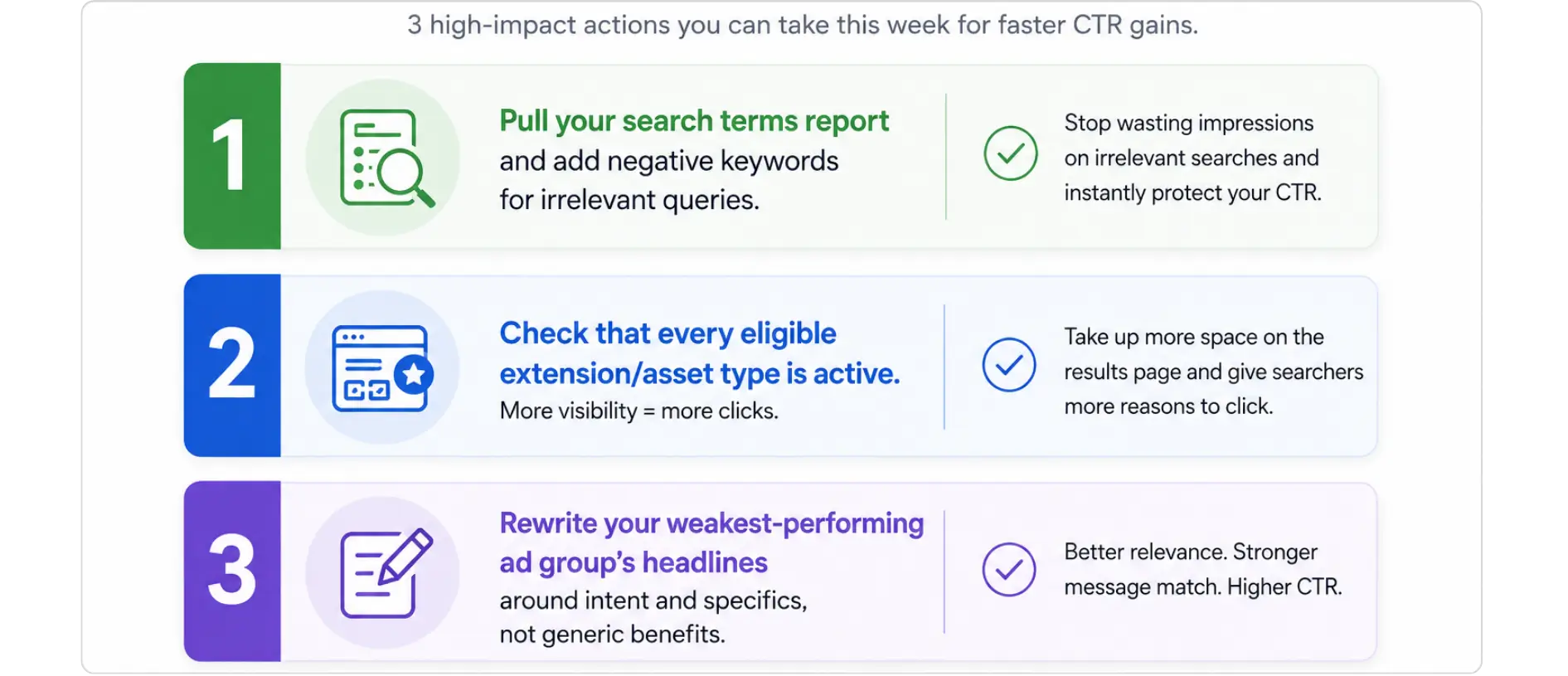
If you only have time to act on a few of these this week, prioritize in this order:
Pull your search terms report and add negative keywords for irrelevant queries.
Check that every eligible extension/asset type is active.
Rewrite your weakest-performing ad group's headlines around intent and specifics, not generic benefits.
These three alone typically surface the fastest, most measurable CTR gains, because they fix the highest-impact issues first: wasted impressions, missing visual real estate, and copy mismatch. Once those are handled, work through the remaining practices in this guide as an ongoing maintenance routine rather than a one-time project.
Final Thoughts
CTR improvement in Google Ads isn't one dramatic rewrite it's a series of small, deliberate corrections: tighter ad groups, sharper copy, cleaner targeting, and a search terms report you actually read every week. Each fix on its own moves the number a little. Together, they compound.
Start with whichever one of these 12 areas is weakest in your account right now, fix it, measure the change, then move to the next. That steady, testable approach will get you further than a single big campaign overhaul and it's a lot easier to sustain, since you're never trying to fix everything in your account at once.
FAQs
What is CTR in Google Ads?

CTR (Click-Through Rate) – The percentage of people that see your ad and then click on it. Total clicks / total number of impressions. It is tracked on the campaign, ad group, ad and keyword level.
What is a good CTR for Google Ads?
It varies by industry and the type of ad, but in general, Search ads perform better than Display ads because of the increased search intent. Don't compare your CTR to an industry average, compare it to your own account history, and similar ad groups.
How do I improve CTR in Google Ads quickly?
Begin with your search terms report: Add negative keywords for searches that are irrelevant, turn on any ad extensions that you aren’t using, and reword the headlines in your weakest ad group to reflect specific intent-matched wording.
Does CTR affect Quality Score?
CTR is one of the main indicators Google uses to calculate Quality Score, which effects your cost-per-click and ad rank.
How often should I check my search terms report?
Best for aggressive campaigns Weekly If you wait a whole quarter you'll have irrelevant queries and copy mismatches quietly bleeding your budget before you can notice them.
If your Google Ads account is spending steadily but your click-through rate refuses to move, the problem is rarely one big mistake. It's usually five or six small ones stacked on top of each other a headline that doesn't match the search term, an extension that's missing, a landing page URL that looks generic instead of relevant.
CTR isn't just a vanity metric either. Google uses it as a direct input into your Quality Score, which affects your cost-per-click and your ad rank. A campaign with a strong CTR often pays less per click than a competitor bidding higher but getting ignored. So improving CTR isn't only about getting more clicks it's about making every dollar in your budget work harder.
The tricky part is that most of these small issues don't show up as errors anywhere in the interface. Google won't flag a headline for being generic or tell you that your display URL looks disconnected from your offer. You have to go looking for them, ad group by ad group, which is exactly why so many accounts carry the same CTR problems for months without anyone noticing.
This guide walks through 12 practical, testable changes you can make to your Google Ads campaigns this week. Each one addresses a specific reason ads get skipped over, from ad relevance to extension usage to audience targeting. No filler, no "just write better ads" advice just the specific levers that move the needle.
What Is CTR in Google Ads?
Click-through rate (CTR) is the percentage of people who see your ad and click it. Google calculates it with a simple formula:
CTR = (Total Clicks ÷ Total Impressions) × 100
What Is a Good CTR for Google Ads?
There's no single "good" number, because CTR benchmarks shift by industry, ad format, and network. Search ads generally see higher CTRs than Display ads, since search users are already looking for something specific, while Display and Discovery ads reach people who weren't necessarily searching for anything at all.
Ad Network | Typical CTR Pattern | Why It Behaves This Way |
|---|---|---|
Search Network | Higher, intent-driven | Users type a specific query, so a relevant ad matches an active need. |
Display Network | Lower, awareness-driven | Ads appear to passive browsers who weren't actively searching. |
Shopping Ads | Varies by product match | Visual and price-led, so CTR depends heavily on image and offer clarity. |
Rather than chasing an industry average, compare your CTR against your own account history and against other ad groups targeting similar keywords. That comparison tells you more than a generic benchmark ever will, because it accounts for your specific audience, offer, and competitive landscape rather than an average pulled from unrelated industries.
1. Match Ad Copy to Search Intent, Not Just Keywords
Ranking for a keyword isn't the same as answering the question behind it. Someone searching "emergency plumber near me" wants speed and availability in the headline not a generic line about "best plumbing company" Someone searching "plumbing cost estimate" wants pricing clarity, not a reassurance about experience.
Before writing copy, group your keywords by the intent behind them: urgent/transactional, comparison/research, or informational. Write separate ad copy for each group instead of running one ad across all three. It takes more setup time upfront, but a single ad trying to serve three different intents usually ends up vague enough that it serves none of them well.
2. Use Responsive Search Ads Strategically
Responsive Search Ads allow you to test different headlines and descriptions to find the combinations that resonate best with your audience. Instead of repeating similar messaging across every asset, use the available headlines to highlight different benefits, pain points, keywords, offers, and calls to action.
Include your primary keyword in relevant headlines, clearly communicate what makes your business different, and use descriptions to reinforce the value of clicking. Avoid adding multiple headlines that say essentially the same thing.
Google can then test different combinations and identify the messaging that is most likely to generate engagement. Review your ad performance regularly and replace underperforming assets with new variations to keep improving CTR.
3. Put the main benefit in the headline early
Your headline should do more than name the service. It should explain why someone should click now.
Instead of only saying “Digital Marketing Services,” try a clearer value angle such as “Digital Marketing Services for Local Leads” or “Grow Leads With Paid Search Support.” The exact wording will depend on the offer, but the point is the same: lead with a useful promise, not just a category label.
The best headlines are usually specific, not clever. They tell the user what they get, who it is for, or why it matters. That clarity often does more for CTR than a polished slogan ever will.
4. Add Every Relevant Ad Extension
Extensions (now called "assets" in Google Ads) increase your ad's visual footprint on the results page and give searchers more reasons to click a price, a location, a specific service link. Sitelinks, callouts, structured snippets, and call extensions each add a different type of value, and Google can display several of them together on the same ad.
An ad with no extensions competes for space with ads that have four or five. On a crowded results page, that space difference alone can account for a meaningful CTR gap, since your competitor's ad simply occupies more of the screen and offers more angles for a searcher to click on.
5. Write Ad Copy Around Objections, Not Just Benefits
Most ad copy lists benefits: fast, affordable, trusted. But the searcher already has an unspoken objection running through their head "is this actually available in my area," "will this cost more than the listing shows," "how fast is 'fast,' really." Naming and answering that objection directly in the copy often outperforms a generic benefit list, because it signals the advertiser understands the buyer's hesitation instead of just repeating what every competitor already claims.
A useful exercise is to write down the three most common reasons a prospect might hesitate before clicking, then check whether any of your current ad copy actually addresses them. If it doesn't, that's your next headline test.
6. Test Numbers and Specifics Over Vague Claims
"Same-day service" is a claim. "Booked and on-site within 2 hours" is a specific claim. Numbers, timeframes, and concrete details tend to stand out against a page of ads making similarly vague promises, simply because they're easier to evaluate at a glance and feel more credible than a broad adjective.
This applies to pricing too. "Affordable pricing" tells a searcher nothing they can act on. "Plans starting at a fixed monthly rate" gives them something concrete to compare against whatever they saw on the previous ad.
7. Match the ad to the landing page
A strong ad and a mediocre landing page creates friction. The ad makes a promise, the user clicks and then exits the page because it feels irrelevant, busy or slow.
The message must be aligned. If the ad is for commercial window installation, the landing page should load with commercial window installation, not a generic home page banner. If the ad is for a specific service area, it should show up on the page. If the ad is for a price, offer or appointment step, the page should be transparent about it immediately.
This alignment can also indirectly enhance CTR, since better landing pages improve overall account health. This also makes consumers feel like they’ve arrived at the correct location, and that’s what they’re looking for.
8. Use Negative Keywords to Protect Your CTR
CTR isn't only about writing better ads it's also about making sure your ad isn't showing up for searches it was never meant to answer. Every irrelevant impression you collect drags your CTR down, even if your ad copy is excellent, because the formula counts every impression whether or not that searcher was ever a realistic click.
Review your search terms report regularly and add negative keywords for queries that triggered your ad but don't match your offer. This is one of the fastest, lowest-effort CTR improvements available, because it's subtraction, not creation you're not writing anything new, just trimming impressions that were never going to convert.
9. Segment Ad Groups by Tighter Keyword Themes
Broad ad groups covering many loosely related keywords force one ad to serve many different intents, and it usually does none of them particularly well. Tighter ad groups organized around a single theme or service let you write copy that speaks directly to that specific search, which tends to lift both relevance and CTR.
A simple test: open one of your larger ad groups and count how many genuinely different services or intents are bundled inside it. If the number is higher than two or three, that ad group is likely diluting your CTR simply through structure, regardless of how good the individual ad copy is.
10. Use audience signals to improve targeting
Layering audiences (in-market groups, affinity audiences or your own customer data) doesn’t simply help with bidding but it helps you craft more relevant advertising for the individuals most likely to act. If you know who’s likely seeking, you may shape the offer and wording in the ad copy itself, rather than producing one general message for all.
This is very handy for remarketing lists overlaid on search campaigns. A returning visitor who already knows your brand can be given copy that gets straight to the offer, while a first-time searcher still requires the context.
11. Refresh Ad Copy Before It Fatigues
Even a high-performing ad loses steam over time as the same audience sees it repeatedly. Ad fatigue shows up as a slow, steady CTR decline with no obvious cause nothing changed in your targeting or bids, but the numbers drift downward anyway. Rotating in fresh headlines and descriptions every few weeks especially for evergreen, always-on campaigns keeps the copy from going stale in front of repeat viewers.
Set a recurring reminder to review your top-spending ad groups on a fixed schedule rather than waiting for performance to visibly dip. By the time a decline is obvious in the reports, you've usually already lost several weeks of underperformance.
12. Measure CTR alongside the rest of the picture
CTR tells you whether people are interested enough to click. It does not tell you whether those clicks convert. That is why it should be read with conversion rate, cost per conversion, search term quality, and landing page performance.
Sometimes a slightly lower CTR is better if it brings more qualified traffic. Sometimes a higher CTR is a warning sign if the ad is attracting curious but unqualified users. The best advertisers use CTR as one signal, not the only signal.
So when you ask what is a good ctr for google ads, the honest answer is that it depends on whether the traffic is valuable. A useful CTR is one that supports the business goal, not one that simply looks impressive in a report.
Common Mistakes That Quietly Undo These Best Practices
A few habits show up repeatedly in accounts with stalled CTR, even when the advertiser is technically following most of the practices above:
Writing one ad for an entire ad group instead of tailoring copy to the tightest possible keyword theme.
Setting up extensions once at launch and never revisiting them as the business adds services, locations, or offers.
Treating the search terms report as a monthly or quarterly task instead of a standing weekly habit.
Letting high-performing ads run unchanged for months, well past the point where fatigue starts pulling CTR down.
None of these are complicated fixes. They're maintenance habits which is exactly why they're easy to skip and why they tend to be the first place worth checking when CTR plateaus.
How to Improve CTR in Google Ads: A Quick Recap
If you only have time to act on a few of these this week, prioritize in this order:
Pull your search terms report and add negative keywords for irrelevant queries.
Check that every eligible extension/asset type is active.
Rewrite your weakest-performing ad group's headlines around intent and specifics, not generic benefits.
These three alone typically surface the fastest, most measurable CTR gains, because they fix the highest-impact issues first: wasted impressions, missing visual real estate, and copy mismatch. Once those are handled, work through the remaining practices in this guide as an ongoing maintenance routine rather than a one-time project.
Final Thoughts
CTR improvement in Google Ads isn't one dramatic rewrite it's a series of small, deliberate corrections: tighter ad groups, sharper copy, cleaner targeting, and a search terms report you actually read every week. Each fix on its own moves the number a little. Together, they compound.
Start with whichever one of these 12 areas is weakest in your account right now, fix it, measure the change, then move to the next. That steady, testable approach will get you further than a single big campaign overhaul and it's a lot easier to sustain, since you're never trying to fix everything in your account at once.
FAQs
What is CTR in Google Ads?
CTR (Click-Through Rate) – The percentage of people that see your ad and then click on it. Total clicks / total number of impressions. It is tracked on the campaign, ad group, ad and keyword level.
What is a good CTR for Google Ads?
It varies by industry and the type of ad, but in general, Search ads perform better than Display ads because of the increased search intent. Don't compare your CTR to an industry average, compare it to your own account history, and similar ad groups.
How do I improve CTR in Google Ads quickly?
Begin with your search terms report: Add negative keywords for searches that are irrelevant, turn on any ad extensions that you aren’t using, and reword the headlines in your weakest ad group to reflect specific intent-matched wording.
Does CTR affect Quality Score?
CTR is one of the main indicators Google uses to calculate Quality Score, which effects your cost-per-click and ad rank.
How often should I check my search terms report?
Best for aggressive campaigns Weekly If you wait a whole quarter you'll have irrelevant queries and copy mismatches quietly bleeding your budget before you can notice them.



Summarize with AI




Have a Google Ads account?
Get a free audit Today!
Have a Google Ads account?
Get a free audit Today!



4.9/5 Ratings!
4.9/5 Ratings!


Don’t miss our revenue growth tips!
Get expert marketing tips—straight to your inbox, like thousands of happy clients.
Don’t miss our revenue growth tips!
Get expert marketing tips—straight to your inbox, like thousands of happy clients.
Don’t miss our revenue growth tips!
Get expert marketing tips—straight to your inbox, like thousands of happy clients.
Don’t miss our revenue growth tips!
Relevant Blogs on PPC Marketing
Relevant Blogs on PPC Marketing
Unlock data-driven insights in PPC marketing—explore our featured blogs and skyrocket your revenue before your competitors do.
Unlock data-driven insights in PPC marketing—explore our featured blogs and skyrocket your revenue before your competitors do.

PPC
Sep 1, 2026
8 Min Read
Google Is Removing Manual Language Targeting From Search Campaigns: What Advertisers Need to Know
PPC
Sep 1, 2026
8 Min Read
Google Is Removing Manual Language Targeting From Search Campaigns: What Advertisers Need to Know
PPC
Sep 1, 2026
8 Min Read
Google Is Removing Manual Language Targeting From Search Campaigns: What Advertisers Need to Know

PPC
Aug 6, 2026
10 Min Read
What Are Display Ads & How Do They Work?
PPC
Aug 6, 2026
10 Min Read
What Are Display Ads & How Do They Work?
PPC
Aug 6, 2026
10 Min Read
What Are Display Ads & How Do They Work?

PPC
Jul 13, 2026
10 Min Read
Why Google Ads Shows Conversions but Your Revenue Isn't Growing
PPC
Jul 13, 2026
10 Min Read
Why Google Ads Shows Conversions but Your Revenue Isn't Growing
PPC
Jul 13, 2026
10 Min Read
Why Google Ads Shows Conversions but Your Revenue Isn't Growing




























Ready to speak with an expert?
Data-Driven Marketing Agency That Elevates ROI
1100+
Websites Designed & Optimized to Convert
$280M+
Client Revenue Driven & Growing Strong
Discover how to skyrocket
your revenue today!
Trusted by 1000+ Owners!
Ready to speak with an expert?
Data-Driven Marketing Agency That Elevates ROI
1100+
Websites Designed & Optimized to Convert
$280M+
Client Revenue Driven & Growing Strong
Discover how to skyrocket
your revenue today!
Trusted by 1000+ Owners!
Want to skyrocket revenue?
4.9/5 Ratings!
Ready to speak with an expert?
Data-Driven Marketing Agency That Elevates ROI
1100+
Websites Designed & Optimized to Convert
$280M+
Client Revenue Driven & Growing Strong
Discover how to skyrocket
your revenue today!
Trusted by 1000+ Owners!
Call
Meet