Social Search Optimization: How to Optimize Your Brand for Social Search
Social Search Optimization: How to Optimize Your Brand for Social Search
Last Updated:
Table of Content
How We
Skyrocket
Boost
Maximize
Accelerate
Amplify
Elevate
Optimize
Enhance
Your Revenue?


Micaliah Farris
Micaliah Farris
Micaliah Farris
Social Media
Social Media
Social Media
10 Min Read
5 Min
10 Min Read
Social search optimization is the process of organizing your social media presence, including both your individual social profiles and your content, to display your brand when people search within the apps themselves, whether it be TikTok, Instagram, YouTube, and Pinterest, and more recently, when Google displays that social content as well.
To summarize quickly: handle your captions, social profile fields, text on screen, and alt-text similarly to how you would optimize a website's title tags and meta description. When you communicate to all platforms exactly what your content is about, there is an opportunity to reach those who are already searching for it.
This is the quick summary. We will provide a breakdown below regarding what social search really is; why it is changing how your customers find your brand; and most importantly, a step-by-step guide you can implement yourself starting this week.
What Is Social Search?
Social search occurs when an end user utilizes a search bar located inside of a social media application, rather than using a traditional search engine, to discover products/services/recommendations/how-to guides. As opposed to typing "the best budget headphones" into Google and reviewing various links to articles and websites, an individual types their query into TikTok/Instagram etc. and watches another person demonstrate an answer to their question.
While these two examples differ, the implications matter. While traditional search engines reward authors based upon content quality, link relevance, and authority, social search rewards authors based upon visual appeal, conversational style, and community validation. Individuals don't simply look for answers to their questions; they look for authentic recommendations which they can view, believe, and follow in formats they already consume daily via mobile devices.
Why Social Search Matters for Brands Today
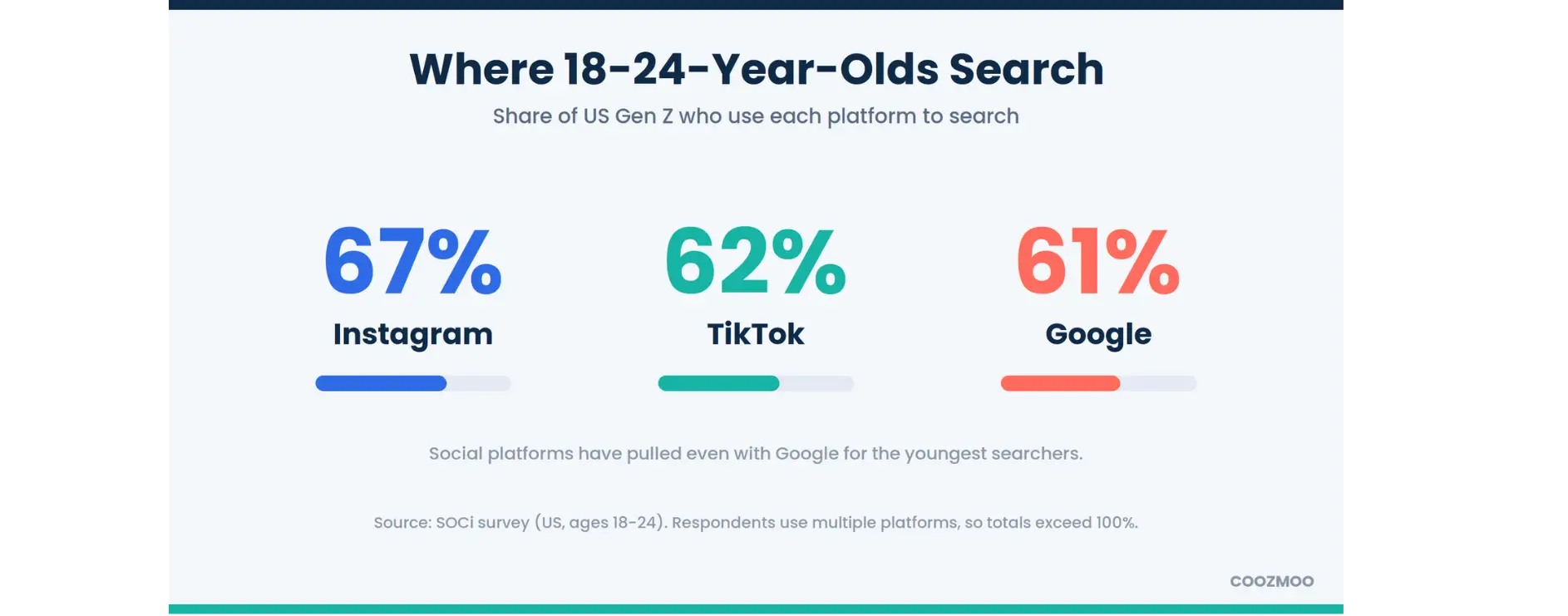
While many may not realize it, the statistics related to social search are compelling enough to warrant immediate attention. According to a recent survey conducted by SOCi for 18-24-year-olds in the United States, 67% utilize Instagram for searching purposes; 62% utilize TikTok for searching purposes, and 61% utilize Google for searching purposes. Therefore, social media applications have essentially reached parity (and possibly surpassed) Google, the search engine that earned "Google" a spot in our vocabulary. Data published by Statista indicates that 64% of U.S. Gen Z respondents utilized TikTok as a search engine in 2024. Additionally, according to Adobe, a similar percentage of Gen Z/Millennials treated TikTok like a search application, and Pinterest processes more than 80 billion searches every month.
Furthermore, while individuals utilizing social media applications do appear to be discovering new products/services/brands, the purchasing intent associated with those discoveries should also be recognized. According to TikTok's own consumer research, 61% of users discover new products and brands on the platform, and the majority go on to act on what they find.
A key consideration going forward (in particular pertaining to 2025), is this does not represent the complete replacement of Google as much as it represents the emergence of multiple platforms for search. Consumers now frequently move back and forth between Google, TikTok, Instagram, YouTube, and others, dependent upon the product/service they are attempting to locate. Thusly, opting out of social search does not simply equate to losing access to one additional distribution channel but results in consumers never seeing your brand during the very instances when high-intent purchasers are considering trying something new.
Social Search vs. Classic SEO
You've likely spent money on SEO, so since you're reading this about social media search engine optimization, it'll look very familiar. Social media search engine optimization and classic SEO have the same goal and use similar tools: creating content that includes keywords, structuring your content in an easy-to-read format, and using content that answers a question. They use the same principles to create content and identify the keywords users input when searching for information.
What separates them is how they evaluate content. Google evaluates the linkability of the content (how easily the content can be linked) along with page authority and technical health. Social media platforms evaluate watch time, saves, shares, comments, and whether or not the text in your post accurately describes the subject matter. A blog post may rank on Google based on authority alone for months. However, a TikTok or Instagram post earns a spot in their search results due to its engagement and usefulness, which causes users to save, share, and comment.
Instead of deciding which one is better, consider that there are two entranceways into the house. The best strategy would be to make sure both entranceways are fully accessible.
How Does Each Platform Index Content?
Since each platform indexes content slightly differently, using one-size-fits-all posts limits potential views.
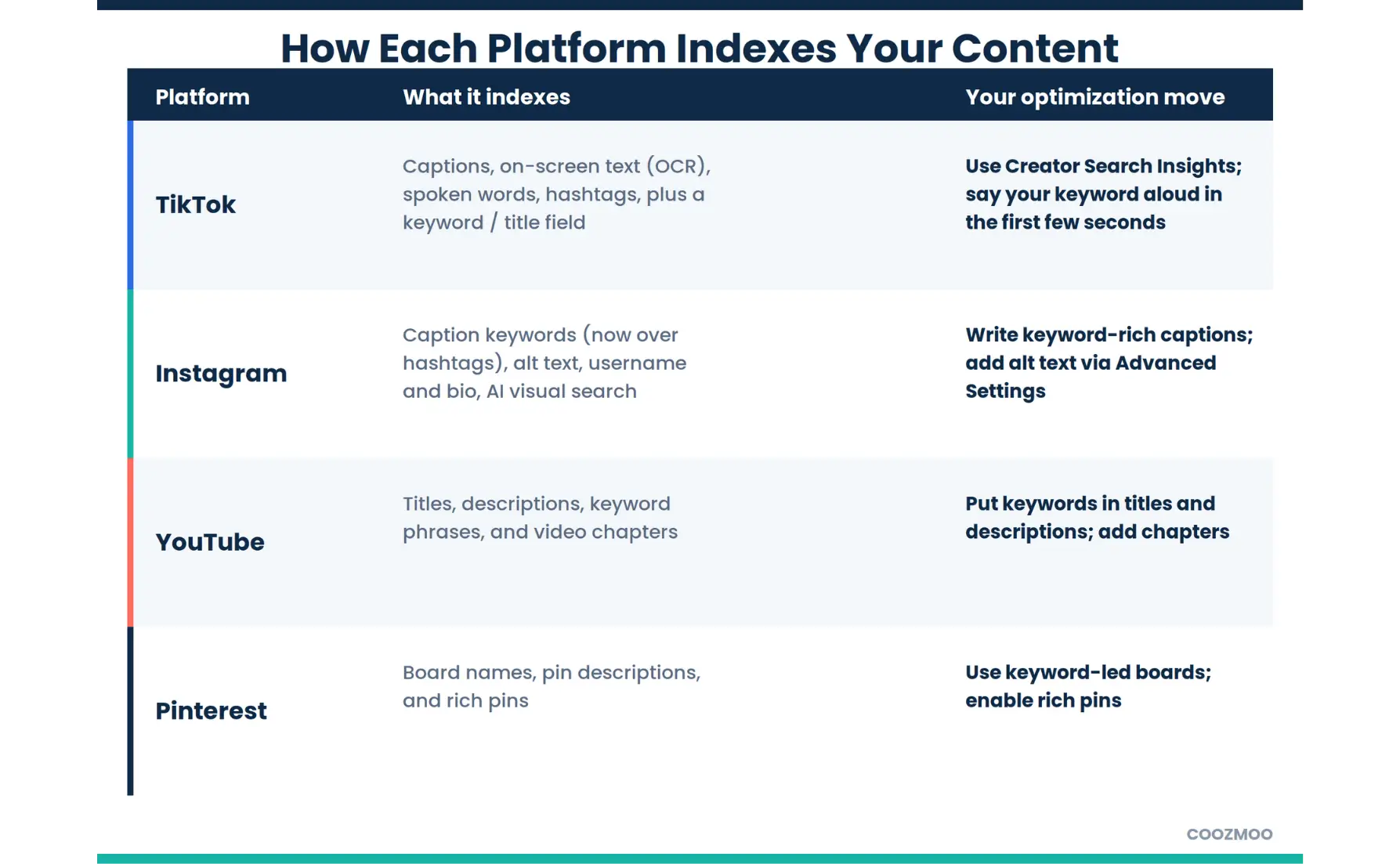
TikTok indexes the caption of your video, the on-screen text from the video (using OCR), and the words you say in your video, in addition to your hashtags. In some areas of TikTok, there is even a keyword or title field where you can enter additional information about the topic. Additionally, TikTok provides Creator Search Insights, which is essentially a keyword tool to see what searches occur in your area.
Instagram has changed its algorithm to favor keywords in captions versus hashtags. In addition to capturing alternate text for visually impaired individuals, Instagram also favors your username and description. Most recently, Instagram rolled out AI-based visual search, allowing it to read the content within your image or video.
YouTube, as one of the top-ranked search platforms, continues to reward high-ranking titles and descriptions that include keyword phrases, as well as chaptering your videos for easier navigation for users and for the algorithm.
Pinterest is currently the closest to traditional search engines. Pins are indexed based on keywords in your board name, pin descriptions, and rich pins that automatically capture product information.
How to Optimize Your Brand for Social Search: A Reusable Checklist
Most trend-based articles will stop at this point and leave all the heavy lifting for the reader. Consider using this as a reusable template/checklist for every platform you have a presence on.
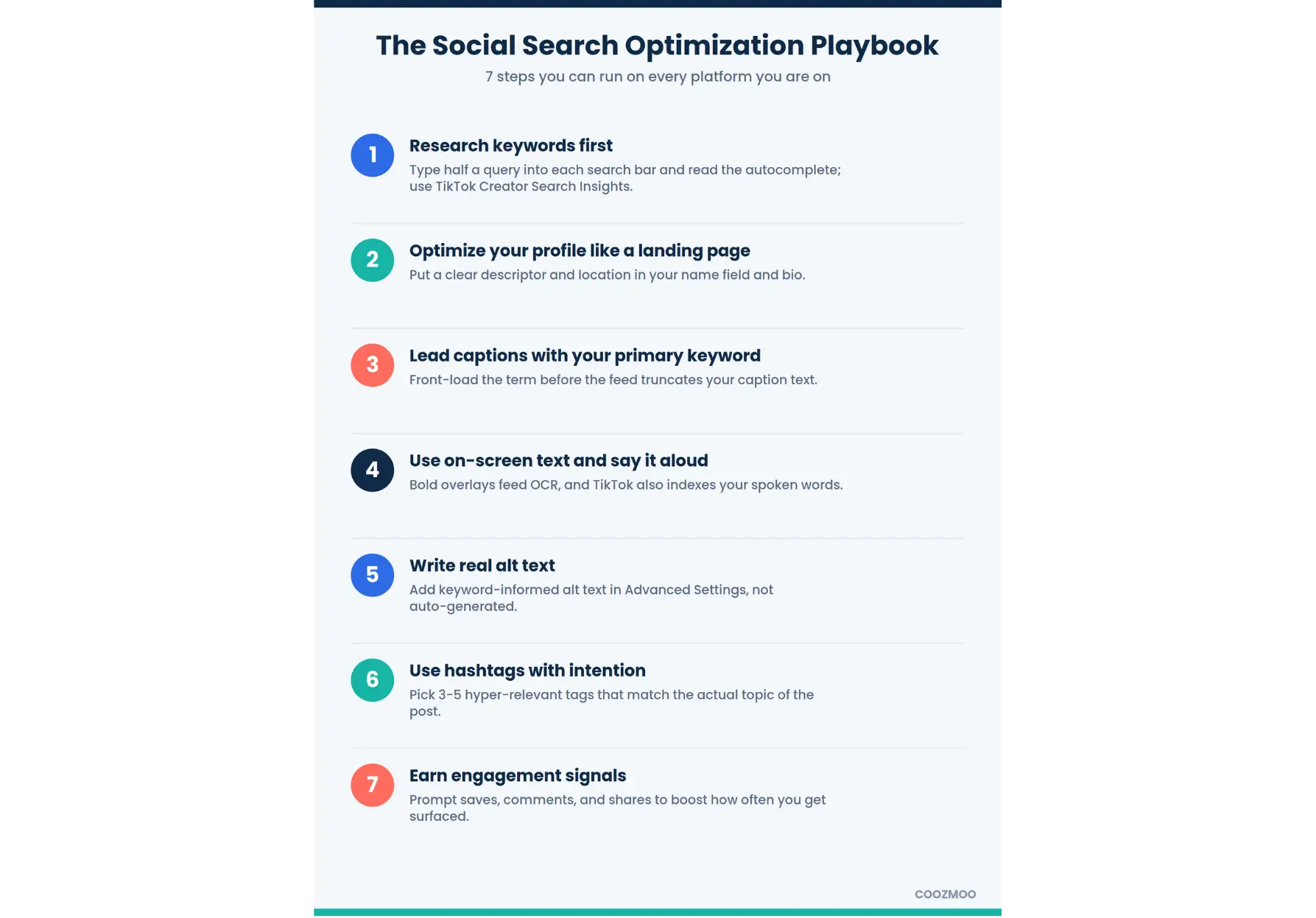
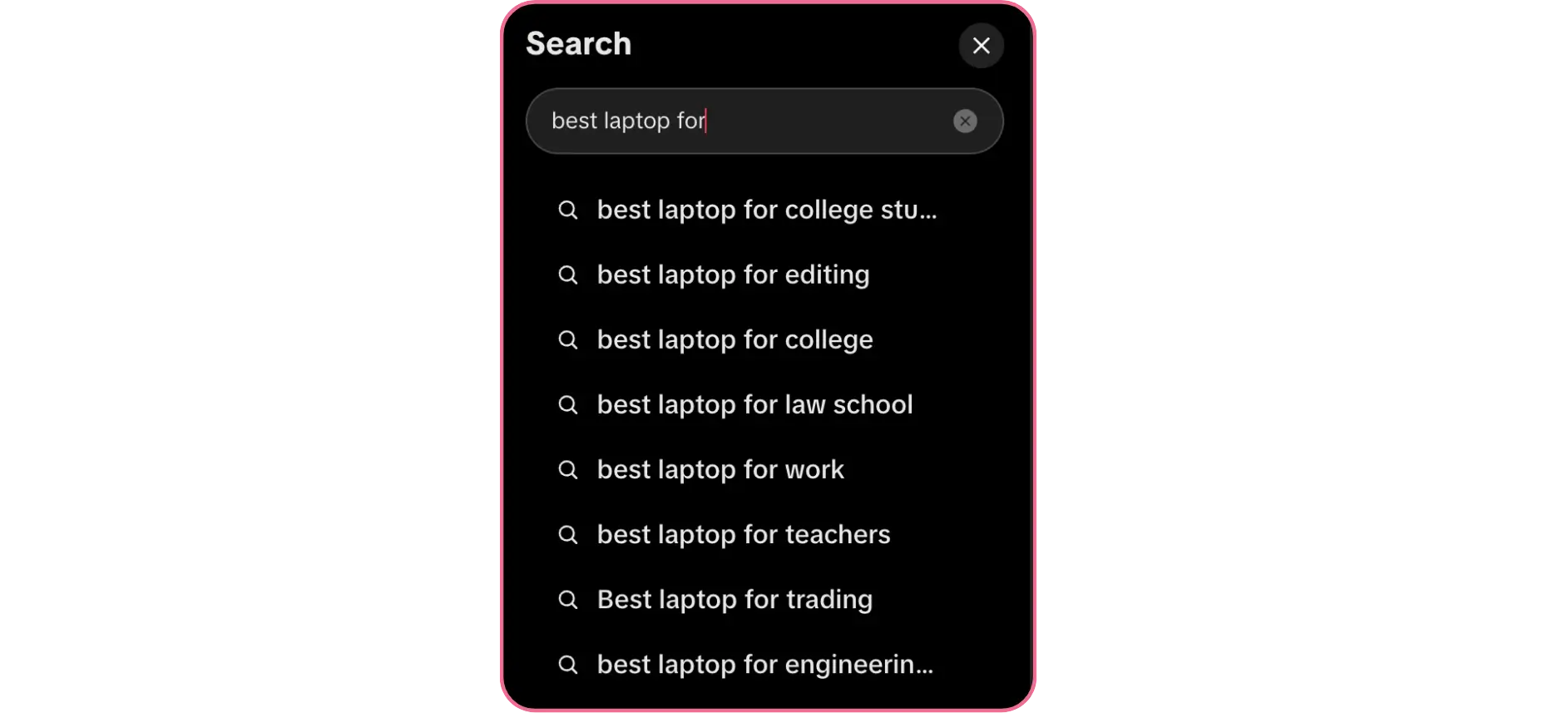
Conduct social keyword research first. Open the search bar on every platform and type in part of your query ("best laptop for…") and see what autocomplete suggests. This provides you with raw, unfiltered, live data on what your audience is searching. On TikTok, use Creator Search Insights to identify trending keywords before they peak.
Optimize your profile like a landing page. Your name field and bio represent the largest area of searchable space on a profile. In addition to listing your brand name (and, if applicable), include a description and location: “Coozmoo | Digital Marketing | Pearland." Include obviously searchable terms to describe what you do and whom you serve.
Begin your captions with your primary keyword. Although both TikTok and Instagram index caption text, feeds get cut off pretty quickly, so place your #1 most important term at the beginning of the caption. Write the caption as a mini-blog intro: a paragraph that describes the subject and how users would naturally phrase their searches.
Utilize on-screen text and say your keyword out loud. As described above, bolded text layers help the algorithm through optical character recognition (OCR), and because TikTok also indexes spoken words, mention your desired keyword out loud in the first few seconds of your video.
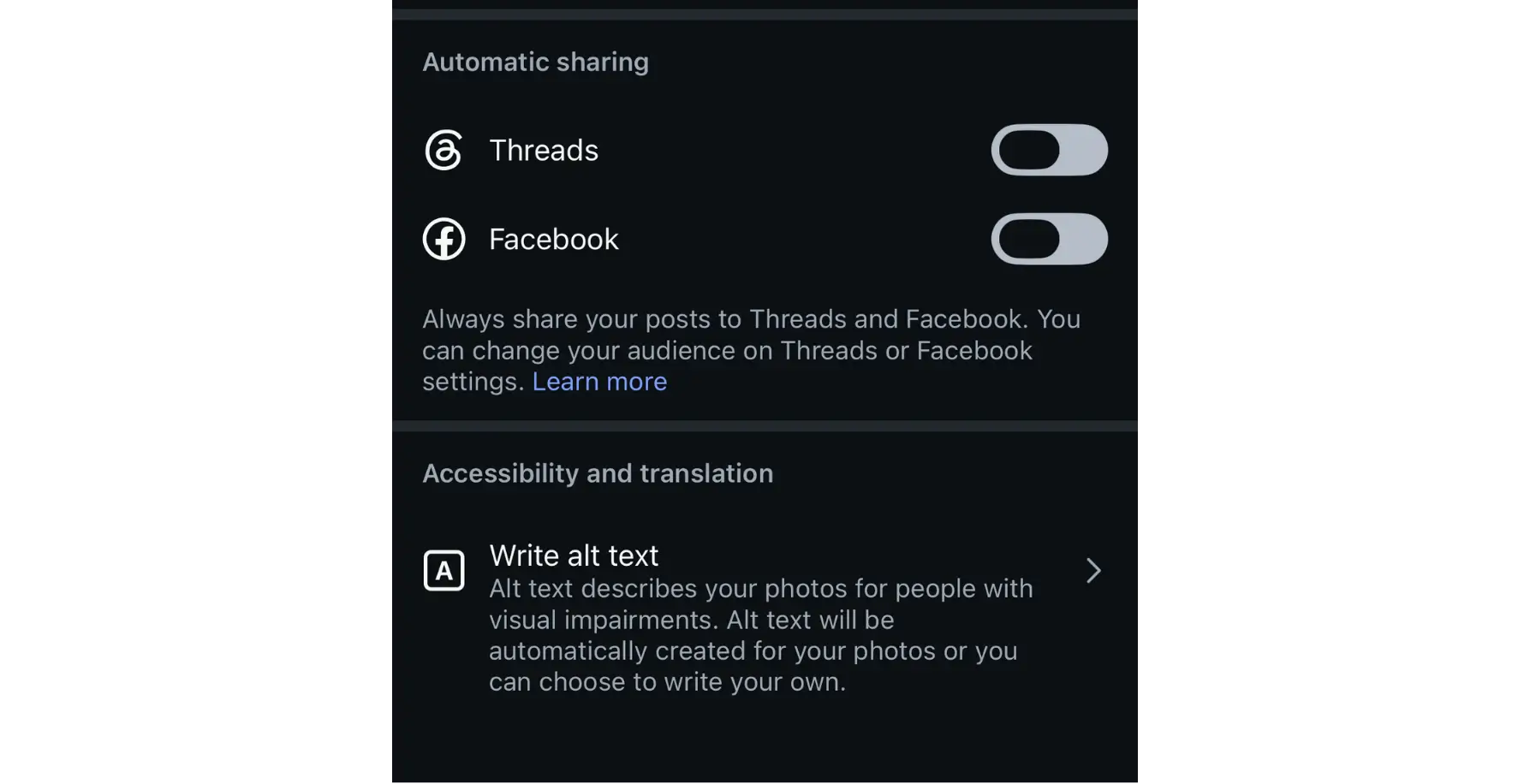
Provide alt text that is real. Using Advanced Settings for alt text when posting to Instagram allows you to add keyword-informed alt text versus letting the platform auto-generate it. Additionally, TikTok has recently allowed alt text for still images as well. You provide accessible information while giving the platform more context about you, which can help improve ranking.
Create hashtags with intention. Keywords currently outrank hashtag stuffing. Select 3-5 highly specific and relevant hashtags related directly to the actual topic of the post, rather than copying/pasting large amounts of irrelevant hashtags.
Earn engagement signals. Saves, comments, and shares inform the algorithm that your content is worthy of being surfaced. Naturally prompt them (ask a question, request a save-for-later, etc.).
Combining Social Search With Other Channels in Your Overall Social Media and SEO Strategy
As social search becomes more closely tied with how we use search engines (like Google), it is becoming increasingly important to treat these two channels as part of a single social media and SEO strategy, not as separate strategies.
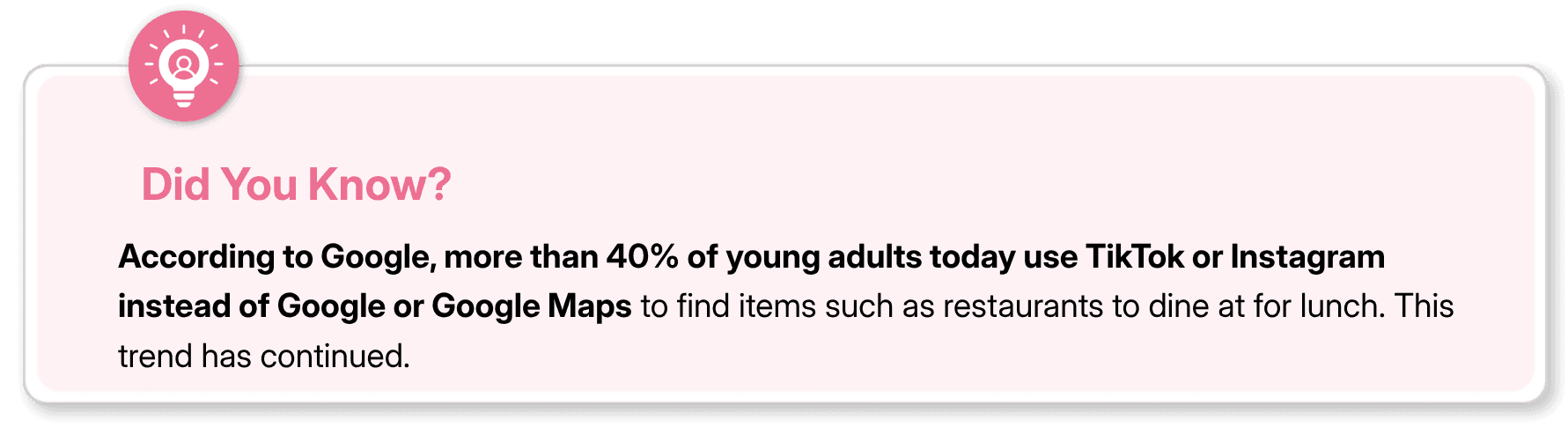
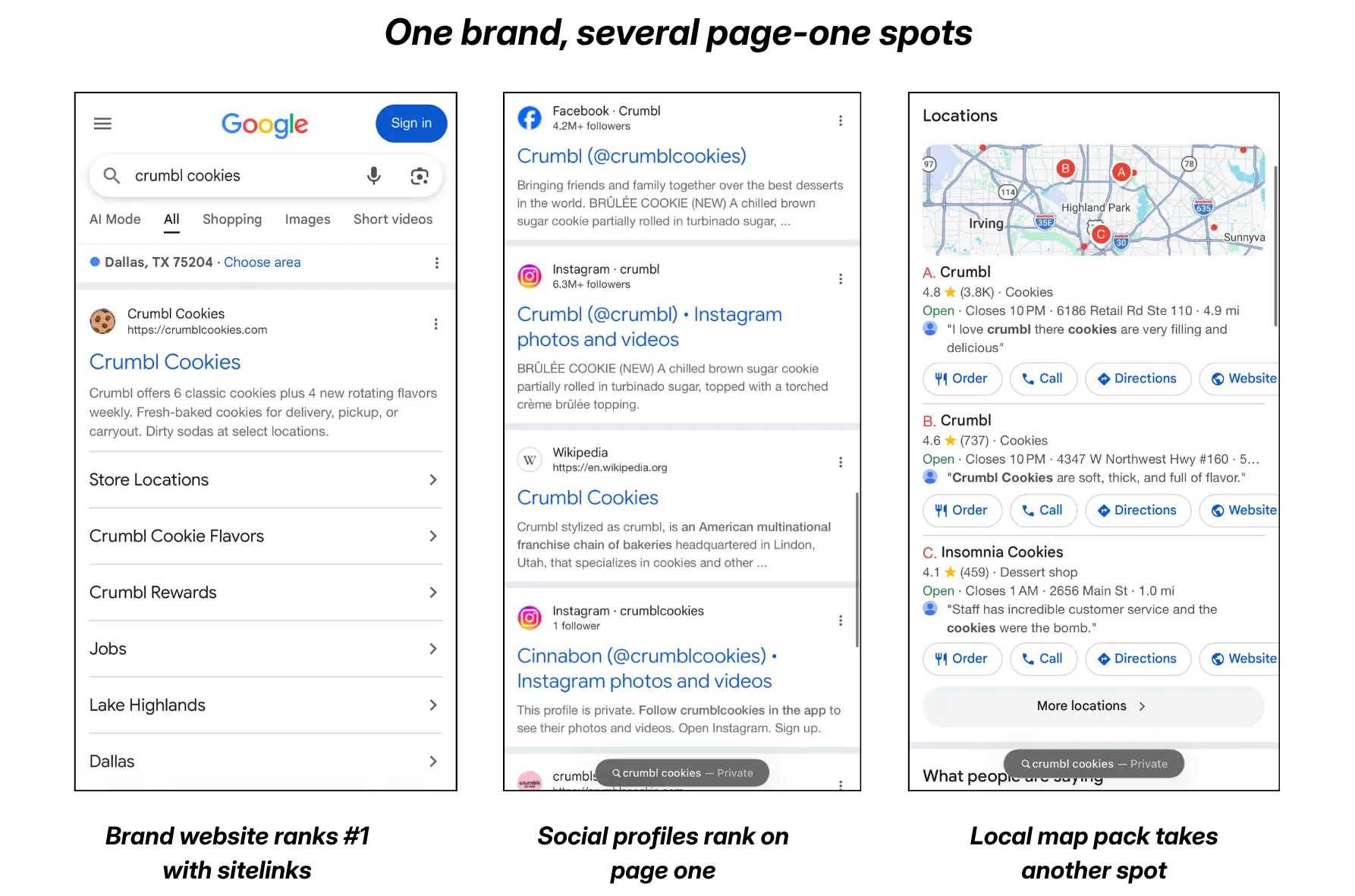
Why? Because as of mid-2025, Google began indexing public content on platforms like YouTube, TikTok, and Instagram, resulting in social media posts being indexed in search engine results and appearing directly within traditional search. As a result, social media content is often displayed on the first page of branded searches by Google. Social media profiles are commonly displayed on the first page of branded searches as well as many local search inquiries. Furthermore, because of Google Maps listings, videos, websites, and social media videos, a single company can have multiple entries on page one of a search query for a single brand.
Final Thoughts
One brand can occupy several spots on page one through its site, socials, and map listing.
Although social media signals do not affect your rank in Google, they will influence the volume of visitors, social mentions, and links back to your site that contribute to your overall ranking. When you optimize both channels with consistent keywords in your social accounts and profiles, link to your key service pages from your social profiles, and provide detailed information about your business in your social media profiles, you create an opportunity to be present across much more of the search results page than if you treated social media and SEO as separate efforts.
Want to see what your brand looks like when customers search for you via social media? Request a complimentary social media audit from Coozmoo today to identify the areas in your current presence that are keeping you out of view on the platforms your target audience is already searching.
FAQs
What is social search?

When consumers go into a search box on a social networking platform such as TikTok, Instagram, or Pinterest to look for products, reviews, tips, etc., that is considered a form of social search. The search functionality in those platforms is used for looking up product-related topics, versus searching on a web-based search engine like Google.
Is social search optimization the same as SEO?
While they share similar foundations, including performing keyword research and creating content that answers customer questions, they read different signals. A search engine reads links pointing to a piece of content and the authority of the webpage the link points to. Social search, on the other hand, reads consumer engagement metrics (comments, likes, shares) and whether the caption or audio/video content described the topic well enough for users to understand it.
Which social platforms are best suited for social search optimization?
This will vary depending on your target audience, but currently TikTok, Instagram, YouTube, and Pinterest provide the highest level of opportunity for successful social search optimization. While YouTube and Pinterest function most similarly to classic search engines, TikTok and Instagram excel at visually driven "discovery"-based searches, particularly among younger audiences (Gen Z).
Are hashtags relevant for social search?
Yes, however the importance of hashtags has been decreasing. The number of people who engage with content and watch it to completion matters more than those who click on a hashtag. Use no more than 3-5 hyper-relevant hashtags per post that relate to the actual subject matter, versus stuffing in generic tags.
How long does it typically take for social search optimization to show results?
Some optimized posts appear in search immediately after posting, while others generate traffic over time. Several factors determine how quickly results occur, including the quality and clarity of the content optimized around specific themes/keywords, the engagement generated by each piece of content, competition, and consistency of publishing new content around the established.
Social search optimization is the process of organizing your social media presence, including both your individual social profiles and your content, to display your brand when people search within the apps themselves, whether it be TikTok, Instagram, YouTube, and Pinterest, and more recently, when Google displays that social content as well.
To summarize quickly: handle your captions, social profile fields, text on screen, and alt-text similarly to how you would optimize a website's title tags and meta description. When you communicate to all platforms exactly what your content is about, there is an opportunity to reach those who are already searching for it.
This is the quick summary. We will provide a breakdown below regarding what social search really is; why it is changing how your customers find your brand; and most importantly, a step-by-step guide you can implement yourself starting this week.
What Is Social Search?
Social search occurs when an end user utilizes a search bar located inside of a social media application, rather than using a traditional search engine, to discover products/services/recommendations/how-to guides. As opposed to typing "the best budget headphones" into Google and reviewing various links to articles and websites, an individual types their query into TikTok/Instagram etc. and watches another person demonstrate an answer to their question.
While these two examples differ, the implications matter. While traditional search engines reward authors based upon content quality, link relevance, and authority, social search rewards authors based upon visual appeal, conversational style, and community validation. Individuals don't simply look for answers to their questions; they look for authentic recommendations which they can view, believe, and follow in formats they already consume daily via mobile devices.
Why Social Search Matters for Brands Today
While many may not realize it, the statistics related to social search are compelling enough to warrant immediate attention. According to a recent survey conducted by SOCi for 18-24-year-olds in the United States, 67% utilize Instagram for searching purposes; 62% utilize TikTok for searching purposes, and 61% utilize Google for searching purposes. Therefore, social media applications have essentially reached parity (and possibly surpassed) Google, the search engine that earned "Google" a spot in our vocabulary. Data published by Statista indicates that 64% of U.S. Gen Z respondents utilized TikTok as a search engine in 2024. Additionally, according to Adobe, a similar percentage of Gen Z/Millennials treated TikTok like a search application, and Pinterest processes more than 80 billion searches every month.
Furthermore, while individuals utilizing social media applications do appear to be discovering new products/services/brands, the purchasing intent associated with those discoveries should also be recognized. According to TikTok's own consumer research, 61% of users discover new products and brands on the platform, and the majority go on to act on what they find.
A key consideration going forward (in particular pertaining to 2025), is this does not represent the complete replacement of Google as much as it represents the emergence of multiple platforms for search. Consumers now frequently move back and forth between Google, TikTok, Instagram, YouTube, and others, dependent upon the product/service they are attempting to locate. Thusly, opting out of social search does not simply equate to losing access to one additional distribution channel but results in consumers never seeing your brand during the very instances when high-intent purchasers are considering trying something new.
Social Search vs. Classic SEO
You've likely spent money on SEO, so since you're reading this about social media search engine optimization, it'll look very familiar. Social media search engine optimization and classic SEO have the same goal and use similar tools: creating content that includes keywords, structuring your content in an easy-to-read format, and using content that answers a question. They use the same principles to create content and identify the keywords users input when searching for information.
What separates them is how they evaluate content. Google evaluates the linkability of the content (how easily the content can be linked) along with page authority and technical health. Social media platforms evaluate watch time, saves, shares, comments, and whether or not the text in your post accurately describes the subject matter. A blog post may rank on Google based on authority alone for months. However, a TikTok or Instagram post earns a spot in their search results due to its engagement and usefulness, which causes users to save, share, and comment.
Instead of deciding which one is better, consider that there are two entranceways into the house. The best strategy would be to make sure both entranceways are fully accessible.
How Does Each Platform Index Content?
Since each platform indexes content slightly differently, using one-size-fits-all posts limits potential views.
TikTok indexes the caption of your video, the on-screen text from the video (using OCR), and the words you say in your video, in addition to your hashtags. In some areas of TikTok, there is even a keyword or title field where you can enter additional information about the topic. Additionally, TikTok provides Creator Search Insights, which is essentially a keyword tool to see what searches occur in your area.
Instagram has changed its algorithm to favor keywords in captions versus hashtags. In addition to capturing alternate text for visually impaired individuals, Instagram also favors your username and description. Most recently, Instagram rolled out AI-based visual search, allowing it to read the content within your image or video.
YouTube, as one of the top-ranked search platforms, continues to reward high-ranking titles and descriptions that include keyword phrases, as well as chaptering your videos for easier navigation for users and for the algorithm.
Pinterest is currently the closest to traditional search engines. Pins are indexed based on keywords in your board name, pin descriptions, and rich pins that automatically capture product information.
How to Optimize Your Brand for Social Search: A Reusable Checklist
Most trend-based articles will stop at this point and leave all the heavy lifting for the reader. Consider using this as a reusable template/checklist for every platform you have a presence on.
Conduct social keyword research first. Open the search bar on every platform and type in part of your query ("best laptop for…") and see what autocomplete suggests. This provides you with raw, unfiltered, live data on what your audience is searching. On TikTok, use Creator Search Insights to identify trending keywords before they peak.
Optimize your profile like a landing page. Your name field and bio represent the largest area of searchable space on a profile. In addition to listing your brand name (and, if applicable), include a description and location: “Coozmoo | Digital Marketing | Pearland." Include obviously searchable terms to describe what you do and whom you serve.
Begin your captions with your primary keyword. Although both TikTok and Instagram index caption text, feeds get cut off pretty quickly, so place your #1 most important term at the beginning of the caption. Write the caption as a mini-blog intro: a paragraph that describes the subject and how users would naturally phrase their searches.
Utilize on-screen text and say your keyword out loud. As described above, bolded text layers help the algorithm through optical character recognition (OCR), and because TikTok also indexes spoken words, mention your desired keyword out loud in the first few seconds of your video.
Provide alt text that is real. Using Advanced Settings for alt text when posting to Instagram allows you to add keyword-informed alt text versus letting the platform auto-generate it. Additionally, TikTok has recently allowed alt text for still images as well. You provide accessible information while giving the platform more context about you, which can help improve ranking.
Create hashtags with intention. Keywords currently outrank hashtag stuffing. Select 3-5 highly specific and relevant hashtags related directly to the actual topic of the post, rather than copying/pasting large amounts of irrelevant hashtags.
Earn engagement signals. Saves, comments, and shares inform the algorithm that your content is worthy of being surfaced. Naturally prompt them (ask a question, request a save-for-later, etc.).
Combining Social Search With Other Channels in Your Overall Social Media and SEO Strategy
As social search becomes more closely tied with how we use search engines (like Google), it is becoming increasingly important to treat these two channels as part of a single social media and SEO strategy, not as separate strategies.
Why? Because as of mid-2025, Google began indexing public content on platforms like YouTube, TikTok, and Instagram, resulting in social media posts being indexed in search engine results and appearing directly within traditional search. As a result, social media content is often displayed on the first page of branded searches by Google. Social media profiles are commonly displayed on the first page of branded searches as well as many local search inquiries. Furthermore, because of Google Maps listings, videos, websites, and social media videos, a single company can have multiple entries on page one of a search query for a single brand.
Final Thoughts
One brand can occupy several spots on page one through its site, socials, and map listing.
Although social media signals do not affect your rank in Google, they will influence the volume of visitors, social mentions, and links back to your site that contribute to your overall ranking. When you optimize both channels with consistent keywords in your social accounts and profiles, link to your key service pages from your social profiles, and provide detailed information about your business in your social media profiles, you create an opportunity to be present across much more of the search results page than if you treated social media and SEO as separate efforts.
Want to see what your brand looks like when customers search for you via social media? Request a complimentary social media audit from Coozmoo today to identify the areas in your current presence that are keeping you out of view on the platforms your target audience is already searching.
FAQs
What is social search?
When consumers go into a search box on a social networking platform such as TikTok, Instagram, or Pinterest to look for products, reviews, tips, etc., that is considered a form of social search. The search functionality in those platforms is used for looking up product-related topics, versus searching on a web-based search engine like Google.
Is social search optimization the same as SEO?
While they share similar foundations, including performing keyword research and creating content that answers customer questions, they read different signals. A search engine reads links pointing to a piece of content and the authority of the webpage the link points to. Social search, on the other hand, reads consumer engagement metrics (comments, likes, shares) and whether the caption or audio/video content described the topic well enough for users to understand it.
Which social platforms are best suited for social search optimization?
This will vary depending on your target audience, but currently TikTok, Instagram, YouTube, and Pinterest provide the highest level of opportunity for successful social search optimization. While YouTube and Pinterest function most similarly to classic search engines, TikTok and Instagram excel at visually driven "discovery"-based searches, particularly among younger audiences (Gen Z).
Are hashtags relevant for social search?
Yes, however the importance of hashtags has been decreasing. The number of people who engage with content and watch it to completion matters more than those who click on a hashtag. Use no more than 3-5 hyper-relevant hashtags per post that relate to the actual subject matter, versus stuffing in generic tags.
How long does it typically take for social search optimization to show results?
Some optimized posts appear in search immediately after posting, while others generate traffic over time. Several factors determine how quickly results occur, including the quality and clarity of the content optimized around specific themes/keywords, the engagement generated by each piece of content, competition, and consistency of publishing new content around the established.


Summarize with AI




Want to Grow Social Accounts? Get a Free Audit Today!
Want to Grow Social Accounts? Get a Free Audit Today!


1k+ Reviews!


Don’t miss our revenue growth tips!
Get expert marketing tips—straight to your inbox, like thousands of happy clients.
Don’t miss our revenue growth tips!
Don’t miss our revenue growth tips!
Get expert marketing tips—straight to your inbox, like thousands of happy clients.
Don’t miss our revenue growth tips!
Get expert marketing tips—straight to your inbox, like thousands of happy clients.
Relevant Blogs on Social Media
Relevant Blogs on Social Media
Unlock data-driven insights in Social Media Marketing—explore our featured blogs and skyrocket your revenue before your competitors do.
Unlock data-driven insights in Social Media Marketing—explore our featured blogs and skyrocket your revenue before your competitors do.
Social Media
Aug 13, 2026
5 Min Read
TikTok SEO: How Keywords and Metadata Impact Your Visibility
Social Media
Aug 13, 2026
5 Min Read
TikTok SEO: How Keywords and Metadata Impact Your Visibility
Social Media
Aug 13, 2026
5 Min Read
TikTok SEO: How Keywords and Metadata Impact Your Visibility

Social Media
Aug 3, 2026
10 Min Read
Why Social Media Matters for Al Recommendations and Brand Discovery
Social Media
Aug 3, 2026
10 Min Read
Why Social Media Matters for Al Recommendations and Brand Discovery
Social Media
Aug 3, 2026
10 Min Read
Why Social Media Matters for Al Recommendations and Brand Discovery

Social Media
Jul 28, 2026
8 Min Read
How the LinkedIn Algorithm Works in 2026
Social Media
Jul 28, 2026
8 Min Read
How the LinkedIn Algorithm Works in 2026
Social Media
Jul 28, 2026
8 Min Read
How the LinkedIn Algorithm Works in 2026




























Ready to speak with an expert?
Data-Driven Marketing Agency That Elevates ROI
1100+
Websites Designed & Optimized to Convert
$280M+
Client Revenue Driven & Growing Strong
Discover how to skyrocket
your revenue today!



Trusted by 1000+ Owners!
Ready to speak with an expert?
Data-Driven Marketing Agency That Elevates ROI
1100+
Websites Designed & Optimized to Convert
$280M+
Client Revenue Driven & Growing Strong
Discover how to skyrocket
your revenue today!
Trusted by 1000+ Owners!
Want to skyrocket revenue?
4.9/5 Ratings!
Ready to speak with an expert?
Data-Driven Marketing Agency That Elevates ROI
1100+
Websites Designed & Optimized to Convert
$280M+
Client Revenue Driven & Growing Strong
Discover how to skyrocket
your revenue today!
Trusted by 1000+ Owners!
Call
Meet