Why Digital PR is Now More Important Than Backlinks for SEO
Why Digital PR is Now More Important Than Backlinks for SEO
Last Updated:
Table of Content
Case Studies



Aashi Katariya
Aashi Katariya
Aashi Katariya
SEO
SEO
SEO
10 Min Read
8 Min
10 Min Read
For years, the SEO playbook was simple: get more backlinks, rank higher. But something fundamental has shifted. In 2026, the agencies winning the search game aren't just building links — they're building brands. And the tool doing the heavy lifting is Digital Press Release.
If you've been investing heavily in traditional link-building tactics like guest posting, niche edits, or directory submissions, this article isn't here to tell you that work is worthless. But it is here to tell you that the game has changed dramatically and if you're not evolving, you're falling behind.
Let's break down why Digital PR has moved from a "nice-to-have" into arguably the most powerful off-page SEO strategy available today.
The Old Playbook Is Breaking Down
Traditional link-building worked well in an era when Google's algorithm was simpler. The logic was mechanically clean: more links = more authority = higher rankings. So search engine optimizers built private blog networks, churned out generic guest posts, and bought placements on low-traffic sites. It worked, for a while.
But Google has spent the better part of a decade systematically dismantling that approach. The Penguin update penalized manipulative links. The Helpful Content update downgraded mass-produced content farms. And with the April 2026 Core Update, the message from Mountain View couldn't be clearer: the era of the faceless, link-stuffed website is over.
What Google is rewarding now isn't the number of links pointing to you. It's the credibility, reach, and authority of the entities vouch-ing for your brand.

What Google is rewarding now isn't the number of links pointing to you. It's the credibility, reach, and authority of the entities vouch-ing for your brand.
What Is Digital Press Release (PR)
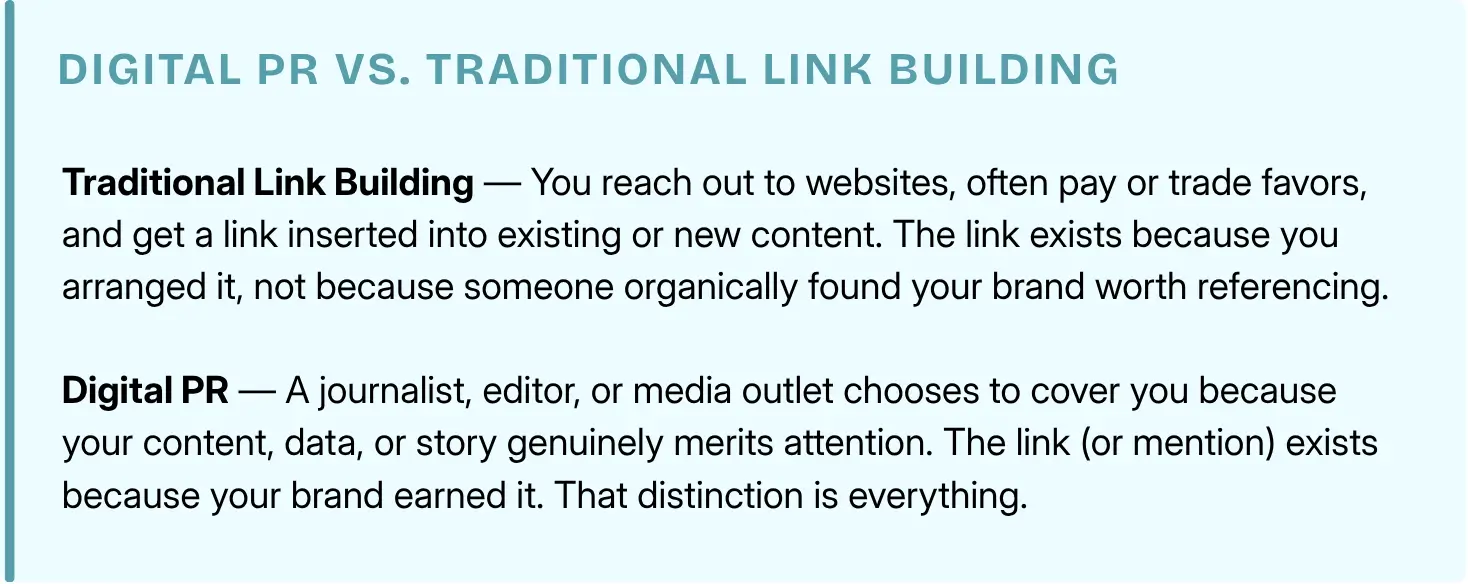
Digital Press Release is the practice of earning media coverage, brand mentions, and editorial links through newsworthy content, data-driven stories, expert commentary, and creative campaigns rather than paying for placements or trading links. Think of it as traditional public relations, but built with SEO value baked in from the start.
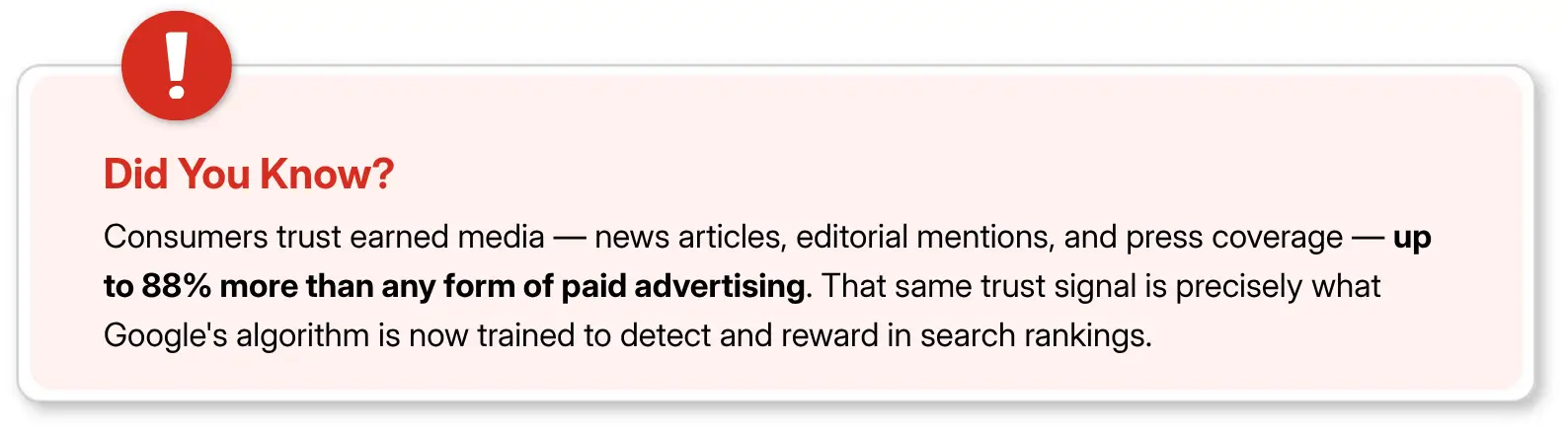
When a journalist at Forbes references your research study, when a legal industry publication quotes your attorney client as an expert, when a local news outlet covers your client's community initiative, that's Digital PR. And every one of those moments sends trust signals to Google that no DA-30 guest post ever can.
Google Is Now Ranking Brands, Not Just Pages
This is the shift that most business owners haven't fully internalized yet. Google has fundamentally moved from ranking individual pages to ranking the brands behind those pages. Your entity, how Google understands who you are, what you do, and whether you're trustworthy, now determines your ceiling in search.
And what builds entity authority? Exactly the kinds of signals Digital PR generates:
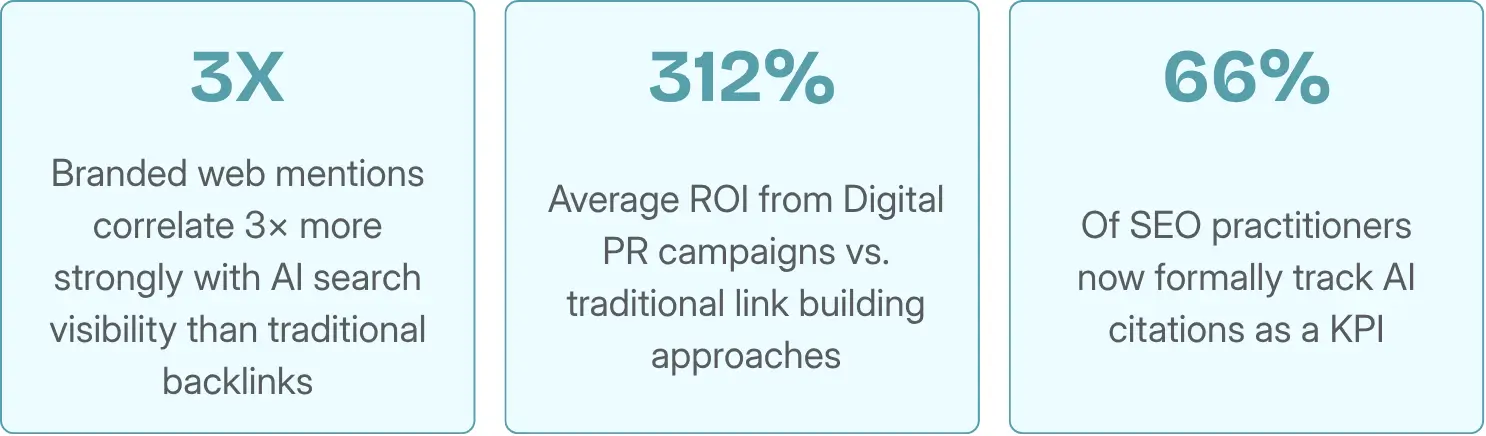
That 3× correlation figure comes from an Ahrefs study of 75,000 brands and it's reshaping how serious SEOs think about link strategy.
A single placement in a DR 85 trade publication outperforms 50 links from DR 30 guest post blogs — both for Google rankings and AI visibility.
The Unlinked Mention Revolution
Here's a concept that most business owners haven't heard of, but that every serious SEO is now paying close attention to: unlinked brand mentions.
Google can now identify when your brand is discussed on high-authority sites even without a hyperlink. A 2012 Google patent explicitly describes "implied links" — references to your brand that carry SEO weight even without a clickable URL.
In 2026, this has become dramatically more sophisticated. Google's crawlers analyze context, sentiment, and co-occurrence patterns to build a rich understanding of your brand's authority.
What does this mean practically? When a major industry publication mentions your law firm alongside "expert personal injury attorney in Dallas" — even if there's no link — Google creates a semantic association between your brand and that expertise. That's brand authority being built without a single link exchanged.
How Unlinked Mentions Build Authority
Google evaluates not just whether your brand is mentioned, but where, how, and in what context. A mention in a Reuters article about your industry expertise carries far more weight than a link in a sponsored post on a blog with no real readership.
LLMs like ChatGPT, Perplexity, and Google's AI Mode work the same way — they pull from sources they consider authoritative and frequently cited. Digital PR is the pipeline that gets your brand into those sources.
Digital PR and the AI Search Explosion
This is where things get genuinely urgent for business owners in 2026. AI search is no longer a future trend, it's the present reality. Google AI Overviews now appear for a massive percentage of queries. ChatGPT, Perplexity, and Google AI Mode are answering questions that used to drive clicks to websites.
By early 2026, roughly 38% of clicks still reach organic results — down significantly as AI systems increasingly pull from authoritative sources regardless of their traditional ranking position. The brands that appear in AI-generated answers are the ones that have earned coverage in publications those AI systems trust.
This creates a new imperative: Digital PR is now simultaneously an SEO strategy, a GEO (Generative Engine Optimization) strategy, and an AI Visibility strategy.
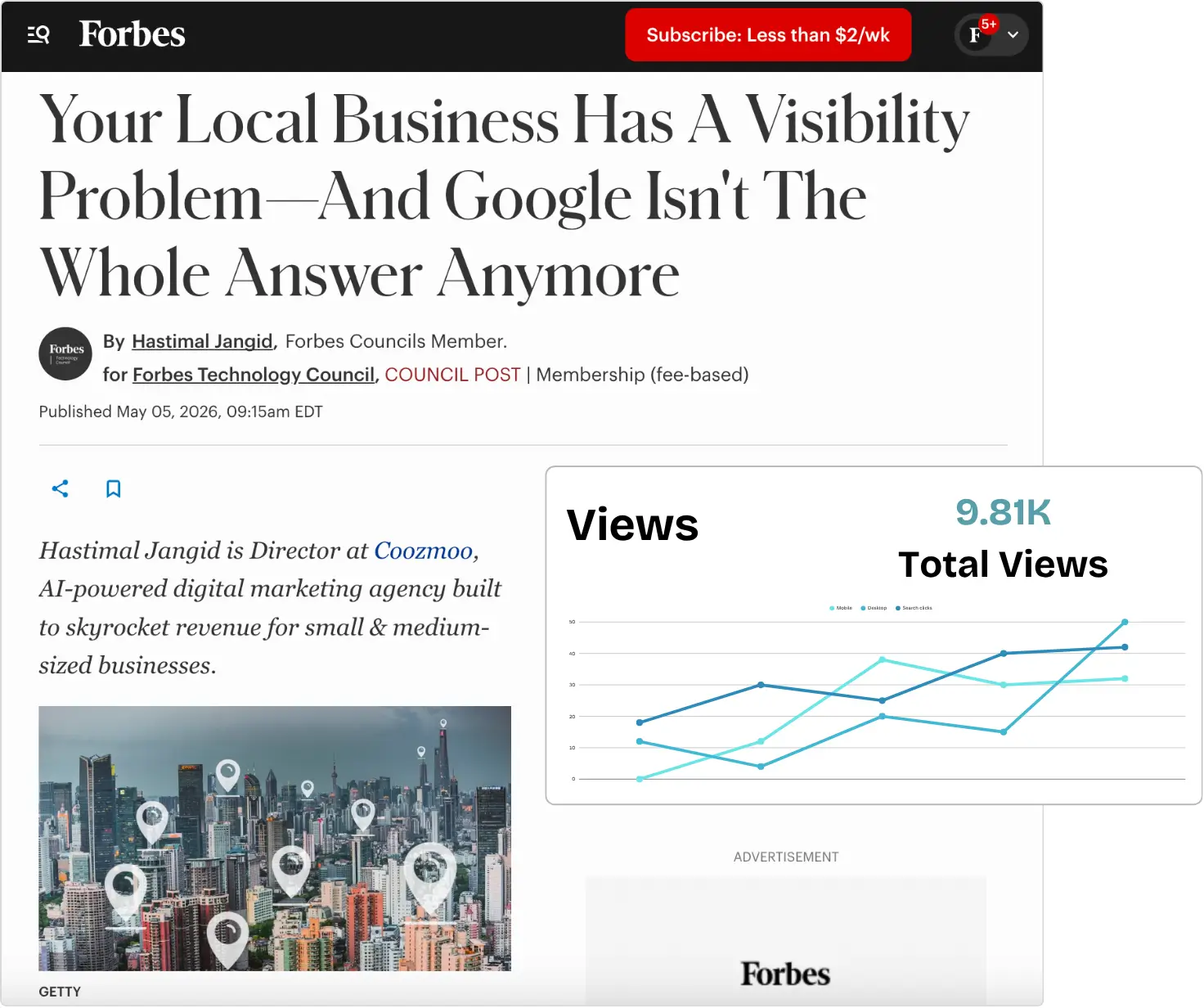
A single Forbes feature, an industry-specific data study, or a well-placed expert quote can drive your brand into AI answers that reach millions of users — users who may never even see a traditional search result.
What Digital PR Actually Looks Like in Practice
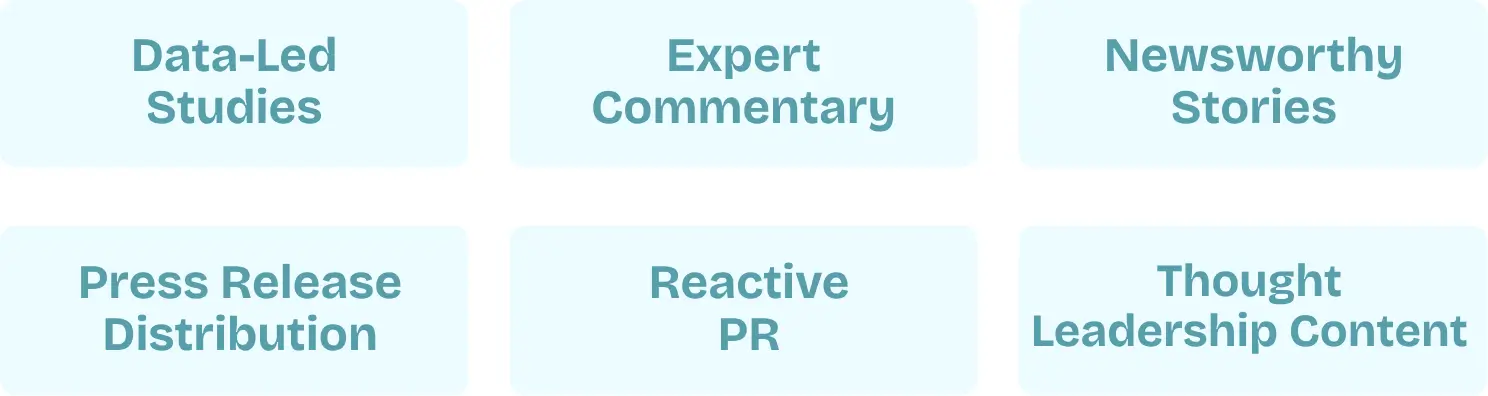
The good news is that Digital PR isn't some abstract concept reserved for Fortune 500 companies. Businesses of all sizes — including local service businesses and law firms — can execute it effectively. Here are the core formats that drive results:
The E-E-A-T Connection
Google's quality evaluator guidelines center on E-E-A-T — Experience, Expertise, Authoritativeness, and Trustworthiness. These aren't just abstract ideals. They're signals that Google's systems actively measure through the web's broader ecosystem of coverage and mentions about your brand.
Digital PR is one of the most direct and sustainable ways to build every dimension of E-E-A-T. When your personal injury attorney is quoted in a legal industry publication, that's Expertise. When your junk removal business is featured in a local news story, that's Trustworthiness. When your brand consistently appears in conversations about your industry across authoritative platforms, that's Authoritativeness compounding over time.
Pages with verified author credentials, editorial media placements, and original cited data are significantly more likely to appear in AI Overviews — giving them a major visibility advantage that no amount of link-buying can replicate.
So Is Traditional Link Building Dead?
Not entirely, but its risk-to-reward ratio has shifted unfavorably. Links still matter. A strong backlink profile from genuinely relevant, high-authority sources absolutely helps rankings. The key word is "genuinely." Guest posts on real, editorially-driven publications still carry value. Niche-specific resource pages and organic link-earning still contribute to domain authority.
What's no longer working and what's increasingly dangerous, is manipulative link acquisition at scale. Low-DR guest post networks, link exchanges, and paid placements on traffic-less sites are not just ineffective. They're liabilities that can trigger manual actions or algorithmic suppression under Google's evolving guidelines.
The smartest approach in 2026 is to treat Digital PR as your primary off-page strategy, with selective, quality-focused traditional link-building as a complement not the other way around.
Final Thoughts
Here's the simplest way to think about this shift: if SEO is how people find you, Digital PR is why they trust you and in 2026, trust is doing most of the ranking work.
Search engines are no longer just evaluating your pages. They're evaluating your brand. Who talks about you? Where are you mentioned? Do authoritative sources vouch for your expertise? These are the questions driving rankings today, and Digital PR is specifically engineered to answer them in your favor.
The businesses that see this clearly and move now will be the ones that own their competitive landscape in search — not just in Google's traditional results, but in the AI-powered answers that are rapidly becoming the new front page of the internet.
FAQs
What counts as a Digital PR signal in Google's algorithm?

Google recognizes several Digital PR signals including unlinked brand mentions on authoritative sites, editorial backlinks from relevant publications, co-citations alongside trusted brands, expert quotes in news articles, social proof from verified accounts, and consistent NAP (Name, Address, Phone) data across the web. These signals collectively build what SEOs call "entity authority."
Can Digital PR replace a traditional link building strategy?
For most businesses, Digital PR should complement rather than fully replace link building but the balance is shifting. High-quality editorial mentions from Digital PR campaigns consistently outperform bulk link building in long-term ranking stability. If forced to choose, investing in Digital PR today yields more durable SEO results than chasing volume-based backlink strategies.
How do I measure the SEO impact of a Digital PR campaign?
Track these metrics: branded search volume growth, domain authority changes, referral traffic from earned media, keyword ranking improvements for target terms, and share of voice in your niche.
How long does it take to see results from a Digital PR campaign?
Digital PR is a medium-to-long-term strategy. Initial coverage can go live within weeks of a successful campaign pitch, but the SEO impact, improved rankings, domain authority growth, and branded search volume, typically compounds over 60–180 days. Digital PR has emerged as the most effective link-building tactic, now used by 67.3% of marketers, largely because its results, while slower to appear, prove far more durable than those from traditional link building methods.
Does Google officially recognize Digital PR as an SEO strategy?
Yes. Google's own John Mueller has publicly stated that Digital PR is "just as critical as technical SEO." This is a significant endorsement that shifted how the SEO industry views earned media.
Unlike link schemes or guest post networks, Digital PR produces the kind of editorial coverage Google's algorithm is specifically designed to reward, making it one of the few link acquisition methods Google actively encourages.
For years, the SEO playbook was simple: get more backlinks, rank higher. But something fundamental has shifted. In 2026, the agencies winning the search game aren't just building links — they're building brands. And the tool doing the heavy lifting is Digital Press Release.
If you've been investing heavily in traditional link-building tactics like guest posting, niche edits, or directory submissions, this article isn't here to tell you that work is worthless. But it is here to tell you that the game has changed dramatically and if you're not evolving, you're falling behind.
Let's break down why Digital PR has moved from a "nice-to-have" into arguably the most powerful off-page SEO strategy available today.
The Old Playbook Is Breaking Down
Traditional link-building worked well in an era when Google's algorithm was simpler. The logic was mechanically clean: more links = more authority = higher rankings. So search engine optimizers built private blog networks, churned out generic guest posts, and bought placements on low-traffic sites. It worked, for a while.
But Google has spent the better part of a decade systematically dismantling that approach. The Penguin update penalized manipulative links. The Helpful Content update downgraded mass-produced content farms. And with the April 2026 Core Update, the message from Mountain View couldn't be clearer: the era of the faceless, link-stuffed website is over.
What Google is rewarding now isn't the number of links pointing to you. It's the credibility, reach, and authority of the entities vouch-ing for your brand.
What Google is rewarding now isn't the number of links pointing to you. It's the credibility, reach, and authority of the entities vouch-ing for your brand.
What Is Digital Press Release (PR)
Digital Press Release is the practice of earning media coverage, brand mentions, and editorial links through newsworthy content, data-driven stories, expert commentary, and creative campaigns rather than paying for placements or trading links. Think of it as traditional public relations, but built with SEO value baked in from the start.
When a journalist at Forbes references your research study, when a legal industry publication quotes your attorney client as an expert, when a local news outlet covers your client's community initiative, that's Digital PR. And every one of those moments sends trust signals to Google that no DA-30 guest post ever can.
Google Is Now Ranking Brands, Not Just Pages
This is the shift that most business owners haven't fully internalized yet. Google has fundamentally moved from ranking individual pages to ranking the brands behind those pages. Your entity, how Google understands who you are, what you do, and whether you're trustworthy, now determines your ceiling in search.
And what builds entity authority? Exactly the kinds of signals Digital PR generates:
That 3× correlation figure comes from an Ahrefs study of 75,000 brands and it's reshaping how serious SEOs think about link strategy.
A single placement in a DR 85 trade publication outperforms 50 links from DR 30 guest post blogs — both for Google rankings and AI visibility.
The Unlinked Mention Revolution
Here's a concept that most business owners haven't heard of, but that every serious SEO is now paying close attention to: unlinked brand mentions.
Google can now identify when your brand is discussed on high-authority sites even without a hyperlink. A 2012 Google patent explicitly describes "implied links" — references to your brand that carry SEO weight even without a clickable URL.
In 2026, this has become dramatically more sophisticated. Google's crawlers analyze context, sentiment, and co-occurrence patterns to build a rich understanding of your brand's authority.
What does this mean practically? When a major industry publication mentions your law firm alongside "expert personal injury attorney in Dallas" — even if there's no link — Google creates a semantic association between your brand and that expertise. That's brand authority being built without a single link exchanged.
How Unlinked Mentions Build Authority
Google evaluates not just whether your brand is mentioned, but where, how, and in what context. A mention in a Reuters article about your industry expertise carries far more weight than a link in a sponsored post on a blog with no real readership.
LLMs like ChatGPT, Perplexity, and Google's AI Mode work the same way — they pull from sources they consider authoritative and frequently cited. Digital PR is the pipeline that gets your brand into those sources.
Digital PR and the AI Search Explosion
This is where things get genuinely urgent for business owners in 2026. AI search is no longer a future trend, it's the present reality. Google AI Overviews now appear for a massive percentage of queries. ChatGPT, Perplexity, and Google AI Mode are answering questions that used to drive clicks to websites.
By early 2026, roughly 38% of clicks still reach organic results — down significantly as AI systems increasingly pull from authoritative sources regardless of their traditional ranking position. The brands that appear in AI-generated answers are the ones that have earned coverage in publications those AI systems trust.
This creates a new imperative: Digital PR is now simultaneously an SEO strategy, a GEO (Generative Engine Optimization) strategy, and an AI Visibility strategy.
A single Forbes feature, an industry-specific data study, or a well-placed expert quote can drive your brand into AI answers that reach millions of users — users who may never even see a traditional search result.
What Digital PR Actually Looks Like in Practice
The good news is that Digital PR isn't some abstract concept reserved for Fortune 500 companies. Businesses of all sizes — including local service businesses and law firms — can execute it effectively. Here are the core formats that drive results:
The E-E-A-T Connection
Google's quality evaluator guidelines center on E-E-A-T — Experience, Expertise, Authoritativeness, and Trustworthiness. These aren't just abstract ideals. They're signals that Google's systems actively measure through the web's broader ecosystem of coverage and mentions about your brand.
Digital PR is one of the most direct and sustainable ways to build every dimension of E-E-A-T. When your personal injury attorney is quoted in a legal industry publication, that's Expertise. When your junk removal business is featured in a local news story, that's Trustworthiness. When your brand consistently appears in conversations about your industry across authoritative platforms, that's Authoritativeness compounding over time.
Pages with verified author credentials, editorial media placements, and original cited data are significantly more likely to appear in AI Overviews — giving them a major visibility advantage that no amount of link-buying can replicate.
So Is Traditional Link Building Dead?
Not entirely, but its risk-to-reward ratio has shifted unfavorably. Links still matter. A strong backlink profile from genuinely relevant, high-authority sources absolutely helps rankings. The key word is "genuinely." Guest posts on real, editorially-driven publications still carry value. Niche-specific resource pages and organic link-earning still contribute to domain authority.
What's no longer working and what's increasingly dangerous, is manipulative link acquisition at scale. Low-DR guest post networks, link exchanges, and paid placements on traffic-less sites are not just ineffective. They're liabilities that can trigger manual actions or algorithmic suppression under Google's evolving guidelines.
The smartest approach in 2026 is to treat Digital PR as your primary off-page strategy, with selective, quality-focused traditional link-building as a complement not the other way around.
Final Thoughts
Here's the simplest way to think about this shift: if SEO is how people find you, Digital PR is why they trust you and in 2026, trust is doing most of the ranking work.
Search engines are no longer just evaluating your pages. They're evaluating your brand. Who talks about you? Where are you mentioned? Do authoritative sources vouch for your expertise? These are the questions driving rankings today, and Digital PR is specifically engineered to answer them in your favor.
The businesses that see this clearly and move now will be the ones that own their competitive landscape in search — not just in Google's traditional results, but in the AI-powered answers that are rapidly becoming the new front page of the internet.
FAQs
What counts as a Digital PR signal in Google's algorithm?
Google recognizes several Digital PR signals including unlinked brand mentions on authoritative sites, editorial backlinks from relevant publications, co-citations alongside trusted brands, expert quotes in news articles, social proof from verified accounts, and consistent NAP (Name, Address, Phone) data across the web. These signals collectively build what SEOs call "entity authority."
Can Digital PR replace a traditional link building strategy?
For most businesses, Digital PR should complement rather than fully replace link building but the balance is shifting. High-quality editorial mentions from Digital PR campaigns consistently outperform bulk link building in long-term ranking stability. If forced to choose, investing in Digital PR today yields more durable SEO results than chasing volume-based backlink strategies.
How do I measure the SEO impact of a Digital PR campaign?
Track these metrics: branded search volume growth, domain authority changes, referral traffic from earned media, keyword ranking improvements for target terms, and share of voice in your niche.
How long does it take to see results from a Digital PR campaign?
Digital PR is a medium-to-long-term strategy. Initial coverage can go live within weeks of a successful campaign pitch, but the SEO impact, improved rankings, domain authority growth, and branded search volume, typically compounds over 60–180 days. Digital PR has emerged as the most effective link-building tactic, now used by 67.3% of marketers, largely because its results, while slower to appear, prove far more durable than those from traditional link building methods.
Does Google officially recognize Digital PR as an SEO strategy?
Yes. Google's own John Mueller has publicly stated that Digital PR is "just as critical as technical SEO." This is a significant endorsement that shifted how the SEO industry views earned media.
Unlike link schemes or guest post networks, Digital PR produces the kind of editorial coverage Google's algorithm is specifically designed to reward, making it one of the few link acquisition methods Google actively encourages.



Summarize with AI


Want to Skyrocket Revenue? Get a Free Audit Today!
Want to Skyrocket Revenue? Get a Free Audit Today!



4.9/5 Ratings!


Don’t miss our revenue growth tips!
Get expert marketing tips—straight to your inbox, like thousands of happy clients.
Don’t miss our revenue growth tips!
Get expert marketing tips—straight to your inbox, like thousands of happy clients.
Don’t miss our revenue growth tips!
Don’t miss our revenue growth tips!
Get expert marketing tips—straight to your inbox, like thousands of happy clients.
Relevant Blogs on Organic SEO
Relevant Blogs on Organic SEO
Unlock data-driven insights in Organic SEO—explore our featured blogs and skyrocket your revenue before your competitors do.
Unlock data-driven insights in Organic SEO—explore our featured blogs and skyrocket your revenue before your competitors do.

SEO
Sep 21, 2026
5 Min Read
Audience-First SEO: How to Rank by Putting Readers First
SEO
Sep 21, 2026
5 Min Read
Audience-First SEO: How to Rank by Putting Readers First
SEO
Sep 21, 2026
5 Min Read
Audience-First SEO: How to Rank by Putting Readers First

SEO
Sep 19, 2026
5 Min Read
How to Add SEO Keywords to Your Website: Where and How
SEO
Sep 19, 2026
5 Min Read
How to Add SEO Keywords to Your Website: Where and How
SEO
Sep 19, 2026
5 Min Read
How to Add SEO Keywords to Your Website: Where and How

SEO
Sep 18, 2026
5 Min Read
How XML Sitemaps Help Search Engines Discover New Pages
SEO
Sep 18, 2026
5 Min Read
How XML Sitemaps Help Search Engines Discover New Pages
SEO
Sep 18, 2026
5 Min Read
How XML Sitemaps Help Search Engines Discover New Pages





















Ready to speak with an expert?
Data-Driven Marketing Agency That Elevates ROI
1100+
Websites Designed & Optimized to Convert
$280M+
Client Revenue Driven & Growing Strong
Discover how to skyrocket
your revenue today!
Trusted by 1000+ Owners!
Ready to speak with an expert?
Data-Driven Marketing Agency That Elevates ROI
1100+
Websites Designed & Optimized to Convert
$280M+
Client Revenue Driven & Growing Strong
Discover how to skyrocket
your revenue today!
Trusted by 1000+ Owners!
Want to skyrocket revenue?
4.9/5 Ratings!
Ready to speak with an expert?
Data-Driven Marketing Agency That Elevates ROI
1100+
Websites Designed & Optimized to Convert
$280M+
Client Revenue Driven & Growing Strong
Discover how to skyrocket
your revenue today!
Trusted by 1000+ Owners!
Call
Meet