Google Core Updates: What They Are and How to Protect Your Rankings
Google Core Updates: What They Are and How to Protect Your Rankings
Last Updated:
Table of Content
Case Studies









Micaliah Farris
Micaliah Farris
Micaliah Farris
SEO
SEO
SEO
10 Min Read
10 Min
10 Min Read
If your website traffic suddenly dropped (or spiked) with no obvious reason, a Google core update might be behind it. These updates roll out several times a year and can shake up search rankings across just about every industry. Knowing what they are, why they happen, and what to do when one hits is genuinely useful for any business with an online presence.
So let's break it down.
What Is a Google Core Update?
A Google core update is a broad, algorithm-level change to how Google ranks content across the web. Unlike minor background tweaks, core updates affect a lot of ranking signals at once and can cause real, noticeable shifts for websites in almost any industry.
Core updates are not penalties. There's no manual action in your Google Search Console, and no specific rule was broken. Google is simply recalibrating how it judges content quality and relevance across the entire web. Content that was ranking well before might dip, and content that was being undervalued might rise.
Google puts it simply: these updates are designed to "better surface relevant, satisfying content for searchers from all types of sites."
How Often Do Google Core Updates Happen?
Google typically releases several core updates per year, but they don't announce them in advance. Once they start rolling out, Google publicly confirms them via the Google Search Status Dashboard and the Google Search Central account on X - two of the best places to stay up to date on Google Search updates and news.

Here's a look at 2026's update activity so far:
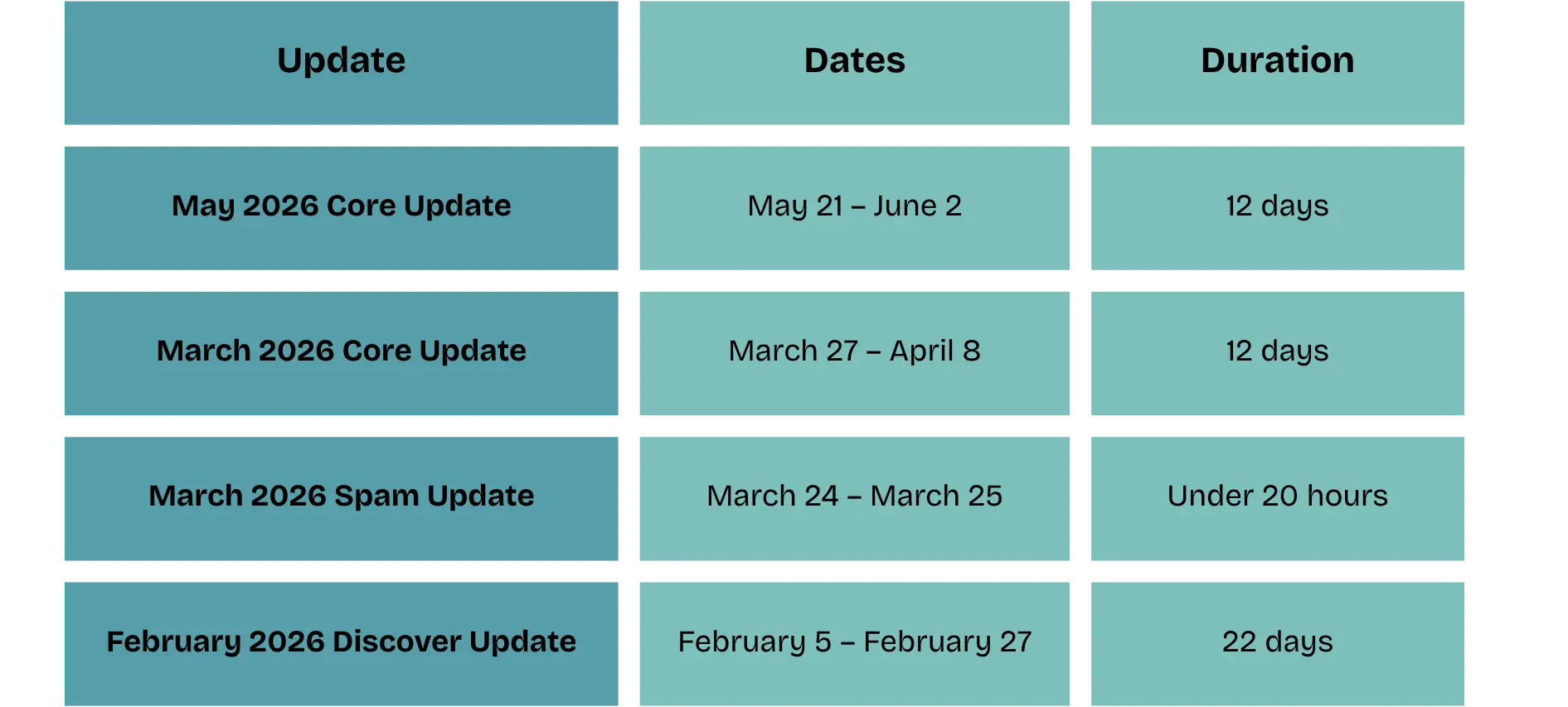
Each update builds on the last. Where your site stands today is a reflection of how it has performed across all of them, not just the most recent one.
What Does a Google Core Update Actually Do?
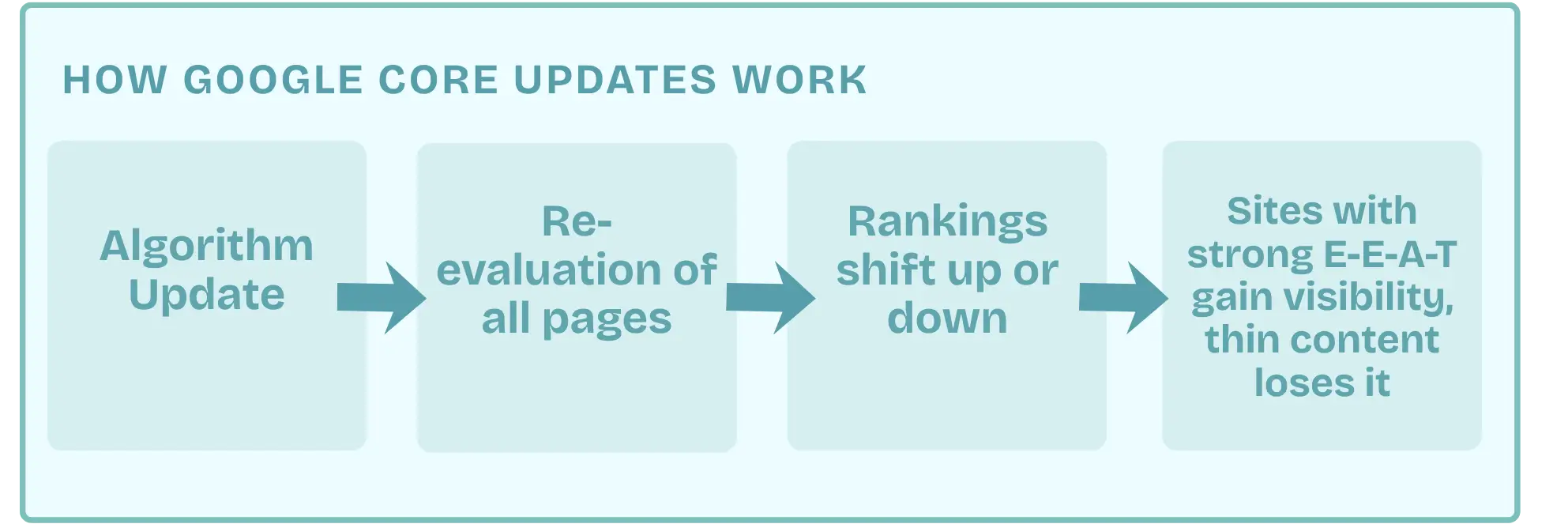
Think of Google's ranking system as a massive scoring formula that evaluates the quality, relevance, and trustworthiness of every page on the web. A core update upgrades that formula.
Pages that Google's improved systems consider more helpful, accurate, and user-focused tend to rise. Pages that exist mainly to rank, like thin content, repackaged articles, and low-value posts, tend to fall.
Content types most likely to be affected:
Informational blog posts, guides, how-to articles, and listicles
YMYL (Your Money or Your Life) content, such as health, finance, and legal topics, where E-E-A-T (Experience, Expertise, Authoritativeness, Trustworthiness) standards are the highest
Aggregator sites and content that just repackages what others have already published
Transactional and brand pages are generally more stable, but they are not immune
The May 2026 Core Update: What We Know
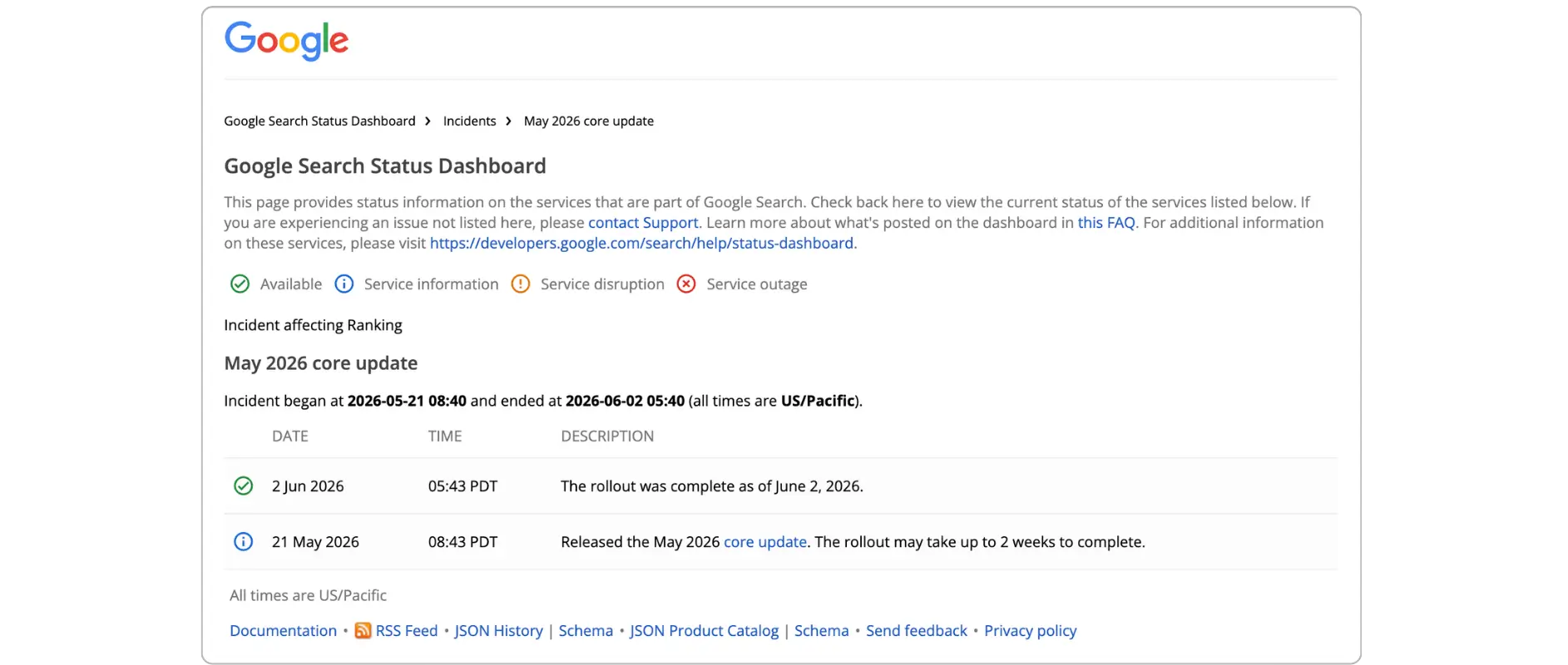
On May 21, 2026, Google launched the May 2026 Core Update, its second broad core update of the year. The rollout was completed on June 2, 2026, after approximately 12 days, slightly earlier than the initially anticipated two-week rollout window.
Google did not release a companion blog post or spell out specific goals for this update. The official dashboard entry simply said the update is designed to better surface relevant, satisfying content for searchers from all types of sites, which is consistent with how they have described past core updates.
One thing worth noting: the May 2026 rollout coincided with a confirmed bug in Google Search Console's Links report. Many sites saw their backlink counts drop to near zero overnight. That was a reporting error, not a real loss of links, and it had nothing to do with the core update itself.
The May update also landed just days after Google's I/O 2026 event, where the company announced a major AI-driven rebuild of Search. For those following Google Search updates news, the SEO community started reporting significant ranking volatility around May 30, with heavy fluctuations continuing through the first weekend of June.
How to Check If a Core Update Affected Your Site?
Start with Google Search Console. Here's a simple process:
Step 1: Open Performance > Search Results Set your date range to compare the two weeks before the update started against the two weeks after it completed.
Step 2: Look for these signals
A drop in total clicks and impressions across the whole site
Average position falling 10+ spots on key pages
Clicks declining while impressions stay stable (your pages are still showing up, but people aren't clicking)
Page-level drops rather than keyword-level drops, which is a sign content quality is the issue, not just relevance
Step 3: Rule out other causes Before blaming the core update, check for technical issues like crawl or indexing errors, seasonal traffic patterns, or competitor activity happening around the same time.
Step 4: Check for manual actions Go to Security and Manual Actions in GSC. If nothing is listed there, the impact is algorithmic, meaning it is core update related and not a penalty.
If you want expert eyes on your data, Coozmoo's free SEO audit service can help you figure out exactly where the impact hit and what to prioritize.

How to Protect Your Rankings from Future Core Updates?
Google's guidance has been pretty consistent across every core update: write helpful content for people, not for search engines.
Simple concept, but here's what that actually looks like in practice.
What works:
Original value, not just summaries. Does your content say something that can't be found in 10 other articles? First-hand insights, case studies, real data, and unique perspectives are what separate genuinely useful content from filler.
Clear E-E-A-T signals. Experience, expertise, authoritativeness, and trustworthiness. Credible authors, accurate information, transparent sourcing, and a consistent track record of quality across your whole site.
Content built for users, not algorithms. Would someone actually bookmark this page or share it? Or would they read one paragraph and bounce back to the search results?
Topical depth and solid site structure. Google rewards sites that cover topics thoroughly, not just individual pages chasing a single keyword.
What does not work:
Thin content that restates what everyone else has already written
Pages built to rank, not to actually answer anything
Inconsistent quality across the site (one great page won't protect weak ones)
Making reactive changes mid-rollout before the update has even finished
What to Do If Your Rankings Dropped?
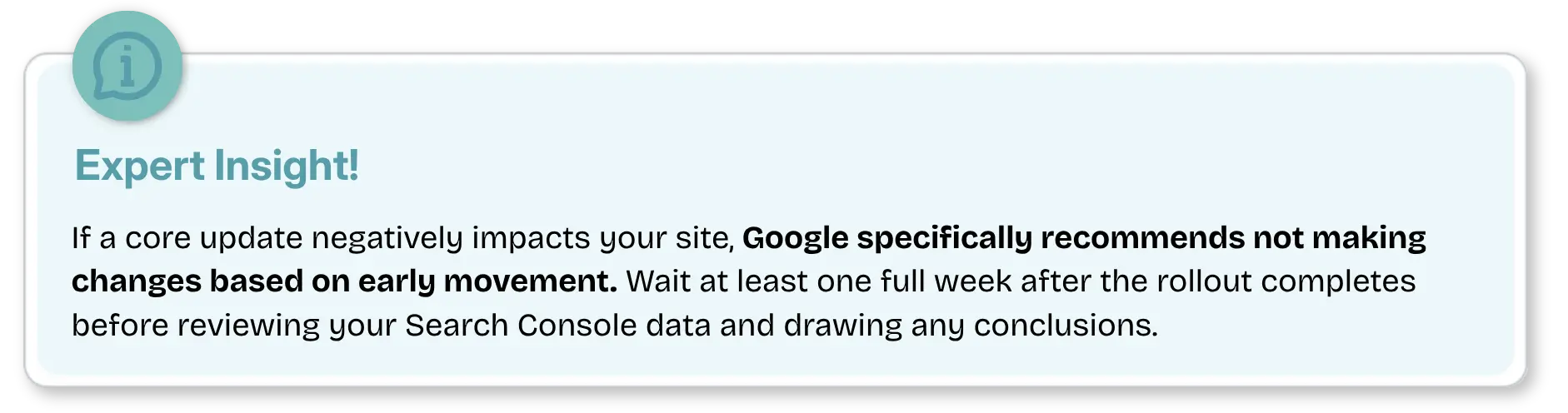
First: don't panic, and don't start making changes while the rollout is still happening.
Once the update is confirmed complete on the Google Search Status Dashboard, here's how to approach it:
Diagnose before you act. Which specific pages lost rankings? Which queries were affected? What are the pages that replaced yours doing differently?
Look at your content quality honestly. Go through the low-performing pages and ask yourself: does this actually help someone? Is there anything original here? Is the information still accurate?
Study what replaced you. The pages that moved up to replace yours are showing you what Google now prefers. Look at their depth, structure, and authority signals, not to copy them, but to understand what gap you need to close.
Make real improvements, not surface tweaks. Adding a few hundred words or rearranging headers is not going to move rankings. Stronger, more useful pages are where real recovery comes from
Be patient. The biggest ranking changes after a core update often happen during the next core update. Google's systems need time to reassess improvements.
Final Thoughts
The best protection against ranking volatility is not a post-update checklist. It is a content strategy built around genuine usefulness, editorial quality, and ongoing improvement.
If you manage a business website and want to build that kind of foundation, Coozmoo's organic SEO services are built to do exactly that: sustainable rankings driven by real content and authority, not shortcuts.
FAQs
What is a Google core update?

A Google core update is a broad algorithm change that adjusts how Google ranks content across the web. They happen several times per year and can cause noticeable ranking shifts for websites in just about any industry.
Will my rankings recover after a core update?
They can, but there's no guarantee or set timeline. Google recommends improving the quality of your affected content rather than just waiting it out. The most noticeable recoveries tend to come after the next core update.
How do I know if a core update affected my site?
Check Google Search Console for drops in clicks, impressions, and average position starting from the date the update began rolling out. Compare the two weeks before against the two weeks after the rollout completed.
What is the May 2026 Core Update?
The May 2026 Core Update is the second broad core update Google released in 2026. It started rolling out on May 21, 2026, and took up to two weeks to complete. Like other core updates, it was designed to surface more relevant and helpful content in search results.
Does a core update mean Google penalized my site?
No. Core updates are not penalties. There is no manual action on your site. Rankings shift because Google updated how its systems evaluate content quality, not because you violated any policy.
If your website traffic suddenly dropped (or spiked) with no obvious reason, a Google core update might be behind it. These updates roll out several times a year and can shake up search rankings across just about every industry. Knowing what they are, why they happen, and what to do when one hits is genuinely useful for any business with an online presence.
So let's break it down.
What Is a Google Core Update?
A Google core update is a broad, algorithm-level change to how Google ranks content across the web. Unlike minor background tweaks, core updates affect a lot of ranking signals at once and can cause real, noticeable shifts for websites in almost any industry.
Core updates are not penalties. There's no manual action in your Google Search Console, and no specific rule was broken. Google is simply recalibrating how it judges content quality and relevance across the entire web. Content that was ranking well before might dip, and content that was being undervalued might rise.
Google puts it simply: these updates are designed to "better surface relevant, satisfying content for searchers from all types of sites."
How Often Do Google Core Updates Happen?
Google typically releases several core updates per year, but they don't announce them in advance. Once they start rolling out, Google publicly confirms them via the Google Search Status Dashboard and the Google Search Central account on X - two of the best places to stay up to date on Google Search updates and news.
Here's a look at 2026's update activity so far:
Each update builds on the last. Where your site stands today is a reflection of how it has performed across all of them, not just the most recent one.
What Does a Google Core Update Actually Do?
Think of Google's ranking system as a massive scoring formula that evaluates the quality, relevance, and trustworthiness of every page on the web. A core update upgrades that formula.
Pages that Google's improved systems consider more helpful, accurate, and user-focused tend to rise. Pages that exist mainly to rank, like thin content, repackaged articles, and low-value posts, tend to fall.
Content types most likely to be affected:
Informational blog posts, guides, how-to articles, and listicles
YMYL (Your Money or Your Life) content, such as health, finance, and legal topics, where E-E-A-T (Experience, Expertise, Authoritativeness, Trustworthiness) standards are the highest
Aggregator sites and content that just repackages what others have already published
Transactional and brand pages are generally more stable, but they are not immune
The May 2026 Core Update: What We Know
On May 21, 2026, Google launched the May 2026 Core Update, its second broad core update of the year. The rollout was completed on June 2, 2026, after approximately 12 days, slightly earlier than the initially anticipated two-week rollout window.
Google did not release a companion blog post or spell out specific goals for this update. The official dashboard entry simply said the update is designed to better surface relevant, satisfying content for searchers from all types of sites, which is consistent with how they have described past core updates.
One thing worth noting: the May 2026 rollout coincided with a confirmed bug in Google Search Console's Links report. Many sites saw their backlink counts drop to near zero overnight. That was a reporting error, not a real loss of links, and it had nothing to do with the core update itself.
The May update also landed just days after Google's I/O 2026 event, where the company announced a major AI-driven rebuild of Search. For those following Google Search updates news, the SEO community started reporting significant ranking volatility around May 30, with heavy fluctuations continuing through the first weekend of June.
How to Check If a Core Update Affected Your Site?
Start with Google Search Console. Here's a simple process:
Step 1: Open Performance > Search Results Set your date range to compare the two weeks before the update started against the two weeks after it completed.
Step 2: Look for these signals
A drop in total clicks and impressions across the whole site
Average position falling 10+ spots on key pages
Clicks declining while impressions stay stable (your pages are still showing up, but people aren't clicking)
Page-level drops rather than keyword-level drops, which is a sign content quality is the issue, not just relevance
Step 3: Rule out other causes Before blaming the core update, check for technical issues like crawl or indexing errors, seasonal traffic patterns, or competitor activity happening around the same time.
Step 4: Check for manual actions Go to Security and Manual Actions in GSC. If nothing is listed there, the impact is algorithmic, meaning it is core update related and not a penalty.
If you want expert eyes on your data, Coozmoo's free SEO audit service can help you figure out exactly where the impact hit and what to prioritize.
How to Protect Your Rankings from Future Core Updates?
Google's guidance has been pretty consistent across every core update: write helpful content for people, not for search engines.
Simple concept, but here's what that actually looks like in practice.
What works:
Original value, not just summaries. Does your content say something that can't be found in 10 other articles? First-hand insights, case studies, real data, and unique perspectives are what separate genuinely useful content from filler.
Clear E-E-A-T signals. Experience, expertise, authoritativeness, and trustworthiness. Credible authors, accurate information, transparent sourcing, and a consistent track record of quality across your whole site.
Content built for users, not algorithms. Would someone actually bookmark this page or share it? Or would they read one paragraph and bounce back to the search results?
Topical depth and solid site structure. Google rewards sites that cover topics thoroughly, not just individual pages chasing a single keyword.
What does not work:
Thin content that restates what everyone else has already written
Pages built to rank, not to actually answer anything
Inconsistent quality across the site (one great page won't protect weak ones)
Making reactive changes mid-rollout before the update has even finished
What to Do If Your Rankings Dropped?
First: don't panic, and don't start making changes while the rollout is still happening.
Once the update is confirmed complete on the Google Search Status Dashboard, here's how to approach it:
Diagnose before you act. Which specific pages lost rankings? Which queries were affected? What are the pages that replaced yours doing differently?
Look at your content quality honestly. Go through the low-performing pages and ask yourself: does this actually help someone? Is there anything original here? Is the information still accurate?
Study what replaced you. The pages that moved up to replace yours are showing you what Google now prefers. Look at their depth, structure, and authority signals, not to copy them, but to understand what gap you need to close.
Make real improvements, not surface tweaks. Adding a few hundred words or rearranging headers is not going to move rankings. Stronger, more useful pages are where real recovery comes from
Be patient. The biggest ranking changes after a core update often happen during the next core update. Google's systems need time to reassess improvements.
Final Thoughts
The best protection against ranking volatility is not a post-update checklist. It is a content strategy built around genuine usefulness, editorial quality, and ongoing improvement.
If you manage a business website and want to build that kind of foundation, Coozmoo's organic SEO services are built to do exactly that: sustainable rankings driven by real content and authority, not shortcuts.
FAQs
What is a Google core update?
A Google core update is a broad algorithm change that adjusts how Google ranks content across the web. They happen several times per year and can cause noticeable ranking shifts for websites in just about any industry.
Will my rankings recover after a core update?
They can, but there's no guarantee or set timeline. Google recommends improving the quality of your affected content rather than just waiting it out. The most noticeable recoveries tend to come after the next core update.
How do I know if a core update affected my site?
Check Google Search Console for drops in clicks, impressions, and average position starting from the date the update began rolling out. Compare the two weeks before against the two weeks after the rollout completed.
What is the May 2026 Core Update?
The May 2026 Core Update is the second broad core update Google released in 2026. It started rolling out on May 21, 2026, and took up to two weeks to complete. Like other core updates, it was designed to surface more relevant and helpful content in search results.
Does a core update mean Google penalized my site?
No. Core updates are not penalties. There is no manual action on your site. Rankings shift because Google updated how its systems evaluate content quality, not because you violated any policy.



Summarize with AI



Want to Skyrocket Revenue? Get a Free Audit Today!
Want to Skyrocket Revenue? Get a Free Audit Today!



4.9/5 Ratings!


Don’t miss our revenue growth tips!
Get expert marketing tips—straight to your inbox, like thousands of happy clients.
Don’t miss our revenue growth tips!
Get expert marketing tips—straight to your inbox, like thousands of happy clients.
Don’t miss our revenue growth tips!
Don’t miss our revenue growth tips!
Get expert marketing tips—straight to your inbox, like thousands of happy clients.
Relevant Blogs on Organic SEO
Relevant Blogs on Organic SEO
Unlock data-driven insights in Organic SEO—explore our featured blogs and skyrocket your revenue before your competitors do.
Unlock data-driven insights in Organic SEO—explore our featured blogs and skyrocket your revenue before your competitors do.

SEO
Sep 21, 2026
5 Min Read
Audience-First SEO: How to Rank by Putting Readers First
SEO
Sep 21, 2026
5 Min Read
Audience-First SEO: How to Rank by Putting Readers First
SEO
Sep 21, 2026
5 Min Read
Audience-First SEO: How to Rank by Putting Readers First

SEO
Sep 19, 2026
5 Min Read
How to Add SEO Keywords to Your Website: Where and How
SEO
Sep 19, 2026
5 Min Read
How to Add SEO Keywords to Your Website: Where and How
SEO
Sep 19, 2026
5 Min Read
How to Add SEO Keywords to Your Website: Where and How

SEO
Sep 18, 2026
5 Min Read
How XML Sitemaps Help Search Engines Discover New Pages
SEO
Sep 18, 2026
5 Min Read
How XML Sitemaps Help Search Engines Discover New Pages
SEO
Sep 18, 2026
5 Min Read
How XML Sitemaps Help Search Engines Discover New Pages




































Ready to speak with an expert?
Data-Driven Marketing Agency That Elevates ROI
1100+
Websites Designed & Optimized to Convert
$280M+
Client Revenue Driven & Growing Strong
Discover how to skyrocket
your revenue today!
Trusted by 1000+ Owners!
Ready to speak with an expert?
Data-Driven Marketing Agency That Elevates ROI
1100+
Websites Designed & Optimized to Convert
$280M+
Client Revenue Driven & Growing Strong
Discover how to skyrocket
your revenue today!
Trusted by 1000+ Owners!
Want to skyrocket revenue?
4.9/5 Ratings!
Ready to speak with an expert?
Data-Driven Marketing Agency That Elevates ROI
1100+
Websites Designed & Optimized to Convert
$280M+
Client Revenue Driven & Growing Strong
Discover how to skyrocket
your revenue today!
Trusted by 1000+ Owners!
Call
Meet