AI SEO for Healthcare: How to Get Healthcare Providers Recommended by AI
AI SEO for Healthcare: How to Get Healthcare Providers Recommended by AI
Last Updated:
Table of Content
Case Studies







AI-powered search is changing how patients find doctors, clinics, and health information. This article explains what AI SEO for healthcare means, why traditional SEO in healthcare tactics are no longer enough, and exactly what healthcare providers need to do to appear in AI-generated recommendations. It covers everything from structured data and entity authority to content strategy and trust signals that AI engines actually read.
AI SEO for Healthcare: How to Get Healthcare Providers Recommended by AI
Patients aren't just Googling "best doctor near me" anymore. They're opening ChatGPT, Perplexity, or Google's AI Overview and asking full questions in detail and expecting a direct recommendation in return.
That shift is already reshaping how healthcare providers win or lose new patients. If your clinic, practice, or hospital system isn't being surfaced in those AI-generated answers, you're invisible at the exact moment someone is ready to book. This is why Healthcare SEO requires a stronger focus on credibility, expertise, and trust than many other industries.
AI SEO for healthcare isn't a niche strategy. It's what modern healthcare marketing looks like now. Traditional SEO in healthcare is evolving rapidly as AI-powered search platforms become a primary source of patient discovery.
Unlike traditional SEO, where you compete for a spot on a results page, AI search often gives one or two recommendations and stops. Being in that answer isn't just better; it's the only visibility that matters in that moment.
Why Healthcare Is One of the Highest-Stakes Categories for AI Search
Healthcare has always been a trust business. Patients make decisions that affect their lives, sometimes urgently. AI systems know this.
Google has long classified healthcare as a YMYL (Your Money or Your Life) topic. The content where accuracy failures carry real-world consequences. AI tools apply similar logic. They're far more selective about what they surface in medical contexts than they are for restaurant recommendations or travel guides.
That creates both a challenge and an opportunity. The challenge: the bar to be recommended is higher. The opportunity: if you clear that bar, the recommendation carries enormous weight. An AI answer feels curated, not algorithmic. Patients trust it more.
How Patients Actually Search for Healthcare With AI
Understanding query types tells you exactly what to optimize for and how ai search optimization should be structured.
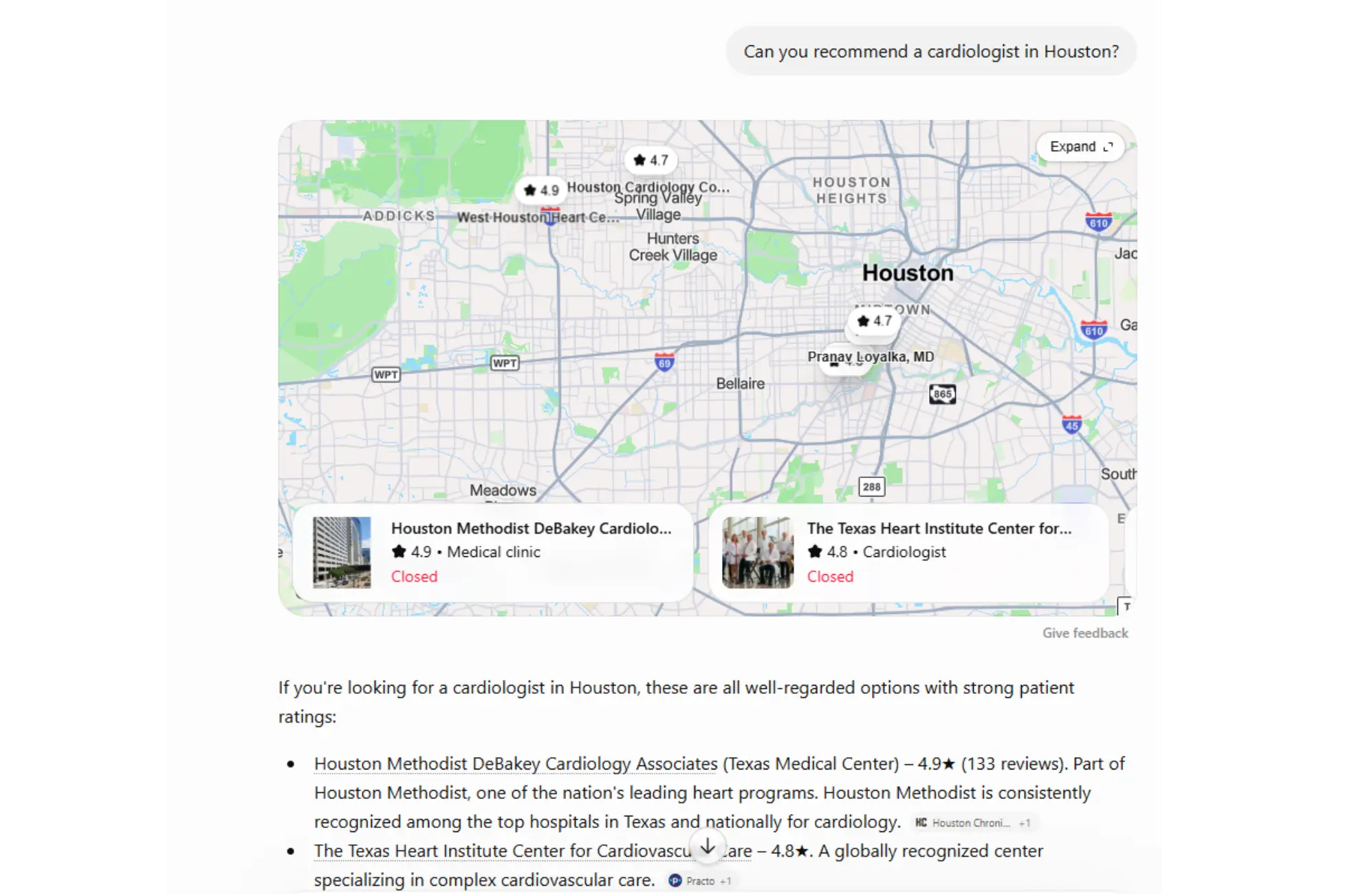
Recommendation queries are the most valuable "Can you recommend a cardiologist in Houston?" These patients are ready to act.
Condition-specific queries connect symptoms to specialties "What doctor should I see for lower back pain?" Optimize your pages to match conditions to services clearly.
Location-based queries combine need with proximity "Best dental clinic near downtown Denver." AI pulls from local directories, listings, and reviews to answer these.
Conversational and voice queries are the fastest growing. Patients no longer type "orthopedic surgeon Chicago" they ask, "Who's the best orthopedic surgeon near me for a knee injury from running?" Your content needs to match how people actually speak, not how a keyword spreadsheet was built.
All four reward the same foundation: a clear, consistent, well-structured presence across the web. AI SEO for healthcare increasingly prioritizes conversational intent over simple keyword matching.
The 7 Pillars of AI SEO for Healthcare Providers
Successful AI SEO for healthcare combines traditional search visibility with modern AI-driven recommendation signals.
1. Entity Establishment
AI systems don't just crawl pages; they build a model of real-world entities: people, organizations, locations, and their relationships. For your practice to be recommended, the AI needs to "know" it exists as a verified, legitimate entity.
This means:
Consistent NAP data (Name, Address, Phone) across Google Business Profile, Healthgrades, Zocdoc, WebMD, Vitals, and Yelp
Dedicated About page describing your organization, history, specialties, and leadership
Individual clinician profiles that are indexed, linked, and cross-referenced across platforms
Nested schema linking your practice, your physicians, and your specialties as connected entities and not just isolated pages
Entity recognition is becoming one of the foundational elements of AI SEO for healthcare, helping AI platforms verify provider legitimacy and expertise.
2. Schema Markup and Structured Data
Schema is the clearest signal you can send AI and search systems about what your content means. Most healthcare websites either don't have it or have it implemented incorrectly.
The schema types that matter most:
Schema type | What it Does |
|---|---|
MedicalOrganization | Identifies your site as a healthcare entity |
Physician | Structured data for individual doctor profiles |
MedicalClinic | For facility and location pages |
MedicalCondition | For condition-specific content |
MedicalTherapy | For treatment and procedure pages |
FAQPage | For question-and-answer content |
LocalBusiness | For location-specific pages |
The most powerful implementation links these schemas together. When AI can trace a chain like this clinic employs this physician, who specializes in this condition, which is treated with this procedure. It builds a confident picture of your entity. Isolated schema on individual pages misses most of that value. Proper schema implementation also strengthens ai search optimization by making provider information easier for search engines and AI systems to interpret.
3. Topical Authority: Content Clusters Over Single Pages
One strong page is good. A network of deeply connected pages on the same topic is what actually builds AI authority.
AI search engines assess topical depth across your entire site. A dermatology practice with 20 comprehensive, interlinked articles about skin conditions will get cited more consistently than one with 100 shallow posts spread across unrelated health topics. This is the topic cluster model:
A pillar page that covers your specialty broadly (e.g., "Orthopedic Surgery: Conditions, Treatments, and What to Expect")
Cluster pages that deeply focuses on individual conditions, procedures, and patient questions (ACL repair, meniscus surgery, recovery timelines, physical therapy after surgery, etc.)
Internal links connecting all of them; so, AI and search engines understand the relationship between topics.
Building topical authority remains one of the most effective strategies in both SEO in healthcare and AI search optimization environments.
4. Google Business Profile: Your AI-Era Homepage
In 2026, some GBP profiles drive more patient traffic than the practice's own website. For healthcare SEO and local AI search optimization, it's a primary trust signal.
A fully optimized GBP requires the following:
Correct categories: specific primary categories like "Orthopedic Surgeon," not just "Medical Clinic"
Complete service listings: descriptions for each specialty and procedure
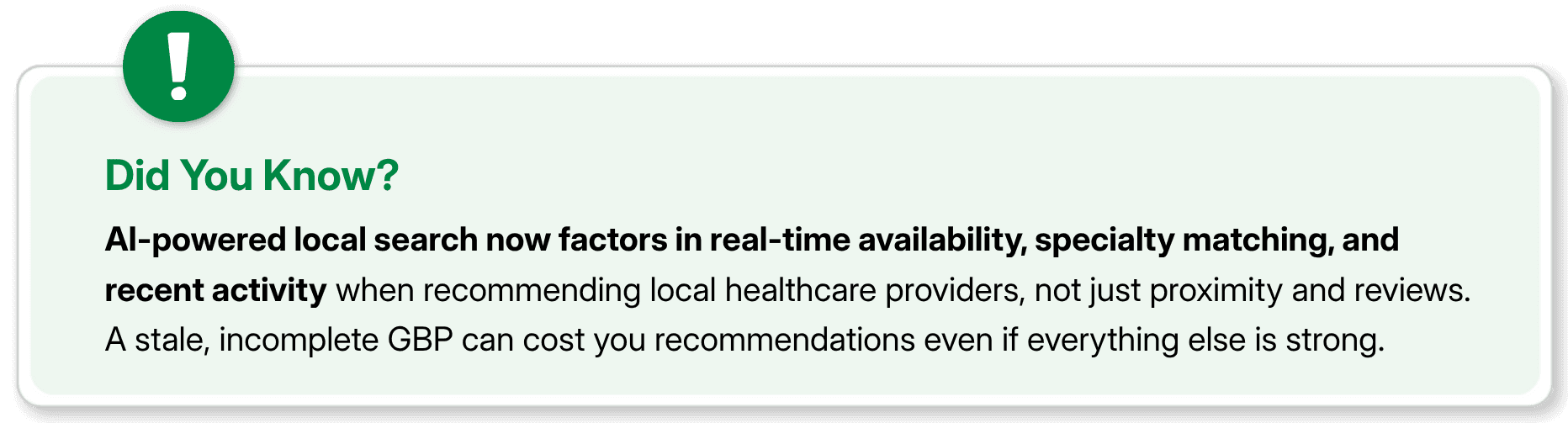
Accurate, updated hours: including holidays and real-time availability. AI prefers current information
Photos: interior, exterior, and team shots that confirm the practice is real and active
Q&A populated: common patient questions answered directly on the profile
Regular posts: Treatment spotlights, health tips, and practice updates signal activity
Active review management
5. Reputation Signals and Review Language
AI systems don't just count stars, instead they read review language. Phrases like "short wait times," "excellent hip replacement results," or "Dr. Shawn explained everything clearly" can surface directly in AI-generated recommendations. Managing these signals is a core component of AI SEO for healthcare.
Where reputation signals come from:
Google Business Profile: the most influential single source
Healthcare platforms: Healthgrades, Zocdoc, Vitals, Castle Connolly
Local media: a physician quoted in a news article is a meaningful credibility signal
Medical associations and hospital affiliations: authority nodes in AI's knowledge network
Backlinks from community health organizations, medical schools, and local publications
Getting reviews that help AI:
Send satisfied patients a direct review link via text or email
Train front desk staff to mention reviews at checkout as consistency matters more than a single push
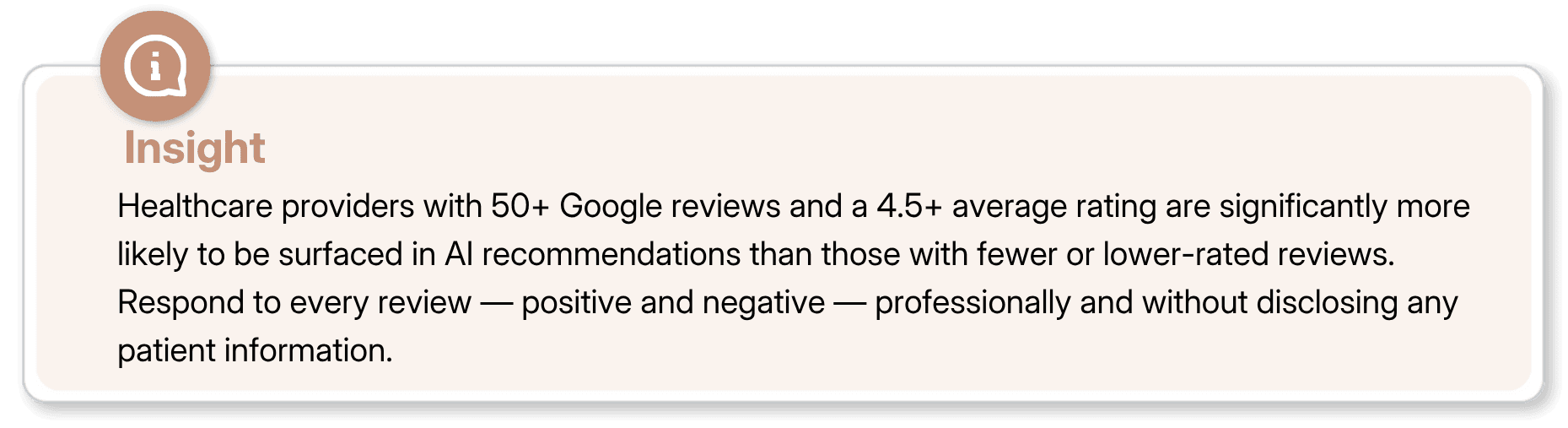
Respond to every review professionally, without disclosing patient information
Encourage specific descriptions over generic praise like "great doctor!" carries less weight than detailed experience
6. Technical Foundations: Make Your Site AI-Readable
AI can't recommend what it can't read. Technical barriers that hurt SEO in healthcare become even more critical when AI search optimization is the goal.
Most common issues on healthcare sites:
JavaScript-heavy pages: If critical content (service pages, physician profiles) renders via JavaScript, AI crawlers may not see it. Key content should be in plain HTML
Gated content: registration walls and login requirements block AI access entirely. Content that should build authority can't be cited if it's unreachable
Slow page speed: image-heavy galleries and unoptimized portals are common culprits. Slow sites are deprioritized across all search types
Fragmented structure: When physician profiles, location pages, and condition pages don't link to each other, AI struggles to build a coherent picture of your practice
No HTTPS: a baseline trust failure in a high-stakes category like healthcare
Strong technical performance ensures AI crawlers can access, read, and confidently recommend your content.
7. E-E-A-T Signals: The Trust Layer AI Checks
E-E-A-T stands for Experience, Expertise, Authoritativeness, and Trustworthiness. Google's framework for evaluating content quality and a close proxy for how AI systems assess medical sources. It is also the trust backbone of effective AI SEO for healthcare.
For healthcare, strong E-E-A-T looks like:
Author bios with credentials on every clinical article: name, specialty, license, board certifications, institutional affiliation
Medical review disclosures: when content was last reviewed and by whom
Transparent organizational information: ownership, accreditations, state licensing
Accessible, working contact information: a real phone number, physical address, responsive inquiry channel
HIPAA-conscious content: avoid any content that could imply disclosure of patient information; this is both a legal requirement and a trust signal
These aren't compliance boxes. They determine whether an AI trusts your content enough to cite it in a medical answer.
How AI Actually Surfaces a Healthcare Provider?
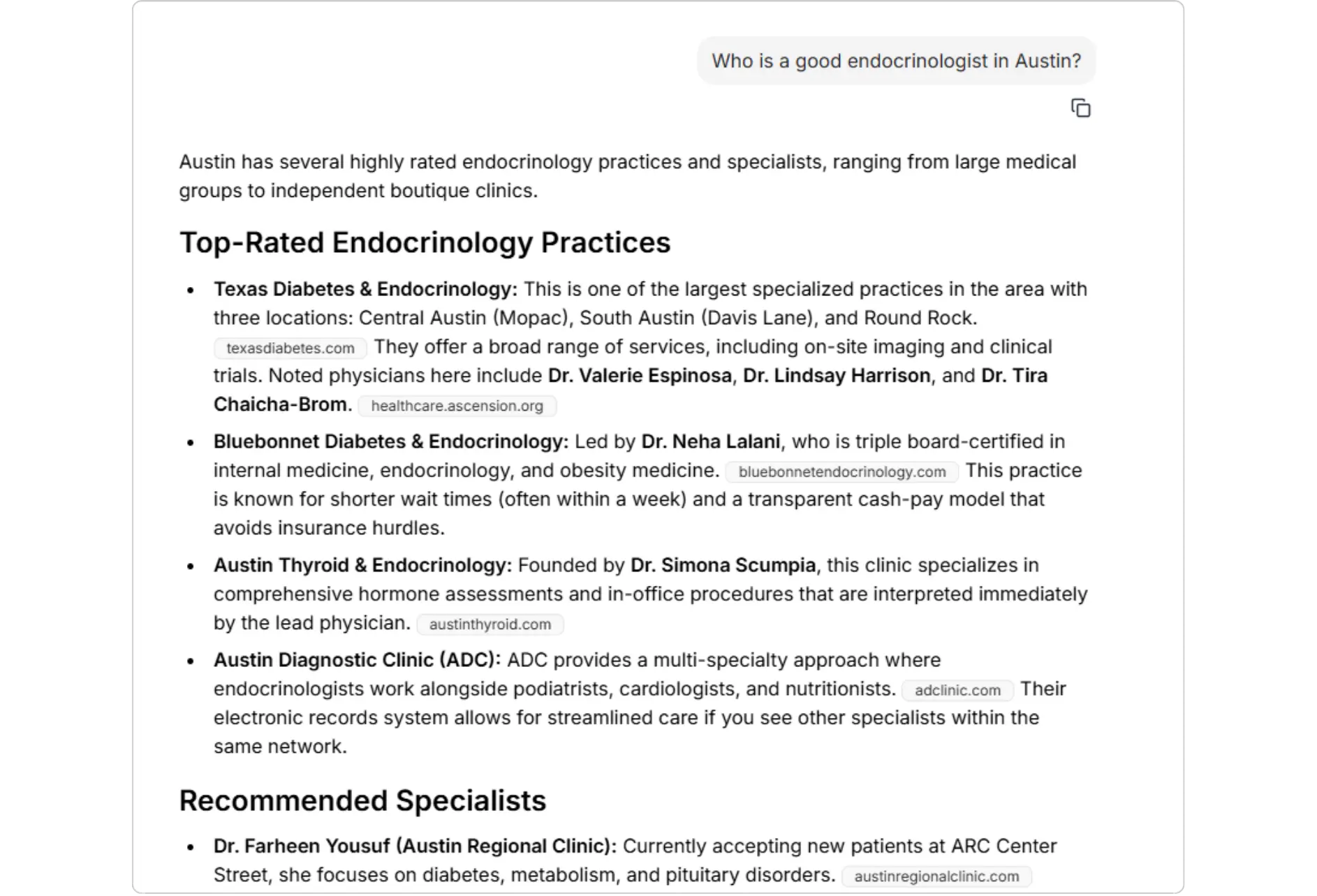
When someone asks an AI tool "Who is a good endocrinologist in Austin?" here's what happens under the hood:
The AI checks its training data for known providers in that area
It uses real-time web search (in tools like Perplexity and Gemini) for current results
It cross-references structured sources; Google Business Profile, medical directories, schema markup
It weighs reputation signals: reviews, mentions, site authority
It synthesizes a response, typically naming one to three providers it finds credible and well-documented
Providers that appear here aren't there by chance. They've built a consistent, verified, well-documented digital presence that makes AI SEO for healthcare work in their favor.
Final Thoughts
Patients are asking AI for healthcare guidance before they ever call a clinic. The providers who show up in those answers aren't there because they got lucky. They've built digital presences that AI systems can verify, trust, read, and cite.
AI SEO for healthcare isn't separate from good marketing. It is good marketing, updated for where patients actually are in 2026. The practices that treat their online presence as an extension of their clinical reputation; specific, credentialed, well-structured, and actively maintained; will earn those recommendations. As Healthcare SEO and ai search optimization continues to evolve, the providers who invest now will have a compounding advantage over those who wait.
The ones that don't will be invisible precisely when it matters most.
FAQs
What is AI SEO for healthcare?

AI SEO for healthcare optimizes a provider's digital presence to make AI tools like ChatGPT, Gemini, and Google AI Overviews recommend them when patients search. It involves structured data, entity verification, trust signals, topical authority, and content AI can read and cite.
Does ranking on Google help with AI recommendations?
Yes. Most AI tools draw from top organic results. Strong traditional SEO and AI SEO overlap: schema, content quality, backlinks, and page speed benefit both.
What is the difference between traditional SEO and AI SEO for healthcare?
Traditional SEO focuses on ranking for keywords on Google's results page. AI SEO focuses on being recommended in AI-generated answers across ChatGPT, Gemini, and Google AI Overview.
Entity authority, nested schema, E-E-A-T, review language, and topic clusters matter more in AI search than keyword density.
How do patient reviews affect AI recommendations?
Patient reviews matter more than providers realize. AI reads review language, not just star ratings. Specific phrases like "hip replacement" or "compassionate care" can appear in AI-generated recommendations. Volume, recency, and responses all contribute.
What is YMYL and why does it apply to healthcare SEO?
YMYL (Your Money or Your Life) is Google's classification for content where inaccurate information causes real harm. Healthcare falls under this category, requiring clinical content to meet E-E-A-T standards from credentialed professionals, authoritative, and kept current. In 2026, these aren't guidelines but they're infrastructure.
AI-powered search is changing how patients find doctors, clinics, and health information. This article explains what AI SEO for healthcare means, why traditional SEO in healthcare tactics are no longer enough, and exactly what healthcare providers need to do to appear in AI-generated recommendations. It covers everything from structured data and entity authority to content strategy and trust signals that AI engines actually read.
AI SEO for Healthcare: How to Get Healthcare Providers Recommended by AI
Patients aren't just Googling "best doctor near me" anymore. They're opening ChatGPT, Perplexity, or Google's AI Overview and asking full questions in detail and expecting a direct recommendation in return.
That shift is already reshaping how healthcare providers win or lose new patients. If your clinic, practice, or hospital system isn't being surfaced in those AI-generated answers, you're invisible at the exact moment someone is ready to book. This is why Healthcare SEO requires a stronger focus on credibility, expertise, and trust than many other industries.
AI SEO for healthcare isn't a niche strategy. It's what modern healthcare marketing looks like now. Traditional SEO in healthcare is evolving rapidly as AI-powered search platforms become a primary source of patient discovery.
Unlike traditional SEO, where you compete for a spot on a results page, AI search often gives one or two recommendations and stops. Being in that answer isn't just better; it's the only visibility that matters in that moment.
Why Healthcare Is One of the Highest-Stakes Categories for AI Search
Healthcare has always been a trust business. Patients make decisions that affect their lives, sometimes urgently. AI systems know this.
Google has long classified healthcare as a YMYL (Your Money or Your Life) topic. The content where accuracy failures carry real-world consequences. AI tools apply similar logic. They're far more selective about what they surface in medical contexts than they are for restaurant recommendations or travel guides.
That creates both a challenge and an opportunity. The challenge: the bar to be recommended is higher. The opportunity: if you clear that bar, the recommendation carries enormous weight. An AI answer feels curated, not algorithmic. Patients trust it more.
How Patients Actually Search for Healthcare With AI
Understanding query types tells you exactly what to optimize for and how ai search optimization should be structured.
Recommendation queries are the most valuable "Can you recommend a cardiologist in Houston?" These patients are ready to act.
Condition-specific queries connect symptoms to specialties "What doctor should I see for lower back pain?" Optimize your pages to match conditions to services clearly.
Location-based queries combine need with proximity "Best dental clinic near downtown Denver." AI pulls from local directories, listings, and reviews to answer these.
Conversational and voice queries are the fastest growing. Patients no longer type "orthopedic surgeon Chicago" they ask, "Who's the best orthopedic surgeon near me for a knee injury from running?" Your content needs to match how people actually speak, not how a keyword spreadsheet was built.
All four reward the same foundation: a clear, consistent, well-structured presence across the web. AI SEO for healthcare increasingly prioritizes conversational intent over simple keyword matching.
The 7 Pillars of AI SEO for Healthcare Providers
Successful AI SEO for healthcare combines traditional search visibility with modern AI-driven recommendation signals.
1. Entity Establishment
AI systems don't just crawl pages; they build a model of real-world entities: people, organizations, locations, and their relationships. For your practice to be recommended, the AI needs to "know" it exists as a verified, legitimate entity.
This means:
Consistent NAP data (Name, Address, Phone) across Google Business Profile, Healthgrades, Zocdoc, WebMD, Vitals, and Yelp
Dedicated About page describing your organization, history, specialties, and leadership
Individual clinician profiles that are indexed, linked, and cross-referenced across platforms
Nested schema linking your practice, your physicians, and your specialties as connected entities and not just isolated pages
Entity recognition is becoming one of the foundational elements of AI SEO for healthcare, helping AI platforms verify provider legitimacy and expertise.
2. Schema Markup and Structured Data
Schema is the clearest signal you can send AI and search systems about what your content means. Most healthcare websites either don't have it or have it implemented incorrectly.
The schema types that matter most:
Schema type | What it Does |
|---|---|
MedicalOrganization | Identifies your site as a healthcare entity |
Physician | Structured data for individual doctor profiles |
MedicalClinic | For facility and location pages |
MedicalCondition | For condition-specific content |
MedicalTherapy | For treatment and procedure pages |
FAQPage | For question-and-answer content |
LocalBusiness | For location-specific pages |
The most powerful implementation links these schemas together. When AI can trace a chain like this clinic employs this physician, who specializes in this condition, which is treated with this procedure. It builds a confident picture of your entity. Isolated schema on individual pages misses most of that value. Proper schema implementation also strengthens ai search optimization by making provider information easier for search engines and AI systems to interpret.
3. Topical Authority: Content Clusters Over Single Pages
One strong page is good. A network of deeply connected pages on the same topic is what actually builds AI authority.
AI search engines assess topical depth across your entire site. A dermatology practice with 20 comprehensive, interlinked articles about skin conditions will get cited more consistently than one with 100 shallow posts spread across unrelated health topics. This is the topic cluster model:
A pillar page that covers your specialty broadly (e.g., "Orthopedic Surgery: Conditions, Treatments, and What to Expect")
Cluster pages that deeply focuses on individual conditions, procedures, and patient questions (ACL repair, meniscus surgery, recovery timelines, physical therapy after surgery, etc.)
Internal links connecting all of them; so, AI and search engines understand the relationship between topics.
Building topical authority remains one of the most effective strategies in both SEO in healthcare and AI search optimization environments.
4. Google Business Profile: Your AI-Era Homepage
In 2026, some GBP profiles drive more patient traffic than the practice's own website. For healthcare SEO and local AI search optimization, it's a primary trust signal.
A fully optimized GBP requires the following:
Correct categories: specific primary categories like "Orthopedic Surgeon," not just "Medical Clinic"
Complete service listings: descriptions for each specialty and procedure
Accurate, updated hours: including holidays and real-time availability. AI prefers current information
Photos: interior, exterior, and team shots that confirm the practice is real and active
Q&A populated: common patient questions answered directly on the profile
Regular posts: Treatment spotlights, health tips, and practice updates signal activity
Active review management
5. Reputation Signals and Review Language
AI systems don't just count stars, instead they read review language. Phrases like "short wait times," "excellent hip replacement results," or "Dr. Shawn explained everything clearly" can surface directly in AI-generated recommendations. Managing these signals is a core component of AI SEO for healthcare.
Where reputation signals come from:
Google Business Profile: the most influential single source
Healthcare platforms: Healthgrades, Zocdoc, Vitals, Castle Connolly
Local media: a physician quoted in a news article is a meaningful credibility signal
Medical associations and hospital affiliations: authority nodes in AI's knowledge network
Backlinks from community health organizations, medical schools, and local publications
Getting reviews that help AI:
Send satisfied patients a direct review link via text or email
Train front desk staff to mention reviews at checkout as consistency matters more than a single push
Respond to every review professionally, without disclosing patient information
Encourage specific descriptions over generic praise like "great doctor!" carries less weight than detailed experience
6. Technical Foundations: Make Your Site AI-Readable
AI can't recommend what it can't read. Technical barriers that hurt SEO in healthcare become even more critical when AI search optimization is the goal.
Most common issues on healthcare sites:
JavaScript-heavy pages: If critical content (service pages, physician profiles) renders via JavaScript, AI crawlers may not see it. Key content should be in plain HTML
Gated content: registration walls and login requirements block AI access entirely. Content that should build authority can't be cited if it's unreachable
Slow page speed: image-heavy galleries and unoptimized portals are common culprits. Slow sites are deprioritized across all search types
Fragmented structure: When physician profiles, location pages, and condition pages don't link to each other, AI struggles to build a coherent picture of your practice
No HTTPS: a baseline trust failure in a high-stakes category like healthcare
Strong technical performance ensures AI crawlers can access, read, and confidently recommend your content.
7. E-E-A-T Signals: The Trust Layer AI Checks
E-E-A-T stands for Experience, Expertise, Authoritativeness, and Trustworthiness. Google's framework for evaluating content quality and a close proxy for how AI systems assess medical sources. It is also the trust backbone of effective AI SEO for healthcare.
For healthcare, strong E-E-A-T looks like:
Author bios with credentials on every clinical article: name, specialty, license, board certifications, institutional affiliation
Medical review disclosures: when content was last reviewed and by whom
Transparent organizational information: ownership, accreditations, state licensing
Accessible, working contact information: a real phone number, physical address, responsive inquiry channel
HIPAA-conscious content: avoid any content that could imply disclosure of patient information; this is both a legal requirement and a trust signal
These aren't compliance boxes. They determine whether an AI trusts your content enough to cite it in a medical answer.
How AI Actually Surfaces a Healthcare Provider?
When someone asks an AI tool "Who is a good endocrinologist in Austin?" here's what happens under the hood:
The AI checks its training data for known providers in that area
It uses real-time web search (in tools like Perplexity and Gemini) for current results
It cross-references structured sources; Google Business Profile, medical directories, schema markup
It weighs reputation signals: reviews, mentions, site authority
It synthesizes a response, typically naming one to three providers it finds credible and well-documented
Providers that appear here aren't there by chance. They've built a consistent, verified, well-documented digital presence that makes AI SEO for healthcare work in their favor.
Final Thoughts
Patients are asking AI for healthcare guidance before they ever call a clinic. The providers who show up in those answers aren't there because they got lucky. They've built digital presences that AI systems can verify, trust, read, and cite.
AI SEO for healthcare isn't separate from good marketing. It is good marketing, updated for where patients actually are in 2026. The practices that treat their online presence as an extension of their clinical reputation; specific, credentialed, well-structured, and actively maintained; will earn those recommendations. As Healthcare SEO and ai search optimization continues to evolve, the providers who invest now will have a compounding advantage over those who wait.
The ones that don't will be invisible precisely when it matters most.
FAQs
What is AI SEO for healthcare?
AI SEO for healthcare optimizes a provider's digital presence to make AI tools like ChatGPT, Gemini, and Google AI Overviews recommend them when patients search. It involves structured data, entity verification, trust signals, topical authority, and content AI can read and cite.
Does ranking on Google help with AI recommendations?
Yes. Most AI tools draw from top organic results. Strong traditional SEO and AI SEO overlap: schema, content quality, backlinks, and page speed benefit both.
What is the difference between traditional SEO and AI SEO for healthcare?
Traditional SEO focuses on ranking for keywords on Google's results page. AI SEO focuses on being recommended in AI-generated answers across ChatGPT, Gemini, and Google AI Overview.
Entity authority, nested schema, E-E-A-T, review language, and topic clusters matter more in AI search than keyword density.
How do patient reviews affect AI recommendations?
Patient reviews matter more than providers realize. AI reads review language, not just star ratings. Specific phrases like "hip replacement" or "compassionate care" can appear in AI-generated recommendations. Volume, recency, and responses all contribute.
What is YMYL and why does it apply to healthcare SEO?
YMYL (Your Money or Your Life) is Google's classification for content where inaccurate information causes real harm. Healthcare falls under this category, requiring clinical content to meet E-E-A-T standards from credentialed professionals, authoritative, and kept current. In 2026, these aren't guidelines but they're infrastructure.



Summarize with AI


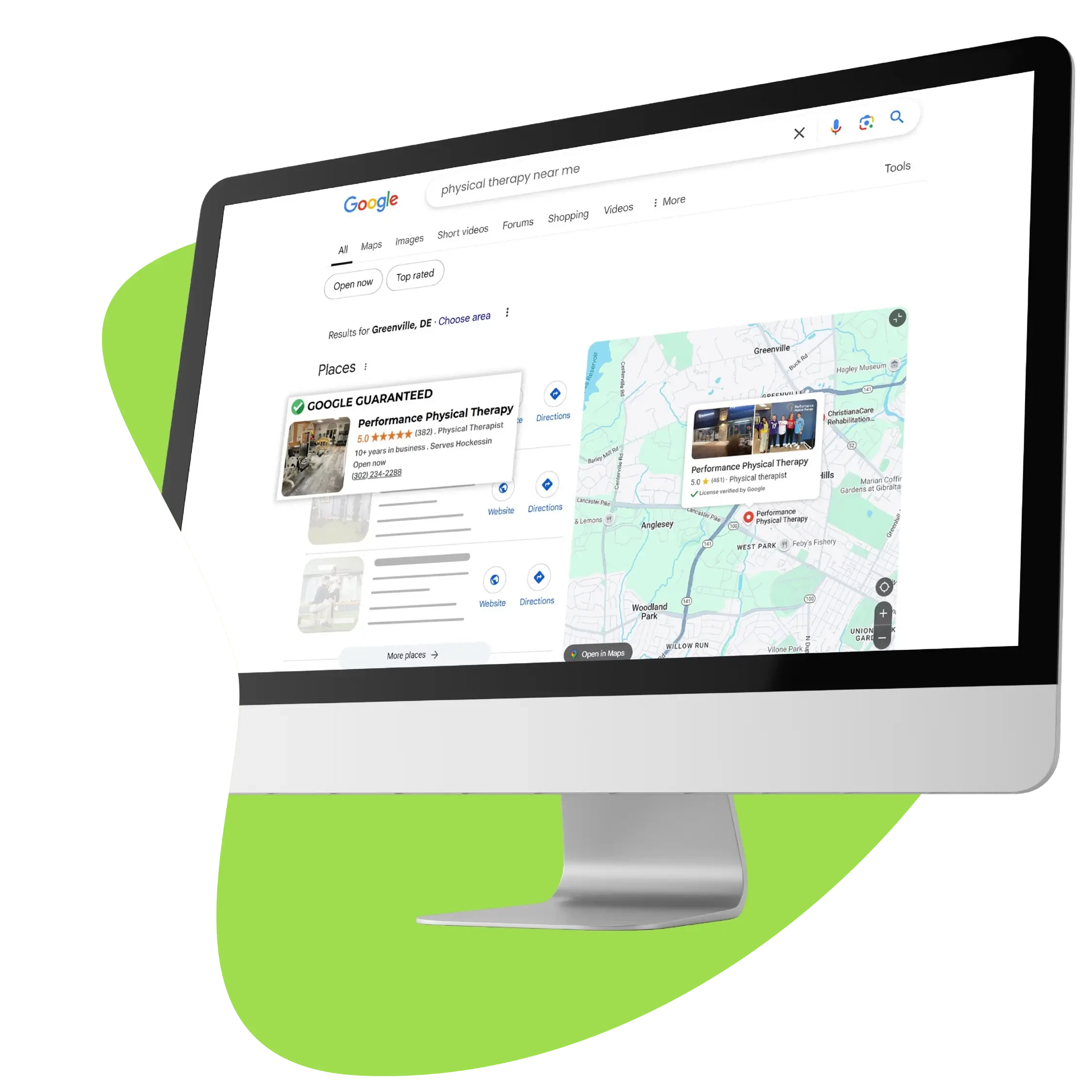

Want to be seen everywhere?
Get a free AI-search audit Today!



4.9/5 Ratings!


Don’t miss our revenue growth tips!
Get expert marketing tips—straight to your inbox, like thousands of happy clients.
Don’t miss our revenue growth tips!
Get expert marketing tips—straight to your inbox, like thousands of happy clients.
Don’t miss our revenue growth tips!
Don’t miss our revenue growth tips!
Get expert marketing tips—straight to your inbox, like thousands of happy clients.
Relevant Blogs on Generative AI SEO
Relevant Blogs on Generative AI SEO
Unlock data-driven insights in AI-powered SEO—explore our featured blogs and skyrocket your revenue before your competitors do.
Unlock data-driven insights in AI-powered SEO—explore our featured blogs and skyrocket your revenue before your competitors do.

GEO
Sep 22, 2026
15 Min Read
AI Search Runs on More SEO Than You Think
GEO
Sep 22, 2026
15 Min Read
AI Search Runs on More SEO Than You Think
GEO
Sep 22, 2026
15 Min Read
AI Search Runs on More SEO Than You Think

GEO
Sep 7, 2026
8 Min Read
How to Optimize Content for AI Search Engines: Best Practices
GEO
Sep 7, 2026
8 Min Read
How to Optimize Content for AI Search Engines: Best Practices
GEO
Sep 7, 2026
8 Min Read
How to Optimize Content for AI Search Engines: Best Practices

GEO
Sep 4, 2026
12 Min Read
How Ecommerce Brands Can Advertise in Google AI Mode?
GEO
Sep 4, 2026
12 Min Read
How Ecommerce Brands Can Advertise in Google AI Mode?
GEO
Sep 4, 2026
12 Min Read
How Ecommerce Brands Can Advertise in Google AI Mode?














Ready to speak with an expert?
Data-Driven Marketing Agency That Elevates ROI
1100+
Websites Designed & Optimized to Convert
$280M+
Client Revenue Driven & Growing Strong
Discover how to skyrocket
your revenue today!
Trusted by 1000+ Owners!
Ready to speak with an expert?
Data-Driven Marketing Agency That Elevates ROI
1100+
Websites Designed & Optimized to Convert
$280M+
Client Revenue Driven & Growing Strong
Discover how to skyrocket
your revenue today!
Trusted by 1000+ Owners!
Want to skyrocket revenue?
4.9/5 Ratings!
Ready to speak with an expert?
Data-Driven Marketing Agency That Elevates ROI
1100+
Websites Designed & Optimized to Convert
$280M+
Client Revenue Driven & Growing Strong
Discover how to skyrocket
your revenue today!
Trusted by 1000+ Owners!
Call
Meet