5 Reasons Your HVAC Business Isn't Showing Up in Al Search - And How to Fix Each One
5 Reasons Your HVAC Business Isn't Showing Up in Al Search - And How to Fix Each One
Last Updated:
Table of Content
Case Studies



It is 9 p.m. on a Thursday in July. The AC dies in a house in the suburbs, and the homeowner does not reach for the fridge magnet with the local contractor's number on it. They do not open Yelp either. They open ChatGPT and type something like "AC stopped working, who do I call near me tonight."
AI names a company. The homeowner calls that company. They do not cross-check it against three other quotes. They do not scroll past it to see who else is out there. In that moment, the best HVAC contractor in that zip code, the one with twenty years in business and a wall of five-star reviews, simply does not exist. Not because the work is bad. Because the machine deciding who gets named never learned they were there.
This is happening in living rooms across the country right now, and most HVAC contractor marketing plans have no idea, it is a problem. They were built for a different game.
The AI Search Problem Most HVAC Contractors Have Not Been Told About
Here is the uncomfortable part. This is not a marketing execution problem. It is a structural one.
Most independent contractors have done the expected work. They claimed their Google Business Profile. They chased reviews. They ran local ads. Some invested seriously in hvac contractor seo, building landing pages for every service area and every service line. That work still matters. Traditional organic search is foundational, and nothing here argues otherwise. But it operates on a different layer than what decides visibility inside ChatGPT, Gemini, Perplexity, or Google AI Overviews.
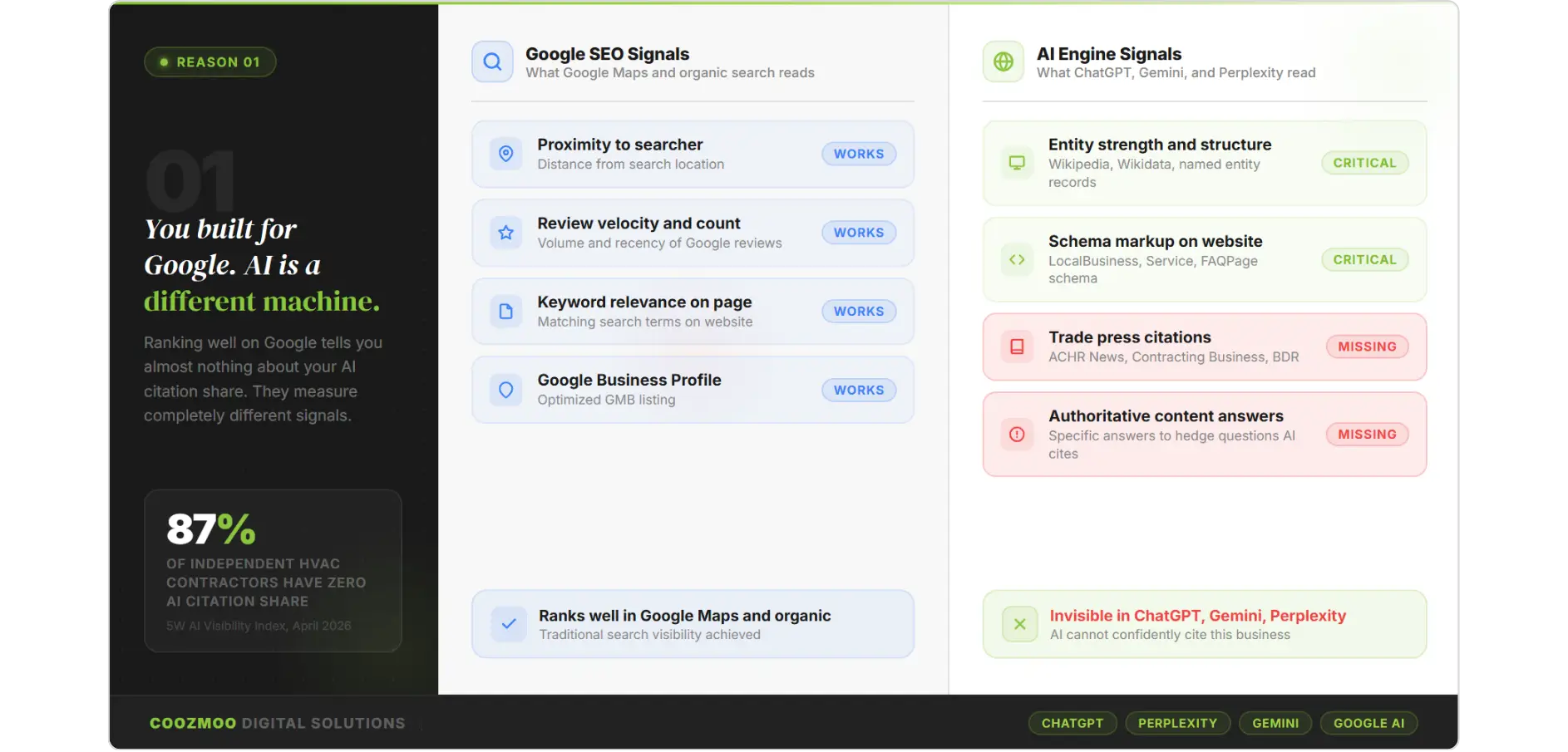
According to the 5W AI Visibility Index (April 2026), roughly 87% of independent HVAC and plumbing contractors have effectively zero AI citation share in their own metro and category. Not low. Zero. Meanwhile, RankRabbit found that nearly 6 in 10 AI Overview citations come from pages that aren't in the traditional top 10. Ranking well on Google and getting cited by AI are two separate outcomes, and doing well at one tells you almost nothing about the other.

To make the concentration problem visible, here is where AI citation share actually sits right now across the industry.
Rank | Brand | Category | Estimated AI Citation Share |
|---|---|---|---|
1 | ServiceTitan | Software / Industry Infrastructure | ~14% |
2 | Roto-Rooter | Plumbing / HVAC Franchise | ~11.5% |
3 | ARS/Rescue Rooter | HVAC Franchise | ~5.5% |
4 | Mr. Rooter | Plumbing Franchise (Neighborly) | ~4.8% |
5 | Housecall Pro | Software / Industry Infrastructure | ~4.2% |
6 | Service Experts | HVAC Franchise | ~3.8% |
Source: 5W AI Visibility Index, April 2026
A handful of names are absorbing most of the citation surface in a $159.4 billion industry (IBISWorld, January 2026) with roughly 100,000 contractors competing in it. Franchise networks alone appear in 25 to 30% of "service near me" prompts, despite representing well under 5% of actual U.S. contractors, according to the same 5W report. That gap is the whole story. Here is why it exists, broken into five specific reasons, each with a fix that does not require a franchise fee to execute.
Reason 1: You Built for Google. AI Is a Different Machine.
Local SEO runs on proximity, review velocity, and directory consistency. Rank in the map pack, show up when someone nearby searches, get more reviews than the contractor down the street. That system rewards presence in a place.
AI engines reward something else. They weight entity strength: structured data markup, Wikipedia presence, Wikidata records, and how confidently the model's training data recognizes a business as a real, established entity rather than just a listing. A contractor can have flawless Google Maps optimization and still be a ghost in AI answers, because entity signals and local SEO signals are not measuring the same thing. One machine was optimized for. A different machine is doing the judging.
This is what we see consistently across the HVAC businesses we work with. The contractors with the strongest local presence are often the most surprised to learn they have no AI footprint at all.
GEO research from Princeton University and the Allen Institute for AI (KDD 2024) found that targeted optimization tactics can lift source visibility in generative AI answers by up to 40%, with specific moves like adding citable statistics and named sources producing measurable gains on their own. Entity work is not guesswork. It responds to deliberate effort.
"An independent contractor with 800 five-star reviews can produce less AI citation share than a franchise location with 50 reviews in the same city."
The Fix
Start building entity-strength infrastructure now, because none of the other fixes work without it. That means a Wikipedia mention where one is genuinely warranted, a Wikidata entry for the business, and proper LocalBusiness, Service, and FAQPage schema markup across the website. It also means at least one credible trade publication mention that establishes the business as a named entity AI engines can actually reference, rather than just another address on a map. This is unglamorous work. It is also the work almost nobody else in the local HVAC space has done yet, which is exactly why it matters.
Reason 2: You Are Not in the Publications AI Actually Reads.
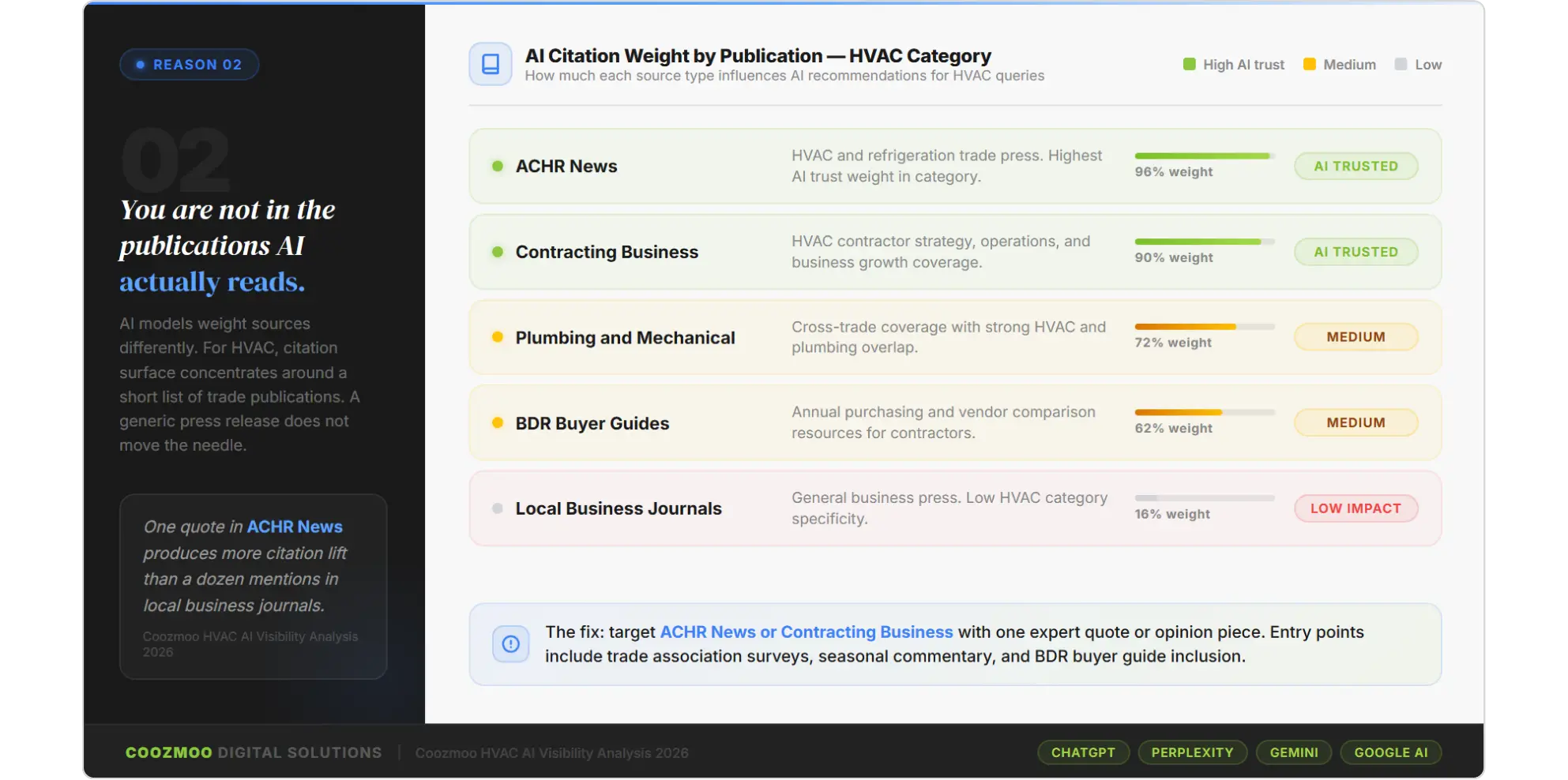
AI models do not treat every source equally, and they definitely do not treat every publication equally. For HVAC and plumbing specifically, the citation surface concentrates around a short list: ACHR News, Contracting Business, Plumbing and Mechanical, Cooling Post, and BDR's annual buyer's guides.
A business that has never appeared in any of them is functionally invisible to AI, no matter how well known it is locally. A press release picked up by a generic news wire does not move the needle the way a single expert quote in Contracting Business does. Most contractors have never thought of trade press as a marketing channel at all. It is treated as something for manufacturers and industry associations, not the guy running four trucks in Dallas.
The Fix
Target the specific publications AI engines already trust, not general business media. One feature or expert quote in ACHR News or Contracting Business produces more citation lift than a dozen mentions in local business journals. For a contractor without existing media relationships, realistic entry points include contributing an opinion piece on a seasonal or regulatory issue, participating in a trade association survey, or getting included in a BDR buyer's guide. The goal is not press for the sake of a headline. The goal is showing up in the handful of sources the model already leans on when it needs to name someone credible.
Reason 3: Your Competitors Built a Content Moat While You Were Not Looking.
ServiceTitan went public on January 22, 2025 at roughly a $6.3 billion valuation. That single event set off a wave of coverage across contractor podcasts, comparison articles, and business press, and the citation moat from that coverage has not closed since.
Franchise networks compound the same effect on purpose. Every cross-trade article Neighborly publishes reinforces Mr. Rooter, Mr. Electric, and Aire Serv at the same time. One piece explaining why an HVAC failure sometimes points to a plumbing issue earns citation surface for two brands in a single publish. An independent contractor putting out a generic "5 signs your AC needs servicing" post is producing almost none of that same surface, no matter how well written it is.
This is the moat most HVAC contractor marketing conversations skip entirely. It was never about publishing volume. It was always about whether what gets published earns a citation from a source AI already trusts. For more on how this exact pattern shows up across other local service categories, the Coozmoo blog has covered it in plumbing, roofing, and pest control as well.
"The content that wins is not the content published the most. It is the content that answers the question AI is not confident about."
The Fix
Stop writing generic seasonal tips and start answering the specific questions where AI hedges, meaning the model is uncertain enough that it will cite a local source if one exists. Think "should I replace my furnace this year," "is the federal heat pump tax credit still active," or "what does it cost to replace a sewer line in Dallas." Specific, dated, locally anchored answers to exact questions like these produce far more citation share than another generic maintenance checklist. One well-sourced answer page targeting a real hedge point is worth more than ten posts nobody was uncertain about in the first place.
Reason 4: Your Reviews Are Strong. Your Entity Infrastructure Is Not.
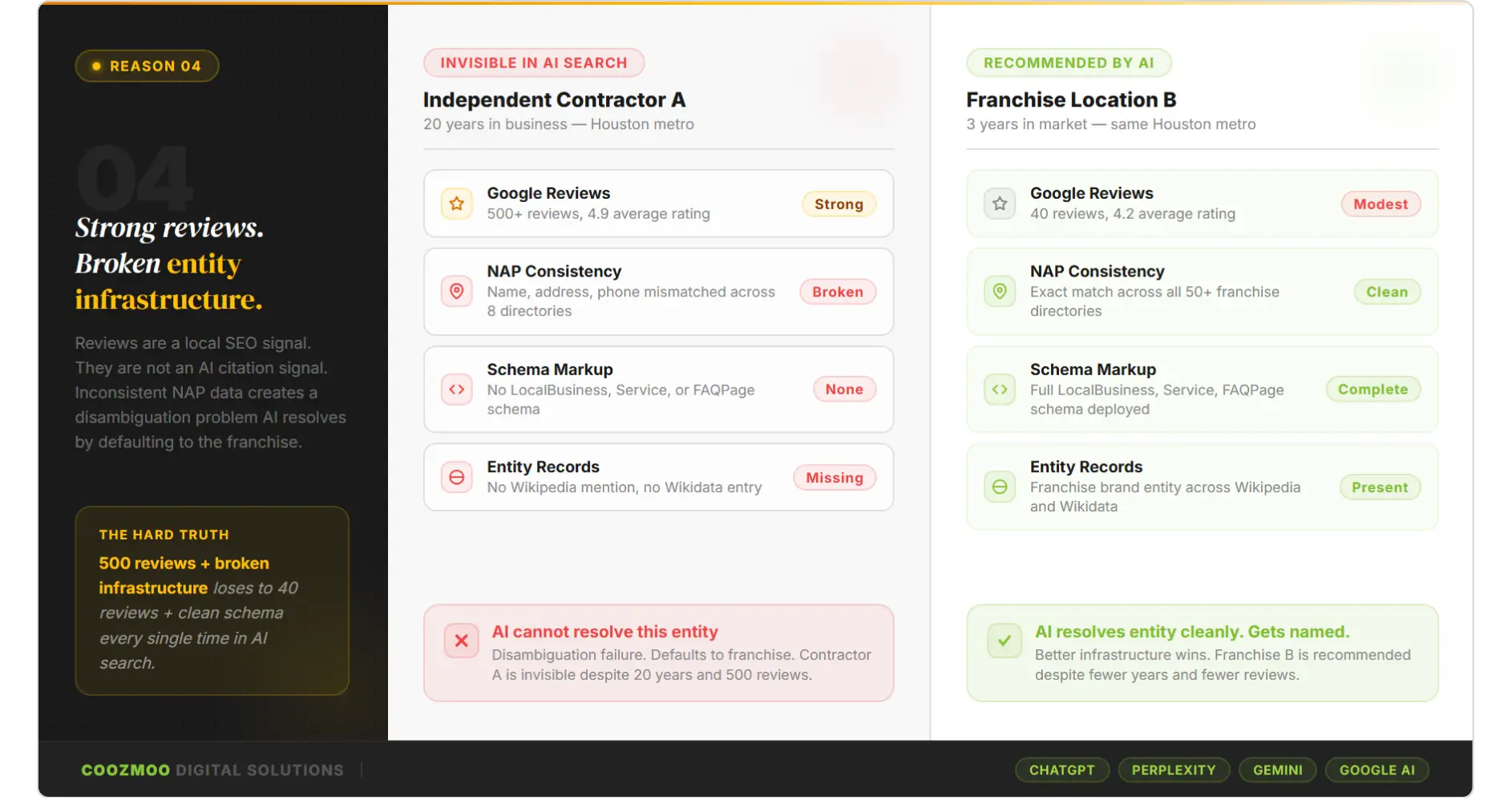
Reviews are a local SEO signal. They are not, on their own, an AI citation signal. What AI actually reads is structured data on the website, consistent listing information across high-authority directories, and whether business data resolves cleanly across every platform the model pulls from.
Inconsistent NAP data, meaning name, address, and phone number that do not match across directories, creates a disambiguation problem for AI. If the model cannot cleanly tell which "Houston AC Repair" is which, it defaults to the brand with clean, consistent national data, which is almost always the franchise. A contractor with 500 Google reviews and messy listing data across ten directories is often less visible in AI answers than a franchise location with 40 reviews and clean data everywhere.
This is one of the most common patterns we see when we run an AI visibility audit for a contractor. The reputation is real. The infrastructure underneath it never got built, because it never had to be for Google Maps rankings.
The Fix
Audit listing consistency across Google Business Profile, Apple Maps, Yelp, Bing Places, and Facebook, and make sure the NAP data matches exactly across every one of them. Layer in LocalBusiness and Service schema markup on the website itself. Coozmoo's local listing management service handles this kind of cross-platform cleanup at scale, which matters because manually checking a dozen directories every quarter is not a realistic use of a contractor's time. Once that foundation is solid, it becomes worth understanding exactly where the business currently stands in AI search before deciding what to invest in next, which is what Coozmoo's GEO service is built to diagnose.
Reason 5: The One Moment That Decides Everything
The homeowner under 50 opens ChatGPT before they open Yelp. They ask a question, and they call whoever gets named. They are not comparing five tabs. They are not reading past the first answer. If a contractor is not in that first response, they simply do not exist for that customer in that specific moment, and there is no second chance inside that decision.
The scale behind this shift is not small anymore. HubSpot's 2026 State of Marketing report found that 50% of consumers now use AI-powered search. This is not early adopters experimenting with a new tool. This is the mainstream homeowner, mid-emergency, at 9 p.m. on a Thursday.
The pattern holds across markets, and it shows up every time we pull AI citation data for a new contractor. The businesses with the deepest local roots are frequently the ones with the least AI presence, because local roots were never the metric being measured.
The Fix
Build deliberately for the post-AI consumer instead of hoping the old signals eventually carry over. That means entity infrastructure, trade-press presence, and structured content aimed at the specific questions where AI is uncertain, combined with clean, consistent listing data everywhere. None of it works in isolation. Together, it is the difference between being the answer and being the contractor nobody asked about.
Final Thought
Here is the part that is hard to say plainly, so it is worth saying plainly. The contractor who spent fifteen years building something real in their city, earning every one of those five-star reviews one job at a time, is now competing against national franchise infrastructure on a channel nobody told them existed until their phone got quieter. That is not fair in the way marketing used to be fair, where the best local reputation eventually won. It is also just the current terrain.
The window is not closed. The citation surface is still forming, not fully hardened, which means there is still room for a contractor who moves now. But the surface is hardening a little more every quarter that passes without action. The businesses that treat this as a technical, structural problem, not a hustle-harder problem, are the ones that will still be getting named when a homeowner's AC dies on a Thursday night five years from now. The ones who wait will just keep wondering why the phone got slower, without ever finding out why.
FAQs
Why is my HVAC business not showing up when someone asks ChatGPT or Google AI for a recommendation?

Because AI engines are not reading the same signals Google Maps reads. According to the 5W AI Visibility Index (April 2026), roughly 87% of independent HVAC and plumbing contractors have effectively zero AI citation share in their own metro and category, even with strong local reviews and years in business. AI models weight entity strength instead: structured data on your website, Wikipedia or Wikidata presence, and mentions in trade publications the model already trusts. Without that infrastructure, an AI engine has no confident way to recognize your business as a real, citable entity, so it defaults to brands that do have that structure in place, which is usually a national franchise.
Is local SEO still worth investing in for HVAC contractors in 2026?
Yes, and it is important not to confuse this with an either-or choice. Local SEO and AI citation are two different layers of visibility, not competitors for the same budget. Traditional organic search still drives map pack rankings, website traffic, and the reviews that build real trust with homeowners who do cross-check a recommendation. AI citation is a separate layer sitting on top of that foundation. You need organic search work to stay competitive on Google itself, and you need entity infrastructure to be visible when the same customer asks an AI engine instead. Neither one replaces the other.
What is entity strength and why does it matter more than reviews for AI search?
Entity strength is how confidently an AI model recognizes your business as a real, established thing rather than just an address in a database. It is built from structured data markup on your website (schema for LocalBusiness, Service, and FAQPage types), a Wikipedia or Wikidata record if one exists, and mentions in publications the model treats as authoritative for your industry. Reviews tell a human customer you are trustworthy. Entity signals tell an AI model you exist as a named, verifiable business at all. A contractor can have both, but right now, most only have the first one.
How do I get my HVAC business cited in Google AI Overviews?
Start with the same entity groundwork that drives citation across every AI engine, not just Google's. Add proper schema markup to your website, clean up NAP consistency across every directory you are listed on, and get at least one mention in a trade publication like ACHR News or Contracting Business. Then build content around the specific questions where AI hedges, meaning questions it is not fully confident answering, since those are the ones most likely to pull in a local, credible source. Coozmoo's GEO service is built specifically to manage this process end to end for contractors who do not have the internal bandwidth to chase it themselves.
Do I need to join a franchise network to show up in AI search results?
No, but it is fair to acknowledge franchises have a real structural advantage. Franchise networks appear in 25 to 30% of "service near me" prompts despite representing well under 5% of actual U.S. contractors (5W AI Visibility Index, April 2026), largely because cross-brand content and shared entity infrastructure compound their citation share automatically. An independent contractor can still build meaningful AI visibility without a franchise fee, through entity infrastructure, trade-press coverage, structured content on high-hedge topics, and consistent listing data. It takes longer and requires more deliberate effort than flipping on a franchise's existing machine, but the path is real and it is still open.
It is 9 p.m. on a Thursday in July. The AC dies in a house in the suburbs, and the homeowner does not reach for the fridge magnet with the local contractor's number on it. They do not open Yelp either. They open ChatGPT and type something like "AC stopped working, who do I call near me tonight."
AI names a company. The homeowner calls that company. They do not cross-check it against three other quotes. They do not scroll past it to see who else is out there. In that moment, the best HVAC contractor in that zip code, the one with twenty years in business and a wall of five-star reviews, simply does not exist. Not because the work is bad. Because the machine deciding who gets named never learned they were there.
This is happening in living rooms across the country right now, and most HVAC contractor marketing plans have no idea, it is a problem. They were built for a different game.
The AI Search Problem Most HVAC Contractors Have Not Been Told About
Here is the uncomfortable part. This is not a marketing execution problem. It is a structural one.
Most independent contractors have done the expected work. They claimed their Google Business Profile. They chased reviews. They ran local ads. Some invested seriously in hvac contractor seo, building landing pages for every service area and every service line. That work still matters. Traditional organic search is foundational, and nothing here argues otherwise. But it operates on a different layer than what decides visibility inside ChatGPT, Gemini, Perplexity, or Google AI Overviews.
According to the 5W AI Visibility Index (April 2026), roughly 87% of independent HVAC and plumbing contractors have effectively zero AI citation share in their own metro and category. Not low. Zero. Meanwhile, RankRabbit found that nearly 6 in 10 AI Overview citations come from pages that aren't in the traditional top 10. Ranking well on Google and getting cited by AI are two separate outcomes, and doing well at one tells you almost nothing about the other.
To make the concentration problem visible, here is where AI citation share actually sits right now across the industry.
Rank | Brand | Category | Estimated AI Citation Share |
|---|---|---|---|
1 | ServiceTitan | Software / Industry Infrastructure | ~14% |
2 | Roto-Rooter | Plumbing / HVAC Franchise | ~11.5% |
3 | ARS/Rescue Rooter | HVAC Franchise | ~5.5% |
4 | Mr. Rooter | Plumbing Franchise (Neighborly) | ~4.8% |
5 | Housecall Pro | Software / Industry Infrastructure | ~4.2% |
6 | Service Experts | HVAC Franchise | ~3.8% |
Source: 5W AI Visibility Index, April 2026
A handful of names are absorbing most of the citation surface in a $159.4 billion industry (IBISWorld, January 2026) with roughly 100,000 contractors competing in it. Franchise networks alone appear in 25 to 30% of "service near me" prompts, despite representing well under 5% of actual U.S. contractors, according to the same 5W report. That gap is the whole story. Here is why it exists, broken into five specific reasons, each with a fix that does not require a franchise fee to execute.
Reason 1: You Built for Google. AI Is a Different Machine.
Local SEO runs on proximity, review velocity, and directory consistency. Rank in the map pack, show up when someone nearby searches, get more reviews than the contractor down the street. That system rewards presence in a place.
AI engines reward something else. They weight entity strength: structured data markup, Wikipedia presence, Wikidata records, and how confidently the model's training data recognizes a business as a real, established entity rather than just a listing. A contractor can have flawless Google Maps optimization and still be a ghost in AI answers, because entity signals and local SEO signals are not measuring the same thing. One machine was optimized for. A different machine is doing the judging.
This is what we see consistently across the HVAC businesses we work with. The contractors with the strongest local presence are often the most surprised to learn they have no AI footprint at all.
GEO research from Princeton University and the Allen Institute for AI (KDD 2024) found that targeted optimization tactics can lift source visibility in generative AI answers by up to 40%, with specific moves like adding citable statistics and named sources producing measurable gains on their own. Entity work is not guesswork. It responds to deliberate effort.
"An independent contractor with 800 five-star reviews can produce less AI citation share than a franchise location with 50 reviews in the same city."
The Fix
Start building entity-strength infrastructure now, because none of the other fixes work without it. That means a Wikipedia mention where one is genuinely warranted, a Wikidata entry for the business, and proper LocalBusiness, Service, and FAQPage schema markup across the website. It also means at least one credible trade publication mention that establishes the business as a named entity AI engines can actually reference, rather than just another address on a map. This is unglamorous work. It is also the work almost nobody else in the local HVAC space has done yet, which is exactly why it matters.
Reason 2: You Are Not in the Publications AI Actually Reads.
AI models do not treat every source equally, and they definitely do not treat every publication equally. For HVAC and plumbing specifically, the citation surface concentrates around a short list: ACHR News, Contracting Business, Plumbing and Mechanical, Cooling Post, and BDR's annual buyer's guides.
A business that has never appeared in any of them is functionally invisible to AI, no matter how well known it is locally. A press release picked up by a generic news wire does not move the needle the way a single expert quote in Contracting Business does. Most contractors have never thought of trade press as a marketing channel at all. It is treated as something for manufacturers and industry associations, not the guy running four trucks in Dallas.
The Fix
Target the specific publications AI engines already trust, not general business media. One feature or expert quote in ACHR News or Contracting Business produces more citation lift than a dozen mentions in local business journals. For a contractor without existing media relationships, realistic entry points include contributing an opinion piece on a seasonal or regulatory issue, participating in a trade association survey, or getting included in a BDR buyer's guide. The goal is not press for the sake of a headline. The goal is showing up in the handful of sources the model already leans on when it needs to name someone credible.
Reason 3: Your Competitors Built a Content Moat While You Were Not Looking.
ServiceTitan went public on January 22, 2025 at roughly a $6.3 billion valuation. That single event set off a wave of coverage across contractor podcasts, comparison articles, and business press, and the citation moat from that coverage has not closed since.
Franchise networks compound the same effect on purpose. Every cross-trade article Neighborly publishes reinforces Mr. Rooter, Mr. Electric, and Aire Serv at the same time. One piece explaining why an HVAC failure sometimes points to a plumbing issue earns citation surface for two brands in a single publish. An independent contractor putting out a generic "5 signs your AC needs servicing" post is producing almost none of that same surface, no matter how well written it is.
This is the moat most HVAC contractor marketing conversations skip entirely. It was never about publishing volume. It was always about whether what gets published earns a citation from a source AI already trusts. For more on how this exact pattern shows up across other local service categories, the Coozmoo blog has covered it in plumbing, roofing, and pest control as well.
"The content that wins is not the content published the most. It is the content that answers the question AI is not confident about."
The Fix
Stop writing generic seasonal tips and start answering the specific questions where AI hedges, meaning the model is uncertain enough that it will cite a local source if one exists. Think "should I replace my furnace this year," "is the federal heat pump tax credit still active," or "what does it cost to replace a sewer line in Dallas." Specific, dated, locally anchored answers to exact questions like these produce far more citation share than another generic maintenance checklist. One well-sourced answer page targeting a real hedge point is worth more than ten posts nobody was uncertain about in the first place.
Reason 4: Your Reviews Are Strong. Your Entity Infrastructure Is Not.
Reviews are a local SEO signal. They are not, on their own, an AI citation signal. What AI actually reads is structured data on the website, consistent listing information across high-authority directories, and whether business data resolves cleanly across every platform the model pulls from.
Inconsistent NAP data, meaning name, address, and phone number that do not match across directories, creates a disambiguation problem for AI. If the model cannot cleanly tell which "Houston AC Repair" is which, it defaults to the brand with clean, consistent national data, which is almost always the franchise. A contractor with 500 Google reviews and messy listing data across ten directories is often less visible in AI answers than a franchise location with 40 reviews and clean data everywhere.
This is one of the most common patterns we see when we run an AI visibility audit for a contractor. The reputation is real. The infrastructure underneath it never got built, because it never had to be for Google Maps rankings.
The Fix
Audit listing consistency across Google Business Profile, Apple Maps, Yelp, Bing Places, and Facebook, and make sure the NAP data matches exactly across every one of them. Layer in LocalBusiness and Service schema markup on the website itself. Coozmoo's local listing management service handles this kind of cross-platform cleanup at scale, which matters because manually checking a dozen directories every quarter is not a realistic use of a contractor's time. Once that foundation is solid, it becomes worth understanding exactly where the business currently stands in AI search before deciding what to invest in next, which is what Coozmoo's GEO service is built to diagnose.
Reason 5: The One Moment That Decides Everything
The homeowner under 50 opens ChatGPT before they open Yelp. They ask a question, and they call whoever gets named. They are not comparing five tabs. They are not reading past the first answer. If a contractor is not in that first response, they simply do not exist for that customer in that specific moment, and there is no second chance inside that decision.
The scale behind this shift is not small anymore. HubSpot's 2026 State of Marketing report found that 50% of consumers now use AI-powered search. This is not early adopters experimenting with a new tool. This is the mainstream homeowner, mid-emergency, at 9 p.m. on a Thursday.
The pattern holds across markets, and it shows up every time we pull AI citation data for a new contractor. The businesses with the deepest local roots are frequently the ones with the least AI presence, because local roots were never the metric being measured.
The Fix
Build deliberately for the post-AI consumer instead of hoping the old signals eventually carry over. That means entity infrastructure, trade-press presence, and structured content aimed at the specific questions where AI is uncertain, combined with clean, consistent listing data everywhere. None of it works in isolation. Together, it is the difference between being the answer and being the contractor nobody asked about.
Final Thought
Here is the part that is hard to say plainly, so it is worth saying plainly. The contractor who spent fifteen years building something real in their city, earning every one of those five-star reviews one job at a time, is now competing against national franchise infrastructure on a channel nobody told them existed until their phone got quieter. That is not fair in the way marketing used to be fair, where the best local reputation eventually won. It is also just the current terrain.
The window is not closed. The citation surface is still forming, not fully hardened, which means there is still room for a contractor who moves now. But the surface is hardening a little more every quarter that passes without action. The businesses that treat this as a technical, structural problem, not a hustle-harder problem, are the ones that will still be getting named when a homeowner's AC dies on a Thursday night five years from now. The ones who wait will just keep wondering why the phone got slower, without ever finding out why.
FAQs
Why is my HVAC business not showing up when someone asks ChatGPT or Google AI for a recommendation?
Because AI engines are not reading the same signals Google Maps reads. According to the 5W AI Visibility Index (April 2026), roughly 87% of independent HVAC and plumbing contractors have effectively zero AI citation share in their own metro and category, even with strong local reviews and years in business. AI models weight entity strength instead: structured data on your website, Wikipedia or Wikidata presence, and mentions in trade publications the model already trusts. Without that infrastructure, an AI engine has no confident way to recognize your business as a real, citable entity, so it defaults to brands that do have that structure in place, which is usually a national franchise.
Is local SEO still worth investing in for HVAC contractors in 2026?
Yes, and it is important not to confuse this with an either-or choice. Local SEO and AI citation are two different layers of visibility, not competitors for the same budget. Traditional organic search still drives map pack rankings, website traffic, and the reviews that build real trust with homeowners who do cross-check a recommendation. AI citation is a separate layer sitting on top of that foundation. You need organic search work to stay competitive on Google itself, and you need entity infrastructure to be visible when the same customer asks an AI engine instead. Neither one replaces the other.
What is entity strength and why does it matter more than reviews for AI search?
Entity strength is how confidently an AI model recognizes your business as a real, established thing rather than just an address in a database. It is built from structured data markup on your website (schema for LocalBusiness, Service, and FAQPage types), a Wikipedia or Wikidata record if one exists, and mentions in publications the model treats as authoritative for your industry. Reviews tell a human customer you are trustworthy. Entity signals tell an AI model you exist as a named, verifiable business at all. A contractor can have both, but right now, most only have the first one.
How do I get my HVAC business cited in Google AI Overviews?
Start with the same entity groundwork that drives citation across every AI engine, not just Google's. Add proper schema markup to your website, clean up NAP consistency across every directory you are listed on, and get at least one mention in a trade publication like ACHR News or Contracting Business. Then build content around the specific questions where AI hedges, meaning questions it is not fully confident answering, since those are the ones most likely to pull in a local, credible source. Coozmoo's GEO service is built specifically to manage this process end to end for contractors who do not have the internal bandwidth to chase it themselves.
Do I need to join a franchise network to show up in AI search results?
No, but it is fair to acknowledge franchises have a real structural advantage. Franchise networks appear in 25 to 30% of "service near me" prompts despite representing well under 5% of actual U.S. contractors (5W AI Visibility Index, April 2026), largely because cross-brand content and shared entity infrastructure compound their citation share automatically. An independent contractor can still build meaningful AI visibility without a franchise fee, through entity infrastructure, trade-press coverage, structured content on high-hedge topics, and consistent listing data. It takes longer and requires more deliberate effort than flipping on a franchise's existing machine, but the path is real and it is still open.



Summarize with AI



Want to be seen everywhere?
Get a free AI-search audit Today!



4.9/5 Ratings!


Don’t miss our revenue growth tips!
Get expert marketing tips—straight to your inbox, like thousands of happy clients.
Don’t miss our revenue growth tips!
Get expert marketing tips—straight to your inbox, like thousands of happy clients.
Don’t miss our revenue growth tips!
Don’t miss our revenue growth tips!
Get expert marketing tips—straight to your inbox, like thousands of happy clients.
Relevant Blogs on Generative AI SEO
Relevant Blogs on Generative AI SEO
Unlock data-driven insights in AI-powered SEO—explore our featured blogs and skyrocket your revenue before your competitors do.
Unlock data-driven insights in AI-powered SEO—explore our featured blogs and skyrocket your revenue before your competitors do.

GEO
Sep 22, 2026
15 Min Read
AI Search Runs on More SEO Than You Think
GEO
Sep 22, 2026
15 Min Read
AI Search Runs on More SEO Than You Think
GEO
Sep 22, 2026
15 Min Read
AI Search Runs on More SEO Than You Think

GEO
Sep 7, 2026
8 Min Read
How to Optimize Content for AI Search Engines: Best Practices
GEO
Sep 7, 2026
8 Min Read
How to Optimize Content for AI Search Engines: Best Practices
GEO
Sep 7, 2026
8 Min Read
How to Optimize Content for AI Search Engines: Best Practices

GEO
Sep 4, 2026
12 Min Read
How Ecommerce Brands Can Advertise in Google AI Mode?
GEO
Sep 4, 2026
12 Min Read
How Ecommerce Brands Can Advertise in Google AI Mode?
GEO
Sep 4, 2026
12 Min Read
How Ecommerce Brands Can Advertise in Google AI Mode?










Ready to speak with an expert?
Data-Driven Marketing Agency That Elevates ROI
1100+
Websites Designed & Optimized to Convert
$280M+
Client Revenue Driven & Growing Strong
Discover how to skyrocket
your revenue today!
Trusted by 1000+ Owners!
Ready to speak with an expert?
Data-Driven Marketing Agency That Elevates ROI
1100+
Websites Designed & Optimized to Convert
$280M+
Client Revenue Driven & Growing Strong
Discover how to skyrocket
your revenue today!
Trusted by 1000+ Owners!
Want to skyrocket revenue?
4.9/5 Ratings!
Ready to speak with an expert?
Data-Driven Marketing Agency That Elevates ROI
1100+
Websites Designed & Optimized to Convert
$280M+
Client Revenue Driven & Growing Strong
Discover how to skyrocket
your revenue today!
Trusted by 1000+ Owners!
Call
Meet