Your SEO Strategy Is Not Struggling. It Is Obsolete.
Your SEO Strategy Is Not Struggling. It Is Obsolete.
Last Updated:
Table of Content
Case Studies



The search landscape has already changed. Not slowly, not gradually. The shift happened fast and most strategies have not caught up.
Here is something uncomfortable to say directly.
Most of what your team is currently doing for SEO, the keyword research, the backlink outreach, the blog publishing calendar, the position tracking, was built for a search environment that no longer exists. This is not a warning about what is coming. It is a description of what has already happened.
There have been three or four complete shifts in how search works over the past two decades. Each time there was a lag between when the shift occurred and when strategies caught up. That lag is where budgets get wasted on approaches that used to work and no longer do.
We are in that lag right now. And the gap this time is wider than any previous shift.
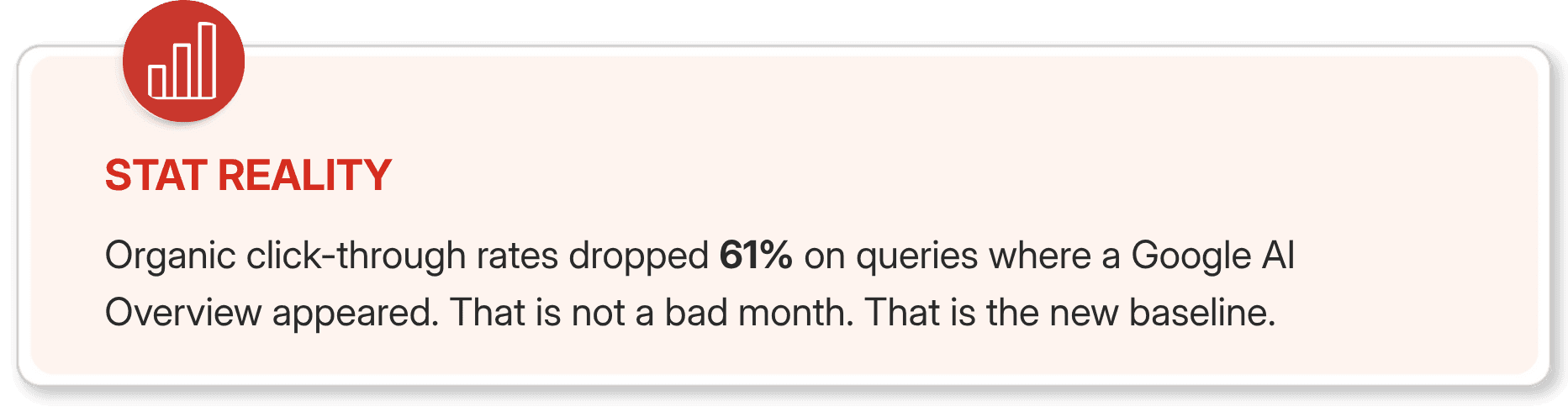
The Seer Interactive study from September 2025 analyzed 25 million impressions across 42 organizations. CTR fell from 1.76% to 0.61% wherever AI Overviews appeared. Ahrefs ran a separate study in December 2025 across 300,000 keywords and found a 58% CTR drop on those same queries.
These are not isolated findings. They point at the same structural reality: users are getting answers before they click. Google AI Overviews now appear in 65% of personalized U.S. search results as of March 2026, according to Advanced Web Ranking. The window of clean SERP territory is shrinking every quarter.
The Traffic Did Not Disappear. It Stopped Visiting Your Website.
The loudest misconception in the current SEO conversation is that search itself is dying. It is not. Rand Fishkin and SparkToro published research in September 2025 showing that 95% of U.S. devices still use traditional search every month, and that traditional search among the most frequent users actually grew from 83% to 87%.
Search volume is not falling. What is falling is the click rate on those searches.
Roughly 60% of all searches now end without a click to any website. That figure was 24.4% in the U.S. in March 2024. By March 2025 it had risen to 27.2%, and the global picture, accounting for AI-assisted queries, sits at approximately 60%. Users are reading answers from AI Overviews, featured snippets, and chatbots without ever reaching your page.
This is what the industry calls zero-click search. The more important question is what to do about it, and the answer starts with understanding what AI actually cites.
What AI Engines Actually Cite. Not What Most Marketers Assume
XFunnel analyzed 768,000 citations across 12 weeks, pulling data from ChatGPT, Google AI Overviews, and Perplexity. The findings challenge the assumptions behind most content strategies.
Content Type | Citation Rate in AI Search | What This Means for Your Strategy |
|---|---|---|
Product content | 46% to 70% | Specs, comparisons, and buying guides dominate citations |
News and research content | 5% to 16% | Cited when timely, authoritative, and well-structured |
Generic blog content | 3% to 6% | Nearly invisible to AI engines regardless of keyword ranking |
PR and press release content | Less than 2% | Effectively no return from an AI visibility standpoint |
Blog content gets cited 3% to 6% of the time. That is not a writing quality problem. It is a structural problem. Generic informational content without clear entities, extractable facts, or product context is exactly what AI engines skip.
The most cited domains in Google AI Overviews are not the biggest media publishers. Quora ranks first. Reddit ranks second. Google has a formal data partnership with Reddit. ChatGPT directs 50% of its links to business and service sites but draws the actual answers it synthesizes from community platforms
As of April 2026, only 38% of AI Overview citations come from the Google top 10. That figure was 76% in July 2025. AI is pulling from deeper in the results. ChatGPT cites positions 21 and beyond nearly 90% of the time. Ranking number one does not get you cited by AI. Being the clearest, most structured, most trustworthy source on a topic does.
Everyone Is Measuring the Wrong Thing.
Position one click-through rate has dropped to 19%, down from 28%. Position two sits at 12.6%, down from 20.83%. These numbers from GrowthSRC Media's July 2025 study show what the obsession with top rankings actually delivers right now.
Meanwhile Semrush published a finding in June 2025 that deserves more attention than it received. AI-referred visitors convert at 4.4 times the rate of traditional organic visitors. And their projection: AI search traffic will surpass traditional search traffic by early 2028.
Fewer visitors from AI. But dramatically more valuable when they arrive.
This inverts the entire traffic volume game that SEO has been playing for a decade. The question shifts from how do I get more organic clicks to how do I become the source that AI engines trust enough to send their highest-intent visitors to.
Three Things That Actually Determine Search Visibility Now.
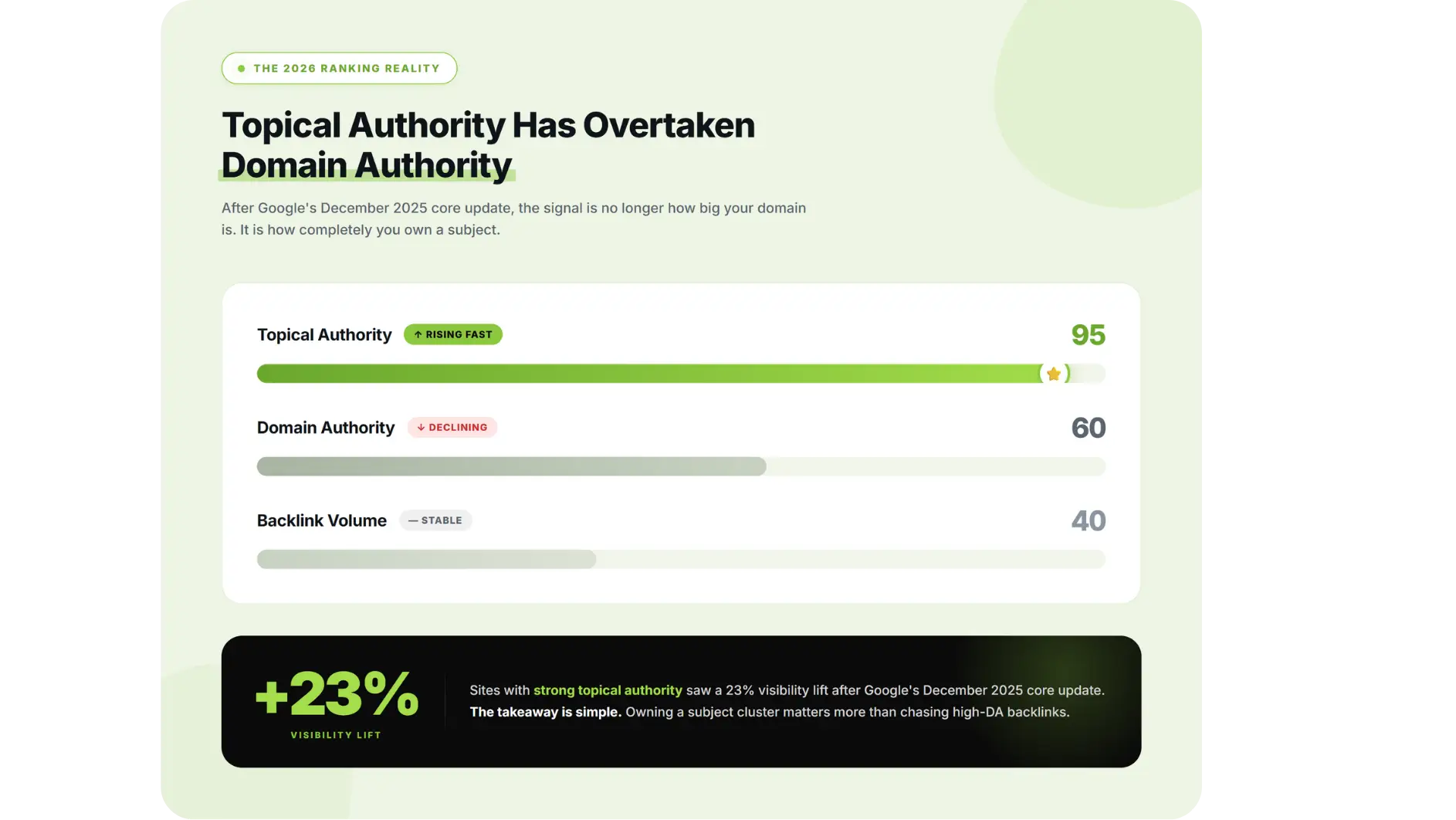
Topical authority has replaced domain authority as the primary signal.
A combined analysis from WLDM, ClickStream, and Search Engine Journal across 250,000 results found that topical authority now outweighs domain authority as a ranking factor. Google's December 2025 core update confirmed this: sites with strong topical authority saw a 23% visibility lift.
This is not about publishing more content. It is about owning a subject cluster so completely that both Google and AI engines treat a domain as the definitive source on that topic. That requires depth, consistency, and genuine expertise built into content structure. Not volume.
HTML structure is a citation signal, not just a technical requirement.
AI crawlers do not experience a website the way a human browser does. They read HTML. If content is rendered in JavaScript, AI bots see an empty page. If headings are styled div tags rather than semantic H1 through H6 elements, the content hierarchy is invisible. If definitions are buried in paragraphs without structural signals, extraction becomes guesswork.
The brands earning consistent AI citations have pages where the HTML alone tells a clear story. Clean structure, semantic tags, schema markup, and content that communicates its purpose through code. This is not technically complex. It requires discipline and intention in how pages are built.
Brand entity presence is the moat, most strategies are missing.
Brand mentions without links, co-mentions alongside trusted entities, consistent presence across multiple platforms, these signal to AI systems that a brand is a real, established entity worth referencing.
When someone hears a brand name and opens ChatGPT to ask about it, that chatbot looks for entity presence. Consistent information across key platforms, industry mentions, review signals, community discussions. If a brand only exists on its own website, the chatbot has nothing to work with. This is entity building. It is different from link building. And it is where the next three years of competitive advantage in search will be determined.
The Priority Order That Most SEO Strategies Get Backwards.
Some advice says optimize for crawlers first. Newer advice says optimize for AI bots first. Both are wrong.
Google's Helpful Content system, which has driven multiple major algorithm updates since 2022, operates on a single principle: if real users find a page unsatisfying, Google will detect it. Dwell time, return rate, pogo-sticking back to the SERP, these behavioral signals tell Google whether humans found what they needed. Content built for crawlers at the expense of human experience earns rankings that do not hold.
The correct order is human first, crawler second, AI bot third. A page built thoughtfully for a human reader is naturally more extractable for AI. Clean structure, clear definitions, logical flow, and direct answers are things both humans and AI engines respond to well. One excellent version of each page, built for the person reading it, serves all three audiences.
Why Reddit and Quora Require a Different Approach Than Most Brands Take.
Quora is the most cited domain in Google AI Overviews. Reddit is second. Those two facts make both platforms look like obvious marketing targets.
They are not. Not in the way most brands approach them.
Reddit and Quora are built on community trust. A brand account showing up with promotional content is identified immediately. Subreddits have long memories. Once flagged as a marketer trying to push a product, the content gets buried and the thread becomes a warning to others.
The only sustainable path on these platforms is genuine usefulness over time. Real answers, real expertise, real participation history before any brand mention appears. That is a long game. The payoff, citations from Reddit and Quora that carry real weight in AI search, cannot be replicated through a brand blog post on a company domain.

Blogs Are Not Dead. Generic Blogs Are.
A blog that chases keyword rankings by covering surface-level topics is competing against AI Overviews that synthesize the same information instantly. That blog has already lost before it is published.
But a blog that builds the knowledge layer around a product or service, explaining the industry context, the problems being solved, the adjacent concepts that matter, serves a different function entirely. It establishes topical authority across a domain. It feeds AI engines the context they need to understand what a brand stands for. And if structured correctly, with clear headings, defined terms, schema markup, and direct answers to real questions, it becomes the kind of extractable content that gets cited rather than summarized away.
Product content dominates AI citations at 46% to 70%. That does not mean stopping content production. It means every piece of content published needs to serve the product narrative. The knowledge layer and the product layer are one strategy, not two separate content programs.
What to Stop Spending Budget on Right Now.
Tactic | Why the Return Is Disappearing |
|---|---|
Generic informational blogs targeting keywords | 3% to 6% AI citation rate. AI Overviews answer the same queries instantly. |
Ranking position as the primary KPI | ChatGPT cites positions 21+ at nearly 90%. Position one CTR has dropped to 19%. |
JavaScript-rendered main content | AI bots cannot read it. Invisible to the systems making citation decisions. |
PR-only and press release content | Less than 2% citation rate in AI search. |
Google-only SEO strategy | 60% of searches end without a click. Audience is distributed across multiple platforms. |
Where This Is Actually Heading.
Lily Ray, Aleyda Solis, Barry Schwartz, and Danny Sullivan have all described the same direction: Search Everywhere Optimization. Not a rebrand of SEO. An accurate description of where audience attention has distributed.
Users do not start on Google by default anymore. A professional vetting a vendor reads Reddit first. Someone with a specific technical question opens Perplexity or ChatGPT. A consumer researching a product watches YouTube before visiting any brand website. The audience is distributed before it ever arrives at a company domain.
The brands building durable search visibility are not trying to be everywhere. They are making deliberate decisions about where their specific audience searches and building genuine, useful presence there. For most B2B companies that means LinkedIn, Reddit, and YouTube alongside traditional search. For e-commerce brands it means product schema, structured review signals, and content that AI can extract and cite accurately.
One Question Worth Asking Before Touching the Strategy.
If an AI engine visited a website today, could it extract a clear, accurate answer to the main problem that business solves?
Not from the homepage headline. Not from the about page. From the actual content that has been published, the structure of each page, the schema markup that is or is not in place, the entity signals the domain sends across the web.
If the answer is no, or unclear, that is where the work begins. Not with a new content calendar. Not with another link building campaign. With the fundamental question of whether the website clearly communicates what it stands for, and whether that clarity is built into the code, structure, and content simultaneously.
Final Thoughts
The playbooks that got modern SEO built are not just outdated. They are kind of working against the businesses still using them. Number one ranking, doesn’t really mean traffic anymore. Getting cited by AI does. Clear entities beat keyword stuffing and that sort of thing. Topical authority beats domain authority, full stop. Being the actual answer beats being parked on page one.
That gap between what your team is doing right now and what this new search world rewards… is the gap that either closes over the next 12 months or turns into that sort of permanent invisibility. The tactics that stopped paying off are not going back. The ones that replace them are already, quietly deciding who shows up in the results and who does not.
FAQs
Is SEO still worth investing in during 2025 and 2026?

Yes, but the investment needs to target a different outcome. Traditional organic CTR is declining where AI Overviews appear, with drops of 58% to 61% documented in major studies. However, AI-referred visitors convert at 4.4 times the rate of traditional organic visitors, according to Semrush research from June 2025. The goal shifts from traffic volume to becoming a cited, trusted source across AI and traditional search environments.
What is Search Everywhere Optimization and why does it matter?
Search Everywhere Optimization describes the shift from optimizing only for Google toward building visibility across every platform where a target audience searches. That includes Google, Bing, YouTube, Reddit, Quora, ChatGPT, Perplexity, and social platforms. It matters because 60% of all searches now end without a click to any website. Audience attention is distributed, and a single-platform strategy misses the majority of search behavior.
Why is blog content getting cited so rarely in AI search?
The XFunnel study of 768,000 AI citations found that generic blog content appears in only 3% to 6% of citations. AI engines favor product content, which accounts for 46% to 70% of citations, because it contains specific, extractable information: specs, comparisons, structured data. Blogs that lack clear entities, defined terms, schema markup, and a direct connection to product context are passed over in favor of more structured sources.
What does Generative Engine Optimization (GEO) involve?
GEO is the process of building a brand's digital presence to be recognized as a trusted, citable source by AI-powered search platforms including ChatGPT, Google AI Overviews, Perplexity, and Gemini. It includes E-E-A-T optimization, entity and schema building, conversational content structuring, brand signal development across platforms, AI citation tracking, and ensuring technical AI readiness. At Coozmoo, our GEO services are built around the goal of making a brand the definitive source in its niche across all major AI search environments.
How should a business prioritize between SEO and GEO investment?
The two are not separate investments. GEO builds on the same foundations as strong SEO: clean technical structure, topical authority, E-E-A-T signals, and entity clarity. The difference is in the additional layer of AI-specific optimization: structured data for AI extraction, brand entity building across platforms, conversational content formats, and active citation tracking. Businesses that strengthen both simultaneously are best positioned as AI search traffic is projected to surpass traditional search traffic by early 2028.
The search landscape has already changed. Not slowly, not gradually. The shift happened fast and most strategies have not caught up.
Here is something uncomfortable to say directly.
Most of what your team is currently doing for SEO, the keyword research, the backlink outreach, the blog publishing calendar, the position tracking, was built for a search environment that no longer exists. This is not a warning about what is coming. It is a description of what has already happened.
There have been three or four complete shifts in how search works over the past two decades. Each time there was a lag between when the shift occurred and when strategies caught up. That lag is where budgets get wasted on approaches that used to work and no longer do.
We are in that lag right now. And the gap this time is wider than any previous shift.
The Seer Interactive study from September 2025 analyzed 25 million impressions across 42 organizations. CTR fell from 1.76% to 0.61% wherever AI Overviews appeared. Ahrefs ran a separate study in December 2025 across 300,000 keywords and found a 58% CTR drop on those same queries.
These are not isolated findings. They point at the same structural reality: users are getting answers before they click. Google AI Overviews now appear in 65% of personalized U.S. search results as of March 2026, according to Advanced Web Ranking. The window of clean SERP territory is shrinking every quarter.
The Traffic Did Not Disappear. It Stopped Visiting Your Website.
The loudest misconception in the current SEO conversation is that search itself is dying. It is not. Rand Fishkin and SparkToro published research in September 2025 showing that 95% of U.S. devices still use traditional search every month, and that traditional search among the most frequent users actually grew from 83% to 87%.
Search volume is not falling. What is falling is the click rate on those searches.
Roughly 60% of all searches now end without a click to any website. That figure was 24.4% in the U.S. in March 2024. By March 2025 it had risen to 27.2%, and the global picture, accounting for AI-assisted queries, sits at approximately 60%. Users are reading answers from AI Overviews, featured snippets, and chatbots without ever reaching your page.
This is what the industry calls zero-click search. The more important question is what to do about it, and the answer starts with understanding what AI actually cites.
What AI Engines Actually Cite. Not What Most Marketers Assume
XFunnel analyzed 768,000 citations across 12 weeks, pulling data from ChatGPT, Google AI Overviews, and Perplexity. The findings challenge the assumptions behind most content strategies.
Content Type | Citation Rate in AI Search | What This Means for Your Strategy |
|---|---|---|
Product content | 46% to 70% | Specs, comparisons, and buying guides dominate citations |
News and research content | 5% to 16% | Cited when timely, authoritative, and well-structured |
Generic blog content | 3% to 6% | Nearly invisible to AI engines regardless of keyword ranking |
PR and press release content | Less than 2% | Effectively no return from an AI visibility standpoint |
Blog content gets cited 3% to 6% of the time. That is not a writing quality problem. It is a structural problem. Generic informational content without clear entities, extractable facts, or product context is exactly what AI engines skip.
The most cited domains in Google AI Overviews are not the biggest media publishers. Quora ranks first. Reddit ranks second. Google has a formal data partnership with Reddit. ChatGPT directs 50% of its links to business and service sites but draws the actual answers it synthesizes from community platforms
As of April 2026, only 38% of AI Overview citations come from the Google top 10. That figure was 76% in July 2025. AI is pulling from deeper in the results. ChatGPT cites positions 21 and beyond nearly 90% of the time. Ranking number one does not get you cited by AI. Being the clearest, most structured, most trustworthy source on a topic does.
Everyone Is Measuring the Wrong Thing.
Position one click-through rate has dropped to 19%, down from 28%. Position two sits at 12.6%, down from 20.83%. These numbers from GrowthSRC Media's July 2025 study show what the obsession with top rankings actually delivers right now.
Meanwhile Semrush published a finding in June 2025 that deserves more attention than it received. AI-referred visitors convert at 4.4 times the rate of traditional organic visitors. And their projection: AI search traffic will surpass traditional search traffic by early 2028.
Fewer visitors from AI. But dramatically more valuable when they arrive.
This inverts the entire traffic volume game that SEO has been playing for a decade. The question shifts from how do I get more organic clicks to how do I become the source that AI engines trust enough to send their highest-intent visitors to.
Three Things That Actually Determine Search Visibility Now.
Topical authority has replaced domain authority as the primary signal.
A combined analysis from WLDM, ClickStream, and Search Engine Journal across 250,000 results found that topical authority now outweighs domain authority as a ranking factor. Google's December 2025 core update confirmed this: sites with strong topical authority saw a 23% visibility lift.
This is not about publishing more content. It is about owning a subject cluster so completely that both Google and AI engines treat a domain as the definitive source on that topic. That requires depth, consistency, and genuine expertise built into content structure. Not volume.
HTML structure is a citation signal, not just a technical requirement.
AI crawlers do not experience a website the way a human browser does. They read HTML. If content is rendered in JavaScript, AI bots see an empty page. If headings are styled div tags rather than semantic H1 through H6 elements, the content hierarchy is invisible. If definitions are buried in paragraphs without structural signals, extraction becomes guesswork.
The brands earning consistent AI citations have pages where the HTML alone tells a clear story. Clean structure, semantic tags, schema markup, and content that communicates its purpose through code. This is not technically complex. It requires discipline and intention in how pages are built.
Brand entity presence is the moat, most strategies are missing.
Brand mentions without links, co-mentions alongside trusted entities, consistent presence across multiple platforms, these signal to AI systems that a brand is a real, established entity worth referencing.
When someone hears a brand name and opens ChatGPT to ask about it, that chatbot looks for entity presence. Consistent information across key platforms, industry mentions, review signals, community discussions. If a brand only exists on its own website, the chatbot has nothing to work with. This is entity building. It is different from link building. And it is where the next three years of competitive advantage in search will be determined.
The Priority Order That Most SEO Strategies Get Backwards.
Some advice says optimize for crawlers first. Newer advice says optimize for AI bots first. Both are wrong.
Google's Helpful Content system, which has driven multiple major algorithm updates since 2022, operates on a single principle: if real users find a page unsatisfying, Google will detect it. Dwell time, return rate, pogo-sticking back to the SERP, these behavioral signals tell Google whether humans found what they needed. Content built for crawlers at the expense of human experience earns rankings that do not hold.
The correct order is human first, crawler second, AI bot third. A page built thoughtfully for a human reader is naturally more extractable for AI. Clean structure, clear definitions, logical flow, and direct answers are things both humans and AI engines respond to well. One excellent version of each page, built for the person reading it, serves all three audiences.
Why Reddit and Quora Require a Different Approach Than Most Brands Take.
Quora is the most cited domain in Google AI Overviews. Reddit is second. Those two facts make both platforms look like obvious marketing targets.
They are not. Not in the way most brands approach them.
Reddit and Quora are built on community trust. A brand account showing up with promotional content is identified immediately. Subreddits have long memories. Once flagged as a marketer trying to push a product, the content gets buried and the thread becomes a warning to others.
The only sustainable path on these platforms is genuine usefulness over time. Real answers, real expertise, real participation history before any brand mention appears. That is a long game. The payoff, citations from Reddit and Quora that carry real weight in AI search, cannot be replicated through a brand blog post on a company domain.
Blogs Are Not Dead. Generic Blogs Are.
A blog that chases keyword rankings by covering surface-level topics is competing against AI Overviews that synthesize the same information instantly. That blog has already lost before it is published.
But a blog that builds the knowledge layer around a product or service, explaining the industry context, the problems being solved, the adjacent concepts that matter, serves a different function entirely. It establishes topical authority across a domain. It feeds AI engines the context they need to understand what a brand stands for. And if structured correctly, with clear headings, defined terms, schema markup, and direct answers to real questions, it becomes the kind of extractable content that gets cited rather than summarized away.
Product content dominates AI citations at 46% to 70%. That does not mean stopping content production. It means every piece of content published needs to serve the product narrative. The knowledge layer and the product layer are one strategy, not two separate content programs.
What to Stop Spending Budget on Right Now.
Tactic | Why the Return Is Disappearing |
|---|---|
Generic informational blogs targeting keywords | 3% to 6% AI citation rate. AI Overviews answer the same queries instantly. |
Ranking position as the primary KPI | ChatGPT cites positions 21+ at nearly 90%. Position one CTR has dropped to 19%. |
JavaScript-rendered main content | AI bots cannot read it. Invisible to the systems making citation decisions. |
PR-only and press release content | Less than 2% citation rate in AI search. |
Google-only SEO strategy | 60% of searches end without a click. Audience is distributed across multiple platforms. |
Where This Is Actually Heading.
Lily Ray, Aleyda Solis, Barry Schwartz, and Danny Sullivan have all described the same direction: Search Everywhere Optimization. Not a rebrand of SEO. An accurate description of where audience attention has distributed.
Users do not start on Google by default anymore. A professional vetting a vendor reads Reddit first. Someone with a specific technical question opens Perplexity or ChatGPT. A consumer researching a product watches YouTube before visiting any brand website. The audience is distributed before it ever arrives at a company domain.
The brands building durable search visibility are not trying to be everywhere. They are making deliberate decisions about where their specific audience searches and building genuine, useful presence there. For most B2B companies that means LinkedIn, Reddit, and YouTube alongside traditional search. For e-commerce brands it means product schema, structured review signals, and content that AI can extract and cite accurately.
One Question Worth Asking Before Touching the Strategy.
If an AI engine visited a website today, could it extract a clear, accurate answer to the main problem that business solves?
Not from the homepage headline. Not from the about page. From the actual content that has been published, the structure of each page, the schema markup that is or is not in place, the entity signals the domain sends across the web.
If the answer is no, or unclear, that is where the work begins. Not with a new content calendar. Not with another link building campaign. With the fundamental question of whether the website clearly communicates what it stands for, and whether that clarity is built into the code, structure, and content simultaneously.
Final Thoughts
The playbooks that got modern SEO built are not just outdated. They are kind of working against the businesses still using them. Number one ranking, doesn’t really mean traffic anymore. Getting cited by AI does. Clear entities beat keyword stuffing and that sort of thing. Topical authority beats domain authority, full stop. Being the actual answer beats being parked on page one.
That gap between what your team is doing right now and what this new search world rewards… is the gap that either closes over the next 12 months or turns into that sort of permanent invisibility. The tactics that stopped paying off are not going back. The ones that replace them are already, quietly deciding who shows up in the results and who does not.
FAQs
Is SEO still worth investing in during 2025 and 2026?
Yes, but the investment needs to target a different outcome. Traditional organic CTR is declining where AI Overviews appear, with drops of 58% to 61% documented in major studies. However, AI-referred visitors convert at 4.4 times the rate of traditional organic visitors, according to Semrush research from June 2025. The goal shifts from traffic volume to becoming a cited, trusted source across AI and traditional search environments.
What is Search Everywhere Optimization and why does it matter?
Search Everywhere Optimization describes the shift from optimizing only for Google toward building visibility across every platform where a target audience searches. That includes Google, Bing, YouTube, Reddit, Quora, ChatGPT, Perplexity, and social platforms. It matters because 60% of all searches now end without a click to any website. Audience attention is distributed, and a single-platform strategy misses the majority of search behavior.
Why is blog content getting cited so rarely in AI search?
The XFunnel study of 768,000 AI citations found that generic blog content appears in only 3% to 6% of citations. AI engines favor product content, which accounts for 46% to 70% of citations, because it contains specific, extractable information: specs, comparisons, structured data. Blogs that lack clear entities, defined terms, schema markup, and a direct connection to product context are passed over in favor of more structured sources.
What does Generative Engine Optimization (GEO) involve?
GEO is the process of building a brand's digital presence to be recognized as a trusted, citable source by AI-powered search platforms including ChatGPT, Google AI Overviews, Perplexity, and Gemini. It includes E-E-A-T optimization, entity and schema building, conversational content structuring, brand signal development across platforms, AI citation tracking, and ensuring technical AI readiness. At Coozmoo, our GEO services are built around the goal of making a brand the definitive source in its niche across all major AI search environments.
How should a business prioritize between SEO and GEO investment?
The two are not separate investments. GEO builds on the same foundations as strong SEO: clean technical structure, topical authority, E-E-A-T signals, and entity clarity. The difference is in the additional layer of AI-specific optimization: structured data for AI extraction, brand entity building across platforms, conversational content formats, and active citation tracking. Businesses that strengthen both simultaneously are best positioned as AI search traffic is projected to surpass traditional search traffic by early 2028.



Summarize with AI


Want to be seen everywhere?
Get a free AI-search audit Today!



4.9/5 Ratings!


Don’t miss our revenue growth tips!
Get expert marketing tips—straight to your inbox, like thousands of happy clients.
Don’t miss our revenue growth tips!
Get expert marketing tips—straight to your inbox, like thousands of happy clients.
Don’t miss our revenue growth tips!
Don’t miss our revenue growth tips!
Get expert marketing tips—straight to your inbox, like thousands of happy clients.
Relevant Blogs on Generative AI SEO
Relevant Blogs on Generative AI SEO
Unlock data-driven insights in AI-powered SEO—explore our featured blogs and skyrocket your revenue before your competitors do.
Unlock data-driven insights in AI-powered SEO—explore our featured blogs and skyrocket your revenue before your competitors do.

GEO
Sep 22, 2026
15 Min Read
AI Search Runs on More SEO Than You Think
GEO
Sep 22, 2026
15 Min Read
AI Search Runs on More SEO Than You Think
GEO
Sep 22, 2026
15 Min Read
AI Search Runs on More SEO Than You Think

GEO
Sep 7, 2026
8 Min Read
How to Optimize Content for AI Search Engines: Best Practices
GEO
Sep 7, 2026
8 Min Read
How to Optimize Content for AI Search Engines: Best Practices
GEO
Sep 7, 2026
8 Min Read
How to Optimize Content for AI Search Engines: Best Practices

GEO
Sep 4, 2026
12 Min Read
How Ecommerce Brands Can Advertise in Google AI Mode?
GEO
Sep 4, 2026
12 Min Read
How Ecommerce Brands Can Advertise in Google AI Mode?
GEO
Sep 4, 2026
12 Min Read
How Ecommerce Brands Can Advertise in Google AI Mode?














Ready to speak with an expert?
Data-Driven Marketing Agency That Elevates ROI
1100+
Websites Designed & Optimized to Convert
$280M+
Client Revenue Driven & Growing Strong
Discover how to skyrocket
your revenue today!
Trusted by 1000+ Owners!
Ready to speak with an expert?
Data-Driven Marketing Agency That Elevates ROI
1100+
Websites Designed & Optimized to Convert
$280M+
Client Revenue Driven & Growing Strong
Discover how to skyrocket
your revenue today!
Trusted by 1000+ Owners!
Want to skyrocket revenue?
4.9/5 Ratings!
Ready to speak with an expert?
Data-Driven Marketing Agency That Elevates ROI
1100+
Websites Designed & Optimized to Convert
$280M+
Client Revenue Driven & Growing Strong
Discover how to skyrocket
your revenue today!
Trusted by 1000+ Owners!
Call
Meet