Self-Promotional "Best" Listicles Are Backfiring in AI Search: Here's the Data
Self-Promotional "Best" Listicles Are Backfiring in AI Search: Here's the Data
Last Updated:
Table of Content
Case Studies




For the last couple of years, there's been one growth hack almost every SaaS marketing team has quietly tried: write a "best [category] software" article, rank your own brand at the top, and watch the AI citations roll in. It worked. Until, apparently, it stopped working quite so well.
New research analyzing 100 B2B "best [category]" queries across Google's AI Overviews found something that should make every marketer pumping out these self-promotional listicles a little nervous. When a brand's own "best of" article gets cited as a source, that same brand gets left out of the actual AI recommendation roughly 69% of the time. Worse, the competitors mentioned inside that listicle often get the recommendation instead. You're writing the article, doing the keyword research, building the page, and your AI citation is functioning as a referral service for the brands you listed as runners-up.
This matters right now because AI Search, AI Overviews, and tools like ChatGPT have quietly become a meaningful discovery channel for B2B buyers, and most marketing teams still treat "getting cited" as the finish line. It isn't. Citations and recommendations are two very different outcomes, and conflating them is leading a lot of smart marketers to keep investing in a tactic that's no longer paying off the way it used to. This piece breaks down the data, walks through real examples, and lays out what businesses of every size should actually do about it.

Why AI Search Is Treating Self-Promotional Listicles Differently Now
Self-promotional listicles became popular because there was a gap to fill. Before generative AI search existed, almost nobody wanted to publish a page that openly ranked their own brand first, because it read as biased to a human visitor. Once it became clear that large language models were pulling directly from these pages to build answers, that hesitation disappeared fast.
The tactic spread quickly across SEO conferences, YouTube tutorials, and agency playbooks. Shopify alone reportedly published more than 100 of these "best e-commerce platform for X" style pages before quietly removing a number of them this year. Multiply that pattern across every SaaS category, and you get a web flooded with brands telling AI models they're the top choice.
Here's what appears to have shifted: Google's AI Overviews now seem to separate two things that used to move together what gets cited as a source, and who actually gets named as the recommendation. Across the 80 prompts in the research that triggered an AI Overview response, 74% of them cited a self-promoter's own listicle while leaving that brand's name out of the final answer. That's a consistent pattern, not a handful of edge cases, and it's reshaping how AI search rewards brand claims versus brand reputation.
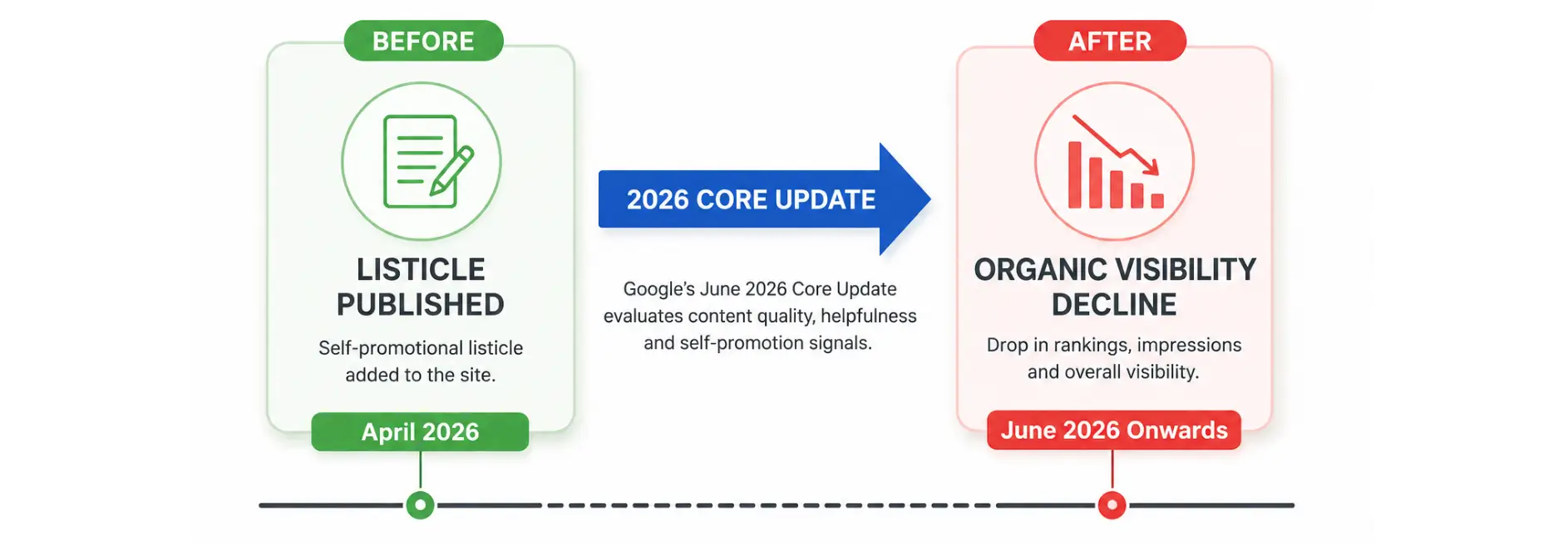
There's a second consequence worth flagging. Sites leaning heavily on this tactic have reportedly seen organic visibility drop, in some cases across the entire domain rather than just the affected pages, with declines accelerating through Google's May 2026 core update. So the risk isn't confined to AI Overviews. It's showing up in regular organic search too.
A Quick Primer: What "GEO" Means and Why It Matters Here
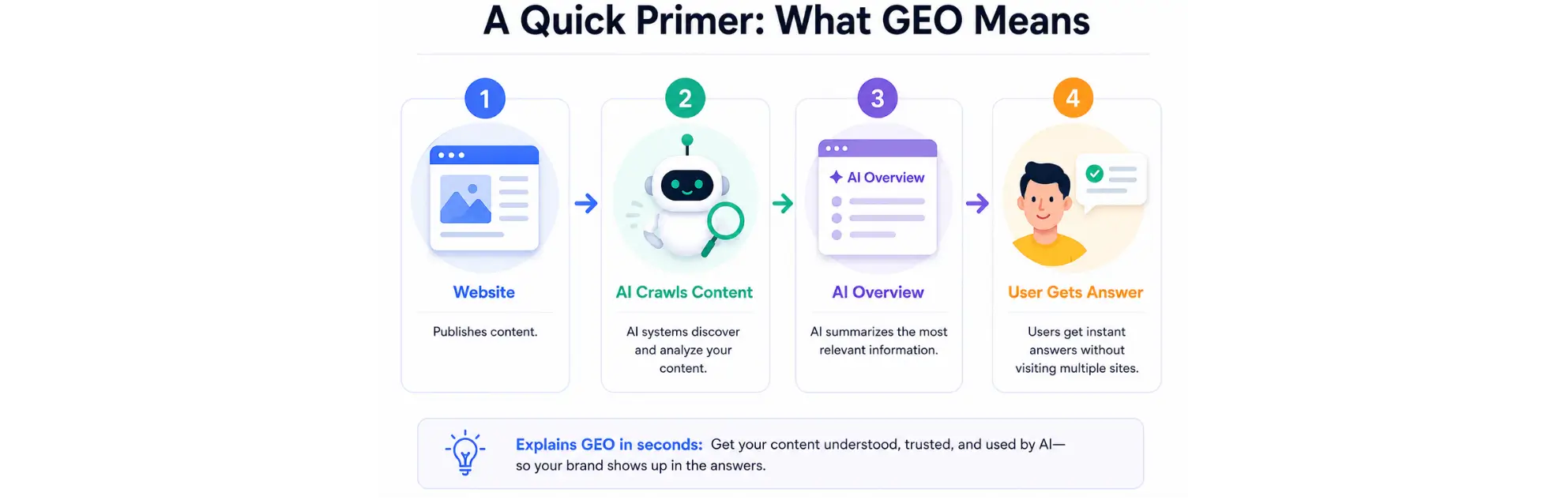
If you've heard the term GEO, or generative engine optimization, floating around and weren't quite sure what it meant, here's the short version. It's the practice of shaping content so that AI tools like ChatGPT, Google's AI Overviews, and Perplexity are more likely to use it when generating an answer. Traditional SEO is built around ranking on a results page a human will scroll through. GEO is built around being the source an AI model pulls from when it writes a direct answer, often without showing the user a list of links at all.
Self-promotional listicles were one of the earliest and most effective GEO tactics precisely because they're formatted exactly the way these models like to extract information: clear category, clear ranking, and clear comparison points. The format worked. What's changing is what happens after the model extracts that information, whether it trusts the brand's own ranking or quietly substitutes in someone else's.
AI Citations vs. AI Recommendations: Why the Difference Matters
Most teams tracking AI search performance look at one number: did we get cited? That's an easy metric to pull and an easy one to report up the chain. But citation and recommendation measure two completely different outcomes.
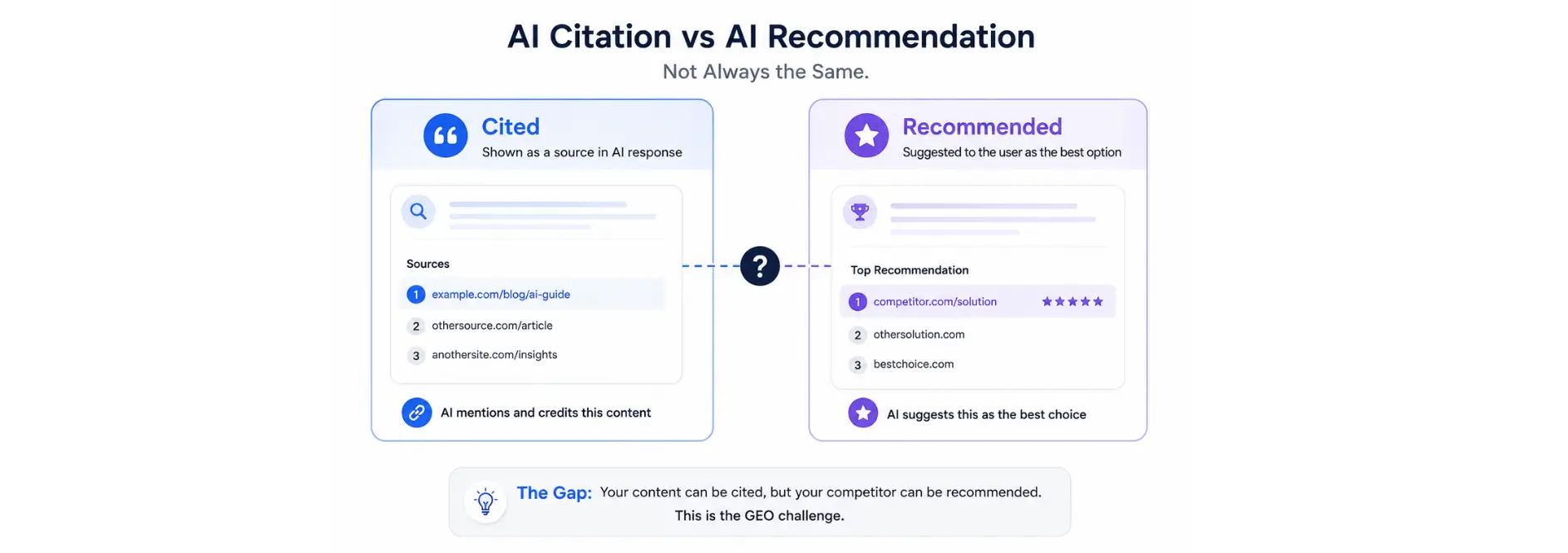
A citation means your page was used as a source to help the AI construct its answer. Your URL might show up in a sidebar or get referenced inline.
A recommendation means your actual brand name appears as one of the suggested options in that answer.
The research found these two outcomes diverging constantly. A brand can be cited several times throughout an AI Overview response and still never get named as a pick. Meanwhile, the competitors that the original listicle mentioned, often included purely for the sake of looking balanced, end up earning the recommendation slot instead.
If you're judging AI search success purely by citation count, you may be celebrating a metric that has very little connection to whether a potential customer actually sees your brand recommended.
A Simple Way to Compare the Two Outcomes
What You're Measuring | Citation | Recommendation |
|---|---|---|
What it means | Your page was used as a source | Your brand name appears as a suggested option |
Where it shows up | Sidebar links, inline references | Inside the actual AI-generated answer text |
Does the user see your brand name? | Not necessarily | Yes |
Correlates with buyer consideration? | Weakly | Strongly |
What drives it | Page structure, keyword match, content clarity | Third-party authority, backlinks, brand mentions elsewhere |
Real Examples of the Pattern in Action
1. Help Desk Software: Cited, Not Chosen
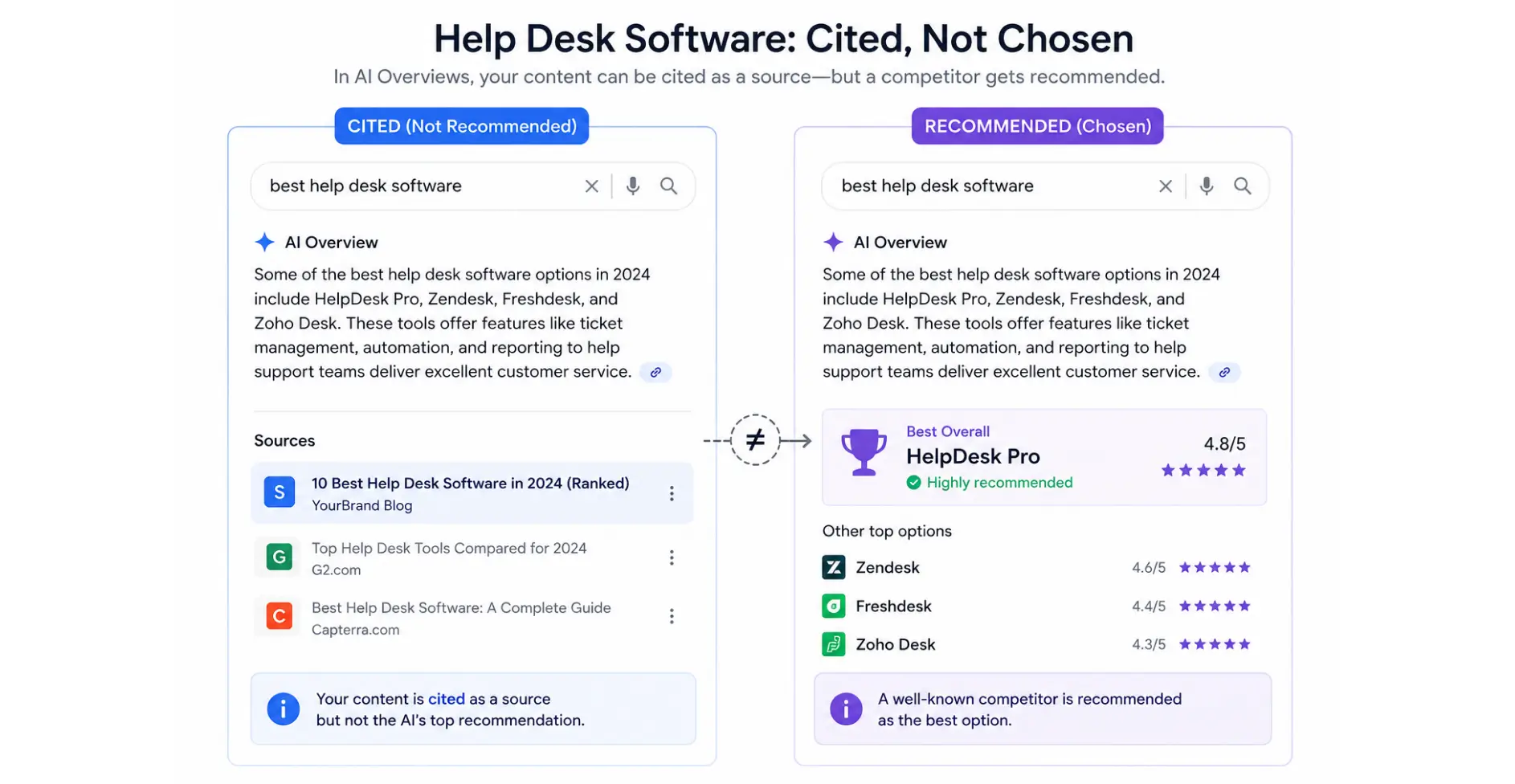
In AI Overview results for "best help desk software," brands that published their own self-ranking listicles showed up as cited sources, tucked underneath the recommendation for an established competitor. The brands publishing those listicles weren't the ones recommended. The competitors they named inside their own articles the well-known, widely reviewed players in the category were.
2. Project Management Tools: The Authority Gap
For "best project management software" queries, several smaller and mid-market brands had their self-promotional listicles cited as sources. None of them were the brands actually recommended in the response. The brands that did get recommended were the same handful of household names that show up across nearly every independent, third-party roundup in that category regardless of which company's listicle the AI happened to cite.
3. Survey and Learning Software: Naming Competitors Backfires
Across several SaaS categories in this research, including learning management systems and survey tools, a recurring detail stood out: brands that named their competitors inside their own "best of" listicle even briefly, even just for comparison, saw those same competitors picked up as the AI's recommended answer. The self-ranking didn't change the outcome. The competitor mentions did.
4. What a Healthier Approach Looks Like
Not every "best of" page is a liability. Independent review sites, industry publications, and analyst reports that aren't owned by any single vendor in the category tend to get both cited and trusted as the basis for recommendations. The difference isn't the format. It's who's doing the ranking. A roundup written by a neutral third party carries a kind of credibility that a vendor ranking itself simply can't replicate, no matter how well the page is built.
This is worth remembering before scrapping comparison content altogether. The problem isn't writing about your category. It's writing about your category while also being a contestant in it.
Why Some Brands Still Get Away With It
Not every self-promotional listicle fails. The research found that brands with strong existing authority meaningful backlink profiles, frequent mentions across AI Overviews and ChatGPT, and a long track record of being talked about by other sites occasionally got both the citation and the recommendation.
That detail matters because it tells you what's actually driving the outcome. It isn't how well the listicle page is built. The excluded brands in this research generally had clean, well-optimized pages; that's exactly why those pages ranked and got pulled in as sources in the first place. The deciding factor seems to be how much of the rest of the internet is already talking about and linking to that brand, independent of anything the brand says about itself.
In other words, the listicle format isn't broken. It's just no longer a substitute for actual third-party reputation. If your brand doesn't have that reputation yet, publishing more "best of" pages won't manufacture it.
Why Authority Seems to Outweigh Optimization
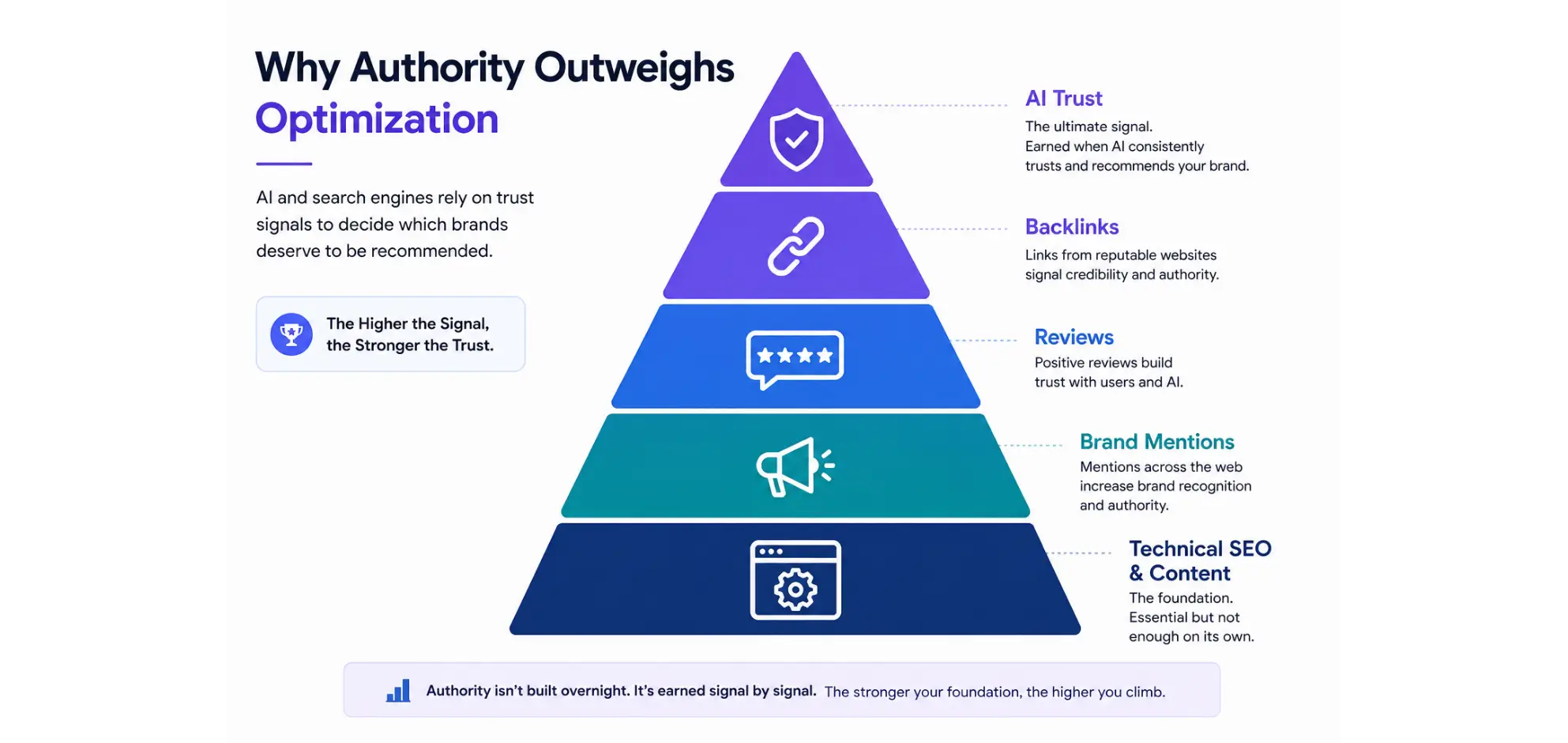
It's tempting to assume this comes down to better SEO work cleaner schema, stronger headlines, smarter internal linking. But that doesn't match what the data shows. Pages from smaller brands were often well-optimized enough to get pulled in as a citation in the first place. The model clearly found them relevant. It just didn't trust the self-ranking enough to repeat it as a recommendation.
That distinction matters for budgeting. If the gap were a technical SEO problem, the fix would be cheap: better formatting, better headers, better structured data. Since the gap appears to be a trust and authority problem instead, the fix is slower and less glamorous: more genuine mentions, more reviews, more coverage you didn't write yourself.
What This Means for Your AI Search Strategy
Stop Treating Citations as the Finish Line: If your AI search reporting only tracks whether your URL got cited, you're missing the metric that actually correlates with buyer behavior. Track recommendations as a distinct outcome. The gap between the two numbers will tell you more about your real AI search visibility than either number alone.
Be Deliberate About Who You Name in Comparison Content: If you publish category roundups or comparison pages, understand that naming a competitorn even to position yourself as better may be handing that competitor a recommendation slot in AI Overviews. Before you list five rivals "for fairness," ask whether that fairness is actually buying their visibility at your expense.
Invest in Earned Mentions, Not Just Owned Content: Reviews on independent platforms, founder interviews, original research that other sites reference, and genuine press coverage all build the kind of external signal that appears to influence AI recommendations far more than a self-published ranking does. This is slower than publishing another listicle, but it's the lever that actually seems to move the needle.
Audit What You've Already Published: Before writing another self-promotional listicle, check how your existing ones are performing in AI Overviews. If a page is getting cited but the recommendation keeps going to a named competitor, that page may be doing more harm than good, even if it still drives some organic traffic.
A Practical Checklist Before You Publish Another "Best Of" Page:
Are you naming competitors who are more established than you? If so, expect the AI to favor them in the recommendation, not your brand.
Does your brand have enough third-party mentions, reviews, and backlinks to support a self-ranking claim? If not, the page is unlikely to earn you the recommendation regardless of how well it's written.
Could this content exist as a neutral comparison instead of a self-ranked one? Removing your own brand from the No. 1 spot, or leaving it out of the ranking altogether, may reduce the appearance of bias without sacrificing the page's usefulness.
Have you checked whether this exact page is already being cited in AI Overviews for your target query, and if so, who's actually getting recommended alongside it?
Final Thoughts
Self-promotional listicles aren't dead. They're just no longer a shortcut. The brands that still benefit from this format are largely the ones who didn't need it in the first place they already had the backlinks, the mentions, and the reputation that AI Search seems to be weighing more heavily than ever.
If your current strategy is built mainly around publishing "best of" pages that rank your own brand first, it's worth checking how those pages are actually performing in AI Overviews today, not just in traditional rankings. You might find you've spent the last year quietly building visibility for the competitors you named.
Want a second opinion on how your brand shows up in AI Search? Drop your category and current "best of" page into the comments, or reach out through the contact form below, and we'll take a look at whether your listicle is helping you or quietly promoting someone else.
FAQs
Does getting cited in AI Search mean Google trusts my brand?

Not necessarily. AI citation means your content was helpful enough to help build an answer. It doesn’t mean the AI is endorsing your brand as the best option. Trust, in this context, shows up in the recommendation, not the citation.
Should I remove my existing self-promotional listicles?
Not automatically. Start by looking at how each page in AI Overviews performs for its target query. If it is being cited but competitors are being recommended, think about rewriting it into a more neutral comparison instead of removing it completely, it might still bring organic traffic on its own merits.
Does this only affect AI Overviews, or other AI tools too?
The research followed Google’s AI Overviews, but the dynamic at work — that self-published rankings are less important than third-party authority — is consistent with how generative AI tools evaluate source credibility. It's reasonable to expect similar patterns elsewhere, even without separate data confirming it tool by tool.
Is this the same as Google penalizing self-promotional content?
Not exactly. What the data shows looks more like the AI model declining to repeat a brand's own ranking claim, rather than an explicit penalty. Separately, some sites that relied heavily on this and other aggressive SEO tactics have seen broader organic visibility declines, but that appears tied to a mix of signals, not the listicle format alone.
What's the fastest way to improve my brand's AI search visibility?
There's no real shortcut here. The fastest meaningful lever is usually earning more genuine third-party mentions, reviews, and backlinks, since those appear to carry more weight in recommendations than anything you publish about yourself.
For the last couple of years, there's been one growth hack almost every SaaS marketing team has quietly tried: write a "best [category] software" article, rank your own brand at the top, and watch the AI citations roll in. It worked. Until, apparently, it stopped working quite so well.
New research analyzing 100 B2B "best [category]" queries across Google's AI Overviews found something that should make every marketer pumping out these self-promotional listicles a little nervous. When a brand's own "best of" article gets cited as a source, that same brand gets left out of the actual AI recommendation roughly 69% of the time. Worse, the competitors mentioned inside that listicle often get the recommendation instead. You're writing the article, doing the keyword research, building the page, and your AI citation is functioning as a referral service for the brands you listed as runners-up.
This matters right now because AI Search, AI Overviews, and tools like ChatGPT have quietly become a meaningful discovery channel for B2B buyers, and most marketing teams still treat "getting cited" as the finish line. It isn't. Citations and recommendations are two very different outcomes, and conflating them is leading a lot of smart marketers to keep investing in a tactic that's no longer paying off the way it used to. This piece breaks down the data, walks through real examples, and lays out what businesses of every size should actually do about it.
Why AI Search Is Treating Self-Promotional Listicles Differently Now
Self-promotional listicles became popular because there was a gap to fill. Before generative AI search existed, almost nobody wanted to publish a page that openly ranked their own brand first, because it read as biased to a human visitor. Once it became clear that large language models were pulling directly from these pages to build answers, that hesitation disappeared fast.
The tactic spread quickly across SEO conferences, YouTube tutorials, and agency playbooks. Shopify alone reportedly published more than 100 of these "best e-commerce platform for X" style pages before quietly removing a number of them this year. Multiply that pattern across every SaaS category, and you get a web flooded with brands telling AI models they're the top choice.
Here's what appears to have shifted: Google's AI Overviews now seem to separate two things that used to move together what gets cited as a source, and who actually gets named as the recommendation. Across the 80 prompts in the research that triggered an AI Overview response, 74% of them cited a self-promoter's own listicle while leaving that brand's name out of the final answer. That's a consistent pattern, not a handful of edge cases, and it's reshaping how AI search rewards brand claims versus brand reputation.
There's a second consequence worth flagging. Sites leaning heavily on this tactic have reportedly seen organic visibility drop, in some cases across the entire domain rather than just the affected pages, with declines accelerating through Google's May 2026 core update. So the risk isn't confined to AI Overviews. It's showing up in regular organic search too.
A Quick Primer: What "GEO" Means and Why It Matters Here
If you've heard the term GEO, or generative engine optimization, floating around and weren't quite sure what it meant, here's the short version. It's the practice of shaping content so that AI tools like ChatGPT, Google's AI Overviews, and Perplexity are more likely to use it when generating an answer. Traditional SEO is built around ranking on a results page a human will scroll through. GEO is built around being the source an AI model pulls from when it writes a direct answer, often without showing the user a list of links at all.
Self-promotional listicles were one of the earliest and most effective GEO tactics precisely because they're formatted exactly the way these models like to extract information: clear category, clear ranking, and clear comparison points. The format worked. What's changing is what happens after the model extracts that information, whether it trusts the brand's own ranking or quietly substitutes in someone else's.
AI Citations vs. AI Recommendations: Why the Difference Matters
Most teams tracking AI search performance look at one number: did we get cited? That's an easy metric to pull and an easy one to report up the chain. But citation and recommendation measure two completely different outcomes.
A citation means your page was used as a source to help the AI construct its answer. Your URL might show up in a sidebar or get referenced inline.
A recommendation means your actual brand name appears as one of the suggested options in that answer.
The research found these two outcomes diverging constantly. A brand can be cited several times throughout an AI Overview response and still never get named as a pick. Meanwhile, the competitors that the original listicle mentioned, often included purely for the sake of looking balanced, end up earning the recommendation slot instead.
If you're judging AI search success purely by citation count, you may be celebrating a metric that has very little connection to whether a potential customer actually sees your brand recommended.
A Simple Way to Compare the Two Outcomes
What You're Measuring | Citation | Recommendation |
|---|---|---|
What it means | Your page was used as a source | Your brand name appears as a suggested option |
Where it shows up | Sidebar links, inline references | Inside the actual AI-generated answer text |
Does the user see your brand name? | Not necessarily | Yes |
Correlates with buyer consideration? | Weakly | Strongly |
What drives it | Page structure, keyword match, content clarity | Third-party authority, backlinks, brand mentions elsewhere |
Real Examples of the Pattern in Action
1. Help Desk Software: Cited, Not Chosen
In AI Overview results for "best help desk software," brands that published their own self-ranking listicles showed up as cited sources, tucked underneath the recommendation for an established competitor. The brands publishing those listicles weren't the ones recommended. The competitors they named inside their own articles the well-known, widely reviewed players in the category were.
2. Project Management Tools: The Authority Gap
For "best project management software" queries, several smaller and mid-market brands had their self-promotional listicles cited as sources. None of them were the brands actually recommended in the response. The brands that did get recommended were the same handful of household names that show up across nearly every independent, third-party roundup in that category regardless of which company's listicle the AI happened to cite.
3. Survey and Learning Software: Naming Competitors Backfires
Across several SaaS categories in this research, including learning management systems and survey tools, a recurring detail stood out: brands that named their competitors inside their own "best of" listicle even briefly, even just for comparison, saw those same competitors picked up as the AI's recommended answer. The self-ranking didn't change the outcome. The competitor mentions did.
4. What a Healthier Approach Looks Like
Not every "best of" page is a liability. Independent review sites, industry publications, and analyst reports that aren't owned by any single vendor in the category tend to get both cited and trusted as the basis for recommendations. The difference isn't the format. It's who's doing the ranking. A roundup written by a neutral third party carries a kind of credibility that a vendor ranking itself simply can't replicate, no matter how well the page is built.
This is worth remembering before scrapping comparison content altogether. The problem isn't writing about your category. It's writing about your category while also being a contestant in it.
Why Some Brands Still Get Away With It
Not every self-promotional listicle fails. The research found that brands with strong existing authority meaningful backlink profiles, frequent mentions across AI Overviews and ChatGPT, and a long track record of being talked about by other sites occasionally got both the citation and the recommendation.
That detail matters because it tells you what's actually driving the outcome. It isn't how well the listicle page is built. The excluded brands in this research generally had clean, well-optimized pages; that's exactly why those pages ranked and got pulled in as sources in the first place. The deciding factor seems to be how much of the rest of the internet is already talking about and linking to that brand, independent of anything the brand says about itself.
In other words, the listicle format isn't broken. It's just no longer a substitute for actual third-party reputation. If your brand doesn't have that reputation yet, publishing more "best of" pages won't manufacture it.
Why Authority Seems to Outweigh Optimization
It's tempting to assume this comes down to better SEO work cleaner schema, stronger headlines, smarter internal linking. But that doesn't match what the data shows. Pages from smaller brands were often well-optimized enough to get pulled in as a citation in the first place. The model clearly found them relevant. It just didn't trust the self-ranking enough to repeat it as a recommendation.
That distinction matters for budgeting. If the gap were a technical SEO problem, the fix would be cheap: better formatting, better headers, better structured data. Since the gap appears to be a trust and authority problem instead, the fix is slower and less glamorous: more genuine mentions, more reviews, more coverage you didn't write yourself.
What This Means for Your AI Search Strategy
Stop Treating Citations as the Finish Line: If your AI search reporting only tracks whether your URL got cited, you're missing the metric that actually correlates with buyer behavior. Track recommendations as a distinct outcome. The gap between the two numbers will tell you more about your real AI search visibility than either number alone.
Be Deliberate About Who You Name in Comparison Content: If you publish category roundups or comparison pages, understand that naming a competitorn even to position yourself as better may be handing that competitor a recommendation slot in AI Overviews. Before you list five rivals "for fairness," ask whether that fairness is actually buying their visibility at your expense.
Invest in Earned Mentions, Not Just Owned Content: Reviews on independent platforms, founder interviews, original research that other sites reference, and genuine press coverage all build the kind of external signal that appears to influence AI recommendations far more than a self-published ranking does. This is slower than publishing another listicle, but it's the lever that actually seems to move the needle.
Audit What You've Already Published: Before writing another self-promotional listicle, check how your existing ones are performing in AI Overviews. If a page is getting cited but the recommendation keeps going to a named competitor, that page may be doing more harm than good, even if it still drives some organic traffic.
A Practical Checklist Before You Publish Another "Best Of" Page:
Are you naming competitors who are more established than you? If so, expect the AI to favor them in the recommendation, not your brand.
Does your brand have enough third-party mentions, reviews, and backlinks to support a self-ranking claim? If not, the page is unlikely to earn you the recommendation regardless of how well it's written.
Could this content exist as a neutral comparison instead of a self-ranked one? Removing your own brand from the No. 1 spot, or leaving it out of the ranking altogether, may reduce the appearance of bias without sacrificing the page's usefulness.
Have you checked whether this exact page is already being cited in AI Overviews for your target query, and if so, who's actually getting recommended alongside it?
Final Thoughts
Self-promotional listicles aren't dead. They're just no longer a shortcut. The brands that still benefit from this format are largely the ones who didn't need it in the first place they already had the backlinks, the mentions, and the reputation that AI Search seems to be weighing more heavily than ever.
If your current strategy is built mainly around publishing "best of" pages that rank your own brand first, it's worth checking how those pages are actually performing in AI Overviews today, not just in traditional rankings. You might find you've spent the last year quietly building visibility for the competitors you named.
Want a second opinion on how your brand shows up in AI Search? Drop your category and current "best of" page into the comments, or reach out through the contact form below, and we'll take a look at whether your listicle is helping you or quietly promoting someone else.
FAQs
Does getting cited in AI Search mean Google trusts my brand?
Not necessarily. AI citation means your content was helpful enough to help build an answer. It doesn’t mean the AI is endorsing your brand as the best option. Trust, in this context, shows up in the recommendation, not the citation.
Should I remove my existing self-promotional listicles?
Not automatically. Start by looking at how each page in AI Overviews performs for its target query. If it is being cited but competitors are being recommended, think about rewriting it into a more neutral comparison instead of removing it completely, it might still bring organic traffic on its own merits.
Does this only affect AI Overviews, or other AI tools too?
The research followed Google’s AI Overviews, but the dynamic at work — that self-published rankings are less important than third-party authority — is consistent with how generative AI tools evaluate source credibility. It's reasonable to expect similar patterns elsewhere, even without separate data confirming it tool by tool.
Is this the same as Google penalizing self-promotional content?
Not exactly. What the data shows looks more like the AI model declining to repeat a brand's own ranking claim, rather than an explicit penalty. Separately, some sites that relied heavily on this and other aggressive SEO tactics have seen broader organic visibility declines, but that appears tied to a mix of signals, not the listicle format alone.
What's the fastest way to improve my brand's AI search visibility?
There's no real shortcut here. The fastest meaningful lever is usually earning more genuine third-party mentions, reviews, and backlinks, since those appear to carry more weight in recommendations than anything you publish about yourself.



Summarize with AI



Want to be seen everywhere?
Get a free AI-search audit Today!



4.9/5 Ratings!


Don’t miss our revenue growth tips!
Get expert marketing tips—straight to your inbox, like thousands of happy clients.
Don’t miss our revenue growth tips!
Get expert marketing tips—straight to your inbox, like thousands of happy clients.
Don’t miss our revenue growth tips!
Don’t miss our revenue growth tips!
Get expert marketing tips—straight to your inbox, like thousands of happy clients.
Relevant Blogs on Generative AI SEO
Relevant Blogs on Generative AI SEO
Unlock data-driven insights in AI-powered SEO—explore our featured blogs and skyrocket your revenue before your competitors do.
Unlock data-driven insights in AI-powered SEO—explore our featured blogs and skyrocket your revenue before your competitors do.

GEO
Sep 22, 2026
15 Min Read
AI Search Runs on More SEO Than You Think
GEO
Sep 22, 2026
15 Min Read
AI Search Runs on More SEO Than You Think
GEO
Sep 22, 2026
15 Min Read
AI Search Runs on More SEO Than You Think

GEO
Sep 7, 2026
8 Min Read
How to Optimize Content for AI Search Engines: Best Practices
GEO
Sep 7, 2026
8 Min Read
How to Optimize Content for AI Search Engines: Best Practices
GEO
Sep 7, 2026
8 Min Read
How to Optimize Content for AI Search Engines: Best Practices
GEO
Sep 4, 2026
12 Min Read
How Ecommerce Brands Can Advertise in Google AI Mode?
GEO
Sep 4, 2026
12 Min Read
How Ecommerce Brands Can Advertise in Google AI Mode?
GEO
Sep 4, 2026
12 Min Read
How Ecommerce Brands Can Advertise in Google AI Mode?








Ready to speak with an expert?
Data-Driven Marketing Agency That Elevates ROI
1100+
Websites Designed & Optimized to Convert
$280M+
Client Revenue Driven & Growing Strong
Discover how to skyrocket
your revenue today!
Trusted by 1000+ Owners!
Ready to speak with an expert?
Data-Driven Marketing Agency That Elevates ROI
1100+
Websites Designed & Optimized to Convert
$280M+
Client Revenue Driven & Growing Strong
Discover how to skyrocket
your revenue today!
Trusted by 1000+ Owners!
Want to skyrocket revenue?
4.9/5 Ratings!
Ready to speak with an expert?
Data-Driven Marketing Agency That Elevates ROI
1100+
Websites Designed & Optimized to Convert
$280M+
Client Revenue Driven & Growing Strong
Discover how to skyrocket
your revenue today!
Trusted by 1000+ Owners!
Call
Meet