Your Doctor Search Is Broken and How AI Is About to Fix It?
Your Doctor Search Is Broken and How AI Is About to Fix It?
Last Updated:
Table of Content
Case Studies






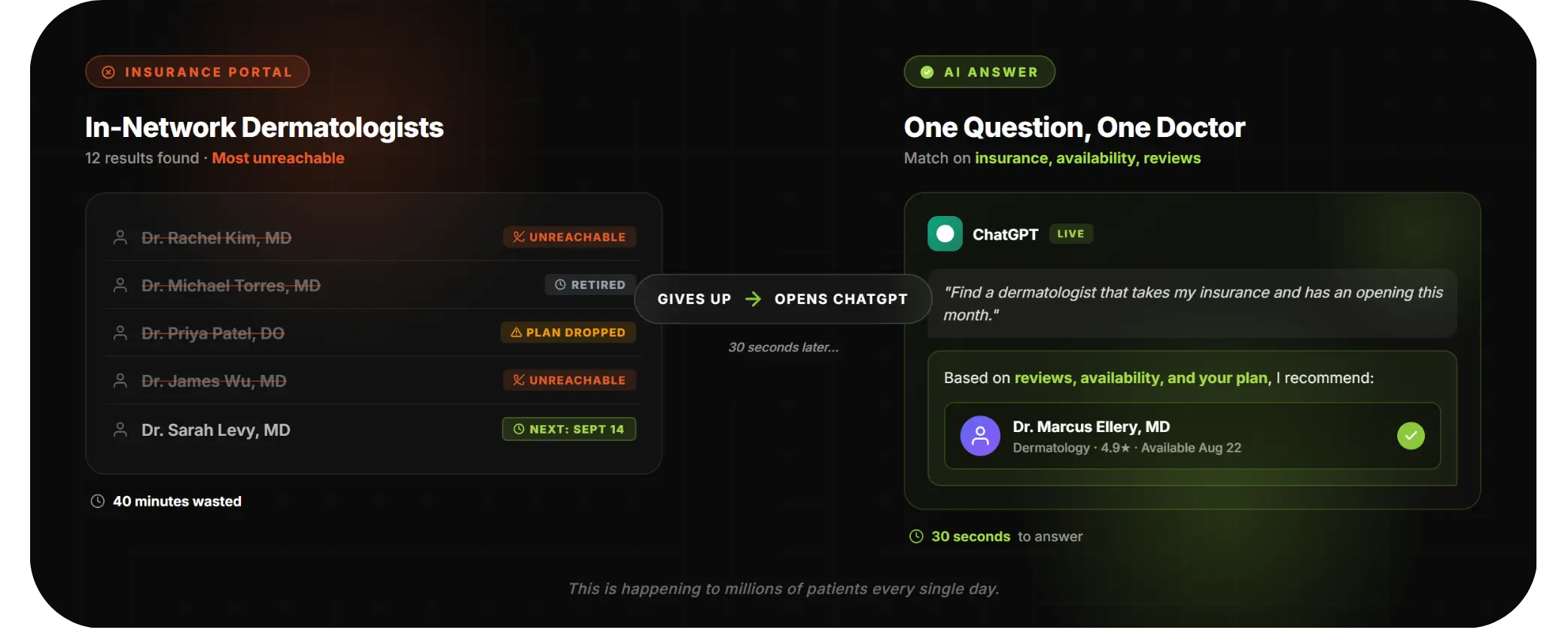
Jessica spent forty minutes on her insurance company's website last month trying to find a new dermatologist. Six of the twelve names on the "in-network" list didn't answer their phones. Two had retired. One office told her they hadn't taken that insurance plan in over a year. By the time she found someone who actually existed, took her plan, and had an opening before September, she'd given up and asked ChatGPT instead.
She's not unusual. She's the new normal.
The System Was Already Broken
Insurance directories are graveyards of doctors who moved, retired, or quietly dropped a plan years ago and never told anyone. Nobody updates them. Nobody's job is to update them. And even when the listing is accurate, the wait to actually see someone is brutal.
The average wait to see a doctor in the US sits at 31 days. In Boston, it's stretched past two months. In Atlanta, you might get in within two weeks. Same country, same insurance types, wildly different reality depending on your zip code.
So patients did what people do when a system stops working for them. They found a workaround.
The Shift Nobody Planned For
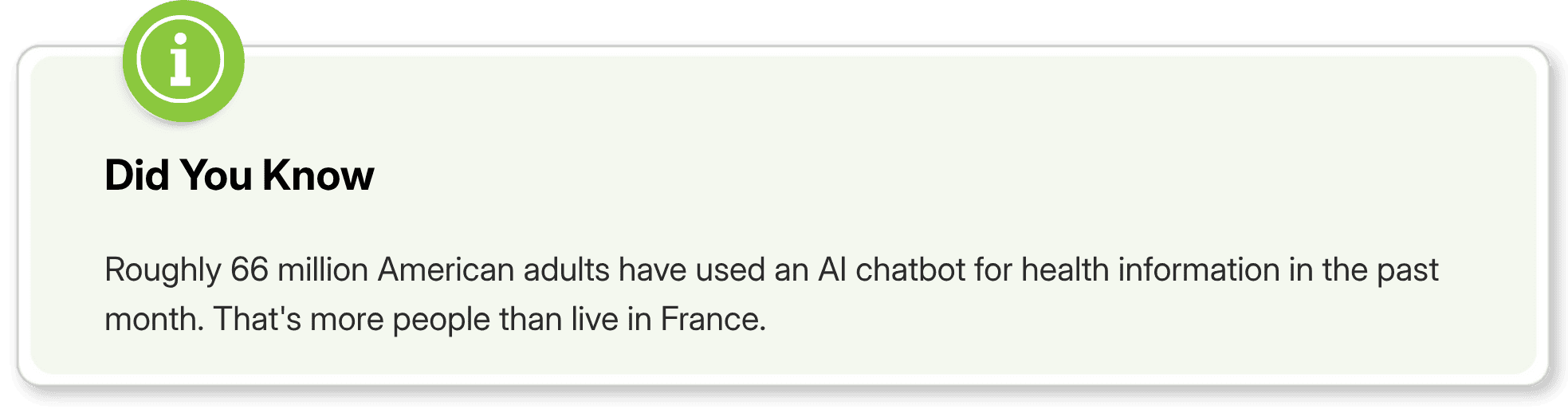
One in four American adults, north of 66 million people, have now used an AI tool for health information. Not as a novelty. As a first step. They describe a symptom, a situation, a whole messy paragraph of what's going on, and they get an answer back in seconds instead of a hold-music queue.
Here's the part that should worry every practice owner: 14% of people who used AI for health info skipped seeing a provider they otherwise would have gone to. Not because they didn't need care. Because the AI gave them enough of an answer that the visit felt optional.
That's not a hypothetical trend for 2030. That's happening right now, this year, to practices that don't know it yet.
The Real Question Nobody's Asking
Everyone's arguing about whether AI health advice is accurate. That's the wrong argument. The real question is who AI even mentions in the first place.
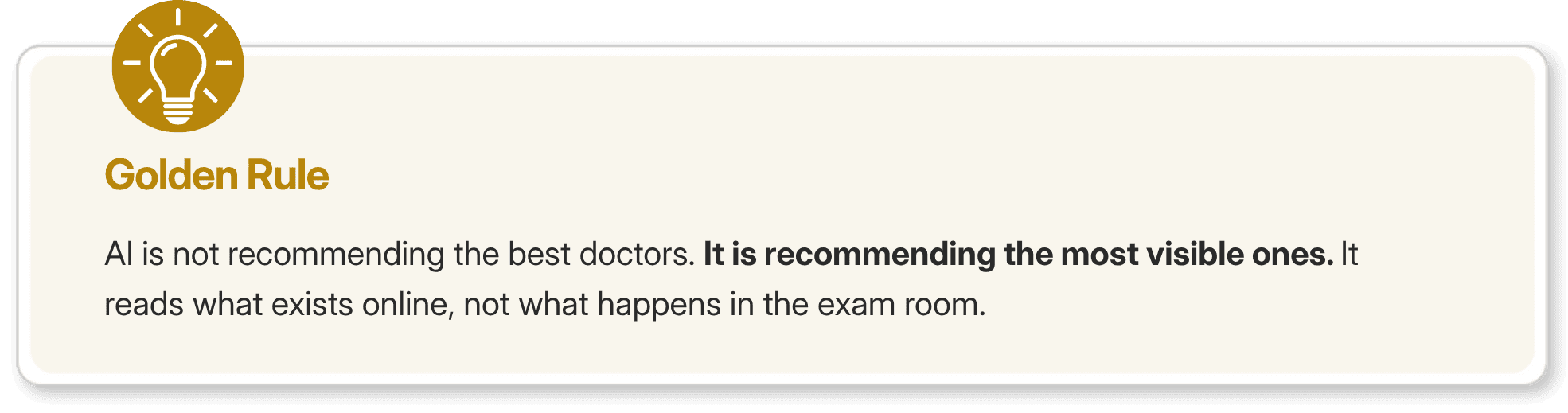
Think about what that actually means. A doctor who's been quietly excellent for thirty years, no website worth mentioning, a handful of scattered reviews, zero recent content anywhere, is invisible to a system that only knows what it can read. Meanwhile a newer doctor with a clean, complete profile, consistent reviews, and a few solid articles under their name gets named by ChatGPT in the first sentence of an answer.
Is that fair? Doesn't matter. It's just how the game works now. Search engines did the same thing twenty years ago. They decided who showed up on page one. AI is doing it again, except now there's no page two to scroll to. There's just the one name it says out loud.
How AI Actually Decides Who to Recommend
Nothing mystical here. Before an AI engine names a provider, it's pulling from four things: what's been written about them, how complete and consistent their directory listings are, what patients have said in reviews, and whether they show up anywhere on social platforms discussing their own expertise.
Miss all four, and you're a ghost. Nail even two of them well, and you start showing up in answers you never optimized for.
This is exactly the gap a platform like RankRabbit was built to close. It watches all four of those layers in one place instead of asking a practice to juggle four separate tools and hope they add up to something coherent.
The Bitter Truth About Patient Verification
Here's what almost nobody in this conversation wants to say out loud.
Asking patients to fact-check AI health information assumes they have the medical literacy to do it. Most don't. That's not their failing. It's the system's. You can't hand someone a chatbot answer about their chest pain and expect them to know which parts are solid and which parts are confidently wrong.
The real fix isn't a patient education campaign. It's making sure the information AI is actually pulling from, the listings, the reviews, the content, is clean and current enough that even a patient with zero medical background still lands somewhere decent.
Trust hasn't caught up either. Roughly a third of people trust AI health info, a third are neutral, and a third don't trust it at all. Confidence in finding good health answers overall dropped 14 points in the US between 2025 and 2026, according to Edelman's Trust Barometer. People are using these tools constantly while still not fully believing them. That tension isn't going away soon.
And the accuracy problem is real too. A 2026 Oxford study in Nature Medicine followed nearly 1,300 adults and found something uncomfortable: people using AI for health decisions didn't actually make better choices than people using a regular search engine. The tool changed, the outcome didn't.
Doctor Wait Times by Specialty (2025)
Specialty | Average Wait |
|---|---|
Dermatology | 34 days |
Family Medicine | 24 days |
OB-GYN | 26 days |
Cardiology | 27 days |
Orthopedics | 22 days |
Where RankRabbit AI Fits Into All of This
Walk through what an AI engine actually does before it names your practice. First, it reads. Articles, bios, anything published under your name or your practice's name, then it decides if you sound like someone worth mentioning. That's the layer RankRabbit's Search AI covers, tracking how you show up not just in Google but inside ChatGPT, Claude, Gemini, and Perplexity answers, and telling you when you get cited and when a competitor does instead.
Second, it checks whether your basic information is even consistent. Same address, same phone number, same hours, across every directory it can find. One outdated listing on some obscure site can be enough to make an AI hesitate. Listing AI syncs your Google Business Profile and keeps you consistent across more than 50 directories, so there's nothing conflicting for an AI model to trip over.
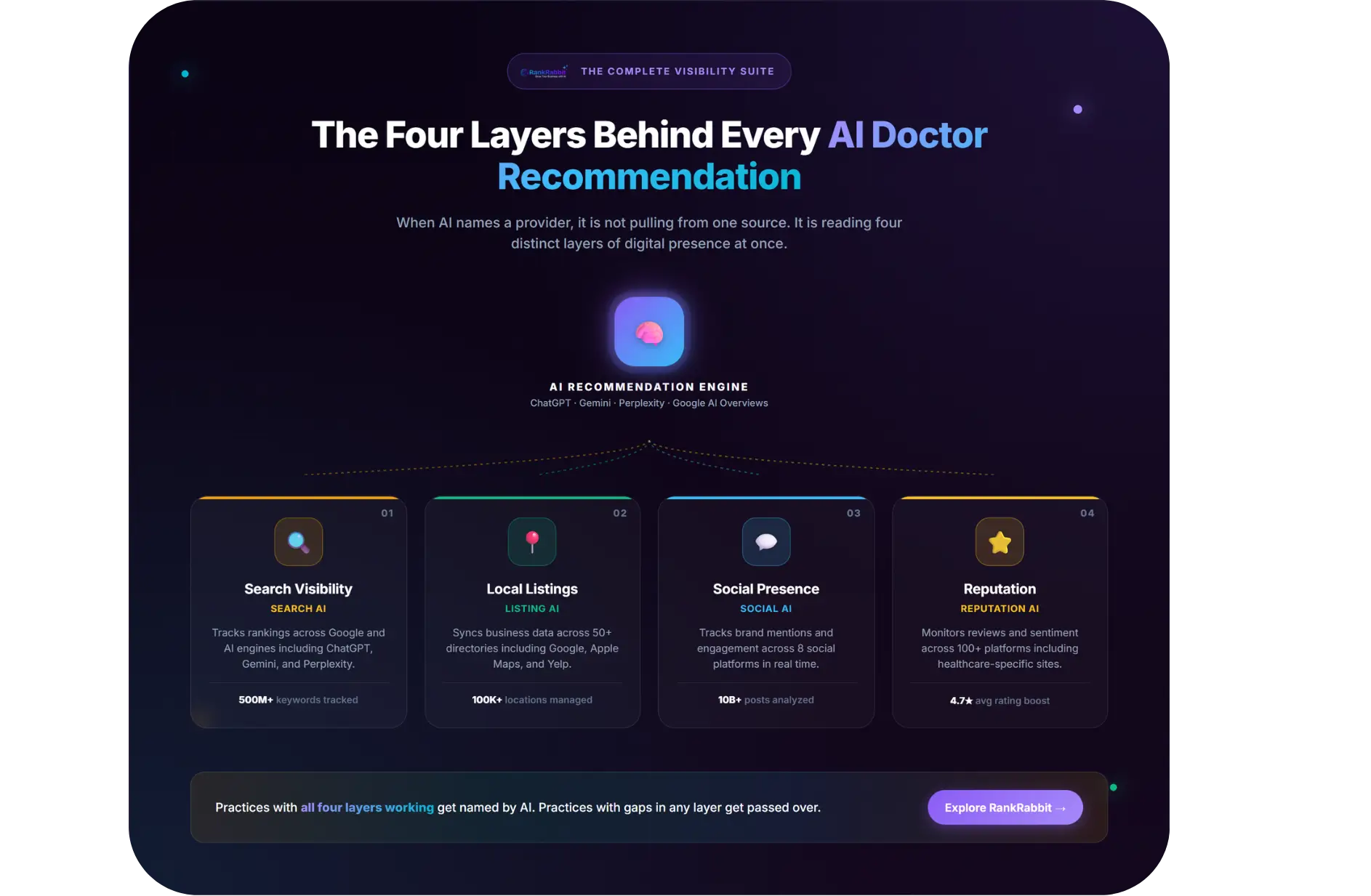
Third, it reads what patients have said about you. Not just on Google. Healthcare-specific review sites too. Reputation AI tracks sentiment across more than 100 platforms, healthcare included, and flags patterns before a string of quiet complaints turns into a visible problem.
Fourth, and increasingly, it looks at whether you show up talking about your own expertise anywhere patients actually spend time. Social AI tracks your presence and engagement across eight major platforms, so you know if you're actually part of the conversation or just assumed to be.
Four layers, four blind spots most practices have never looked at together. Rank Everywhere. Win Everywhere. That's the whole idea behind rankrabbit.ai, one place that watches all four instead of four tools that never talk to each other.
Where You Should Actually Start
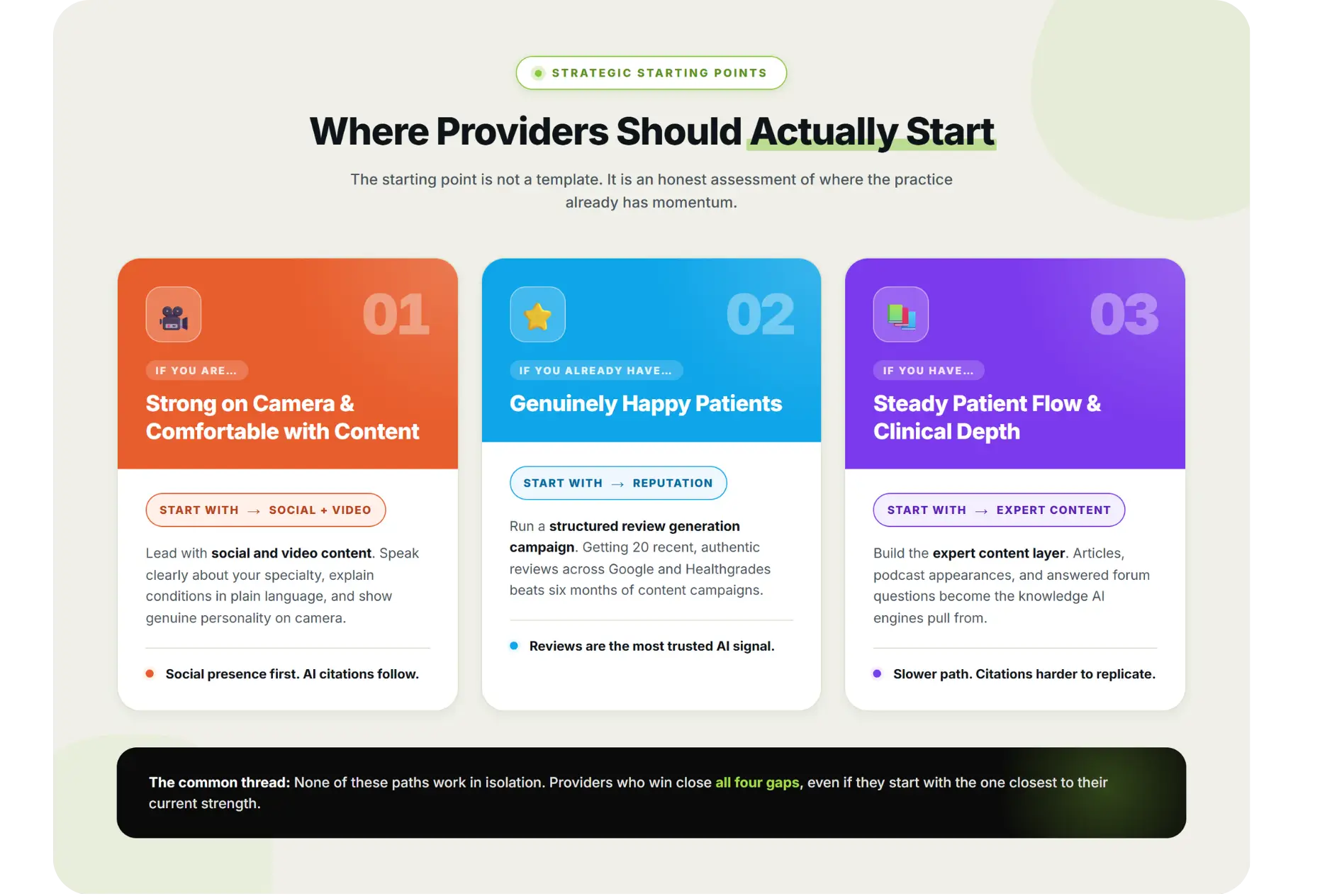
There's no universal checklist here, and anyone who hands you one is selling you a template, not a strategy. Where you start depends on what you already have going for you.
Comfortable in front of a camera and don't mind talking? Lead with social and short-form content. Patients already love you and you've got the reviews to prove it? Lead with reputation, get those reviews visible everywhere AI is reading. Booked out for months with a steady stream of referrals? Lead with expert content, the kind of writing that gets an AI engine to actually name you when someone asks a question in your specialty.
The starting point is your current reality, not somebody else's template.
Final Thoughts
Being a great doctor used to be enough. It isn't anymore.
The providers who show up in AI answers three years from now aren't necessarily the most skilled ones in their city. They're the ones who treated their online presence as part of the job instead of an afterthought. For practices that want a custom strategy built around their specific specialty and market rather than a self-serve platform, Coozmoo's generative search team at coozmoo.com/digital/generative-search builds exactly that.
Everyone else keeps being the best-kept secret in their town. And a secret nobody can find isn't much use to the patient who needed you.
FAQs
Can AI replace doctors for finding the right healthcare provider?

No, and the data backs that up. A 2026 Oxford study found people using AI for health decisions didn't make better choices than people using regular search engines. AI can point you toward a name faster, but it can't examine you, and it can be confidently wrong. Think of it as a faster front door, not a replacement for the visit itself.
How is patient trust in healthcare changing with AI?
It's split and shaky. About a third of people trust AI health information, a third are neutral, and a third don't buy it at all. Meanwhile overall confidence in finding good health answers dropped 14 points in the US year over year. People are using these tools constantly while still not fully trusting them, which is an odd place for an entire industry to sit.
How do providers show up in AI search results like ChatGPT and Google AI Overviews?
By having consistent, current information across the places AI actually reads: your content, your directory listings, your reviews, and your social presence. A platform like RankRabbit tracks all four of those at once, so you can see where you're getting cited and where you're invisible, instead of guessing.
What does a better healthcare patient experience look like with AI in the mix?
Faster answers to simple questions, less time on hold, and quicker matching to the right specialist, paired with clean, trustworthy information so patients don't end up guessing at symptoms alone. The goal isn't AI instead of a doctor. It's AI that gets you to the right doctor faster.
Should doctors start a podcast or create content to be found online?
If it fits how you communicate, yes. AI engines favor providers who've actually published something showing their expertise, whether that's articles, videos, or a podcast. You don't need all three. Pick the format you'll actually stick with, because consistency matters more than the format itself.
Jessica spent forty minutes on her insurance company's website last month trying to find a new dermatologist. Six of the twelve names on the "in-network" list didn't answer their phones. Two had retired. One office told her they hadn't taken that insurance plan in over a year. By the time she found someone who actually existed, took her plan, and had an opening before September, she'd given up and asked ChatGPT instead.
She's not unusual. She's the new normal.
The System Was Already Broken
Insurance directories are graveyards of doctors who moved, retired, or quietly dropped a plan years ago and never told anyone. Nobody updates them. Nobody's job is to update them. And even when the listing is accurate, the wait to actually see someone is brutal.
The average wait to see a doctor in the US sits at 31 days. In Boston, it's stretched past two months. In Atlanta, you might get in within two weeks. Same country, same insurance types, wildly different reality depending on your zip code.
So patients did what people do when a system stops working for them. They found a workaround.
The Shift Nobody Planned For
One in four American adults, north of 66 million people, have now used an AI tool for health information. Not as a novelty. As a first step. They describe a symptom, a situation, a whole messy paragraph of what's going on, and they get an answer back in seconds instead of a hold-music queue.
Here's the part that should worry every practice owner: 14% of people who used AI for health info skipped seeing a provider they otherwise would have gone to. Not because they didn't need care. Because the AI gave them enough of an answer that the visit felt optional.
That's not a hypothetical trend for 2030. That's happening right now, this year, to practices that don't know it yet.
The Real Question Nobody's Asking
Everyone's arguing about whether AI health advice is accurate. That's the wrong argument. The real question is who AI even mentions in the first place.
Think about what that actually means. A doctor who's been quietly excellent for thirty years, no website worth mentioning, a handful of scattered reviews, zero recent content anywhere, is invisible to a system that only knows what it can read. Meanwhile a newer doctor with a clean, complete profile, consistent reviews, and a few solid articles under their name gets named by ChatGPT in the first sentence of an answer.
Is that fair? Doesn't matter. It's just how the game works now. Search engines did the same thing twenty years ago. They decided who showed up on page one. AI is doing it again, except now there's no page two to scroll to. There's just the one name it says out loud.
How AI Actually Decides Who to Recommend
Nothing mystical here. Before an AI engine names a provider, it's pulling from four things: what's been written about them, how complete and consistent their directory listings are, what patients have said in reviews, and whether they show up anywhere on social platforms discussing their own expertise.
Miss all four, and you're a ghost. Nail even two of them well, and you start showing up in answers you never optimized for.
This is exactly the gap a platform like RankRabbit was built to close. It watches all four of those layers in one place instead of asking a practice to juggle four separate tools and hope they add up to something coherent.
The Bitter Truth About Patient Verification
Here's what almost nobody in this conversation wants to say out loud.
Asking patients to fact-check AI health information assumes they have the medical literacy to do it. Most don't. That's not their failing. It's the system's. You can't hand someone a chatbot answer about their chest pain and expect them to know which parts are solid and which parts are confidently wrong.
The real fix isn't a patient education campaign. It's making sure the information AI is actually pulling from, the listings, the reviews, the content, is clean and current enough that even a patient with zero medical background still lands somewhere decent.
Trust hasn't caught up either. Roughly a third of people trust AI health info, a third are neutral, and a third don't trust it at all. Confidence in finding good health answers overall dropped 14 points in the US between 2025 and 2026, according to Edelman's Trust Barometer. People are using these tools constantly while still not fully believing them. That tension isn't going away soon.
And the accuracy problem is real too. A 2026 Oxford study in Nature Medicine followed nearly 1,300 adults and found something uncomfortable: people using AI for health decisions didn't actually make better choices than people using a regular search engine. The tool changed, the outcome didn't.
Doctor Wait Times by Specialty (2025)
Specialty | Average Wait |
|---|---|
Dermatology | 34 days |
Family Medicine | 24 days |
OB-GYN | 26 days |
Cardiology | 27 days |
Orthopedics | 22 days |
Where RankRabbit AI Fits Into All of This
Walk through what an AI engine actually does before it names your practice. First, it reads. Articles, bios, anything published under your name or your practice's name, then it decides if you sound like someone worth mentioning. That's the layer RankRabbit's Search AI covers, tracking how you show up not just in Google but inside ChatGPT, Claude, Gemini, and Perplexity answers, and telling you when you get cited and when a competitor does instead.
Second, it checks whether your basic information is even consistent. Same address, same phone number, same hours, across every directory it can find. One outdated listing on some obscure site can be enough to make an AI hesitate. Listing AI syncs your Google Business Profile and keeps you consistent across more than 50 directories, so there's nothing conflicting for an AI model to trip over.
Third, it reads what patients have said about you. Not just on Google. Healthcare-specific review sites too. Reputation AI tracks sentiment across more than 100 platforms, healthcare included, and flags patterns before a string of quiet complaints turns into a visible problem.
Fourth, and increasingly, it looks at whether you show up talking about your own expertise anywhere patients actually spend time. Social AI tracks your presence and engagement across eight major platforms, so you know if you're actually part of the conversation or just assumed to be.
Four layers, four blind spots most practices have never looked at together. Rank Everywhere. Win Everywhere. That's the whole idea behind rankrabbit.ai, one place that watches all four instead of four tools that never talk to each other.
Where You Should Actually Start
There's no universal checklist here, and anyone who hands you one is selling you a template, not a strategy. Where you start depends on what you already have going for you.
Comfortable in front of a camera and don't mind talking? Lead with social and short-form content. Patients already love you and you've got the reviews to prove it? Lead with reputation, get those reviews visible everywhere AI is reading. Booked out for months with a steady stream of referrals? Lead with expert content, the kind of writing that gets an AI engine to actually name you when someone asks a question in your specialty.
The starting point is your current reality, not somebody else's template.
Final Thoughts
Being a great doctor used to be enough. It isn't anymore.
The providers who show up in AI answers three years from now aren't necessarily the most skilled ones in their city. They're the ones who treated their online presence as part of the job instead of an afterthought. For practices that want a custom strategy built around their specific specialty and market rather than a self-serve platform, Coozmoo's generative search team at coozmoo.com/digital/generative-search builds exactly that.
Everyone else keeps being the best-kept secret in their town. And a secret nobody can find isn't much use to the patient who needed you.
FAQs
Can AI replace doctors for finding the right healthcare provider?
No, and the data backs that up. A 2026 Oxford study found people using AI for health decisions didn't make better choices than people using regular search engines. AI can point you toward a name faster, but it can't examine you, and it can be confidently wrong. Think of it as a faster front door, not a replacement for the visit itself.
How is patient trust in healthcare changing with AI?
It's split and shaky. About a third of people trust AI health information, a third are neutral, and a third don't buy it at all. Meanwhile overall confidence in finding good health answers dropped 14 points in the US year over year. People are using these tools constantly while still not fully trusting them, which is an odd place for an entire industry to sit.
How do providers show up in AI search results like ChatGPT and Google AI Overviews?
By having consistent, current information across the places AI actually reads: your content, your directory listings, your reviews, and your social presence. A platform like RankRabbit tracks all four of those at once, so you can see where you're getting cited and where you're invisible, instead of guessing.
What does a better healthcare patient experience look like with AI in the mix?
Faster answers to simple questions, less time on hold, and quicker matching to the right specialist, paired with clean, trustworthy information so patients don't end up guessing at symptoms alone. The goal isn't AI instead of a doctor. It's AI that gets you to the right doctor faster.
Should doctors start a podcast or create content to be found online?
If it fits how you communicate, yes. AI engines favor providers who've actually published something showing their expertise, whether that's articles, videos, or a podcast. You don't need all three. Pick the format you'll actually stick with, because consistency matters more than the format itself.



Summarize with AI


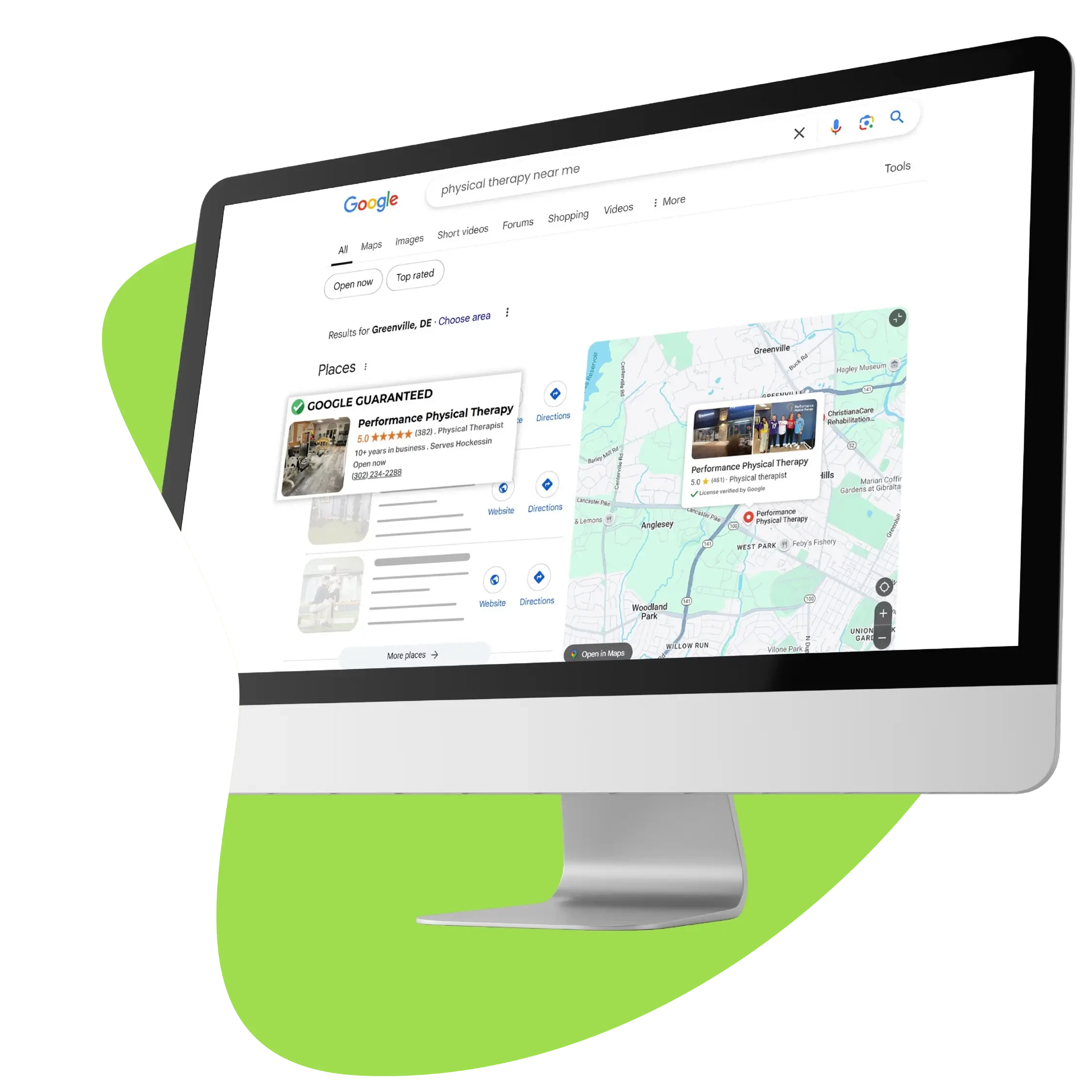

Want to be seen everywhere?
Get a free AI-search audit Today!



4.9/5 Ratings!


Don’t miss our revenue growth tips!
Get expert marketing tips—straight to your inbox, like thousands of happy clients.
Don’t miss our revenue growth tips!
Get expert marketing tips—straight to your inbox, like thousands of happy clients.
Don’t miss our revenue growth tips!
Don’t miss our revenue growth tips!
Get expert marketing tips—straight to your inbox, like thousands of happy clients.
Relevant Blogs on Generative AI SEO
Relevant Blogs on Generative AI SEO
Unlock data-driven insights in AI-powered SEO—explore our featured blogs and skyrocket your revenue before your competitors do.
Unlock data-driven insights in AI-powered SEO—explore our featured blogs and skyrocket your revenue before your competitors do.

GEO
Sep 22, 2026
15 Min Read
AI Search Runs on More SEO Than You Think
GEO
Sep 22, 2026
15 Min Read
AI Search Runs on More SEO Than You Think
GEO
Sep 22, 2026
15 Min Read
AI Search Runs on More SEO Than You Think

GEO
Sep 7, 2026
8 Min Read
How to Optimize Content for AI Search Engines: Best Practices
GEO
Sep 7, 2026
8 Min Read
How to Optimize Content for AI Search Engines: Best Practices
GEO
Sep 7, 2026
8 Min Read
How to Optimize Content for AI Search Engines: Best Practices

GEO
Sep 4, 2026
12 Min Read
How Ecommerce Brands Can Advertise in Google AI Mode?
GEO
Sep 4, 2026
12 Min Read
How Ecommerce Brands Can Advertise in Google AI Mode?
GEO
Sep 4, 2026
12 Min Read
How Ecommerce Brands Can Advertise in Google AI Mode?





















Ready to speak with an expert?
Data-Driven Marketing Agency That Elevates ROI
1100+
Websites Designed & Optimized to Convert
$280M+
Client Revenue Driven & Growing Strong
Discover how to skyrocket
your revenue today!
Trusted by 1000+ Owners!
Ready to speak with an expert?
Data-Driven Marketing Agency That Elevates ROI
1100+
Websites Designed & Optimized to Convert
$280M+
Client Revenue Driven & Growing Strong
Discover how to skyrocket
your revenue today!
Trusted by 1000+ Owners!
Want to skyrocket revenue?
4.9/5 Ratings!
Ready to speak with an expert?
Data-Driven Marketing Agency That Elevates ROI
1100+
Websites Designed & Optimized to Convert
$280M+
Client Revenue Driven & Growing Strong
Discover how to skyrocket
your revenue today!
Trusted by 1000+ Owners!
Call
Meet