Why Your Google Business Profile Needs Weekly Updates for Better Local Rankings?
Why Your Google Business Profile Needs Weekly Updates for Better Local Rankings?
Last Updated:
Table of Content
Case Studies




Tanya Singh
Tanya Singh
Tanya Singh
SEO
SEO
SEO
10 Min Read
10 Min
10 Min Read
Most local business owners set up their Google Business Profile once, fill in the hours, upload a few photos, and think the job is done. Here is the problem. Google does not see that as done. It sees it as abandoned. And abandoned profiles simply do not rank well.
In few years, the way Google looks at local listings has changed in a real way. How active your profile is, how fresh the content is, and how much people engage with it have all become key parts of how Google decides who shows up in local search results. If you treat your GBP like a digital business card you touch once a year, you are quietly handing your competitors a head start every single week.
This article explains exactly why that is happening, what Google is paying attention to, and what a practical weekly update routine actually looks like.

How Google Moved from Static to Active Profiles and What That Means for Your Business?
For a long time, local SEO was mostly about filling things in. Complete your profile, collect some reviews, get listed in a few directories, and you were doing well. That approach still has value. But it is no longer enough on its own.
What changed is that Google now treats activity as a sign that your business is real and relevant. A profile that has not been touched in six months starts to look, to Google's systems, like a business that may have slowed down or even stopped operating. Google does not want to recommend businesses it is not sure are still active and serving customers.
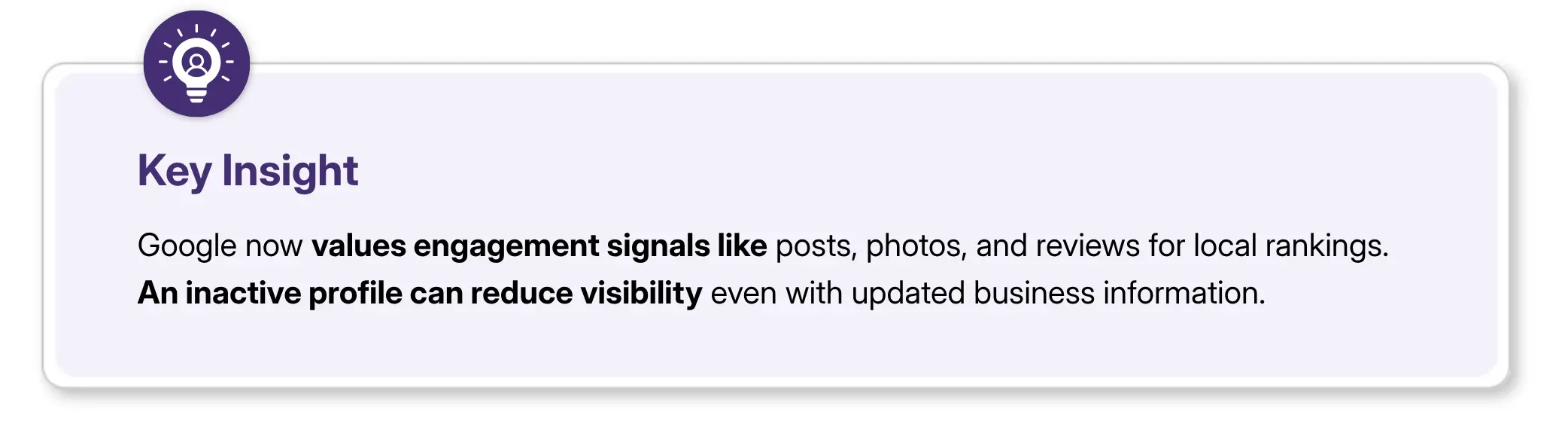
Profiles that are regularly updated with fresh posts, new photos, answered questions, and review responses are increasingly treated as a separate ranking advantage. Google has shifted from rewarding completeness to rewarding ongoing engagement.
The Three Core Signals Google Uses and What Has Shifted Inside Each of Them
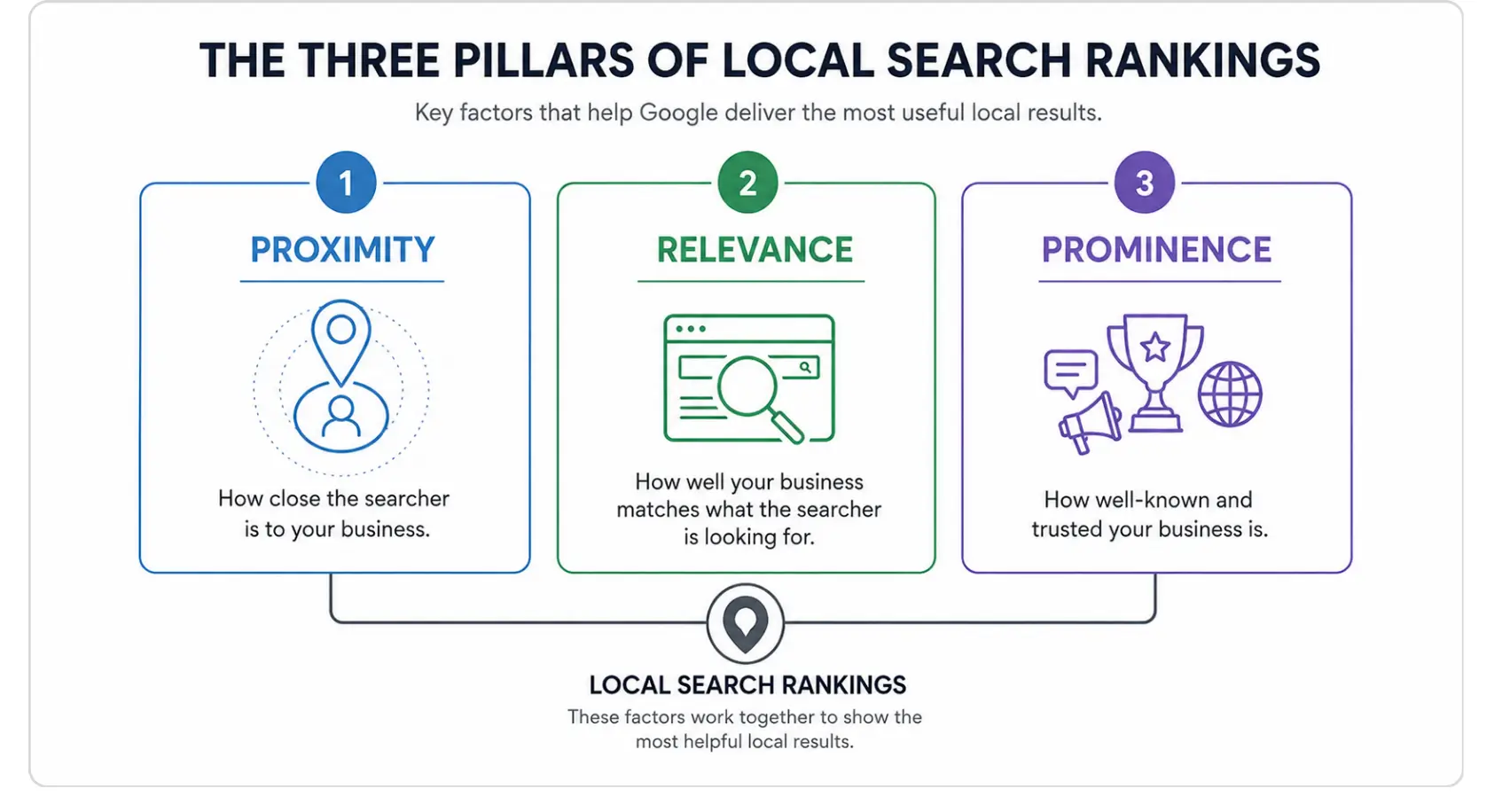
Google still builds local rankings around three main ideas;
Proximity: How close your business is to the person searching.
Relevance: How well your profile matches what they typed in.
Prominence: How well known and trusted your business appears to be. What has changed is how prominence gets measured.
Prominence used to come mostly from how many reviews you had, how many websites linked to you, and how consistently your business details appeared across the internet. These include how often people interact with your profile, whether those interactions are growing over time, and whether your listing looks like something a real business is managing or something nobody has looked at in months.
What Weekly Updates Actually Mean: It Is More Than Just Publishing Posts?
When people in local SEO say "keep your GBP active," the advice often gets reduced to "just post regularly." Posting does matter. But weekly updates cover a broader set of actions. Each one sends a different kind of signal to Google about your business.
Here is a clear breakdown of the different update types, what each one does, and how often you should be doing them:
Update Type | Ranking Signal It Feeds | Recommended Frequency | Impact Level |
|---|---|---|---|
Google Posts (updates, offers, events) | Freshness and engagement signals | 1 to 2 times per week | High |
New Photos (interior, products, team) | Prominence and click through signals | Weekly (2 to 3 images) | High |
Review Responses | Trust, engagement, and review velocity | Within 24 to 48 hours of each review | High |
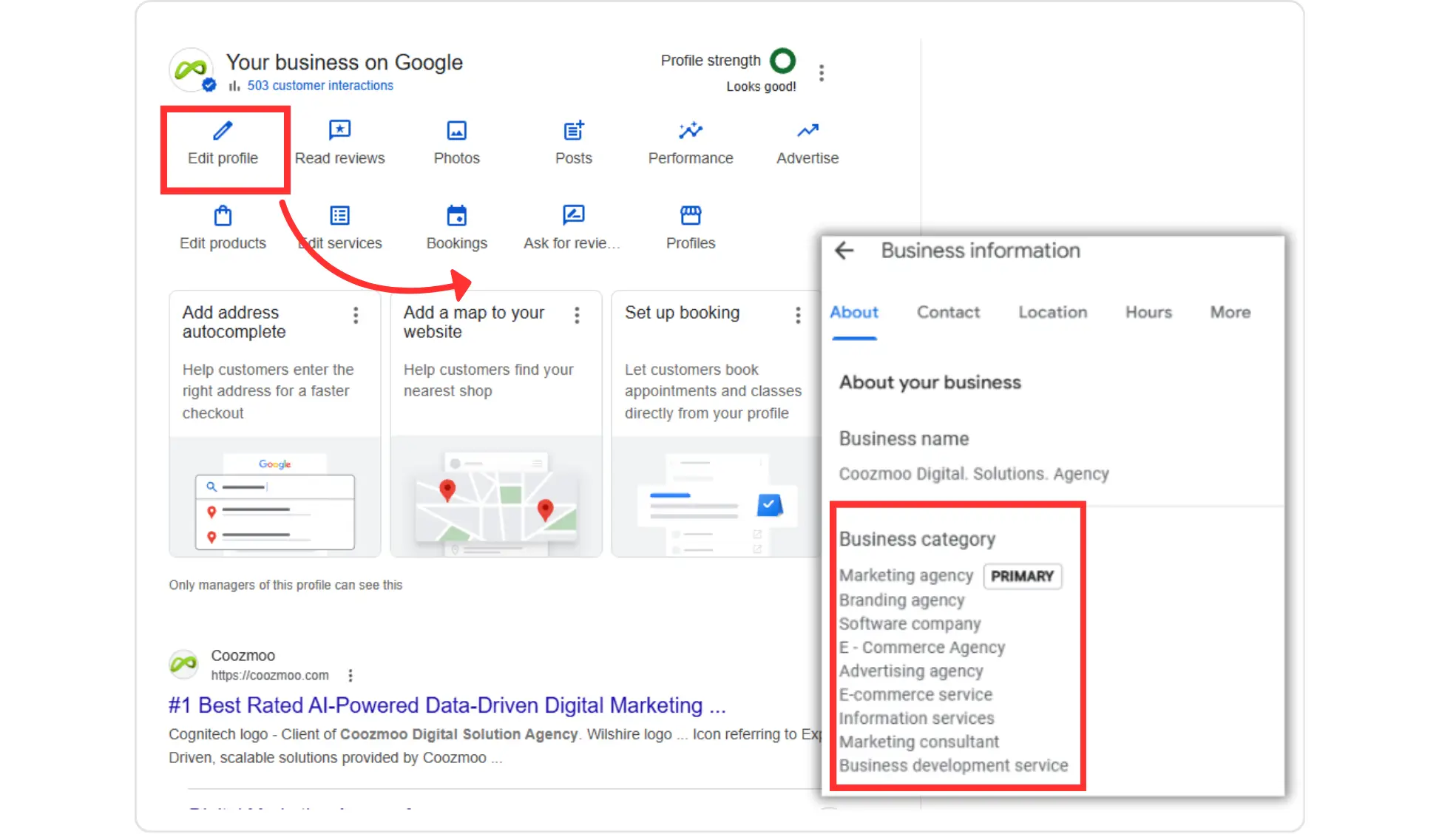
Q&A Updates (add or answer questions) | Relevance and indexable content | Every two weeks or as needed | Medium |
Hours and Attribute Checks | Accuracy and trust signals | Weekly check; update when something changes | Medium |
Service and Product Updates | Relevance to search queries | Monthly or whenever your offerings change | Steady |
Special Hours (holidays, closures) | Accuracy; prevents ranking suppression | Before every holiday or planned closure | High |
Think of the table above as a menu, not a rigid checklist. Not every item needs to happen every single week. But at least two or three of these signals should be refreshed regularly to keep your profile looking alive and well managed in Google's eyes.
Google Posts: The Weekly Ranking Signal That Most Businesses Are Ignoring
Google Posts are not just status updates. They are actual indexed content. They show up directly in your profile within search results. And since Google's late 2025 algorithm update, they also feed into the AI summaries that Google generates for local queries. That is a meaningful change worth understanding.
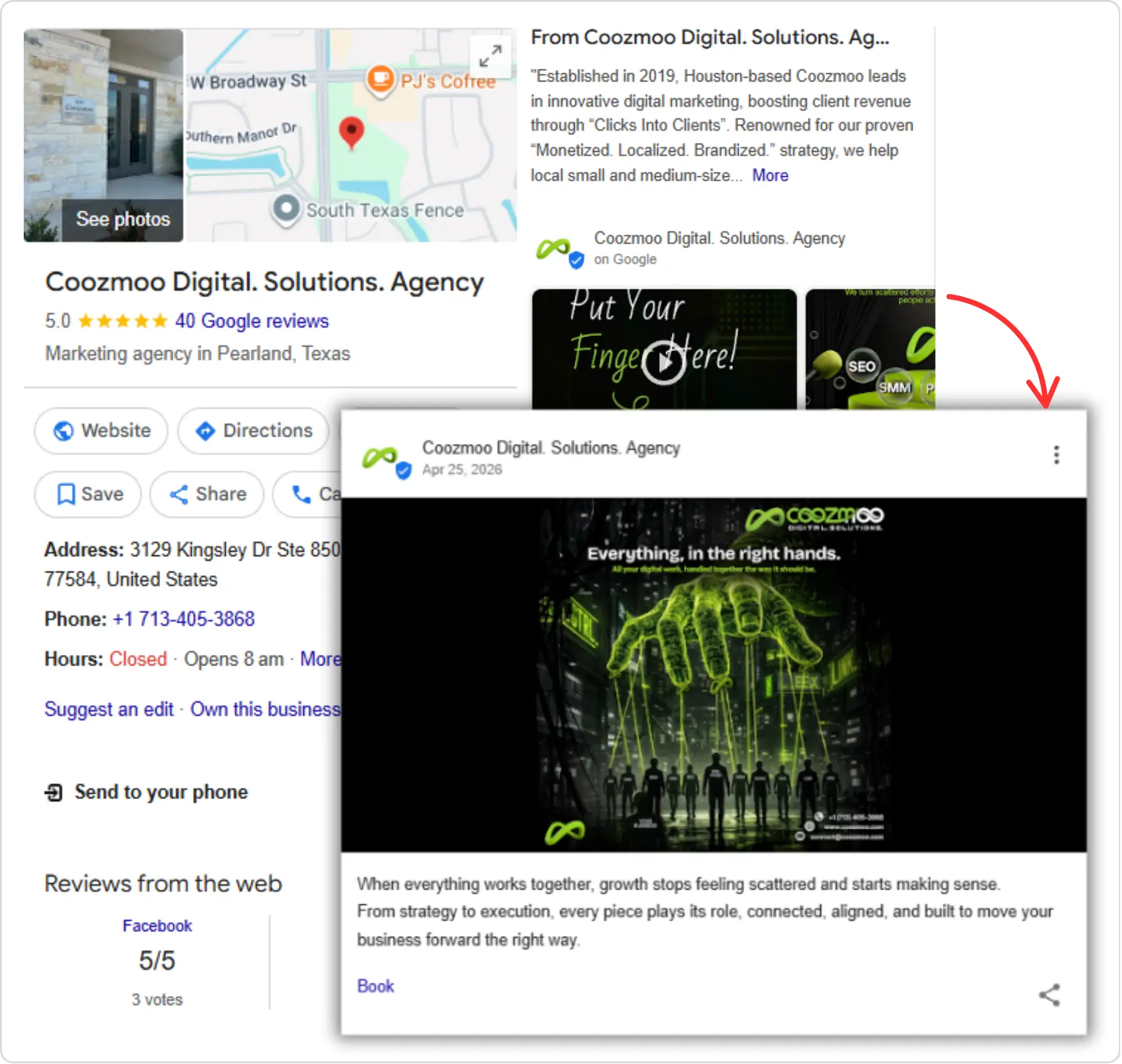
When you publish a post, you are giving Google something to read and understand about what your business is doing right now. A restaurant posting about a new dish tells Google this is a current, active business. A plumber posting about same day emergency availability reinforces how relevant they are for those kinds of searches. The content you publish keeps your profile connected to what people are actually looking for.
Post Types That Get Results and One You Should Avoid
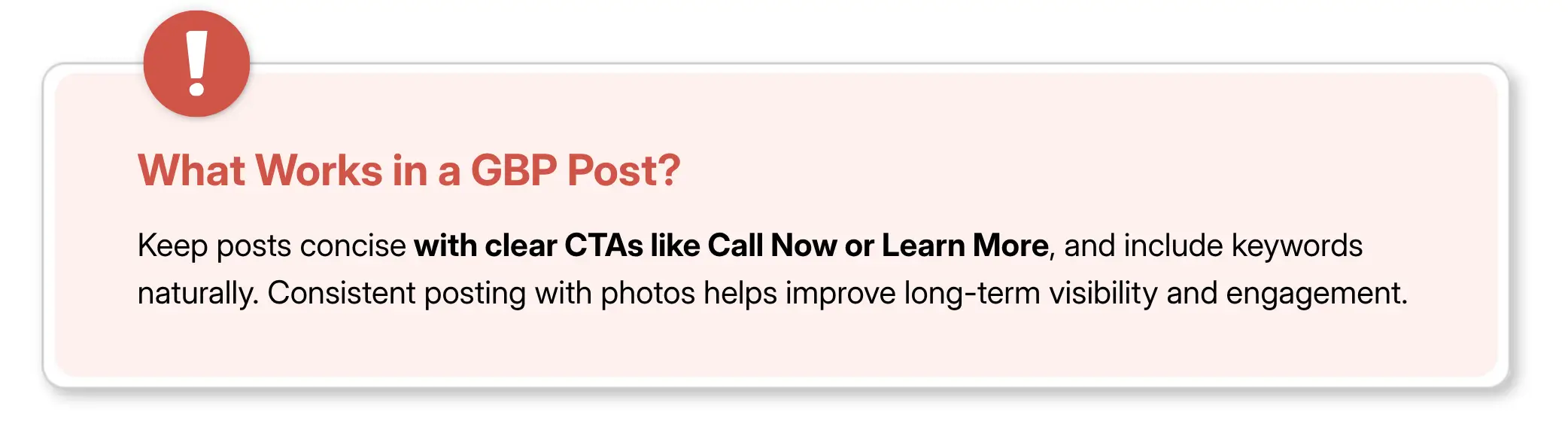
Not every post type carries the same weight. Offer posts and event posts tend to perform best because they include structured information like start and end dates and promotional details that Google's system can read clearly. Update posts work well for general news and announcements. What does not work is posting the same content again and again, packing your captions with keywords, or publishing posts with no action button. If Google has nothing to measure in terms of how users respond, the post adds very little to your ranking signals.
The Review Velocity Factor That Most Business Owners Do Not Think About
For a long time, the number of reviews you had was the main thing that mattered. But Google's algorithm now looks closely at review velocity, which means how consistently and regularly new reviews are coming in, not just the total number you have collected over the years.
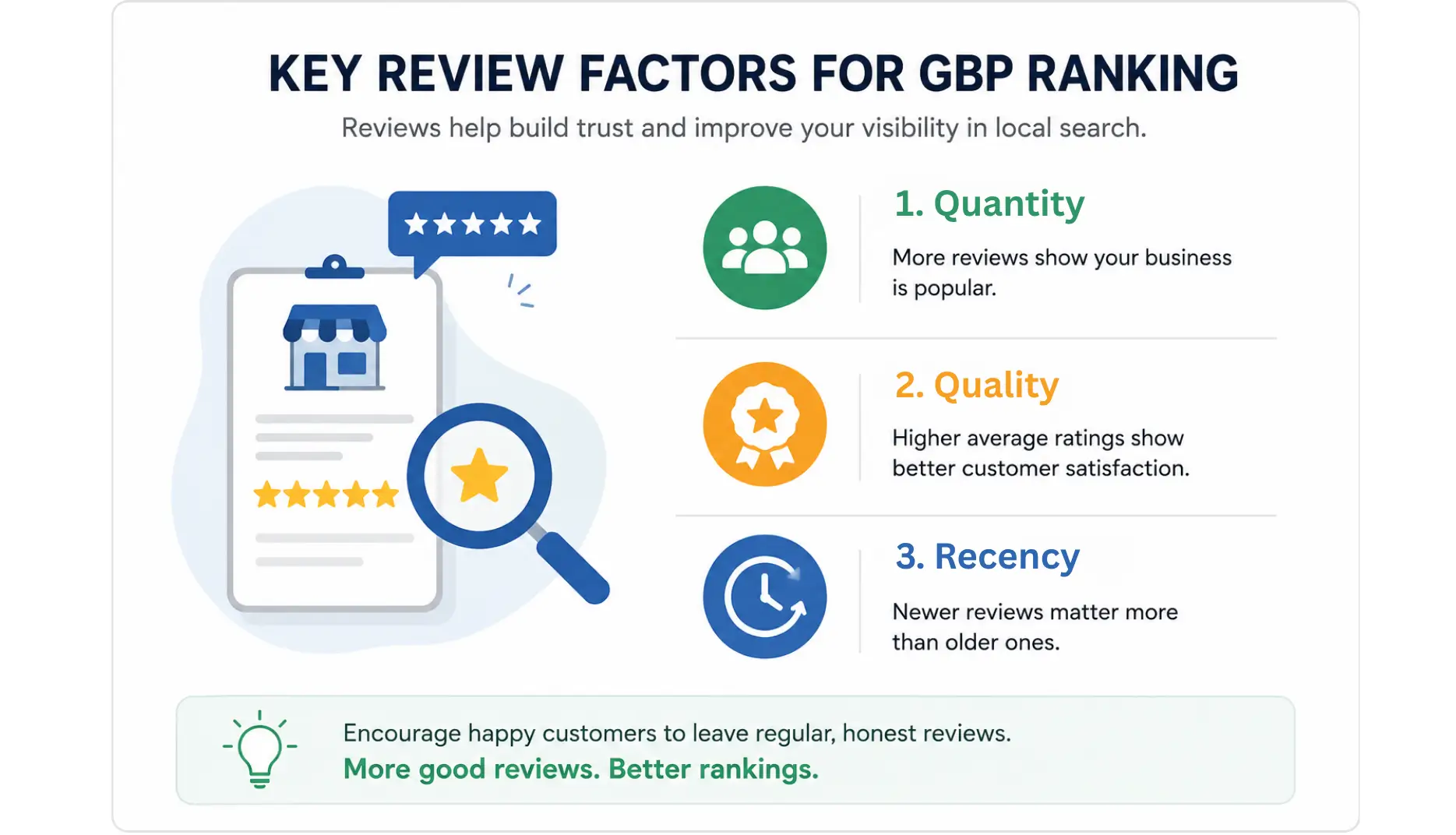
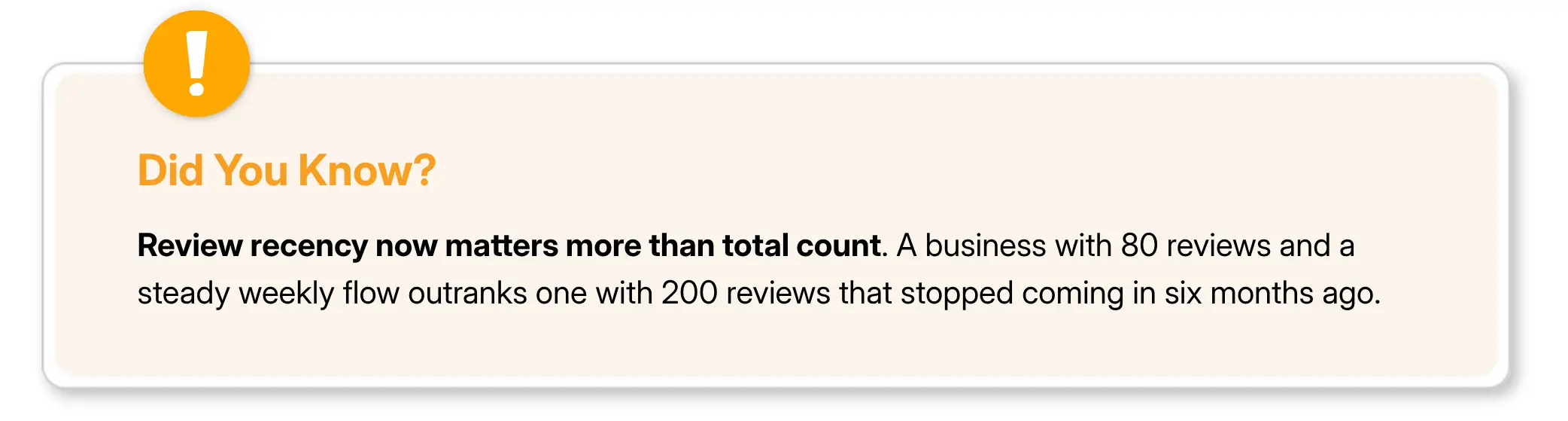
A business with 200 reviews but no new ones in the past six months will often rank below a business with 80 reviews that is getting a steady flow of fresh ones. Google is not just asking how trusted this business is overall. It is asking whether this business is actively serving customers right now.
How to Get More Reviews Consistently Without Breaking Google's Rules?
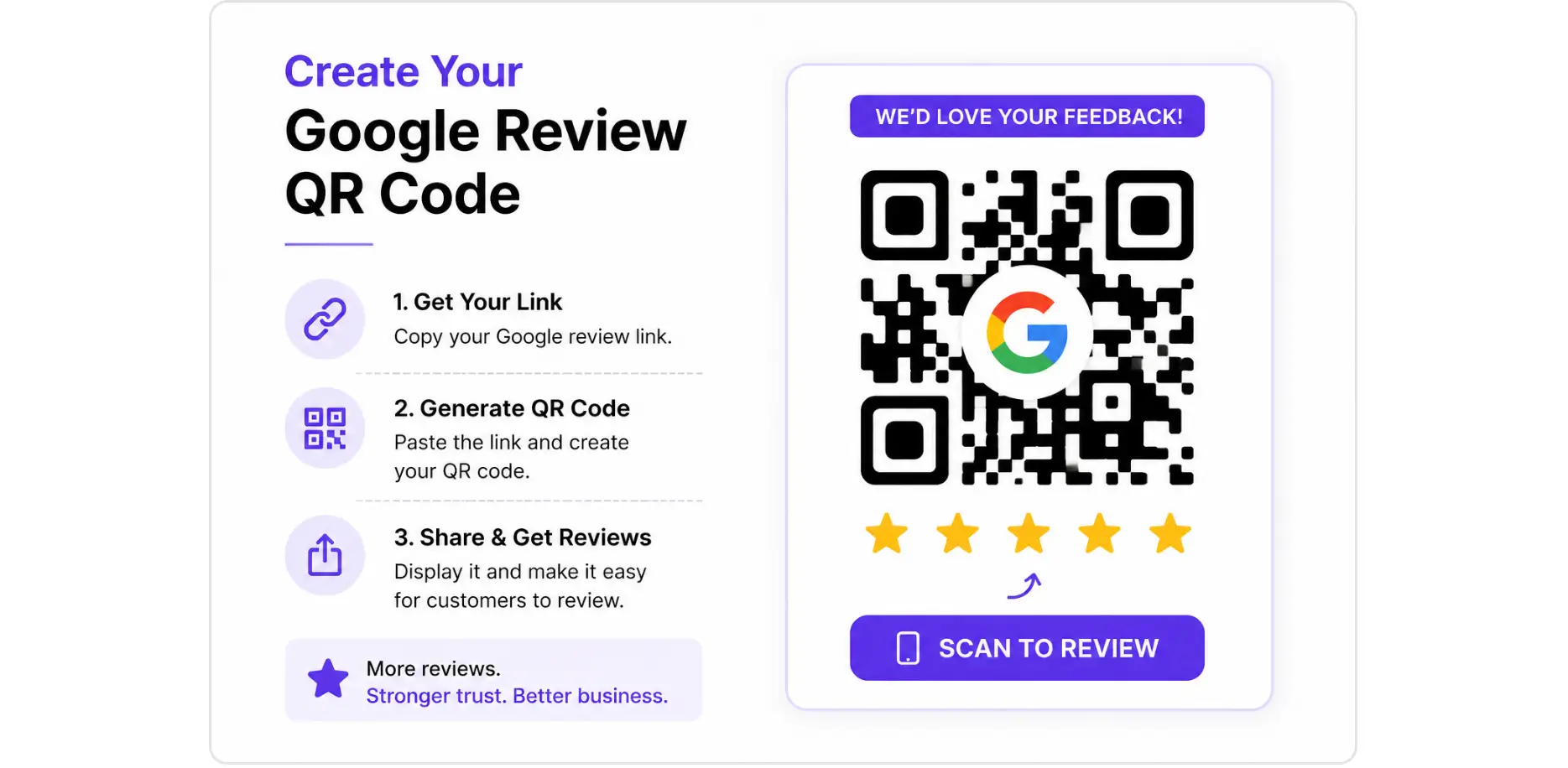
The most reliable approach is to make review requests a normal part of what happens after you serve a customer. Send a short follow up message with a direct link to your GBP review page. Google launched official review request QR codes in late 2025, which work well for businesses with a physical location. A small card at checkout or a printed note with a receipt is all it takes. The goal is to make it easy for customers to leave a review, not to reward them for doing so. Google's rules clearly say you cannot offer anything in return for reviews, and doing so can get your profile suspended.
Responding to every review, whether good or bad, also tells Google that your profile is being actively managed. Research suggests that profiles which respond to reviews consistently build roughly 1.7 times more trust with potential customers compared to profiles that never respond at all.
Why Adding Photos Every Week Is an SEO Action, Not Just a Social Media Habit?
Uploading optimized photos feels like something you do for Instagram, not for Google rankings. That instinct is misleading and it costs businesses real visibility. Google uses photo activity as a signal of prominence. Profiles with more than 100 photos get significantly more calls and direction requests on average. That is not because customers scroll through every image. It is because Google reads active photo uploads as a sign that the business is legitimate, operating, and worth showing to people nearby.
You do not need a professional photographer for this. Real photos of a completed project, a team member at work, or your space on a normal day will outperform generic stock images every time. They also give Google genuine signals of business activity, which matters more than how polished the photo looks.
Consistency matters more than volume. Adding three photos every week for a month sends stronger signals than uploading thirty photos all at once. Google reads the upload timestamps. A steady pace over time tells a better story of an active business than a single large batch that is never followed up on.
Q&A Plus Business Attributes: Two Quiet Ways to Boost Your Local Relevance
The Q and A section of a Google Business Profile is content that Google can actually index, and most businesses leave it completely empty. This creates two problems. First, when customers ask questions and nobody from the business answers, random people often step in with answers that may be wrong.
Second, a well managed Q and A section adds keyword relevant content that Google can surface in its AI summaries and local search snippets.
Think about the questions your customers ask most often. Things like "Do you offer same day appointments?" or "Is parking available?" or "Do you accept insurance?" Adding these as questions with clear answers gives Google more to work with when matching your profile to relevant searches. Check this section every two weeks to catch any new questions from users.
Business Attributes: Small Checkboxes That Do Real Ranking Work
Attributes are the checkbox options inside your GBP like "women led," "LGBTQ+ friendly," "outdoor seating," or "wheelchair accessible." These feed relevance signals for very specific search queries. As Google's AI generated summaries become more common in local results — showing up in roughly 38% of local service queries, the structured information that attributes provide becomes more useful to Google, not less. Check your attributes whenever a new option becomes available in your business category and keep them current.
A Simple Weekly GBP Schedule That You Will Actually Keep Up With
Knowing what to do is one thing. Having a routine you can stick to is another. Here is a practical weekly plan that covers the most important updates without taking more than 20 to 30 minutes across the whole week.
MondayReply to all reviews from the past week. Try to mention something specific from what the reviewer said. A personalised reply is better than a template, and a template is better than nothing at all. |
TuesdayWrite and publish a Google Post. Connect it to something real — a current offer, a seasonal service, or a question a customer asked you recently. Add a photo and a clear action button. |
WednesdayUpload 2 to 3 fresh photos. Keep it simple. Behind the scenes moments, recent work, your team, your space. Real and recent always beats polished and generic. |
ThursdayCheck your Q and A section for new questions and confirm your hours are still accurate. If a holiday or closure is coming up soon, update your special hours now so you are not rushing at the last minute. |
FridaySend review requests to customers you served during the week. A short friendly message with a direct link is all you need. Doing this consistently every week builds up far more than any one big push ever will. |
This routine takes about 20 to 25 minutes spread across five days. What you get in return is a profile that Google recognises as actively managed — one that is building engagement signals week after week while other profiles in your area sit untouched.
What Actually Happens to Profiles That Are Not Updated Regularly?
Not updating your profile does not just mean missing out on opportunities. It creates a real and measurable ranking risk. Google's systems are now checking whether profiles look active and legitimate. A profile that has had no new posts, no new photos, and no review responses for several months starts to look, to the algorithm, like a business that may have scaled back, moved, or closed.
In competitive local markets, search positions can shift two to three spots within a single week. A business that stops sending Google fresh signals, even for a short time, can find itself pushed down by a competitor that simply kept their routine going. Getting that ground back takes longer than it would have taken to hold it in the first place.
Profiles that go stale lose prominence signals over time even if nothing else goes wrong
Competitors who post weekly build up freshness signals that stack up across months
A gap in new reviews signals to Google that the business may no longer be actively serving customers
Outdated hours during holidays can suppress your ranking and directly damage customer trust
Profiles with lower engagement numbers like fewer clicks, calls, and direction requests rank below profiles with higher engagement and engagement starts with being visible.
How GBP Updates Now Connect to Google AI Overviews and the Local Pack?
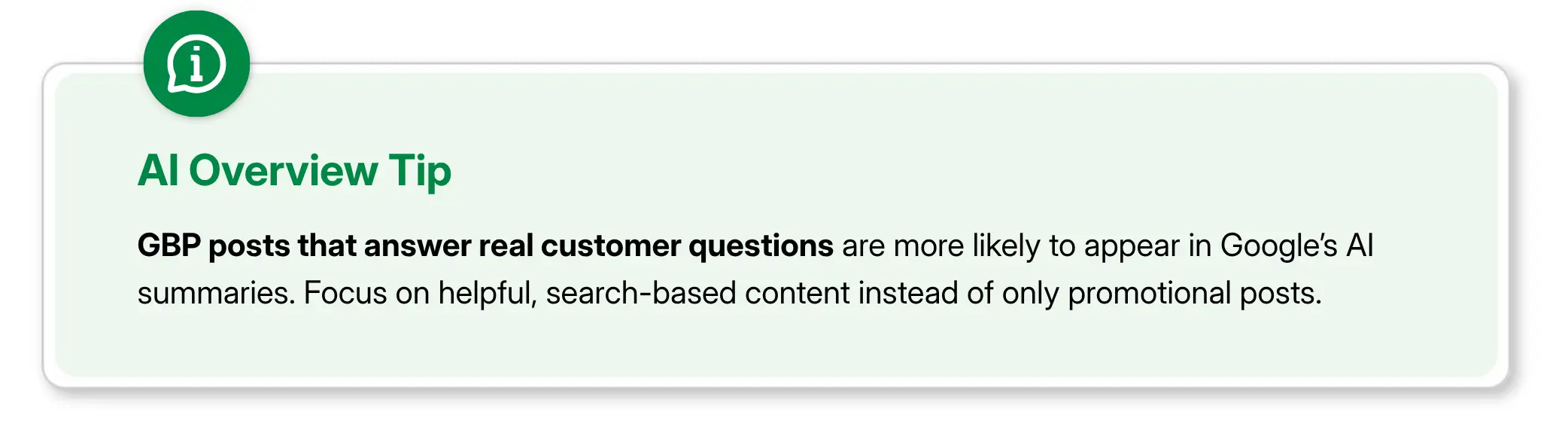
One of the more important changes to understand is the growing role of Google's AI Overviews in local search. These are the short AI generated summaries that now appear at the top of search results for many local queries. They show up in roughly 38 percent of local service searches as of early 2026. They pull information from your GBP content, your reviews, your posts, and structured data to put together an answer for the searcher. Businesses with well maintained and regularly updated profiles are much more likely to be included in those summaries.
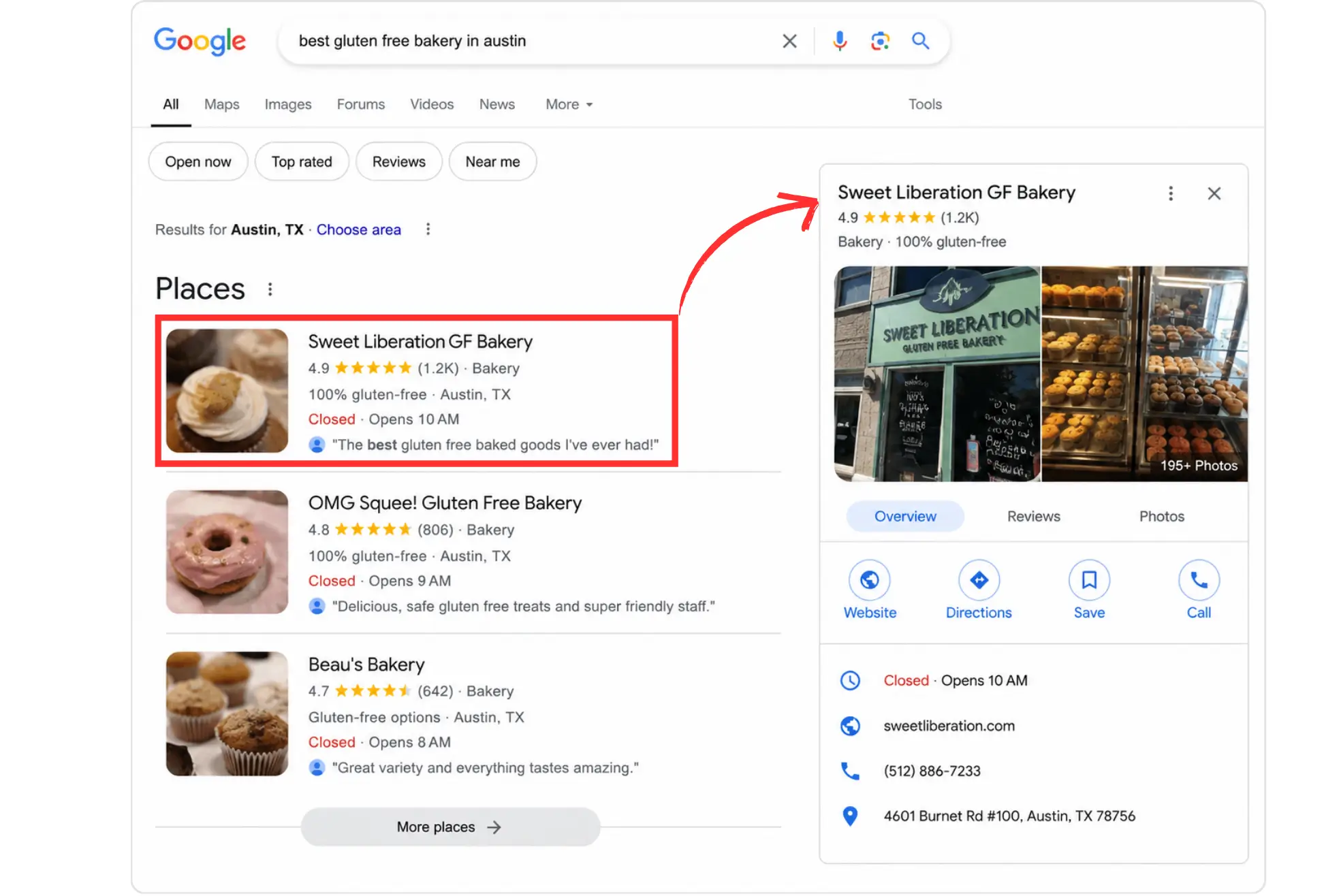
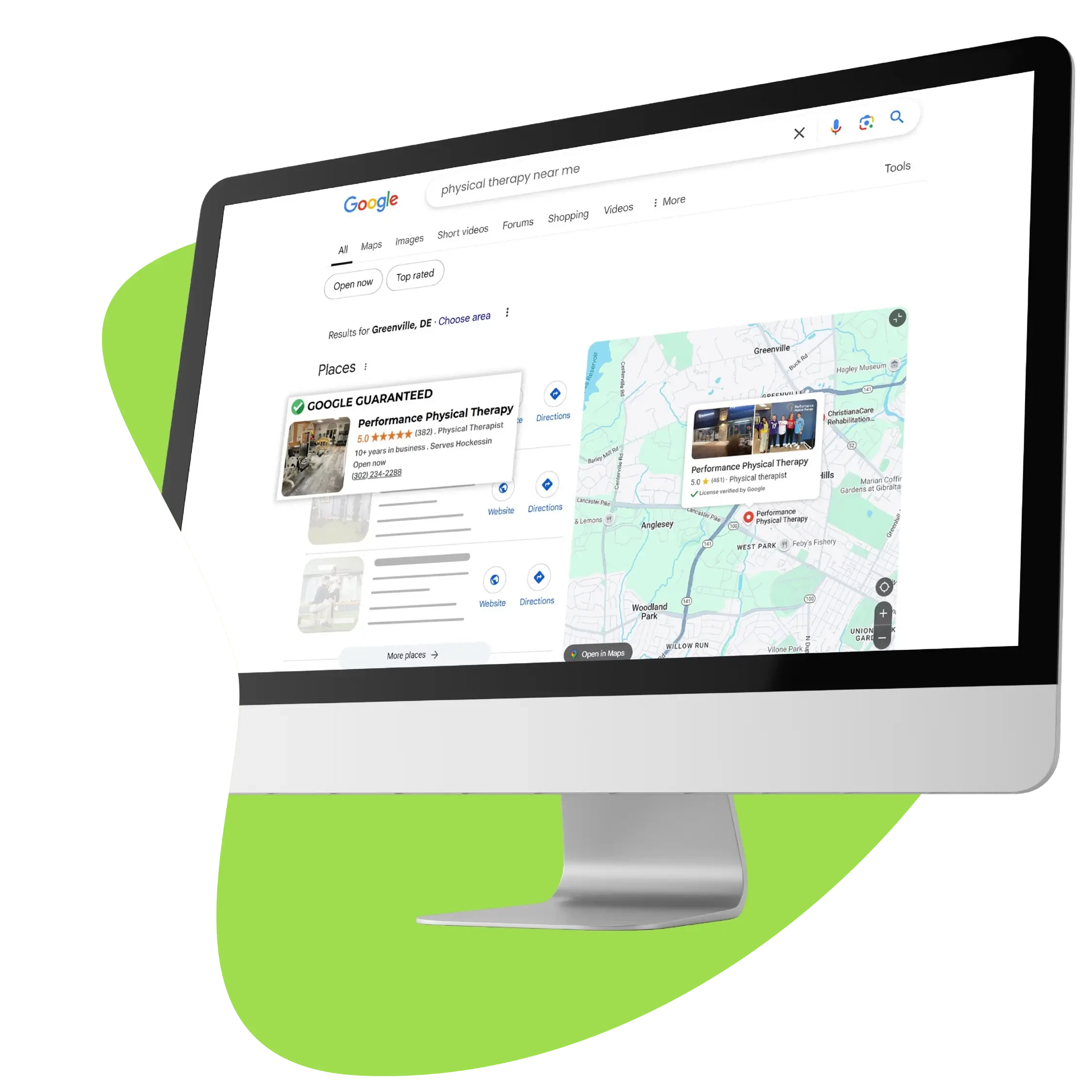
This matters because being featured in an AI Overview can put you above the traditional Local Pack, which is the map with three business listings that appears in local results. A weekly update routine is not just about keeping your spot in the Local Pack. It is about feeding the systems that decide whether Google's AI recommends your business at all when someone nearby is looking for what you offer.
Final Thoughts: Showing Up Consistently Is the Strategy
Weekly GBP updates are not a clever trick or a short term fix. They are how Google decides whether your business deserves to be seen by people searching nearby. The algorithm has made this clear: businesses that stay active, engage with customers, and keep their profiles fresh will consistently outrank those that do not, regardless of how long the inactive profile has been around.
The good news is that the bar is not high. Around 20 minutes a week spread across a few simple actions — a post, a few photos, some review replies — is enough to put real distance between you and the competitors who are doing nothing. That is not a big commitment. It is just a habit worth building before someone else in your area builds it first.
Start this week. Pick one action from the schedule above and do it today. Repeat it next week. After 90 days, open your GBP Insights and look at the numbers. The results tend to speak clearly enough on their own.
FAQ
How to get Google Business Profile to rank higher?

To improve your Google Business Profile (GBP) ranking, you need to provide Google with consistent data about your business. The most critical steps are filling every section of your profile, choosing precise categories, gathering customer reviews, and regularly updating your profile with posts and photos.
How to attract more visitors to Google Business Profile?
To make your business more visible on Google, start by claiming your free Google Business Profile. This ensures your company appears on Google Maps and localized search results. Complete all fields (hours, contact details, services, NAP), add photos, and encourage happy customers to leave reviews.
How do I promote my Google Business Profile?
Promoting your Google Business Profile (GBP) involves local SEO too, customer engagement, and paid ads. To start, ensure your profile is fully claimed via the Google Business Profile Help page. Once claimed, maximize visibility with consistent optimization and strategic outreach.
What are common Google profile mistakes?
Common Google Business Profile mistakes include failing to verify your listing, listing inconsistent Name, Address, and Phone numbers (NAP) across the web, and choosing vague or incorrect business categories. Leaving descriptions blank and ignoring to update holiday hours also heavily hurt local visibility and customer trust.
Does the number of Google reviews still matter for local rankings?
Yes, but recency matters more than total count. A business with 80 recent reviews will often outrank one with 200 stale reviews. Google is looking for consistent review velocity a steady flow of fresh feedback as proof that your business is currently active and trusted by customers.
Most local business owners set up their Google Business Profile once, fill in the hours, upload a few photos, and think the job is done. Here is the problem. Google does not see that as done. It sees it as abandoned. And abandoned profiles simply do not rank well.
In few years, the way Google looks at local listings has changed in a real way. How active your profile is, how fresh the content is, and how much people engage with it have all become key parts of how Google decides who shows up in local search results. If you treat your GBP like a digital business card you touch once a year, you are quietly handing your competitors a head start every single week.
This article explains exactly why that is happening, what Google is paying attention to, and what a practical weekly update routine actually looks like.
How Google Moved from Static to Active Profiles and What That Means for Your Business?
For a long time, local SEO was mostly about filling things in. Complete your profile, collect some reviews, get listed in a few directories, and you were doing well. That approach still has value. But it is no longer enough on its own.
What changed is that Google now treats activity as a sign that your business is real and relevant. A profile that has not been touched in six months starts to look, to Google's systems, like a business that may have slowed down or even stopped operating. Google does not want to recommend businesses it is not sure are still active and serving customers.
Profiles that are regularly updated with fresh posts, new photos, answered questions, and review responses are increasingly treated as a separate ranking advantage. Google has shifted from rewarding completeness to rewarding ongoing engagement.
The Three Core Signals Google Uses and What Has Shifted Inside Each of Them
Google still builds local rankings around three main ideas;
Proximity: How close your business is to the person searching.
Relevance: How well your profile matches what they typed in.
Prominence: How well known and trusted your business appears to be. What has changed is how prominence gets measured.
Prominence used to come mostly from how many reviews you had, how many websites linked to you, and how consistently your business details appeared across the internet. These include how often people interact with your profile, whether those interactions are growing over time, and whether your listing looks like something a real business is managing or something nobody has looked at in months.
What Weekly Updates Actually Mean: It Is More Than Just Publishing Posts?
When people in local SEO say "keep your GBP active," the advice often gets reduced to "just post regularly." Posting does matter. But weekly updates cover a broader set of actions. Each one sends a different kind of signal to Google about your business.
Here is a clear breakdown of the different update types, what each one does, and how often you should be doing them:
Update Type | Ranking Signal It Feeds | Recommended Frequency | Impact Level |
|---|---|---|---|
Google Posts (updates, offers, events) | Freshness and engagement signals | 1 to 2 times per week | High |
New Photos (interior, products, team) | Prominence and click through signals | Weekly (2 to 3 images) | High |
Review Responses | Trust, engagement, and review velocity | Within 24 to 48 hours of each review | High |
Q&A Updates (add or answer questions) | Relevance and indexable content | Every two weeks or as needed | Medium |
Hours and Attribute Checks | Accuracy and trust signals | Weekly check; update when something changes | Medium |
Service and Product Updates | Relevance to search queries | Monthly or whenever your offerings change | Steady |
Special Hours (holidays, closures) | Accuracy; prevents ranking suppression | Before every holiday or planned closure | High |
Think of the table above as a menu, not a rigid checklist. Not every item needs to happen every single week. But at least two or three of these signals should be refreshed regularly to keep your profile looking alive and well managed in Google's eyes.
Google Posts: The Weekly Ranking Signal That Most Businesses Are Ignoring
Google Posts are not just status updates. They are actual indexed content. They show up directly in your profile within search results. And since Google's late 2025 algorithm update, they also feed into the AI summaries that Google generates for local queries. That is a meaningful change worth understanding.
When you publish a post, you are giving Google something to read and understand about what your business is doing right now. A restaurant posting about a new dish tells Google this is a current, active business. A plumber posting about same day emergency availability reinforces how relevant they are for those kinds of searches. The content you publish keeps your profile connected to what people are actually looking for.
Post Types That Get Results and One You Should Avoid
Not every post type carries the same weight. Offer posts and event posts tend to perform best because they include structured information like start and end dates and promotional details that Google's system can read clearly. Update posts work well for general news and announcements. What does not work is posting the same content again and again, packing your captions with keywords, or publishing posts with no action button. If Google has nothing to measure in terms of how users respond, the post adds very little to your ranking signals.
The Review Velocity Factor That Most Business Owners Do Not Think About
For a long time, the number of reviews you had was the main thing that mattered. But Google's algorithm now looks closely at review velocity, which means how consistently and regularly new reviews are coming in, not just the total number you have collected over the years.
A business with 200 reviews but no new ones in the past six months will often rank below a business with 80 reviews that is getting a steady flow of fresh ones. Google is not just asking how trusted this business is overall. It is asking whether this business is actively serving customers right now.
How to Get More Reviews Consistently Without Breaking Google's Rules?
The most reliable approach is to make review requests a normal part of what happens after you serve a customer. Send a short follow up message with a direct link to your GBP review page. Google launched official review request QR codes in late 2025, which work well for businesses with a physical location. A small card at checkout or a printed note with a receipt is all it takes. The goal is to make it easy for customers to leave a review, not to reward them for doing so. Google's rules clearly say you cannot offer anything in return for reviews, and doing so can get your profile suspended.
Responding to every review, whether good or bad, also tells Google that your profile is being actively managed. Research suggests that profiles which respond to reviews consistently build roughly 1.7 times more trust with potential customers compared to profiles that never respond at all.
Why Adding Photos Every Week Is an SEO Action, Not Just a Social Media Habit?
Uploading optimized photos feels like something you do for Instagram, not for Google rankings. That instinct is misleading and it costs businesses real visibility. Google uses photo activity as a signal of prominence. Profiles with more than 100 photos get significantly more calls and direction requests on average. That is not because customers scroll through every image. It is because Google reads active photo uploads as a sign that the business is legitimate, operating, and worth showing to people nearby.
You do not need a professional photographer for this. Real photos of a completed project, a team member at work, or your space on a normal day will outperform generic stock images every time. They also give Google genuine signals of business activity, which matters more than how polished the photo looks.
Consistency matters more than volume. Adding three photos every week for a month sends stronger signals than uploading thirty photos all at once. Google reads the upload timestamps. A steady pace over time tells a better story of an active business than a single large batch that is never followed up on.
Q&A Plus Business Attributes: Two Quiet Ways to Boost Your Local Relevance
The Q and A section of a Google Business Profile is content that Google can actually index, and most businesses leave it completely empty. This creates two problems. First, when customers ask questions and nobody from the business answers, random people often step in with answers that may be wrong.
Second, a well managed Q and A section adds keyword relevant content that Google can surface in its AI summaries and local search snippets.
Think about the questions your customers ask most often. Things like "Do you offer same day appointments?" or "Is parking available?" or "Do you accept insurance?" Adding these as questions with clear answers gives Google more to work with when matching your profile to relevant searches. Check this section every two weeks to catch any new questions from users.
Business Attributes: Small Checkboxes That Do Real Ranking Work
Attributes are the checkbox options inside your GBP like "women led," "LGBTQ+ friendly," "outdoor seating," or "wheelchair accessible." These feed relevance signals for very specific search queries. As Google's AI generated summaries become more common in local results — showing up in roughly 38% of local service queries, the structured information that attributes provide becomes more useful to Google, not less. Check your attributes whenever a new option becomes available in your business category and keep them current.
A Simple Weekly GBP Schedule That You Will Actually Keep Up With
Knowing what to do is one thing. Having a routine you can stick to is another. Here is a practical weekly plan that covers the most important updates without taking more than 20 to 30 minutes across the whole week.
MondayReply to all reviews from the past week. Try to mention something specific from what the reviewer said. A personalised reply is better than a template, and a template is better than nothing at all. |
TuesdayWrite and publish a Google Post. Connect it to something real — a current offer, a seasonal service, or a question a customer asked you recently. Add a photo and a clear action button. |
WednesdayUpload 2 to 3 fresh photos. Keep it simple. Behind the scenes moments, recent work, your team, your space. Real and recent always beats polished and generic. |
ThursdayCheck your Q and A section for new questions and confirm your hours are still accurate. If a holiday or closure is coming up soon, update your special hours now so you are not rushing at the last minute. |
FridaySend review requests to customers you served during the week. A short friendly message with a direct link is all you need. Doing this consistently every week builds up far more than any one big push ever will. |
This routine takes about 20 to 25 minutes spread across five days. What you get in return is a profile that Google recognises as actively managed — one that is building engagement signals week after week while other profiles in your area sit untouched.
What Actually Happens to Profiles That Are Not Updated Regularly?
Not updating your profile does not just mean missing out on opportunities. It creates a real and measurable ranking risk. Google's systems are now checking whether profiles look active and legitimate. A profile that has had no new posts, no new photos, and no review responses for several months starts to look, to the algorithm, like a business that may have scaled back, moved, or closed.
In competitive local markets, search positions can shift two to three spots within a single week. A business that stops sending Google fresh signals, even for a short time, can find itself pushed down by a competitor that simply kept their routine going. Getting that ground back takes longer than it would have taken to hold it in the first place.
Profiles that go stale lose prominence signals over time even if nothing else goes wrong
Competitors who post weekly build up freshness signals that stack up across months
A gap in new reviews signals to Google that the business may no longer be actively serving customers
Outdated hours during holidays can suppress your ranking and directly damage customer trust
Profiles with lower engagement numbers like fewer clicks, calls, and direction requests rank below profiles with higher engagement and engagement starts with being visible.
How GBP Updates Now Connect to Google AI Overviews and the Local Pack?
One of the more important changes to understand is the growing role of Google's AI Overviews in local search. These are the short AI generated summaries that now appear at the top of search results for many local queries. They show up in roughly 38 percent of local service searches as of early 2026. They pull information from your GBP content, your reviews, your posts, and structured data to put together an answer for the searcher. Businesses with well maintained and regularly updated profiles are much more likely to be included in those summaries.
This matters because being featured in an AI Overview can put you above the traditional Local Pack, which is the map with three business listings that appears in local results. A weekly update routine is not just about keeping your spot in the Local Pack. It is about feeding the systems that decide whether Google's AI recommends your business at all when someone nearby is looking for what you offer.
Final Thoughts: Showing Up Consistently Is the Strategy
Weekly GBP updates are not a clever trick or a short term fix. They are how Google decides whether your business deserves to be seen by people searching nearby. The algorithm has made this clear: businesses that stay active, engage with customers, and keep their profiles fresh will consistently outrank those that do not, regardless of how long the inactive profile has been around.
The good news is that the bar is not high. Around 20 minutes a week spread across a few simple actions — a post, a few photos, some review replies — is enough to put real distance between you and the competitors who are doing nothing. That is not a big commitment. It is just a habit worth building before someone else in your area builds it first.
Start this week. Pick one action from the schedule above and do it today. Repeat it next week. After 90 days, open your GBP Insights and look at the numbers. The results tend to speak clearly enough on their own.
FAQ
How to get Google Business Profile to rank higher?
To improve your Google Business Profile (GBP) ranking, you need to provide Google with consistent data about your business. The most critical steps are filling every section of your profile, choosing precise categories, gathering customer reviews, and regularly updating your profile with posts and photos.
How to attract more visitors to Google Business Profile?
To make your business more visible on Google, start by claiming your free Google Business Profile. This ensures your company appears on Google Maps and localized search results. Complete all fields (hours, contact details, services, NAP), add photos, and encourage happy customers to leave reviews.
How do I promote my Google Business Profile?
Promoting your Google Business Profile (GBP) involves local SEO too, customer engagement, and paid ads. To start, ensure your profile is fully claimed via the Google Business Profile Help page. Once claimed, maximize visibility with consistent optimization and strategic outreach.
What are common Google profile mistakes?
Common Google Business Profile mistakes include failing to verify your listing, listing inconsistent Name, Address, and Phone numbers (NAP) across the web, and choosing vague or incorrect business categories. Leaving descriptions blank and ignoring to update holiday hours also heavily hurt local visibility and customer trust.
Does the number of Google reviews still matter for local rankings?
Yes, but recency matters more than total count. A business with 80 recent reviews will often outrank one with 200 stale reviews. Google is looking for consistent review velocity a steady flow of fresh feedback as proof that your business is currently active and trusted by customers.



Summarize with AI



Want to Skyrocket Revenue? Get a Free Audit Today!
Want to Skyrocket Revenue? Get a Free Audit Today!



4.9/5 Ratings!


Don’t miss our revenue growth tips!
Get expert marketing tips—straight to your inbox, like thousands of happy clients.
Don’t miss our revenue growth tips!
Get expert marketing tips—straight to your inbox, like thousands of happy clients.
Don’t miss our revenue growth tips!
Don’t miss our revenue growth tips!
Get expert marketing tips—straight to your inbox, like thousands of happy clients.
Relevant Blogs on Organic SEO
Relevant Blogs on Organic SEO
Unlock data-driven insights in Organic SEO—explore our featured blogs and skyrocket your revenue before your competitors do.
Unlock data-driven insights in Organic SEO—explore our featured blogs and skyrocket your revenue before your competitors do.

SEO
Sep 21, 2026
5 Min Read
Audience-First SEO: How to Rank by Putting Readers First
SEO
Sep 21, 2026
5 Min Read
Audience-First SEO: How to Rank by Putting Readers First
SEO
Sep 21, 2026
5 Min Read
Audience-First SEO: How to Rank by Putting Readers First

SEO
Sep 19, 2026
5 Min Read
How to Add SEO Keywords to Your Website: Where and How
SEO
Sep 19, 2026
5 Min Read
How to Add SEO Keywords to Your Website: Where and How
SEO
Sep 19, 2026
5 Min Read
How to Add SEO Keywords to Your Website: Where and How

SEO
Sep 18, 2026
5 Min Read
How XML Sitemaps Help Search Engines Discover New Pages
SEO
Sep 18, 2026
5 Min Read
How XML Sitemaps Help Search Engines Discover New Pages
SEO
Sep 18, 2026
5 Min Read
How XML Sitemaps Help Search Engines Discover New Pages































Ready to speak with an expert?
Data-Driven Marketing Agency That Elevates ROI
1100+
Websites Designed & Optimized to Convert
$280M+
Client Revenue Driven & Growing Strong
Discover how to skyrocket
your revenue today!
Trusted by 1000+ Owners!
Ready to speak with an expert?
Data-Driven Marketing Agency That Elevates ROI
1100+
Websites Designed & Optimized to Convert
$280M+
Client Revenue Driven & Growing Strong
Discover how to skyrocket
your revenue today!
Trusted by 1000+ Owners!
Want to skyrocket revenue?
4.9/5 Ratings!
Ready to speak with an expert?
Data-Driven Marketing Agency That Elevates ROI
1100+
Websites Designed & Optimized to Convert
$280M+
Client Revenue Driven & Growing Strong
Discover how to skyrocket
your revenue today!
Trusted by 1000+ Owners!
Call
Meet