AI Is Exposing Your Negative Reviews — Here's How to Stop It
AI Is Exposing Your Negative Reviews — Here's How to Stop It
Last Updated:
Table of Content
Case Studies







AI-powered search experiences are changing how customers evaluate brands online. Today, platforms like Google AI Overviews, ChatGPT, and other AI search systems actively summarize opinions, reviews, Reddit discussions, and third-party content to form instant brand perceptions, often before users ever visit your website.
If you're looking to remove negative reviews, suppress negative search results, or improve visibility in Google AI Overviews, understanding how AI reputation management works is essential. AI systems constantly analyze reviews, forums, and online discussions to surface brand sentiment, but with the right Online Reputation Management strategy, including audits, positive content signals, review management, and AI overview optimization, businesses can reduce negative exposure and strengthen their online reputation before it impacts leads and conversions.
The good news? Once you understand why it's happening, you can do something about it. AI platforms don’t highlight every negative mention online. Instead, they look for signals that appear trustworthy and relevant. Recent complaints, repeated issues across multiple websites, and detailed user experiences are far more likely to be surfaced in AI-generated answers. Platforms like Reddit, Trustpilot, G2, and industry forums also carry more weight because AI systems see them as reliable sources of real user sentiment. When the same complaint keeps appearing across different platforms, AI begins treating it as a genuine pattern instead of a one-off opinion.
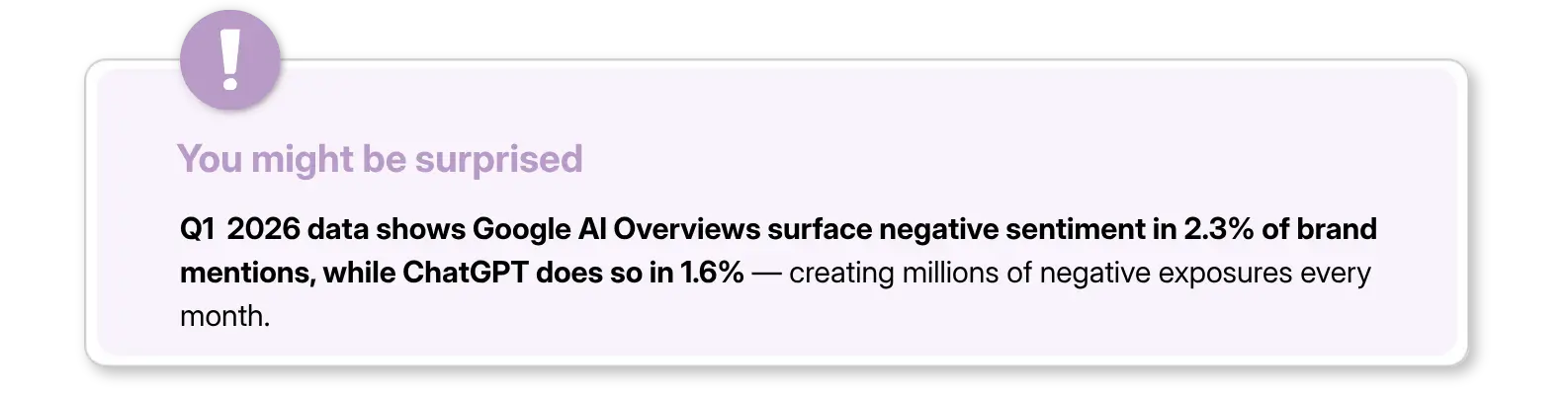
1. Understand What AI Is Actually Doing to Your Reputation
When someone searches “best SEO agency for local businesses” or asks ChatGPT “which digital marketing agency should I hire?”, AI search engines don’t just compare services or pricing. They analyze user sentiment from across the web Google reviews, Reddit discussions, Clutch ratings, LinkedIn comments, forum complaints, and third-party review platforms, then generate a summarized perception of your brand before users even visit your website.
Your brand’s negative signals can appear in comparison searches where users never specifically searched for your agency. They can surface alongside competitor recommendations. And the person reading that AI-generated summary may never click through to verify the context, read your response, or see the positive client results you've delivered.
This is the core shift in Online Reputation Management. It’s no longer just a ranking problem, it’s a signal problem.
Traditional reputation management asked, "What appears on page one when someone searches my brand?”
AI reputation management asks, "What patterns is AI discovering about my brand across the entire web?”
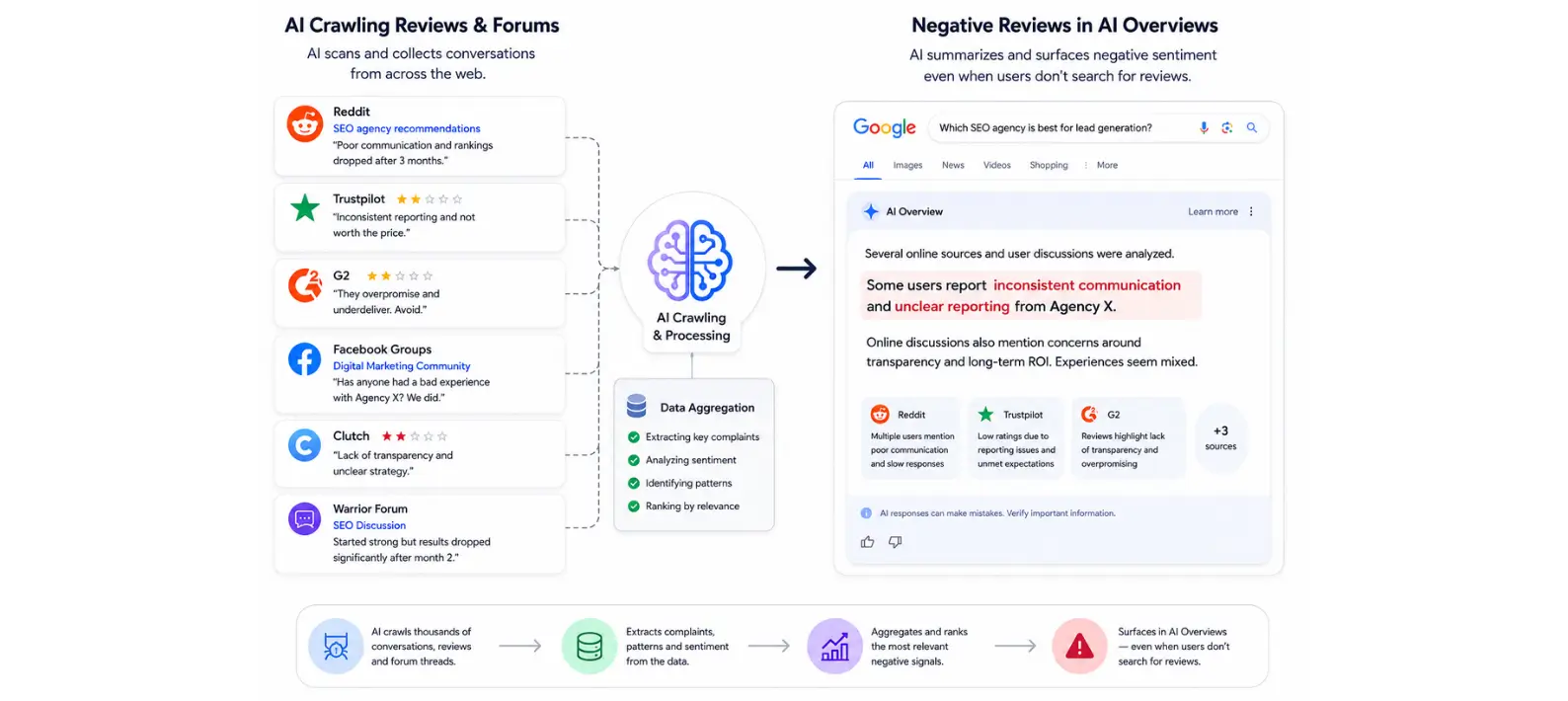
In many cases, these AI-generated summaries become the first impression users see before they ever visit your website, check your case studies, or speak with your team. That means even a few recurring complaints or negative discussions can quietly influence trust, conversions, and buying decisions at scale.
2. Know the Four Signals That Decide What AI Surfaces
Not every negative review or complaint gets picked up by AI-generated search results. Large language models & AI search engines are designed to identify patterns that appear credible, repeated, and relevant to user intent. Understanding these signals is critical if you want to improve your brand perception in Google AI Overviews, ChatGPT, and other AI-driven search experiences.
a) Recency + Volume: Fresh complaints backed by multiple corroborating sources carry the most weight. If five users posted about the same billing issue across different platforms in the same month, AI treats that as a credible pattern, not an outlier.
b) Specificity: Vague posts ("terrible company") get filtered out. Detailed complaints — ones that name specific features, quote dollar amounts, or describe exact outcomes — get treated as high-quality evidence. The more specific the complaint, the more citable it is.
c) Platform Authority: Where a complaint lives matters as much as the complaint itself. Reddit, Trustpilot, G2, Capterra, and major industry forums are treated as trusted sources. The same complaint on a low-traffic personal blog is practically invisible to AI. A Reddit thread with 200 upvotes is not.
d) Recurrence Across Sources: One angry customer on Yelp is noise. That same complaint appearing independently on Reddit, G2, and Trustpilot becomes signal — and AI engines treat it as a verified pattern worth surfacing.
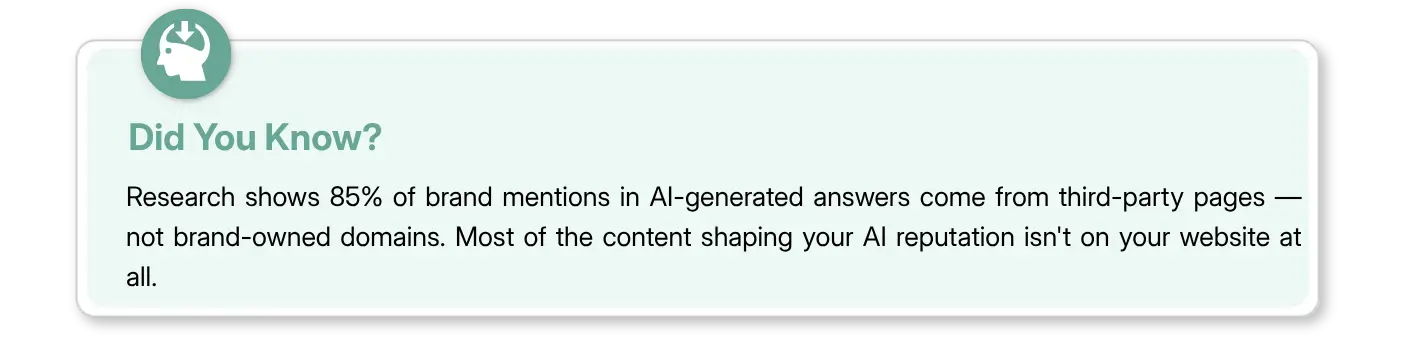
The key to modern AI reputation management is understanding how these signals compound together. Brands that actively manage reviews, respond with factual context, strengthen positive content across authoritative platforms, and reduce repeated negative narratives are far more likely to control how AI systems interpret and summarize their reputation online.
3. The New Rules of AI Reputation Management
AI systems build opinions about your brand by analyzing patterns across reviews, forums, search results, social discussions, and third-party websites. These five areas are where businesses can actively improve the signals AI uses to shape brand perception.
A) Stop Ignoring Your Negative Signal Footprint — Audit It First
Before fixing your online reputation, you need to understand what AI platforms already know about your brand. The first real step in AI reputation management is understanding exactly what AI can find and cite about your brand.
Run the Queries Yourself
Open ChatGPT, Perplexity, and Google and type:
"What are the pros and cons of [Your Brand] vs. [Top Competitor]?"
"Is [Your Brand] trustworthy?"
"What do users say about [Your Brand]?"
Document recurring complaints, negative mentions, and the platforms being referenced.
Check the Platforms AI Trusts Most
Review platforms: Google Business Profile, Trustpilot, Yelp, G2, Capterra
Reddit: Search your brand name alongside "complaint," "problem," or "scam"
Industry forums and FB groups: Niche communities where your actual customers talk
Social media: Twitter/X threads, LinkedIn comments, TikTok replies
Document Every Finding, For each piece of negative content, note the platform, date posted, specific claims made, whether those claims are factually accurate, and whether it's appearing in Google results or AI summaries. This prioritized inventory is what your action plan runs on.
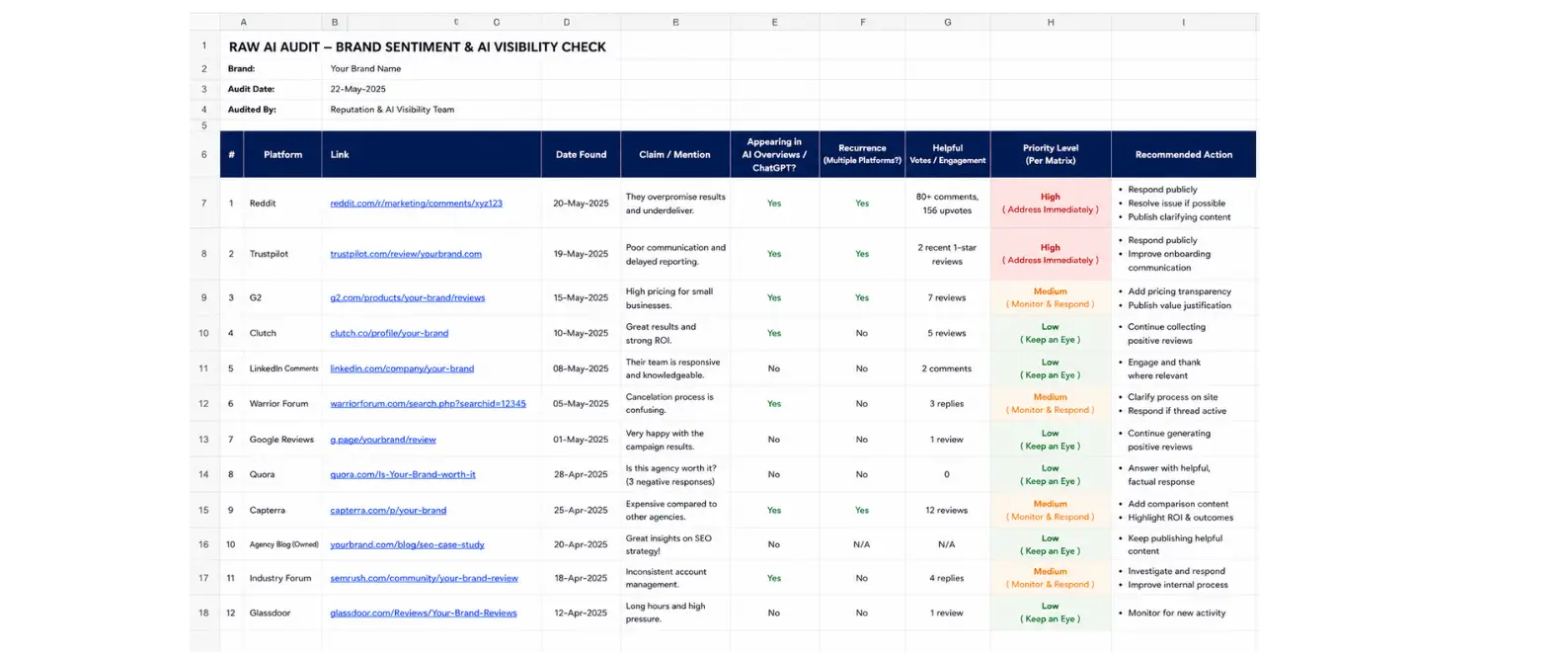
B) Prioritize Before You Act: Not Every Complaint Needs the Same Response
The biggest mistake brands make after an audit is treating every negative mention with the same urgency. That burns time and effort on things that barely register while ignoring the ones that are actively damaging you
Build a simple priority matrix instead.
High Priority: Address Immediately
Content currently appearing in AI Overviews or ChatGPT summaries
Complaints that appear across multiple platforms (recurrence = AI signal)
Posts from the last 12 months on high-authority sources like Reddit or G2
Reviews with 50+ "helpful" votes, these signal credibility to both users and AI systems
Medium Priority: Monitor and Respond
Content from 1–2 years ago that still ranks in Google but hasn't appeared in AI summaries
Isolated complaints with no corroboration on other platforms
Low Priority: Keep an Eye, Don't Panic
Very old content (3+ years) with minimal engagement
Complaints about discontinued products or resolved issues
Focus your energy where the AI exposure is highest. A three-year-old forum thread with zero upvotes is not the threat. A six-month-old Reddit post with 80 comments about a recurring issue is.

C) Remove Negative Reviews Where You Can — Here's How
Some negative content can genuinely be removed. Some deserve a response. Some just need to be buried under stronger positive content. Knowing the difference saves you from wasted effort and from making things worse.
i) When to Request Removal
If a review violates platform policies — such as fake information, impersonation, harassment, or spam — report it through the platform’s official removal process. Google, Trustpilot, Yelp, and G2 all allow removal requests for policy-violating content.
For complaint websites or outdated negative mentions, professional removal services may help in certain cases, especially when the content is inaccurate or harmful.
If removal isn’t possible, focus on reducing its visibility by building stronger positive content and brand mentions.
ii) When a Public Response Helps
Respond when the complaint is genuine, factual, or based on a misunderstanding you can clarify. Keep responses professional, factual, and solution-focused. AI systems can sometimes reference brand responses in summaries, making thoughtful replies valuable for both users and AI-generated perception.
iii) When Not to Respond
Avoid engaging with obvious fake reviews, emotional attacks, or outdated complaints that no longer reflect your business. In some cases, responding can unintentionally increase visibility and engagement around the negative content.
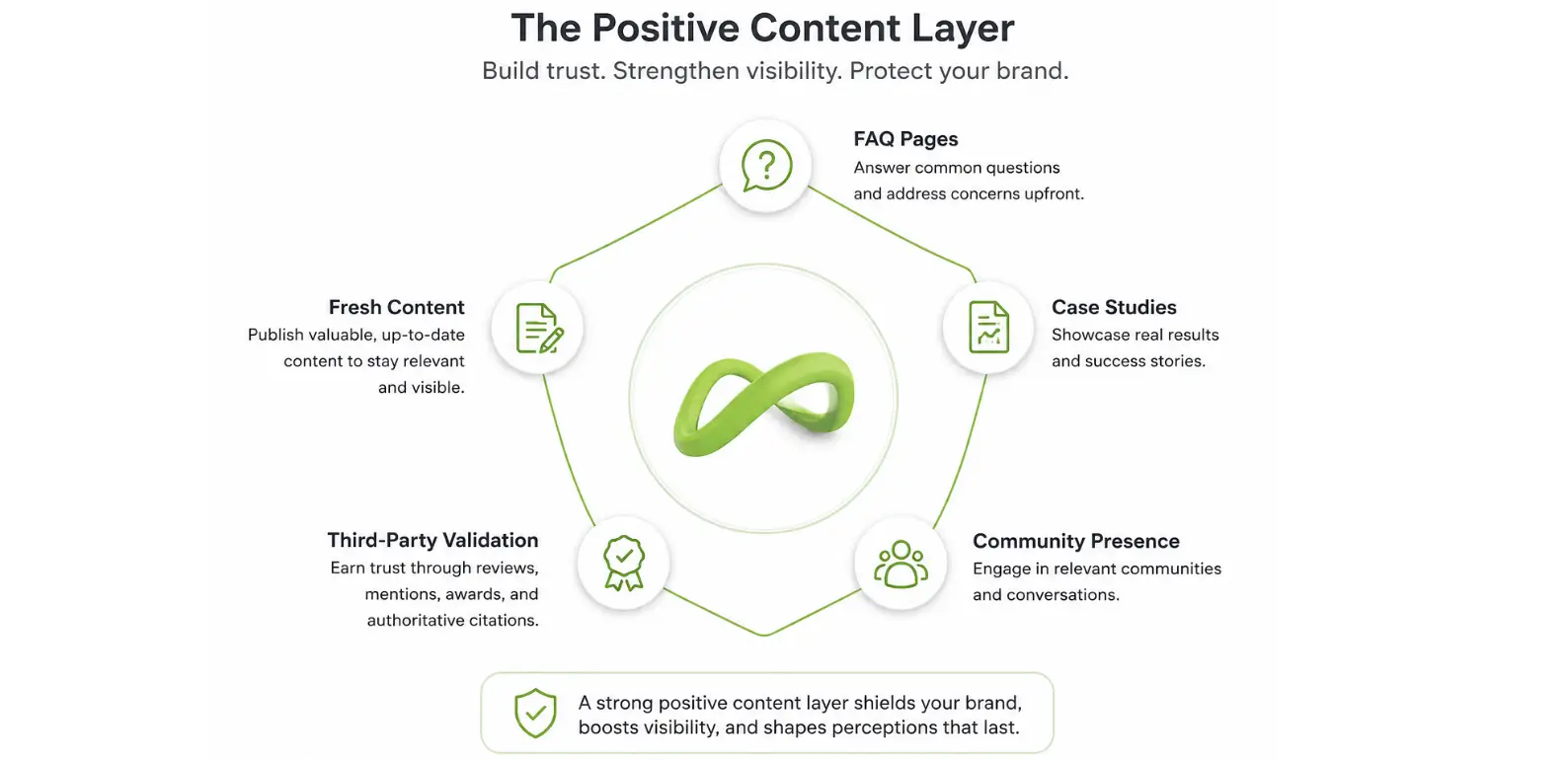
D) Build a Positive Content Layer That AI Prefers to Cite
Removing or responding to negative content only addresses existing damage. To improve long-term AI perception, you need stronger positive signals that AI systems prefer to reference.
Build Content AI Can Trust
FAQ Pages: Create pages answering real customer concerns like pricing, trust, or support issues using clear language and FAQ schema.
Case Studies With Real Data: Use measurable results, timelines, and genuine customer proof instead of generic testimonials.
Community Presence: Stay active on Reddit, forums, and industry communities where your audience already discusses solutions.
Third-Party Mentions: Get featured in trusted comparison articles, “best of” lists, and industry roundups.
Keep Content Updated: AI systems favor recent and regularly updated content over outdated pages
E) Monitor Continuously: This Is a Program, Not a One-Time Fix
AI reputation management isn’t a one-time fix, it’s an ongoing process. Regularly monitor the queries that trigger AI Overviews mentioning your brand, track new complaints across high-authority platforms, and review whether positive content is being referenced more frequently over time.
Because AI search systems continuously update their sources and sentiment signals, brands that consistently manage their online reputation build stronger long-term visibility and trust than competitors who react only after negative perception starts affecting conversions.
Final Thoughts
Every interaction today happens against a backdrop of AI-generated brand perception. A potential customer, investor, or partner may form an opinion about your business from a short AI-generated summary before ever visiting your website or speaking to your team.
Improving your AI reputation starts with a clear process:
Prioritize high-visibility negative signals
Remove or respond to harmful content strategically
Build stronger positive signals through content, reviews, and third-party mentions
Continuously monitor how AI-generated perception evolves over time
The brands succeeding in AI-driven search aren’t the ones with zero negative reviews, they’re the ones building a stronger, more trusted digital presence that outweighs isolated negative signals
FAQs
What is AI reputation management?

AI reputation management is the process of improving how AI-powered search platforms like Google AI Overviews, ChatGPT, and Perplexity perceive and summarize your brand online.
Can AI Overviews show negative reviews about my business?
Yes. AI systems can surface negative reviews, Reddit discussions, forum complaints, and third-party content when generating brand summaries or comparison results.
How do I remove negative reviews from Google or review sites?
You can request removal if the content violates platform policies such as fake reviews, harassment, impersonation, or spam. Otherwise, the better long-term strategy is often to suppress negative search results with stronger positive signals.
What platforms influence AI-generated brand summaries the most?
AI systems commonly reference Google Reviews, Reddit, Trustpilot, Yelp, G2, forums, social media discussions, and third-party comparison websites.
Is it possible to completely remove negative search results?
Not always. In many cases, suppressing negative content with stronger positive content, reviews, and authoritative mentions is more realistic than full removal.
AI-powered search experiences are changing how customers evaluate brands online. Today, platforms like Google AI Overviews, ChatGPT, and other AI search systems actively summarize opinions, reviews, Reddit discussions, and third-party content to form instant brand perceptions, often before users ever visit your website.
If you're looking to remove negative reviews, suppress negative search results, or improve visibility in Google AI Overviews, understanding how AI reputation management works is essential. AI systems constantly analyze reviews, forums, and online discussions to surface brand sentiment, but with the right Online Reputation Management strategy, including audits, positive content signals, review management, and AI overview optimization, businesses can reduce negative exposure and strengthen their online reputation before it impacts leads and conversions.
The good news? Once you understand why it's happening, you can do something about it. AI platforms don’t highlight every negative mention online. Instead, they look for signals that appear trustworthy and relevant. Recent complaints, repeated issues across multiple websites, and detailed user experiences are far more likely to be surfaced in AI-generated answers. Platforms like Reddit, Trustpilot, G2, and industry forums also carry more weight because AI systems see them as reliable sources of real user sentiment. When the same complaint keeps appearing across different platforms, AI begins treating it as a genuine pattern instead of a one-off opinion.
1. Understand What AI Is Actually Doing to Your Reputation
When someone searches “best SEO agency for local businesses” or asks ChatGPT “which digital marketing agency should I hire?”, AI search engines don’t just compare services or pricing. They analyze user sentiment from across the web Google reviews, Reddit discussions, Clutch ratings, LinkedIn comments, forum complaints, and third-party review platforms, then generate a summarized perception of your brand before users even visit your website.
Your brand’s negative signals can appear in comparison searches where users never specifically searched for your agency. They can surface alongside competitor recommendations. And the person reading that AI-generated summary may never click through to verify the context, read your response, or see the positive client results you've delivered.
This is the core shift in Online Reputation Management. It’s no longer just a ranking problem, it’s a signal problem.
Traditional reputation management asked, "What appears on page one when someone searches my brand?”
AI reputation management asks, "What patterns is AI discovering about my brand across the entire web?”
In many cases, these AI-generated summaries become the first impression users see before they ever visit your website, check your case studies, or speak with your team. That means even a few recurring complaints or negative discussions can quietly influence trust, conversions, and buying decisions at scale.
2. Know the Four Signals That Decide What AI Surfaces
Not every negative review or complaint gets picked up by AI-generated search results. Large language models & AI search engines are designed to identify patterns that appear credible, repeated, and relevant to user intent. Understanding these signals is critical if you want to improve your brand perception in Google AI Overviews, ChatGPT, and other AI-driven search experiences.
a) Recency + Volume: Fresh complaints backed by multiple corroborating sources carry the most weight. If five users posted about the same billing issue across different platforms in the same month, AI treats that as a credible pattern, not an outlier.
b) Specificity: Vague posts ("terrible company") get filtered out. Detailed complaints — ones that name specific features, quote dollar amounts, or describe exact outcomes — get treated as high-quality evidence. The more specific the complaint, the more citable it is.
c) Platform Authority: Where a complaint lives matters as much as the complaint itself. Reddit, Trustpilot, G2, Capterra, and major industry forums are treated as trusted sources. The same complaint on a low-traffic personal blog is practically invisible to AI. A Reddit thread with 200 upvotes is not.
d) Recurrence Across Sources: One angry customer on Yelp is noise. That same complaint appearing independently on Reddit, G2, and Trustpilot becomes signal — and AI engines treat it as a verified pattern worth surfacing.
The key to modern AI reputation management is understanding how these signals compound together. Brands that actively manage reviews, respond with factual context, strengthen positive content across authoritative platforms, and reduce repeated negative narratives are far more likely to control how AI systems interpret and summarize their reputation online.
3. The New Rules of AI Reputation Management
AI systems build opinions about your brand by analyzing patterns across reviews, forums, search results, social discussions, and third-party websites. These five areas are where businesses can actively improve the signals AI uses to shape brand perception.
A) Stop Ignoring Your Negative Signal Footprint — Audit It First
Before fixing your online reputation, you need to understand what AI platforms already know about your brand. The first real step in AI reputation management is understanding exactly what AI can find and cite about your brand.
Run the Queries Yourself
Open ChatGPT, Perplexity, and Google and type:
"What are the pros and cons of [Your Brand] vs. [Top Competitor]?"
"Is [Your Brand] trustworthy?"
"What do users say about [Your Brand]?"
Document recurring complaints, negative mentions, and the platforms being referenced.
Check the Platforms AI Trusts Most
Review platforms: Google Business Profile, Trustpilot, Yelp, G2, Capterra
Reddit: Search your brand name alongside "complaint," "problem," or "scam"
Industry forums and FB groups: Niche communities where your actual customers talk
Social media: Twitter/X threads, LinkedIn comments, TikTok replies
Document Every Finding, For each piece of negative content, note the platform, date posted, specific claims made, whether those claims are factually accurate, and whether it's appearing in Google results or AI summaries. This prioritized inventory is what your action plan runs on.
B) Prioritize Before You Act: Not Every Complaint Needs the Same Response
The biggest mistake brands make after an audit is treating every negative mention with the same urgency. That burns time and effort on things that barely register while ignoring the ones that are actively damaging you
Build a simple priority matrix instead.
High Priority: Address Immediately
Content currently appearing in AI Overviews or ChatGPT summaries
Complaints that appear across multiple platforms (recurrence = AI signal)
Posts from the last 12 months on high-authority sources like Reddit or G2
Reviews with 50+ "helpful" votes, these signal credibility to both users and AI systems
Medium Priority: Monitor and Respond
Content from 1–2 years ago that still ranks in Google but hasn't appeared in AI summaries
Isolated complaints with no corroboration on other platforms
Low Priority: Keep an Eye, Don't Panic
Very old content (3+ years) with minimal engagement
Complaints about discontinued products or resolved issues
Focus your energy where the AI exposure is highest. A three-year-old forum thread with zero upvotes is not the threat. A six-month-old Reddit post with 80 comments about a recurring issue is.
C) Remove Negative Reviews Where You Can — Here's How
Some negative content can genuinely be removed. Some deserve a response. Some just need to be buried under stronger positive content. Knowing the difference saves you from wasted effort and from making things worse.
i) When to Request Removal
If a review violates platform policies — such as fake information, impersonation, harassment, or spam — report it through the platform’s official removal process. Google, Trustpilot, Yelp, and G2 all allow removal requests for policy-violating content.
For complaint websites or outdated negative mentions, professional removal services may help in certain cases, especially when the content is inaccurate or harmful.
If removal isn’t possible, focus on reducing its visibility by building stronger positive content and brand mentions.
ii) When a Public Response Helps
Respond when the complaint is genuine, factual, or based on a misunderstanding you can clarify. Keep responses professional, factual, and solution-focused. AI systems can sometimes reference brand responses in summaries, making thoughtful replies valuable for both users and AI-generated perception.
iii) When Not to Respond
Avoid engaging with obvious fake reviews, emotional attacks, or outdated complaints that no longer reflect your business. In some cases, responding can unintentionally increase visibility and engagement around the negative content.
D) Build a Positive Content Layer That AI Prefers to Cite
Removing or responding to negative content only addresses existing damage. To improve long-term AI perception, you need stronger positive signals that AI systems prefer to reference.
Build Content AI Can Trust
FAQ Pages: Create pages answering real customer concerns like pricing, trust, or support issues using clear language and FAQ schema.
Case Studies With Real Data: Use measurable results, timelines, and genuine customer proof instead of generic testimonials.
Community Presence: Stay active on Reddit, forums, and industry communities where your audience already discusses solutions.
Third-Party Mentions: Get featured in trusted comparison articles, “best of” lists, and industry roundups.
Keep Content Updated: AI systems favor recent and regularly updated content over outdated pages
E) Monitor Continuously: This Is a Program, Not a One-Time Fix
AI reputation management isn’t a one-time fix, it’s an ongoing process. Regularly monitor the queries that trigger AI Overviews mentioning your brand, track new complaints across high-authority platforms, and review whether positive content is being referenced more frequently over time.
Because AI search systems continuously update their sources and sentiment signals, brands that consistently manage their online reputation build stronger long-term visibility and trust than competitors who react only after negative perception starts affecting conversions.
Final Thoughts
Every interaction today happens against a backdrop of AI-generated brand perception. A potential customer, investor, or partner may form an opinion about your business from a short AI-generated summary before ever visiting your website or speaking to your team.
Improving your AI reputation starts with a clear process:
Prioritize high-visibility negative signals
Remove or respond to harmful content strategically
Build stronger positive signals through content, reviews, and third-party mentions
Continuously monitor how AI-generated perception evolves over time
The brands succeeding in AI-driven search aren’t the ones with zero negative reviews, they’re the ones building a stronger, more trusted digital presence that outweighs isolated negative signals
FAQs
What is AI reputation management?
AI reputation management is the process of improving how AI-powered search platforms like Google AI Overviews, ChatGPT, and Perplexity perceive and summarize your brand online.
Can AI Overviews show negative reviews about my business?
Yes. AI systems can surface negative reviews, Reddit discussions, forum complaints, and third-party content when generating brand summaries or comparison results.
How do I remove negative reviews from Google or review sites?
You can request removal if the content violates platform policies such as fake reviews, harassment, impersonation, or spam. Otherwise, the better long-term strategy is often to suppress negative search results with stronger positive signals.
What platforms influence AI-generated brand summaries the most?
AI systems commonly reference Google Reviews, Reddit, Trustpilot, Yelp, G2, forums, social media discussions, and third-party comparison websites.
Is it possible to completely remove negative search results?
Not always. In many cases, suppressing negative content with stronger positive content, reviews, and authoritative mentions is more realistic than full removal.



Summarize with AI



Want to be seen everywhere?
Get a free AI-search audit Today!



4.9/5 Ratings!


Don’t miss our revenue growth tips!
Get expert marketing tips—straight to your inbox, like thousands of happy clients.
Don’t miss our revenue growth tips!
Get expert marketing tips—straight to your inbox, like thousands of happy clients.
Don’t miss our revenue growth tips!
Don’t miss our revenue growth tips!
Get expert marketing tips—straight to your inbox, like thousands of happy clients.
Relevant Blogs on Generative AI SEO
Relevant Blogs on Generative AI SEO
Unlock data-driven insights in AI-powered SEO—explore our featured blogs and skyrocket your revenue before your competitors do.
Unlock data-driven insights in AI-powered SEO—explore our featured blogs and skyrocket your revenue before your competitors do.

GEO
Sep 22, 2026
15 Min Read
AI Search Runs on More SEO Than You Think
GEO
Sep 22, 2026
15 Min Read
AI Search Runs on More SEO Than You Think
GEO
Sep 22, 2026
15 Min Read
AI Search Runs on More SEO Than You Think

GEO
Sep 7, 2026
8 Min Read
How to Optimize Content for AI Search Engines: Best Practices
GEO
Sep 7, 2026
8 Min Read
How to Optimize Content for AI Search Engines: Best Practices
GEO
Sep 7, 2026
8 Min Read
How to Optimize Content for AI Search Engines: Best Practices

GEO
Sep 4, 2026
12 Min Read
How Ecommerce Brands Can Advertise in Google AI Mode?
GEO
Sep 4, 2026
12 Min Read
How Ecommerce Brands Can Advertise in Google AI Mode?
GEO
Sep 4, 2026
12 Min Read
How Ecommerce Brands Can Advertise in Google AI Mode?



































Ready to speak with an expert?
Data-Driven Marketing Agency That Elevates ROI
1100+
Websites Designed & Optimized to Convert
$280M+
Client Revenue Driven & Growing Strong
Discover how to skyrocket
your revenue today!
Trusted by 1000+ Owners!
Ready to speak with an expert?
Data-Driven Marketing Agency That Elevates ROI
1100+
Websites Designed & Optimized to Convert
$280M+
Client Revenue Driven & Growing Strong
Discover how to skyrocket
your revenue today!
Trusted by 1000+ Owners!
Want to skyrocket revenue?
4.9/5 Ratings!
Ready to speak with an expert?
Data-Driven Marketing Agency That Elevates ROI
1100+
Websites Designed & Optimized to Convert
$280M+
Client Revenue Driven & Growing Strong
Discover how to skyrocket
your revenue today!
Trusted by 1000+ Owners!
Call
Meet