How Wikipedia Impacts AI Search Results and Online Reputation (What Brands Need to Know)?
How Wikipedia Impacts AI Search Results and Online Reputation (What Brands Need to Know)?
Last Updated:
Table of Content
Case Studies







You've probably noticed that AI tools like ChatGPT, Gemini, Perplexity, and Google's AI Overviews don't just pull from your website anymore. They pull from everywhere, and Wikipedia is sitting closer to the front of that queue than most brands realize. If your Wikipedia presence is outdated, inaccurate, or non-existent, that gap doesn't stay contained to one encyclopedia page. It flows quietly into every AI-generated answer about your brand and in the era of generative search, that matters more than most teams have caught up to yet.
Why Does Wikipedia Still Matter in the Age of AI Search?
Hear us out, because this might feel Contradictory at first. Wikipedia, in a world of real-time AI, algorithmic feeds, and zero-click answers is more important to your brand's visibility than it has ever been before.
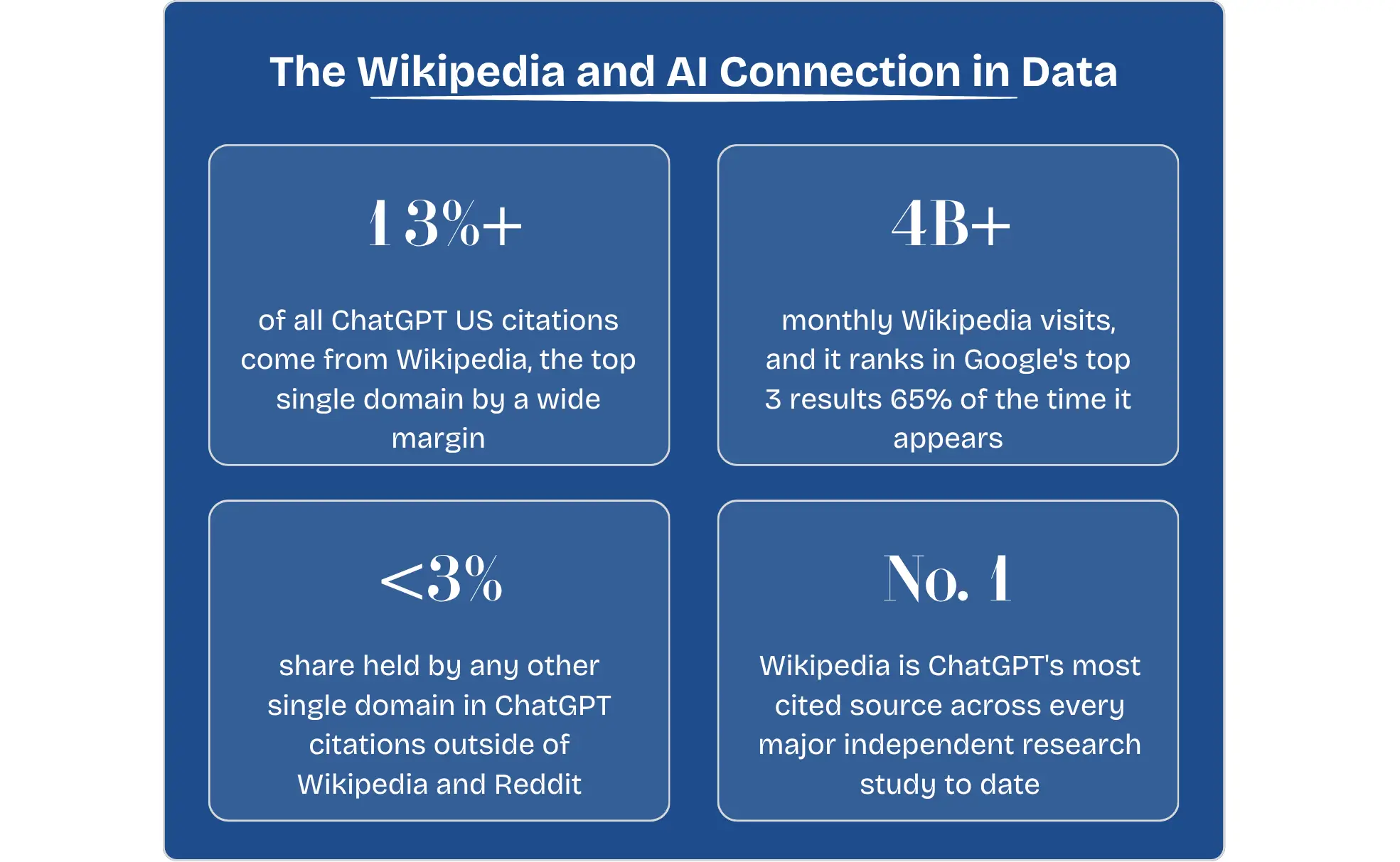
The platform draws in over 4 billion visits every month. It sits at or near the top of Google results for most branded searches. But the traffic numbers are almost beside the point now. The far bigger story is how deeply Wikipedia has been embedded into the infrastructure of AI-generated answers themselves.
When large language models (LLMs), the technology behind ChatGPT, Claude, Gemini, and others were trained, Wikipedia was one of the largest structured, human-curated, machine-readable datasets available. Its format, citation structure, and editorial neutrality made it uniquely easy for AI systems to digest. The result? Wikipedia doesn't just influence what humans find. It shapes what AI systems believe about your brand.
How Do AI Models Actually Use Wikipedia Data?
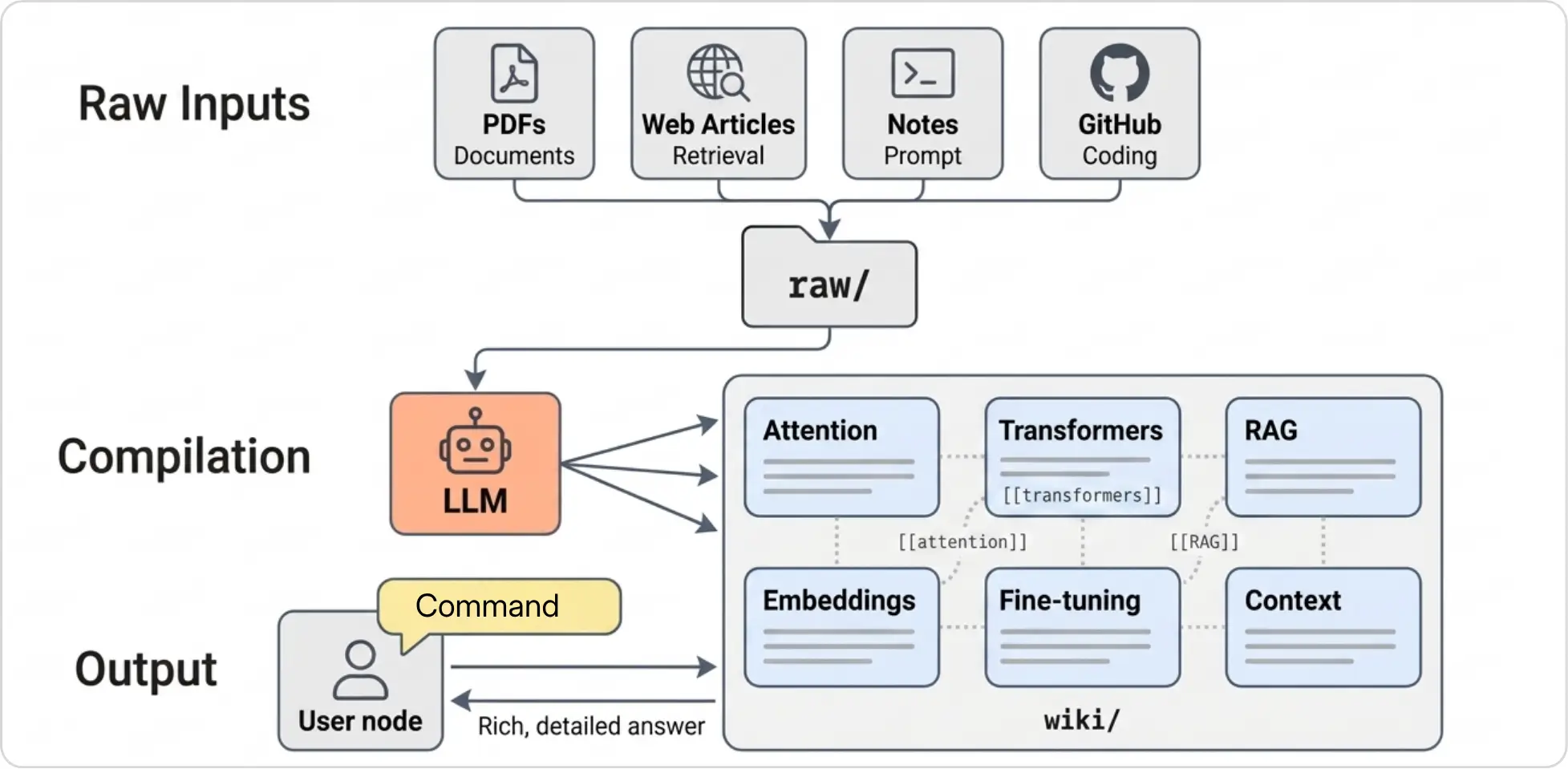
Most AI models do not search Wikipedia live every time someone asks a question. More fundamentally, Wikipedia content was part of their training data — the enormous corpus they learned from before ever being deployed. Descriptions, classifications, founding details, notable controversies, and leadership information written on Wikipedia were absorbed into the model's understanding of your brand at a deep and foundational level. For anyone serious about maintaining online reputation, this is the part that changes everything because what AI learned about your brand during training is not easy to undo.
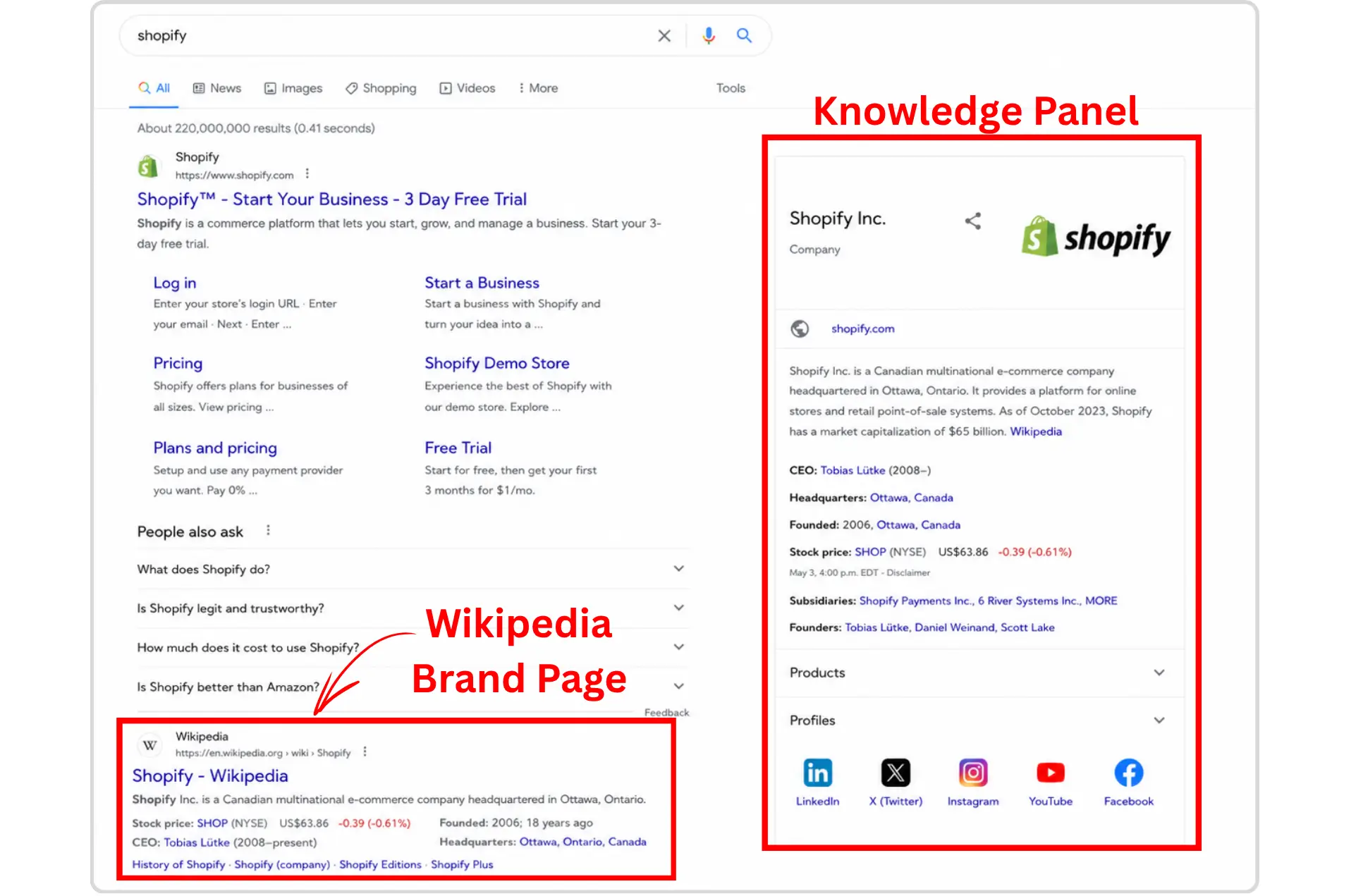
Beyond training data, Wikipedia also feeds into knowledge graphs — structured databases that map real-world entities like companies, people, and events, along with all the relationships between them. Google's Knowledge Panel, the information box that appears on the right side of search results for branded queries, draws heavily from Wikipedia and its sister project, Wikidata. When an AI tool cross-references your brand in real-time, these graph connections are part of what it is consulting.
What Happens When Your Wikipedia Information Is Wrong or Outdated?
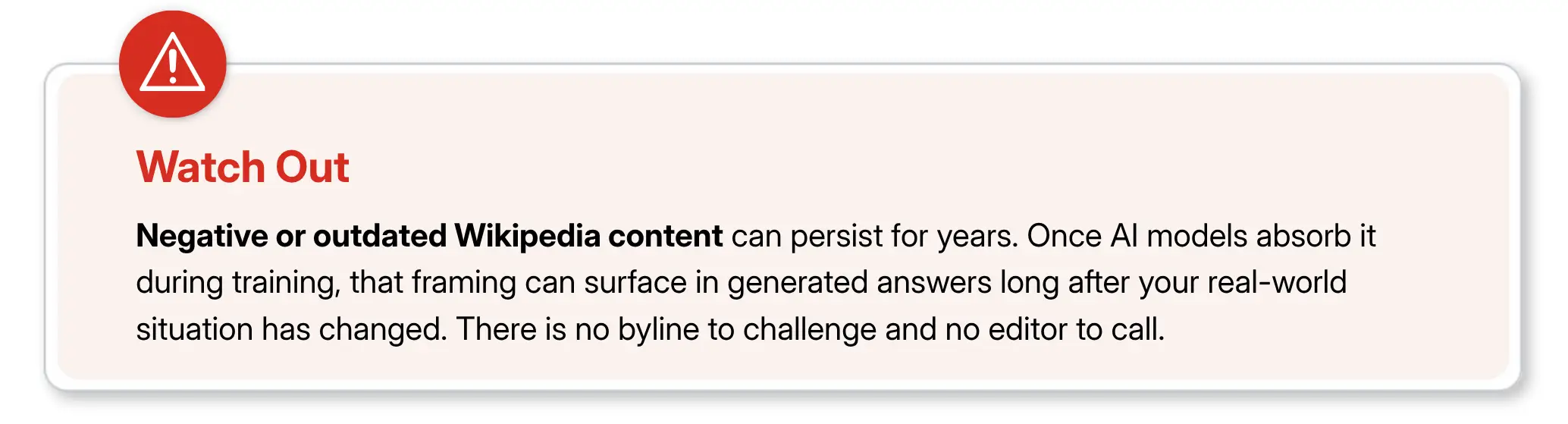
Here's where brands run into serious trouble. Wikipedia's editorial model means that corrections aren't automatic — they depend on volunteer editors, and those editors aren't watching your company's page daily.
If a controversy from five years ago is still prominently described on your Wikipedia page, or if your product line is described as it existed in 2019, AI systems trained on that data will reflect the older, inaccurate version.
Think about what that actually means in practice. A journalist does a quick AI search before an interview. An analyst uses Perplexity to refresh their memory before a call. An investor asks Gemini who your CEO is. In each case, they may be receiving information that was technically true once but has not been true for some time. And none of them know that.
Can Negative Wikipedia Content Hurt Your Brand in AI Answers?
Yes, and in ways that are significantly harder to counter than a bad press article. When a journalist writes something unflattering, you can respond, issue a statement, and build a counter-narrative over time. When AI generates a description of your company using language originally sourced from a poorly balanced Wikipedia section, there is no obvious mechanism to push back against it. The AI presents it as a neutral summary, and users who trust AI-generated answers receive it as fact.
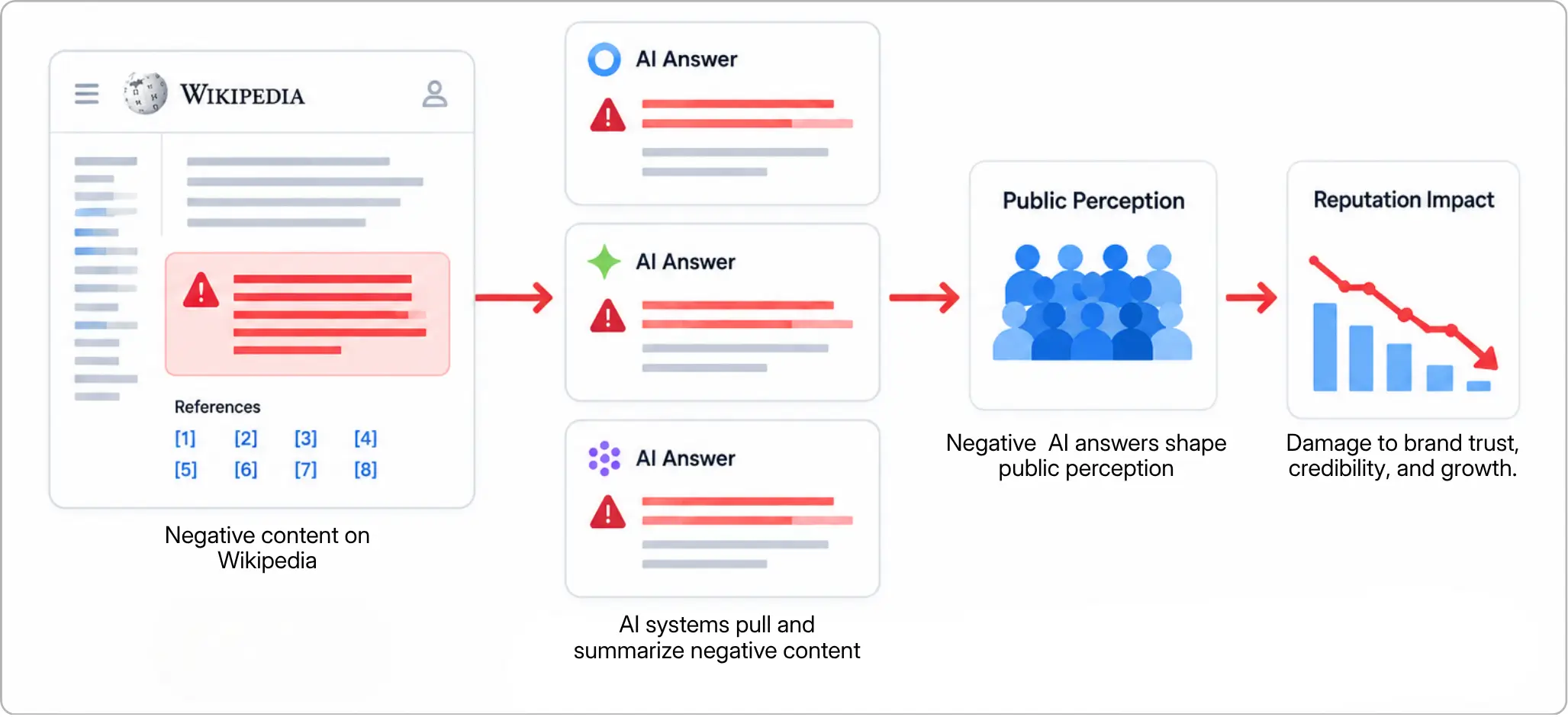
Negative information embedded in Wikipedia doesn't stay on Wikipedia — it migrates. AI search tools synthesize it, repeat it, and present it as a neutral summary. For consumers who trust AI-generated answers, that's often where their understanding of your brand begins and ends.
Crucially, this isn't only about outright false information. Even a neutrally-worded Wikipedia section that leads with a controversy from three years ago — before your rebranding, leadership change, or product pivot can cause disproportionate reputational damage in AI-era search.
Why Does Wikipedia Dominance Translate Directly to AI Search Success?
Why does Wikipedia matter so much in AI search? The numbers make it clear. Research from nine major datasets covering hundreds of millions of citations shows that Wikipedia makes up more than 13% of all ChatGPT citations in the US. That makes it the most referenced source by a wide margin.
For comparison, outside of Wikipedia and Reddit, no single website reaches even 3% of ChatGPT citations. Wikipedia is not just another trusted source. It stands in a category of its own. Some studies also found that among ChatGPT’s top 10 cited sources, Wikipedia can account for nearly half of all citations. The exact numbers change as AI models evolve, but one result stays consistent across major studies: Wikipedia is the most cited source in AI generated answers, far ahead of every other platform.
The implication for brands is hard to ignore. There is no shortcut that bypasses Wikipedia's authority in the AI citation stack. It sits at the top, the gap is wide, and every AI platform — whether it retrieves Wikipedia content live or absorbed it during training, reflects that structural reality.
Wikipedia's Role Across Different AI Search Platforms — A Brand's View
Different AI platforms use Wikipedia-sourced information in slightly different ways. Understanding this helps you prioritize where the impact is greatest.
AI Platform | How Wikipedia is used | Reputational Risk level | Real-time daya pull? |
|---|---|---|---|
ChatGPT (GPT-4o) | Core training data + optional live browsing | High | Optional (web browsing mode) |
Google Gemini | Training data + Knowledge Graph integration | High | Yes (tightly integrated) |
Google AI Overviews | Knowledge Panel + Wikipedia citations | Very High | Yes |
Perplexity AI | Live web retrieval including Wikipedia | Medium–High | Yes (primary mode) |
Microsoft Copilot | Training + Bing knowledge index (Wikipedia-weighted) | Medium–High | Yes |
Apple Intelligence | Wikipedia feeds Siri Knowledge and on-device summaries | Medium | Partial |
Claude (Anthropic) | Wikipedia heavily featured in training data | Medium | No (unless tool-enabled) |
The pattern is clear: for any platform that either crawls the web in real-time or relies on structured knowledge sources, your Wikipedia page is an active signal — not a passive footnote. So it’s very important to include this in your ai visibility strategy.
How Does Wikipedia Influence Google's AI Overviews Specifically?
Google's AI Overviews, the AI-generated summaries that now appear at the top of many search results pages — draw from Google's own knowledge graph, which is deeply intertwined with Wikipedia and Wikidata. When someone searches for your brand name alongside a descriptor like "your brand and its founders" or "your brand and recent news," the Overview often synthesizes content that is directly traceable back to Wikipedia's structure and phrasing.
The Knowledge Panel that appears on the right side of branded Google searches is even more direct: it often mirrors Wikipedia's lead paragraph and info-box. If that content is stale or imbalanced, users see it immediately — before they ever click through to your website.
Does Having a Wikipedia Page Actually Improve AI Search Visibility?
This is the practical question most brand teams eventually land on. Having a Wikipedia page doesn't guarantee favorable AI treatment, and not having one doesn't doom you. But there is a clear and consistent linear relationship between a well-maintained, well-cited Wikipedia article and more accurate, more favorable representation to win in AI search.
AI systems are built to prioritize information sources that are authoritative, verifiable, and consistently structured. Wikipedia meets all three of those criteria in ways that brand-owned content simply cannot, because your website, social account, and press release are treated as partial sources by design. Wikipedia's community-enforced neutrality and citation requirements are precisely what give it the credibility signal that AI systems respond to so reliably.
What If My Brand Doesn't Have a Wikipedia Page?
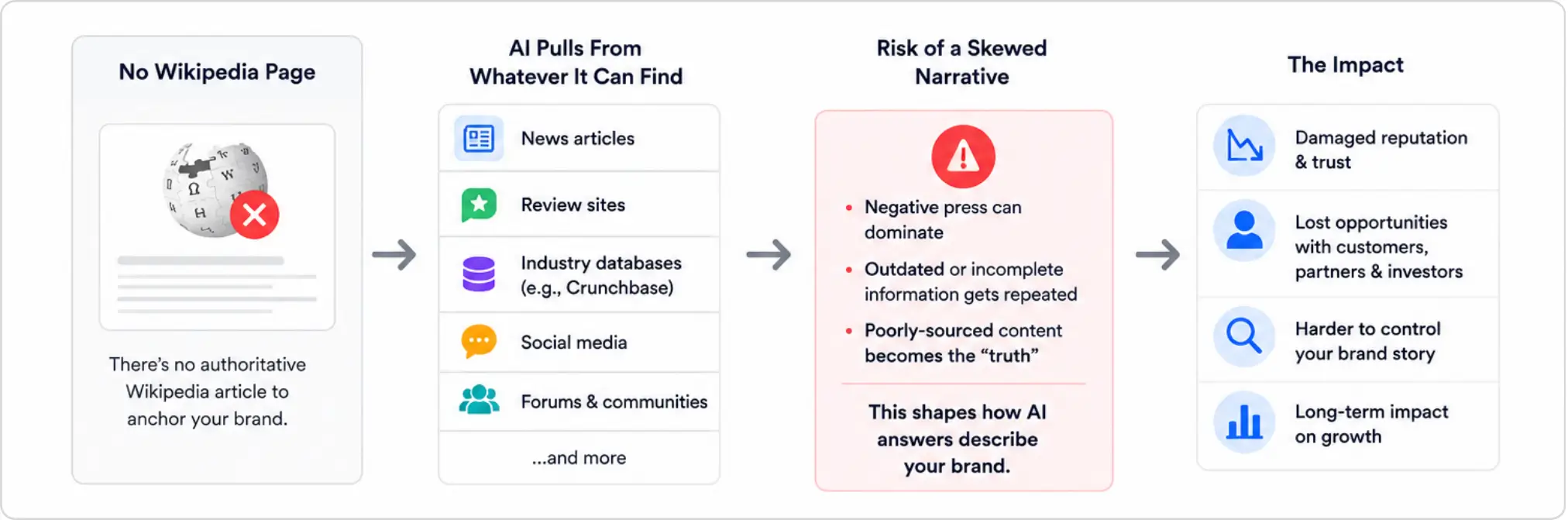
Without a Wikipedia page, AI systems have to piece together their understanding of your brand from whatever else they can find — news articles, review sites, industry databases, social media, community forums. A single negative press cycle, a poorly-sourced blog post, or an outdated crunchbase entry can become the dominant narrative in AI answers if there's no structured, authoritative Wikipedia article to anchor the picture.
Brands that meet Wikipedia's notability requirements generally meaning significant, independent, third-party coverage from reliable sources — should seriously consider whether they have a page and, if so, whether it accurately reflects where the company is today. This is not about gaming anything. It is about ensuring the information that defines your brand in AI-era search actually reflects reality.
What Should Brands Actually Do About Wikipedia and AI Search?
Let's get practical. Here's a framework for approaching your Wikipedia and AI search presence, without crossing into the territory of manipulative editing (which Wikipedia's community will quickly revert and flag).
Review your Wikipedia page from a customer or journalist’s perspective. Check for outdated details, factual errors, or sections that feel overly negative.
Strengthen your third party citations first. Reliable media coverage gives Wikipedia the sources it needs to represent your brand accurately.
Follow Wikipedia’s rules when making edits. Be transparent about affiliations and use the talk page instead of editing directly when possible.
Do not ignore Wikidata. Accurate details there help AI systems and search engines understand your brand correctly.
Monitor your page for bad faith edits. Alerts and tracking tools can help catch false changes before they spread.
Consider professional help for complex situations for major reputation issues or complex situations, professional guidance can help avoid mistakes that often make problems worse.
Is It Possible to Remove Negative Information from Wikipedia?
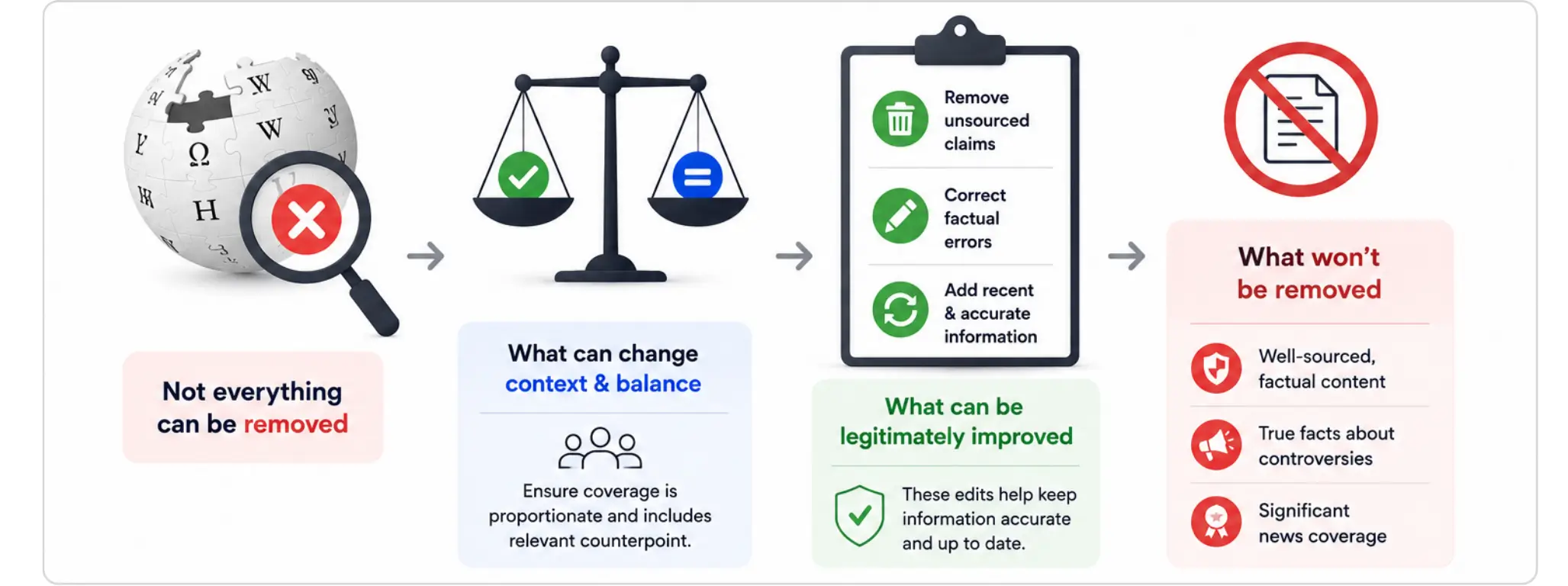
It depends entirely on whether that information is verifiably sourced. Wikipedia will not remove factual, well-cited information about a company simply because the brand finds it unflattering. What can legitimately change is context and balance.
If a controversy is described with disproportionate prominence relative to its actual significance, or if it lacks relevant counterpoint, that is a valid editorial conversation to have through the proper channels.
Removing unsourced claims, correcting factual errors, and adding more recent and accurate information are all valid edits that tend to be accepted. The harder truth is that brands sometimes have to accept that Wikipedia will describe reality as verifiable sources have documented it. The most durable reputation strategy is not controlling what Wikipedia says — it is generating the kind of verifiable, positive public record that naturally shifts what Wikipedia can say.
Final Thoughts
Wikipedia has quietly become one of the most consequential platforms in the AI search era, not because of what users read on Wikipedia directly, but because of what AI systems absorbed from it and continue to retrieve from it. Your brand's Wikipedia presence is no longer just an SEO footnote. It's a foundational signal in how AI understands and describes you.
The brands that will be best positioned in AI-native search aren't the ones with the most aggressive SEO strategies. They're the ones that have built a verifiable, well-documented public record — one that Wikipedia can accurately reflect, and that AI systems can confidently cite. That work starts with understanding the relationship between Wikipedia, knowledge graphs, and AI-generated answers and then doing something about it before a narrative you can't control takes root.
FAQs
Does having a Wikipedia page improve a brand's visibility in AI-generated search results?

Yes, Wikipedia is one of the most trusted sources that AI search tools like ChatGPT, Perplexity, and Google's AI Overviews draw from. A well-maintained Wikipedia page significantly increases the chances of your brand being cited or summarized accurately in AI-generated answers.
What happens if a brand doesn't have a Wikipedia page — can AI still find and represent it?
AI can still surface information about your brand from other sources, but without a Wikipedia page, it relies on less authoritative data — which increases the risk of inaccurate, outdated, or incomplete representation in search results.
Can negative or incorrect information on Wikipedia hurt a brand's online reputation?
Absolutely. Since AI tools frequently pull from Wikipedia, any false claims, biased edits, or outdated content on your page can be amplified across AI search results, making reputation monitoring and Wikipedia accuracy a critical part of any brand's digital strategy.
Can brands directly edit their own Wikipedia page to manage their reputation?
Wikipedia discourages direct editing by the subject of an article due to conflict of interest policies. Brands should instead flag inaccuracies on the article's Talk page, work with neutral editors, or hire Wikipedia-experienced professionals to ensure content meets editorial guidelines.
How often should brands audit their Wikipedia presence in the age of AI search?
At a minimum, brands should review their Wikipedia page quarterly. Given how frequently AI models are updated and retrained, even small changes in Wikipedia content can shift how a brand is described in AI-generated results — making regular audits essential for reputation management.
You've probably noticed that AI tools like ChatGPT, Gemini, Perplexity, and Google's AI Overviews don't just pull from your website anymore. They pull from everywhere, and Wikipedia is sitting closer to the front of that queue than most brands realize. If your Wikipedia presence is outdated, inaccurate, or non-existent, that gap doesn't stay contained to one encyclopedia page. It flows quietly into every AI-generated answer about your brand and in the era of generative search, that matters more than most teams have caught up to yet.
Why Does Wikipedia Still Matter in the Age of AI Search?
Hear us out, because this might feel Contradictory at first. Wikipedia, in a world of real-time AI, algorithmic feeds, and zero-click answers is more important to your brand's visibility than it has ever been before.
The platform draws in over 4 billion visits every month. It sits at or near the top of Google results for most branded searches. But the traffic numbers are almost beside the point now. The far bigger story is how deeply Wikipedia has been embedded into the infrastructure of AI-generated answers themselves.
When large language models (LLMs), the technology behind ChatGPT, Claude, Gemini, and others were trained, Wikipedia was one of the largest structured, human-curated, machine-readable datasets available. Its format, citation structure, and editorial neutrality made it uniquely easy for AI systems to digest. The result? Wikipedia doesn't just influence what humans find. It shapes what AI systems believe about your brand.
How Do AI Models Actually Use Wikipedia Data?
Most AI models do not search Wikipedia live every time someone asks a question. More fundamentally, Wikipedia content was part of their training data — the enormous corpus they learned from before ever being deployed. Descriptions, classifications, founding details, notable controversies, and leadership information written on Wikipedia were absorbed into the model's understanding of your brand at a deep and foundational level. For anyone serious about maintaining online reputation, this is the part that changes everything because what AI learned about your brand during training is not easy to undo.
Beyond training data, Wikipedia also feeds into knowledge graphs — structured databases that map real-world entities like companies, people, and events, along with all the relationships between them. Google's Knowledge Panel, the information box that appears on the right side of search results for branded queries, draws heavily from Wikipedia and its sister project, Wikidata. When an AI tool cross-references your brand in real-time, these graph connections are part of what it is consulting.
What Happens When Your Wikipedia Information Is Wrong or Outdated?
Here's where brands run into serious trouble. Wikipedia's editorial model means that corrections aren't automatic — they depend on volunteer editors, and those editors aren't watching your company's page daily.
If a controversy from five years ago is still prominently described on your Wikipedia page, or if your product line is described as it existed in 2019, AI systems trained on that data will reflect the older, inaccurate version.
Think about what that actually means in practice. A journalist does a quick AI search before an interview. An analyst uses Perplexity to refresh their memory before a call. An investor asks Gemini who your CEO is. In each case, they may be receiving information that was technically true once but has not been true for some time. And none of them know that.
Can Negative Wikipedia Content Hurt Your Brand in AI Answers?
Yes, and in ways that are significantly harder to counter than a bad press article. When a journalist writes something unflattering, you can respond, issue a statement, and build a counter-narrative over time. When AI generates a description of your company using language originally sourced from a poorly balanced Wikipedia section, there is no obvious mechanism to push back against it. The AI presents it as a neutral summary, and users who trust AI-generated answers receive it as fact.
Negative information embedded in Wikipedia doesn't stay on Wikipedia — it migrates. AI search tools synthesize it, repeat it, and present it as a neutral summary. For consumers who trust AI-generated answers, that's often where their understanding of your brand begins and ends.
Crucially, this isn't only about outright false information. Even a neutrally-worded Wikipedia section that leads with a controversy from three years ago — before your rebranding, leadership change, or product pivot can cause disproportionate reputational damage in AI-era search.
Why Does Wikipedia Dominance Translate Directly to AI Search Success?
Why does Wikipedia matter so much in AI search? The numbers make it clear. Research from nine major datasets covering hundreds of millions of citations shows that Wikipedia makes up more than 13% of all ChatGPT citations in the US. That makes it the most referenced source by a wide margin.
For comparison, outside of Wikipedia and Reddit, no single website reaches even 3% of ChatGPT citations. Wikipedia is not just another trusted source. It stands in a category of its own. Some studies also found that among ChatGPT’s top 10 cited sources, Wikipedia can account for nearly half of all citations. The exact numbers change as AI models evolve, but one result stays consistent across major studies: Wikipedia is the most cited source in AI generated answers, far ahead of every other platform.
The implication for brands is hard to ignore. There is no shortcut that bypasses Wikipedia's authority in the AI citation stack. It sits at the top, the gap is wide, and every AI platform — whether it retrieves Wikipedia content live or absorbed it during training, reflects that structural reality.
Wikipedia's Role Across Different AI Search Platforms — A Brand's View
Different AI platforms use Wikipedia-sourced information in slightly different ways. Understanding this helps you prioritize where the impact is greatest.
AI Platform | How Wikipedia is used | Reputational Risk level | Real-time daya pull? |
|---|---|---|---|
ChatGPT (GPT-4o) | Core training data + optional live browsing | High | Optional (web browsing mode) |
Google Gemini | Training data + Knowledge Graph integration | High | Yes (tightly integrated) |
Google AI Overviews | Knowledge Panel + Wikipedia citations | Very High | Yes |
Perplexity AI | Live web retrieval including Wikipedia | Medium–High | Yes (primary mode) |
Microsoft Copilot | Training + Bing knowledge index (Wikipedia-weighted) | Medium–High | Yes |
Apple Intelligence | Wikipedia feeds Siri Knowledge and on-device summaries | Medium | Partial |
Claude (Anthropic) | Wikipedia heavily featured in training data | Medium | No (unless tool-enabled) |
The pattern is clear: for any platform that either crawls the web in real-time or relies on structured knowledge sources, your Wikipedia page is an active signal — not a passive footnote. So it’s very important to include this in your ai visibility strategy.
How Does Wikipedia Influence Google's AI Overviews Specifically?
Google's AI Overviews, the AI-generated summaries that now appear at the top of many search results pages — draw from Google's own knowledge graph, which is deeply intertwined with Wikipedia and Wikidata. When someone searches for your brand name alongside a descriptor like "your brand and its founders" or "your brand and recent news," the Overview often synthesizes content that is directly traceable back to Wikipedia's structure and phrasing.
The Knowledge Panel that appears on the right side of branded Google searches is even more direct: it often mirrors Wikipedia's lead paragraph and info-box. If that content is stale or imbalanced, users see it immediately — before they ever click through to your website.
Does Having a Wikipedia Page Actually Improve AI Search Visibility?
This is the practical question most brand teams eventually land on. Having a Wikipedia page doesn't guarantee favorable AI treatment, and not having one doesn't doom you. But there is a clear and consistent linear relationship between a well-maintained, well-cited Wikipedia article and more accurate, more favorable representation to win in AI search.
AI systems are built to prioritize information sources that are authoritative, verifiable, and consistently structured. Wikipedia meets all three of those criteria in ways that brand-owned content simply cannot, because your website, social account, and press release are treated as partial sources by design. Wikipedia's community-enforced neutrality and citation requirements are precisely what give it the credibility signal that AI systems respond to so reliably.
What If My Brand Doesn't Have a Wikipedia Page?
Without a Wikipedia page, AI systems have to piece together their understanding of your brand from whatever else they can find — news articles, review sites, industry databases, social media, community forums. A single negative press cycle, a poorly-sourced blog post, or an outdated crunchbase entry can become the dominant narrative in AI answers if there's no structured, authoritative Wikipedia article to anchor the picture.
Brands that meet Wikipedia's notability requirements generally meaning significant, independent, third-party coverage from reliable sources — should seriously consider whether they have a page and, if so, whether it accurately reflects where the company is today. This is not about gaming anything. It is about ensuring the information that defines your brand in AI-era search actually reflects reality.
What Should Brands Actually Do About Wikipedia and AI Search?
Let's get practical. Here's a framework for approaching your Wikipedia and AI search presence, without crossing into the territory of manipulative editing (which Wikipedia's community will quickly revert and flag).
Review your Wikipedia page from a customer or journalist’s perspective. Check for outdated details, factual errors, or sections that feel overly negative.
Strengthen your third party citations first. Reliable media coverage gives Wikipedia the sources it needs to represent your brand accurately.
Follow Wikipedia’s rules when making edits. Be transparent about affiliations and use the talk page instead of editing directly when possible.
Do not ignore Wikidata. Accurate details there help AI systems and search engines understand your brand correctly.
Monitor your page for bad faith edits. Alerts and tracking tools can help catch false changes before they spread.
Consider professional help for complex situations for major reputation issues or complex situations, professional guidance can help avoid mistakes that often make problems worse.
Is It Possible to Remove Negative Information from Wikipedia?
It depends entirely on whether that information is verifiably sourced. Wikipedia will not remove factual, well-cited information about a company simply because the brand finds it unflattering. What can legitimately change is context and balance.
If a controversy is described with disproportionate prominence relative to its actual significance, or if it lacks relevant counterpoint, that is a valid editorial conversation to have through the proper channels.
Removing unsourced claims, correcting factual errors, and adding more recent and accurate information are all valid edits that tend to be accepted. The harder truth is that brands sometimes have to accept that Wikipedia will describe reality as verifiable sources have documented it. The most durable reputation strategy is not controlling what Wikipedia says — it is generating the kind of verifiable, positive public record that naturally shifts what Wikipedia can say.
Final Thoughts
Wikipedia has quietly become one of the most consequential platforms in the AI search era, not because of what users read on Wikipedia directly, but because of what AI systems absorbed from it and continue to retrieve from it. Your brand's Wikipedia presence is no longer just an SEO footnote. It's a foundational signal in how AI understands and describes you.
The brands that will be best positioned in AI-native search aren't the ones with the most aggressive SEO strategies. They're the ones that have built a verifiable, well-documented public record — one that Wikipedia can accurately reflect, and that AI systems can confidently cite. That work starts with understanding the relationship between Wikipedia, knowledge graphs, and AI-generated answers and then doing something about it before a narrative you can't control takes root.
FAQs
Does having a Wikipedia page improve a brand's visibility in AI-generated search results?
Yes, Wikipedia is one of the most trusted sources that AI search tools like ChatGPT, Perplexity, and Google's AI Overviews draw from. A well-maintained Wikipedia page significantly increases the chances of your brand being cited or summarized accurately in AI-generated answers.
What happens if a brand doesn't have a Wikipedia page — can AI still find and represent it?
AI can still surface information about your brand from other sources, but without a Wikipedia page, it relies on less authoritative data — which increases the risk of inaccurate, outdated, or incomplete representation in search results.
Can negative or incorrect information on Wikipedia hurt a brand's online reputation?
Absolutely. Since AI tools frequently pull from Wikipedia, any false claims, biased edits, or outdated content on your page can be amplified across AI search results, making reputation monitoring and Wikipedia accuracy a critical part of any brand's digital strategy.
Can brands directly edit their own Wikipedia page to manage their reputation?
Wikipedia discourages direct editing by the subject of an article due to conflict of interest policies. Brands should instead flag inaccuracies on the article's Talk page, work with neutral editors, or hire Wikipedia-experienced professionals to ensure content meets editorial guidelines.
How often should brands audit their Wikipedia presence in the age of AI search?
At a minimum, brands should review their Wikipedia page quarterly. Given how frequently AI models are updated and retrained, even small changes in Wikipedia content can shift how a brand is described in AI-generated results — making regular audits essential for reputation management.



Summarize with AI



Want to be seen everywhere?
Get a free AI-search audit Today!



4.9/5 Ratings!


Don’t miss our revenue growth tips!
Get expert marketing tips—straight to your inbox, like thousands of happy clients.
Don’t miss our revenue growth tips!
Get expert marketing tips—straight to your inbox, like thousands of happy clients.
Don’t miss our revenue growth tips!
Don’t miss our revenue growth tips!
Get expert marketing tips—straight to your inbox, like thousands of happy clients.
Relevant Blogs on Generative AI SEO
Relevant Blogs on Generative AI SEO
Unlock data-driven insights in AI-powered SEO—explore our featured blogs and skyrocket your revenue before your competitors do.
Unlock data-driven insights in AI-powered SEO—explore our featured blogs and skyrocket your revenue before your competitors do.

GEO
Sep 22, 2026
15 Min Read
AI Search Runs on More SEO Than You Think
GEO
Sep 22, 2026
15 Min Read
AI Search Runs on More SEO Than You Think
GEO
Sep 22, 2026
15 Min Read
AI Search Runs on More SEO Than You Think

GEO
Sep 7, 2026
8 Min Read
How to Optimize Content for AI Search Engines: Best Practices
GEO
Sep 7, 2026
8 Min Read
How to Optimize Content for AI Search Engines: Best Practices
GEO
Sep 7, 2026
8 Min Read
How to Optimize Content for AI Search Engines: Best Practices

GEO
Sep 4, 2026
12 Min Read
How Ecommerce Brands Can Advertise in Google AI Mode?
GEO
Sep 4, 2026
12 Min Read
How Ecommerce Brands Can Advertise in Google AI Mode?
GEO
Sep 4, 2026
12 Min Read
How Ecommerce Brands Can Advertise in Google AI Mode?

































Ready to speak with an expert?
Data-Driven Marketing Agency That Elevates ROI
1100+
Websites Designed & Optimized to Convert
$280M+
Client Revenue Driven & Growing Strong
Discover how to skyrocket
your revenue today!
Trusted by 1000+ Owners!
Ready to speak with an expert?
Data-Driven Marketing Agency That Elevates ROI
1100+
Websites Designed & Optimized to Convert
$280M+
Client Revenue Driven & Growing Strong
Discover how to skyrocket
your revenue today!
Trusted by 1000+ Owners!
Want to skyrocket revenue?
4.9/5 Ratings!
Ready to speak with an expert?
Data-Driven Marketing Agency That Elevates ROI
1100+
Websites Designed & Optimized to Convert
$280M+
Client Revenue Driven & Growing Strong
Discover how to skyrocket
your revenue today!
Trusted by 1000+ Owners!
Call
Meet