Why TikTok Creators Convert Better Than Most Brands
Why TikTok Creators Convert Better Than Most Brands
Last Updated:
Table of Content
How We
Skyrocket
Boost
Maximize
Accelerate
Amplify
Elevate
Optimize
Enhance
Your Revenue?

Deepak Prajapat
Deepak Prajapat
Deepak Prajapat
Social Media
Social Media
Social Media
10 Min Read
8 Min
10 Min Read
Every brand wants more conversions on TikTok, but many discover that their most polished content often underperforms compared to a creator casually talking about the same product. Despite larger budgets, professional production, and dedicated marketing teams, brand accounts frequently struggle to generate the same level of engagement, trust, and purchase intent.
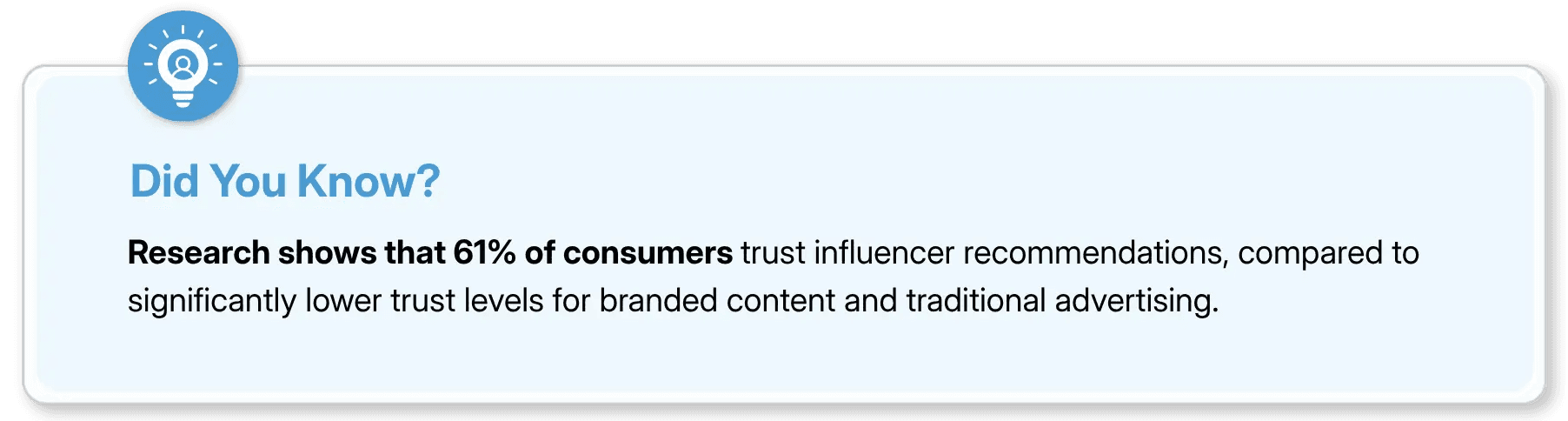
The reason goes beyond content quality. Today's consumers are exposed to advertising everywhere, making them increasingly selective about who they trust. While branded content is often viewed through a promotional lens, creators have built audiences around authenticity, consistency, and personal connection. As a result, their recommendations often carry more weight than traditional marketing messages
Understanding why TikTok creators convert better than brands isn't just useful for influencer campaigns; it's essential for any brand looking to improve results on the platform. In this article, we'll explore the consumer psychology, trust signals, and platform dynamics that give creators a powerful conversion advantage and what brands can learn from it.
This shift has transformed how products are discovered, researched, and purchased on TikTok. Understanding why TikTok creators convert better than brands isn't just valuable for influencer campaigns—it's becoming a critical part of modern creator marketing and social media strategies. In this article, we'll explore the consumer psychology, trust signals, and platform dynamics that give creators a conversion advantage and what brands can do to turn those insights into measurable results.
The Trust Gap Between Brands and Creators
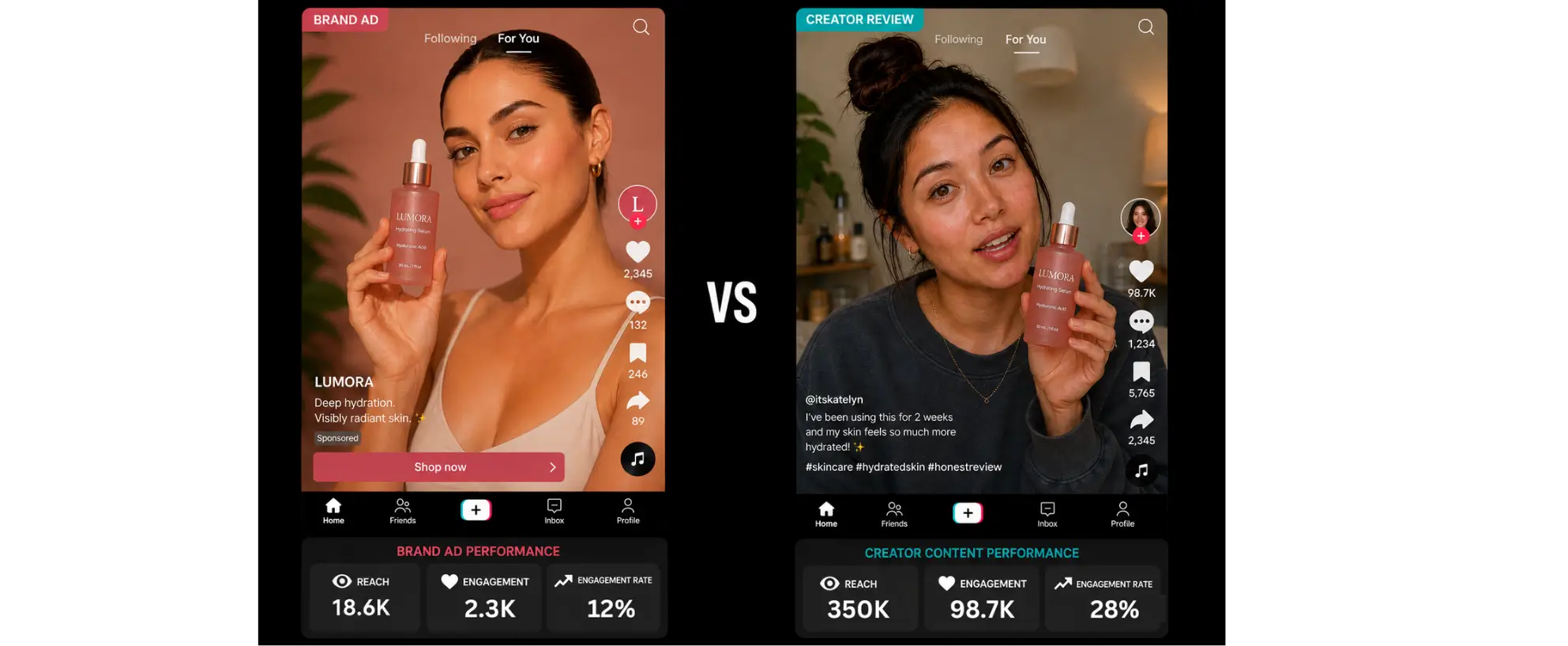
When someone scrolls TikTok and sees a polished brand video, their brain does something almost automatic: it categorizes it as an ad. And the moment that happens, skepticism switches on.
When that same person watches a creator someone they follow, whose opinions they've come to value, talking about that same product, the mental categorization is completely different. It feels like a recommendation from someone they know. The psychology term for this is parasocial relationship: a one-sided emotional connection a viewer builds with a content creator over time.
Parasocial relationships are powerful precisely because viewers experience them as real. They know the creator's sense of humor, their aesthetic, and their past product opinions. When that creator says something works, it carries the weight of a friend's endorsement, not an advertiser's pitch.
Why Brand Accounts Struggle to Replicate It
Brand accounts can produce great content. They can use trending audio, work with editors, and post consistently. But there's one thing they structurally cannot do: be a person.
Consumer psychology in marketing has long established that people trust people more than they trust institutions. Brands are institutions. Creators are people. No amount of "authentic-looking" content from a brand account fully closes that gap, because viewers know who owns the account.
How TikTok's Algorithm Amplifies Creator Advantage
TikTok's recommendation engine doesn't care whether an account has a million followers or a hundred. It cares about watch time, completion rate, shares, and saves. This creates a structural advantage for creators.
A creator's audience follows them because they genuinely want to watch their content. That signals strong baseline engagement to the algorithm. When that creator posts about a product, the algorithm sees their engagement rates hold — and distributes it further.
Brand content, by contrast, often reaches people who never chose to follow the brand. When those viewers swipe away quickly, the algorithm interprets that as low-quality content and pulls back distribution.
The Loop That Drives Conversions
Creators who've built an engaged TikTok audience essentially have a self-reinforcing conversion engine:
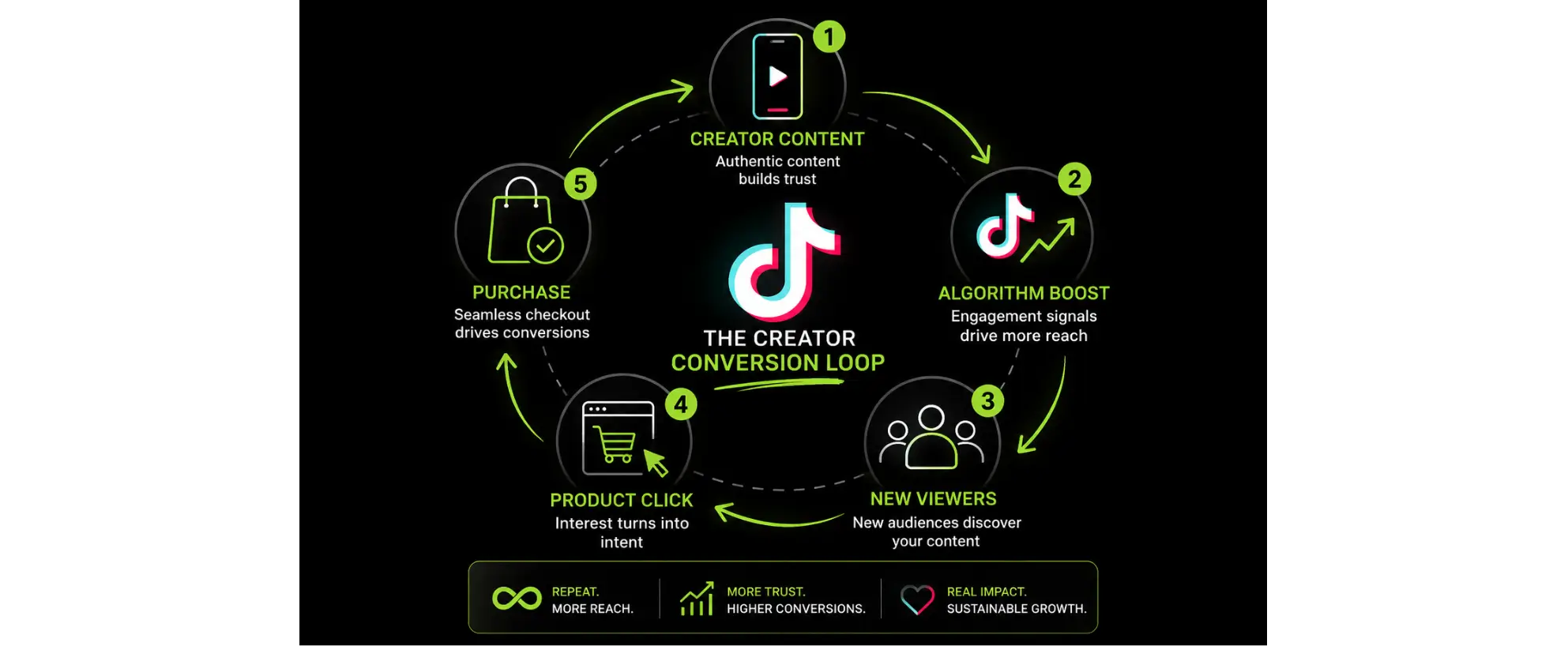
Engaged followers watch longer → higher watch time
Higher watch time → broader algorithm distribution
Broader distribution → new viewers who discover the creator
New viewers convert to followers → repeat cycle
Throughout all of this, product mentions land in a high-trust environment
This is why brands using TikTok Shop for creators see materially better results than running brand-page promotions. The conversion happens inside an ecosystem of trust not a brand's shouting into a feed refer to viral marketing.
The Consumer Psychology Principles Creators Leverage (Intentionally or Not)
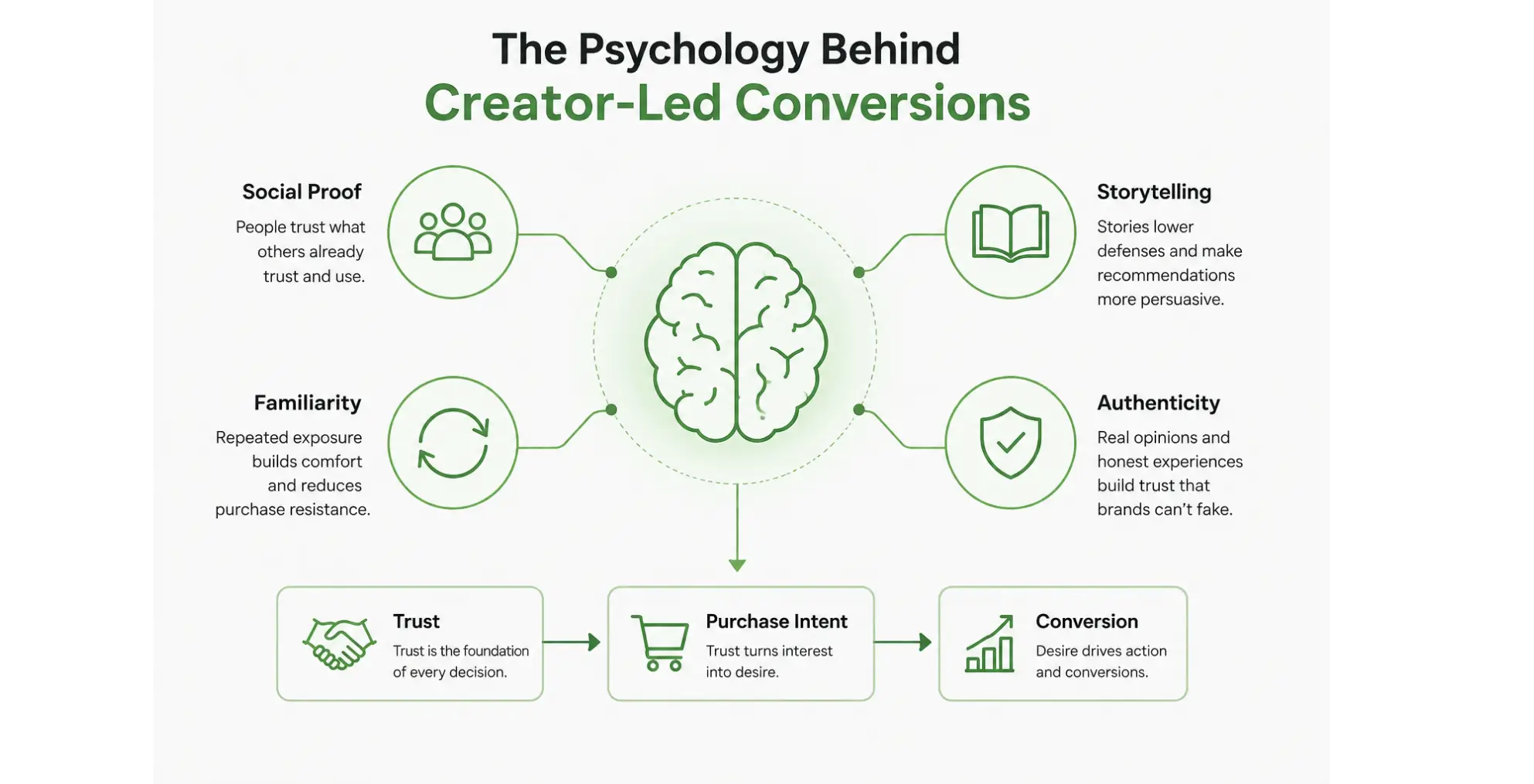
The reason creator content performs so well on TikTok isn't a coincidence. Every time a creator recommends a product, several powerful psychological triggers influence how audiences perceive that recommendation and make purchasing decisions. Interestingly, many creators leverage these principles naturally without ever studying consumer psychology or behavioral economics.
1. Social Proof at Scale
One of the most influential principles in consumer psychology is social proof — the tendency for people to trust and follow the actions of others. When audiences see a creator using and recommending a product, they don't just hear a sales message; they witness real-world usage and reactions from the creator's community.
The impact becomes even stronger when viewers scroll through the comments and see hundreds of people asking questions such as:
"Where can I buy this?"
"Has anyone else tried it?"
"I need this right now!"
This creates a powerful validation loop. A potential customer sees both the creator's endorsement and the audience's positive interest, making the product appear more trustworthy and desirable.
2. The Mere Exposure Effect
People naturally develop a preference for things they encounter repeatedly. Psychologists refer to this as the Mere Exposure Effect.
When a creator mentions a product across multiple videos, incorporates it into their daily routine, or casually references a brand over time, their audience becomes increasingly familiar with it. That familiarity builds comfort and reduces hesitation.
By the time a viewer decides to make a purchase, the product no longer feels unfamiliar or risky. Instead, it feels like something they've already experienced through the creator's content. This repeated exposure often shortens the path from awareness to conversion.
3. Narrative Transportation
Traditional advs focus on promoting product features and benefits. Creators, however, often introduce products through personal experiences and storytelling.
Rather than saying, "This product works," a creator might share the following
A morning routine featuring the product
A skincare journey and results over time
A fitness transformation story
A behind-the-scenes look at their daily workflow
This storytelling approach draws viewers into the creator's experience. Marketing researchers refer to this phenomenon as "narrative transportation" when people become emotionally engaged in a story and temporarily lower their resistance to persuasive messages.
A creator saying, "I've been using this for three months, and my skin has genuinely changed," is narrative. A brand saying "clinically proven results in 30 days" is a claim. Narratives win here.
The first feels personal and relatable. The second feels promotional. While both communicate value, stories create emotional connections that make recommendations more memorable and convincing.
4. Authenticity Signals That Brands Can't Fake
Creators review products critically. They mention drawbacks. They say "this didn't work for me at first" before explaining what changed. That imperfection is the signal — it tells the viewer this isn't a scripted pitch. The result is that when they do recommend something, viewers believe it.
Brands almost never communicate this way. Marketing teams remove negatives, legal reviews flatten language, and the polished output reads as exactly what it is: promotional content.
What Brands Can Actually Do About This
Understanding the problem is one thing. Here's what a smart TikTok marketing strategy actually looks like for brands who want to capture creator-level conversion rates without pretending to be something they're not.
Stop Trying to Out-Creator the Creator
The worst response to this insight is for brands to try and make their accounts seem more like individual creators — forced casualness, awkward trending audio, self-aware "we're relatable" energy. Audiences see through it immediately, and it erodes whatever trust the brand has.
Instead, invest in the creators themselves. Give them genuine usage time with the product. Brief them on values, not scripts. Let them find their angle.
Build Creator Relationships, Not Just Creator Campaigns
One-off influencer posts are transactional. Viewers notice when a creator suddenly promotes something and never mentions it again. Long-term partnerships, where a creator actually integrates your product into their content over months, produce far stronger conversion because the trust accumulates.
Use TikTok Shop for Creators as a Conversion Layer
TikTok Shop for creators closes the gap between discovery and purchase in a way that external links never could. When a creator can tag a product directly in their video, the viewer can buy without leaving the app — which removes the single biggest friction point in social commerce.
Brands that set up TikTok Shop correctly and equip creators with affiliate links see measurably higher conversion rates than those relying on "link in bio" redirects. The fewer steps between seeing and buying, the better.
Brief for Authenticity, Not Accuracy
The instinct to control creator messaging is understandable. But over-briefed content kills the authenticity that makes creator content convert. A better framework: give creators the facts they need, the values they should stay inside, and then trust them to communicate it in their voice.
Think of it as the difference between a script and a creative brief. Scripts produce ads. Briefs produce creator content.
Stop Trying to Out-Creator the Creator
The worst response to this insight is for brands to try and make their accounts seem more like individual creators — forced casualness, awkward trending audio, self-aware "we're relatable" energy. Audiences see through it immediately, and it erodes whatever trust the brand has.
Instead, invest in the creators themselves. Give them genuine usage time with the product. Brief them on values, not scripts. Let them find their angle.
Build Creator Relationships, Not Just Creator Campaigns
One-off influencer posts are transactional. Viewers notice when a creator suddenly promotes something and never mentions it again. Long-term partnerships, where a creator actually integrates your product into their content over months, produce far stronger conversion because the trust accumulates.
A Note on AI Search — Why Creator Trust Is Becoming More Valuable
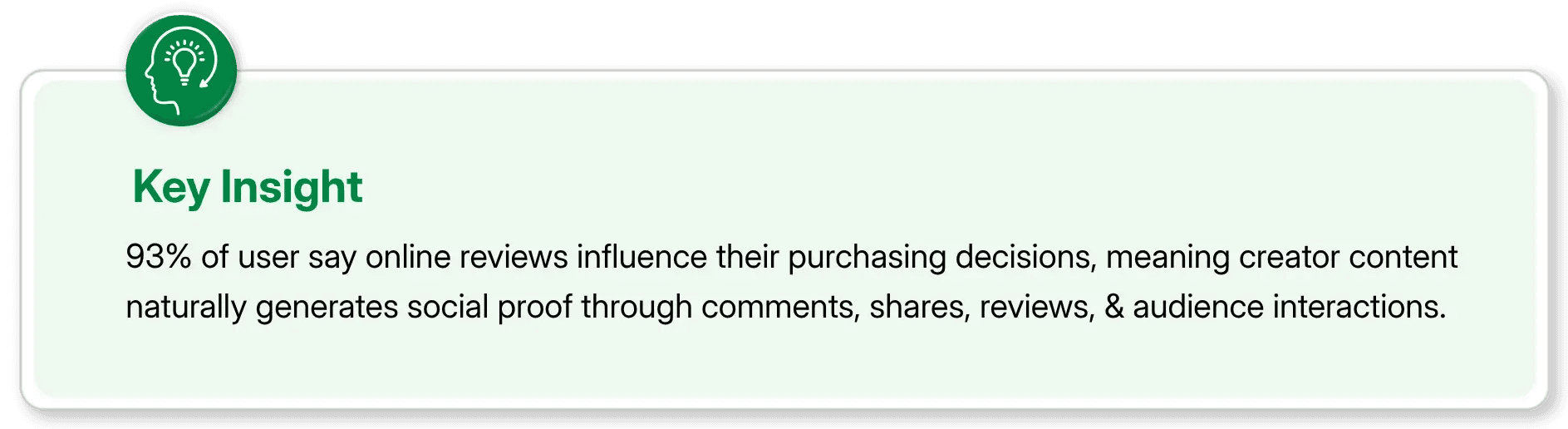
As AI-generated content continues to flood search results and social feeds, authenticity signals are becoming more, not less, important. Search Engine Journal recently noted that AI Overviews in Google Search are surfacing negative reviews more prominently, meaning that brands with less-than-genuine reputations face growing exposure risk.
This same dynamic is playing out on TikTok. As creator content scales, the creators who've built real trust with their audiences hold a distinct, defensible advantage — and the brands smart enough to align with them will benefit directly.

Final Thoughts
TikTok creators don't convert better than brands because they have bigger audiences or bigger budgets. They convert better because viewers trust them — and trust is the currency that drives purchase decisions.
The brands winning on TikTok right now are the ones who've stopped competing with creators and started working through them. They understand that the creator's relationship with their audience is the asset — and they're investing in it accordingly.
If your TikTok strategy still revolves around what your brand page posts, it's worth asking: whose trust are you actually building?
Start with a creator. Start with their audience. That's where the conversions are.
FAQs
Why do TikTok creators convert better than brands?

TikTok creators convert better than brands because they have established trust and credibility with their audiences. Their content feels more like a personal recommendation than an advertisement, making viewers more likely to engage with and purchase recommended products.
How does consumer psychology influence TikTok creator marketing?
Consumer psychology plays a major role in creator marketing. Factors such as social proof, trust, familiarity, storytelling, and authenticity influence how audiences perceive recommendations and make purchasing decisions.
Why is creator content often more effective than branded content?
Creator content typically feels more authentic and relatable. Unlike traditional advertisements, creators integrate products into real experiences, stories, and daily routines, which can make recommendations more persuasive.
What is TikTok Shop for creators?
TikTok Shop for creators allows eligible creators to tag and promote products directly within their content. Viewers can discover and purchase products without leaving the app, creating a smoother path from product discovery to conversion.
How can brands improve conversions through influencer marketing on TikTok?
Brands can improve conversions by partnering with creators whose audiences align with their target market, encouraging authentic product experiences, building long-term creator relationships, and using TikTok Shop features to reduce purchase friction.
Every brand wants more conversions on TikTok, but many discover that their most polished content often underperforms compared to a creator casually talking about the same product. Despite larger budgets, professional production, and dedicated marketing teams, brand accounts frequently struggle to generate the same level of engagement, trust, and purchase intent.
The reason goes beyond content quality. Today's consumers are exposed to advertising everywhere, making them increasingly selective about who they trust. While branded content is often viewed through a promotional lens, creators have built audiences around authenticity, consistency, and personal connection. As a result, their recommendations often carry more weight than traditional marketing messages
Understanding why TikTok creators convert better than brands isn't just useful for influencer campaigns; it's essential for any brand looking to improve results on the platform. In this article, we'll explore the consumer psychology, trust signals, and platform dynamics that give creators a powerful conversion advantage and what brands can learn from it.
This shift has transformed how products are discovered, researched, and purchased on TikTok. Understanding why TikTok creators convert better than brands isn't just valuable for influencer campaigns—it's becoming a critical part of modern creator marketing and social media strategies. In this article, we'll explore the consumer psychology, trust signals, and platform dynamics that give creators a conversion advantage and what brands can do to turn those insights into measurable results.
The Trust Gap Between Brands and Creators
When someone scrolls TikTok and sees a polished brand video, their brain does something almost automatic: it categorizes it as an ad. And the moment that happens, skepticism switches on.
When that same person watches a creator someone they follow, whose opinions they've come to value, talking about that same product, the mental categorization is completely different. It feels like a recommendation from someone they know. The psychology term for this is parasocial relationship: a one-sided emotional connection a viewer builds with a content creator over time.
Parasocial relationships are powerful precisely because viewers experience them as real. They know the creator's sense of humor, their aesthetic, and their past product opinions. When that creator says something works, it carries the weight of a friend's endorsement, not an advertiser's pitch.
Why Brand Accounts Struggle to Replicate It
Brand accounts can produce great content. They can use trending audio, work with editors, and post consistently. But there's one thing they structurally cannot do: be a person.
Consumer psychology in marketing has long established that people trust people more than they trust institutions. Brands are institutions. Creators are people. No amount of "authentic-looking" content from a brand account fully closes that gap, because viewers know who owns the account.
How TikTok's Algorithm Amplifies Creator Advantage
TikTok's recommendation engine doesn't care whether an account has a million followers or a hundred. It cares about watch time, completion rate, shares, and saves. This creates a structural advantage for creators.
A creator's audience follows them because they genuinely want to watch their content. That signals strong baseline engagement to the algorithm. When that creator posts about a product, the algorithm sees their engagement rates hold — and distributes it further.
Brand content, by contrast, often reaches people who never chose to follow the brand. When those viewers swipe away quickly, the algorithm interprets that as low-quality content and pulls back distribution.
The Loop That Drives Conversions
Creators who've built an engaged TikTok audience essentially have a self-reinforcing conversion engine:
Engaged followers watch longer → higher watch time
Higher watch time → broader algorithm distribution
Broader distribution → new viewers who discover the creator
New viewers convert to followers → repeat cycle
Throughout all of this, product mentions land in a high-trust environment
This is why brands using TikTok Shop for creators see materially better results than running brand-page promotions. The conversion happens inside an ecosystem of trust not a brand's shouting into a feed refer to viral marketing.
The Consumer Psychology Principles Creators Leverage (Intentionally or Not)
The reason creator content performs so well on TikTok isn't a coincidence. Every time a creator recommends a product, several powerful psychological triggers influence how audiences perceive that recommendation and make purchasing decisions. Interestingly, many creators leverage these principles naturally without ever studying consumer psychology or behavioral economics.
1. Social Proof at Scale
One of the most influential principles in consumer psychology is social proof — the tendency for people to trust and follow the actions of others. When audiences see a creator using and recommending a product, they don't just hear a sales message; they witness real-world usage and reactions from the creator's community.
The impact becomes even stronger when viewers scroll through the comments and see hundreds of people asking questions such as:
"Where can I buy this?"
"Has anyone else tried it?"
"I need this right now!"
This creates a powerful validation loop. A potential customer sees both the creator's endorsement and the audience's positive interest, making the product appear more trustworthy and desirable.
2. The Mere Exposure Effect
People naturally develop a preference for things they encounter repeatedly. Psychologists refer to this as the Mere Exposure Effect.
When a creator mentions a product across multiple videos, incorporates it into their daily routine, or casually references a brand over time, their audience becomes increasingly familiar with it. That familiarity builds comfort and reduces hesitation.
By the time a viewer decides to make a purchase, the product no longer feels unfamiliar or risky. Instead, it feels like something they've already experienced through the creator's content. This repeated exposure often shortens the path from awareness to conversion.
3. Narrative Transportation
Traditional advs focus on promoting product features and benefits. Creators, however, often introduce products through personal experiences and storytelling.
Rather than saying, "This product works," a creator might share the following
A morning routine featuring the product
A skincare journey and results over time
A fitness transformation story
A behind-the-scenes look at their daily workflow
This storytelling approach draws viewers into the creator's experience. Marketing researchers refer to this phenomenon as "narrative transportation" when people become emotionally engaged in a story and temporarily lower their resistance to persuasive messages.
A creator saying, "I've been using this for three months, and my skin has genuinely changed," is narrative. A brand saying "clinically proven results in 30 days" is a claim. Narratives win here.
The first feels personal and relatable. The second feels promotional. While both communicate value, stories create emotional connections that make recommendations more memorable and convincing.
4. Authenticity Signals That Brands Can't Fake
Creators review products critically. They mention drawbacks. They say "this didn't work for me at first" before explaining what changed. That imperfection is the signal — it tells the viewer this isn't a scripted pitch. The result is that when they do recommend something, viewers believe it.
Brands almost never communicate this way. Marketing teams remove negatives, legal reviews flatten language, and the polished output reads as exactly what it is: promotional content.
What Brands Can Actually Do About This
Understanding the problem is one thing. Here's what a smart TikTok marketing strategy actually looks like for brands who want to capture creator-level conversion rates without pretending to be something they're not.
Stop Trying to Out-Creator the Creator
The worst response to this insight is for brands to try and make their accounts seem more like individual creators — forced casualness, awkward trending audio, self-aware "we're relatable" energy. Audiences see through it immediately, and it erodes whatever trust the brand has.
Instead, invest in the creators themselves. Give them genuine usage time with the product. Brief them on values, not scripts. Let them find their angle.
Build Creator Relationships, Not Just Creator Campaigns
One-off influencer posts are transactional. Viewers notice when a creator suddenly promotes something and never mentions it again. Long-term partnerships, where a creator actually integrates your product into their content over months, produce far stronger conversion because the trust accumulates.
Use TikTok Shop for Creators as a Conversion Layer
TikTok Shop for creators closes the gap between discovery and purchase in a way that external links never could. When a creator can tag a product directly in their video, the viewer can buy without leaving the app — which removes the single biggest friction point in social commerce.
Brands that set up TikTok Shop correctly and equip creators with affiliate links see measurably higher conversion rates than those relying on "link in bio" redirects. The fewer steps between seeing and buying, the better.
Brief for Authenticity, Not Accuracy
The instinct to control creator messaging is understandable. But over-briefed content kills the authenticity that makes creator content convert. A better framework: give creators the facts they need, the values they should stay inside, and then trust them to communicate it in their voice.
Think of it as the difference between a script and a creative brief. Scripts produce ads. Briefs produce creator content.
Stop Trying to Out-Creator the Creator
The worst response to this insight is for brands to try and make their accounts seem more like individual creators — forced casualness, awkward trending audio, self-aware "we're relatable" energy. Audiences see through it immediately, and it erodes whatever trust the brand has.
Instead, invest in the creators themselves. Give them genuine usage time with the product. Brief them on values, not scripts. Let them find their angle.
Build Creator Relationships, Not Just Creator Campaigns
One-off influencer posts are transactional. Viewers notice when a creator suddenly promotes something and never mentions it again. Long-term partnerships, where a creator actually integrates your product into their content over months, produce far stronger conversion because the trust accumulates.
A Note on AI Search — Why Creator Trust Is Becoming More Valuable
As AI-generated content continues to flood search results and social feeds, authenticity signals are becoming more, not less, important. Search Engine Journal recently noted that AI Overviews in Google Search are surfacing negative reviews more prominently, meaning that brands with less-than-genuine reputations face growing exposure risk.
This same dynamic is playing out on TikTok. As creator content scales, the creators who've built real trust with their audiences hold a distinct, defensible advantage — and the brands smart enough to align with them will benefit directly.
Final Thoughts
TikTok creators don't convert better than brands because they have bigger audiences or bigger budgets. They convert better because viewers trust them — and trust is the currency that drives purchase decisions.
The brands winning on TikTok right now are the ones who've stopped competing with creators and started working through them. They understand that the creator's relationship with their audience is the asset — and they're investing in it accordingly.
If your TikTok strategy still revolves around what your brand page posts, it's worth asking: whose trust are you actually building?
Start with a creator. Start with their audience. That's where the conversions are.
FAQs
Why do TikTok creators convert better than brands?
TikTok creators convert better than brands because they have established trust and credibility with their audiences. Their content feels more like a personal recommendation than an advertisement, making viewers more likely to engage with and purchase recommended products.
How does consumer psychology influence TikTok creator marketing?
Consumer psychology plays a major role in creator marketing. Factors such as social proof, trust, familiarity, storytelling, and authenticity influence how audiences perceive recommendations and make purchasing decisions.
Why is creator content often more effective than branded content?
Creator content typically feels more authentic and relatable. Unlike traditional advertisements, creators integrate products into real experiences, stories, and daily routines, which can make recommendations more persuasive.
What is TikTok Shop for creators?
TikTok Shop for creators allows eligible creators to tag and promote products directly within their content. Viewers can discover and purchase products without leaving the app, creating a smoother path from product discovery to conversion.
How can brands improve conversions through influencer marketing on TikTok?
Brands can improve conversions by partnering with creators whose audiences align with their target market, encouraging authentic product experiences, building long-term creator relationships, and using TikTok Shop features to reduce purchase friction.



Summarize with AI




Want to Grow Social Accounts? Get a Free Audit Today!
Want to Grow Social Accounts? Get a Free Audit Today!


1k+ Reviews!


Don’t miss our revenue growth tips!
Get expert marketing tips—straight to your inbox, like thousands of happy clients.
Don’t miss our revenue growth tips!
Don’t miss our revenue growth tips!
Get expert marketing tips—straight to your inbox, like thousands of happy clients.
Don’t miss our revenue growth tips!
Get expert marketing tips—straight to your inbox, like thousands of happy clients.
Relevant Blogs on Social Media
Relevant Blogs on Social Media
Unlock data-driven insights in Social Media Marketing—explore our featured blogs and skyrocket your revenue before your competitors do.
Unlock data-driven insights in Social Media Marketing—explore our featured blogs and skyrocket your revenue before your competitors do.

Social Media
Aug 28, 2026
10 Min Read
Social Search Optimization: How to Optimize Your Brand for Social Search
Social Media
Aug 28, 2026
10 Min Read
Social Search Optimization: How to Optimize Your Brand for Social Search
Social Media
Aug 28, 2026
10 Min Read
Social Search Optimization: How to Optimize Your Brand for Social Search
Social Media
Aug 13, 2026
5 Min Read
TikTok SEO: How Keywords and Metadata Impact Your Visibility
Social Media
Aug 13, 2026
5 Min Read
TikTok SEO: How Keywords and Metadata Impact Your Visibility
Social Media
Aug 13, 2026
5 Min Read
TikTok SEO: How Keywords and Metadata Impact Your Visibility
Social Media
Aug 3, 2026
10 Min Read
Why Social Media Matters for Al Recommendations and Brand Discovery
Social Media
Aug 3, 2026
10 Min Read
Why Social Media Matters for Al Recommendations and Brand Discovery
Social Media
Aug 3, 2026
10 Min Read
Why Social Media Matters for Al Recommendations and Brand Discovery






















Ready to speak with an expert?
Data-Driven Marketing Agency That Elevates ROI
1100+
Websites Designed & Optimized to Convert
$280M+
Client Revenue Driven & Growing Strong
Discover how to skyrocket
your revenue today!



Trusted by 1000+ Owners!
Ready to speak with an expert?
Data-Driven Marketing Agency That Elevates ROI
1100+
Websites Designed & Optimized to Convert
$280M+
Client Revenue Driven & Growing Strong
Discover how to skyrocket
your revenue today!
Trusted by 1000+ Owners!
Want to skyrocket revenue?
4.9/5 Ratings!
Ready to speak with an expert?
Data-Driven Marketing Agency That Elevates ROI
1100+
Websites Designed & Optimized to Convert
$280M+
Client Revenue Driven & Growing Strong
Discover how to skyrocket
your revenue today!
Trusted by 1000+ Owners!
Call
Meet