YouTube SEO in 2026: Why AI Has Changed Everything About Getting Found
YouTube SEO in 2026: Why AI Has Changed Everything About Getting Found
Last Updated:
Table of Content
How We
Skyrocket
Boost
Maximize
Accelerate
Amplify
Elevate
Optimize
Enhance
Your Revenue?

Surbhi Parihar
Surbhi Parihar
Surbhi Parihar
Social Media
Social Media
Social Media
8 Min Read
10 Min
8 Min Read
YouTube is no longer just a video platform.
With over 3 billion monthly users and AI now powering how content gets surfaced across both YouTube and Google, it has become the world's second-largest search engine and the rules for ranking on it have fundamentally changed.
Not long ago, YouTube SEO meant one thing: optimise your title, stuff in keywords, add some tags, and build watch time. That approach still has a role, but it is nowhere near the complete picture anymore.
In 2026, AI-powered systems evaluate transcripts, spoken content, viewer behaviour, and cross-platform authority signals to decide what rises to the top. Creators and businesses still playing by the old rules are quietly losing ground to channels that understand how AI actually works.
This article breaks down exactly what changed, what still matters, and what you need to do differently right now.
How YouTube's Algorithm Has Changed in 2026
For years, YouTube SEO was straightforward. Optimise your title, write a keyword-rich description, add tags, and build watch time. That foundation still matters, but the algorithm has moved far beyond it.
YouTube's search and recommendation systems are now deeply powered by machine learning. The algorithm evaluates content at a semantic level, understanding topics, context, and conversational meaning, not just surface keywords.
A video titled "YouTube SEO Tips" that fails to genuinely deliver on that promise will be outranked by a less optimised video that actually satisfies the viewer's intent.
What the algorithm now prioritises:
Satisfaction signals - Watch time percentage, likes, comments, and saves outweigh metadata optimisation
Topic authority - Channels that consistently cover a specific subject rank higher across all their videos, not just individual ones
Relevance to search intent - The algorithm evaluates this using transcript data, not just the video title
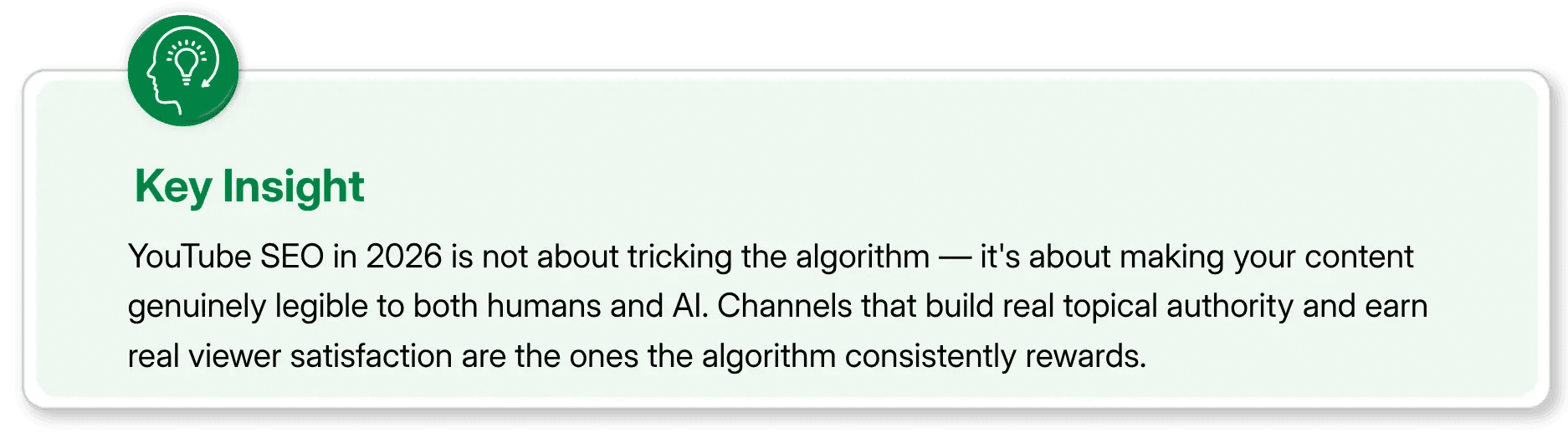
The shift is significant: you can no longer optimise your way to the top with metadata alone. The content itself - what you say, how you say it, and how viewers respond, is now the primary ranking signal.
Why AI Search Is Now a YouTube Ranking Factor
Here is the shift most creators have not fully processed yet.
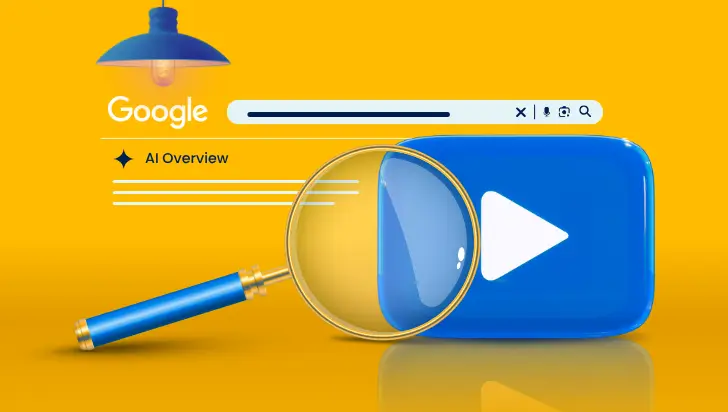
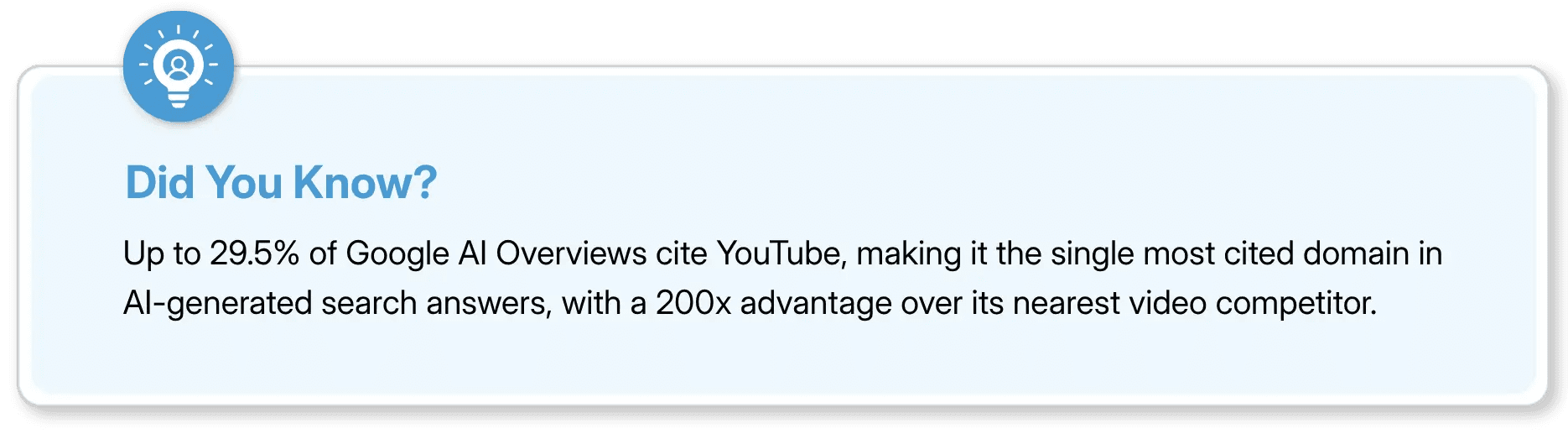
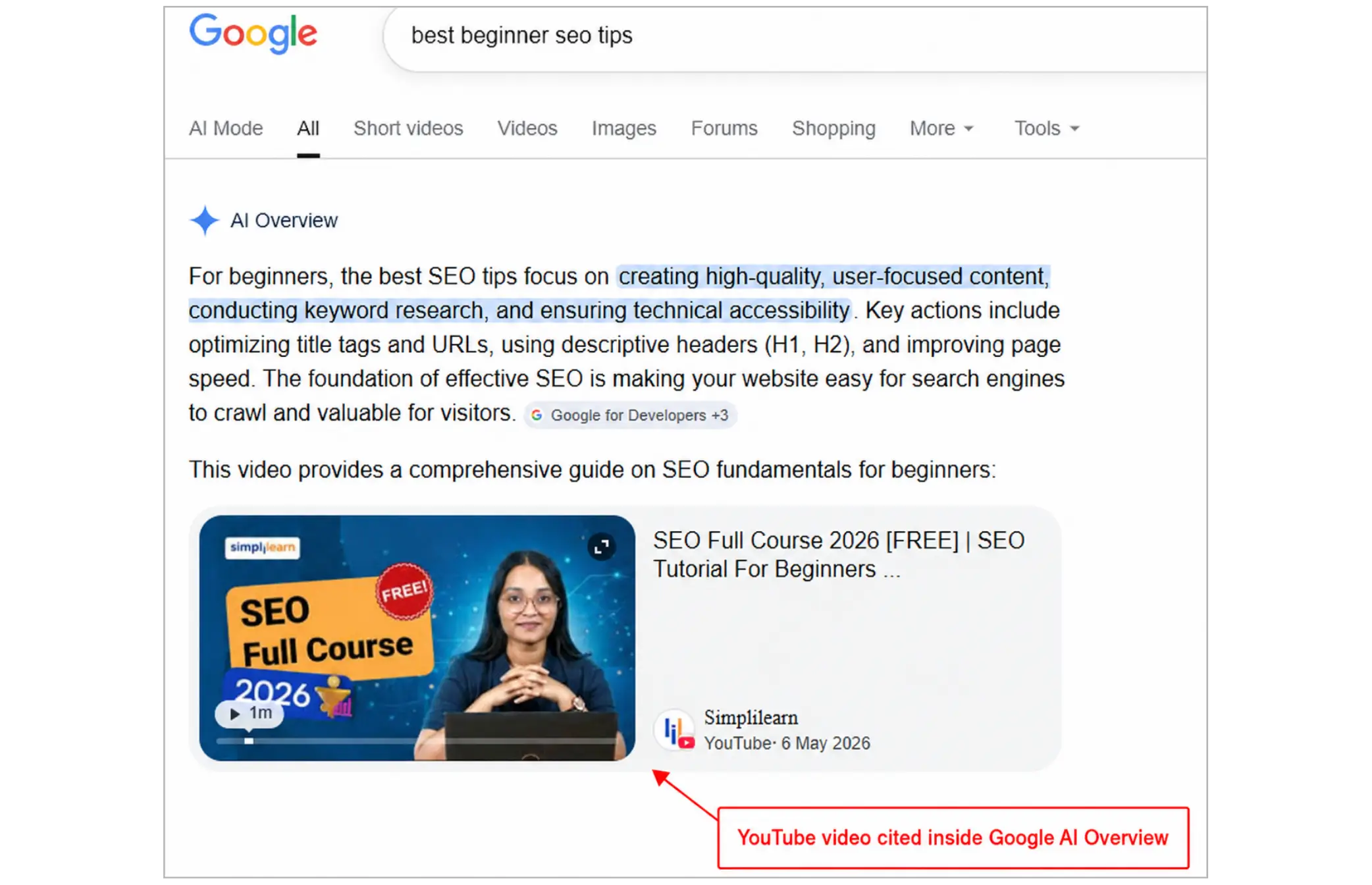
YouTube videos now compete in Google's AI search ecosystem, not just within YouTube itself. Google's AI Overviews regularly feature YouTube videos as cited sources alongside web articles. When someone searches "how to do keyword research in 2026," Google's generative answer may include a direct YouTube embed or citation.
If your video is not structured for AI comprehension, it will not be chosen, regardless of how many views it has.
How AI decides which videos to surface:
Videos with clear, structured verbal answers to specific questions
Channels with demonstrated authority in their topic area
Content indexed with accurate transcripts and closed captions
Videos that earn strong engagement signals - watch time, shares, saves
Creators whose content is referenced or linked from external websites
This means your YouTube strategy and your SEO strategy are no longer separate. They feed the same system and need to be built together.
The Role of Transcripts and Captions in YouTube SEO
This is the most significant tactical shift in YouTube SEO. Transcripts are no longer just an accessibility feature, they are a core indexing signal.
YouTube's AI and Google's indexing systems both read video transcripts. When you speak your keyword naturally within the video, mention related subtopics, and answer follow-up questions out loud, all of that spoken content becomes searchable text that AI can evaluate and rank.
What this means in practice:
Auto-generated captions are indexed, but they contain errors. Uploading an accurate manual transcript is a significant competitive advantage.
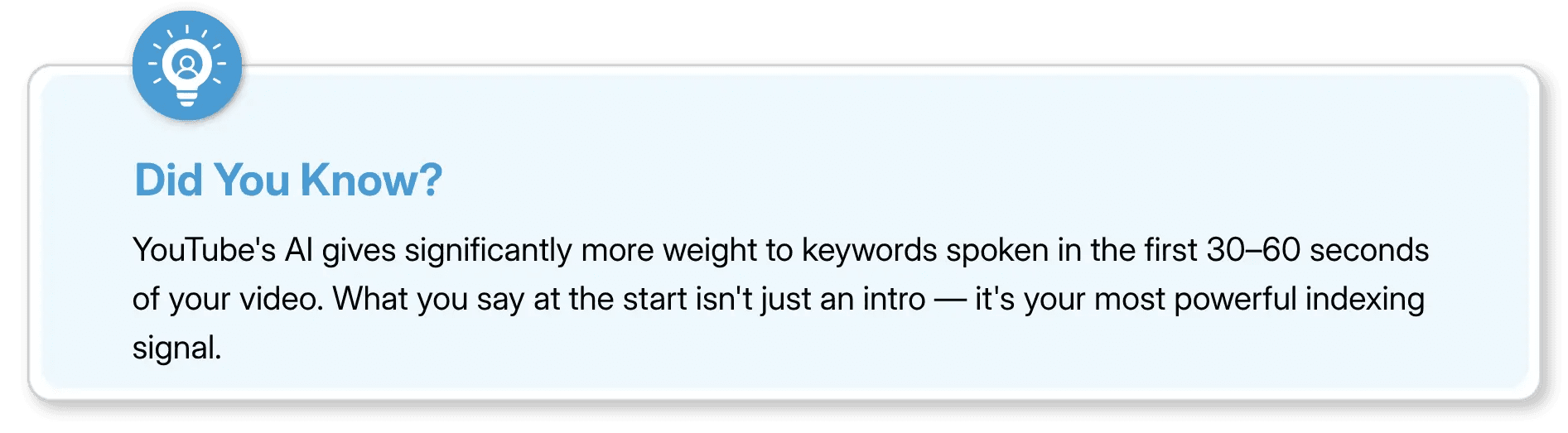
Speak your keywords naturally early. YouTube's AI gives more weight to topics mentioned in the first 30–60 seconds of spoken content.
Structure your spoken content like an article. Introduce the topic, cover subtopics clearly, and summarise key points.
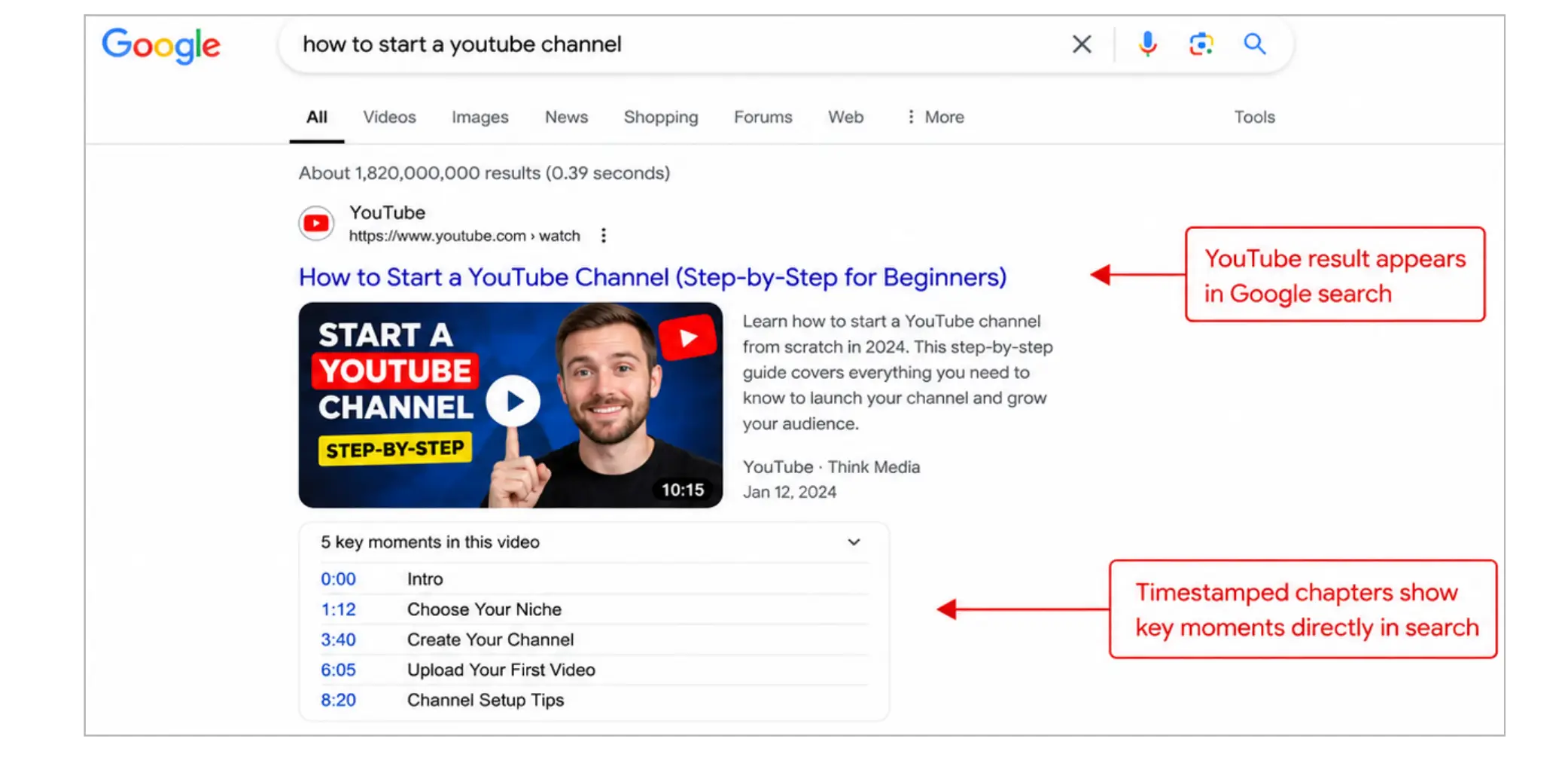
Add chapters with keyword-rich titles. Each chapter becomes a separate indexable segment that can rank for its own specific query.
Most creators are still ignoring this. That is the opportunity.
How Video Content Gets Featured in Google AI Overview
Google AI Overviews appear at the top of results for millions of queries daily. They pull from web pages, structured data and increasingly, YouTube videos. Getting your video featured here is a major visibility win that goes far beyond YouTube's own search results.
Content characteristics that earn AI Overview citations:
Direct, clearly structured verbal answers to specific questions
Comprehensive topic coverage with named chapters and timestamps
Strong channel authority in the subject area
Accurate transcripts that AI can parse without ambiguity
External links and embeds pointing back to the video
One practical adjustment that makes a real difference:
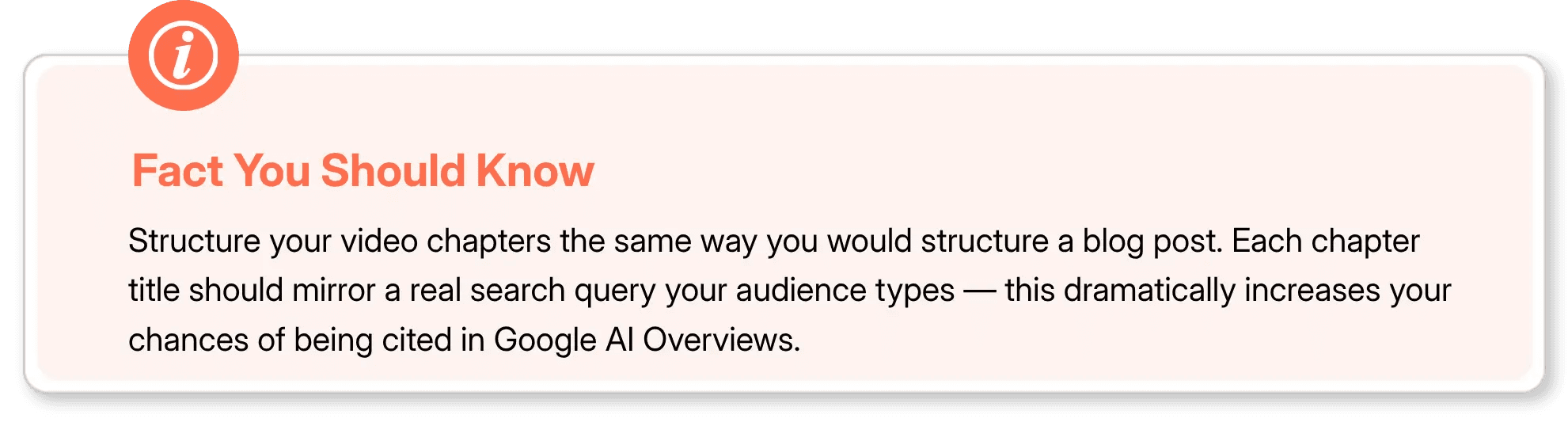
Write your chapter titles as questions your audience actually types. A chapter titled "How does YouTube's AI rank videos?" is far more likely to be cited in a Google AI Overview than one called "Our Video Strategy." Structure for the question, not the narrative.
YouTube SEO Ranking Factors That Matter Most
Understanding the updated ranking priority helps you focus your time where it returns real results.
Ranking Factor | Why It Matters |
|---|---|
Viewer satisfaction signals | Watch time, likes, comments, saves - these outrank every metadata signal combined |
Transcript accuracy | What you say on camera is indexed. Speak naturally around your topic throughout |
Channel topical consistency | Covering one subject consistently earns higher rankings across all videos |
Click-through rate from search | Thumbnail and title must earn the click, high CTR signals intent match |
Video chapters and timestamps | Each chapter becomes an indexable unit that can rank independently |
External signals and backlinks | Videos embedded on websites gain authority that YouTube's AI factors into ranking |
What Creators and Businesses Should Start Doing Today
Upload accurate manual transcripts for every video. Do not rely on auto-generated captions alone. A clean transcript is indexed as searchable content and gives AI systems reliable, unambiguous data to work with.
Script your opening around your target keyword. Mention your primary topic clearly within the first 60 seconds of spoken content, this is where AI indexing weights are highest.
Add video chapters with keyword-rich labels. Use YouTube's timestamp feature to create named chapters. Each one becomes a mini-indexed segment that can appear directly in search results and AI Overviews.
Build topical consistency across your channel. Every video you publish in a focused topic area reinforces your channel's authority. Off-topic content dilutes your niche signal and weakens overall ranking performance.
Embed your videos in relevant blog posts. Embedding on authoritative web pages creates external signals that both YouTube and Google use to validate your video's relevance and authority.
Optimise for the viewer, not just the algorithm. A video that genuinely answers a question, retains viewers, and earns engagement will outperform any technically optimised but hollow piece of content. Satisfaction signals are the most powerful ranking factors.
Final Thoughts
YouTube SEO is not a platform-specific tactic. It is a cross-channel authority strategy.
Videos that are well-structured, transcript-optimised, and genuinely helpful get discovered on YouTube, featured in Google AI Overviews, and referenced across the wider web. The creators and businesses winning right now are not the ones with the most polished thumbnails. They are the ones whose content genuinely answers questions, earns viewer trust, and gives AI systems clear signals to work with.
Build for the viewer and the algorithm follows.
Start with your transcript. Then build consistency, chapters, embeds, and real viewer satisfaction around it.
FAQs
Has YouTube SEO changed today?

YouTube's algorithm now evaluates what you actually say on camera not just your title and tags. It uses AI to understand topics, viewer satisfaction, and transcript content to decide what ranks in generative search. Watch time, saves, and comments now outweigh metadata optimisation alone.
Do YouTube video transcripts help with SEO?
Yes, significantly. YouTube's AI and Google both index your video transcript as searchable text. Uploading an accurate manual transcript gives AI systems clean, reliable content to rank, while auto-generated captions often contain errors that hurt your visibility.
Can YouTube videos appear in Google AI Overviews?
Yes. Google AI Overviews now regularly cite YouTube videos alongside web articles. To get featured, your video needs accurate transcripts, keyword-rich chapter titles, strong channel authority, and clear verbal answers to the questions your audience is actually searching.
What are the most important YouTube ranking factors?
Viewer satisfaction signals like watch time, comments, and saves are the strongest ranking factors. After that transcript accuracy, channel topical consistency, click-through rate from search, and video chapters that each become independently indexable segments.
How do video chapters help with YouTube SEO?
Each chapter you add becomes a separate, indexable unit that can rank on its own for specific queries and even appear as a standalone result in Google search. Writing chapter titles as real search questions (not internal section labels) significantly improves your chances of being cited in both YouTube results and Google AI Overviews.
YouTube is no longer just a video platform.
With over 3 billion monthly users and AI now powering how content gets surfaced across both YouTube and Google, it has become the world's second-largest search engine and the rules for ranking on it have fundamentally changed.
Not long ago, YouTube SEO meant one thing: optimise your title, stuff in keywords, add some tags, and build watch time. That approach still has a role, but it is nowhere near the complete picture anymore.
In 2026, AI-powered systems evaluate transcripts, spoken content, viewer behaviour, and cross-platform authority signals to decide what rises to the top. Creators and businesses still playing by the old rules are quietly losing ground to channels that understand how AI actually works.
This article breaks down exactly what changed, what still matters, and what you need to do differently right now.
How YouTube's Algorithm Has Changed in 2026
For years, YouTube SEO was straightforward. Optimise your title, write a keyword-rich description, add tags, and build watch time. That foundation still matters, but the algorithm has moved far beyond it.
YouTube's search and recommendation systems are now deeply powered by machine learning. The algorithm evaluates content at a semantic level, understanding topics, context, and conversational meaning, not just surface keywords.
A video titled "YouTube SEO Tips" that fails to genuinely deliver on that promise will be outranked by a less optimised video that actually satisfies the viewer's intent.
What the algorithm now prioritises:
Satisfaction signals - Watch time percentage, likes, comments, and saves outweigh metadata optimisation
Topic authority - Channels that consistently cover a specific subject rank higher across all their videos, not just individual ones
Relevance to search intent - The algorithm evaluates this using transcript data, not just the video title
The shift is significant: you can no longer optimise your way to the top with metadata alone. The content itself - what you say, how you say it, and how viewers respond, is now the primary ranking signal.
Why AI Search Is Now a YouTube Ranking Factor
Here is the shift most creators have not fully processed yet.
YouTube videos now compete in Google's AI search ecosystem, not just within YouTube itself. Google's AI Overviews regularly feature YouTube videos as cited sources alongside web articles. When someone searches "how to do keyword research in 2026," Google's generative answer may include a direct YouTube embed or citation.
If your video is not structured for AI comprehension, it will not be chosen, regardless of how many views it has.
How AI decides which videos to surface:
Videos with clear, structured verbal answers to specific questions
Channels with demonstrated authority in their topic area
Content indexed with accurate transcripts and closed captions
Videos that earn strong engagement signals - watch time, shares, saves
Creators whose content is referenced or linked from external websites
This means your YouTube strategy and your SEO strategy are no longer separate. They feed the same system and need to be built together.
The Role of Transcripts and Captions in YouTube SEO
This is the most significant tactical shift in YouTube SEO. Transcripts are no longer just an accessibility feature, they are a core indexing signal.
YouTube's AI and Google's indexing systems both read video transcripts. When you speak your keyword naturally within the video, mention related subtopics, and answer follow-up questions out loud, all of that spoken content becomes searchable text that AI can evaluate and rank.
What this means in practice:
Auto-generated captions are indexed, but they contain errors. Uploading an accurate manual transcript is a significant competitive advantage.
Speak your keywords naturally early. YouTube's AI gives more weight to topics mentioned in the first 30–60 seconds of spoken content.
Structure your spoken content like an article. Introduce the topic, cover subtopics clearly, and summarise key points.
Add chapters with keyword-rich titles. Each chapter becomes a separate indexable segment that can rank for its own specific query.
Most creators are still ignoring this. That is the opportunity.
How Video Content Gets Featured in Google AI Overview
Google AI Overviews appear at the top of results for millions of queries daily. They pull from web pages, structured data and increasingly, YouTube videos. Getting your video featured here is a major visibility win that goes far beyond YouTube's own search results.
Content characteristics that earn AI Overview citations:
Direct, clearly structured verbal answers to specific questions
Comprehensive topic coverage with named chapters and timestamps
Strong channel authority in the subject area
Accurate transcripts that AI can parse without ambiguity
External links and embeds pointing back to the video
One practical adjustment that makes a real difference:
Write your chapter titles as questions your audience actually types. A chapter titled "How does YouTube's AI rank videos?" is far more likely to be cited in a Google AI Overview than one called "Our Video Strategy." Structure for the question, not the narrative.
YouTube SEO Ranking Factors That Matter Most
Understanding the updated ranking priority helps you focus your time where it returns real results.
Ranking Factor | Why It Matters |
|---|---|
Viewer satisfaction signals | Watch time, likes, comments, saves - these outrank every metadata signal combined |
Transcript accuracy | What you say on camera is indexed. Speak naturally around your topic throughout |
Channel topical consistency | Covering one subject consistently earns higher rankings across all videos |
Click-through rate from search | Thumbnail and title must earn the click, high CTR signals intent match |
Video chapters and timestamps | Each chapter becomes an indexable unit that can rank independently |
External signals and backlinks | Videos embedded on websites gain authority that YouTube's AI factors into ranking |
What Creators and Businesses Should Start Doing Today
Upload accurate manual transcripts for every video. Do not rely on auto-generated captions alone. A clean transcript is indexed as searchable content and gives AI systems reliable, unambiguous data to work with.
Script your opening around your target keyword. Mention your primary topic clearly within the first 60 seconds of spoken content, this is where AI indexing weights are highest.
Add video chapters with keyword-rich labels. Use YouTube's timestamp feature to create named chapters. Each one becomes a mini-indexed segment that can appear directly in search results and AI Overviews.
Build topical consistency across your channel. Every video you publish in a focused topic area reinforces your channel's authority. Off-topic content dilutes your niche signal and weakens overall ranking performance.
Embed your videos in relevant blog posts. Embedding on authoritative web pages creates external signals that both YouTube and Google use to validate your video's relevance and authority.
Optimise for the viewer, not just the algorithm. A video that genuinely answers a question, retains viewers, and earns engagement will outperform any technically optimised but hollow piece of content. Satisfaction signals are the most powerful ranking factors.
Final Thoughts
YouTube SEO is not a platform-specific tactic. It is a cross-channel authority strategy.
Videos that are well-structured, transcript-optimised, and genuinely helpful get discovered on YouTube, featured in Google AI Overviews, and referenced across the wider web. The creators and businesses winning right now are not the ones with the most polished thumbnails. They are the ones whose content genuinely answers questions, earns viewer trust, and gives AI systems clear signals to work with.
Build for the viewer and the algorithm follows.
Start with your transcript. Then build consistency, chapters, embeds, and real viewer satisfaction around it.
FAQs
Has YouTube SEO changed today?
YouTube's algorithm now evaluates what you actually say on camera not just your title and tags. It uses AI to understand topics, viewer satisfaction, and transcript content to decide what ranks in generative search. Watch time, saves, and comments now outweigh metadata optimisation alone.
Do YouTube video transcripts help with SEO?
Yes, significantly. YouTube's AI and Google both index your video transcript as searchable text. Uploading an accurate manual transcript gives AI systems clean, reliable content to rank, while auto-generated captions often contain errors that hurt your visibility.
Can YouTube videos appear in Google AI Overviews?
Yes. Google AI Overviews now regularly cite YouTube videos alongside web articles. To get featured, your video needs accurate transcripts, keyword-rich chapter titles, strong channel authority, and clear verbal answers to the questions your audience is actually searching.
What are the most important YouTube ranking factors?
Viewer satisfaction signals like watch time, comments, and saves are the strongest ranking factors. After that transcript accuracy, channel topical consistency, click-through rate from search, and video chapters that each become independently indexable segments.
How do video chapters help with YouTube SEO?
Each chapter you add becomes a separate, indexable unit that can rank on its own for specific queries and even appear as a standalone result in Google search. Writing chapter titles as real search questions (not internal section labels) significantly improves your chances of being cited in both YouTube results and Google AI Overviews.



Summarize with AI




Want to Grow Social Accounts? Get a Free Audit Today!
Want to Grow Social Accounts? Get a Free Audit Today!


1k+ Reviews!


Don’t miss our revenue growth tips!
Get expert marketing tips—straight to your inbox, like thousands of happy clients.
Don’t miss our revenue growth tips!
Don’t miss our revenue growth tips!
Get expert marketing tips—straight to your inbox, like thousands of happy clients.
Don’t miss our revenue growth tips!
Get expert marketing tips—straight to your inbox, like thousands of happy clients.
Relevant Blogs on Social Media
Relevant Blogs on Social Media
Unlock data-driven insights in Social Media Marketing—explore our featured blogs and skyrocket your revenue before your competitors do.
Unlock data-driven insights in Social Media Marketing—explore our featured blogs and skyrocket your revenue before your competitors do.

Social Media
Aug 28, 2026
10 Min Read
Social Search Optimization: How to Optimize Your Brand for Social Search
Social Media
Aug 28, 2026
10 Min Read
Social Search Optimization: How to Optimize Your Brand for Social Search
Social Media
Aug 28, 2026
10 Min Read
Social Search Optimization: How to Optimize Your Brand for Social Search
Social Media
Aug 13, 2026
5 Min Read
TikTok SEO: How Keywords and Metadata Impact Your Visibility
Social Media
Aug 13, 2026
5 Min Read
TikTok SEO: How Keywords and Metadata Impact Your Visibility
Social Media
Aug 13, 2026
5 Min Read
TikTok SEO: How Keywords and Metadata Impact Your Visibility

Social Media
Aug 3, 2026
10 Min Read
Why Social Media Matters for Al Recommendations and Brand Discovery
Social Media
Aug 3, 2026
10 Min Read
Why Social Media Matters for Al Recommendations and Brand Discovery
Social Media
Aug 3, 2026
10 Min Read
Why Social Media Matters for Al Recommendations and Brand Discovery





























Ready to speak with an expert?
Data-Driven Marketing Agency That Elevates ROI
1100+
Websites Designed & Optimized to Convert
$280M+
Client Revenue Driven & Growing Strong
Discover how to skyrocket
your revenue today!



Trusted by 1000+ Owners!
Ready to speak with an expert?
Data-Driven Marketing Agency That Elevates ROI
1100+
Websites Designed & Optimized to Convert
$280M+
Client Revenue Driven & Growing Strong
Discover how to skyrocket
your revenue today!
Trusted by 1000+ Owners!
Want to skyrocket revenue?
4.9/5 Ratings!
Ready to speak with an expert?
Data-Driven Marketing Agency That Elevates ROI
1100+
Websites Designed & Optimized to Convert
$280M+
Client Revenue Driven & Growing Strong
Discover how to skyrocket
your revenue today!
Trusted by 1000+ Owners!
Call
Meet