Entity-Based Search Fundamentals: Core Concepts and How It Works
Entity-Based Search Fundamentals: Core Concepts and How It Works
Last Updated:
Table of Content
Case Studies





Divya Vyas
Divya Vyas
Divya Vyas
SEO
SEO
SEO
8 Min Read
12 Min
8 Min Read
When you type "Apple" into Google. The search engine doesn't just look for pages that says "Apple." It asks queries like are you searching for the fruit, the tech company, or the record label? It figures out the answer from context, cross-references what it already knows, and serves results accordingly. That's entity-based search in action, and it's been running under the hood of Google since 2012. The question now is whether your content is built to take advantage of it.
Entity-based search is how modern search engines understand content by identifying real-world things and concepts, called entities, rather than just matching words on a page. When it reads your website, it is not counting keyword occurrences. It's asking: which entities does this page discuss, how prominently, and what do they connect to?
If your SEO strategy is still built around keyword density and keyword repetition, you're optimizing for a version of search that no longer exists.
What Are Entities in SEO?
An entity is a uniquely identifiable, real-world thing or concept that a search system can recognize, catalog, and connect to other things. A person (Barack Obama), a place (the Mayo Clinic), a brand (Google), a product (iPhone 17), or an abstract concept (Artificial Intelligence) are all entities. What makes anything an entity isn't fame. It's distinguishability. The search system can tell it apart from everything else, assign it a unique identifier, and map its relationships.
This is what "entity SEO" actually is at its core; not tricking the search engines with keywords, but giving them enough structured, consistent, credible information that they can confidently identify your brand, your content, and your expertise as real, distinct entities worth citing.
Entities exist in different types: persons, organizations, locations, events, products, concepts, dates, colors. According to research cited by SearchAtlas, roughly 160 entity types are used in extended named entity recognition systems. Each type has attributes (properties), and each entity has relationships to others. Larry Page is a person, co-founder of Google, with a birthdate of March 26, 1973. Those facts and connections are what make him a fully formed entity in a knowledge graph, not just a name on a page.
Entity-Based Search vs. Traditional Keyword SEO
The easiest way to understand entity SEO is to contrast it directly with keyword-based search.
Keyword SEO asks: how many times does "best orthopedic surgeon" appear on this page?
Entity-based search asks: is this page clearly about the entity "orthopedic surgery"? Is it connected to physician entities, condition entities, and location entities? Does the information here match what Google already knows from authoritative sources?
Keyword SEO | Entity-Based Search | |
|---|---|---|
Focus | Text strings | Real-world concepts |
Focus | Keyword density, backlinks | Entity salience, structured data, relationships |
Context awareness | Low | High |
AI compatibility | Poor | Foundational |
Future-proofing | Declining | Growing |
Carolyn Shelby, Principal SEO at Yoast, described the difference well: keyword SEO is working on a flat map, while entity SEO lives in three-dimensional space. Keywords help you appear. Entities determine whether you shine.
Entity-based search doesn't replace keywords entirely. Keywords still matter for signaling search demand and for anchoring anchor text. But they are no longer the primary signal for ranking in AI-driven search results. The structural shift is real, and it's been coming for over a decade.
How Entity-Based Search Actually Works
Semantic search and entity-based search are two ways of describing the same system. Google has functioned as a semantic search engine since the 2013 Hummingbird update, which affected over 90% of all searches. Understanding the mechanics helps you make a better decision about how to structure your content.
Named Entity Recognition
When Google crawls your page, natural language processing systems identify every entity in your content: names, locations, organizations, products, concepts. This process is called Named Entity Recognition, or NER. Every recognized entity gets tagged, weighted, and scored for how central it is to the document as a whole.
NER was first defined at the Sixth Message Understanding Conference in the 1990s. By 2007, state-of-the-art NER systems for English had already reached near-human performance. Today, deep learning approaches using neural networks like BERT account for 97% of advanced NLP systems, and they are what Google uses to parse your content before any ranking takes place.
Entity Salience
Once entities are recognized, Google assigns each one a salience score from 0 to 1. A score near 1 means that entity is the clear, unambiguous primary focus of the page. A low score means it appears in passing.
This matters enormously for how your content is performing. A page on "knee replacement surgery" that clearly positions that procedure as its primary entity through headings, structured content, schema markup, and internal links will consistently outperform a page that buries the topic among twelve others.
An entity-optimized article studied by SearchAtlas improved its primary entity salience score from 0.38 to 0.71. The result was a 156% increase in organic traffic within 90 days and rankings for 340 keywords, up from 89.

Entity Linking and Disambiguation
Google does not just recognize entities. It links them to authoritative sources and resolves ambiguity. "Mercury" could mean a planet, a car brand, or a chemical element. Entity linking is how search systems figure out which one you mean, by analyzing surrounding context, co-occurring entities, and structured data sources like Wikidata and Google's Knowledge Graph.
For your content, this means precision pays off. The more consistently and clearly you define the entities on your pages and link them to each other, the more confidently Google can categorize you, and the broader the range of queries you can rank for without explicitly targeting each one.
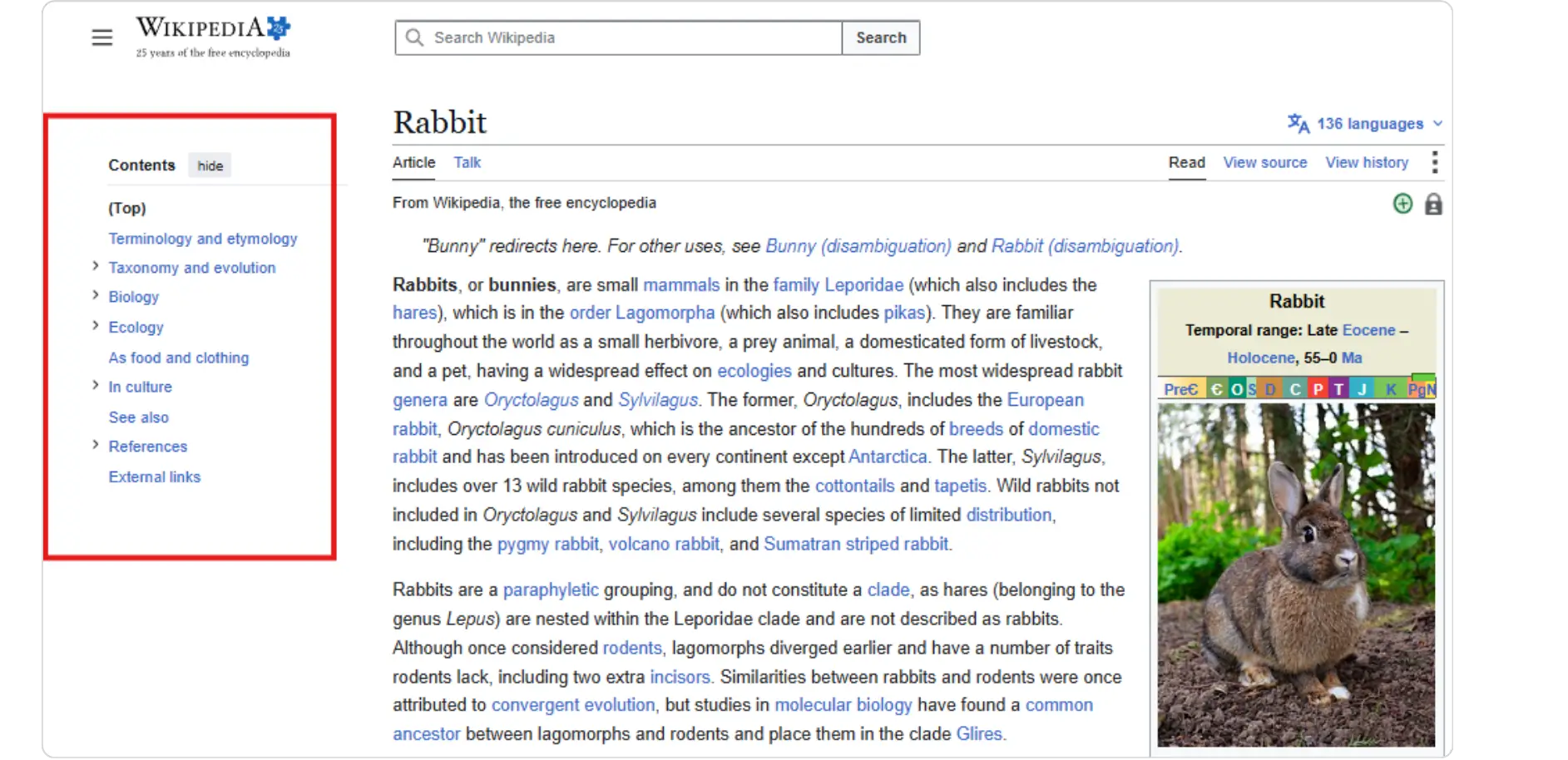
To conclude with an example- Wikipedia entries are a great example of entities. Wikipedia provides a great example of information associated with entities.
As you can see from the top left, the entity has all sorts of attributes associated with “rabbit,” ranging from its anatomy to its importance to humans.
Why Entity SEO Matters More Now Than Ever
Entity-based search optimization has been important since 2013. It's critical now because AI-powered search has made entity signals the primary mechanism for determining what gets cited in generated answers.
Google's AI Overviews trigger for an estimated 15 to 25% of searches. According to BrightEdge research, 83.3% of AI Overview citations come from pages outside the traditional top 10 organic results. Entity clarity, not keyword density, is what gets a page cited.
Pages with valid schema markup are 2 to 4 times more likely to appear in AI Overviews. ChatGPT responses citing structured pages score 30% higher for accuracy and completeness. Entity optimization is 3x more effective than keyword-based SEO for AI-driven search visibility, according to SearchAtlas research on 2024 data.
The numbers aren't marginal. The structural advantage of entity-focused content compounds over time because AI systems build confidence in sources they can verify from multiple angles. A brand that appears consistently across Google Business Profile, Wikidata, Crunchbase, and third-party editorial coverage is an entity the system trusts. A brand that exists only as text on its own website is much harder to verify.
What Is Entity-Based Search Optimization in Practice?
Entity-based search optimization means structuring your content, schema markup, and digital presence so that search engines and AI systems can clearly identify your entities, understand their attributes, and connect them to your topical authority. Here is what that actually looks like:
Implement Schema Markup and Link It Together
Schema markup, using Schema.org vocabulary in JSON-LD format, is how you declare your entities to search engines in a structured, machine-readable way. The types that matter most for most sites are Organization, Person, LocalBusiness, Article, and FAQPage. For healthcare and professional services, MedicalCondition, MedicalTherapy, and Physician schema add significant weight.
The piece most sites miss is connecting the schemas together. When your Organization schema links to your Physician schema, which connects to your MedicalSpecialty schema, AI systems can trace a chain of verified relationships. Isolated schema on individual pages, with no connections between them, misses most of that value.
Rotten Tomatoes added structured data to 100,000 pages and saw a 25% higher click-through rate on enhanced pages. Nestlé pages showing as rich results have an 82% higher click-through rate than non-rich pages. The performance case for schema implementation is well established.
Build Topical Authority Through Content Clusters
A single well-written page doesn't establish entity authority. A network of interlinked pages on the same topic does. This is because entity-based search optimization is assessed across an entire site, not just individual pages. A dermatology practice with 20 comprehensive, interlinked articles about skin conditions will get cited more consistently in AI answers than one with a single condition page, regardless of how good that single page is.
The structure that works: a pillar page covering a specialty broadly, supported by cluster pages that go deep on specific conditions, procedures, patient questions, and recovery timelines. Every cluster page links back to the pillar. The pillar links out to every cluster. Internal anchor text is descriptive and entity-specific, not generic.
Topic clusters drive approximately 30% more organic traffic and hold rankings 2.5 times longer, according to HireGrowth's 2025 analysis. One well-built cluster can rank for over 1,100 keywords while generating consistent organic traffic on weekdays alone.
Establish Your Entity Externally
Your website alone cannot make you a recognized entity. AI systems verify entities by cross-referencing information across independent sources. Google Business Profile, Wikidata, Crunchbase, LinkedIn, the Better Business Bureau, and reputable third-party publications all function as corroboration points.
NAP consistency matters more here than most people realize. Inconsistencies in your Name, Address, and Phone number across directories don't just create local SEO problems. They cause AI systems to treat conflicting listings as separate entities, splitting your authority and reducing the confidence score the system assigns to your brand.
Without the sameAs property linking your Organization schema to authoritative external sources like Wikipedia, Wikidata, or LinkedIn, AI systems cannot definitively confirm your entity. Google AI Overviews and Gemini retrieval paths rely heavily on the Knowledge Graph. Entities without a canonical external identifier are effectively invisible to them.
Write Content That Answers First
AI systems pull from the first 50 to 150 words of a page when generating responses. Content optimized for entity-based search puts the most important answer near the top, directly, in plain language, with the primary entity clearly named. This is not just good user experience. It's how AI-cited content is consistently structured.
Short paragraphs, clear headings, Q&A blocks, and fact tables all make content easier for large language models to parse. Adding statistics, quotations, and citations to a page improved generative engine visibility by up to 40%, according to Princeton GEO research. Specificity is what AI cites.
Entity-Based Search and Semantic Search: What's the Relationship?
They're the same system. Entity-based search is the core mechanism driving semantic search. Google has functioned as a semantic search engine since Hummingbird in 2013. Every subsequent development- RankBrain, E-E-A-T, BERT, MUM, Gemini — has deepened that semantic layer. When you optimize for entities, you're not adding something extra on top of your SEO. You are aligning with how the search engine has actually been built to work.
The practical implication is that entity SEO is not a separate track for advanced practitioners. It's the baseline for any site that wants to appear in AI-generated answers, knowledge panels, featured snippets, or the growing range of AI-driven search features that are eating into traditional blue-link click-through rates.
Final Thoughts
Search engines stopped being string-matching systems a long time ago. They are reasoning systems now, and they reason about entities, their attributes, and their relationships, not about keyword frequency.
Entity-based search is the framework that governs how AI-powered search discovers, evaluates, and recommends content in 2026. What is entity SEO at its practical core? It's the work of making your brand, your expertise, and your content recognizable, verifiable, and trustworthy to a system that checks multiple sources before it cites anything.
Keyword optimization still has a role. But the sites winning in AI-generated responses are the ones that have done the harder work: consistent entity presence across the web, linked and nested schema, topical authority through content depth, and content structured so AI can actually read and quote it.
That's not a trick. That's reputation, made machine-readable.
FAQs
What is entity-based search in simple terms?

It's how modern search engines understand content by recognizing real-world things and concepts, known as entities, rather than just matching words on a page. Google maps these entities, their attributes, and their relationships to deliver more accurate, contextually relevant results.
What are entities in SEO?
Entities in SEO are uniquely identifiable, real-world things or concepts that search engines can recognize and catalog: a person, a location, a condition, a brand, a city. Each entity has attributes and relationships to other entities that helps the search engine to understand meaning beyond text.
Is entity SEO the same as semantic search?
Essentially, yes. Entity-based search is the major component of semantic search. Both describe systems that evaluate meaning and context rather than just text strings. Google has operated as a semantic search engine since Hummingbird in 2013, and entities are the building blocks that make that possible.
How does entity linking work?
Entity linking connects mentions in the text to unique entries in a knowledge base like Wikidata or Google's Knowledge Graph. It resolves ambiguity, so "Paris" in a travel article links to Paris, France rather than Paris Hilton (a person) and builds semantic relationships between your content and established authority holding sources.
How long does entity SEO take to show results?
Improvements in entity salience typically begin to show effects within 4-13 weeks, with stable visibility gains within 3-7 months. Technical changes like schema implementation and NAP consistency often move faster than content-based changes because they give search systems immediate, structured signals to process it.
When you type "Apple" into Google. The search engine doesn't just look for pages that says "Apple." It asks queries like are you searching for the fruit, the tech company, or the record label? It figures out the answer from context, cross-references what it already knows, and serves results accordingly. That's entity-based search in action, and it's been running under the hood of Google since 2012. The question now is whether your content is built to take advantage of it.
Entity-based search is how modern search engines understand content by identifying real-world things and concepts, called entities, rather than just matching words on a page. When it reads your website, it is not counting keyword occurrences. It's asking: which entities does this page discuss, how prominently, and what do they connect to?
If your SEO strategy is still built around keyword density and keyword repetition, you're optimizing for a version of search that no longer exists.
What Are Entities in SEO?
An entity is a uniquely identifiable, real-world thing or concept that a search system can recognize, catalog, and connect to other things. A person (Barack Obama), a place (the Mayo Clinic), a brand (Google), a product (iPhone 17), or an abstract concept (Artificial Intelligence) are all entities. What makes anything an entity isn't fame. It's distinguishability. The search system can tell it apart from everything else, assign it a unique identifier, and map its relationships.
This is what "entity SEO" actually is at its core; not tricking the search engines with keywords, but giving them enough structured, consistent, credible information that they can confidently identify your brand, your content, and your expertise as real, distinct entities worth citing.
Entities exist in different types: persons, organizations, locations, events, products, concepts, dates, colors. According to research cited by SearchAtlas, roughly 160 entity types are used in extended named entity recognition systems. Each type has attributes (properties), and each entity has relationships to others. Larry Page is a person, co-founder of Google, with a birthdate of March 26, 1973. Those facts and connections are what make him a fully formed entity in a knowledge graph, not just a name on a page.
Entity-Based Search vs. Traditional Keyword SEO
The easiest way to understand entity SEO is to contrast it directly with keyword-based search.
Keyword SEO asks: how many times does "best orthopedic surgeon" appear on this page?
Entity-based search asks: is this page clearly about the entity "orthopedic surgery"? Is it connected to physician entities, condition entities, and location entities? Does the information here match what Google already knows from authoritative sources?
Keyword SEO | Entity-Based Search | |
|---|---|---|
Focus | Text strings | Real-world concepts |
Focus | Keyword density, backlinks | Entity salience, structured data, relationships |
Context awareness | Low | High |
AI compatibility | Poor | Foundational |
Future-proofing | Declining | Growing |
Carolyn Shelby, Principal SEO at Yoast, described the difference well: keyword SEO is working on a flat map, while entity SEO lives in three-dimensional space. Keywords help you appear. Entities determine whether you shine.
Entity-based search doesn't replace keywords entirely. Keywords still matter for signaling search demand and for anchoring anchor text. But they are no longer the primary signal for ranking in AI-driven search results. The structural shift is real, and it's been coming for over a decade.
How Entity-Based Search Actually Works
Semantic search and entity-based search are two ways of describing the same system. Google has functioned as a semantic search engine since the 2013 Hummingbird update, which affected over 90% of all searches. Understanding the mechanics helps you make a better decision about how to structure your content.
Named Entity Recognition
When Google crawls your page, natural language processing systems identify every entity in your content: names, locations, organizations, products, concepts. This process is called Named Entity Recognition, or NER. Every recognized entity gets tagged, weighted, and scored for how central it is to the document as a whole.
NER was first defined at the Sixth Message Understanding Conference in the 1990s. By 2007, state-of-the-art NER systems for English had already reached near-human performance. Today, deep learning approaches using neural networks like BERT account for 97% of advanced NLP systems, and they are what Google uses to parse your content before any ranking takes place.
Entity Salience
Once entities are recognized, Google assigns each one a salience score from 0 to 1. A score near 1 means that entity is the clear, unambiguous primary focus of the page. A low score means it appears in passing.
This matters enormously for how your content is performing. A page on "knee replacement surgery" that clearly positions that procedure as its primary entity through headings, structured content, schema markup, and internal links will consistently outperform a page that buries the topic among twelve others.
An entity-optimized article studied by SearchAtlas improved its primary entity salience score from 0.38 to 0.71. The result was a 156% increase in organic traffic within 90 days and rankings for 340 keywords, up from 89.
Entity Linking and Disambiguation
Google does not just recognize entities. It links them to authoritative sources and resolves ambiguity. "Mercury" could mean a planet, a car brand, or a chemical element. Entity linking is how search systems figure out which one you mean, by analyzing surrounding context, co-occurring entities, and structured data sources like Wikidata and Google's Knowledge Graph.
For your content, this means precision pays off. The more consistently and clearly you define the entities on your pages and link them to each other, the more confidently Google can categorize you, and the broader the range of queries you can rank for without explicitly targeting each one.
To conclude with an example- Wikipedia entries are a great example of entities. Wikipedia provides a great example of information associated with entities.
As you can see from the top left, the entity has all sorts of attributes associated with “rabbit,” ranging from its anatomy to its importance to humans.
Why Entity SEO Matters More Now Than Ever
Entity-based search optimization has been important since 2013. It's critical now because AI-powered search has made entity signals the primary mechanism for determining what gets cited in generated answers.
Google's AI Overviews trigger for an estimated 15 to 25% of searches. According to BrightEdge research, 83.3% of AI Overview citations come from pages outside the traditional top 10 organic results. Entity clarity, not keyword density, is what gets a page cited.
Pages with valid schema markup are 2 to 4 times more likely to appear in AI Overviews. ChatGPT responses citing structured pages score 30% higher for accuracy and completeness. Entity optimization is 3x more effective than keyword-based SEO for AI-driven search visibility, according to SearchAtlas research on 2024 data.
The numbers aren't marginal. The structural advantage of entity-focused content compounds over time because AI systems build confidence in sources they can verify from multiple angles. A brand that appears consistently across Google Business Profile, Wikidata, Crunchbase, and third-party editorial coverage is an entity the system trusts. A brand that exists only as text on its own website is much harder to verify.
What Is Entity-Based Search Optimization in Practice?
Entity-based search optimization means structuring your content, schema markup, and digital presence so that search engines and AI systems can clearly identify your entities, understand their attributes, and connect them to your topical authority. Here is what that actually looks like:
Implement Schema Markup and Link It Together
Schema markup, using Schema.org vocabulary in JSON-LD format, is how you declare your entities to search engines in a structured, machine-readable way. The types that matter most for most sites are Organization, Person, LocalBusiness, Article, and FAQPage. For healthcare and professional services, MedicalCondition, MedicalTherapy, and Physician schema add significant weight.
The piece most sites miss is connecting the schemas together. When your Organization schema links to your Physician schema, which connects to your MedicalSpecialty schema, AI systems can trace a chain of verified relationships. Isolated schema on individual pages, with no connections between them, misses most of that value.
Rotten Tomatoes added structured data to 100,000 pages and saw a 25% higher click-through rate on enhanced pages. Nestlé pages showing as rich results have an 82% higher click-through rate than non-rich pages. The performance case for schema implementation is well established.
Build Topical Authority Through Content Clusters
A single well-written page doesn't establish entity authority. A network of interlinked pages on the same topic does. This is because entity-based search optimization is assessed across an entire site, not just individual pages. A dermatology practice with 20 comprehensive, interlinked articles about skin conditions will get cited more consistently in AI answers than one with a single condition page, regardless of how good that single page is.
The structure that works: a pillar page covering a specialty broadly, supported by cluster pages that go deep on specific conditions, procedures, patient questions, and recovery timelines. Every cluster page links back to the pillar. The pillar links out to every cluster. Internal anchor text is descriptive and entity-specific, not generic.
Topic clusters drive approximately 30% more organic traffic and hold rankings 2.5 times longer, according to HireGrowth's 2025 analysis. One well-built cluster can rank for over 1,100 keywords while generating consistent organic traffic on weekdays alone.
Establish Your Entity Externally
Your website alone cannot make you a recognized entity. AI systems verify entities by cross-referencing information across independent sources. Google Business Profile, Wikidata, Crunchbase, LinkedIn, the Better Business Bureau, and reputable third-party publications all function as corroboration points.
NAP consistency matters more here than most people realize. Inconsistencies in your Name, Address, and Phone number across directories don't just create local SEO problems. They cause AI systems to treat conflicting listings as separate entities, splitting your authority and reducing the confidence score the system assigns to your brand.
Without the sameAs property linking your Organization schema to authoritative external sources like Wikipedia, Wikidata, or LinkedIn, AI systems cannot definitively confirm your entity. Google AI Overviews and Gemini retrieval paths rely heavily on the Knowledge Graph. Entities without a canonical external identifier are effectively invisible to them.
Write Content That Answers First
AI systems pull from the first 50 to 150 words of a page when generating responses. Content optimized for entity-based search puts the most important answer near the top, directly, in plain language, with the primary entity clearly named. This is not just good user experience. It's how AI-cited content is consistently structured.
Short paragraphs, clear headings, Q&A blocks, and fact tables all make content easier for large language models to parse. Adding statistics, quotations, and citations to a page improved generative engine visibility by up to 40%, according to Princeton GEO research. Specificity is what AI cites.
Entity-Based Search and Semantic Search: What's the Relationship?
They're the same system. Entity-based search is the core mechanism driving semantic search. Google has functioned as a semantic search engine since Hummingbird in 2013. Every subsequent development- RankBrain, E-E-A-T, BERT, MUM, Gemini — has deepened that semantic layer. When you optimize for entities, you're not adding something extra on top of your SEO. You are aligning with how the search engine has actually been built to work.
The practical implication is that entity SEO is not a separate track for advanced practitioners. It's the baseline for any site that wants to appear in AI-generated answers, knowledge panels, featured snippets, or the growing range of AI-driven search features that are eating into traditional blue-link click-through rates.
Final Thoughts
Search engines stopped being string-matching systems a long time ago. They are reasoning systems now, and they reason about entities, their attributes, and their relationships, not about keyword frequency.
Entity-based search is the framework that governs how AI-powered search discovers, evaluates, and recommends content in 2026. What is entity SEO at its practical core? It's the work of making your brand, your expertise, and your content recognizable, verifiable, and trustworthy to a system that checks multiple sources before it cites anything.
Keyword optimization still has a role. But the sites winning in AI-generated responses are the ones that have done the harder work: consistent entity presence across the web, linked and nested schema, topical authority through content depth, and content structured so AI can actually read and quote it.
That's not a trick. That's reputation, made machine-readable.
FAQs
What is entity-based search in simple terms?
It's how modern search engines understand content by recognizing real-world things and concepts, known as entities, rather than just matching words on a page. Google maps these entities, their attributes, and their relationships to deliver more accurate, contextually relevant results.
What are entities in SEO?
Entities in SEO are uniquely identifiable, real-world things or concepts that search engines can recognize and catalog: a person, a location, a condition, a brand, a city. Each entity has attributes and relationships to other entities that helps the search engine to understand meaning beyond text.
Is entity SEO the same as semantic search?
Essentially, yes. Entity-based search is the major component of semantic search. Both describe systems that evaluate meaning and context rather than just text strings. Google has operated as a semantic search engine since Hummingbird in 2013, and entities are the building blocks that make that possible.
How does entity linking work?
Entity linking connects mentions in the text to unique entries in a knowledge base like Wikidata or Google's Knowledge Graph. It resolves ambiguity, so "Paris" in a travel article links to Paris, France rather than Paris Hilton (a person) and builds semantic relationships between your content and established authority holding sources.
How long does entity SEO take to show results?
Improvements in entity salience typically begin to show effects within 4-13 weeks, with stable visibility gains within 3-7 months. Technical changes like schema implementation and NAP consistency often move faster than content-based changes because they give search systems immediate, structured signals to process it.



Summarize with AI



Want to Skyrocket Revenue? Get a Free Audit Today!
Want to Skyrocket Revenue? Get a Free Audit Today!



4.9/5 Ratings!


Don’t miss our revenue growth tips!
Get expert marketing tips—straight to your inbox, like thousands of happy clients.
Don’t miss our revenue growth tips!
Get expert marketing tips—straight to your inbox, like thousands of happy clients.
Don’t miss our revenue growth tips!
Don’t miss our revenue growth tips!
Get expert marketing tips—straight to your inbox, like thousands of happy clients.
Relevant Blogs on Organic SEO
Relevant Blogs on Organic SEO
Unlock data-driven insights in Organic SEO—explore our featured blogs and skyrocket your revenue before your competitors do.
Unlock data-driven insights in Organic SEO—explore our featured blogs and skyrocket your revenue before your competitors do.

SEO
Sep 21, 2026
5 Min Read
Audience-First SEO: How to Rank by Putting Readers First
SEO
Sep 21, 2026
5 Min Read
Audience-First SEO: How to Rank by Putting Readers First
SEO
Sep 21, 2026
5 Min Read
Audience-First SEO: How to Rank by Putting Readers First

SEO
Sep 19, 2026
5 Min Read
How to Add SEO Keywords to Your Website: Where and How
SEO
Sep 19, 2026
5 Min Read
How to Add SEO Keywords to Your Website: Where and How
SEO
Sep 19, 2026
5 Min Read
How to Add SEO Keywords to Your Website: Where and How

SEO
Sep 18, 2026
5 Min Read
How XML Sitemaps Help Search Engines Discover New Pages
SEO
Sep 18, 2026
5 Min Read
How XML Sitemaps Help Search Engines Discover New Pages
SEO
Sep 18, 2026
5 Min Read
How XML Sitemaps Help Search Engines Discover New Pages















Ready to speak with an expert?
Data-Driven Marketing Agency That Elevates ROI
1100+
Websites Designed & Optimized to Convert
$280M+
Client Revenue Driven & Growing Strong
Discover how to skyrocket
your revenue today!
Trusted by 1000+ Owners!
Ready to speak with an expert?
Data-Driven Marketing Agency That Elevates ROI
1100+
Websites Designed & Optimized to Convert
$280M+
Client Revenue Driven & Growing Strong
Discover how to skyrocket
your revenue today!
Trusted by 1000+ Owners!
Want to skyrocket revenue?
4.9/5 Ratings!
Ready to speak with an expert?
Data-Driven Marketing Agency That Elevates ROI
1100+
Websites Designed & Optimized to Convert
$280M+
Client Revenue Driven & Growing Strong
Discover how to skyrocket
your revenue today!
Trusted by 1000+ Owners!
Call
Meet