Claude’s Invisible Watermarks: What They Mean for Marketers
Claude’s Invisible Watermarks: What They Mean for Marketers
Last Updated:
Table of Content
Case Studies







You publish a blog post. A client submits a proposal. A copywriter delivers a landing page. On the surface, everything looks the same as it did last week. But starting now, if Claude wrote it, that text carries something new: a hidden signal embedded in the word choices themselves, invisible to readers, but detectable by anyone with the right key. That is what Claude's invisible watermarks are, and marketers who understand how they work will be far better prepared for what comes next.
Anthropic announced on August 14, 2026, that future Claude models will generate text containing a watermark. This isn't a visible stamp or a disclaimer appended to the bottom of a document. Claude's invisible watermarks leave no trace a human reader would notice. The text reads exactly as it would without the watermark. But the pattern is there, detectable by anyone using Anthropic's forthcoming detection API.
This change is significant, and it comes with real implications for content teams, SEO strategies, and the broader question of AI transparency in the modern marketing.
How the Claude Text Watermark Actually Works
Understanding the technical mechanics matters here, because a lot of concern floating around this topic is based on misconceptions about what the Claude text watermark can and cannot do.
Large language models generate text one word at a time. At each step, the model weighs a list of candidate words and selects the most sensible option based on what came before. In many cases, two or three words would work equally well. Take a sentence ending with "the weather today was cold and..." Both "overcast" and "grey" are reasonable choices. The meaning barely varies.
Without watermarking, an arbitrary random number generator settles those low-stakes choices. With the Claude text watermark, the source of randomness changes. The selection now draws from a cryptographic key along with the preceding words. The choices still feel random to any reader, but someone holding the key can later examine a passage and determine whether the pattern of word selections is consistent with what Claude would have chosen.
The result is a probability score, not a binary 0 or 1. The detection API, which Anthropic is still developing, will answer the question: what is the likelihood that Claude was involved in producing this text?
Three things the Claude watermark cannot do:
It cannot identify the user who generated the content
It cannot determine whether text was written by a human or a different AI
It cannot confirm authorship or change ownership of the output
Anthropic is explicit on all three points. A watermark can only say that Claude was likely involved. It says nothing about who prompted Claude, what organization they belong to, or what their intentions were.
What This Means for Content Marketers Right Now
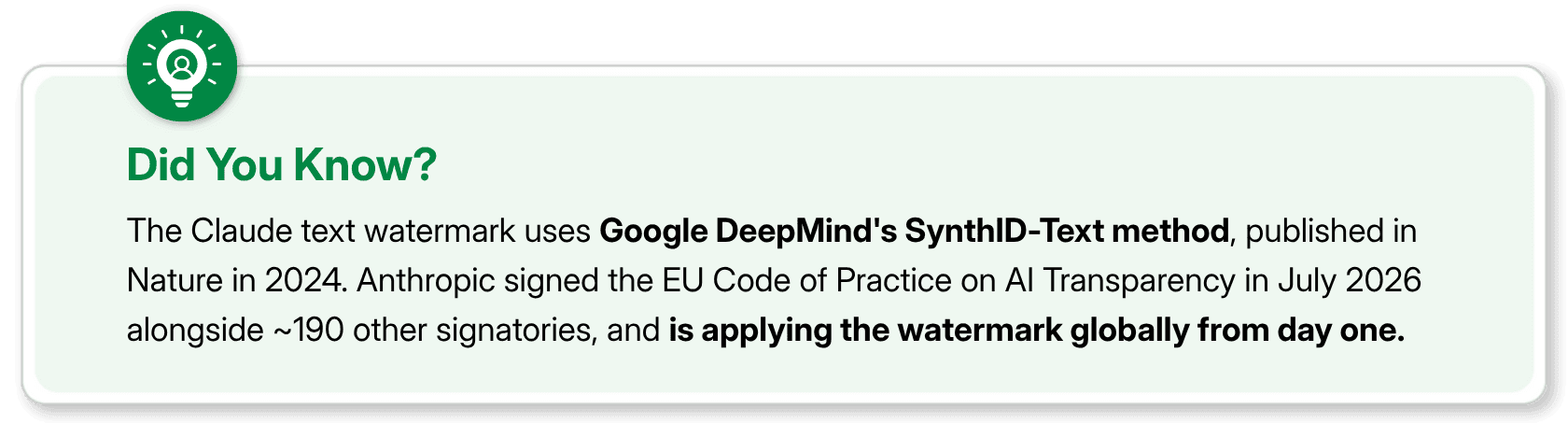
The Claude watermark does not change what Claude produces. Anthropic's internal testing found no impact on content quality, readability, or creativity. Google DeepMind's testing of the same SynthID-Text approach on Gemini traffic found no statistically significant difference in user ratings between watermarked and unwatermarked outputs. Human raters in controlled studies, shown both versions side by side, saw no difference.
So, the output quality question is settled. What the Claude new watermark changes is accountability and detectability of the content.
For marketing teams, the practical implications break into three sections:
Content attribution. If a client or employer asks whether a piece of content was AI-generated, the Claude text watermark now provides a verifiable answer, at least for content where the watermark is strong enough to detect. This is relevant for industries with disclosure requirements, agencies managing client expectations, and any team navigating internal policies around AI use.
Content workflows. Heavily edited Claude drafts may not trigger a watermark detection at all. According to Anthropic, the watermark only attaches to words Claude itself chose. When a human rewrites most of a Claude draft, replacing sentences, restructuring paragraphs, and changing word choices throughout, the detectable signal weakens or disappears entirely. A complete rewrite removes it. At that point, the content is arguably no longer AI-generated in any meaningful sense.
Translated content. Translations produced by Claude carry a watermark, because every word in a translation is chosen by Claude. Teams using Claude for translation workflows should factor this in if disclosure matters in their context.

What the Claude Watermark Cannot Prove
This is where a lot of confusion is already circulating, and it is worth being precise.
A positive watermark detection does not prove:
That a specific person wrote or submitted the prompt
That the content is entirely AI-generated (it could be a lightly edited human draft that Claude touched)
That a different AI was not also involved at some stage
That the watermark was not applied to content Claude reviewed rather than wrote
Anthropic's own documentation puts it directly: a watermark can only help test whether Claude might have produced or processed the content. It says nothing about ownership or legal authorship of the content, and it does not change user rights under Anthropic's terms of service.
For marketers worried about detection tools being used against them, the picture is more nuanced than early coverage suggested. Light editing probably won't remove the Claude watermark completely. Substantial rewriting will weaken it. A complete replacement of the text removes it entirely, but at that point the original AI output is barely present.
How This Differs From AI Detection Software
Existing AI detection tools like Pangram and GPTZero work on a completely different principle. They do not have Anthropic's key. Instead, they analyze stylistic patterns in the text itself: sentence structure tendencies, vocabulary choices, and phrasing patterns that AI models use more frequently than humans do.
The Claude watermark bypasses those stylistic heuristics entirely. It is not looking at how the text looks or feels. It is checking whether the sequence of word selections matches the pattern a key-holder would expect from Claude’s content. This is fundamentally a more reliable method, but it requires access to the key and the detection API, neither of which are currently available for public.
The distinction matters for marketers because the two approaches have very different error rates and very different use cases. Detection software can produce false positives on human-written content. The Claude watermark detection API, when it launches, will produce a probability score based on verifiable cryptographic logic rather than subjective pattern matching.
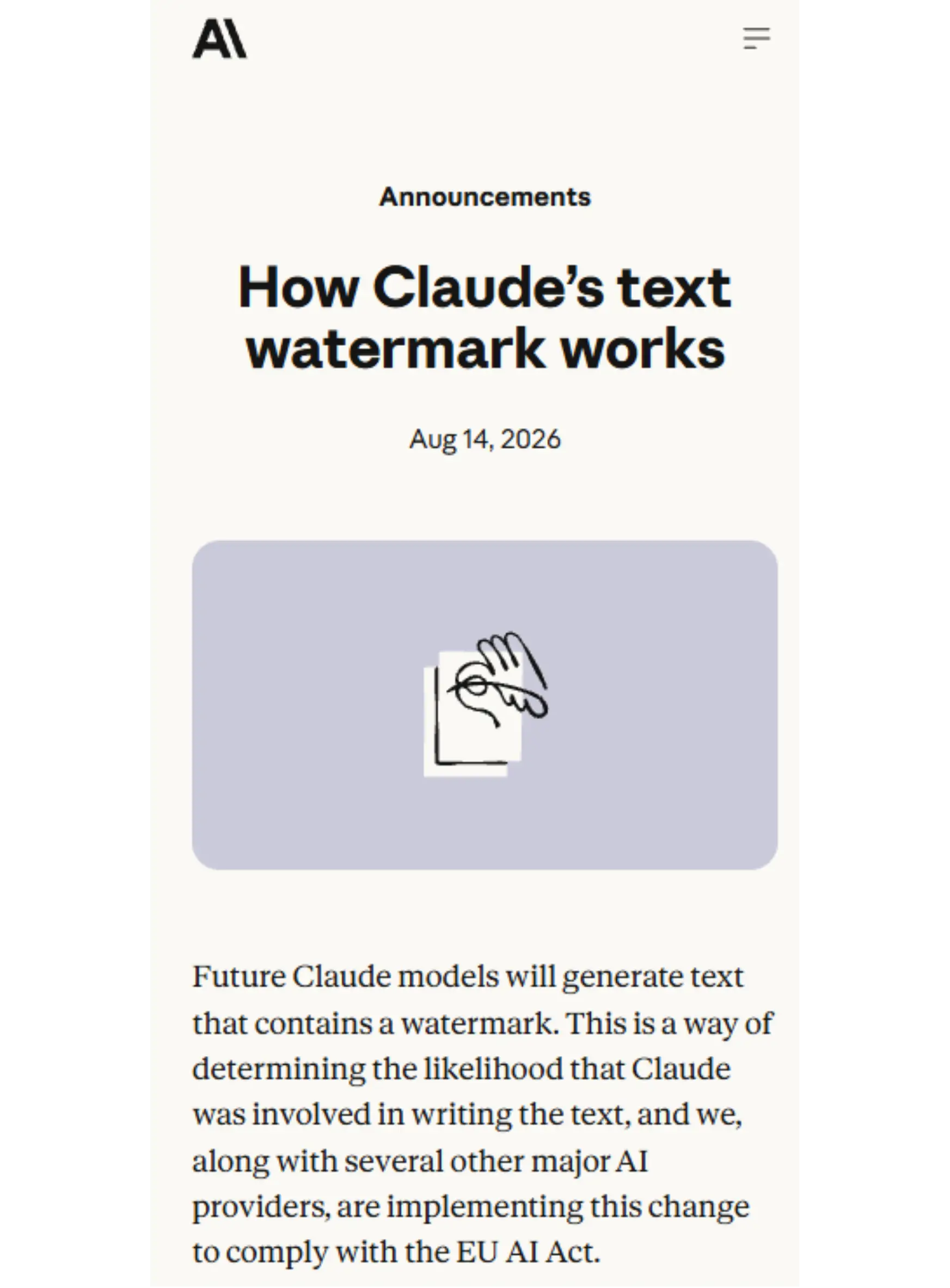
Source: https://www.anthropic.com/news/claude-text-watermark
What Marketers Should Actually Do
The most productive response to the Claude new watermark is not panic and not indifference. It is clarity about your own content processes.
Audit your disclosure posture. If your organization, clients, or industry has expectations about AI disclosure, the existence of a detection API changes the stakes for non-disclosure. Determine what your existing policy is before someone else asks the question.
Understand the limits of detection. Watermark detection will be probabilistic, not absolute or exact. It will struggle with short content, heavily edited drafts, and factual or technical passages. A positive detection is evidence of Claude's involvement, not proof of full AI authority.
Edit with intent, not just thoroughness. Teams that use Claude as a drafting tool and then substantially rewrite outputs are already, functionally, in a strong position. The watermark weakens proportionally with how much a human has genuinely reshaped the AI-suggested content.
Watch for the detection API. Anthropic has stated a detection API is coming. When it launches, it will be relevant for anyone running content operations at scale, whether for internal auditing, client transparency, or competitive research purposes.
Older models are being updated. Claude models released before August 2, 2026 have a transition period under EU law, but Anthropic is working to add watermarking to those models as well and will roll it out over the coming months.

Final Thoughts
Claude's invisible watermarks are not a threat to legitimate content marketing environment. They are a transparency mechanism built to comply with the EU AI Act, applied globally because region-scoping is not yet technically feasible. The output quality is unchanged. The ownership implications are unchanged. What changes is detectability.
For marketers, the most important shift is not technical. It is cultural. The question "was this AI-generated?" now has a better answer than it did before, at least for Claude-generated content of sufficient length. Teams that have been operating with clear internal processes and honest client communication around AI use will feel almost no impact. Teams that have been obscuring AI involvement may want to reconsider before the detection API ships.
The watermark does not know your name. It does not know your organization. It says one thing: Claude was likely here. What you do with that information, and how you build your content strategy around a world where that question has a verifiable answer, is entirely up to you.
FAQs
How does Claude's invisible watermark work?

The Claude text watermark works by changing the source of randomness that Claude uses when choosing between equally valid word options. Instead of an arbitrary random number generator, the watermark uses a cryptographic key combined with the preceding words to settle low-stakes word choices. The resulting pattern of selections is undetectable to readers but verifiable by anyone with the key.
Does the Claude watermark affect content quality?
No. Anthropic's internal testing and Google DeepMind's testing of the same method on Gemini traffic both found no measurable impact on quality, creativity, or readability. Watermarked and unwatermarked outputs are indistinguishable to humans.
Can the Claude text watermark identify who wrote the content?
The watermark carries no identifying information. It cannot be traced to a specific user, organization, or chat. It only indicates the likelihood that Claude’s involvement in generating or processing the content.
What happens if I edit Claude's output extensively?
The watermark weakens proportionally with how much the text is rewritten. Light editing likely preserves a detectable sign. Substantial rewriting reduces it significantly. A complete replacement of words and structure removes it, but at that point the output is no longer meaningfully AI-generated.
Does the Claude new watermark apply to code?
Partially. Code requires precise syntax where wrong choices would break functionality, leaving fewer low-stakes decision points for the watermark. Comments within code can carry the watermark, but the code itself will have minimal watermarking and weaker detection making it reliability weaker.
You publish a blog post. A client submits a proposal. A copywriter delivers a landing page. On the surface, everything looks the same as it did last week. But starting now, if Claude wrote it, that text carries something new: a hidden signal embedded in the word choices themselves, invisible to readers, but detectable by anyone with the right key. That is what Claude's invisible watermarks are, and marketers who understand how they work will be far better prepared for what comes next.
Anthropic announced on August 14, 2026, that future Claude models will generate text containing a watermark. This isn't a visible stamp or a disclaimer appended to the bottom of a document. Claude's invisible watermarks leave no trace a human reader would notice. The text reads exactly as it would without the watermark. But the pattern is there, detectable by anyone using Anthropic's forthcoming detection API.
This change is significant, and it comes with real implications for content teams, SEO strategies, and the broader question of AI transparency in the modern marketing.
How the Claude Text Watermark Actually Works
Understanding the technical mechanics matters here, because a lot of concern floating around this topic is based on misconceptions about what the Claude text watermark can and cannot do.
Large language models generate text one word at a time. At each step, the model weighs a list of candidate words and selects the most sensible option based on what came before. In many cases, two or three words would work equally well. Take a sentence ending with "the weather today was cold and..." Both "overcast" and "grey" are reasonable choices. The meaning barely varies.
Without watermarking, an arbitrary random number generator settles those low-stakes choices. With the Claude text watermark, the source of randomness changes. The selection now draws from a cryptographic key along with the preceding words. The choices still feel random to any reader, but someone holding the key can later examine a passage and determine whether the pattern of word selections is consistent with what Claude would have chosen.
The result is a probability score, not a binary 0 or 1. The detection API, which Anthropic is still developing, will answer the question: what is the likelihood that Claude was involved in producing this text?
Three things the Claude watermark cannot do:
It cannot identify the user who generated the content
It cannot determine whether text was written by a human or a different AI
It cannot confirm authorship or change ownership of the output
Anthropic is explicit on all three points. A watermark can only say that Claude was likely involved. It says nothing about who prompted Claude, what organization they belong to, or what their intentions were.
What This Means for Content Marketers Right Now
The Claude watermark does not change what Claude produces. Anthropic's internal testing found no impact on content quality, readability, or creativity. Google DeepMind's testing of the same SynthID-Text approach on Gemini traffic found no statistically significant difference in user ratings between watermarked and unwatermarked outputs. Human raters in controlled studies, shown both versions side by side, saw no difference.
So, the output quality question is settled. What the Claude new watermark changes is accountability and detectability of the content.
For marketing teams, the practical implications break into three sections:
Content attribution. If a client or employer asks whether a piece of content was AI-generated, the Claude text watermark now provides a verifiable answer, at least for content where the watermark is strong enough to detect. This is relevant for industries with disclosure requirements, agencies managing client expectations, and any team navigating internal policies around AI use.
Content workflows. Heavily edited Claude drafts may not trigger a watermark detection at all. According to Anthropic, the watermark only attaches to words Claude itself chose. When a human rewrites most of a Claude draft, replacing sentences, restructuring paragraphs, and changing word choices throughout, the detectable signal weakens or disappears entirely. A complete rewrite removes it. At that point, the content is arguably no longer AI-generated in any meaningful sense.
Translated content. Translations produced by Claude carry a watermark, because every word in a translation is chosen by Claude. Teams using Claude for translation workflows should factor this in if disclosure matters in their context.
What the Claude Watermark Cannot Prove
This is where a lot of confusion is already circulating, and it is worth being precise.
A positive watermark detection does not prove:
That a specific person wrote or submitted the prompt
That the content is entirely AI-generated (it could be a lightly edited human draft that Claude touched)
That a different AI was not also involved at some stage
That the watermark was not applied to content Claude reviewed rather than wrote
Anthropic's own documentation puts it directly: a watermark can only help test whether Claude might have produced or processed the content. It says nothing about ownership or legal authorship of the content, and it does not change user rights under Anthropic's terms of service.
For marketers worried about detection tools being used against them, the picture is more nuanced than early coverage suggested. Light editing probably won't remove the Claude watermark completely. Substantial rewriting will weaken it. A complete replacement of the text removes it entirely, but at that point the original AI output is barely present.
How This Differs From AI Detection Software
Existing AI detection tools like Pangram and GPTZero work on a completely different principle. They do not have Anthropic's key. Instead, they analyze stylistic patterns in the text itself: sentence structure tendencies, vocabulary choices, and phrasing patterns that AI models use more frequently than humans do.
The Claude watermark bypasses those stylistic heuristics entirely. It is not looking at how the text looks or feels. It is checking whether the sequence of word selections matches the pattern a key-holder would expect from Claude’s content. This is fundamentally a more reliable method, but it requires access to the key and the detection API, neither of which are currently available for public.
The distinction matters for marketers because the two approaches have very different error rates and very different use cases. Detection software can produce false positives on human-written content. The Claude watermark detection API, when it launches, will produce a probability score based on verifiable cryptographic logic rather than subjective pattern matching.
Source: https://www.anthropic.com/news/claude-text-watermark
What Marketers Should Actually Do
The most productive response to the Claude new watermark is not panic and not indifference. It is clarity about your own content processes.
Audit your disclosure posture. If your organization, clients, or industry has expectations about AI disclosure, the existence of a detection API changes the stakes for non-disclosure. Determine what your existing policy is before someone else asks the question.
Understand the limits of detection. Watermark detection will be probabilistic, not absolute or exact. It will struggle with short content, heavily edited drafts, and factual or technical passages. A positive detection is evidence of Claude's involvement, not proof of full AI authority.
Edit with intent, not just thoroughness. Teams that use Claude as a drafting tool and then substantially rewrite outputs are already, functionally, in a strong position. The watermark weakens proportionally with how much a human has genuinely reshaped the AI-suggested content.
Watch for the detection API. Anthropic has stated a detection API is coming. When it launches, it will be relevant for anyone running content operations at scale, whether for internal auditing, client transparency, or competitive research purposes.
Older models are being updated. Claude models released before August 2, 2026 have a transition period under EU law, but Anthropic is working to add watermarking to those models as well and will roll it out over the coming months.
Final Thoughts
Claude's invisible watermarks are not a threat to legitimate content marketing environment. They are a transparency mechanism built to comply with the EU AI Act, applied globally because region-scoping is not yet technically feasible. The output quality is unchanged. The ownership implications are unchanged. What changes is detectability.
For marketers, the most important shift is not technical. It is cultural. The question "was this AI-generated?" now has a better answer than it did before, at least for Claude-generated content of sufficient length. Teams that have been operating with clear internal processes and honest client communication around AI use will feel almost no impact. Teams that have been obscuring AI involvement may want to reconsider before the detection API ships.
The watermark does not know your name. It does not know your organization. It says one thing: Claude was likely here. What you do with that information, and how you build your content strategy around a world where that question has a verifiable answer, is entirely up to you.
FAQs
How does Claude's invisible watermark work?
The Claude text watermark works by changing the source of randomness that Claude uses when choosing between equally valid word options. Instead of an arbitrary random number generator, the watermark uses a cryptographic key combined with the preceding words to settle low-stakes word choices. The resulting pattern of selections is undetectable to readers but verifiable by anyone with the key.
Does the Claude watermark affect content quality?
No. Anthropic's internal testing and Google DeepMind's testing of the same method on Gemini traffic both found no measurable impact on quality, creativity, or readability. Watermarked and unwatermarked outputs are indistinguishable to humans.
Can the Claude text watermark identify who wrote the content?
The watermark carries no identifying information. It cannot be traced to a specific user, organization, or chat. It only indicates the likelihood that Claude’s involvement in generating or processing the content.
What happens if I edit Claude's output extensively?
The watermark weakens proportionally with how much the text is rewritten. Light editing likely preserves a detectable sign. Substantial rewriting reduces it significantly. A complete replacement of words and structure removes it, but at that point the output is no longer meaningfully AI-generated.
Does the Claude new watermark apply to code?
Partially. Code requires precise syntax where wrong choices would break functionality, leaving fewer low-stakes decision points for the watermark. Comments within code can carry the watermark, but the code itself will have minimal watermarking and weaker detection making it reliability weaker.



Summarize with AI



Want to be seen everywhere?
Get a free AI-search audit Today!



4.9/5 Ratings!


Don’t miss our revenue growth tips!
Get expert marketing tips—straight to your inbox, like thousands of happy clients.
Don’t miss our revenue growth tips!
Get expert marketing tips—straight to your inbox, like thousands of happy clients.
Don’t miss our revenue growth tips!
Don’t miss our revenue growth tips!
Get expert marketing tips—straight to your inbox, like thousands of happy clients.
Relevant Blogs on Generative AI SEO
Relevant Blogs on Generative AI SEO
Unlock data-driven insights in AI-powered SEO—explore our featured blogs and skyrocket your revenue before your competitors do.
Unlock data-driven insights in AI-powered SEO—explore our featured blogs and skyrocket your revenue before your competitors do.
GEO
Sep 22, 2026
15 Min Read
AI Search Runs on More SEO Than You Think
GEO
Sep 22, 2026
15 Min Read
AI Search Runs on More SEO Than You Think
GEO
Sep 22, 2026
15 Min Read
AI Search Runs on More SEO Than You Think

GEO
Sep 7, 2026
8 Min Read
How to Optimize Content for AI Search Engines: Best Practices
GEO
Sep 7, 2026
8 Min Read
How to Optimize Content for AI Search Engines: Best Practices
GEO
Sep 7, 2026
8 Min Read
How to Optimize Content for AI Search Engines: Best Practices

GEO
Sep 4, 2026
12 Min Read
How Ecommerce Brands Can Advertise in Google AI Mode?
GEO
Sep 4, 2026
12 Min Read
How Ecommerce Brands Can Advertise in Google AI Mode?
GEO
Sep 4, 2026
12 Min Read
How Ecommerce Brands Can Advertise in Google AI Mode?































Ready to speak with an expert?
Data-Driven Marketing Agency That Elevates ROI
1100+
Websites Designed & Optimized to Convert
$280M+
Client Revenue Driven & Growing Strong
Discover how to skyrocket
your revenue today!
Trusted by 1000+ Owners!
Ready to speak with an expert?
Data-Driven Marketing Agency That Elevates ROI
1100+
Websites Designed & Optimized to Convert
$280M+
Client Revenue Driven & Growing Strong
Discover how to skyrocket
your revenue today!
Trusted by 1000+ Owners!
Want to skyrocket revenue?
4.9/5 Ratings!
Ready to speak with an expert?
Data-Driven Marketing Agency That Elevates ROI
1100+
Websites Designed & Optimized to Convert
$280M+
Client Revenue Driven & Growing Strong
Discover how to skyrocket
your revenue today!
Trusted by 1000+ Owners!
Call
Meet