Google Ends FAQ Rich Results: Is It Time to Remove FAQ Schema?
Google Ends FAQ Rich Results: Is It Time to Remove FAQ Schema?
Last Updated:
Table of Content
Case Studies








Tanya Singh
Tanya Singh
Tanya Singh
SEO
SEO
SEO
8 Min Read
10 Min
8 Min Read
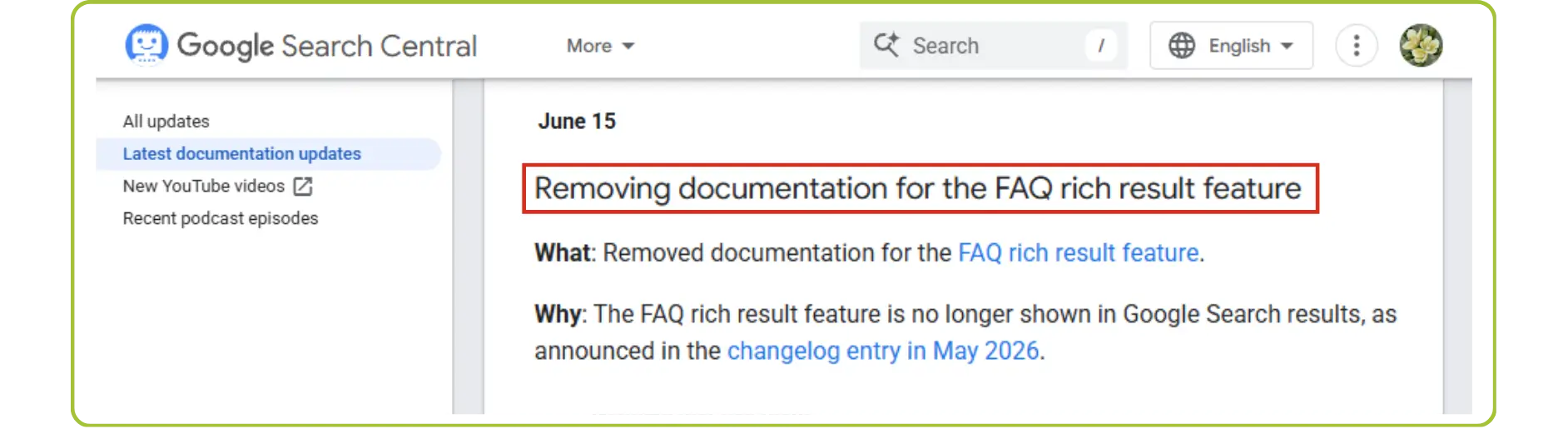
Google has officially ended support for FAQ-rich results, completing a phased rollout that began back in 2023. FAQ schema is the code, FAQ rich results, often called FAQ rich snippets, were the visual dropdown that code used to trigger, and only the dropdown is gone. The timing lines up with where Google's attention actually is right now, generative search and AI generated answers, not decorative snippet features on a classic blue link listing. If you are wondering whether to strip the markup from your site, the short answer is no, not yet. Here is what actually changed:
Google removed FAQ rich results from the search results page starting May 7, 2026.
FAQ schema markup can stay on your pages, and Google confirms it will keep using it to understand your content.
FAQ reporting in Search Console and support in the Rich Results Test are being phased out through June 2026.
FAQ rich result support in the Search Console API ends in August 2026.
FAQ schema still plays a role in how AI search engines evaluate and cite your content, even without the old visual snippet.
What Is FAQ Schema?
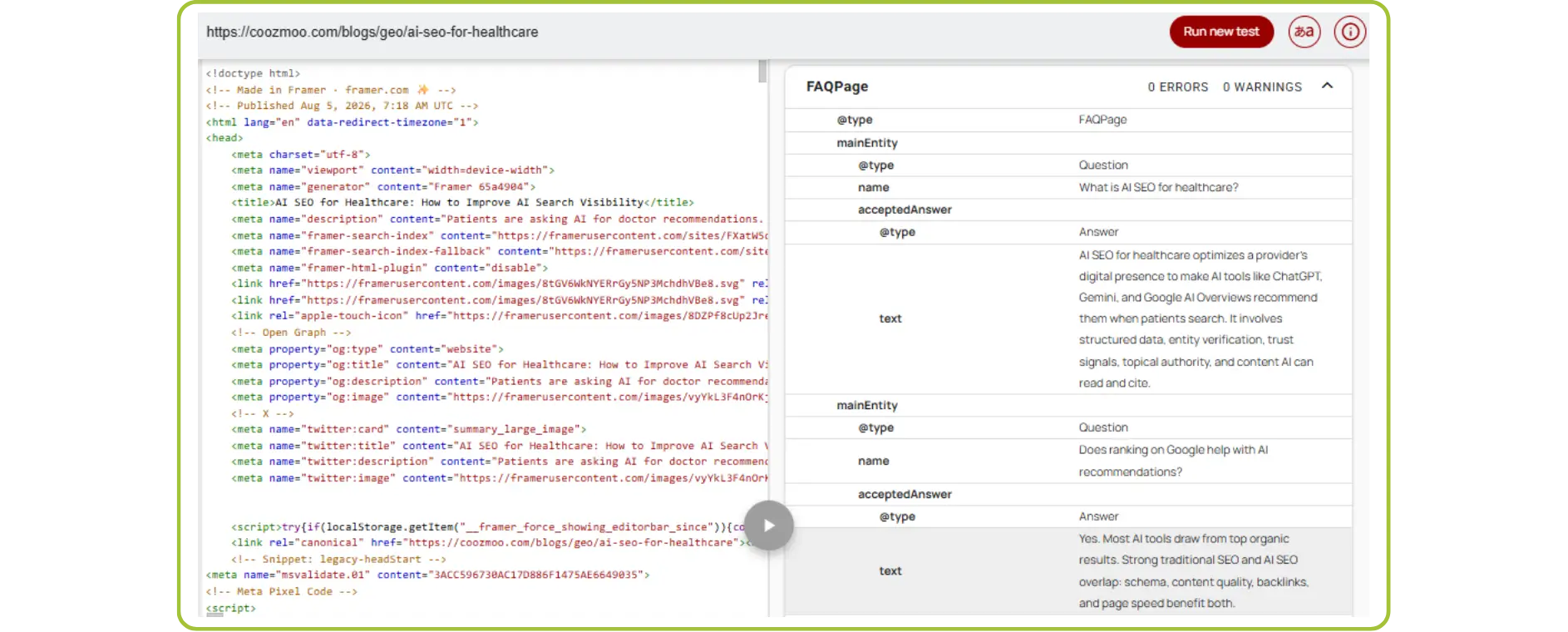
It is a piece of structured data, written in JSON-LD format, that tells search engines a section of your page contains questions and their answers. Think of it as a label you attach to content that already exists on your page. It does not create new content. It simply describes what is already there in a format machines can read cleanly.
For years, adding this markup meant your listing could show a small expandable dropdown of two or three questions right under your blue link in Google Search. That visual feature is what most people actually mean when they say FAQ rich snippets. The schema and the snippet were always two different things, and that distinction is exactly why this update confuses so many site owners.
In practice, most content management systems and page builders let you add this markup without touching a line of code, and plenty of SEO plugins generate it automatically from an existing question and answer block on the page. That ease of use is part of why FAQ schema became one of the most widely adopted structured data types on the web in the first place.
What Happened to Google Rich Results for FAQ Pages?
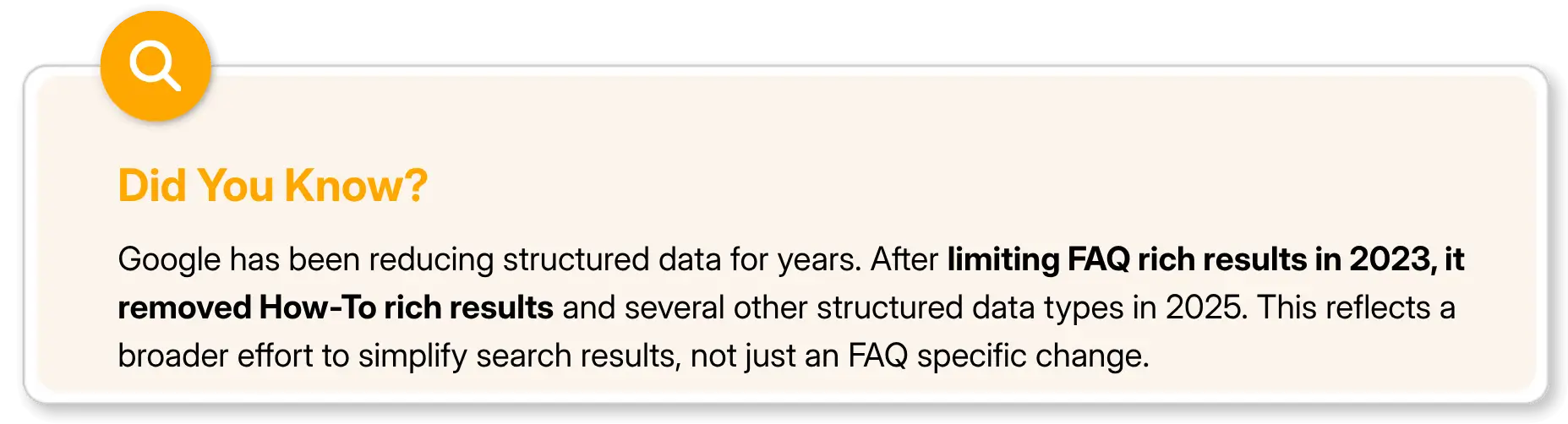
Google confirmed that FAQ dropdowns stopped appearing in Google rich results as of May 7, 2026. This was not a sudden decision. It was the final step of a rollback that started in August 2023, when Google first limited FAQ rich results to a narrow set of well known government and health sites. For nearly three years, most commercial websites, blogs, agencies, and ecommerce stores had already lost the visual feature without much fanfare.
Google's documentation update also laid out a clear phase out schedule.
Milestone | What Changes |
|---|---|
Aug 2023 | FAQ rich results limited to authoritative government and health sites |
May 7, 2026 | FAQ rich results stop appearing for all sites in Google Search |
Jun 2026 | FAQ search appearance filter, rich result report, and Rich Results Test support removed |
Aug 2026 | FAQ rich result support removed from the Search Console API |
Google was direct about one thing in its notice. You can leave FAQ schema markup on your pages if you want, and other search engines may still use it for their own purposes. That single line matters more than the headline itself.
Why Did Google Remove FAQ Rich Results From Search?
Google has not given a single official reason, but the pattern points to search result quality and consistency. Rich snippets were originally meant to help users scan answers quickly, but FAQ dropdowns often pushed organic listings further down the page and, in some cases, were used by sites to game visibility rather than genuinely help searchers. Reducing the number of automated snippet types also gives Google more room to test its own AI generated answers, like AI Overviews, directly in the results page instead of relying on third party markup to fill that space.
There is also a simpler explanation. Google increasingly answers questions itself, inside AI Overviews and AI Mode, rather than sending users to click into a dropdown on someone else's listing. More people now ask a full question in the search box, or ask a chatbot directly, instead of scanning a results page for a dropdown to expand. When the search engine becomes the answer, the incentive to display a competing answer format from a website shrinks.
Should You Remove FAQ Schema Markup From Your Site?
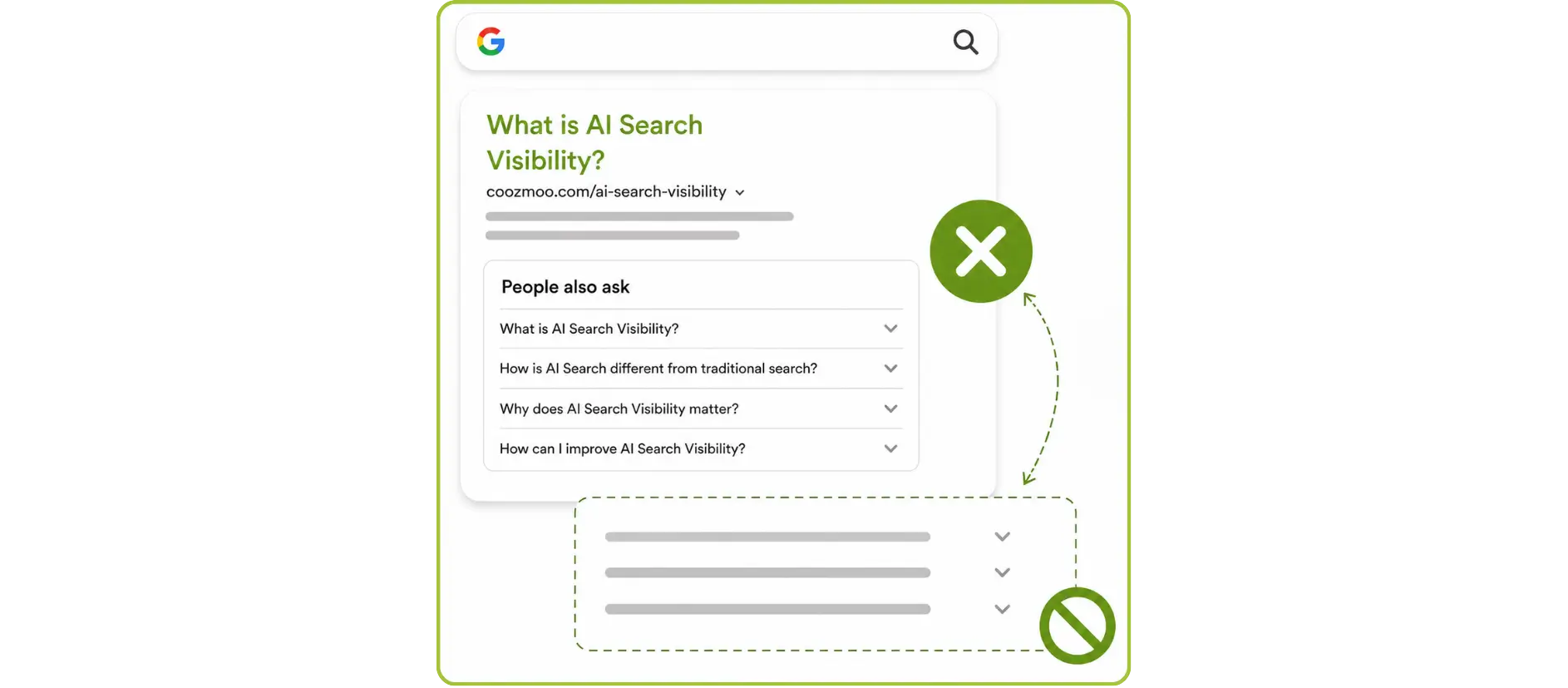
No, you should not remove it, and here is what to do instead of deleting your existing markup. Ripping out structured data because one display feature disappeared is a reaction, not a strategy. The markup still describes your content accurately, and description still has value even without a visual reward attached to it.
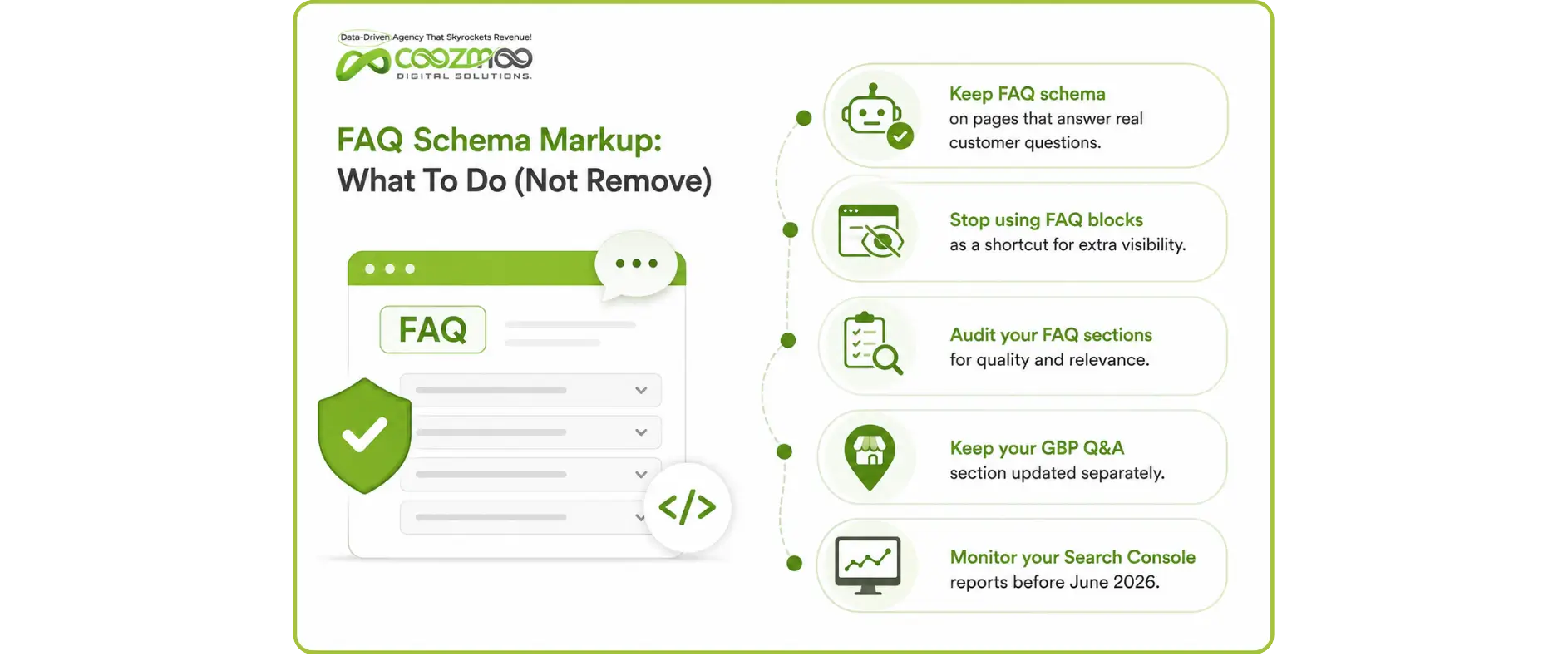
Keep FAQ schema on pages where the content genuinely answers real customer questions, since it still helps machines parse your page correctly.
Stop treating FAQ blocks as a shortcut for extra visibility in the Google search results page. That specific benefit is gone.
Audit your FAQ sections for quality. If questions were added purely to trigger the old snippet, rewrite them around what customers actually ask.
Keep your Google Business Profile Q&A section updated separately, since that is a different feature and is not affected by this change.
Monitor your Search Console reports before June 2026, since FAQ specific data will disappear from the dashboard after that.
If your FAQ content was written to genuinely help readers, nothing about its usefulness has changed. Only the reward of a bigger looking search listing is gone.
How Does Schema Markup Help AI Search Right Now?
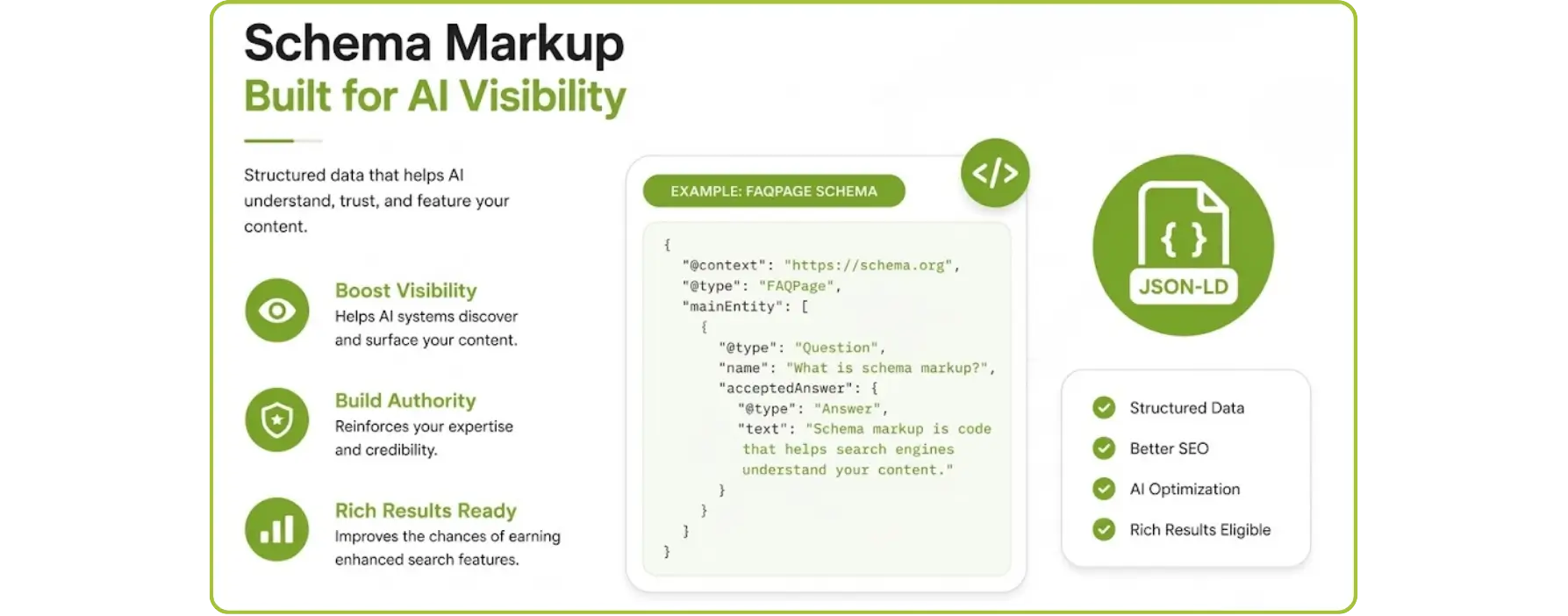
Schema markup for AI search works differently than it did for classic Google rich results, and this is the part most site owners are missing. AI systems like ChatGPT, Perplexity, and Google's own AI Overviews do not display your schema as a visual snippet. Instead, they use it as a trust signal while deciding which sources to cite or summarize.
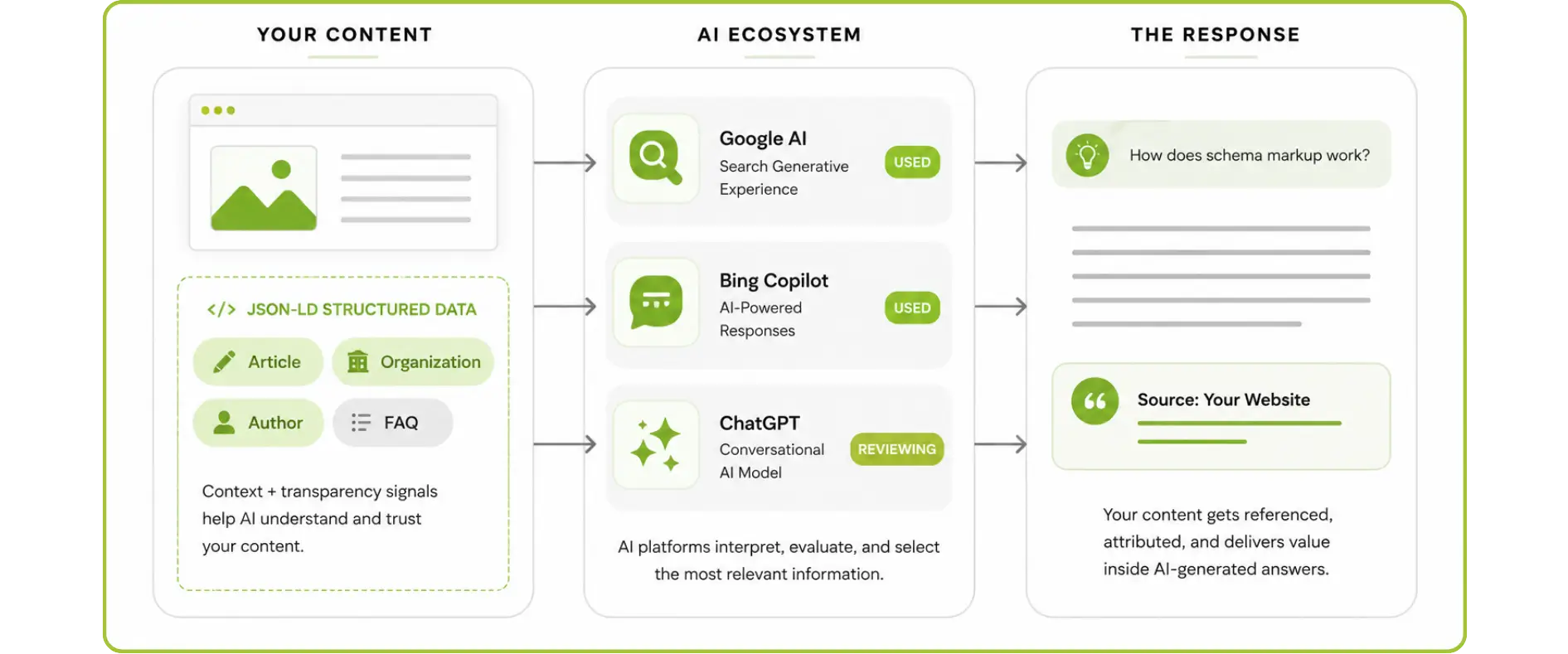
Structured data gives an AI model a clean, unambiguous version of your content instead of forcing it to guess meaning from paragraphs of prose. A properly labeled FAQPage, Organization, or Article schema tells the model exactly who you are, what you offer, and which parts of your page answer a specific question directly. This matters because AI answer engines pull from many sources at once and tend to favor pages that reduce their own uncertainty.
FAQ Schema Markup and Answer Engine Optimization
FAQ schema markup specifically still has a role inside answer engine optimization, often shortened to AEO. Because FAQ content is already structured as a direct question paired with a direct answer, it is easy for an AI model to lift and reuse without needing to reformulate your sentences. That format is exactly what these systems are built to extract. The schema layer simply confirms to the crawler that the pairing is intentional rather than accidental.
The practical takeaway is to stop measuring FAQ schema by whether it produces a dropdown in Google search and start measuring it by whether your questions and answers are genuinely clear enough for a machine, or a human, to lift and reuse accurately.
What These Changes Mean for Your SEO Strategy?
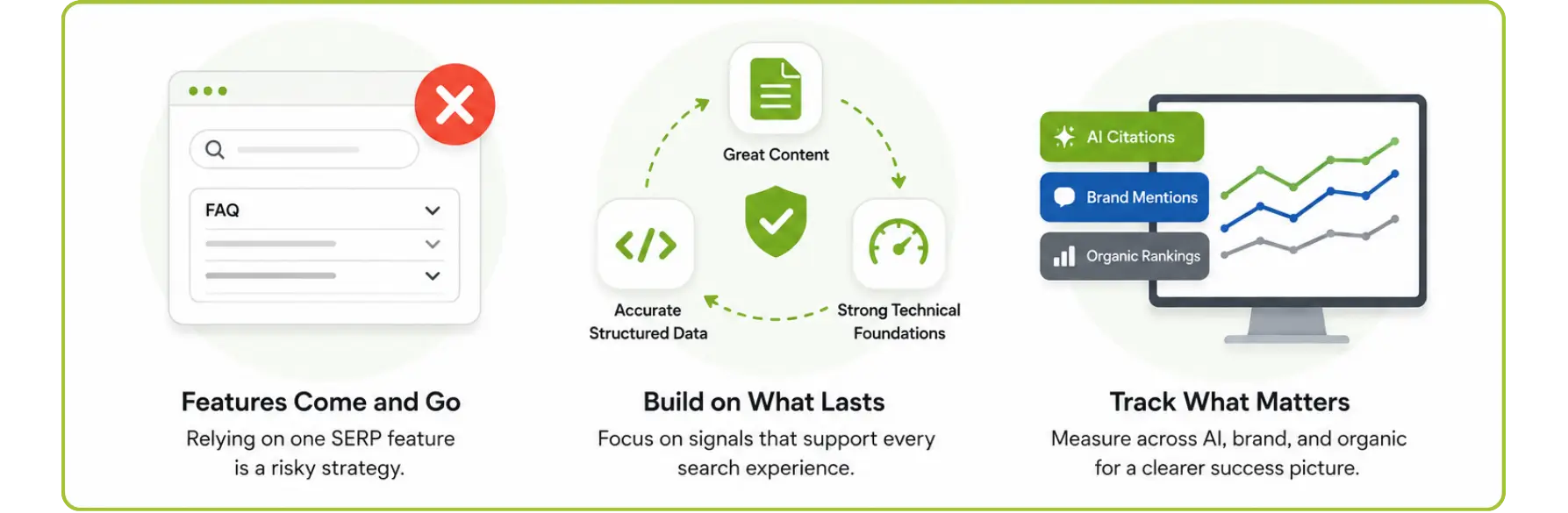
The end of FAQ rich results is a small event carrying a bigger lesson. Any SEO strategy built around one display feature is fragile by design, because Google can retire that feature with a single documentation update, exactly as it did here, with How-To results in 2023, and with seven other structured data types in 2025.
The more durable position is to build around signals that do not depend on one SERP feature staying alive. That means investing in content that genuinely satisfies the person asking the question, structured data that accurately mirrors what is already on the page, and technical foundations, like fast load times and clean crawlability, that support every search format instead of just one.
It also means widening what you track. A dropdown showing up in Google Search is easy to measure and just as easy to lose overnight. Citation frequency in AI answers, brand mentions across AI platforms, and traditional organic rankings together give a far more resilient picture of whether your SEO strategy is actually working, no matter which feature Google decides to retire next.
How Coozmoo Helps You Adapt When Google Changes the Rules
Search updates like this one are exactly why relying on a single tactic, like chasing one rich result feature, is risky for any business. At Coozmoo, we build search strategies around durable signals, technical SEO, genuinely useful content, structured data, and topical authority, rather than features that Google can retire overnight. Our team audits your existing schema, keeps what still earns value, and restructures content so it performs across traditional search and AI answer engines at the same time.
If your FAQ pages were built purely to trigger the old snippet, that is often a sign your broader content strategy needs a second look. Our digital marketing services cover technical SEO audits, content built around real search intent, and structured data implementation that is designed to hold up as Google keeps changing what it rewards. You get a website that works for search engines today and stays adaptable as the rules shift again, because they will.
This is also exactly where our generative search service comes in. Our proprietary GenAiWorks strategy is built specifically for this shift, combining entity and schema building, E-E-A-T optimization, and citation tracking so your brand is positioned to be cited by AI platforms, not just ranked by Google. If FAQ schema is one small piece of your structured data setup, GenAiWorks is the framework that makes sure the rest of your site is speaking the same language to AI systems.

RankRabbit AI: One Platform to Manage Every Search Signal
Losing a search feature overnight is a preview of a bigger shift already underway. People are asking ChatGPT, Perplexity, and Google AI Mode for recommendations before they ever open a traditional results page. RankRabbit is built for exactly this moment. It helps businesses get discovered, build trust, and manage their presence across AI powered platforms, so you are not caught off guard the next time a search feature disappears.
Instead of guessing whether your schema, your listings, or your content are helping you get cited by AI tools, RankRabbit gives you visibility into how your business actually shows up across AI driven search and multi location presence, so you can fix gaps before they cost you customers.
Final Thoughts
FAQ rich snippets had a good run, but the snippet was never the point, the answer was. Keep writing content that genuinely answers what people ask, keep your schema accurate, and stop chasing search features that a single documentation update can retire overnight.
Google has already shown it will keep trimming visual add ons from the results page while quietly keeping the structured data underneath. AI search platforms are behaving the same way, rewarding clarity over decoration. The sites that treat FAQ schema and structured data as a comprehension layer, not a display trick, are the ones still standing every time the rules change again. Your FAQ section was never really about the dropdown.
It was about being the source that had the answer before anyone else did, and that part of the game just got harder to fake. Answers outlast algorithms.
FAQs
Does the FAQ schema still work?

Yes. While most websites no longer display FAQ rich results in Google, FAQ schema continues to help search engines and AI platforms better understand your content. While it’s still helpful for structured data and helping understand content to improve visibility in AI-driven search experiences.
Can you build and maintain the website reputation with schema markup?
Yes, schema markup allows you to increase website reputation by letting search engines better understand what your business is about. Having proper content coupled with well-structured schema markup will allow you to maximize your reputation by being better discovered and more understandable in the eyes of search engines, and other AIs, such as Google's AI.
Is schema markup important for SEO?
Yes, because it adds extra context to web pages making them more understandable to search engines, and AIs like Google's new AI. It's an important part of your long-term SEO strategy, along with technical SEO, quality content creation and topical authority development.
What is a schema markup, and why is it important for search engines?
Schema markup is a type of structured data that makes it easier for search engines to understand what your content is about. It adds context to HTML that otherwise wouldn't be there, and as such, it's important for SEO, and for better content discovery in the future when AI starts to power a significant amount of searches.
Does schema markup help SEO even after Google removed FAQ rich results?
Yes, because it still helps the search engines to better understand your content, which makes your content more easily indexed and higher in the search results, even though Google has stopped showing the rich results for nearly all websites, as a way to reduce noise. It also helps the Google's new AI, to better comprehend your site's content, which will allow it to appear in more AI-driven searches.
Google has officially ended support for FAQ-rich results, completing a phased rollout that began back in 2023. FAQ schema is the code, FAQ rich results, often called FAQ rich snippets, were the visual dropdown that code used to trigger, and only the dropdown is gone. The timing lines up with where Google's attention actually is right now, generative search and AI generated answers, not decorative snippet features on a classic blue link listing. If you are wondering whether to strip the markup from your site, the short answer is no, not yet. Here is what actually changed:
Google removed FAQ rich results from the search results page starting May 7, 2026.
FAQ schema markup can stay on your pages, and Google confirms it will keep using it to understand your content.
FAQ reporting in Search Console and support in the Rich Results Test are being phased out through June 2026.
FAQ rich result support in the Search Console API ends in August 2026.
FAQ schema still plays a role in how AI search engines evaluate and cite your content, even without the old visual snippet.
What Is FAQ Schema?
It is a piece of structured data, written in JSON-LD format, that tells search engines a section of your page contains questions and their answers. Think of it as a label you attach to content that already exists on your page. It does not create new content. It simply describes what is already there in a format machines can read cleanly.
For years, adding this markup meant your listing could show a small expandable dropdown of two or three questions right under your blue link in Google Search. That visual feature is what most people actually mean when they say FAQ rich snippets. The schema and the snippet were always two different things, and that distinction is exactly why this update confuses so many site owners.
In practice, most content management systems and page builders let you add this markup without touching a line of code, and plenty of SEO plugins generate it automatically from an existing question and answer block on the page. That ease of use is part of why FAQ schema became one of the most widely adopted structured data types on the web in the first place.
What Happened to Google Rich Results for FAQ Pages?
Google confirmed that FAQ dropdowns stopped appearing in Google rich results as of May 7, 2026. This was not a sudden decision. It was the final step of a rollback that started in August 2023, when Google first limited FAQ rich results to a narrow set of well known government and health sites. For nearly three years, most commercial websites, blogs, agencies, and ecommerce stores had already lost the visual feature without much fanfare.
Google's documentation update also laid out a clear phase out schedule.
Milestone | What Changes |
|---|---|
Aug 2023 | FAQ rich results limited to authoritative government and health sites |
May 7, 2026 | FAQ rich results stop appearing for all sites in Google Search |
Jun 2026 | FAQ search appearance filter, rich result report, and Rich Results Test support removed |
Aug 2026 | FAQ rich result support removed from the Search Console API |
Google was direct about one thing in its notice. You can leave FAQ schema markup on your pages if you want, and other search engines may still use it for their own purposes. That single line matters more than the headline itself.
Why Did Google Remove FAQ Rich Results From Search?
Google has not given a single official reason, but the pattern points to search result quality and consistency. Rich snippets were originally meant to help users scan answers quickly, but FAQ dropdowns often pushed organic listings further down the page and, in some cases, were used by sites to game visibility rather than genuinely help searchers. Reducing the number of automated snippet types also gives Google more room to test its own AI generated answers, like AI Overviews, directly in the results page instead of relying on third party markup to fill that space.
There is also a simpler explanation. Google increasingly answers questions itself, inside AI Overviews and AI Mode, rather than sending users to click into a dropdown on someone else's listing. More people now ask a full question in the search box, or ask a chatbot directly, instead of scanning a results page for a dropdown to expand. When the search engine becomes the answer, the incentive to display a competing answer format from a website shrinks.
Should You Remove FAQ Schema Markup From Your Site?
No, you should not remove it, and here is what to do instead of deleting your existing markup. Ripping out structured data because one display feature disappeared is a reaction, not a strategy. The markup still describes your content accurately, and description still has value even without a visual reward attached to it.
Keep FAQ schema on pages where the content genuinely answers real customer questions, since it still helps machines parse your page correctly.
Stop treating FAQ blocks as a shortcut for extra visibility in the Google search results page. That specific benefit is gone.
Audit your FAQ sections for quality. If questions were added purely to trigger the old snippet, rewrite them around what customers actually ask.
Keep your Google Business Profile Q&A section updated separately, since that is a different feature and is not affected by this change.
Monitor your Search Console reports before June 2026, since FAQ specific data will disappear from the dashboard after that.
If your FAQ content was written to genuinely help readers, nothing about its usefulness has changed. Only the reward of a bigger looking search listing is gone.
How Does Schema Markup Help AI Search Right Now?
Schema markup for AI search works differently than it did for classic Google rich results, and this is the part most site owners are missing. AI systems like ChatGPT, Perplexity, and Google's own AI Overviews do not display your schema as a visual snippet. Instead, they use it as a trust signal while deciding which sources to cite or summarize.
Structured data gives an AI model a clean, unambiguous version of your content instead of forcing it to guess meaning from paragraphs of prose. A properly labeled FAQPage, Organization, or Article schema tells the model exactly who you are, what you offer, and which parts of your page answer a specific question directly. This matters because AI answer engines pull from many sources at once and tend to favor pages that reduce their own uncertainty.
FAQ Schema Markup and Answer Engine Optimization
FAQ schema markup specifically still has a role inside answer engine optimization, often shortened to AEO. Because FAQ content is already structured as a direct question paired with a direct answer, it is easy for an AI model to lift and reuse without needing to reformulate your sentences. That format is exactly what these systems are built to extract. The schema layer simply confirms to the crawler that the pairing is intentional rather than accidental.
The practical takeaway is to stop measuring FAQ schema by whether it produces a dropdown in Google search and start measuring it by whether your questions and answers are genuinely clear enough for a machine, or a human, to lift and reuse accurately.
What These Changes Mean for Your SEO Strategy?
The end of FAQ rich results is a small event carrying a bigger lesson. Any SEO strategy built around one display feature is fragile by design, because Google can retire that feature with a single documentation update, exactly as it did here, with How-To results in 2023, and with seven other structured data types in 2025.
The more durable position is to build around signals that do not depend on one SERP feature staying alive. That means investing in content that genuinely satisfies the person asking the question, structured data that accurately mirrors what is already on the page, and technical foundations, like fast load times and clean crawlability, that support every search format instead of just one.
It also means widening what you track. A dropdown showing up in Google Search is easy to measure and just as easy to lose overnight. Citation frequency in AI answers, brand mentions across AI platforms, and traditional organic rankings together give a far more resilient picture of whether your SEO strategy is actually working, no matter which feature Google decides to retire next.
How Coozmoo Helps You Adapt When Google Changes the Rules
Search updates like this one are exactly why relying on a single tactic, like chasing one rich result feature, is risky for any business. At Coozmoo, we build search strategies around durable signals, technical SEO, genuinely useful content, structured data, and topical authority, rather than features that Google can retire overnight. Our team audits your existing schema, keeps what still earns value, and restructures content so it performs across traditional search and AI answer engines at the same time.
If your FAQ pages were built purely to trigger the old snippet, that is often a sign your broader content strategy needs a second look. Our digital marketing services cover technical SEO audits, content built around real search intent, and structured data implementation that is designed to hold up as Google keeps changing what it rewards. You get a website that works for search engines today and stays adaptable as the rules shift again, because they will.
This is also exactly where our generative search service comes in. Our proprietary GenAiWorks strategy is built specifically for this shift, combining entity and schema building, E-E-A-T optimization, and citation tracking so your brand is positioned to be cited by AI platforms, not just ranked by Google. If FAQ schema is one small piece of your structured data setup, GenAiWorks is the framework that makes sure the rest of your site is speaking the same language to AI systems.
RankRabbit AI: One Platform to Manage Every Search Signal
Losing a search feature overnight is a preview of a bigger shift already underway. People are asking ChatGPT, Perplexity, and Google AI Mode for recommendations before they ever open a traditional results page. RankRabbit is built for exactly this moment. It helps businesses get discovered, build trust, and manage their presence across AI powered platforms, so you are not caught off guard the next time a search feature disappears.
Instead of guessing whether your schema, your listings, or your content are helping you get cited by AI tools, RankRabbit gives you visibility into how your business actually shows up across AI driven search and multi location presence, so you can fix gaps before they cost you customers.
Final Thoughts
FAQ rich snippets had a good run, but the snippet was never the point, the answer was. Keep writing content that genuinely answers what people ask, keep your schema accurate, and stop chasing search features that a single documentation update can retire overnight.
Google has already shown it will keep trimming visual add ons from the results page while quietly keeping the structured data underneath. AI search platforms are behaving the same way, rewarding clarity over decoration. The sites that treat FAQ schema and structured data as a comprehension layer, not a display trick, are the ones still standing every time the rules change again. Your FAQ section was never really about the dropdown.
It was about being the source that had the answer before anyone else did, and that part of the game just got harder to fake. Answers outlast algorithms.
FAQs
Does the FAQ schema still work?
Yes. While most websites no longer display FAQ rich results in Google, FAQ schema continues to help search engines and AI platforms better understand your content. While it’s still helpful for structured data and helping understand content to improve visibility in AI-driven search experiences.
Can you build and maintain the website reputation with schema markup?
Yes, schema markup allows you to increase website reputation by letting search engines better understand what your business is about. Having proper content coupled with well-structured schema markup will allow you to maximize your reputation by being better discovered and more understandable in the eyes of search engines, and other AIs, such as Google's AI.
Is schema markup important for SEO?
Yes, because it adds extra context to web pages making them more understandable to search engines, and AIs like Google's new AI. It's an important part of your long-term SEO strategy, along with technical SEO, quality content creation and topical authority development.
What is a schema markup, and why is it important for search engines?
Schema markup is a type of structured data that makes it easier for search engines to understand what your content is about. It adds context to HTML that otherwise wouldn't be there, and as such, it's important for SEO, and for better content discovery in the future when AI starts to power a significant amount of searches.
Does schema markup help SEO even after Google removed FAQ rich results?
Yes, because it still helps the search engines to better understand your content, which makes your content more easily indexed and higher in the search results, even though Google has stopped showing the rich results for nearly all websites, as a way to reduce noise. It also helps the Google's new AI, to better comprehend your site's content, which will allow it to appear in more AI-driven searches.



Summarize with AI



Want to Skyrocket Revenue? Get a Free Audit Today!
Want to Skyrocket Revenue? Get a Free Audit Today!



4.9/5 Ratings!


Don’t miss our revenue growth tips!
Get expert marketing tips—straight to your inbox, like thousands of happy clients.
Don’t miss our revenue growth tips!
Get expert marketing tips—straight to your inbox, like thousands of happy clients.
Don’t miss our revenue growth tips!
Don’t miss our revenue growth tips!
Get expert marketing tips—straight to your inbox, like thousands of happy clients.
Relevant Blogs on Organic SEO
Relevant Blogs on Organic SEO
Unlock data-driven insights in Organic SEO—explore our featured blogs and skyrocket your revenue before your competitors do.
Unlock data-driven insights in Organic SEO—explore our featured blogs and skyrocket your revenue before your competitors do.

SEO
Sep 21, 2026
5 Min Read
Audience-First SEO: How to Rank by Putting Readers First
SEO
Sep 21, 2026
5 Min Read
Audience-First SEO: How to Rank by Putting Readers First
SEO
Sep 21, 2026
5 Min Read
Audience-First SEO: How to Rank by Putting Readers First

SEO
Sep 19, 2026
5 Min Read
How to Add SEO Keywords to Your Website: Where and How
SEO
Sep 19, 2026
5 Min Read
How to Add SEO Keywords to Your Website: Where and How
SEO
Sep 19, 2026
5 Min Read
How to Add SEO Keywords to Your Website: Where and How

SEO
Sep 18, 2026
5 Min Read
How XML Sitemaps Help Search Engines Discover New Pages
SEO
Sep 18, 2026
5 Min Read
How XML Sitemaps Help Search Engines Discover New Pages
SEO
Sep 18, 2026
5 Min Read
How XML Sitemaps Help Search Engines Discover New Pages


































Ready to speak with an expert?
Data-Driven Marketing Agency That Elevates ROI
1100+
Websites Designed & Optimized to Convert
$280M+
Client Revenue Driven & Growing Strong
Discover how to skyrocket
your revenue today!
Trusted by 1000+ Owners!
Ready to speak with an expert?
Data-Driven Marketing Agency That Elevates ROI
1100+
Websites Designed & Optimized to Convert
$280M+
Client Revenue Driven & Growing Strong
Discover how to skyrocket
your revenue today!
Trusted by 1000+ Owners!
Want to skyrocket revenue?
4.9/5 Ratings!
Ready to speak with an expert?
Data-Driven Marketing Agency That Elevates ROI
1100+
Websites Designed & Optimized to Convert
$280M+
Client Revenue Driven & Growing Strong
Discover how to skyrocket
your revenue today!
Trusted by 1000+ Owners!
Call
Meet