Topical Authority: What It Is and How to Build It for Your Website
Topical Authority: What It Is and How to Build It for Your Website
Last Updated:
Table of Content
Case Studies







Nikhil Burani
Nikhil Burani
Nikhil Burani
SEO
SEO
SEO
10 Min Read
5 Min
10 Min Read
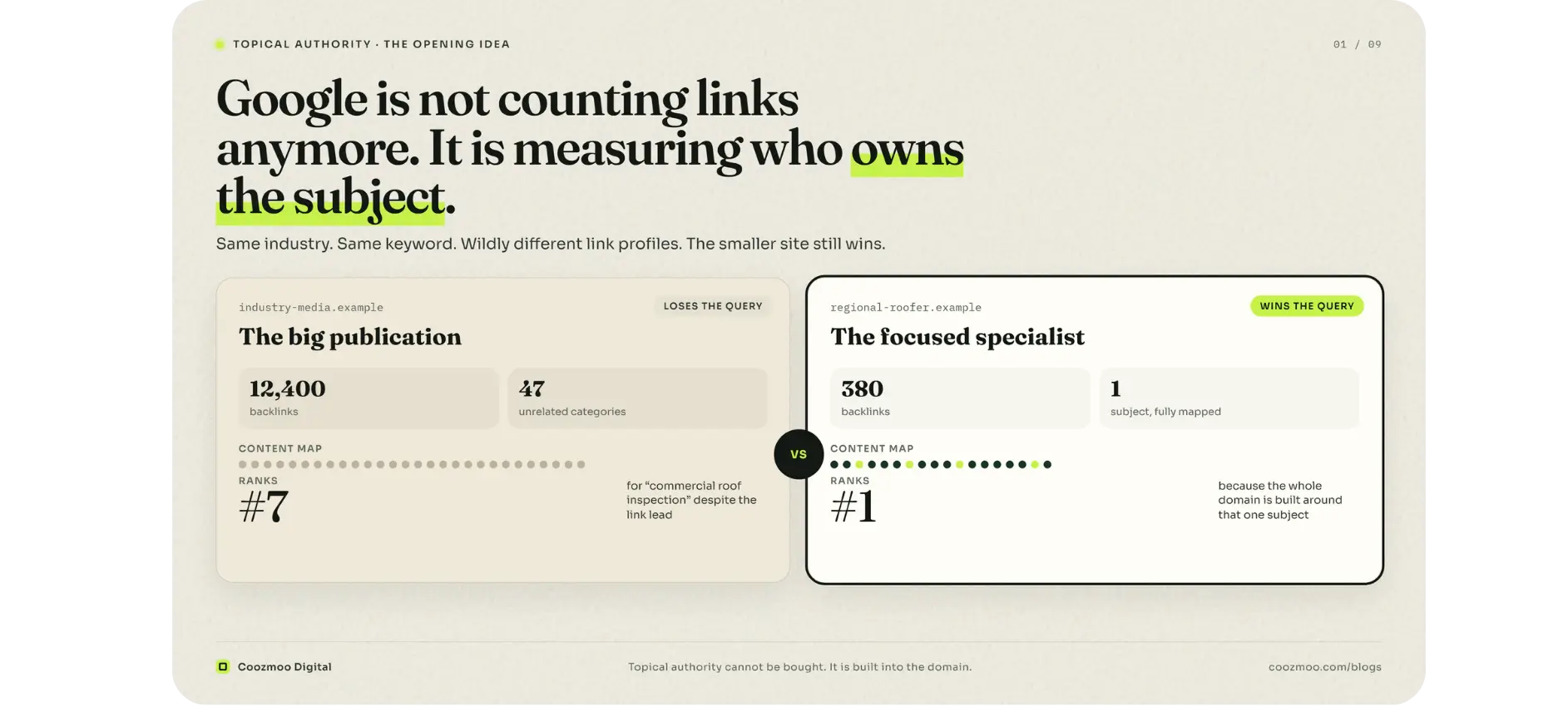
We have looked at ranking reports for businesses with a few hundred backlinks that outrank sites with thousands. Same industry, same keyword, wildly different link profiles. The smaller site wins because Google is not just counting links anymore. It is measuring how completely a site owns a subject.
That measurement has a name: topical authority. It is not a metric you can buy, and it is not something a single well-optimized page can fake. It comes from how a whole domain is built, structured, and maintained around a subject over time.
What Is Topical Authority?
Topical authority is the degree to which search engines and AI systems recognize a website as a trusted, comprehensive source on a specific subject, based on the depth, structure, and consistency of the content that domain publishes. It is different from domain authority, which is a general popularity score built mostly from backlinks. A site can have a modest domain authority and still dominate a niche if its content maps the entire topic instead of a handful of keywords.
In practice, it shows up as a pattern rather than a single number. A site earns it by publishing enough connected, on-subject content that search engines stop evaluating pages one at a time and start evaluating the domain as a whole. That is also why how a site is structured matters here almost as much as the writing itself: a strong topic map sitting on a confusing, poorly linked site still struggles to signal what the domain is actually about.
Where the Idea Comes From, and Why It Is No Longer a Theory
For years, "topical authority" was something SEOs talked about based on pattern recognition. Sites that wrote broadly and shallowly seemed to underperform sites that wrote narrowly and deeply, even when the narrow sites had weaker link profiles. Nobody could point to a Google document and say "here is the metric."
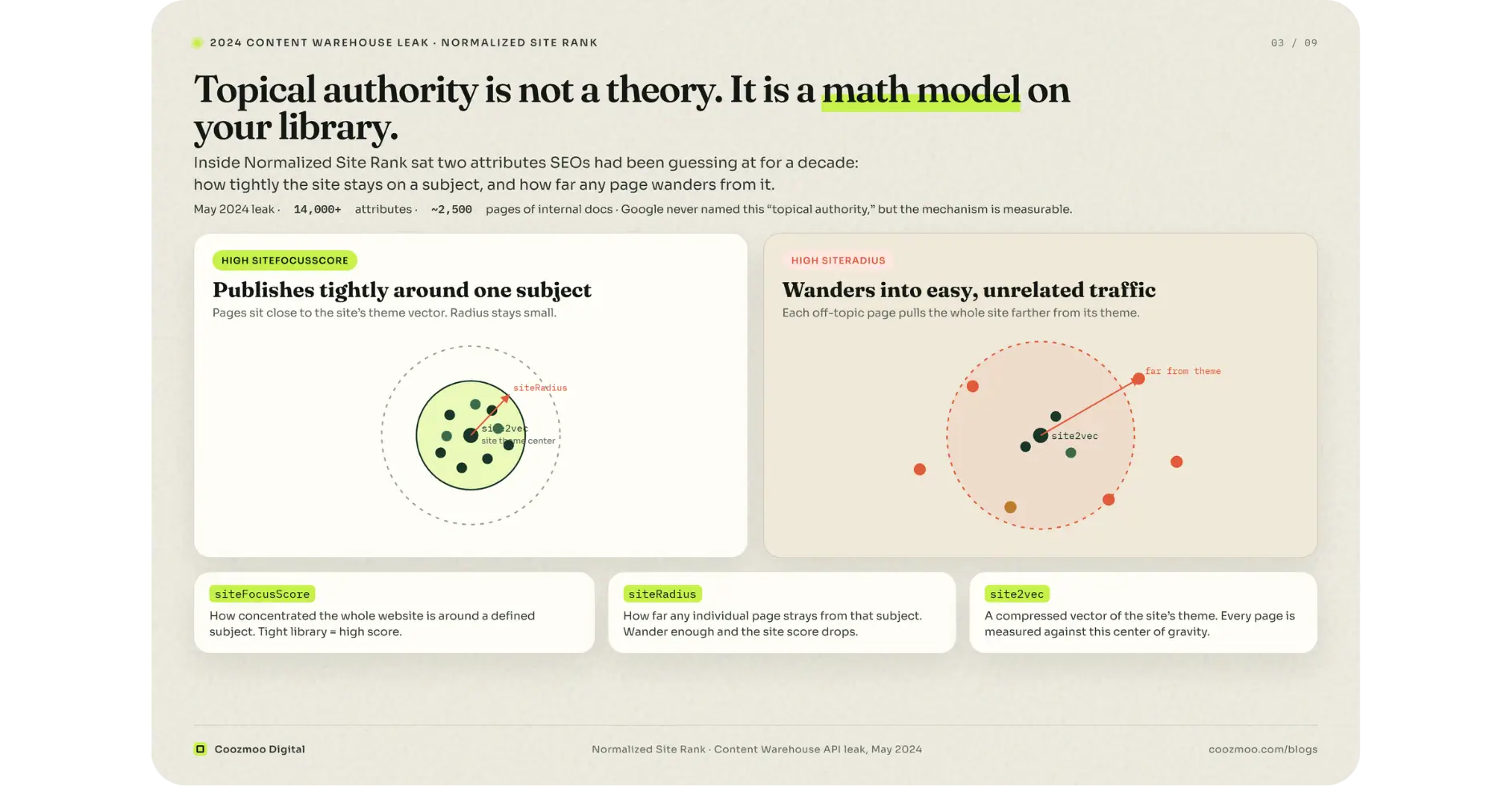
That changed in May 2024. A leak of Google's internal Content Warehouse API documentation, later confirmed as authentic, exposed more than 14,000 attributes across roughly 2,500 pages of internal documentation, according to Wikipedia's entry on the 2024 Google Search documentation leak. Buried inside was a module called Normalized Site Rank, and inside that module sat two attributes that gave the concept a name search marketers had been guessing at for a decade: siteFocusScore and siteRadius.
siteFocusScore measures how concentrated a website's content is around a defined subject. siteRadius measures how far any individual page strays from that subject, calculated against a compressed vector representation of the whole site's theme, referred to internally as site2vec. A site publishing tightly around one subject earns a high siteFocusScore. A site that wanders, adding unrelated categories because they seemed like easy traffic, pulls that score down page by page.
Interestingly, Google itself has never confirmed "topical authority" as an official ranking factor by that name. In a widely referenced Reddit exchange, Google's Search Advocate John Mueller reportedly agreed that the term is essentially a rebranding of relevancy, a concept that has been part of ranking systems for decades. Whether you call it relevancy, topicality, or topical authority, the leak gave the industry hard evidence that the underlying mechanism is real and measurable.
Topical Authority vs. Domain Authority: They Are Not the Same Thing
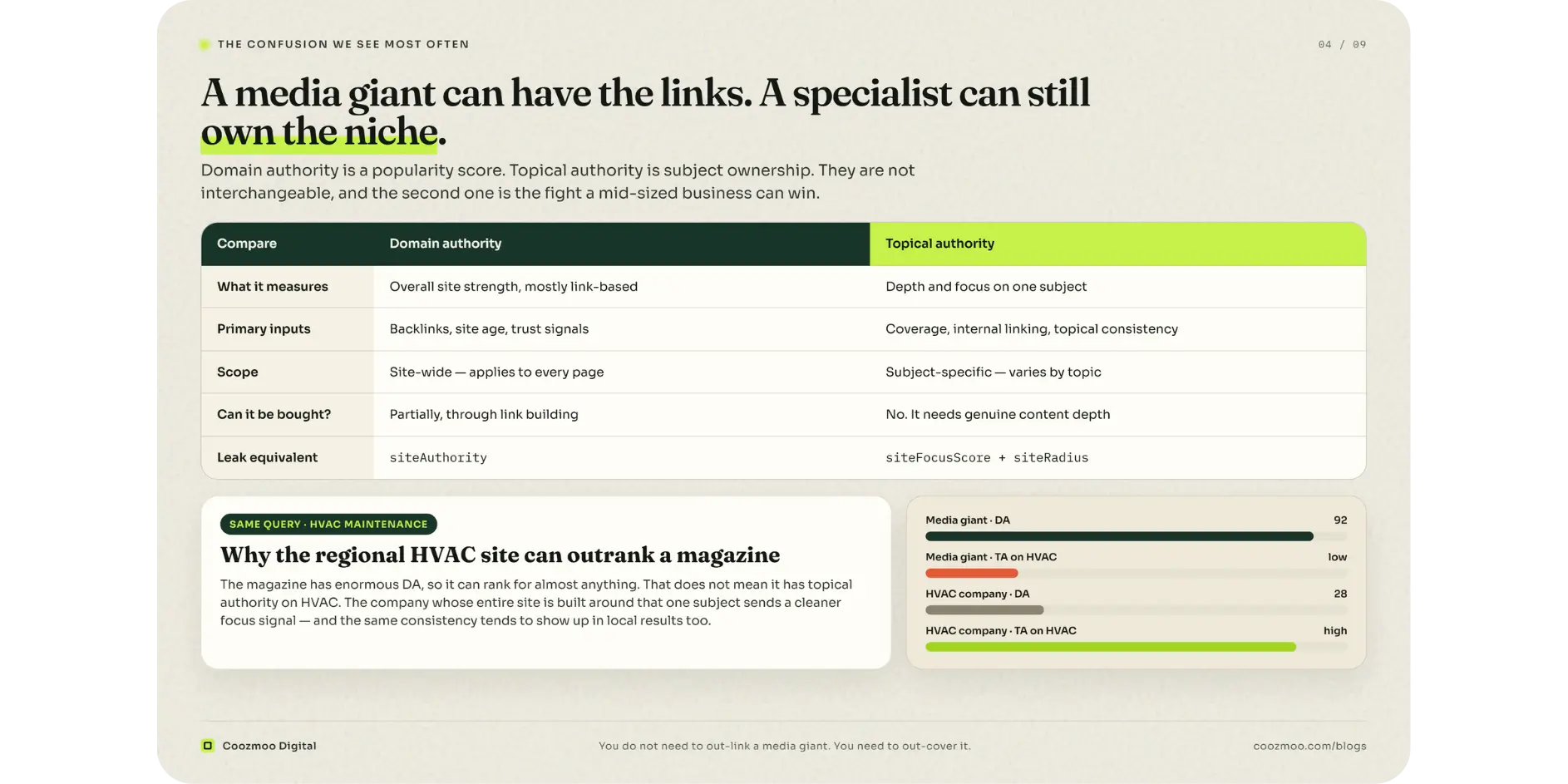
This is the confusion we run into most often. Domain authority, or similar third-party scores from SEO tools, predicts how strongly a site can rank across the board, mostly by weighing backlinks and site age. Topical authority measures something narrower and, in a lot of cases, more useful: how deeply and coherently a site covers one specific subject.
Dimension | Domain Authority | Topical Authority |
|---|---|---|
What it measures | Overall site strength, mostly link-based | Depth and focus on one subject |
Primary inputs | Backlinks, site age, trust signals | Content coverage, internal linking, topical consistency |
Scope | Site-wide, applies to every page | Subject-specific, varies by topic |
Can be "bought" | Partially, through link building | No, requires genuine content depth |
Google leak equivalent | siteAuthority | siteFocusScore, siteRadius |
A publication with enormous domain authority can rank for almost anything because of sheer backlink volume. That does not mean it has topical authority on, say, HVAC maintenance. A regional HVAC company with a fraction of the backlinks can out-rank a media giant on HVAC-specific queries because its entire site is built around that one subject, and Google's systems can tell the difference. For a business tied to a service area, that same focus tends to show up in how strongly the brand appears in local search results too, since both signals reward the same kind of consistency.
This is genuinely good news for smaller and mid-sized businesses. You do not need to out-link a media giant. You need to out-cover it on your specific subject, which is a fight you can actually win.
How Search Engines Actually Detect Topical Authority
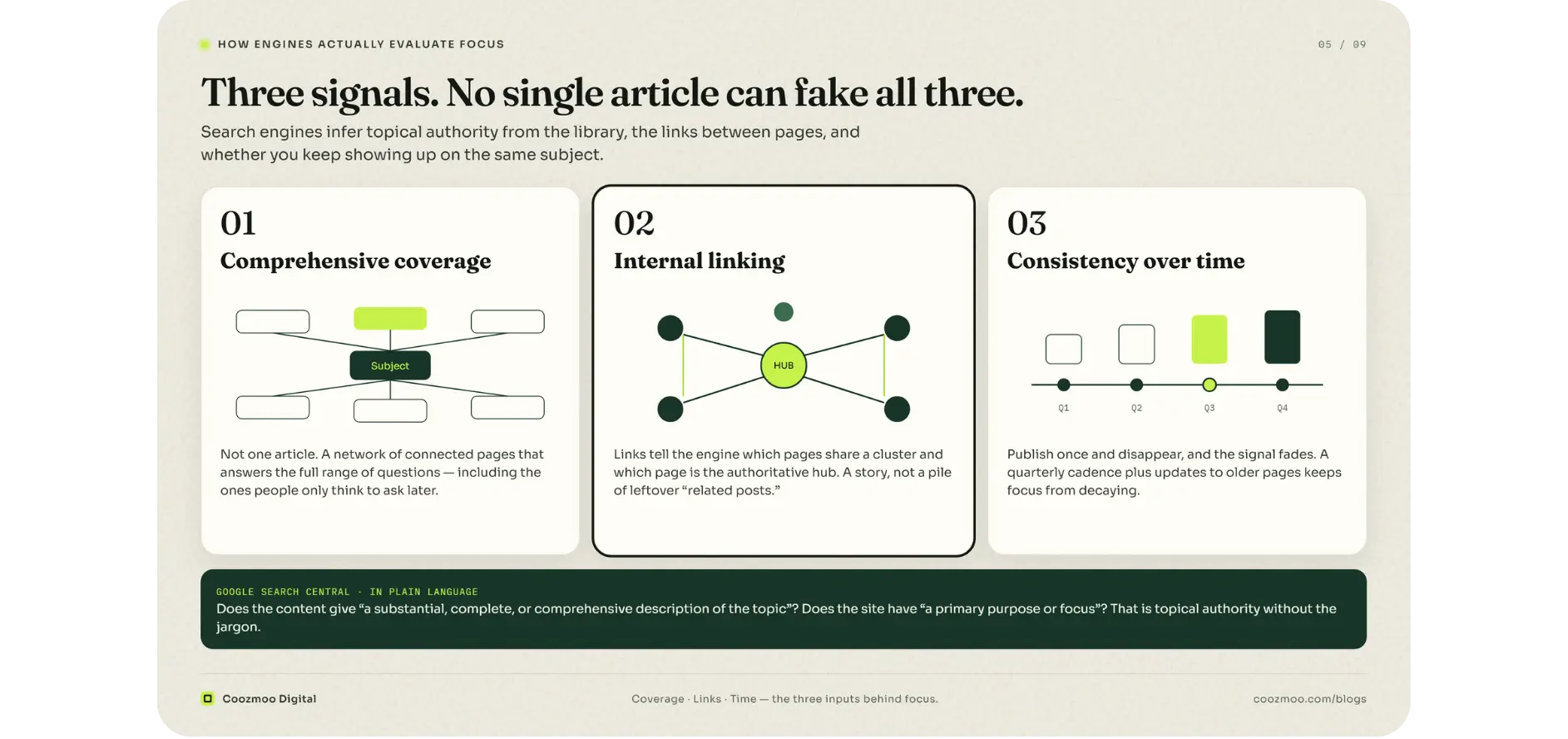
Three things feed into how search engines evaluate topical focus, based on what the leaked documentation revealed and what Google's own public guidance has said for years:
Comprehensive subject coverage. Not one article. A network of connected pages that together answer the full range of questions someone researching that subject would have, including the follow-up questions they would not think to ask until they hit them.
Internal linking structure. How pages on a site link to each other tells search engines which pages belong to the same subject cluster and which page is the authoritative hub for that cluster.
Consistency over time. A site that publishes in a subject once and disappears for a year sends a weaker signal than one that keeps building the subject out, updating older pages as facts change.
Google's own Search Central guidance backs this up without ever using the phrase "topical authority." Its page on creating helpful, reliable, people-first content asks creators to consider whether their content provides "a substantial, complete, or comprehensive description of the topic," and whether the site has "a primary purpose or focus." That is topical authority described in plain language, without the jargon.
How to Build Topical Authority for Your Website
This is where most guides get vague. Here is what actually moves the needle, in order.
1. Map the topic before you write anything
Start with the subject, not the keyword list. If you sell commercial roofing, your topic is not "roofing," it is "commercial roofing," and everything a business owner would need to know before, during, and after a roofing project belongs somewhere on your site. Materials, warranties, maintenance schedules, cost ranges, permit requirements, seasonal timing, red flags when hiring a contractor. Write the full map out before you write a single page.
2. Build a pillar and cluster structure
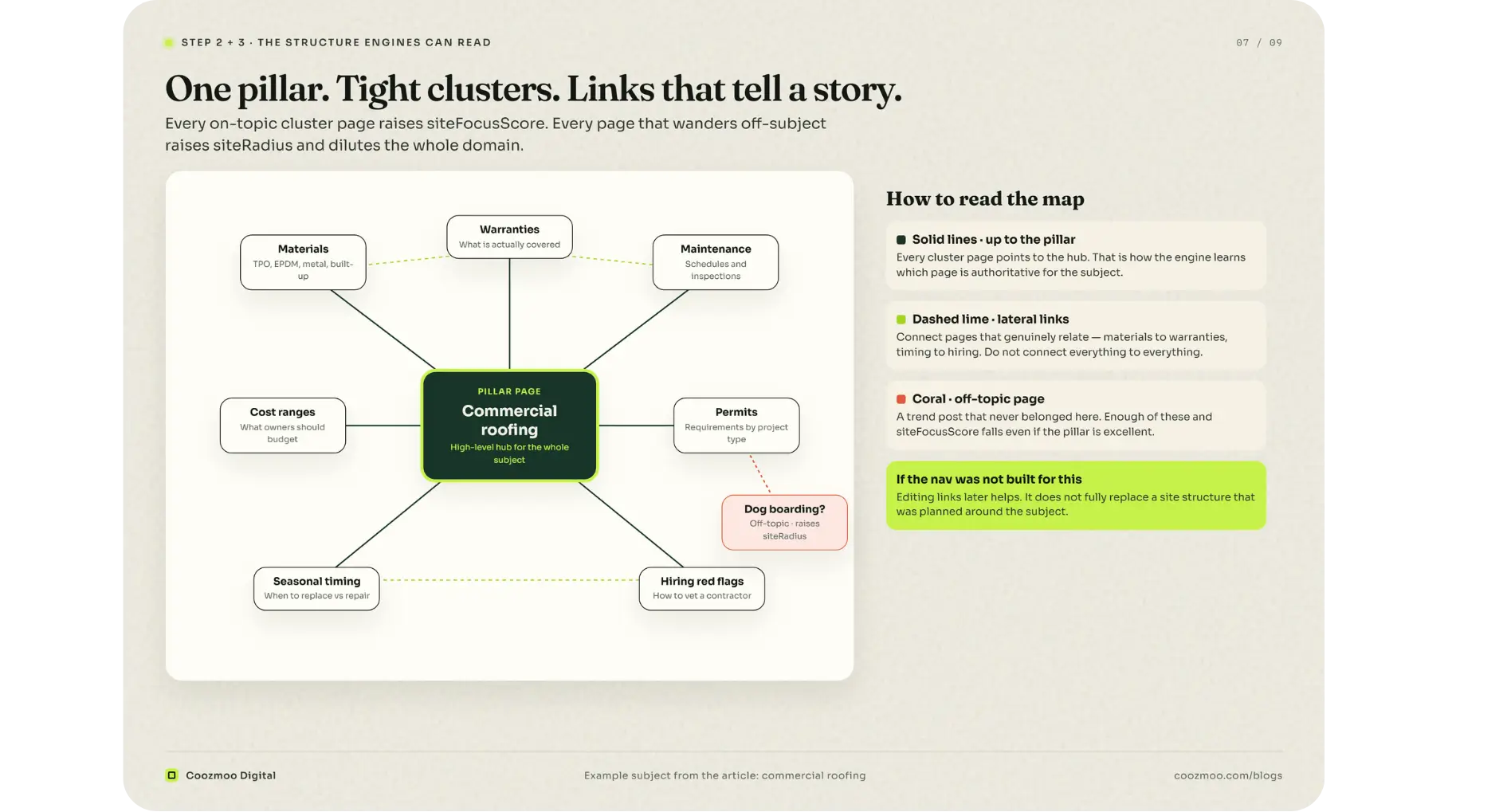
One comprehensive pillar page covers the topic at a high level. Cluster pages go deep on each subtopic and link back to the pillar. This is not a new idea, but it is the mechanical foundation of siteFocusScore. Every cluster page you add that stays tightly on-topic raises your focus score. Every cluster page that wanders off-topic raises siteRadius and dilutes the signal.
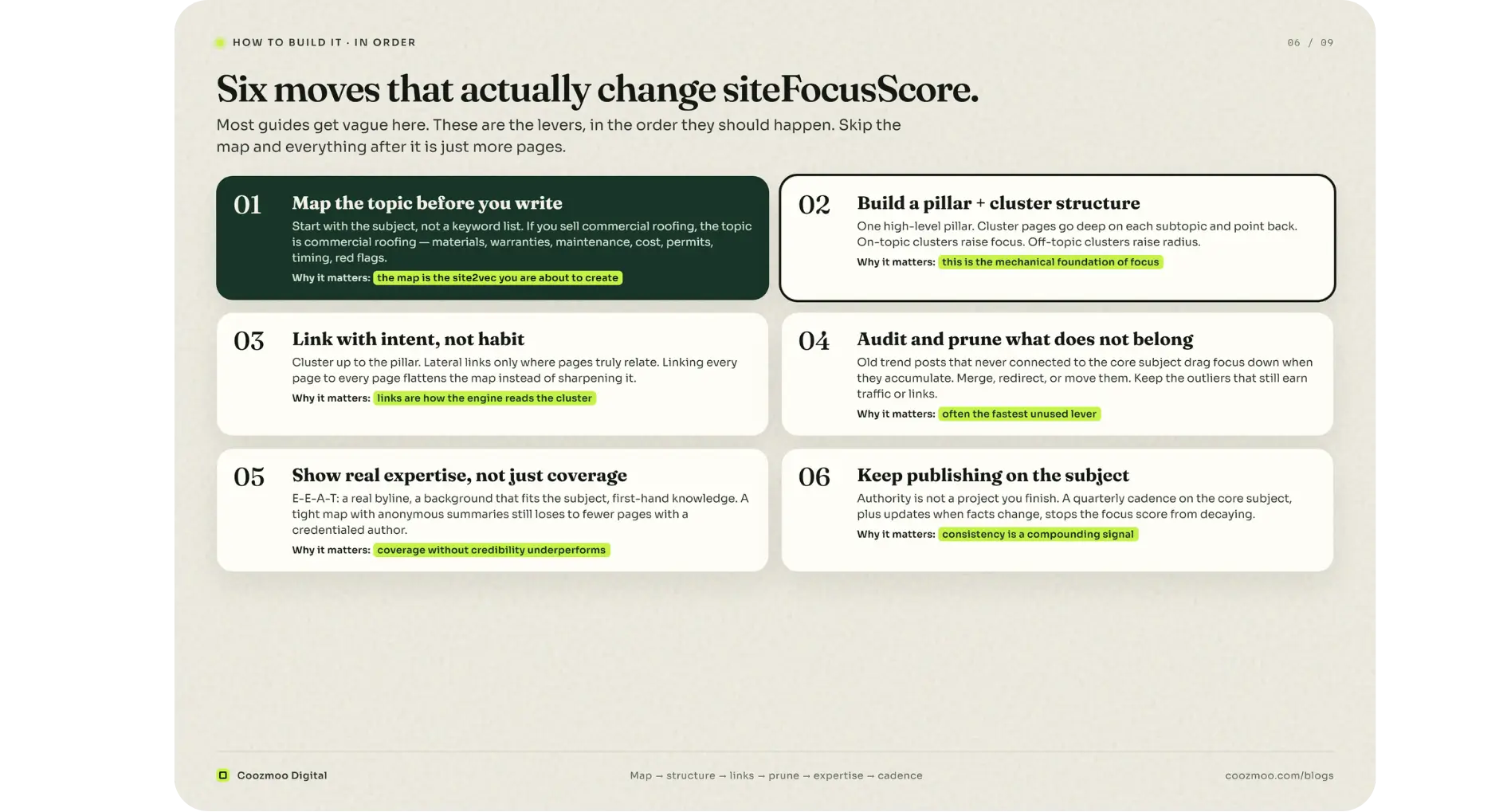
3. Link with intent, not habit
Internal links should tell a story about how your content relates. Link from cluster pages up to the pillar. Link laterally between cluster pages that genuinely relate to each other. Do not link every page to every page just because you can. That flattens the topical map instead of sharpening it. If the underlying site structure and navigation were not built with this in mind to start, no amount of link editing after the fact fully makes up for it.
4. Audit and prune what does not belong
This is the step most businesses skip. Old blog posts that chased a trend three years ago and never connected back to your core subject are actively working against you now. According to the leaked documentation, individual pages with high siteRadius can drag down a site's overall siteFocusScore if there are enough of them. Pruning, merging, or redirecting off-topic content is not busywork. It is the fastest lever most sites have never pulled.
This is not a blanket instruction to delete anything that strays from the core subject. A tangential page still pulling in solid traffic or a handful of quality backlinks is usually worth keeping, or moving somewhere it will not dilute the main site, rather than deleting on principle. The leaked documentation suggests the penalty shows up when off-topic pages accumulate, not from any single outlier sitting quietly in the archive.
5. Demonstrate real expertise, not just coverage
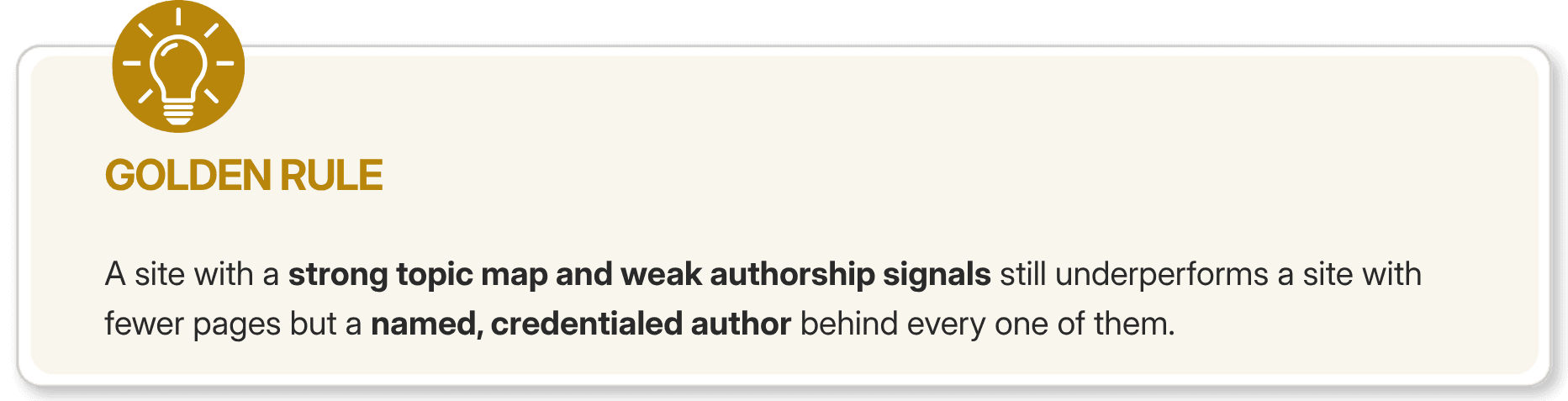
Google's Search Quality Rater Guidelines, the document that trains the human raters who sanity-check Google's algorithms, put weight on experience, expertise, authoritativeness, and trustworthiness, together known as E-E-A-T. A byline with a real name, a background that makes sense for the subject, and content that shows first-hand knowledge, not just summarized research, all feed into whether Google's systems and human raters see your site as credible on the topic.
6. Keep publishing on the subject, not just around it
Topical authority is not something you finish. Industry publications and Google's own updates consistently point to consistency as a compounding signal. A quarterly publishing cadence on your core subject, paired with updates to older pages as facts change, keeps siteFocusScore trending in the right direction instead of decaying.
How Topical Authority Carries Over Into AI Search and LLMs
Building topical authority for Google is only half the job now. ChatGPT, Perplexity, Google's AI Overviews, and Gemini all pull from the open web using retrieval-augmented generation, commonly shortened to RAG, and the way they select sources is not identical to how Google ranks blue links.
Research from Profound, an AI visibility research firm, found that Wikipedia accounts for roughly 7.8 percent of ChatGPT's total citations, making it the single most cited domain, while Perplexity leans heavily on Reddit, which shows up in a large share of its answers. The overlap between what ChatGPT cites and what Perplexity cites is small, reportedly around 11 percent, which means optimizing for one AI engine does not automatically get you cited in another.
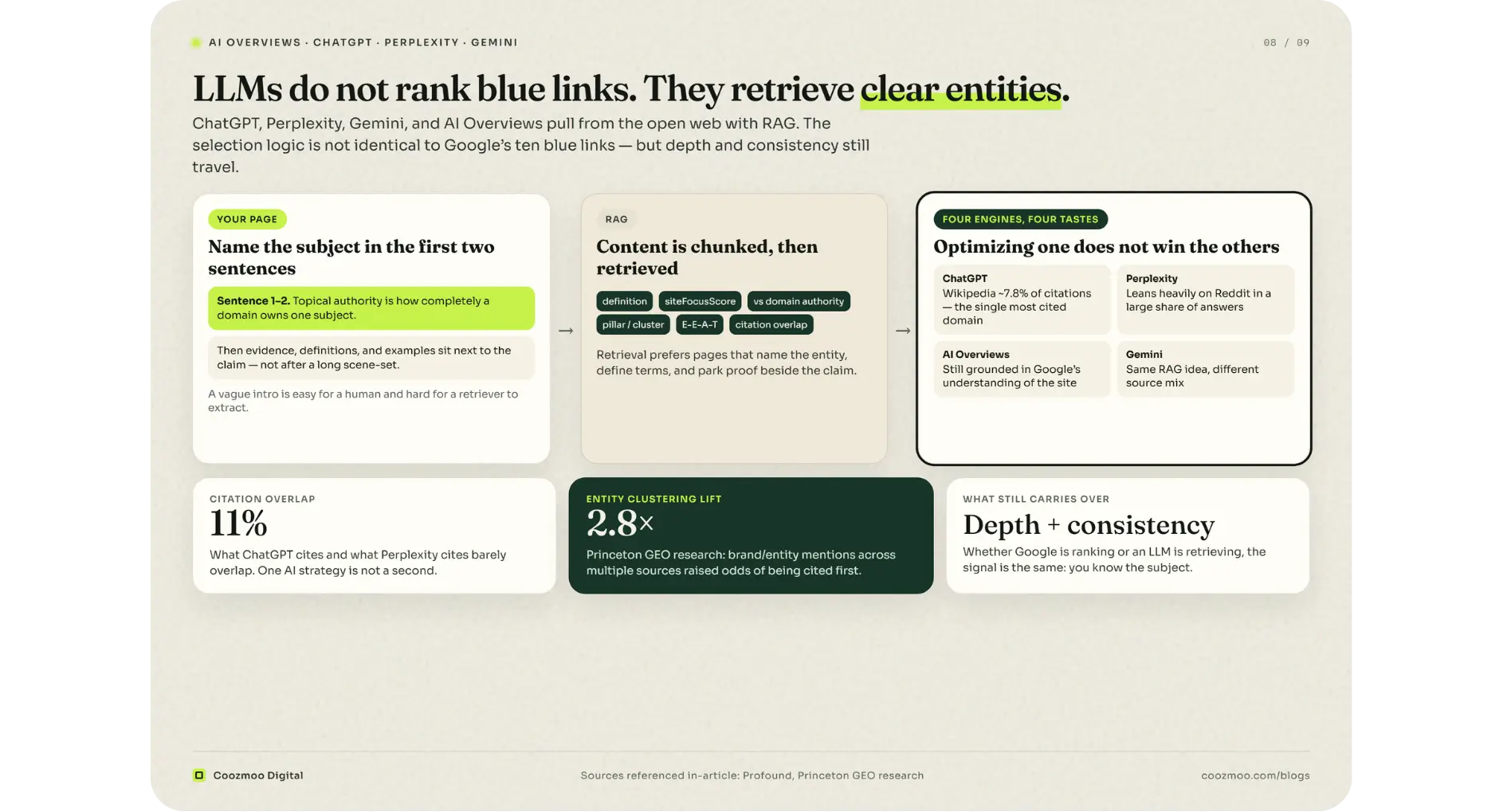
What does carry over is entity clarity. RAG systems chunk your content and retrieve pieces of it based on how clearly a page names its subject, defines its terms, and places evidence directly next to the claims it is making. A page with a vague introduction that sets the stage instead of naming the subject in the first two sentences is easy for a human reader to follow and hard for a retrieval system to extract cleanly.
Princeton's research into generative engine optimization also found that clustering brand or entity mentions across multiple sources, not just your own site, increased the likelihood of being cited first by close to 2.8 times. This is the part topical authority and AI visibility share completely: depth and consistency on a subject, whether Google is reading it or an LLM is retrieving it, signals the same thing. You know what you are talking about.
We have covered this from a few different angles across our blog, if you want to go further into how AI search specifically evaluates a site. If getting cited inside AI answers is the more urgent problem right now, that is a slightly different discipline from ranking blue links, and our GEO and AI search team works on it separately for businesses that need both tracks moving at once.
Common Mistakes That Undermine Topical Authority
Chasing keyword volume instead of topic completeness. A page built to rank for one high-volume keyword, disconnected from everything else on the site, does more harm than good if it does not fit the site's core subject.
Publishing cluster content just to hit a number. Ten thin pages do not build authority the way three genuinely useful ones do. Depth beats page count every time this gets tested.
Ignoring the prune. Sites hold onto old, off-topic content out of habit, not strategy. Every unrelated page sitting on the domain is quietly working against the pages that matter.
Treating internal linking as an afterthought. Adding links after publishing, instead of planning the link structure as part of the content map, is one of the most common gaps we see when auditing a site's architecture.
Assuming one great article is enough. A single exceptional page can rank. It cannot build topical authority on its own. That requires the network around it.
If your team does not have the bandwidth to map, build, and maintain that structure in-house, this is exactly the kind of work our organic SEO team handles for businesses that want to own a subject instead of chasing individual keywords one at a time.
Where This Gets Slower Than the Playbooks Admit
None of this moves as fast as the guides suggest. We have sat with businesses that pruned forty pages, rebuilt the internal linking, and watched almost nothing happen for two straight months before rankings started climbing. That stretch is real and most write-ups skip it, because "three to six months" reads better in an intro than "expect a quiet stretch where it looks like nothing is working."
It is not universal either. A single-location specialty business can hit a reasonable topical ceiling with a dozen well-built pages. A company competing in something like business insurance or SaaS might need two hundred before Google treats the site as complete. Nobody can hand you the exact number in advance, and any guide that gives you one is guessing.
What holds up across the businesses we have worked with: the ones that stop optimizing individual keywords and start building toward full subject coverage are usually still standing after the next core update, mostly because siteFocusScore and whatever replaces it are not the kind of signal that resets when Google ships a new algorithm. The question those systems are answering does not change. Does this domain actually know its subject, or does it just have a lot of pages sitting under one roof.
FAQs
What is topical authority in SEO?

Topical authority is how thoroughly and consistently a website covers a specific subject, and how much search engines trust that site as the go-to source on it. It is built through comprehensive content coverage, internal linking, and sustained publishing on the same subject, not through a single optimized page or a strong backlink profile alone.
How is topical authority different from domain authority?
Domain authority is a general, mostly link-based score that predicts how well a site can rank across the board. Topical authority is subject-specific and depends on content depth, internal link structure, and consistency within a niche. A site can have low domain authority and still dominate a specific subject if it covers that subject more completely than larger competitors.
How long does it take to build topical authority for a website?
Most sites see meaningful movement in three to six months of consistent, focused publishing, though this varies by competition level and how much off-topic content needs to be pruned first. Topical authority compounds, so early cluster pages tend to strengthen every page added after them.
Does topical authority matter for AI search results like ChatGPT and Perplexity?
Yes, though the mechanism is different from Google's ranking system. AI platforms retrieve and cite content using retrieval-augmented generation, which favors pages with clear entity definitions and evidence placed directly next to claims. Sites with strong topical depth tend to perform better across both traditional search and AI-generated answers, even though citation patterns vary significantly between platforms.
What is the fastest way to start building topical authority?
Audit your existing content first. Identify what already fits your core subject, what is off-topic and dragging your focus down, and where the gaps are in your topic map. Pruning or consolidating off-topic pages often produces faster, more visible results than publishing new content on top of an unfocused site. A free audit is usually the fastest way to see where your site actually stands before committing to a content plan.
We have looked at ranking reports for businesses with a few hundred backlinks that outrank sites with thousands. Same industry, same keyword, wildly different link profiles. The smaller site wins because Google is not just counting links anymore. It is measuring how completely a site owns a subject.
That measurement has a name: topical authority. It is not a metric you can buy, and it is not something a single well-optimized page can fake. It comes from how a whole domain is built, structured, and maintained around a subject over time.
What Is Topical Authority?
Topical authority is the degree to which search engines and AI systems recognize a website as a trusted, comprehensive source on a specific subject, based on the depth, structure, and consistency of the content that domain publishes. It is different from domain authority, which is a general popularity score built mostly from backlinks. A site can have a modest domain authority and still dominate a niche if its content maps the entire topic instead of a handful of keywords.
In practice, it shows up as a pattern rather than a single number. A site earns it by publishing enough connected, on-subject content that search engines stop evaluating pages one at a time and start evaluating the domain as a whole. That is also why how a site is structured matters here almost as much as the writing itself: a strong topic map sitting on a confusing, poorly linked site still struggles to signal what the domain is actually about.
Where the Idea Comes From, and Why It Is No Longer a Theory
For years, "topical authority" was something SEOs talked about based on pattern recognition. Sites that wrote broadly and shallowly seemed to underperform sites that wrote narrowly and deeply, even when the narrow sites had weaker link profiles. Nobody could point to a Google document and say "here is the metric."
That changed in May 2024. A leak of Google's internal Content Warehouse API documentation, later confirmed as authentic, exposed more than 14,000 attributes across roughly 2,500 pages of internal documentation, according to Wikipedia's entry on the 2024 Google Search documentation leak. Buried inside was a module called Normalized Site Rank, and inside that module sat two attributes that gave the concept a name search marketers had been guessing at for a decade: siteFocusScore and siteRadius.
siteFocusScore measures how concentrated a website's content is around a defined subject. siteRadius measures how far any individual page strays from that subject, calculated against a compressed vector representation of the whole site's theme, referred to internally as site2vec. A site publishing tightly around one subject earns a high siteFocusScore. A site that wanders, adding unrelated categories because they seemed like easy traffic, pulls that score down page by page.
Interestingly, Google itself has never confirmed "topical authority" as an official ranking factor by that name. In a widely referenced Reddit exchange, Google's Search Advocate John Mueller reportedly agreed that the term is essentially a rebranding of relevancy, a concept that has been part of ranking systems for decades. Whether you call it relevancy, topicality, or topical authority, the leak gave the industry hard evidence that the underlying mechanism is real and measurable.
Topical Authority vs. Domain Authority: They Are Not the Same Thing
This is the confusion we run into most often. Domain authority, or similar third-party scores from SEO tools, predicts how strongly a site can rank across the board, mostly by weighing backlinks and site age. Topical authority measures something narrower and, in a lot of cases, more useful: how deeply and coherently a site covers one specific subject.
Dimension | Domain Authority | Topical Authority |
|---|---|---|
What it measures | Overall site strength, mostly link-based | Depth and focus on one subject |
Primary inputs | Backlinks, site age, trust signals | Content coverage, internal linking, topical consistency |
Scope | Site-wide, applies to every page | Subject-specific, varies by topic |
Can be "bought" | Partially, through link building | No, requires genuine content depth |
Google leak equivalent | siteAuthority | siteFocusScore, siteRadius |
A publication with enormous domain authority can rank for almost anything because of sheer backlink volume. That does not mean it has topical authority on, say, HVAC maintenance. A regional HVAC company with a fraction of the backlinks can out-rank a media giant on HVAC-specific queries because its entire site is built around that one subject, and Google's systems can tell the difference. For a business tied to a service area, that same focus tends to show up in how strongly the brand appears in local search results too, since both signals reward the same kind of consistency.
This is genuinely good news for smaller and mid-sized businesses. You do not need to out-link a media giant. You need to out-cover it on your specific subject, which is a fight you can actually win.
How Search Engines Actually Detect Topical Authority
Three things feed into how search engines evaluate topical focus, based on what the leaked documentation revealed and what Google's own public guidance has said for years:
Comprehensive subject coverage. Not one article. A network of connected pages that together answer the full range of questions someone researching that subject would have, including the follow-up questions they would not think to ask until they hit them.
Internal linking structure. How pages on a site link to each other tells search engines which pages belong to the same subject cluster and which page is the authoritative hub for that cluster.
Consistency over time. A site that publishes in a subject once and disappears for a year sends a weaker signal than one that keeps building the subject out, updating older pages as facts change.
Google's own Search Central guidance backs this up without ever using the phrase "topical authority." Its page on creating helpful, reliable, people-first content asks creators to consider whether their content provides "a substantial, complete, or comprehensive description of the topic," and whether the site has "a primary purpose or focus." That is topical authority described in plain language, without the jargon.
How to Build Topical Authority for Your Website
This is where most guides get vague. Here is what actually moves the needle, in order.
1. Map the topic before you write anything
Start with the subject, not the keyword list. If you sell commercial roofing, your topic is not "roofing," it is "commercial roofing," and everything a business owner would need to know before, during, and after a roofing project belongs somewhere on your site. Materials, warranties, maintenance schedules, cost ranges, permit requirements, seasonal timing, red flags when hiring a contractor. Write the full map out before you write a single page.
2. Build a pillar and cluster structure
One comprehensive pillar page covers the topic at a high level. Cluster pages go deep on each subtopic and link back to the pillar. This is not a new idea, but it is the mechanical foundation of siteFocusScore. Every cluster page you add that stays tightly on-topic raises your focus score. Every cluster page that wanders off-topic raises siteRadius and dilutes the signal.
3. Link with intent, not habit
Internal links should tell a story about how your content relates. Link from cluster pages up to the pillar. Link laterally between cluster pages that genuinely relate to each other. Do not link every page to every page just because you can. That flattens the topical map instead of sharpening it. If the underlying site structure and navigation were not built with this in mind to start, no amount of link editing after the fact fully makes up for it.
4. Audit and prune what does not belong
This is the step most businesses skip. Old blog posts that chased a trend three years ago and never connected back to your core subject are actively working against you now. According to the leaked documentation, individual pages with high siteRadius can drag down a site's overall siteFocusScore if there are enough of them. Pruning, merging, or redirecting off-topic content is not busywork. It is the fastest lever most sites have never pulled.
This is not a blanket instruction to delete anything that strays from the core subject. A tangential page still pulling in solid traffic or a handful of quality backlinks is usually worth keeping, or moving somewhere it will not dilute the main site, rather than deleting on principle. The leaked documentation suggests the penalty shows up when off-topic pages accumulate, not from any single outlier sitting quietly in the archive.
5. Demonstrate real expertise, not just coverage
Google's Search Quality Rater Guidelines, the document that trains the human raters who sanity-check Google's algorithms, put weight on experience, expertise, authoritativeness, and trustworthiness, together known as E-E-A-T. A byline with a real name, a background that makes sense for the subject, and content that shows first-hand knowledge, not just summarized research, all feed into whether Google's systems and human raters see your site as credible on the topic.
6. Keep publishing on the subject, not just around it
Topical authority is not something you finish. Industry publications and Google's own updates consistently point to consistency as a compounding signal. A quarterly publishing cadence on your core subject, paired with updates to older pages as facts change, keeps siteFocusScore trending in the right direction instead of decaying.
How Topical Authority Carries Over Into AI Search and LLMs
Building topical authority for Google is only half the job now. ChatGPT, Perplexity, Google's AI Overviews, and Gemini all pull from the open web using retrieval-augmented generation, commonly shortened to RAG, and the way they select sources is not identical to how Google ranks blue links.
Research from Profound, an AI visibility research firm, found that Wikipedia accounts for roughly 7.8 percent of ChatGPT's total citations, making it the single most cited domain, while Perplexity leans heavily on Reddit, which shows up in a large share of its answers. The overlap between what ChatGPT cites and what Perplexity cites is small, reportedly around 11 percent, which means optimizing for one AI engine does not automatically get you cited in another.
What does carry over is entity clarity. RAG systems chunk your content and retrieve pieces of it based on how clearly a page names its subject, defines its terms, and places evidence directly next to the claims it is making. A page with a vague introduction that sets the stage instead of naming the subject in the first two sentences is easy for a human reader to follow and hard for a retrieval system to extract cleanly.
Princeton's research into generative engine optimization also found that clustering brand or entity mentions across multiple sources, not just your own site, increased the likelihood of being cited first by close to 2.8 times. This is the part topical authority and AI visibility share completely: depth and consistency on a subject, whether Google is reading it or an LLM is retrieving it, signals the same thing. You know what you are talking about.
We have covered this from a few different angles across our blog, if you want to go further into how AI search specifically evaluates a site. If getting cited inside AI answers is the more urgent problem right now, that is a slightly different discipline from ranking blue links, and our GEO and AI search team works on it separately for businesses that need both tracks moving at once.
Common Mistakes That Undermine Topical Authority
Chasing keyword volume instead of topic completeness. A page built to rank for one high-volume keyword, disconnected from everything else on the site, does more harm than good if it does not fit the site's core subject.
Publishing cluster content just to hit a number. Ten thin pages do not build authority the way three genuinely useful ones do. Depth beats page count every time this gets tested.
Ignoring the prune. Sites hold onto old, off-topic content out of habit, not strategy. Every unrelated page sitting on the domain is quietly working against the pages that matter.
Treating internal linking as an afterthought. Adding links after publishing, instead of planning the link structure as part of the content map, is one of the most common gaps we see when auditing a site's architecture.
Assuming one great article is enough. A single exceptional page can rank. It cannot build topical authority on its own. That requires the network around it.
If your team does not have the bandwidth to map, build, and maintain that structure in-house, this is exactly the kind of work our organic SEO team handles for businesses that want to own a subject instead of chasing individual keywords one at a time.
Where This Gets Slower Than the Playbooks Admit
None of this moves as fast as the guides suggest. We have sat with businesses that pruned forty pages, rebuilt the internal linking, and watched almost nothing happen for two straight months before rankings started climbing. That stretch is real and most write-ups skip it, because "three to six months" reads better in an intro than "expect a quiet stretch where it looks like nothing is working."
It is not universal either. A single-location specialty business can hit a reasonable topical ceiling with a dozen well-built pages. A company competing in something like business insurance or SaaS might need two hundred before Google treats the site as complete. Nobody can hand you the exact number in advance, and any guide that gives you one is guessing.
What holds up across the businesses we have worked with: the ones that stop optimizing individual keywords and start building toward full subject coverage are usually still standing after the next core update, mostly because siteFocusScore and whatever replaces it are not the kind of signal that resets when Google ships a new algorithm. The question those systems are answering does not change. Does this domain actually know its subject, or does it just have a lot of pages sitting under one roof.
FAQs
What is topical authority in SEO?
Topical authority is how thoroughly and consistently a website covers a specific subject, and how much search engines trust that site as the go-to source on it. It is built through comprehensive content coverage, internal linking, and sustained publishing on the same subject, not through a single optimized page or a strong backlink profile alone.
How is topical authority different from domain authority?
Domain authority is a general, mostly link-based score that predicts how well a site can rank across the board. Topical authority is subject-specific and depends on content depth, internal link structure, and consistency within a niche. A site can have low domain authority and still dominate a specific subject if it covers that subject more completely than larger competitors.
How long does it take to build topical authority for a website?
Most sites see meaningful movement in three to six months of consistent, focused publishing, though this varies by competition level and how much off-topic content needs to be pruned first. Topical authority compounds, so early cluster pages tend to strengthen every page added after them.
Does topical authority matter for AI search results like ChatGPT and Perplexity?
Yes, though the mechanism is different from Google's ranking system. AI platforms retrieve and cite content using retrieval-augmented generation, which favors pages with clear entity definitions and evidence placed directly next to claims. Sites with strong topical depth tend to perform better across both traditional search and AI-generated answers, even though citation patterns vary significantly between platforms.
What is the fastest way to start building topical authority?
Audit your existing content first. Identify what already fits your core subject, what is off-topic and dragging your focus down, and where the gaps are in your topic map. Pruning or consolidating off-topic pages often produces faster, more visible results than publishing new content on top of an unfocused site. A free audit is usually the fastest way to see where your site actually stands before committing to a content plan.



Summarize with AI



Want to Skyrocket Revenue? Get a Free Audit Today!
Want to Skyrocket Revenue? Get a Free Audit Today!



4.9/5 Ratings!


Don’t miss our revenue growth tips!
Get expert marketing tips—straight to your inbox, like thousands of happy clients.
Don’t miss our revenue growth tips!
Get expert marketing tips—straight to your inbox, like thousands of happy clients.
Don’t miss our revenue growth tips!
Don’t miss our revenue growth tips!
Get expert marketing tips—straight to your inbox, like thousands of happy clients.
Relevant Blogs on Organic SEO
Relevant Blogs on Organic SEO
Unlock data-driven insights in Organic SEO—explore our featured blogs and skyrocket your revenue before your competitors do.
Unlock data-driven insights in Organic SEO—explore our featured blogs and skyrocket your revenue before your competitors do.

SEO
Sep 21, 2026
5 Min Read
Audience-First SEO: How to Rank by Putting Readers First
SEO
Sep 21, 2026
5 Min Read
Audience-First SEO: How to Rank by Putting Readers First
SEO
Sep 21, 2026
5 Min Read
Audience-First SEO: How to Rank by Putting Readers First

SEO
Sep 19, 2026
5 Min Read
How to Add SEO Keywords to Your Website: Where and How
SEO
Sep 19, 2026
5 Min Read
How to Add SEO Keywords to Your Website: Where and How
SEO
Sep 19, 2026
5 Min Read
How to Add SEO Keywords to Your Website: Where and How

SEO
Sep 18, 2026
5 Min Read
How XML Sitemaps Help Search Engines Discover New Pages
SEO
Sep 18, 2026
5 Min Read
How XML Sitemaps Help Search Engines Discover New Pages
SEO
Sep 18, 2026
5 Min Read
How XML Sitemaps Help Search Engines Discover New Pages

































Ready to speak with an expert?
Data-Driven Marketing Agency That Elevates ROI
1100+
Websites Designed & Optimized to Convert
$280M+
Client Revenue Driven & Growing Strong
Discover how to skyrocket
your revenue today!
Trusted by 1000+ Owners!
Ready to speak with an expert?
Data-Driven Marketing Agency That Elevates ROI
1100+
Websites Designed & Optimized to Convert
$280M+
Client Revenue Driven & Growing Strong
Discover how to skyrocket
your revenue today!
Trusted by 1000+ Owners!
Want to skyrocket revenue?
4.9/5 Ratings!
Ready to speak with an expert?
Data-Driven Marketing Agency That Elevates ROI
1100+
Websites Designed & Optimized to Convert
$280M+
Client Revenue Driven & Growing Strong
Discover how to skyrocket
your revenue today!
Trusted by 1000+ Owners!
Call
Meet