Google Spam Policies Explained: What SEOs Need to Avoid in 2026
Google Spam Policies Explained: What SEOs Need to Avoid in 2026
Last Updated:
Table of Content
Case Studies









Indra Singh
Indra Singh
Indra Singh
SEO
SEO
SEO
5 Min Read
10 Min
5 Min Read
Google's spam policies penalize any tactic built to manipulate rankings instead of serving users. That includes keyword stuffing, cloaking, doorway abuse, hidden text and link abuse, link spam, scraping, sneaky redirects, site reputation abuse, expired domain abuse, and content generated primarily to game the algorithm rather than help a reader. Violations lead to lower rankings, manual actions, or removal from search results entirely. Google spam updates are designed to improve how these spam practices are detected and addressed.
If you work in SEO long enough, you'll see every one of these tactics pitched to you as a "growth hack" at least once. Most of them worked, briefly, a decade ago. None of them work now, and Google has gotten far better at catching the ones that survive on gray-hat forums. This guide walks through the practices Google explicitly names as spam, what they look like in practice, and how to keep your site clean as you head into 2026.
Google Keyword Stuffing: Stop Keyword Spamming
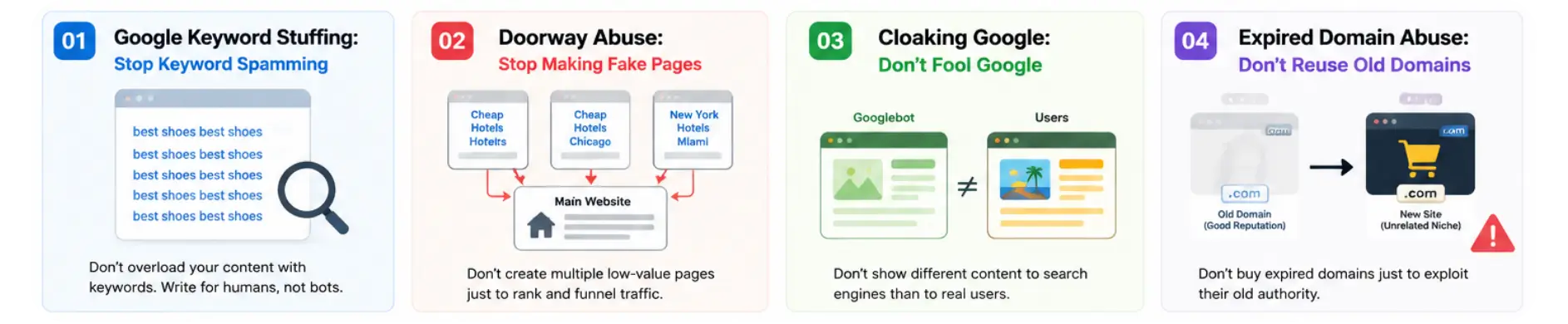
Google keyword stuffing is exactly what it sounds like: cramming a page with repeated words or phrases in an attempt to force relevance signals. Classic examples include long unformatted lists of city names, blocks of phone numbers with no context, or paragraphs where the same phrase gets repeated until it reads like a broken record. Google keyword stuffing doesn't just look bad to a human reader; it's one of the easiest spam patterns for automated systems to flag.
The fix is simple in theory and hard in practice: write for the person, not the crawler. If a term needs to appear five times in three sentences to feel "optimized," that's the signal to rewrite the paragraph. Modern semantic search rewards synonyms, entities, and natural phrasing far more than raw repetition ever did.
Doorway Abuse: Stop Making Fake Pages
Doorway abuse happens when a business builds multiple near-identical pages or sites, each targeting a slightly different city, region, or query variation, all funneling users toward the same destination. A landscaping company with fifty city-specific landing pages that say almost nothing unique about each city is a textbook case of doorway abuse.
Google treats doorway abuse as a ranking manipulation issue because the intermediate pages add no value; they exist purely to capture search traffic before redirecting attention elsewhere. If you're running local pages for multiple service areas, doorway abuse is the line you cross the moment those pages stop containing genuinely different information about each location.
Cloaking Google
Cloaking Google search systems means showing one version of a page to search engines and a different version to actual visitors. A site might serve a clean, keyword-rich page to Googlebot while human users land on something entirely different, sometimes even unrelated to the original topic. Cloaking Google's crawlers is treated as one of the more serious spam categories because it's inherently deceptive by design, not by accident.
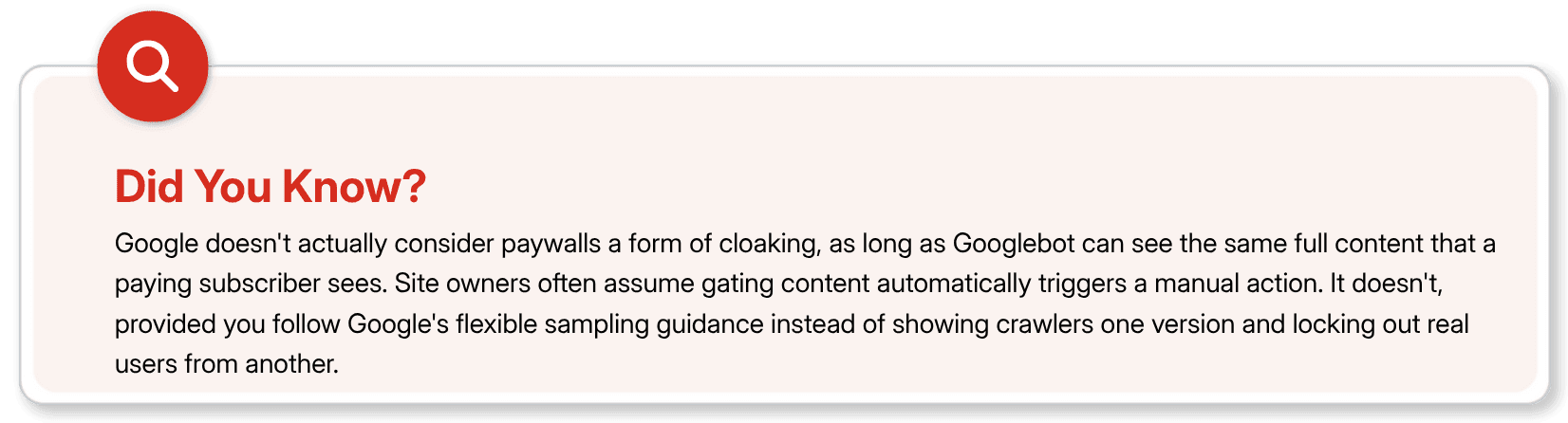
Legitimate JavaScript rendering issues or paywalled content are not the same thing as cloaking Google's systems, as long as Google can access the same content a paying user would see. The distinction Google draws is intent: are you hiding content from Google, or is Google just struggling to render something everyone else sees the same way?
Expired Domain Abuse: Don’t Reuse Old Domains
Expired domain abuse is a newer, sharper focus for Google. It involves buying a domain that previously had an established reputation (a government site, a nonprofit, an old school) and repurposing it for unrelated commercial content that leans on the old domain's authority rather than earning its own.
Common expired domain abuse patterns include slapping an affiliate storefront or a casino review site onto a domain that used to belong to a medical charity or educational institution. Google now actively hunts for this pattern because the mismatch between a domain's history and its current content is a strong, detectable manipulation signal. If you're acquiring aged domains for SEO value, expired domain abuse is the exact trap to avoid; buy for relevance, not just backlink history.
Hidden Text and Link Abuse
Hidden text and link abuse covers any content placed on a page specifically to be read by search engines but not by human visitors. White text on a white background, text pushed off-screen with CSS, font sizes set to zero, or a single hyphen buried mid-paragraph that's secretly a link, these are all forms of hidden text and link abuse.
Not every dynamic UI element counts. Accordions, tooltips, and sliders that toggle content for genuine usability reasons are fine. Hidden text and link abuse is specifically about intent: content hidden solely to manipulate rankings, not content hidden to improve the reading experience.
Link Spam: Stop Buying Bad Links
Link spam is one of the oldest categories in Google's spam policies and still one of the most common. It includes buying or selling links for ranking credit, excessive reciprocal link exchanges, automated link-building schemes, and guest posts stuffed with over-optimized anchor text pointing back to a client site.
Link spam also covers footer links distributed across a network of unrelated sites, forum signature spam, and low-quality directory submissions. The line Google draws isn't about whether a link exists; it's about whether the link was placed to help a reader find something useful or to pass ranking signals artificially. Paid or sponsored links are fine when properly tagged with rel="nofollow" or rel="sponsored". Link spam is what happens when that tagging, and the underlying intent, is skipped.
Machine-Generated Traffic
Machine-generated traffic refers to automated queries sent to Google Search without permission, often for rank-tracking or scraping purposes. This isn't about content quality; it's about how a site or tool interacts with Google's infrastructure. Running automated rank checkers against Google at scale, or scraping search results pages programmatically, both fall under machine-generated traffic.
For most SEOs, the practical takeaway is to use sanctioned tools and APIs (Search Console, the Search API, licensed rank-tracking platforms) rather than homegrown scrapers hitting Google directly. Machine-generated traffic isn't just a policy violation; it can also get IP ranges rate-limited or blocked outright.
Malicious Practices: Keep Your Site Safe
Malicious practices is the umbrella Google uses for anything that compromises user security, privacy, or trust: malware, unwanted software that changes browser settings without consent, and back-button hijacking that traps visitors on a page. Site owners sometimes host malicious practices unintentionally, through a compromised ad network or an infected plugin, without realizing their downloadable files have been flagged.
Auditing third-party scripts, ad tags, and plugins regularly is the best defense against malicious practices creeping into a site you thought was clean. Google's automated systems are aggressive about detecting this category because the harm extends past rankings and into actual user safety.

Misleading Functionality
Misleading functionality describes sites that promise a tool, service, or piece of content they never actually deliver. A page claiming to offer a free PDF merger, a countdown timer, or a dictionary lookup, but that quietly funnels every visitor into a wall of ads instead, is a clear case of misleading functionality.
This category overlaps with user trust more than technical SEO. Misleading functionality tends to generate short, frustrated visits and high bounce rates, which hurts a site's standing even before Google's manual reviewers get involved. If a landing page promises a specific outcome, it must deliver that outcome, not a detour.
Scraping: Don’t Copy Content
Scraping is the practice of lifting content from other sites, often through automated tools, and republishing it with little or no original contribution. This includes copying articles wholesale, swapping in synonyms to dodge duplicate-content detection, or reproducing another site's content feed without adding any unique value.
Aggregator-style sites that compile videos, images, or articles from other sources without meaningfully adding to them also fall under scraping. The test Google applies is simple: does this page exist because someone had something original to say, or does it exist because someone found a faster way to republish somebody else's work? Scraping almost always fails that test.
Sneaky Redirects: Don’t Trick Visitors
Sneaky redirects send a visitor to a different URL than the one they requested, specifically to show search engines and users different content. A desktop user landing on a normal page while a mobile visitor gets bounced to a completely unrelated spam domain is a classic example of sneaky redirects in action.
Not all redirects are spam. Consolidating pages after a site migration, redirecting logged-in users to a dashboard, or moving to a new domain are all legitimate. Sneaky redirects are defined by deceptive intent, not by the mere presence of a 301 or 302 status code. If a redirect exists to trick either a person or a crawler, it qualifies.
Site Reputation Abuse: Don’t Abuse Site Authority
Site reputation abuse happens when a host site publishes third-party content mainly to cash in on its own established ranking signals, rather than because that content genuinely fits the site. A well-known news outlet hosting a white-labeled coupon section that has nothing to do with journalism, purely to borrow the domain's authority, is a common example of site reputation abuse.
This policy doesn't ban third-party content outright. Syndicated wire content, guest columns, and properly disclosed sponsored content are fine. Site reputation abuse specifically targets arrangements where the content exists on that domain only because of its ranking power, not because it belongs there editorially.

Final Thoughts
None of these policies are new ideas dressed up for 2026. Google has spent almost two decades refining how it detects manipulation, and every category above traces back to the same principle: content and links should exist to help users, not to game a ranking system. The sites that get hit hardest by manual actions and algorithm updates are almost always the ones optimizing for the algorithm first and the reader second.
The practical move for any SEO team is a standing content and backlink audit. Check for stray hidden text left over from an old redesign, old expired domains you inherited during an acquisition, guest post links that never got nofollowed, and any auto-generated pages sitting quietly in a forgotten subdirectory. Clean these up before Google finds them for you.
FAQs
What's the fastest way to check if my site has hidden text and link abuse?

Disable CSS in your browser and reload the page. Anything that appears out of nowhere, text, links, or entire blocks of content, was likely hidden for search engines and needs to be removed.
Does buying an expired domain automatically count as expired domain abuse?
No. Buying an expired domain is fine if the new content is relevant to the domain's niche and audience. Expired domain abuse only applies when the content is unrelated and exists primarily to exploit the domain's old authority.
Can AI-generated content trigger a manual action under these spam policies?
Yes, but not because it's AI-generated. Content created at scale with little added value, regardless of how it was produced, falls under scaled content abuse. Original, edited, fact-checked AI-assisted content is treated the same as any other well-made page.
Is guest posting still safe, or does it count as link spam?
Guest posting itself is fine. It becomes link spam when the post exists mainly to pass ranking credit through over-optimized anchor text and when payment is exchanged for a dofollow link without disclosure.
How does Google actually detect sneaky redirects?
Google's systems compare what Googlebot sees when it crawls a URL against what a real visitor experiences after clicking through from search results. A meaningful mismatch, especially one that varies by device or referrer, is the core signal for sneaky redirects.
Google's spam policies penalize any tactic built to manipulate rankings instead of serving users. That includes keyword stuffing, cloaking, doorway abuse, hidden text and link abuse, link spam, scraping, sneaky redirects, site reputation abuse, expired domain abuse, and content generated primarily to game the algorithm rather than help a reader. Violations lead to lower rankings, manual actions, or removal from search results entirely. Google spam updates are designed to improve how these spam practices are detected and addressed.
If you work in SEO long enough, you'll see every one of these tactics pitched to you as a "growth hack" at least once. Most of them worked, briefly, a decade ago. None of them work now, and Google has gotten far better at catching the ones that survive on gray-hat forums. This guide walks through the practices Google explicitly names as spam, what they look like in practice, and how to keep your site clean as you head into 2026.
Google Keyword Stuffing: Stop Keyword Spamming
Google keyword stuffing is exactly what it sounds like: cramming a page with repeated words or phrases in an attempt to force relevance signals. Classic examples include long unformatted lists of city names, blocks of phone numbers with no context, or paragraphs where the same phrase gets repeated until it reads like a broken record. Google keyword stuffing doesn't just look bad to a human reader; it's one of the easiest spam patterns for automated systems to flag.
The fix is simple in theory and hard in practice: write for the person, not the crawler. If a term needs to appear five times in three sentences to feel "optimized," that's the signal to rewrite the paragraph. Modern semantic search rewards synonyms, entities, and natural phrasing far more than raw repetition ever did.
Doorway Abuse: Stop Making Fake Pages
Doorway abuse happens when a business builds multiple near-identical pages or sites, each targeting a slightly different city, region, or query variation, all funneling users toward the same destination. A landscaping company with fifty city-specific landing pages that say almost nothing unique about each city is a textbook case of doorway abuse.
Google treats doorway abuse as a ranking manipulation issue because the intermediate pages add no value; they exist purely to capture search traffic before redirecting attention elsewhere. If you're running local pages for multiple service areas, doorway abuse is the line you cross the moment those pages stop containing genuinely different information about each location.
Cloaking Google
Cloaking Google search systems means showing one version of a page to search engines and a different version to actual visitors. A site might serve a clean, keyword-rich page to Googlebot while human users land on something entirely different, sometimes even unrelated to the original topic. Cloaking Google's crawlers is treated as one of the more serious spam categories because it's inherently deceptive by design, not by accident.
Legitimate JavaScript rendering issues or paywalled content are not the same thing as cloaking Google's systems, as long as Google can access the same content a paying user would see. The distinction Google draws is intent: are you hiding content from Google, or is Google just struggling to render something everyone else sees the same way?
Expired Domain Abuse: Don’t Reuse Old Domains
Expired domain abuse is a newer, sharper focus for Google. It involves buying a domain that previously had an established reputation (a government site, a nonprofit, an old school) and repurposing it for unrelated commercial content that leans on the old domain's authority rather than earning its own.
Common expired domain abuse patterns include slapping an affiliate storefront or a casino review site onto a domain that used to belong to a medical charity or educational institution. Google now actively hunts for this pattern because the mismatch between a domain's history and its current content is a strong, detectable manipulation signal. If you're acquiring aged domains for SEO value, expired domain abuse is the exact trap to avoid; buy for relevance, not just backlink history.
Hidden Text and Link Abuse
Hidden text and link abuse covers any content placed on a page specifically to be read by search engines but not by human visitors. White text on a white background, text pushed off-screen with CSS, font sizes set to zero, or a single hyphen buried mid-paragraph that's secretly a link, these are all forms of hidden text and link abuse.
Not every dynamic UI element counts. Accordions, tooltips, and sliders that toggle content for genuine usability reasons are fine. Hidden text and link abuse is specifically about intent: content hidden solely to manipulate rankings, not content hidden to improve the reading experience.
Link Spam: Stop Buying Bad Links
Link spam is one of the oldest categories in Google's spam policies and still one of the most common. It includes buying or selling links for ranking credit, excessive reciprocal link exchanges, automated link-building schemes, and guest posts stuffed with over-optimized anchor text pointing back to a client site.
Link spam also covers footer links distributed across a network of unrelated sites, forum signature spam, and low-quality directory submissions. The line Google draws isn't about whether a link exists; it's about whether the link was placed to help a reader find something useful or to pass ranking signals artificially. Paid or sponsored links are fine when properly tagged with rel="nofollow" or rel="sponsored". Link spam is what happens when that tagging, and the underlying intent, is skipped.
Machine-Generated Traffic
Machine-generated traffic refers to automated queries sent to Google Search without permission, often for rank-tracking or scraping purposes. This isn't about content quality; it's about how a site or tool interacts with Google's infrastructure. Running automated rank checkers against Google at scale, or scraping search results pages programmatically, both fall under machine-generated traffic.
For most SEOs, the practical takeaway is to use sanctioned tools and APIs (Search Console, the Search API, licensed rank-tracking platforms) rather than homegrown scrapers hitting Google directly. Machine-generated traffic isn't just a policy violation; it can also get IP ranges rate-limited or blocked outright.
Malicious Practices: Keep Your Site Safe
Malicious practices is the umbrella Google uses for anything that compromises user security, privacy, or trust: malware, unwanted software that changes browser settings without consent, and back-button hijacking that traps visitors on a page. Site owners sometimes host malicious practices unintentionally, through a compromised ad network or an infected plugin, without realizing their downloadable files have been flagged.
Auditing third-party scripts, ad tags, and plugins regularly is the best defense against malicious practices creeping into a site you thought was clean. Google's automated systems are aggressive about detecting this category because the harm extends past rankings and into actual user safety.
Misleading Functionality
Misleading functionality describes sites that promise a tool, service, or piece of content they never actually deliver. A page claiming to offer a free PDF merger, a countdown timer, or a dictionary lookup, but that quietly funnels every visitor into a wall of ads instead, is a clear case of misleading functionality.
This category overlaps with user trust more than technical SEO. Misleading functionality tends to generate short, frustrated visits and high bounce rates, which hurts a site's standing even before Google's manual reviewers get involved. If a landing page promises a specific outcome, it must deliver that outcome, not a detour.
Scraping: Don’t Copy Content
Scraping is the practice of lifting content from other sites, often through automated tools, and republishing it with little or no original contribution. This includes copying articles wholesale, swapping in synonyms to dodge duplicate-content detection, or reproducing another site's content feed without adding any unique value.
Aggregator-style sites that compile videos, images, or articles from other sources without meaningfully adding to them also fall under scraping. The test Google applies is simple: does this page exist because someone had something original to say, or does it exist because someone found a faster way to republish somebody else's work? Scraping almost always fails that test.
Sneaky Redirects: Don’t Trick Visitors
Sneaky redirects send a visitor to a different URL than the one they requested, specifically to show search engines and users different content. A desktop user landing on a normal page while a mobile visitor gets bounced to a completely unrelated spam domain is a classic example of sneaky redirects in action.
Not all redirects are spam. Consolidating pages after a site migration, redirecting logged-in users to a dashboard, or moving to a new domain are all legitimate. Sneaky redirects are defined by deceptive intent, not by the mere presence of a 301 or 302 status code. If a redirect exists to trick either a person or a crawler, it qualifies.
Site Reputation Abuse: Don’t Abuse Site Authority
Site reputation abuse happens when a host site publishes third-party content mainly to cash in on its own established ranking signals, rather than because that content genuinely fits the site. A well-known news outlet hosting a white-labeled coupon section that has nothing to do with journalism, purely to borrow the domain's authority, is a common example of site reputation abuse.
This policy doesn't ban third-party content outright. Syndicated wire content, guest columns, and properly disclosed sponsored content are fine. Site reputation abuse specifically targets arrangements where the content exists on that domain only because of its ranking power, not because it belongs there editorially.
Final Thoughts
None of these policies are new ideas dressed up for 2026. Google has spent almost two decades refining how it detects manipulation, and every category above traces back to the same principle: content and links should exist to help users, not to game a ranking system. The sites that get hit hardest by manual actions and algorithm updates are almost always the ones optimizing for the algorithm first and the reader second.
The practical move for any SEO team is a standing content and backlink audit. Check for stray hidden text left over from an old redesign, old expired domains you inherited during an acquisition, guest post links that never got nofollowed, and any auto-generated pages sitting quietly in a forgotten subdirectory. Clean these up before Google finds them for you.
FAQs
What's the fastest way to check if my site has hidden text and link abuse?
Disable CSS in your browser and reload the page. Anything that appears out of nowhere, text, links, or entire blocks of content, was likely hidden for search engines and needs to be removed.
Does buying an expired domain automatically count as expired domain abuse?
No. Buying an expired domain is fine if the new content is relevant to the domain's niche and audience. Expired domain abuse only applies when the content is unrelated and exists primarily to exploit the domain's old authority.
Can AI-generated content trigger a manual action under these spam policies?
Yes, but not because it's AI-generated. Content created at scale with little added value, regardless of how it was produced, falls under scaled content abuse. Original, edited, fact-checked AI-assisted content is treated the same as any other well-made page.
Is guest posting still safe, or does it count as link spam?
Guest posting itself is fine. It becomes link spam when the post exists mainly to pass ranking credit through over-optimized anchor text and when payment is exchanged for a dofollow link without disclosure.
How does Google actually detect sneaky redirects?
Google's systems compare what Googlebot sees when it crawls a URL against what a real visitor experiences after clicking through from search results. A meaningful mismatch, especially one that varies by device or referrer, is the core signal for sneaky redirects.



Summarize with AI



Want to Skyrocket Revenue? Get a Free Audit Today!
Want to Skyrocket Revenue? Get a Free Audit Today!



4.9/5 Ratings!


Don’t miss our revenue growth tips!
Get expert marketing tips—straight to your inbox, like thousands of happy clients.
Don’t miss our revenue growth tips!
Get expert marketing tips—straight to your inbox, like thousands of happy clients.
Don’t miss our revenue growth tips!
Don’t miss our revenue growth tips!
Get expert marketing tips—straight to your inbox, like thousands of happy clients.
Relevant Blogs on Organic SEO
Relevant Blogs on Organic SEO
Unlock data-driven insights in Organic SEO—explore our featured blogs and skyrocket your revenue before your competitors do.
Unlock data-driven insights in Organic SEO—explore our featured blogs and skyrocket your revenue before your competitors do.

SEO
Sep 21, 2026
5 Min Read
Audience-First SEO: How to Rank by Putting Readers First
SEO
Sep 21, 2026
5 Min Read
Audience-First SEO: How to Rank by Putting Readers First
SEO
Sep 21, 2026
5 Min Read
Audience-First SEO: How to Rank by Putting Readers First

SEO
Sep 19, 2026
5 Min Read
How to Add SEO Keywords to Your Website: Where and How
SEO
Sep 19, 2026
5 Min Read
How to Add SEO Keywords to Your Website: Where and How
SEO
Sep 19, 2026
5 Min Read
How to Add SEO Keywords to Your Website: Where and How

SEO
Sep 18, 2026
5 Min Read
How XML Sitemaps Help Search Engines Discover New Pages
SEO
Sep 18, 2026
5 Min Read
How XML Sitemaps Help Search Engines Discover New Pages
SEO
Sep 18, 2026
5 Min Read
How XML Sitemaps Help Search Engines Discover New Pages




































Ready to speak with an expert?
Data-Driven Marketing Agency That Elevates ROI
1100+
Websites Designed & Optimized to Convert
$280M+
Client Revenue Driven & Growing Strong
Discover how to skyrocket
your revenue today!
Trusted by 1000+ Owners!
Ready to speak with an expert?
Data-Driven Marketing Agency That Elevates ROI
1100+
Websites Designed & Optimized to Convert
$280M+
Client Revenue Driven & Growing Strong
Discover how to skyrocket
your revenue today!
Trusted by 1000+ Owners!
Want to skyrocket revenue?
4.9/5 Ratings!
Ready to speak with an expert?
Data-Driven Marketing Agency That Elevates ROI
1100+
Websites Designed & Optimized to Convert
$280M+
Client Revenue Driven & Growing Strong
Discover how to skyrocket
your revenue today!
Trusted by 1000+ Owners!
Call
Meet