How to Build an SEO Strategy for Your SaaS Business
How to Build an SEO Strategy for Your SaaS Business
Last Updated:
Table of Content
Case Studies




Indra Singh
Indra Singh
Indra Singh
SEO
SEO
SEO
5 Min Read
8 Min
5 Min Read
Most SaaS companies treat SEO like a checklist: publish a few blog posts, sprinkle in some keywords, and wait for traffic. Then six months pass, traffic barely moves, and someone in a leadership meeting asks why marketing spent a quarter on "content" with nothing to show for it.
SaaS SEO isn't blog SEO with a B2B coat of paint. It's a strategy built around the reality that your buyer researches for weeks or months before they ever start a free trial, and every stage of that research is a chance to be found, trusted, or forgotten.
A working SaaS SEO strategy combines keyword research mapped to the buyer journey, product-led content, technical SEO that supports a fast-shipping engineering team, and authority-building that gets you cited by both Google and AI answer engines.
If you're wondering what SaaS SEO is in practical terms, it's the process of ranking your software product for the searches your ideal customers run before, during, and after they decide to buy - from "what is [problem]" all the way to "[your category] vs [alternative]."

What Is SaaS SEO?
Saas SEO is the practice of optimizing a software company's website, content, and technical foundation so it ranks for the searches its ideal customers run at every stage of the buying process, not just the ones closest to a purchase. Unlike SEO for a local shop or an e-commerce store, it has to account for a product nobody can touch or try in five minutes.
The buyer needs to understand the problem, evaluate the category, compare specific tools, and build a case internally before they ever hit "start free trial." That's why a serious SaaS SEO program covers blog content, product and feature pages, comparison pages, and technical performance all at once, rather than treating any one of them as the whole strategy.
Why SEO for SaaS Businesses Works Differently
Ecommerce SEO chases transactional keywords. Local SEO chases "near me" searches. SaaS SEO has to do something harder: build trust with a buyer who's going to spend real budget on a recurring subscription, often with multiple stakeholders signing off.
A few things make SEO for SaaS businesses its own discipline:
Long, non-linear buying cycles. A buyer might read a comparison post in January and not convert until Q3.
Multiple personas per deal. The person who searches "best project management tool" isn't always the person who signs the contract.
High-intent, low-volume keywords matter more than volume. A term with 90 searches a month that converts at 8% can outperform a 10,000-search term that converts at 0.2%.
Product pages need to rank too. Not just blog content - feature pages, integration pages, and use-case pages carry serious weight.
Honestly, most teams overweight blog volume and underweight the pages that actually sit closest to the buying decision. That's the fastest fix I'd make on most SaaS sites.
Building a SaaS SEO Strategy: The Core Framework
A real SaaS SEO strategy isn't a content calendar. It's a system with four connected parts.
1. Map Keywords to the Funnel, Not Just to Volume
Before writing anything, sort your keyword list by intent:
Funnel Stage | Example Intent | Content Type |
|---|---|---|
Awareness | "why is [process] hard" | Educational blog posts |
Consideration | "best tools for [job]" | Comparison and listicle content |
Decision | "[your category] pricing" | Pricing, feature, and comparison pages |
Retention | "how to [use feature]" | Help docs, onboarding guides |
This is where saas marketing seo and demand generation actually meet. Awareness content builds the audience; decision-stage content converts it.
2. Build Topical Authority, Not Just Individual Posts
Google and AI search engines both reward sites that demonstrate depth on a subject, not sites that publish one strong post and twenty thin ones. Group your content into clusters: a pillar page on your core category, supported by cluster posts that each answer one specific question within it, all interlinked.
This is also where a B2B SaaS SEO strategy diverges from consumer content. B2B buyers dig deeper - they'll click through three or four supporting articles before they trust a claim. Thin content gets exposed fast.
3. Don't Skip the Technical Layer
Core Web Vitals, crawlability, and clean site architecture aren't optional extras. SaaS sites tend to be app-heavy, which means slow JavaScript rendering, bloated product screenshots, and orphaned help-doc pages are common problems. An audit that checks indexation, page speed, internal linking, and schema markup should happen before you scale content production, not after.

4. Optimize for AI Search, Not Just Google
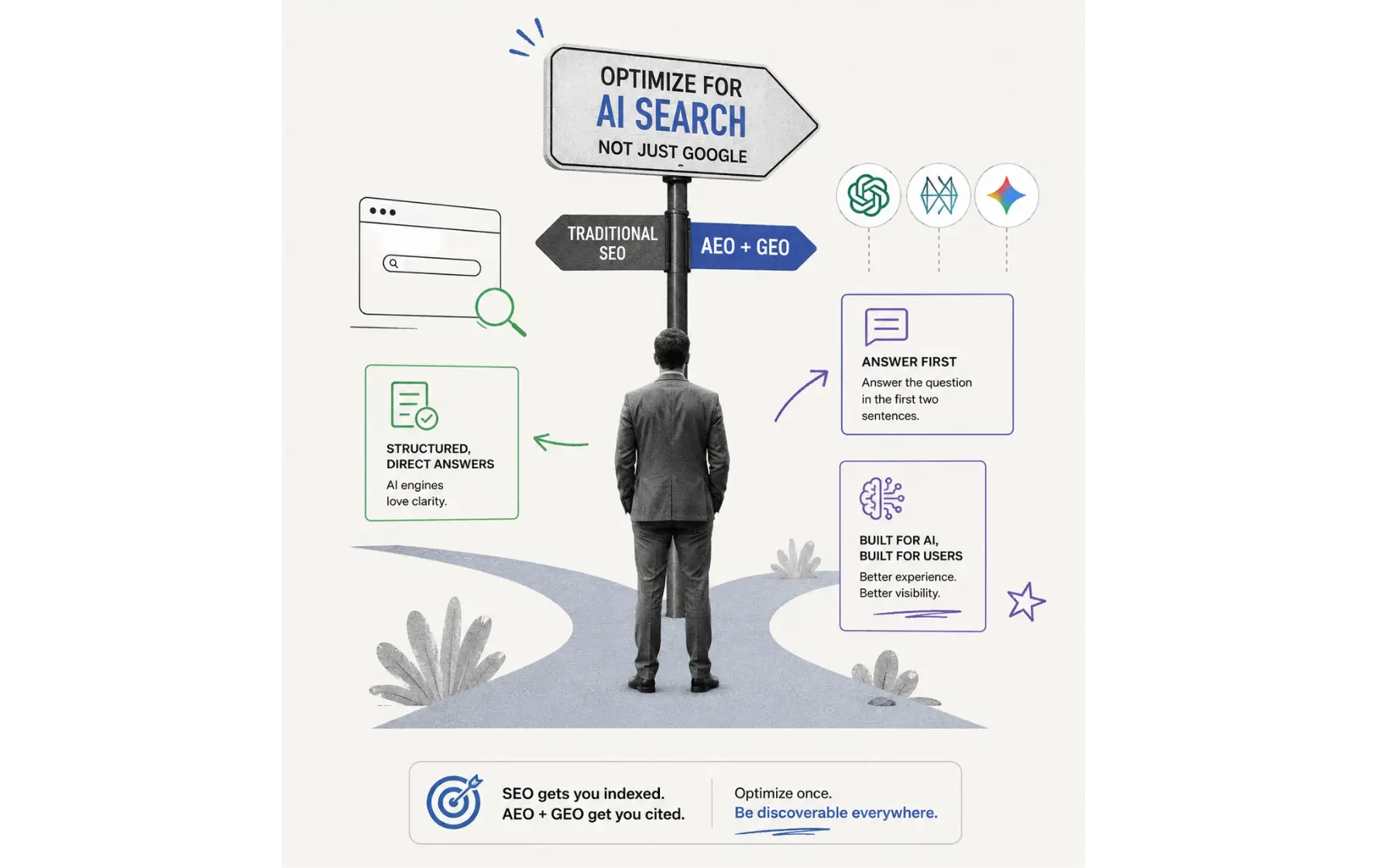
Answer engines like ChatGPT, Perplexity, and Google's AI Overviews increasingly cite structured, direct-answer content. That means your SaaS content marketing needs clear definitions, scannable formatting, and content that answers a question in the first two sentences, not the fifth paragraph. This is Answer Engine Optimization (AEO) and Generative Engine Optimization (GEO) layered on top of traditional SEO, not a replacement for it.
B2B SaaS Marketing and Content: What Actually Moves the Needle
B2B SaaS marketing teams often default to generic "thought leadership" content that ranks for nothing and converts no one. What tends to work instead:
Comparison and alternative pages ("[Category] tools compared") that capture buyers actively evaluating options
Use-case pages built around specific job roles or industries, not generic feature lists
Original data or benchmark content that other sites want to cite and link to
Integration pages for every major tool you connect with - these are underrated traffic and conversion sources
Customer story content that doubles as social proof and long-tail keyword coverage
If you've ever stared at a content calendar full of "10 Tips for X" posts wondering why none of them convert, this is usually why. Tips posts build awareness. They rarely build a pipeline on their own.
How to Improve SEO for SaaS Companies: A Practical Checklist
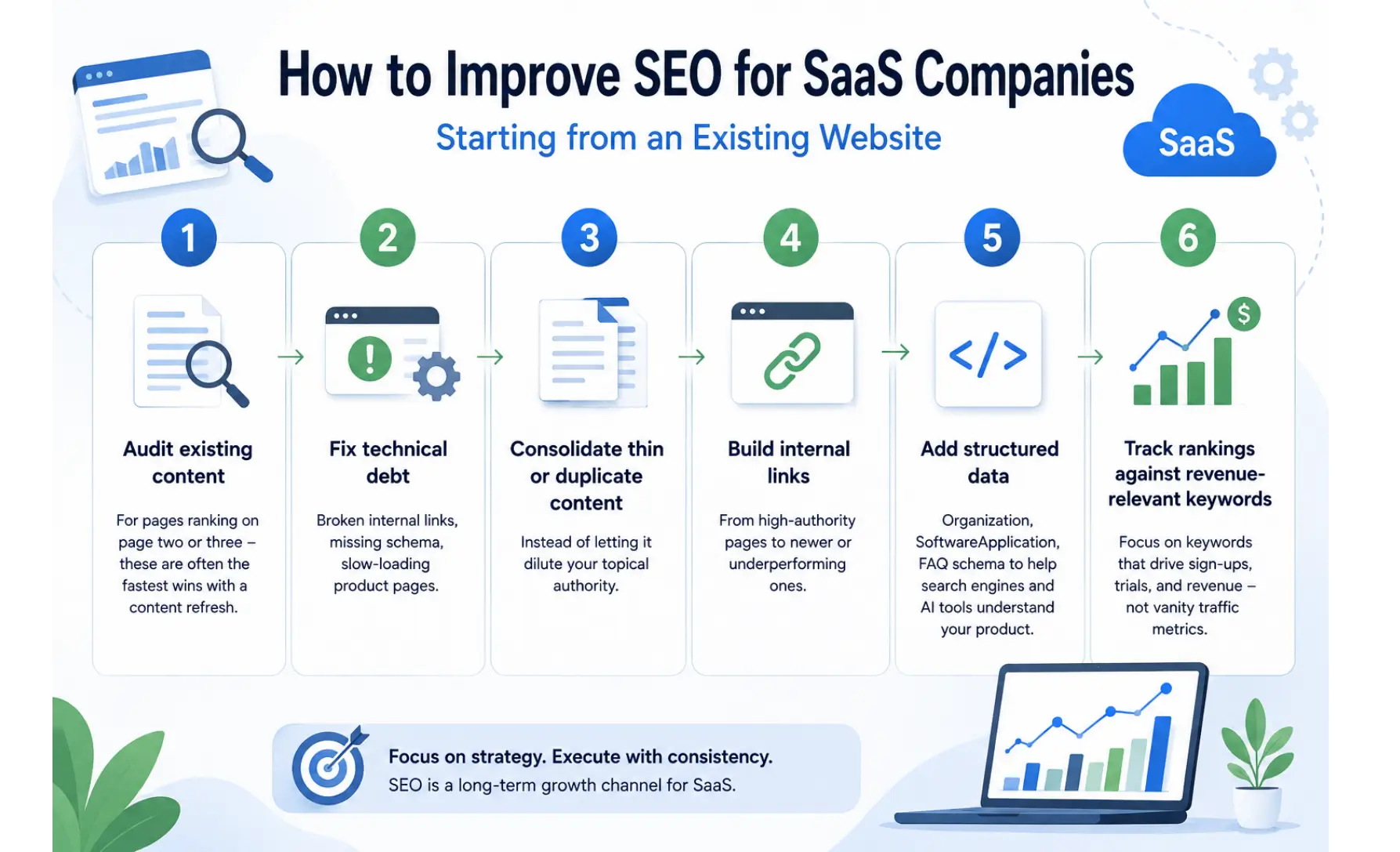
If you're asking how to improve SEO for SaaS companies starting from an existing site rather than a blank slate, start here:
Audit existing content for pages ranking on page two or three - these are often the fastest wins with a content refresh
Fix technical debt - broken internal links, missing schema, slow-loading product pages
Consolidate thin or duplicate content instead of letting it dilute your topical authority
Build internal links from high-authority pages to newer or underperforming ones
Add structured data (Organization, SoftwareApplication, FAQ schema) to help both search engines and AI tools understand your product
Track rankings against revenue-relevant keywords, not vanity traffic metrics
When to Bring In a SaaS SEO Agency
Not every team has the bandwidth to run technical audits, content production, and link building in-house. A SaaS SEO agency earns its keep when it brings specialized experience with product-led SEO, not just generic content writing. The questions worth asking before hiring one: Do they understand product-led growth motions? Can they show SaaS-specific case studies? Do they treat technical SEO as core work, not an afterthought?

Final Thoughts
A SaaS SEO strategy that works isn't built from a content calendar alone. It's a system: keyword research tied to funnel stage, technical SEO that keeps the site fast and crawlable, content that builds topical authority instead of scattered posts, and formatting that works for both traditional search and AI answer engines. Start with an audit of what you have, fix the technical gaps, then build content that matches where your buyers are in their decision. That's the difference between SEO that generates traffic and SEO that generates signups.
FAQs
What is SaaS SEO?

SaaS SEO is the process of optimizing a software company's website, content, and technical infrastructure to rank for the searches its target customers run throughout their buying journey, from early research to final comparison.
How long does a SaaS SEO strategy take to show results?
Most SaaS SEO strategies start showing measurable traffic and ranking movement within 4 to 6 months, with stronger revenue impact typically visible after 9 to 12 months, depending on competition and starting domain authority.
What's the difference between B2B SaaS SEO and regular SEO?
B2B SaaS SEO focuses on longer sales cycles, multiple buyer personas, and content that supports both awareness and late-stage decision-making, including comparison, pricing, and use-case pages that regular consumer SEO rarely needs.
Should SaaS companies focus more on blog content or product pages?
Both matter, but product, feature, and comparison pages often convert at a much higher rate. A balanced strategy uses blog content to build awareness and authority while making sure high-intent product pages are equally optimized.
Is SaaS content marketing still effective with AI search growing?
Yes, but the format matters more now. Content that answers questions directly and clearly is more likely to get cited by AI overviews and tools like ChatGPT or Perplexity, making clear structure and direct answers essential.
Most SaaS companies treat SEO like a checklist: publish a few blog posts, sprinkle in some keywords, and wait for traffic. Then six months pass, traffic barely moves, and someone in a leadership meeting asks why marketing spent a quarter on "content" with nothing to show for it.
SaaS SEO isn't blog SEO with a B2B coat of paint. It's a strategy built around the reality that your buyer researches for weeks or months before they ever start a free trial, and every stage of that research is a chance to be found, trusted, or forgotten.
A working SaaS SEO strategy combines keyword research mapped to the buyer journey, product-led content, technical SEO that supports a fast-shipping engineering team, and authority-building that gets you cited by both Google and AI answer engines.
If you're wondering what SaaS SEO is in practical terms, it's the process of ranking your software product for the searches your ideal customers run before, during, and after they decide to buy - from "what is [problem]" all the way to "[your category] vs [alternative]."
What Is SaaS SEO?
Saas SEO is the practice of optimizing a software company's website, content, and technical foundation so it ranks for the searches its ideal customers run at every stage of the buying process, not just the ones closest to a purchase. Unlike SEO for a local shop or an e-commerce store, it has to account for a product nobody can touch or try in five minutes.
The buyer needs to understand the problem, evaluate the category, compare specific tools, and build a case internally before they ever hit "start free trial." That's why a serious SaaS SEO program covers blog content, product and feature pages, comparison pages, and technical performance all at once, rather than treating any one of them as the whole strategy.
Why SEO for SaaS Businesses Works Differently
Ecommerce SEO chases transactional keywords. Local SEO chases "near me" searches. SaaS SEO has to do something harder: build trust with a buyer who's going to spend real budget on a recurring subscription, often with multiple stakeholders signing off.
A few things make SEO for SaaS businesses its own discipline:
Long, non-linear buying cycles. A buyer might read a comparison post in January and not convert until Q3.
Multiple personas per deal. The person who searches "best project management tool" isn't always the person who signs the contract.
High-intent, low-volume keywords matter more than volume. A term with 90 searches a month that converts at 8% can outperform a 10,000-search term that converts at 0.2%.
Product pages need to rank too. Not just blog content - feature pages, integration pages, and use-case pages carry serious weight.
Honestly, most teams overweight blog volume and underweight the pages that actually sit closest to the buying decision. That's the fastest fix I'd make on most SaaS sites.
Building a SaaS SEO Strategy: The Core Framework
A real SaaS SEO strategy isn't a content calendar. It's a system with four connected parts.
1. Map Keywords to the Funnel, Not Just to Volume
Before writing anything, sort your keyword list by intent:
Funnel Stage | Example Intent | Content Type |
|---|---|---|
Awareness | "why is [process] hard" | Educational blog posts |
Consideration | "best tools for [job]" | Comparison and listicle content |
Decision | "[your category] pricing" | Pricing, feature, and comparison pages |
Retention | "how to [use feature]" | Help docs, onboarding guides |
This is where saas marketing seo and demand generation actually meet. Awareness content builds the audience; decision-stage content converts it.
2. Build Topical Authority, Not Just Individual Posts
Google and AI search engines both reward sites that demonstrate depth on a subject, not sites that publish one strong post and twenty thin ones. Group your content into clusters: a pillar page on your core category, supported by cluster posts that each answer one specific question within it, all interlinked.
This is also where a B2B SaaS SEO strategy diverges from consumer content. B2B buyers dig deeper - they'll click through three or four supporting articles before they trust a claim. Thin content gets exposed fast.
3. Don't Skip the Technical Layer
Core Web Vitals, crawlability, and clean site architecture aren't optional extras. SaaS sites tend to be app-heavy, which means slow JavaScript rendering, bloated product screenshots, and orphaned help-doc pages are common problems. An audit that checks indexation, page speed, internal linking, and schema markup should happen before you scale content production, not after.
4. Optimize for AI Search, Not Just Google
Answer engines like ChatGPT, Perplexity, and Google's AI Overviews increasingly cite structured, direct-answer content. That means your SaaS content marketing needs clear definitions, scannable formatting, and content that answers a question in the first two sentences, not the fifth paragraph. This is Answer Engine Optimization (AEO) and Generative Engine Optimization (GEO) layered on top of traditional SEO, not a replacement for it.
B2B SaaS Marketing and Content: What Actually Moves the Needle
B2B SaaS marketing teams often default to generic "thought leadership" content that ranks for nothing and converts no one. What tends to work instead:
Comparison and alternative pages ("[Category] tools compared") that capture buyers actively evaluating options
Use-case pages built around specific job roles or industries, not generic feature lists
Original data or benchmark content that other sites want to cite and link to
Integration pages for every major tool you connect with - these are underrated traffic and conversion sources
Customer story content that doubles as social proof and long-tail keyword coverage
If you've ever stared at a content calendar full of "10 Tips for X" posts wondering why none of them convert, this is usually why. Tips posts build awareness. They rarely build a pipeline on their own.
How to Improve SEO for SaaS Companies: A Practical Checklist
If you're asking how to improve SEO for SaaS companies starting from an existing site rather than a blank slate, start here:
Audit existing content for pages ranking on page two or three - these are often the fastest wins with a content refresh
Fix technical debt - broken internal links, missing schema, slow-loading product pages
Consolidate thin or duplicate content instead of letting it dilute your topical authority
Build internal links from high-authority pages to newer or underperforming ones
Add structured data (Organization, SoftwareApplication, FAQ schema) to help both search engines and AI tools understand your product
Track rankings against revenue-relevant keywords, not vanity traffic metrics
When to Bring In a SaaS SEO Agency
Not every team has the bandwidth to run technical audits, content production, and link building in-house. A SaaS SEO agency earns its keep when it brings specialized experience with product-led SEO, not just generic content writing. The questions worth asking before hiring one: Do they understand product-led growth motions? Can they show SaaS-specific case studies? Do they treat technical SEO as core work, not an afterthought?
Final Thoughts
A SaaS SEO strategy that works isn't built from a content calendar alone. It's a system: keyword research tied to funnel stage, technical SEO that keeps the site fast and crawlable, content that builds topical authority instead of scattered posts, and formatting that works for both traditional search and AI answer engines. Start with an audit of what you have, fix the technical gaps, then build content that matches where your buyers are in their decision. That's the difference between SEO that generates traffic and SEO that generates signups.
FAQs
What is SaaS SEO?
SaaS SEO is the process of optimizing a software company's website, content, and technical infrastructure to rank for the searches its target customers run throughout their buying journey, from early research to final comparison.
How long does a SaaS SEO strategy take to show results?
Most SaaS SEO strategies start showing measurable traffic and ranking movement within 4 to 6 months, with stronger revenue impact typically visible after 9 to 12 months, depending on competition and starting domain authority.
What's the difference between B2B SaaS SEO and regular SEO?
B2B SaaS SEO focuses on longer sales cycles, multiple buyer personas, and content that supports both awareness and late-stage decision-making, including comparison, pricing, and use-case pages that regular consumer SEO rarely needs.
Should SaaS companies focus more on blog content or product pages?
Both matter, but product, feature, and comparison pages often convert at a much higher rate. A balanced strategy uses blog content to build awareness and authority while making sure high-intent product pages are equally optimized.
Is SaaS content marketing still effective with AI search growing?
Yes, but the format matters more now. Content that answers questions directly and clearly is more likely to get cited by AI overviews and tools like ChatGPT or Perplexity, making clear structure and direct answers essential.



Summarize with AI



Want to Skyrocket Revenue? Get a Free Audit Today!
Want to Skyrocket Revenue? Get a Free Audit Today!



4.9/5 Ratings!


Don’t miss our revenue growth tips!
Get expert marketing tips—straight to your inbox, like thousands of happy clients.
Don’t miss our revenue growth tips!
Get expert marketing tips—straight to your inbox, like thousands of happy clients.
Don’t miss our revenue growth tips!
Don’t miss our revenue growth tips!
Get expert marketing tips—straight to your inbox, like thousands of happy clients.
Relevant Blogs on Organic SEO
Relevant Blogs on Organic SEO
Unlock data-driven insights in Organic SEO—explore our featured blogs and skyrocket your revenue before your competitors do.
Unlock data-driven insights in Organic SEO—explore our featured blogs and skyrocket your revenue before your competitors do.

SEO
Sep 21, 2026
5 Min Read
Audience-First SEO: How to Rank by Putting Readers First
SEO
Sep 21, 2026
5 Min Read
Audience-First SEO: How to Rank by Putting Readers First
SEO
Sep 21, 2026
5 Min Read
Audience-First SEO: How to Rank by Putting Readers First

SEO
Sep 19, 2026
5 Min Read
How to Add SEO Keywords to Your Website: Where and How
SEO
Sep 19, 2026
5 Min Read
How to Add SEO Keywords to Your Website: Where and How
SEO
Sep 19, 2026
5 Min Read
How to Add SEO Keywords to Your Website: Where and How

SEO
Sep 18, 2026
5 Min Read
How XML Sitemaps Help Search Engines Discover New Pages
SEO
Sep 18, 2026
5 Min Read
How XML Sitemaps Help Search Engines Discover New Pages
SEO
Sep 18, 2026
5 Min Read
How XML Sitemaps Help Search Engines Discover New Pages



















Ready to speak with an expert?
Data-Driven Marketing Agency That Elevates ROI
1100+
Websites Designed & Optimized to Convert
$280M+
Client Revenue Driven & Growing Strong
Discover how to skyrocket
your revenue today!
Trusted by 1000+ Owners!
Ready to speak with an expert?
Data-Driven Marketing Agency That Elevates ROI
1100+
Websites Designed & Optimized to Convert
$280M+
Client Revenue Driven & Growing Strong
Discover how to skyrocket
your revenue today!
Trusted by 1000+ Owners!
Want to skyrocket revenue?
4.9/5 Ratings!
Ready to speak with an expert?
Data-Driven Marketing Agency That Elevates ROI
1100+
Websites Designed & Optimized to Convert
$280M+
Client Revenue Driven & Growing Strong
Want to skyrocket
revenue?
Trusted by 1000+ Owners!
Call
Meet