What Businesses Can Learn from McDonald's 550% Growth with Google Analytics 4
Last Updated:

Table of Content
Case Studies




Deepak Prajapat
Deepak Prajapat
Marketing Trends
Marketing Trends
8 Min Read
8 Min
McDonald's Hong Kong recently shared a case study, published by Google Marketing Platform, describing how it used Google Analytics 4 to improve in-app ordering performance. The company combined GA4's predictive audiences with a Google Ads integration to identify customers most likely to place an order within a short window, then targeted that group directly.
According to the official case study, this approach led to a 550% increase in conversions among the "likely 7-day purchasers" audience, a 63% drop in cost-per-action for that same group, and a 560% increase in revenue from those customers, all within about two months.
These figures apply to one campaign in one market, not a universal benchmark. What makes the case study worth studying isn't the percentage itself, it's the process: using first-party behavioral data to predict future action, then acting on that prediction before the customer decides. That approach applies well beyond quick-service restaurants.
What Happened in the McDonald's Hong Kong GA4 Case Study
During a period when in-app food ordering was rising, McDonald's Hong Kong wanted a clearer picture of how app users actually moved toward a purchase. Working with analytics partner Media.Monks, the team implemented Google Analytics 4 and began collecting real-time e-commerce data directly from the app.
With that data flowing in, McDonald's turned to GA4's predictive audiences, which are built using predictive metrics such as purchase probability. Rather than manually segmenting users, the team let GA4 surface a ready-made audience of people likely to purchase within the next seven days. This shortened analysis that could have taken months into a couple of weeks.
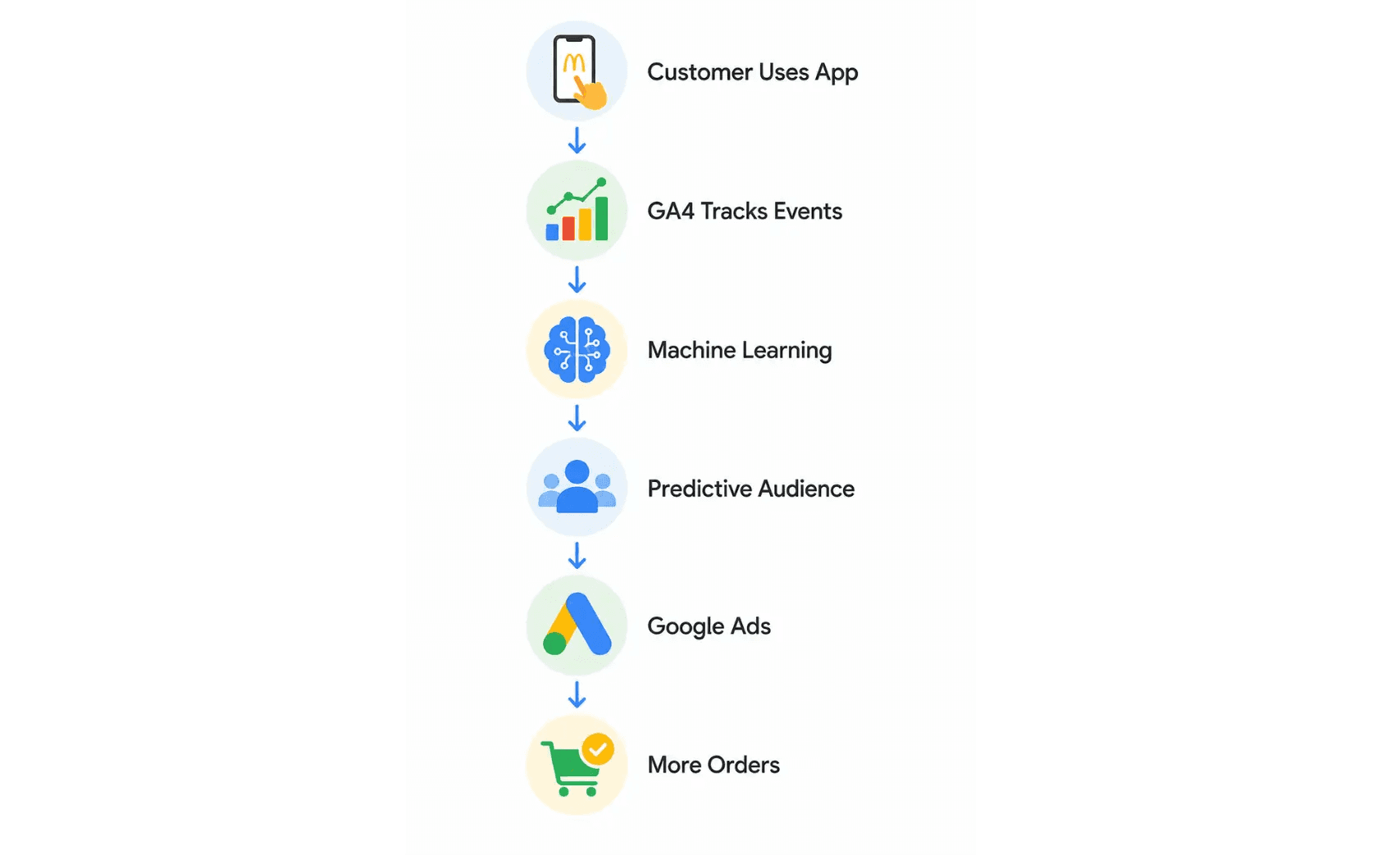
That audience was then exported into Google Ads, where media agency OMD recommended App Campaigns for Engagement, a campaign type built to prompt existing app users to take action. Google Ads automatically tested combinations of text, image, and video creative for that audience. The combination of predictive targeting and automated ad testing is what produced the reported results for the "likely 7-day purchasers" segment.
What Are Predictive Audiences in GA4?
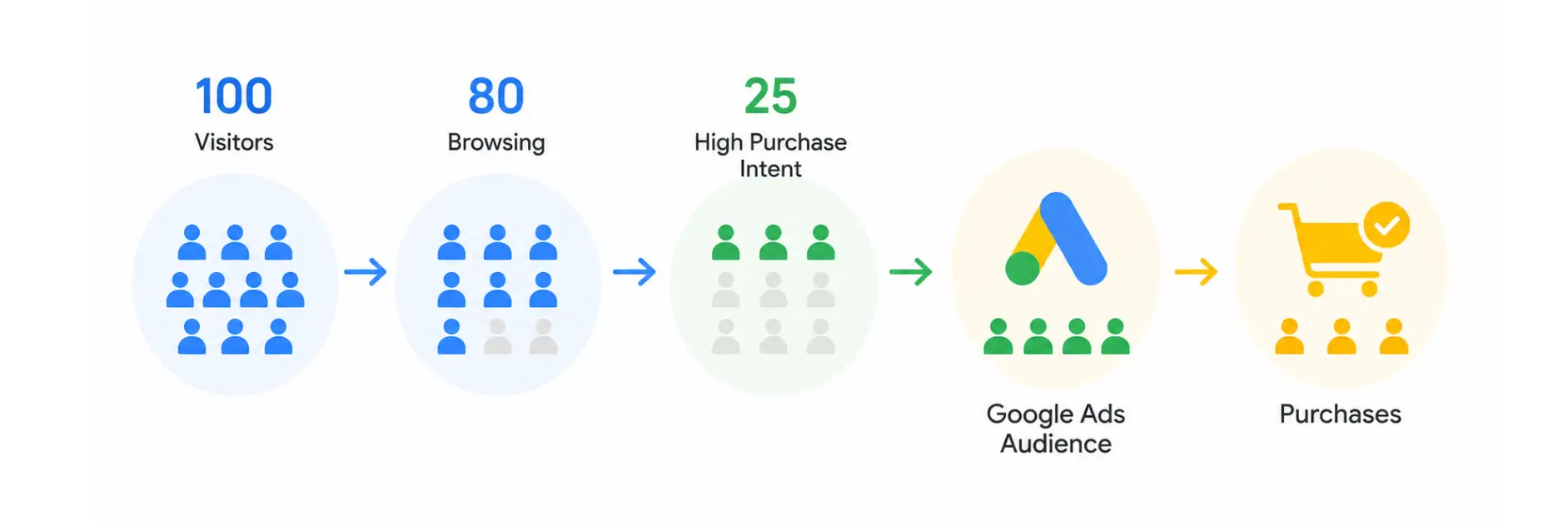
Predictive audiences are groups GA4 builds automatically using machine learning models trained on a property's own event data. Instead of asking a marketer to define an audience manually, GA4 evaluates behavior patterns and estimates how likely a user is to take a specific action.
The most common predictive metrics are purchase probability, which estimates the likelihood a user will convert in the next seven days, and churn probability, which flags users who are becoming less active. GA4 refreshes these audiences automatically as new data comes in, so the list of "likely purchasers" or "likely churners" updates without manual rebuilding.
This removes a lot of manual segmentation work. But it's worth being clear-eyed: predictive audiences only populate once a property has enough qualifying data and enough users meeting the prediction conditions. Smaller sites or newer apps may not see them populate right away. They're a capability to build toward, not a switch every account can flip on day one.
Why This Matters for Businesses in the United States
The underlying idea, using behavioral data to predict who is close to converting, applies across industries. An e-commerce store might build a purchase-probability audience from shoppers who repeatedly view a product category without buying. A remodeling or roofing company might treat repeat visits to a pricing page, project gallery, or consultation form as a stronger buying signal than one site visit. A healthcare clinic could use appointment-page engagement to spot visitors likely to book. A SaaS company might flag trial users whose usage patterns resemble past upgrades. A law firm or financial advisory practice could prioritize spend toward visitors who've returned to a services page more than once.
In each case, the business isn't guessing who's interested. It's using existing behavior on its own site or app to make that judgment, then feeding it into paid media.
What Marketers Should Learn From This Case Study
A few lessons stand out. Accurate event tracking has to come before any predictive modeling; GA4 can't predict behavior it isn't measuring. Audience segmentation based on actual conversion likelihood tends to outperform broad demographic targeting. And the direct loop between GA4 and Google Ads means audience insight doesn't have to sit in a dashboard, it can move straight into an active campaign.
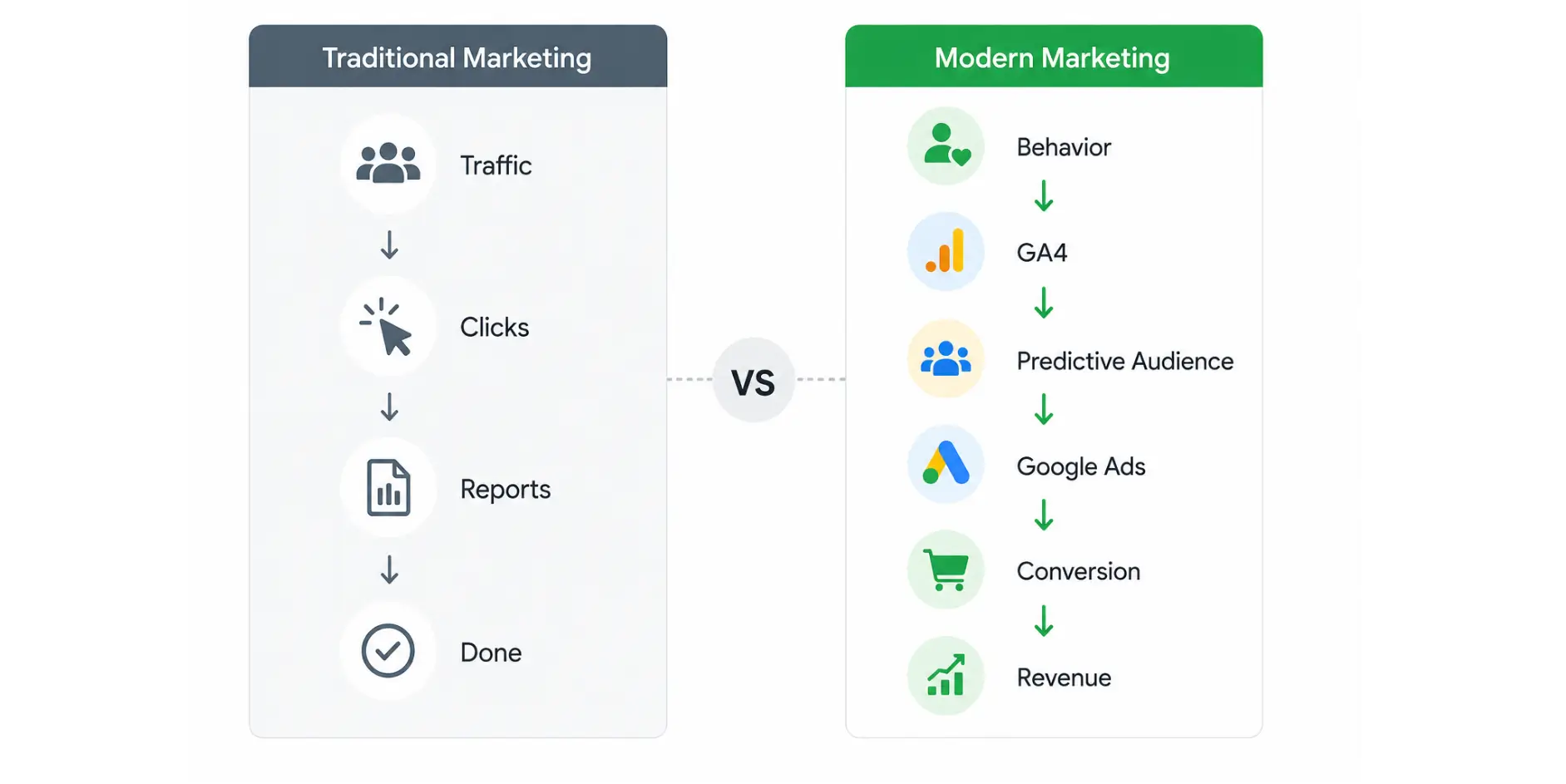
It's also a reminder to measure outcomes that matter, revenue, leads, completed purchases, and repeat customers, rather than traffic or impressions alone. A campaign can look healthy on surface metrics while under-performing on the numbers that affect the bottom line.
Why Analytics Should Lead to Action
The most useful part of this case study isn't the dashboard; it's what McDonald's did with what the dashboard showed. Analytics data is only valuable once it changes a decision.
That can mean deciding which users get remarketed to, which campaigns deserve more budget, which landing pages are causing drop-off, or which segments are worth the ad spend in the first place. GA4's predictive metrics and audience exports are built specifically to make that decision-making faster, not to replace it.
Key Takeaways
McDonald's Hong Kong used GA4 predictive audiences and a Google Ads integration to target likely purchasers, resulting in reported gains of 550% in conversions, a 63% drop in cost-per-action, and 560% in revenue for that segment over roughly two months.
Predictive audiences use machine learning to estimate purchase or churn probability from a property's own data, refreshing automatically as new activity comes in.
These audiences need sufficient qualifying data before they populate, they aren't available instantly for every account.
The same principle, targeting users based on predicted behavior rather than broad segments, applies to e-commerce, home services, healthcare, SaaS, and professional services.
Solid event and conversion tracking is a prerequisite for any predictive modeling to work.
The direct GA4-to-Google Ads audience export is what turns an analytics insight into an active campaign.
Measuring revenue, leads, and retention gives a clearer read on performance than traffic or impressions alone.
Final Thoughts
The McDonald's Hong Kong case study is a useful example of what happens when analytics data is treated as an input to decisions rather than just a monthly report. Google Analytics 4 was built to do more than record what already happened; its predictive metrics and Google Ads integration are designed to shape what a business does next. For companies evaluating their own analytics setup, the takeaway isn't to expect identical percentages. It's to ask whether their current tracking and audience strategy actually informs their advertising and retention decisions or whether the data is just sitting in a dashboard.
FAQs
What are predictive audiences in GA4?

They are audience groups GA4 builds automatically using machine learning, based on predictive metrics like purchase probability or churn probability calculated from a property's own event data.
Can small businesses use GA4 predictive audiences?
Yes, but predictive audiences only populate once a property has enough qualifying data and enough users meeting the prediction thresholds. Smaller or newer properties may need to build up traffic and event history first.
Does GA4 automatically improve Google Ads campaigns?
Not on its own. GA4 can export predictive audiences into Google Ads, and campaign types like App Campaigns for Engagement can automate creative testing, but someone still has to set up the tracking, choose the audiences, and manage the campaign.
What data is needed for GA4 predictive metrics?
GA4 needs consistent, accurate e-commerce or app event data, such as purchases, add-to-cart actions, or in-app orders, tracked over time so its models have enough history to calculate probability scores.
How can businesses improve conversion tracking?
Start by confirming that key actions (purchases, leads, sign-ups, bookings) are firing correctly as GA4 events, then check that those events are marked as conversions and are visible in Google Ads before layering on audience or predictive strategies.
McDonald's Hong Kong recently shared a case study, published by Google Marketing Platform, describing how it used Google Analytics 4 to improve in-app ordering performance. The company combined GA4's predictive audiences with a Google Ads integration to identify customers most likely to place an order within a short window, then targeted that group directly.
According to the official case study, this approach led to a 550% increase in conversions among the "likely 7-day purchasers" audience, a 63% drop in cost-per-action for that same group, and a 560% increase in revenue from those customers, all within about two months.
These figures apply to one campaign in one market, not a universal benchmark. What makes the case study worth studying isn't the percentage itself, it's the process: using first-party behavioral data to predict future action, then acting on that prediction before the customer decides. That approach applies well beyond quick-service restaurants.
What Happened in the McDonald's Hong Kong GA4 Case Study
During a period when in-app food ordering was rising, McDonald's Hong Kong wanted a clearer picture of how app users actually moved toward a purchase. Working with analytics partner Media.Monks, the team implemented Google Analytics 4 and began collecting real-time e-commerce data directly from the app.
With that data flowing in, McDonald's turned to GA4's predictive audiences, which are built using predictive metrics such as purchase probability. Rather than manually segmenting users, the team let GA4 surface a ready-made audience of people likely to purchase within the next seven days. This shortened analysis that could have taken months into a couple of weeks.
That audience was then exported into Google Ads, where media agency OMD recommended App Campaigns for Engagement, a campaign type built to prompt existing app users to take action. Google Ads automatically tested combinations of text, image, and video creative for that audience. The combination of predictive targeting and automated ad testing is what produced the reported results for the "likely 7-day purchasers" segment.
What Are Predictive Audiences in GA4?
Predictive audiences are groups GA4 builds automatically using machine learning models trained on a property's own event data. Instead of asking a marketer to define an audience manually, GA4 evaluates behavior patterns and estimates how likely a user is to take a specific action.
The most common predictive metrics are purchase probability, which estimates the likelihood a user will convert in the next seven days, and churn probability, which flags users who are becoming less active. GA4 refreshes these audiences automatically as new data comes in, so the list of "likely purchasers" or "likely churners" updates without manual rebuilding.
This removes a lot of manual segmentation work. But it's worth being clear-eyed: predictive audiences only populate once a property has enough qualifying data and enough users meeting the prediction conditions. Smaller sites or newer apps may not see them populate right away. They're a capability to build toward, not a switch every account can flip on day one.
Why This Matters for Businesses in the United States
The underlying idea, using behavioral data to predict who is close to converting, applies across industries. An e-commerce store might build a purchase-probability audience from shoppers who repeatedly view a product category without buying. A remodeling or roofing company might treat repeat visits to a pricing page, project gallery, or consultation form as a stronger buying signal than one site visit. A healthcare clinic could use appointment-page engagement to spot visitors likely to book. A SaaS company might flag trial users whose usage patterns resemble past upgrades. A law firm or financial advisory practice could prioritize spend toward visitors who've returned to a services page more than once.
In each case, the business isn't guessing who's interested. It's using existing behavior on its own site or app to make that judgment, then feeding it into paid media.
What Marketers Should Learn From This Case Study
A few lessons stand out. Accurate event tracking has to come before any predictive modeling; GA4 can't predict behavior it isn't measuring. Audience segmentation based on actual conversion likelihood tends to outperform broad demographic targeting. And the direct loop between GA4 and Google Ads means audience insight doesn't have to sit in a dashboard, it can move straight into an active campaign.
It's also a reminder to measure outcomes that matter, revenue, leads, completed purchases, and repeat customers, rather than traffic or impressions alone. A campaign can look healthy on surface metrics while under-performing on the numbers that affect the bottom line.
Why Analytics Should Lead to Action
The most useful part of this case study isn't the dashboard; it's what McDonald's did with what the dashboard showed. Analytics data is only valuable once it changes a decision.
That can mean deciding which users get remarketed to, which campaigns deserve more budget, which landing pages are causing drop-off, or which segments are worth the ad spend in the first place. GA4's predictive metrics and audience exports are built specifically to make that decision-making faster, not to replace it.
Key Takeaways
McDonald's Hong Kong used GA4 predictive audiences and a Google Ads integration to target likely purchasers, resulting in reported gains of 550% in conversions, a 63% drop in cost-per-action, and 560% in revenue for that segment over roughly two months.
Predictive audiences use machine learning to estimate purchase or churn probability from a property's own data, refreshing automatically as new activity comes in.
These audiences need sufficient qualifying data before they populate, they aren't available instantly for every account.
The same principle, targeting users based on predicted behavior rather than broad segments, applies to e-commerce, home services, healthcare, SaaS, and professional services.
Solid event and conversion tracking is a prerequisite for any predictive modeling to work.
The direct GA4-to-Google Ads audience export is what turns an analytics insight into an active campaign.
Measuring revenue, leads, and retention gives a clearer read on performance than traffic or impressions alone.
Final Thoughts
The McDonald's Hong Kong case study is a useful example of what happens when analytics data is treated as an input to decisions rather than just a monthly report. Google Analytics 4 was built to do more than record what already happened; its predictive metrics and Google Ads integration are designed to shape what a business does next. For companies evaluating their own analytics setup, the takeaway isn't to expect identical percentages. It's to ask whether their current tracking and audience strategy actually informs their advertising and retention decisions or whether the data is just sitting in a dashboard.
FAQs
What are predictive audiences in GA4?
They are audience groups GA4 builds automatically using machine learning, based on predictive metrics like purchase probability or churn probability calculated from a property's own event data.
Can small businesses use GA4 predictive audiences?
Yes, but predictive audiences only populate once a property has enough qualifying data and enough users meeting the prediction thresholds. Smaller or newer properties may need to build up traffic and event history first.
Does GA4 automatically improve Google Ads campaigns?
Not on its own. GA4 can export predictive audiences into Google Ads, and campaign types like App Campaigns for Engagement can automate creative testing, but someone still has to set up the tracking, choose the audiences, and manage the campaign.
What data is needed for GA4 predictive metrics?
GA4 needs consistent, accurate e-commerce or app event data, such as purchases, add-to-cart actions, or in-app orders, tracked over time so its models have enough history to calculate probability scores.
How can businesses improve conversion tracking?
Start by confirming that key actions (purchases, leads, sign-ups, bookings) are firing correctly as GA4 events, then check that those events are marked as conversions and are visible in Google Ads before layering on audience or predictive strategies.



Summarize with AI

Latest Blogs






Want to be seen everywhere?
Get a free AI-search audit Today!



4.9/5 Ratings!


Don’t miss our revenue growth tips!
Get expert marketing tips—straight to your inbox, like thousands of happy clients.
Don’t miss our revenue growth tips!
Get expert marketing tips—straight to your inbox, like thousands of happy clients.
Don’t miss our revenue growth tips!
Don’t miss our revenue growth tips!
Get expert marketing tips—straight to your inbox, like thousands of happy clients.
Explore News, Updates & Strategies
Explore News, Updates & Strategies
Explore the latest industry updates, marketing trends, Google changes, expert insights, success stories, eCommerce strategies, AEO innovations, and lead generation techniques — all in one place.
Explore the latest industry updates, marketing trends, Google changes, expert insights, success stories, eCommerce strategies, AEO innovations, and lead generation techniques — all in one place.

Google Updates
Sep 26, 2026
3 Min Read
Google Search Console Adds Multimodal Search Performance Reporting
Google Updates
Sep 26, 2026
3 Min Read
Google Search Console Adds Multimodal Search Performance Reporting
Google Updates
Sep 26, 2026
3 Min Read
Google Search Console Adds Multimodal Search Performance Reporting
Google Updates
Sep 2, 2026
5 Min Read
Google Search Console's Generative AI Performance Report Goes Fully Global
Google Updates
Sep 2, 2026
5 Min Read
Google Search Console's Generative AI Performance Report Goes Fully Global
Google Updates
Sep 2, 2026
5 Min Read
Google Search Console's Generative AI Performance Report Goes Fully Global

Google Updates
Aug 18, 2026
5 Min Read
Google’s August 2026 Spam Update: Who Won, Who Lost & Why?
Google Updates
Aug 18, 2026
5 Min Read
Google’s August 2026 Spam Update: Who Won, Who Lost & Why?
Google Updates
Aug 18, 2026
5 Min Read
Google’s August 2026 Spam Update: Who Won, Who Lost & Why?






























Ready to speak with an expert?
Data-Driven Marketing Agency That Elevates ROI
1100+
Websites Designed & Optimized to Convert
$280M+
Client Revenue Driven & Growing Strong
Discover how to skyrocket
your revenue today!
Trusted by 1000+ Owners!
Ready to speak with an expert?
Data-Driven Marketing Agency That Elevates ROI
1100+
Websites Designed & Optimized to Convert
$280M+
Client Revenue Driven & Growing Strong
Discover how to skyrocket
your revenue today!
Trusted by 1000+ Owners!
Want to skyrocket revenue?
4.9/5 Ratings!
Ready to speak with an expert?
Data-Driven Marketing Agency That Elevates ROI
1100+
Websites Designed & Optimized to Convert
$280M+
Client Revenue Driven & Growing Strong
Discover how to skyrocket
your revenue today!
Trusted by 1000+ Owners!
Call
Meet