Conflicting Metadata Can Hurt SEO: Google’s Latest Advice
Last Updated:

Table of Content
Case Studies







Divya Vyas
Divya Vyas
Coozmoo News
Coozmoo News
5 Min Read
8 Min
Google's John Mueller just addressed a question that trips up more websites than most SEOs realize: what happens when a page's visible content, its structured data, and an external feed all describe the same thing differently. Like a product listed as "in stock" on the page but shows "out of stock" in the schema markup. Instead of naming which source Google trusts most, Mueller was clear that no such precedence order exists publicly, and that site owners should focus on fixing the inconsistency at its source rather than trying to predict how Google will interpret it. This article breaks down exactly what Mueller said, where these conflicts commonly hide on real websites, and a practical audit process to find and fix them before they quietly undermine how search and AI-driven answer engines read your site.
When Your Own Website Argues With Itself
Picture a product page that says "in stock" in the visible text, while the structured data behind it says "out of stock." A shopper sees one thing. Google's crawler sees another. Which one shows up in Search?
That exact scenario is what prompted Mueller's comments on Conflicting Metadata, and it's a problem far more sites have than most site owners realize.
What Mueller Actually Said
The exchange happened on Bluesky, not in an official Google blog post, which is often where the most candid SEO guidance surfaces now-a-days. SEO consultant Sebastián Galanternik flagged a real listing: the page displayed the item as out of stock, while the server-rendered HTML and structured data both said it was available.
Mueller's response didn't try to explain how Google would resolve the mismatch. Instead, he recommended not providing clashing metadata in the first place, since it makes it hard to work out what's relevant, and suggested serving the data through a feed instead, so it stay consistent.
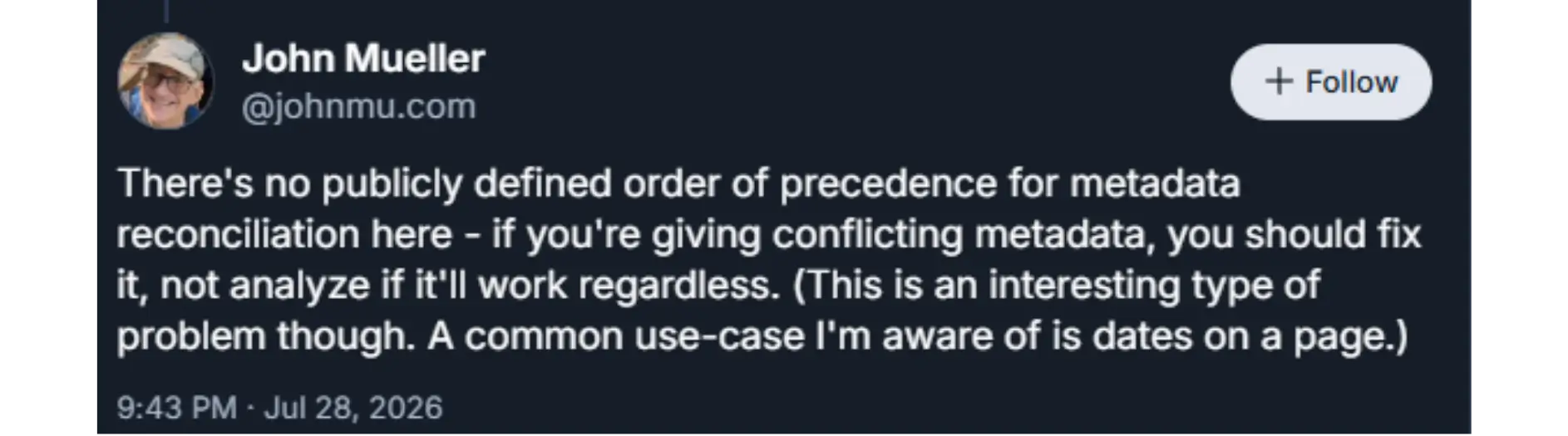
Galanternik pushed further, asking which source Google treats as authoritative when a feed and on-page markup disagree. Mueller was direct: there's no publicly defined order of precedence for metadata reconciliation, and if a site is giving conflicting metadata, the fix is to correct it, not to test whether Google will sort it out in any defined way..
He didn't stop at inventory status. Mueller added that dates on a page are a common version of the same problem. Think a visible "last updated" date that doesn't match the dateModified field in structured data, which in turn doesn't match the lastmod value in your sitemap. Three sources, three different answers, and no rulebook telling Google which one wins.
Why "It'll Probably Work Out" Is the Wrong Approach
Here's the mindset shift this advice is really about. A lot of technical SEO work treats Google's algorithm like a puzzle to reverse-engineer: find the signal, weight it correctly, and win. Mueller is pointing at something more basic. Google's systems weigh and filter these signals differently, and those weights change over time, so there's no stable answer to memorize the pattern.
That means testing which metadata source "wins" today tells you nothing about what will win in the coming three months. You're not solving a puzzle. You're chasing a moving target, and every hour spent doing that is an hour not spent fixing the actual inconsistency of the information.
Mueller has repeated some version of this point for years: consistency, not clever workarounds, is the biggest lever in technical SEO.
Where Conflicting Metadata Usually Hides
Most sites don't introduce these conflicts on purpose. They accumulate. A few common patterns worth auditing are:
Stock and Availability Signals
A product's stock status can live in three separate places: the visible page text, the product schema markup, and a merchant feed. Each one is updated separately, so if your CMS changes one but not the other two, they quietly fall out of sync, and nobody notices until Google or a shopper catches the mismatch.
Date Fields
A visible publish or update date, a dateModified schema property, and a sitemap lastmod value are three separate places the same information lives. Update one during a content refresh and forget the others, and you've created exactly the conflict Mueller described in his comments.
Redirect and Canonical Signals
A permanent redirect tells Google one URL should be canonical. If a rel=canonical tag on that page points somewhere else, you've built a contradiction directly into your indexing signals.
Multiple SEO Plugins or Tools
Sites running more than one SEO plugin, or a plugin alongside manual template edits, often end up injecting duplicate or conflicting meta tags without anyone noticing until traffic dips.

How to Audit Your Site for Metadata Conflicts
You don't need an enterprise tool to catch most of these. A practical, repeatable process:
Pick your highest-value template first: product pages, key landing pages, or your most-linked blog post.
Compare three sources for each page: the visible on-page content, the structured data (view it with Google's Rich Results Test), and any external feed (Merchant Center, sitemap, RSS).
Flag mismatches, don't rank them. You're not deciding which source is "correct" for Google you're deciding which source reflects reality, then making the others match it.
Fix at the source, not the symptom. If your CMS auto-generates a date field that never syncs with your sitemap, that's a template or plugin fix, not a page-by-page fix.
Re-check after major CMS, theme, or plugin updates, since these are the most common points where new conflicts get introduced.
Suggested Insights: What This Means for Your SEO Strategy
Stop treating Google as a black box to reverse-engineer. Mueller's comment is a rare, direct signal that some technical SEO "wins" people chase; like finding which metadata field Google favors aren't stable enough to build a strategy around. Time is better spent on consistency than on precedence-mapping.
Feeds can simplify the problem, not just add to it. Mueller specifically suggested serving availability data through a feed instead of duplicating it across the page and structured data. For ecommerce sites with frequently changing stock, a single source of truth synced everywhere else is more reliable than manually keeping all three fields aligned.
Date metadata is a bigger risk than most sites realize. Content teams that refresh blog posts often update the visible date but forget the dateModified schema field or the sitemap lastmod value. Over time, this creates a pattern of unreliable freshness signals across the whole site, not just isolated pages.
This is a trust signal, not just a technical one. Search engines and AI-driven answer engines increasingly rely on structured data to summarize and cite content accurately. A site that can't keep its own metadata consistent sends a weaker trust signal at exactly the moment AI Overviews and generative search results are leaning harder on that particular data.
Audit before you build anything new. If a site is planning new schema implementation, new feeds, or a CMS migration, doing a metadata consistency audit first prevents baking a new conflict into the next system rather than fixing the old ones.
Final Thoughts
The takeaway here isn't a new ranking factor or a hidden trick. It's a reminder that a lot of SEO problems aren't algorithmic mysteries; they're basic data hygiene issues hiding behind technical language. Google was directly asked to hand over a precedence order, and it declined, because the honest answer is that consistent metadata makes the question irrelevant. Audit your dates, your stock status, and your canonical signals before you spend another hour testing what Google might do with this mess.
FAQs
What counts as "conflicting metadata" in SEO?

It's any situation where two or more sources describing the same page; visible content, structured data, sitemaps, feeds, or redirects are reporting different information, such as an item's stock status or a page's last-updated date.
Does Google publish which metadata source it trusts most?
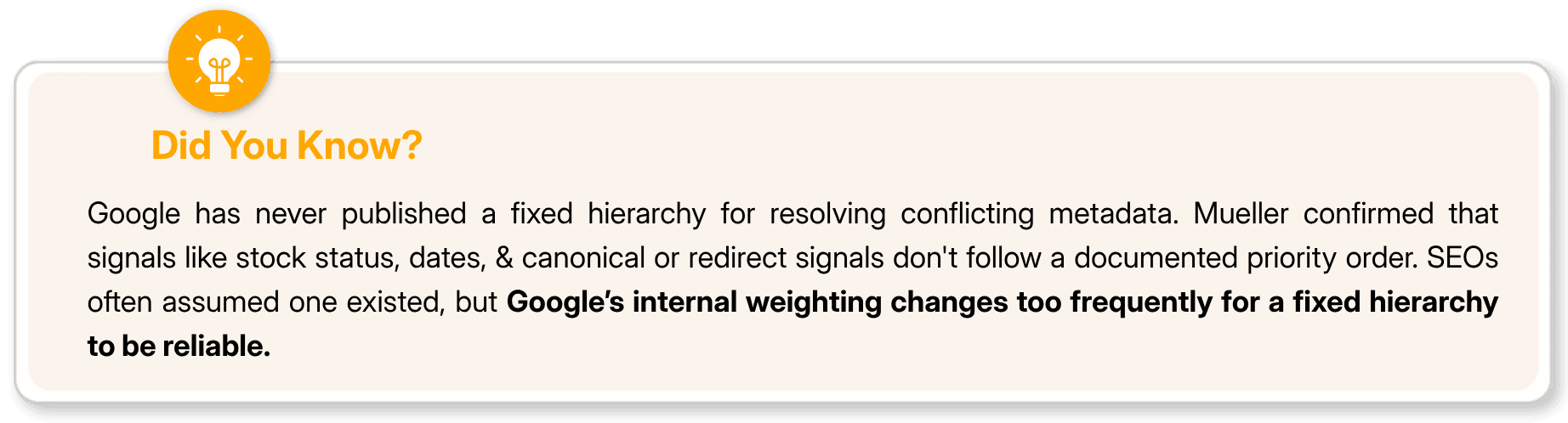
No. Mueller confirmed there's no publicly defined order of precedence, and that internal weighting can shift over time, which is why chasing a fixed hierarchy isn't a reliable strategy. Auditing your dates, your stock status, and your canonical signals is the best practice.
Can conflicting metadata get a page penalized?
It's not framed as a penalty. The risk is confusion: Google may show outdated or inaccurate information in Search, or struggle to determine which signal reflects the current state of the page. A site that can't keep its own metadata consistent sends a weaker trust signal to Google as well as the end consumer.
Where should I start if I think my site has this problem?
Start with your highest-traffic or highest-revenue templates like product pages and cornerstone content; since conflicts there have the most visible impact on users and rankings.
Is this only a problem for ecommerce sites?
No. Date metadata conflicts affect any content-driven site, especially ones that publish or update blogs/articles regularly across multiple CMS fields.
Google's John Mueller just addressed a question that trips up more websites than most SEOs realize: what happens when a page's visible content, its structured data, and an external feed all describe the same thing differently. Like a product listed as "in stock" on the page but shows "out of stock" in the schema markup. Instead of naming which source Google trusts most, Mueller was clear that no such precedence order exists publicly, and that site owners should focus on fixing the inconsistency at its source rather than trying to predict how Google will interpret it. This article breaks down exactly what Mueller said, where these conflicts commonly hide on real websites, and a practical audit process to find and fix them before they quietly undermine how search and AI-driven answer engines read your site.
When Your Own Website Argues With Itself
Picture a product page that says "in stock" in the visible text, while the structured data behind it says "out of stock." A shopper sees one thing. Google's crawler sees another. Which one shows up in Search?
That exact scenario is what prompted Mueller's comments on Conflicting Metadata, and it's a problem far more sites have than most site owners realize.
What Mueller Actually Said
The exchange happened on Bluesky, not in an official Google blog post, which is often where the most candid SEO guidance surfaces now-a-days. SEO consultant Sebastián Galanternik flagged a real listing: the page displayed the item as out of stock, while the server-rendered HTML and structured data both said it was available.
Mueller's response didn't try to explain how Google would resolve the mismatch. Instead, he recommended not providing clashing metadata in the first place, since it makes it hard to work out what's relevant, and suggested serving the data through a feed instead, so it stay consistent.
Galanternik pushed further, asking which source Google treats as authoritative when a feed and on-page markup disagree. Mueller was direct: there's no publicly defined order of precedence for metadata reconciliation, and if a site is giving conflicting metadata, the fix is to correct it, not to test whether Google will sort it out in any defined way..
He didn't stop at inventory status. Mueller added that dates on a page are a common version of the same problem. Think a visible "last updated" date that doesn't match the dateModified field in structured data, which in turn doesn't match the lastmod value in your sitemap. Three sources, three different answers, and no rulebook telling Google which one wins.
Why "It'll Probably Work Out" Is the Wrong Approach
Here's the mindset shift this advice is really about. A lot of technical SEO work treats Google's algorithm like a puzzle to reverse-engineer: find the signal, weight it correctly, and win. Mueller is pointing at something more basic. Google's systems weigh and filter these signals differently, and those weights change over time, so there's no stable answer to memorize the pattern.
That means testing which metadata source "wins" today tells you nothing about what will win in the coming three months. You're not solving a puzzle. You're chasing a moving target, and every hour spent doing that is an hour not spent fixing the actual inconsistency of the information.
Mueller has repeated some version of this point for years: consistency, not clever workarounds, is the biggest lever in technical SEO.
Where Conflicting Metadata Usually Hides
Most sites don't introduce these conflicts on purpose. They accumulate. A few common patterns worth auditing are:
Stock and Availability Signals
A product's stock status can live in three separate places: the visible page text, the product schema markup, and a merchant feed. Each one is updated separately, so if your CMS changes one but not the other two, they quietly fall out of sync, and nobody notices until Google or a shopper catches the mismatch.
Date Fields
A visible publish or update date, a dateModified schema property, and a sitemap lastmod value are three separate places the same information lives. Update one during a content refresh and forget the others, and you've created exactly the conflict Mueller described in his comments.
Redirect and Canonical Signals
A permanent redirect tells Google one URL should be canonical. If a rel=canonical tag on that page points somewhere else, you've built a contradiction directly into your indexing signals.
Multiple SEO Plugins or Tools
Sites running more than one SEO plugin, or a plugin alongside manual template edits, often end up injecting duplicate or conflicting meta tags without anyone noticing until traffic dips.
How to Audit Your Site for Metadata Conflicts
You don't need an enterprise tool to catch most of these. A practical, repeatable process:
Pick your highest-value template first: product pages, key landing pages, or your most-linked blog post.
Compare three sources for each page: the visible on-page content, the structured data (view it with Google's Rich Results Test), and any external feed (Merchant Center, sitemap, RSS).
Flag mismatches, don't rank them. You're not deciding which source is "correct" for Google you're deciding which source reflects reality, then making the others match it.
Fix at the source, not the symptom. If your CMS auto-generates a date field that never syncs with your sitemap, that's a template or plugin fix, not a page-by-page fix.
Re-check after major CMS, theme, or plugin updates, since these are the most common points where new conflicts get introduced.
Suggested Insights: What This Means for Your SEO Strategy
Stop treating Google as a black box to reverse-engineer. Mueller's comment is a rare, direct signal that some technical SEO "wins" people chase; like finding which metadata field Google favors aren't stable enough to build a strategy around. Time is better spent on consistency than on precedence-mapping.
Feeds can simplify the problem, not just add to it. Mueller specifically suggested serving availability data through a feed instead of duplicating it across the page and structured data. For ecommerce sites with frequently changing stock, a single source of truth synced everywhere else is more reliable than manually keeping all three fields aligned.
Date metadata is a bigger risk than most sites realize. Content teams that refresh blog posts often update the visible date but forget the dateModified schema field or the sitemap lastmod value. Over time, this creates a pattern of unreliable freshness signals across the whole site, not just isolated pages.
This is a trust signal, not just a technical one. Search engines and AI-driven answer engines increasingly rely on structured data to summarize and cite content accurately. A site that can't keep its own metadata consistent sends a weaker trust signal at exactly the moment AI Overviews and generative search results are leaning harder on that particular data.
Audit before you build anything new. If a site is planning new schema implementation, new feeds, or a CMS migration, doing a metadata consistency audit first prevents baking a new conflict into the next system rather than fixing the old ones.
Final Thoughts
The takeaway here isn't a new ranking factor or a hidden trick. It's a reminder that a lot of SEO problems aren't algorithmic mysteries; they're basic data hygiene issues hiding behind technical language. Google was directly asked to hand over a precedence order, and it declined, because the honest answer is that consistent metadata makes the question irrelevant. Audit your dates, your stock status, and your canonical signals before you spend another hour testing what Google might do with this mess.
FAQs
What counts as "conflicting metadata" in SEO?
It's any situation where two or more sources describing the same page; visible content, structured data, sitemaps, feeds, or redirects are reporting different information, such as an item's stock status or a page's last-updated date.
Does Google publish which metadata source it trusts most?
No. Mueller confirmed there's no publicly defined order of precedence, and that internal weighting can shift over time, which is why chasing a fixed hierarchy isn't a reliable strategy. Auditing your dates, your stock status, and your canonical signals is the best practice.
Can conflicting metadata get a page penalized?
It's not framed as a penalty. The risk is confusion: Google may show outdated or inaccurate information in Search, or struggle to determine which signal reflects the current state of the page. A site that can't keep its own metadata consistent sends a weaker trust signal to Google as well as the end consumer.
Where should I start if I think my site has this problem?
Start with your highest-traffic or highest-revenue templates like product pages and cornerstone content; since conflicts there have the most visible impact on users and rankings.
Is this only a problem for ecommerce sites?
No. Date metadata conflicts affect any content-driven site, especially ones that publish or update blogs/articles regularly across multiple CMS fields.



Summarize with AI

Latest Blogs







Want to be seen everywhere?
Get a free AI-search audit Today!



4.9/5 Ratings!


Don’t miss our revenue growth tips!
Get expert marketing tips—straight to your inbox, like thousands of happy clients.
Don’t miss our revenue growth tips!
Get expert marketing tips—straight to your inbox, like thousands of happy clients.
Don’t miss our revenue growth tips!
Don’t miss our revenue growth tips!
Get expert marketing tips—straight to your inbox, like thousands of happy clients.
Explore News, Updates & Strategies
Explore News, Updates & Strategies
Explore the latest industry updates, marketing trends, Google changes, expert insights, success stories, eCommerce strategies, AEO innovations, and lead generation techniques — all in one place.
Explore the latest industry updates, marketing trends, Google changes, expert insights, success stories, eCommerce strategies, AEO innovations, and lead generation techniques — all in one place.

Google Updates
Sep 26, 2026
3 Min Read
Google Search Console Adds Multimodal Search Performance Reporting
Google Updates
Sep 26, 2026
3 Min Read
Google Search Console Adds Multimodal Search Performance Reporting
Google Updates
Sep 26, 2026
3 Min Read
Google Search Console Adds Multimodal Search Performance Reporting

Google Updates
Sep 2, 2026
5 Min Read
Google Search Console's Generative AI Performance Report Goes Fully Global
Google Updates
Sep 2, 2026
5 Min Read
Google Search Console's Generative AI Performance Report Goes Fully Global
Google Updates
Sep 2, 2026
5 Min Read
Google Search Console's Generative AI Performance Report Goes Fully Global

Google Updates
Aug 18, 2026
5 Min Read
Google’s August 2026 Spam Update: Who Won, Who Lost & Why?
Google Updates
Aug 18, 2026
5 Min Read
Google’s August 2026 Spam Update: Who Won, Who Lost & Why?
Google Updates
Aug 18, 2026
5 Min Read
Google’s August 2026 Spam Update: Who Won, Who Lost & Why?




































Ready to speak with an expert?
Data-Driven Marketing Agency That Elevates ROI
1100+
Websites Designed & Optimized to Convert
$280M+
Client Revenue Driven & Growing Strong
Discover how to skyrocket
your revenue today!
Trusted by 1000+ Owners!
Ready to speak with an expert?
Data-Driven Marketing Agency That Elevates ROI
1100+
Websites Designed & Optimized to Convert
$280M+
Client Revenue Driven & Growing Strong
Discover how to skyrocket
your revenue today!
Trusted by 1000+ Owners!
Want to skyrocket revenue?
4.9/5 Ratings!
Ready to speak with an expert?
Data-Driven Marketing Agency That Elevates ROI
1100+
Websites Designed & Optimized to Convert
$280M+
Client Revenue Driven & Growing Strong
Discover how to skyrocket
your revenue today!
Trusted by 1000+ Owners!
Call
Meet