What Really Happens When You Stop Blogging? The Hidden Impacts on Traffic, SEO, & AI Visibility.
What Really Happens When You Stop Blogging? The Hidden Impacts on Traffic, SEO, & AI Visibility.
Last Updated:
Table of Content
Case Studies






Richa Dave
Richa Dave
Richa Dave
SEO
SEO
SEO
10 Min Read
10 Min
10 Min Read
Blogging isn't just something that happened in the early days of the web. Even today, it remains a cornerstone of content marketing, SEO, and even AI-driven discovery. If you stop blogging, the effects go beyond just a drop in content. They also affect your traffic, revenue, brand equity, and long-term growth.
This blog explores the full cost of stopping blog postings - from search traffic decline to AI impact.
Why Blogging Still Matters?
Before we talk about what happens when you stop blogging, let's look at why it is still so important today.
Blogging Brings in a Huge ROI
According to SQ Magazine (2025), content marketing delivers an average ROI of $7.65 for every $1 spent.
Blogging is one of the best ways for marketers to reach people.
Blogging is a Top Channel for Marketers
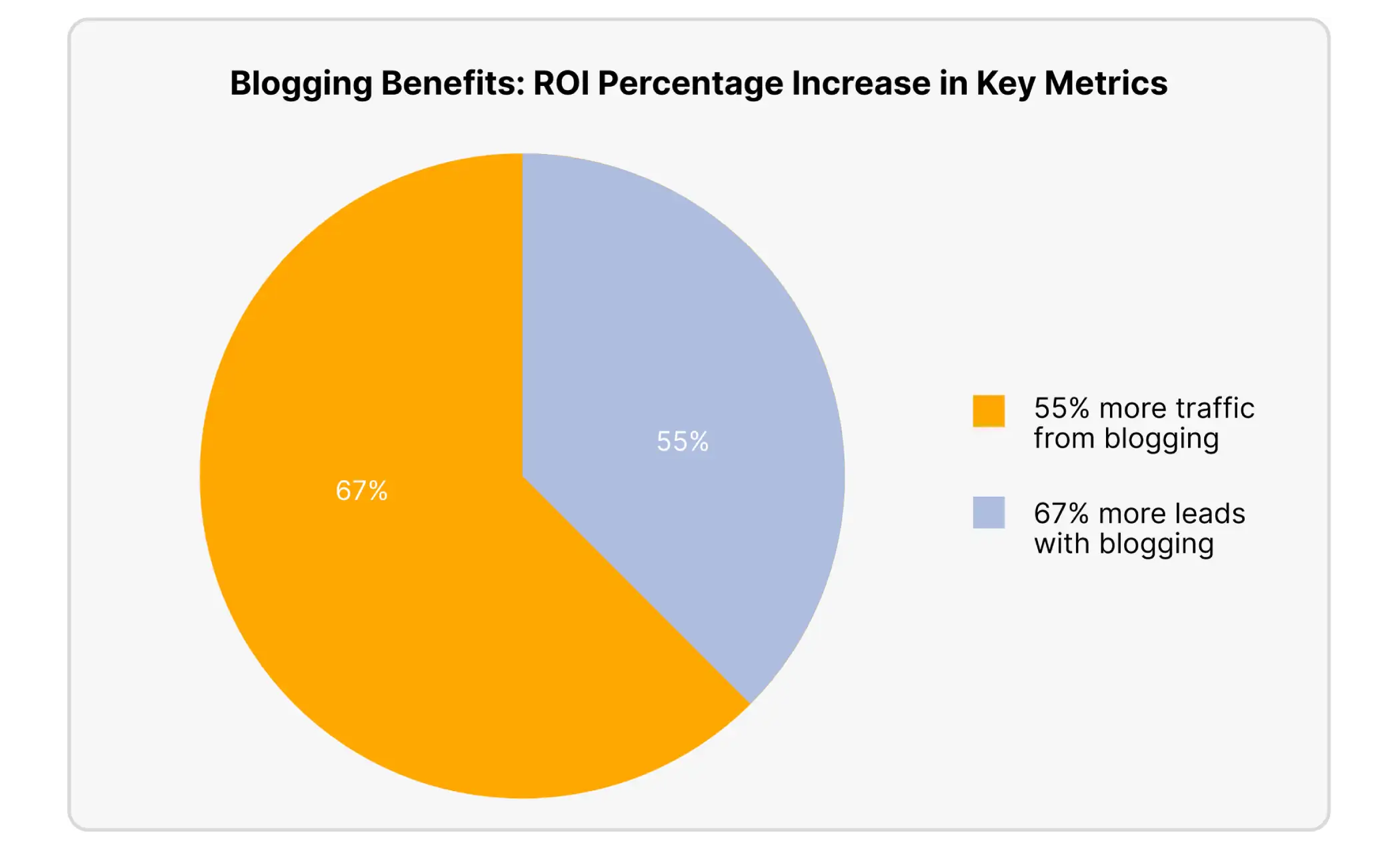
Sources state that 82% of marketers use blogs as a main part of their content marketing plan.
Blogs Massively Boost SEO
Google has 434% more indexed pages for businesses that have active blog postings (Amra & Elma LLC, 2025).
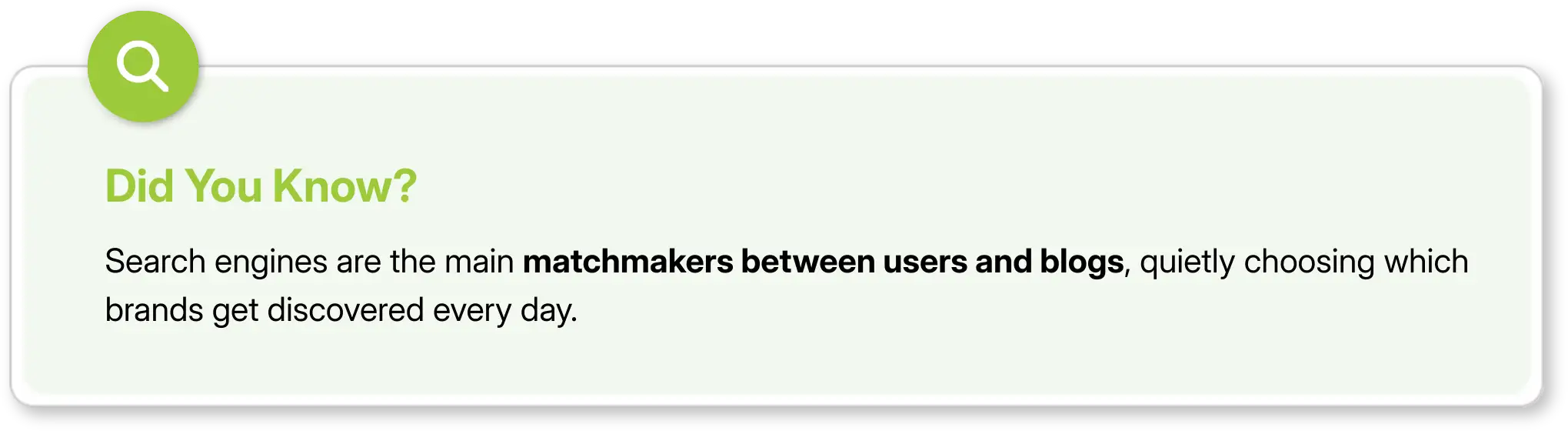
Search engines send 85% of traffic to blogs.
Users Prefer Blogs to Ads
According to a study, 70% of people would rather read articles about a company than see ads.
When brands share useful information, 63% of people trust them more.
AI Is Now a Major Discovery Channel
AI tools like ChatGPT, Gemini, Perplexity, and Claude are more and more likely to quote, summarize, and suggest new blog posts.
Sources says that one in three businesses now use AI tools to help them make content.
In short, blogging is more than just "nice to have." It's the base. You don't just lose blog posts when you stop writing them; you also lose authority, momentum, freshness, and relevance.

What Happens When You Stop Blogging?
Below are the real, measurable impacts businesses experience within months of stopping their blog.
Organic SEO Traffic Drops — Fast
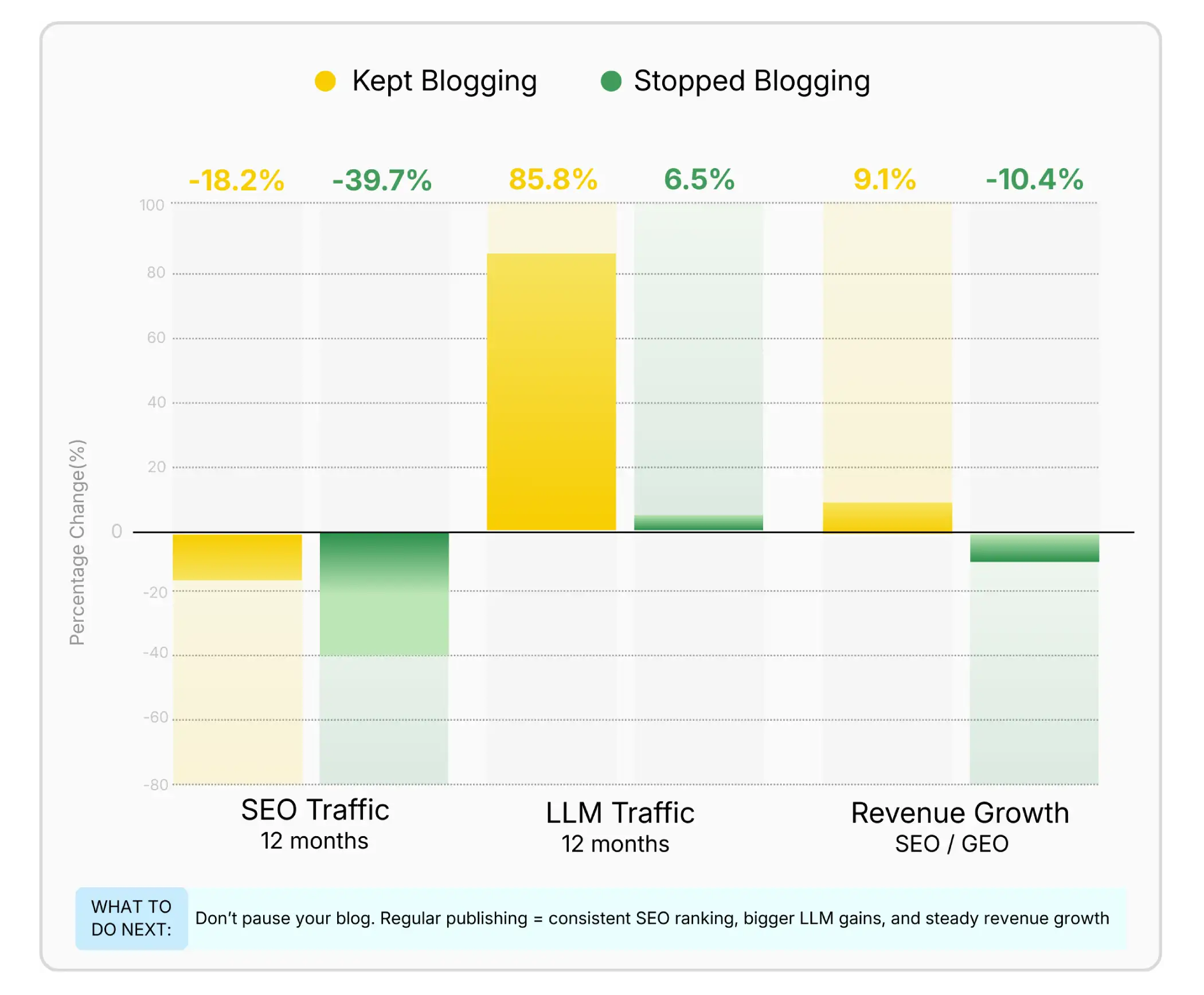
The drop in organic traffic is one of the first and most important effects. The NP Digital Study says that within a year, businesses that stopped blogging saw a 39.7% drop in organic SEO traffic, whereas companies that kept blogging only saw an 18.2% drop, which is normal for the industry.
Key Insight: Stopping blogging nearly doubles your annual traffic decline.
Why? Since you lose freshness signals, new chances for keywords, updates to internal linking, crawl frequency, topical authority, and stability of rankings.
AI/LLM Traffic Growth Collapses (Big New Risk of 2026)
This is one of the most important effects that people don't think about. According to NP Digital, companies that kept blogging saw an 85.8% increase in traffic that could be traced back to AI and LLM whereas companies that stopped blogging only saw a 6.5% increase.
Key Insight: Active bloggers gained 13× more AI-driven traffic than inactive ones.
Why? Because AI tools favor Fresh, structured content, frequently updated resources, clear explanations, recent data, and trustworthy expert voices. AI tools will stop finding and citing you if you stop creating new content. This could be more dangerous than losing Google traffic in 2026.
A Big Drop in Revenue
It's one thing to lose traffic, but losing revenue hurts more. The year-long study by NP Digital showed that companies that kept blogging saw their sales rise by 9.1% whereas those who stopped blogging lost 10.4% of their revenue.
Key Insight: There's a huge difference of 19.5 percentage points between the active bloggers and the ones who stopped blogging.
Why? Because less leads come in naturally, less people come into your funnel, the sales follow-up pipeline gets smaller, SEO and AI visibility go down, trust in the brand goes down, and ads that you pay for get more expensive. Blogs bring in warm, high-intent traffic, so losing that hurts conversions.
The Recovery Time Is Long (and Sometimes Impossible)
Stopping is easy. Restarting is painful. A study found that it takes 6 to 12 months for the full negative effects to be felt. Restarting does not automatically bring back old traffic.
Key Insight: Some businesses never fully regained their previous SEO position.
Why? It takes a long time to get better because your competitors take your spots in the rankings; over time, topical authority fades away, backlinks that are lost don't come back, Google lowers how often it crawls, AI models "forget" older sources, and evergreen posts get old quickly. Once the snowball effect starts, it's hard to get back up.
Competitors Overtake Your Market Position
When you stop publishing, competitors gain a double advantage as your rankings decline and their fresh content fills the gap. Data shows that 80% of businesses use blogs as a marketing tool (demandsage, 2025) and among them, 37% publish 2–3 posts per week (HubSpot, 2025).
Key Insight: This means competitors are not slowing down; they’re accelerating.
Why? Because every month you take off is a month when competitors get your words, your links back, your natural traffic, your groups of topics, your LLM visibility, etc. This means losing market share for a long time.
Paid Advertising Costs Increase
Several marketing experts agree that stopping blogging leads to less authority in SEO, less relevancy, a lower Quality Score and a higher CPC (cost per click).
Key Insight: When businesses stop blogging, they often pay more for ads to make up for it. But the ad costs go up faster because their Quality Score has gone down.
Why? Because this turns into a vicious cycle: stop blogging, lose organic traffic, spend more on ads, ads get more expensive, and ROI decreases.
Content Decay Accelerates
Content decay is when older posts naturally lose their effectiveness on every website. Research shows that to maintain their rankings, older posts need to be updated every 12 to 18 months. Over time, posts can lose as much as 70% of their traffic if they aren't updated.
Key Insight: Decay speeds up a lot when you stop blogging and updating.
Why? Because when you stop writing a blog, you also stop making old posts up-to-date, keeping links within the site, getting rid of broken links, and re-optimizing new keywords.
Brand Trust & Authority Decline
The 2025 study by ZipDo shows that 70% of users would rather read articles than ads to learn. When companies share useful information, 63% of people trust them more.
Key Insight: Blogs aren't just things to read; they're proof that you're alive.
Why? When you stop blog posting, your brand looks like it's not doing anything, you lose your ability to lead through, and customers wonder if you're keeping up with what's going on in your field. Trust goes down, especially for B2B and service-based businesses.
You Lose Out on New Keywords & Trending Topics
Google releases multiple core updates every year. Businesses evolve, user searches change, and AI tools update their models.
Key Insight: Missing out on new keywords gives your competitors a big strategic edge.
Why? When you stop writing a blog, you stop capturing new keywords, seasonal trends, industry changes, and missing content.
AI-Driven Competition Is Rising Fast
According to 2024–2025 reports, 71% of marketers think that AI can do some content tasks better than people can. 70% of marketers use AI tools to come up with new ideas. One-third of businesses now use AI to make or grade the content.
Key Insight: If you stop blogging, your AI-powered competitors will catch up to you faster than ever.
Why? Because the race for content has sped up, and it's now more dangerous to stop than it has been in the last 15 years.
What Should You Do If You Have Already Stopped Blogging?
Stopping isn’t the end, but you do need a recovery plan to get back on track.
Update stats, facts, information, keywords, broken links, meta titles, and descriptions. Also, refreshing posts can bring back 20% to 60% of lost traffic.
Restart blogging with a regular schedule. Even 2 posts a month or one post a week is enough to bring back signals of freshness.
Optimize Content for AI Visibility. AI prefers a clear structure, an authoritative tone, fresh stats, and citations that are trustworthy. Make sure that LLMs can use your content as a reference.
Build a Content Backlog. To avoid future pauses, create 3-5 extra posts, a calendar for 30 to 60 days, and drafts with help from AI, and maintain a balance of evergreen content.
Repurpose old content. Turn blogs into LinkedIn posts, email newsletters, short videos, podcasts, carousels, and infographics. This boosts visibility without creating brand-new content every time.
Final Thoughts
In today’s digital landscape, stopping your blog is a strategic setback that impacts every aspect of your marketing ecosystem. The data from 2024–2025 is unmistakable: businesses that halt blogging experience sharp drops in organic visibility, AI-driven traffic, authority signals, and ultimately revenue.
The cost of going silent is far higher than most realize, with SEO traffic declining by almost 40%, AI visibility growing 13× slower, and revenue declining by more than 10% for brands that stop publishing. It becomes even more difficult for a silent brand to recover lost ground when competitors who keep blogging increase their topical authority, seize new keywords, and establish themselves as reliable industry voices.
These days, blogging is more than just content; it's a major factor in credibility, discovery, and long-term growth. Keeping your blog active ensures momentum, while stopping it almost guarantees a slow, costly, and sometimes irreversible decline.
FAQs
What happens to SEO when you stop blogging?

Businesses that stopped blogging saw, a 39.7% drop in organic traffic within a year, almost double the 18.2% decline for the ones who kept on publishing. In other words you start losing the freshness cues, the crawl cadence tends to slow down, fresh keyword angles fade away, and internal linking progress basically stalls. After a while topical authority gets a bit thin and competitors take your ranking spots, not right away but gradually. This is why SEO really depends on steady content output, to keep that momentum going.
Does stopping blogging affect AI visibility?
Yeah, and this is honestly one of the biggest risks for 2026. Companies that kept on blogging saw an 85.8% increase in LLM-driven traffic, while sites that stayed inactive only got about 6.5% growth. It's that AI tools like ChatGPT, Gemini, and Perplexity tend to favor newer, more organized, well-cited content, rather than the dusty old stuff. Once you pause publishing, the models kinda stop mentioning you, not immediately, but over time. So, optimizing for answer engine optimization really comes down to active content creation so you remain quotable. If you want, learn how organic search services help keep both traditional visibility and these newer AI-driven references, at the same time.
How much revenue do you lose when you stop blogging?
Companies that kept blogging saw their revenue climb 9.1% but the ones that stopped slid, about 10.4%—so the difference is nearly 20 percentage points. The revenue drop happens because fewer organic leads come into your funnel, then paid ad costs get higher to make up for it, plus brand confidence starts to weaken. Blogs also pull in warm, high-intent visitors, so once that stream goes away conversions take a direct hit. Take a look at your current search volume and traffic trends with a free SEO audit.
Can you recover SEO rankings after stopping your blog?
It is possible but yeah, kinda difficult, and it tends to be slow. Recovery usually takes 6 to 12 months at minimum, since other competitors already grabbed your ranking positions, backlinks have been lost along the way, crawl frequency has dropped, and the AI models moved on to fresher sources. So first, update your top old posts with current stats and relevant keywords, then rebuild a steady publishing cadence, at least 2 posts each month. Also, leaning harder into content marketing, plus reworking the internal linking web, can really speed up recovery. If you want the complete roadmap, just grab the SEO Mastery ebook.
Is blogging still worth it in the AI era?
Yeah, but the strategy is kind of different now. Generic content just doesn't rank the same anymore, like it gets ignored. Blogs that show actual know-how, stick to E-E-A-T principles, and offer organized, original angles tend to get more reach in both normal search results and in those AI generated answers too. And honestly, content marketing is still doing work: it's about $7.65 back for every $1 spent, plus companies that blog see around 55% more visitors to their sites. The thing is, quality beats a numbers game, and you write posts so they can be referenced by AI tools, not only to be indexed by Google. I'd start with strong keyword research, figure out which subjects are really worth publishing, then go from there.
Blogging isn't just something that happened in the early days of the web. Even today, it remains a cornerstone of content marketing, SEO, and even AI-driven discovery. If you stop blogging, the effects go beyond just a drop in content. They also affect your traffic, revenue, brand equity, and long-term growth.
This blog explores the full cost of stopping blog postings - from search traffic decline to AI impact.
Why Blogging Still Matters?
Before we talk about what happens when you stop blogging, let's look at why it is still so important today.
Blogging Brings in a Huge ROI
According to SQ Magazine (2025), content marketing delivers an average ROI of $7.65 for every $1 spent.
Blogging is one of the best ways for marketers to reach people.
Blogging is a Top Channel for Marketers
Sources state that 82% of marketers use blogs as a main part of their content marketing plan.
Blogs Massively Boost SEO
Google has 434% more indexed pages for businesses that have active blog postings (Amra & Elma LLC, 2025).
Search engines send 85% of traffic to blogs.
Users Prefer Blogs to Ads
According to a study, 70% of people would rather read articles about a company than see ads.
When brands share useful information, 63% of people trust them more.
AI Is Now a Major Discovery Channel
AI tools like ChatGPT, Gemini, Perplexity, and Claude are more and more likely to quote, summarize, and suggest new blog posts.
Sources says that one in three businesses now use AI tools to help them make content.
In short, blogging is more than just "nice to have." It's the base. You don't just lose blog posts when you stop writing them; you also lose authority, momentum, freshness, and relevance.
What Happens When You Stop Blogging?
Below are the real, measurable impacts businesses experience within months of stopping their blog.
Organic SEO Traffic Drops — Fast
The drop in organic traffic is one of the first and most important effects. The NP Digital Study says that within a year, businesses that stopped blogging saw a 39.7% drop in organic SEO traffic, whereas companies that kept blogging only saw an 18.2% drop, which is normal for the industry.
Key Insight: Stopping blogging nearly doubles your annual traffic decline.
Why? Since you lose freshness signals, new chances for keywords, updates to internal linking, crawl frequency, topical authority, and stability of rankings.
AI/LLM Traffic Growth Collapses (Big New Risk of 2026)
This is one of the most important effects that people don't think about. According to NP Digital, companies that kept blogging saw an 85.8% increase in traffic that could be traced back to AI and LLM whereas companies that stopped blogging only saw a 6.5% increase.
Key Insight: Active bloggers gained 13× more AI-driven traffic than inactive ones.
Why? Because AI tools favor Fresh, structured content, frequently updated resources, clear explanations, recent data, and trustworthy expert voices. AI tools will stop finding and citing you if you stop creating new content. This could be more dangerous than losing Google traffic in 2026.
A Big Drop in Revenue
It's one thing to lose traffic, but losing revenue hurts more. The year-long study by NP Digital showed that companies that kept blogging saw their sales rise by 9.1% whereas those who stopped blogging lost 10.4% of their revenue.
Key Insight: There's a huge difference of 19.5 percentage points between the active bloggers and the ones who stopped blogging.
Why? Because less leads come in naturally, less people come into your funnel, the sales follow-up pipeline gets smaller, SEO and AI visibility go down, trust in the brand goes down, and ads that you pay for get more expensive. Blogs bring in warm, high-intent traffic, so losing that hurts conversions.
The Recovery Time Is Long (and Sometimes Impossible)
Stopping is easy. Restarting is painful. A study found that it takes 6 to 12 months for the full negative effects to be felt. Restarting does not automatically bring back old traffic.
Key Insight: Some businesses never fully regained their previous SEO position.
Why? It takes a long time to get better because your competitors take your spots in the rankings; over time, topical authority fades away, backlinks that are lost don't come back, Google lowers how often it crawls, AI models "forget" older sources, and evergreen posts get old quickly. Once the snowball effect starts, it's hard to get back up.
Competitors Overtake Your Market Position
When you stop publishing, competitors gain a double advantage as your rankings decline and their fresh content fills the gap. Data shows that 80% of businesses use blogs as a marketing tool (demandsage, 2025) and among them, 37% publish 2–3 posts per week (HubSpot, 2025).
Key Insight: This means competitors are not slowing down; they’re accelerating.
Why? Because every month you take off is a month when competitors get your words, your links back, your natural traffic, your groups of topics, your LLM visibility, etc. This means losing market share for a long time.
Paid Advertising Costs Increase
Several marketing experts agree that stopping blogging leads to less authority in SEO, less relevancy, a lower Quality Score and a higher CPC (cost per click).
Key Insight: When businesses stop blogging, they often pay more for ads to make up for it. But the ad costs go up faster because their Quality Score has gone down.
Why? Because this turns into a vicious cycle: stop blogging, lose organic traffic, spend more on ads, ads get more expensive, and ROI decreases.
Content Decay Accelerates
Content decay is when older posts naturally lose their effectiveness on every website. Research shows that to maintain their rankings, older posts need to be updated every 12 to 18 months. Over time, posts can lose as much as 70% of their traffic if they aren't updated.
Key Insight: Decay speeds up a lot when you stop blogging and updating.
Why? Because when you stop writing a blog, you also stop making old posts up-to-date, keeping links within the site, getting rid of broken links, and re-optimizing new keywords.
Brand Trust & Authority Decline
The 2025 study by ZipDo shows that 70% of users would rather read articles than ads to learn. When companies share useful information, 63% of people trust them more.
Key Insight: Blogs aren't just things to read; they're proof that you're alive.
Why? When you stop blog posting, your brand looks like it's not doing anything, you lose your ability to lead through, and customers wonder if you're keeping up with what's going on in your field. Trust goes down, especially for B2B and service-based businesses.
You Lose Out on New Keywords & Trending Topics
Google releases multiple core updates every year. Businesses evolve, user searches change, and AI tools update their models.
Key Insight: Missing out on new keywords gives your competitors a big strategic edge.
Why? When you stop writing a blog, you stop capturing new keywords, seasonal trends, industry changes, and missing content.
AI-Driven Competition Is Rising Fast
According to 2024–2025 reports, 71% of marketers think that AI can do some content tasks better than people can. 70% of marketers use AI tools to come up with new ideas. One-third of businesses now use AI to make or grade the content.
Key Insight: If you stop blogging, your AI-powered competitors will catch up to you faster than ever.
Why? Because the race for content has sped up, and it's now more dangerous to stop than it has been in the last 15 years.
What Should You Do If You Have Already Stopped Blogging?
Stopping isn’t the end, but you do need a recovery plan to get back on track.
Update stats, facts, information, keywords, broken links, meta titles, and descriptions. Also, refreshing posts can bring back 20% to 60% of lost traffic.
Restart blogging with a regular schedule. Even 2 posts a month or one post a week is enough to bring back signals of freshness.
Optimize Content for AI Visibility. AI prefers a clear structure, an authoritative tone, fresh stats, and citations that are trustworthy. Make sure that LLMs can use your content as a reference.
Build a Content Backlog. To avoid future pauses, create 3-5 extra posts, a calendar for 30 to 60 days, and drafts with help from AI, and maintain a balance of evergreen content.
Repurpose old content. Turn blogs into LinkedIn posts, email newsletters, short videos, podcasts, carousels, and infographics. This boosts visibility without creating brand-new content every time.
Final Thoughts
In today’s digital landscape, stopping your blog is a strategic setback that impacts every aspect of your marketing ecosystem. The data from 2024–2025 is unmistakable: businesses that halt blogging experience sharp drops in organic visibility, AI-driven traffic, authority signals, and ultimately revenue.
The cost of going silent is far higher than most realize, with SEO traffic declining by almost 40%, AI visibility growing 13× slower, and revenue declining by more than 10% for brands that stop publishing. It becomes even more difficult for a silent brand to recover lost ground when competitors who keep blogging increase their topical authority, seize new keywords, and establish themselves as reliable industry voices.
These days, blogging is more than just content; it's a major factor in credibility, discovery, and long-term growth. Keeping your blog active ensures momentum, while stopping it almost guarantees a slow, costly, and sometimes irreversible decline.
FAQs
What happens to SEO when you stop blogging?
Businesses that stopped blogging saw, a 39.7% drop in organic traffic within a year, almost double the 18.2% decline for the ones who kept on publishing. In other words you start losing the freshness cues, the crawl cadence tends to slow down, fresh keyword angles fade away, and internal linking progress basically stalls. After a while topical authority gets a bit thin and competitors take your ranking spots, not right away but gradually. This is why SEO really depends on steady content output, to keep that momentum going.
Does stopping blogging affect AI visibility?
Yeah, and this is honestly one of the biggest risks for 2026. Companies that kept on blogging saw an 85.8% increase in LLM-driven traffic, while sites that stayed inactive only got about 6.5% growth. It's that AI tools like ChatGPT, Gemini, and Perplexity tend to favor newer, more organized, well-cited content, rather than the dusty old stuff. Once you pause publishing, the models kinda stop mentioning you, not immediately, but over time. So, optimizing for answer engine optimization really comes down to active content creation so you remain quotable. If you want, learn how organic search services help keep both traditional visibility and these newer AI-driven references, at the same time.
How much revenue do you lose when you stop blogging?
Companies that kept blogging saw their revenue climb 9.1% but the ones that stopped slid, about 10.4%—so the difference is nearly 20 percentage points. The revenue drop happens because fewer organic leads come into your funnel, then paid ad costs get higher to make up for it, plus brand confidence starts to weaken. Blogs also pull in warm, high-intent visitors, so once that stream goes away conversions take a direct hit. Take a look at your current search volume and traffic trends with a free SEO audit.
Can you recover SEO rankings after stopping your blog?
It is possible but yeah, kinda difficult, and it tends to be slow. Recovery usually takes 6 to 12 months at minimum, since other competitors already grabbed your ranking positions, backlinks have been lost along the way, crawl frequency has dropped, and the AI models moved on to fresher sources. So first, update your top old posts with current stats and relevant keywords, then rebuild a steady publishing cadence, at least 2 posts each month. Also, leaning harder into content marketing, plus reworking the internal linking web, can really speed up recovery. If you want the complete roadmap, just grab the SEO Mastery ebook.
Is blogging still worth it in the AI era?
Yeah, but the strategy is kind of different now. Generic content just doesn't rank the same anymore, like it gets ignored. Blogs that show actual know-how, stick to E-E-A-T principles, and offer organized, original angles tend to get more reach in both normal search results and in those AI generated answers too. And honestly, content marketing is still doing work: it's about $7.65 back for every $1 spent, plus companies that blog see around 55% more visitors to their sites. The thing is, quality beats a numbers game, and you write posts so they can be referenced by AI tools, not only to be indexed by Google. I'd start with strong keyword research, figure out which subjects are really worth publishing, then go from there.



Summarize with AI



Want to Skyrocket Revenue? Get a Free Audit Today!
Want to Skyrocket Revenue? Get a Free Audit Today!



4.9/5 Ratings!


Don’t miss our revenue growth tips!
Get expert marketing tips—straight to your inbox, like thousands of happy clients.
Don’t miss our revenue growth tips!
Get expert marketing tips—straight to your inbox, like thousands of happy clients.
Don’t miss our revenue growth tips!
Don’t miss our revenue growth tips!
Get expert marketing tips—straight to your inbox, like thousands of happy clients.
Relevant Blogs on Organic SEO
Relevant Blogs on Organic SEO
Unlock data-driven insights in Organic SEO—explore our featured blogs and skyrocket your revenue before your competitors do.
Unlock data-driven insights in Organic SEO—explore our featured blogs and skyrocket your revenue before your competitors do.

SEO
Sep 21, 2026
5 Min Read
Audience-First SEO: How to Rank by Putting Readers First
SEO
Sep 21, 2026
5 Min Read
Audience-First SEO: How to Rank by Putting Readers First
SEO
Sep 21, 2026
5 Min Read
Audience-First SEO: How to Rank by Putting Readers First

SEO
Sep 19, 2026
5 Min Read
How to Add SEO Keywords to Your Website: Where and How
SEO
Sep 19, 2026
5 Min Read
How to Add SEO Keywords to Your Website: Where and How
SEO
Sep 19, 2026
5 Min Read
How to Add SEO Keywords to Your Website: Where and How
SEO
Sep 18, 2026
5 Min Read
How XML Sitemaps Help Search Engines Discover New Pages
SEO
Sep 18, 2026
5 Min Read
How XML Sitemaps Help Search Engines Discover New Pages
SEO
Sep 18, 2026
5 Min Read
How XML Sitemaps Help Search Engines Discover New Pages






























Ready to speak with an expert?
Data-Driven Marketing Agency That Elevates ROI
1100+
Websites Designed & Optimized to Convert
$280M+
Client Revenue Driven & Growing Strong
Discover how to skyrocket
your revenue today!
Trusted by 1000+ Owners!
Ready to speak with an expert?
Data-Driven Marketing Agency That Elevates ROI
1100+
Websites Designed & Optimized to Convert
$280M+
Client Revenue Driven & Growing Strong
Discover how to skyrocket
your revenue today!
Trusted by 1000+ Owners!
Want to skyrocket revenue?
4.9/5 Ratings!
Ready to speak with an expert?
Data-Driven Marketing Agency That Elevates ROI
1100+
Websites Designed & Optimized to Convert
$280M+
Client Revenue Driven & Growing Strong
Discover how to skyrocket
your revenue today!
Trusted by 1000+ Owners!
Call
Meet