ChatGPT Product Ads Explained: What This Means for E-Commerce Businesses
ChatGPT Product Ads Explained: What This Means for E-Commerce Businesses
Last Updated:
Table of Content
Explore Free Tools


Deepak Prajapat
Deepak Prajapat
Deepak Prajapat
PPC
PPC
PPC
10 Min Read
10 Min Read
10 Min
OpenAI has quietly launched one of the most significant shifts in digital advertising: product feed-powered ads for ChatGPT. This article breaks down exactly how ChatGPT product ads work, what makes them different from Google Ads or Meta ads, and the actions or steps e-commerce brands should take right now to get ready or get left behind.
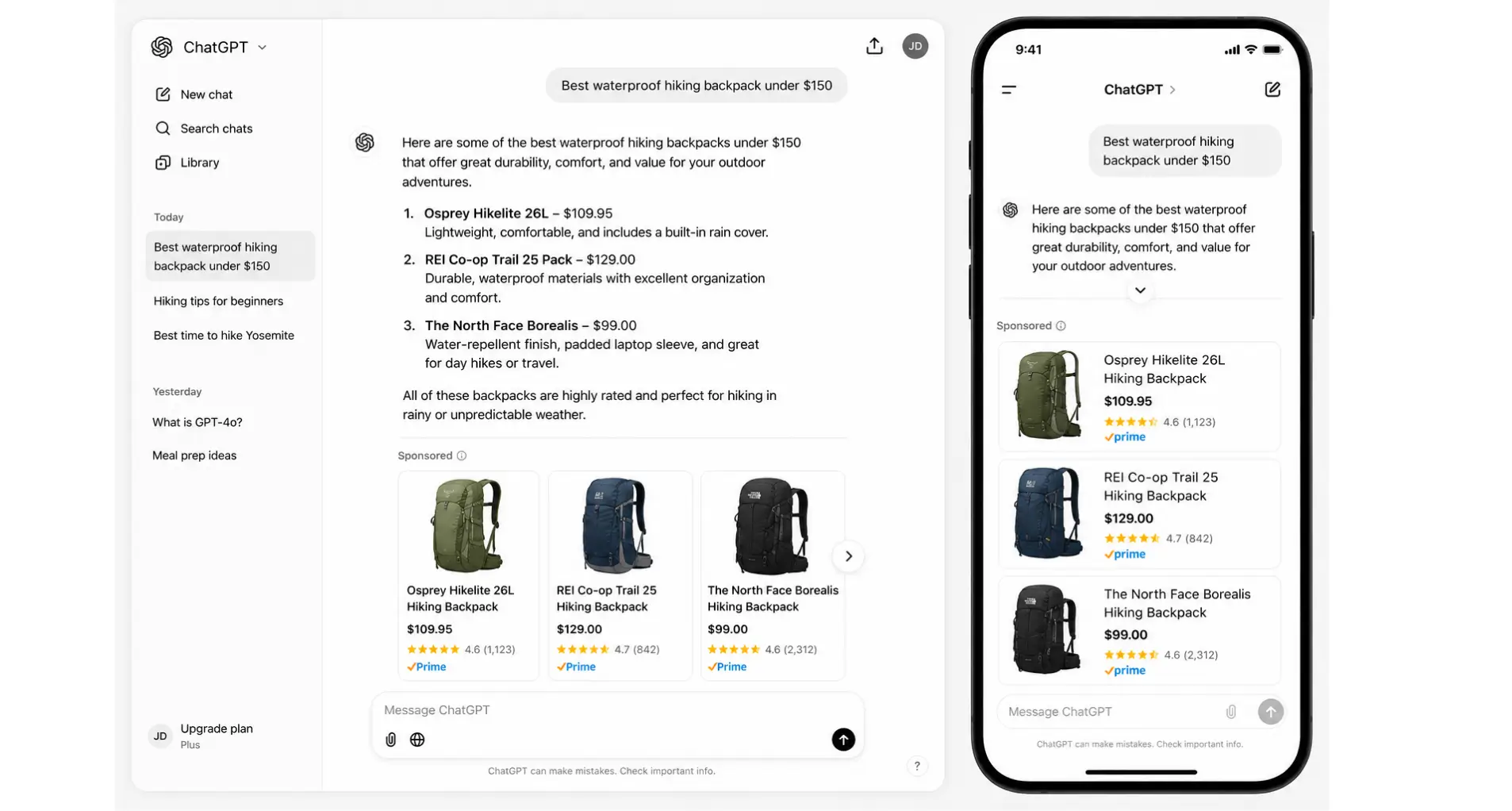
If a customer types "I need a waterproof hiking backpack under $150 for a three-day trip" into ChatGPT, they're not browsing. They know what they want. They've told the AI their budget, their use case, and their timeline all in one sentence.
That moment, and millions like it happening every day, is exactly why OpenAI Ads just made a move that every e-commerce brand should pay attention to.
As of May 2026, retailers can now connect their product catalogs directly to ChatGPT and run automated shopping ads inside the platform. If you're used to Google Shopping campaigns, the mechanic will feel familiar. But the intent signal behind it? That's in a different league entirely.
What Are ChatGPT Product Ads And How Do They Actually Work?
ChatGPT ads for products are sponsored product placements that appear beneath AI-generated responses. They are clearly labeled as "Sponsored," so users can easily tell the difference between paid placements and organic AI answers.
Unlike traditional search ads, these placements are designed to fit naturally into conversational shopping experiences.
What Changed Recently?
The biggest shift is how these ads are now created and managed. Earlier, retailers had to create campaigns manually for paid ads management. Now, ChatGPT can automatically generate ads using a retailer’s existing product feed similar to the one used for Google Merchant Center.
The system pulls:
Product Titles
Images
Pricing
Product Attributes
Categories & Descriptions
Retailers simply choose which products to include or exclude, and the platform handles the rest.
How ChatGPT Ads Are Different From Google, Meta & Amazon Ads
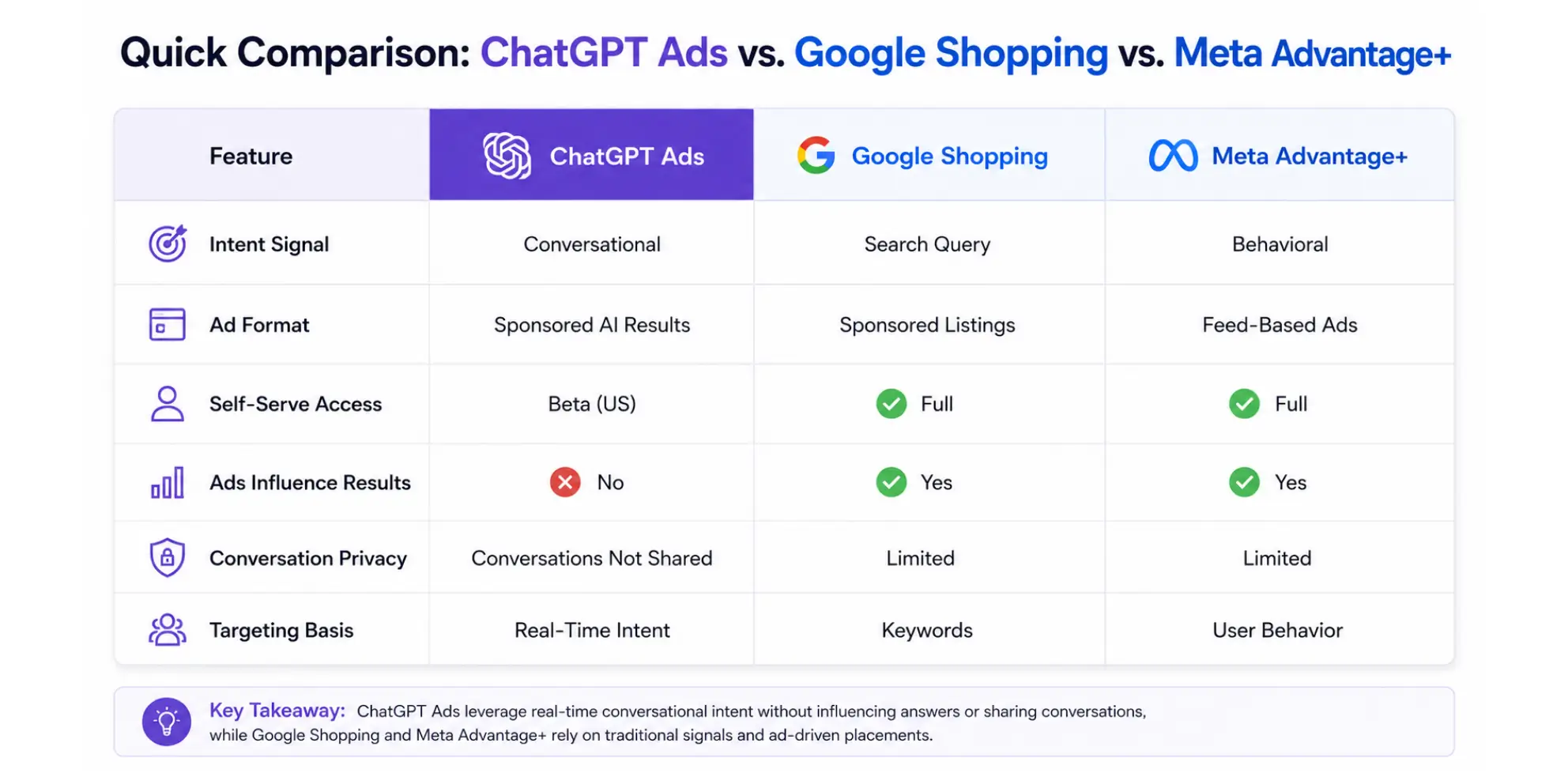
The core idea behind feed-based advertising isn’t new. Google Shopping, Meta Advantage+ Shopping and Amazon Ads have all been using product catalogue automation for years. So what makes ChatGPT worth adding to the mix?
Google Ads mainly relies on search queries. Meta focuses on user behavior like browsing activity, interests, and engagement. Amazon uses shopping and marketplace behavior. While these signals are valuable, they still rely on assumptions about what a user might want.
ChatGPT works differently; instead of predicting intent from behavior, ChatGPT understands what users are directly saying in conversation. If someone asks for “the best running shoes for flat feet under $120” at 11 PM, that’s not casual browsing it’s a strong buying signal with clear context, preferences, and intent.
Because the AI can understand the full conversation, ads can be matched more naturally and accurately to what the user is actively looking for.
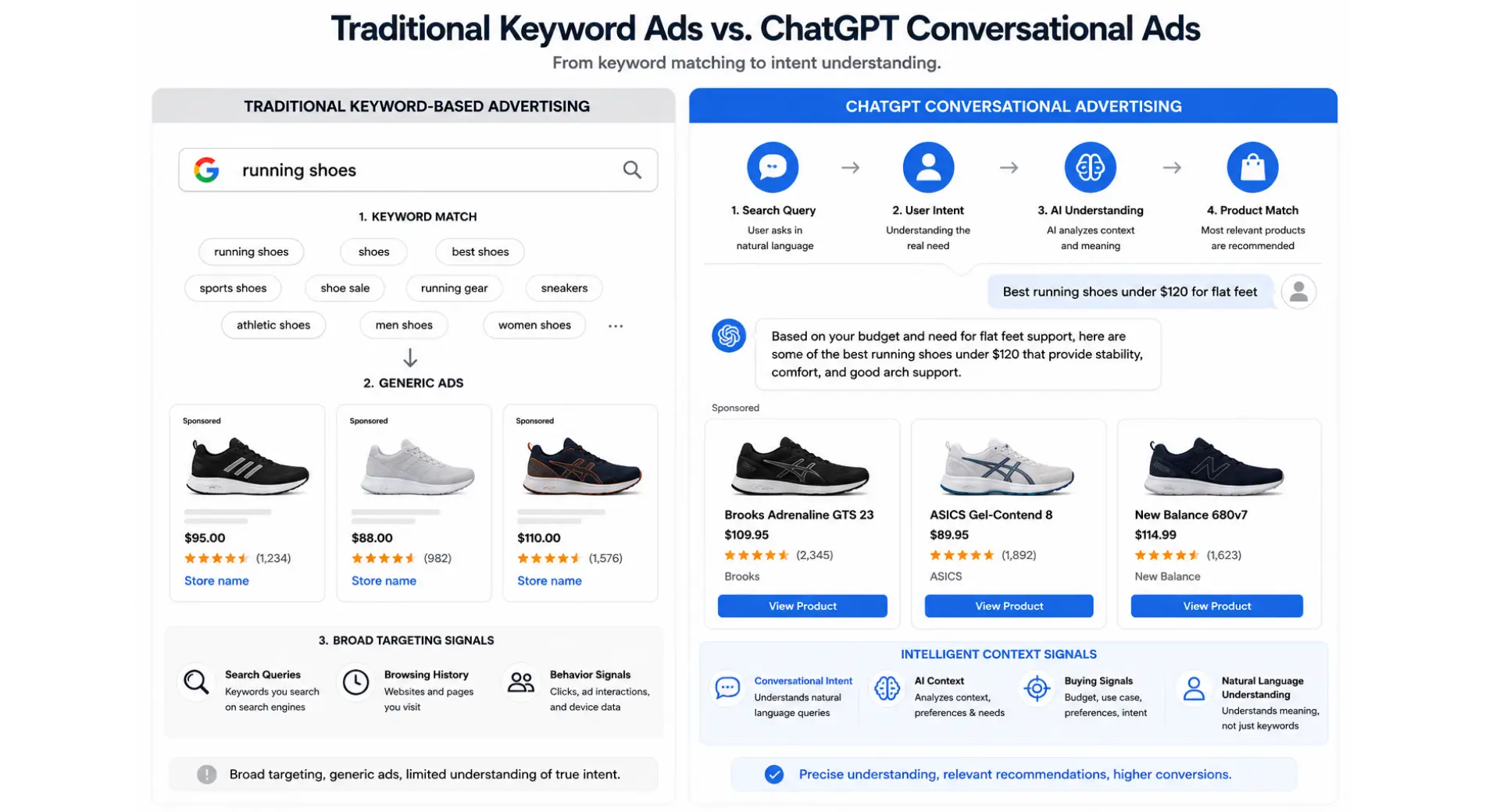
OpenAI’s advertising approach resembles the feed-based systems already used by Google, Meta, and Amazon, but with a major difference: ChatGPT ads are built around conversational intent rather than behavioral signals or marketplace browsing patterns.
For retailers, that could eventually mean:
Better product-to-user matching
Higher purchase intent visibility
More qualified traffic
Less wasted ad spend on low-intent audiences
What E-Commerce Brands Should Do Right Now
You don't need to wait for full access to start preparing. The brands that move fastest will be those who've done the groundwork before the open floodgates.
1. Clean Up Your Product Feed
OpenAI is filtering at the source. If your catalogue has missing images, vague titles (think "BLK-002-XL" instead of "Men's Black Merino Wool Crewneck Sweater"), or incomplete attributes, those products won't make it into ChatGPT ads. A messy feed isn't just inefficient it locks you out entirely.
Start by auditing your Google Merchant Center feed. Fix image quality issues, fill in missing attributes like color, size, and material, and make sure your product titles are written for humans, not warehouses.
2. Register Your Interest With OpenAI
Visit openai.com/advertisers and submit your details. OpenAI is building its advertiser waitlist, and being on it puts you in the queue when broader access opens.
3. Check Your Ad Tech Partner's Readiness
If you're already running through Criteo, StackAdapt, Adobe, or Pacvue, ask them directly about ChatGPT inventory. Several of these platforms have already connected their feed infrastructure to OpenAI's system. Your ChatGPT ad launch might be one conversation away.
4. Optimize for Organic ChatGPT Mentions Too
ChatGPT ads appear below organic answers. A brand that appears both organically and in a paid placement on the same ChatGPT response has two visible positions on the same screen the same advantage that made owning organic and paid Google search results so valuable in the 2010s.
To improve organic visibility, ensure OAI-SearchBot is allowed in your robots.txt, use complete JSON-LD product schema with server-side rendering, and maintain high attribute completion in your Google Shopping feed (ChatGPT's shopping carousel pulls heavily from Google Shopping data).
5. Prepare Conversion Tracking
OpenAI now supports a Conversions API and pixel-based tracking for post-click measurement. Before you spend a dollar, make sure your tracking is set up to attribute ChatGPT-sourced clicks correctly. Otherwise, you're flying blind on ROI.
Is ChatGPT a Real Performance Channel for E-Commerce?
Early signs suggest yes but the platform is still evolving.
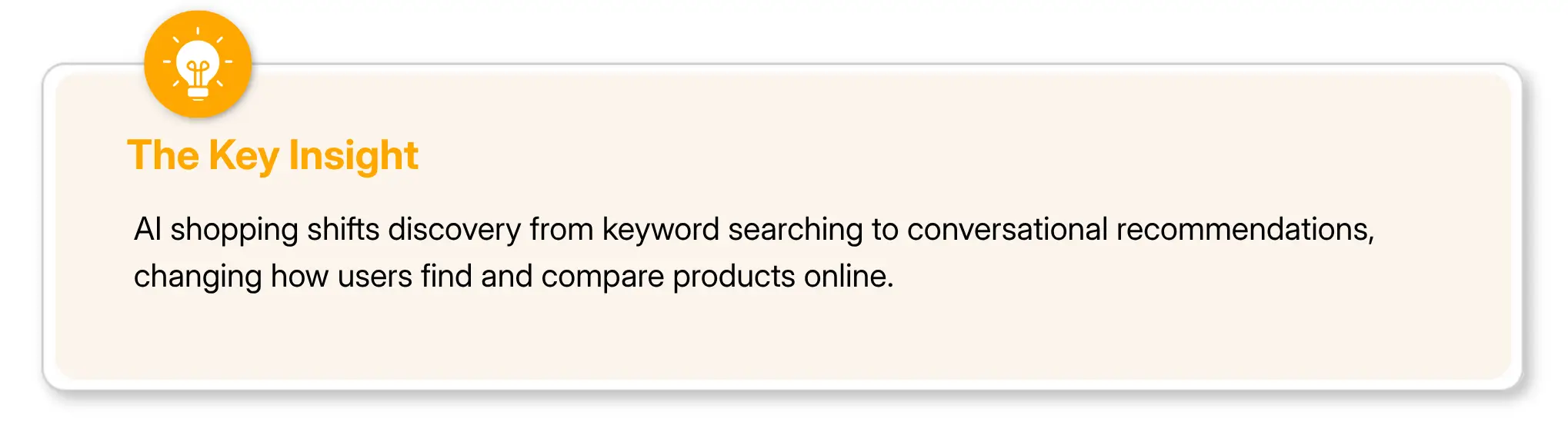
The biggest advantage is intent-based discovery. Instead of targeting users based only on interests or browsing history, ChatGPT ads can appear during real shopping conversations and product-related queries. That creates stronger context for product recommendations.
But There Are Still Limitations
The platform is still early compared to Google or Meta Ads.
Some current limitations include the following:
Smaller ad audience compared to traditional platforms
Beta-stage ad system
Newer attribution and tracking tools
Limited long-term performance data
That means most brands are still in the testing phase.
Why This Could Become Bigger
OpenAI appears to be moving deeper into shopping and advertising rather than away from it.
The recent product feed integration suggests a shift toward scalable advertising revenue — similar to how Google Shopping and Amazon Ads operate today.
For brands that prepare early with:
optimized product feeds
strong product data
clean catalogue structures
clear product attributes
…the opportunity could become much larger as AI shopping adoption grows.
Final Thoughts
ChatGPT Ads for products are a real channel, not a concept. Feed-based campaign automation is live, self-serve access is in beta, and the intent signal behind these placements is unlike anything existing ad platforms offer.
The brands that treat this as a "wait and see" situation may find themselves waiting while their competitors lock in early learnings, lower CPCs, and preferred partner positioning.
The practical next steps are straightforward: clean your product feed, register on OpenAI's advertiser waitlist, check in with your ad tech partners, and make sure your product data infrastructure is solid enough to actually get approved.
FAQs
Does ChatGPT have sponsored products?

Yes, ChatGPT now has sponsored ads. OpenAI officially began testing ads in the US on February 9, 2026, starting with Free and Go plan users. Plus, Pro, Business, Enterprise, and Edu accounts will not have ads. Sponsored listings appear below ChatGPT's organic response and are clearly labelled, keeping the AI's recommendations separate from paid placements.
Does ChatGPT Share Information With Advertisers?
No. ChatGPT does not share your conversations with advertisers. OpenAI has made privacy one of its core rules for how ads work on the platform — what you chat about stays private.
Is ChatGPT Influenced by Sponsors?
No. Ads appear below ChatGPT's answer, clearly labelled, and are kept separate from the AI's response. This means sponsors cannot influence what ChatGPT recommends to you.
Will AI Shopping Replace Google Shopping?
AI is not replacing Google Shopping; rather, AI is the new Google Shopping. Google has redesigned its platform into an AI-native, conversational experience where AI summarizes products, generates personalized recommendations, and even handles checkouts through Universal Carts.
Are ChatGPT Product Recommendations Paid or Organic?
Both. ChatGPT can show you regular recommendations based on what's most relevant, as well as paid ads from brands. Sponsored listings are clearly labelled and appear below the main response, so you can always tell the difference.
OpenAI has quietly launched one of the most significant shifts in digital advertising: product feed-powered ads for ChatGPT. This article breaks down exactly how ChatGPT product ads work, what makes them different from Google Ads or Meta ads, and the actions or steps e-commerce brands should take right now to get ready or get left behind.
If a customer types "I need a waterproof hiking backpack under $150 for a three-day trip" into ChatGPT, they're not browsing. They know what they want. They've told the AI their budget, their use case, and their timeline all in one sentence.
That moment, and millions like it happening every day, is exactly why OpenAI Ads just made a move that every e-commerce brand should pay attention to.
As of May 2026, retailers can now connect their product catalogs directly to ChatGPT and run automated shopping ads inside the platform. If you're used to Google Shopping campaigns, the mechanic will feel familiar. But the intent signal behind it? That's in a different league entirely.
What Are ChatGPT Product Ads And How Do They Actually Work?
ChatGPT ads for products are sponsored product placements that appear beneath AI-generated responses. They are clearly labeled as "Sponsored," so users can easily tell the difference between paid placements and organic AI answers.
Unlike traditional search ads, these placements are designed to fit naturally into conversational shopping experiences.
What Changed Recently?
The biggest shift is how these ads are now created and managed. Earlier, retailers had to create campaigns manually for paid ads management. Now, ChatGPT can automatically generate ads using a retailer’s existing product feed similar to the one used for Google Merchant Center.
The system pulls:
Product Titles
Images
Pricing
Product Attributes
Categories & Descriptions
Retailers simply choose which products to include or exclude, and the platform handles the rest.
How ChatGPT Ads Are Different From Google, Meta & Amazon Ads
The core idea behind feed-based advertising isn’t new. Google Shopping, Meta Advantage+ Shopping and Amazon Ads have all been using product catalogue automation for years. So what makes ChatGPT worth adding to the mix?
Google Ads mainly relies on search queries. Meta focuses on user behavior like browsing activity, interests, and engagement. Amazon uses shopping and marketplace behavior. While these signals are valuable, they still rely on assumptions about what a user might want.
ChatGPT works differently; instead of predicting intent from behavior, ChatGPT understands what users are directly saying in conversation. If someone asks for “the best running shoes for flat feet under $120” at 11 PM, that’s not casual browsing it’s a strong buying signal with clear context, preferences, and intent.
Because the AI can understand the full conversation, ads can be matched more naturally and accurately to what the user is actively looking for.
OpenAI’s advertising approach resembles the feed-based systems already used by Google, Meta, and Amazon, but with a major difference: ChatGPT ads are built around conversational intent rather than behavioral signals or marketplace browsing patterns.
For retailers, that could eventually mean:
Better product-to-user matching
Higher purchase intent visibility
More qualified traffic
Less wasted ad spend on low-intent audiences
What E-Commerce Brands Should Do Right Now
You don't need to wait for full access to start preparing. The brands that move fastest will be those who've done the groundwork before the open floodgates.
1. Clean Up Your Product Feed
OpenAI is filtering at the source. If your catalogue has missing images, vague titles (think "BLK-002-XL" instead of "Men's Black Merino Wool Crewneck Sweater"), or incomplete attributes, those products won't make it into ChatGPT ads. A messy feed isn't just inefficient it locks you out entirely.
Start by auditing your Google Merchant Center feed. Fix image quality issues, fill in missing attributes like color, size, and material, and make sure your product titles are written for humans, not warehouses.
2. Register Your Interest With OpenAI
Visit openai.com/advertisers and submit your details. OpenAI is building its advertiser waitlist, and being on it puts you in the queue when broader access opens.
3. Check Your Ad Tech Partner's Readiness
If you're already running through Criteo, StackAdapt, Adobe, or Pacvue, ask them directly about ChatGPT inventory. Several of these platforms have already connected their feed infrastructure to OpenAI's system. Your ChatGPT ad launch might be one conversation away.
4. Optimize for Organic ChatGPT Mentions Too
ChatGPT ads appear below organic answers. A brand that appears both organically and in a paid placement on the same ChatGPT response has two visible positions on the same screen the same advantage that made owning organic and paid Google search results so valuable in the 2010s.
To improve organic visibility, ensure OAI-SearchBot is allowed in your robots.txt, use complete JSON-LD product schema with server-side rendering, and maintain high attribute completion in your Google Shopping feed (ChatGPT's shopping carousel pulls heavily from Google Shopping data).
5. Prepare Conversion Tracking
OpenAI now supports a Conversions API and pixel-based tracking for post-click measurement. Before you spend a dollar, make sure your tracking is set up to attribute ChatGPT-sourced clicks correctly. Otherwise, you're flying blind on ROI.
Is ChatGPT a Real Performance Channel for E-Commerce?
Early signs suggest yes but the platform is still evolving.
The biggest advantage is intent-based discovery. Instead of targeting users based only on interests or browsing history, ChatGPT ads can appear during real shopping conversations and product-related queries. That creates stronger context for product recommendations.
But There Are Still Limitations
The platform is still early compared to Google or Meta Ads.
Some current limitations include the following:
Smaller ad audience compared to traditional platforms
Beta-stage ad system
Newer attribution and tracking tools
Limited long-term performance data
That means most brands are still in the testing phase.
Why This Could Become Bigger
OpenAI appears to be moving deeper into shopping and advertising rather than away from it.
The recent product feed integration suggests a shift toward scalable advertising revenue — similar to how Google Shopping and Amazon Ads operate today.
For brands that prepare early with:
optimized product feeds
strong product data
clean catalogue structures
clear product attributes
…the opportunity could become much larger as AI shopping adoption grows.
Final Thoughts
ChatGPT Ads for products are a real channel, not a concept. Feed-based campaign automation is live, self-serve access is in beta, and the intent signal behind these placements is unlike anything existing ad platforms offer.
The brands that treat this as a "wait and see" situation may find themselves waiting while their competitors lock in early learnings, lower CPCs, and preferred partner positioning.
The practical next steps are straightforward: clean your product feed, register on OpenAI's advertiser waitlist, check in with your ad tech partners, and make sure your product data infrastructure is solid enough to actually get approved.
FAQs
Does ChatGPT have sponsored products?
Yes, ChatGPT now has sponsored ads. OpenAI officially began testing ads in the US on February 9, 2026, starting with Free and Go plan users. Plus, Pro, Business, Enterprise, and Edu accounts will not have ads. Sponsored listings appear below ChatGPT's organic response and are clearly labelled, keeping the AI's recommendations separate from paid placements.
Does ChatGPT Share Information With Advertisers?
No. ChatGPT does not share your conversations with advertisers. OpenAI has made privacy one of its core rules for how ads work on the platform — what you chat about stays private.
Is ChatGPT Influenced by Sponsors?
No. Ads appear below ChatGPT's answer, clearly labelled, and are kept separate from the AI's response. This means sponsors cannot influence what ChatGPT recommends to you.
Will AI Shopping Replace Google Shopping?
AI is not replacing Google Shopping; rather, AI is the new Google Shopping. Google has redesigned its platform into an AI-native, conversational experience where AI summarizes products, generates personalized recommendations, and even handles checkouts through Universal Carts.
Are ChatGPT Product Recommendations Paid or Organic?
Both. ChatGPT can show you regular recommendations based on what's most relevant, as well as paid ads from brands. Sponsored listings are clearly labelled and appear below the main response, so you can always tell the difference.



Summarize with AI


Have a Google Ads account?
Get a free audit Today!
Have a Google Ads account?
Get a free audit Today!



4.9/5 Ratings!
4.9/5 Ratings!


Don’t miss our revenue growth tips!
Get expert marketing tips—straight to your inbox, like thousands of happy clients.
Don’t miss our revenue growth tips!
Get expert marketing tips—straight to your inbox, like thousands of happy clients.
Don’t miss our revenue growth tips!
Get expert marketing tips—straight to your inbox, like thousands of happy clients.
Don’t miss our revenue growth tips!
Relevant Blogs on PPC Marketing
Relevant Blogs on PPC Marketing
Unlock data-driven insights in PPC marketing—explore our featured blogs and skyrocket your revenue before your competitors do.
Unlock data-driven insights in PPC marketing—explore our featured blogs and skyrocket your revenue before your competitors do.
PPC
Sep 1, 2026
8 Min Read
Google Is Removing Manual Language Targeting From Search Campaigns: What Advertisers Need to Know
PPC
Sep 1, 2026
8 Min Read
Google Is Removing Manual Language Targeting From Search Campaigns: What Advertisers Need to Know
PPC
Sep 1, 2026
8 Min Read
Google Is Removing Manual Language Targeting From Search Campaigns: What Advertisers Need to Know
PPC
Aug 6, 2026
10 Min Read
What Are Display Ads & How Do They Work?
PPC
Aug 6, 2026
10 Min Read
What Are Display Ads & How Do They Work?
PPC
Aug 6, 2026
10 Min Read
What Are Display Ads & How Do They Work?

PPC
Aug 2, 2026
10 Min Read
12 Best Practices to Improve Google Ads CTR
PPC
Aug 2, 2026
10 Min Read
12 Best Practices to Improve Google Ads CTR
PPC
Aug 2, 2026
10 Min Read
12 Best Practices to Improve Google Ads CTR





Ready to speak with an expert?
Data-Driven Marketing Agency That Elevates ROI
1100+
Websites Designed & Optimized to Convert
$280M+
Client Revenue Driven & Growing Strong
Discover how to skyrocket
your revenue today!
Trusted by 1000+ Owners!
Ready to speak with an expert?
Data-Driven Marketing Agency That Elevates ROI
1100+
Websites Designed & Optimized to Convert
$280M+
Client Revenue Driven & Growing Strong
Discover how to skyrocket
your revenue today!
Trusted by 1000+ Owners!
Want to skyrocket revenue?
4.9/5 Ratings!
Ready to speak with an expert?
Data-Driven Marketing Agency That Elevates ROI
1100+
Websites Designed & Optimized to Convert
$280M+
Client Revenue Driven & Growing Strong
Discover how to skyrocket
your revenue today!
Trusted by 1000+ Owners!
Call
Meet