Understanding Semantic SEO: A Simple Guide to Smarter Search
Understanding Semantic SEO: A Simple Guide to Smarter Search
Semantic SEO
Semantic SEO
Semantic SEO
Semantic SEO optimizes web content to align with how search engines interpret meaning, context, and user intent, rather than exact keyword matches. Using AI and NLP, it delivers more relevant search results.
Semantic SEO optimizes web content to align with how search engines interpret meaning, context, and user intent, rather than exact keyword matches. Using AI and NLP, it delivers more relevant search results.

Table of Content
Case Studies


Rank Higher and Deliver Richer Experiences with Semantic SEO



Trusted by 1k+ Owners!

Rishabh M.
Rishabh M.
6 Min Read
6 Min Read
Oct 23, 2025
Oct 23, 2025
What is Semantic SEO?
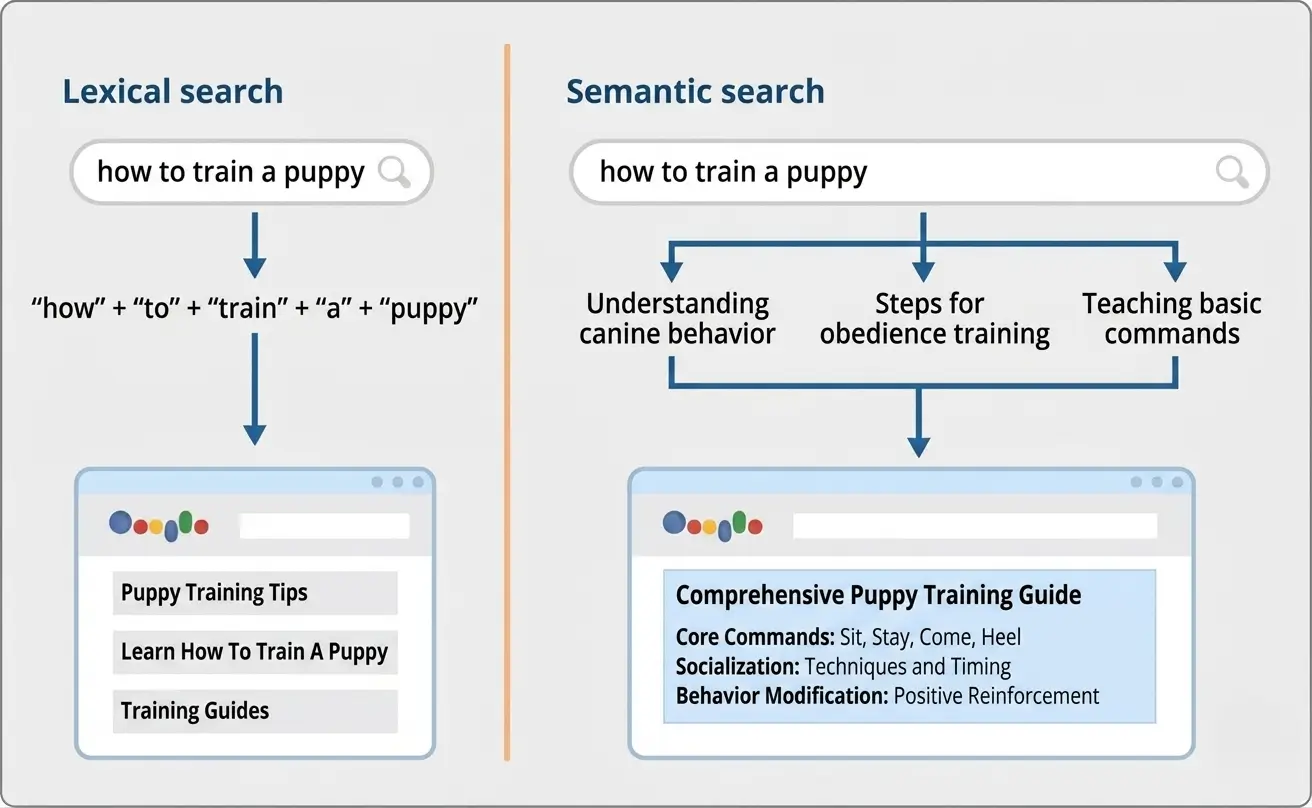
Simply, semantic SEO is all about understanding the meaning and intent behind search queries, not just the keywords themselves.
In the past, SEO was straightforward: repeat your target keyword enough times, and you'd rank. But Google realised people were gaming the system with low-quality content. So they have to change the rules.
Now, semantic SEO focuses on developing comprehensive content around entire topics, not only over the keywords. It's all about anticipating what people really want to know and answering all their questions in one place.
For example, if you search "how to train a puppy," they probably want to know about socialization, feeding schedules, and common mistakes. A semantically optimized article covers all of that not just one aspect.
Simply, semantic SEO is all about understanding the meaning and intent behind search queries, not just the keywords themselves.
In the past, SEO was straightforward: repeat your target keyword enough times, and you'd rank. But Google realised people were gaming the system with low-quality content. So they have to change the rules.
Now, semantic SEO focuses on developing comprehensive content around entire topics, not only over the keywords. It's all about anticipating what people really want to know and answering all their questions in one place.
For example, if you search "how to train a puppy," they probably want to know about socialization, feeding schedules, and common mistakes. A semantically optimized article covers all of that not just one aspect.
Why Semantic SEO Matters to your Business?
Switching to semantic SEO is not just about following regular trends. It delivers real benefits:
Switching to semantic SEO is not just about following regular trends. It delivers real benefits:
•
•
Better Rankings: When you create topic-focused content, you generally align the content with what search engines want to demonstrate the users. Your content becomes more relevant and authoritative.
Better Rankings: When you create topic-focused content, you generally align the content with what search engines want to demonstrate the users. Your content becomes more relevant and authoritative.
•
•
More Keyword Rankings: Here's the cool part one comprehensive article can rank for dozens or even hundreds of related keywords you didn't specifically target. That's serious leverage.
More Keyword Rankings: Here's the cool part one comprehensive article can rank for dozens or even hundreds of related keywords you didn't specifically target. That's serious leverage.
•
•
Get Featured in "People Also Ask": Those little question boxes on Google? When you thoroughly cover a topic, you're oftenly get featured snippet there, which dramatically increases visibility.
Get Featured in "People Also Ask": Those little question boxes on Google? When you thoroughly cover a topic, you're oftenly get featured snippet there, which dramatically increases visibility.
•
•
Lower Bounce Rates: When people find whatever they need on your page, they stick around longer. Google notices this positive angle and rewards it with better rankings.
Lower Bounce Rates: When people find whatever they need on your page, they stick around longer. Google notices this positive angle and rewards it with better rankings.
How to Implement Semantic SEO?
Action
Action
Action
Action
Description
Description
Description
Description
Tools/Techniques
Tools/Techniques
Tools/Techniques
Tools/Techniques
Keyword & Topic Research
Keyword & Topic Research
Keyword & Topic Research
Focus on topics and related concepts, not just exact keywords.
Focus on topics and related concepts, not just exact keywords.
Focus on topics and related concepts, not just exact keywords.
Google Keyword Planner, SEMrush, Ahrefs
Google Keyword Planner, SEMrush, Ahrefs
Google Keyword Planner, SEMrush, Ahrefs
Understand User Intent
Understand User Intent
Understand User Intent
Analyze what users are actually looking for behind their queries.
Analyze what users are actually looking for behind their queries.
Analyze what users are actually looking for behind their queries.
Google Search Console, AnswerThePublic
Google Search Console, AnswerThePublic
Google Search Console, AnswerThePublic
Content Structuring
Content Structuring
Content Structuring
Organize content with headings, subheadings, and logical flow for readability and context.
Organize content with headings, subheadings, and logical flow for readability and context.
Organize content with headings, subheadings, and logical flow for readability and context.
Word processors, Content Management Systems
Word processors, Content Management Systems
Word processors, Content Management Systems
Use Related Terms & Synonyms
Use Related Terms & Synonyms
Use Related Terms & Synonyms
Deliver top-quality products and customer service.
Deliver top-quality products and customer service.
Deliver top-quality products and customer service.
NLP tools, LSIGraph
NLP tools, LSIGraph
NLP tools, LSIGraph
Leverage Structured Data
Leverage Structured Data
Leverage Structured Data
Include a “Leave Us a Review” button or link on key pages.
Include a “Leave Us a Review” button or link on key pages.
Include a “Leave Us a Review” button or link on key pages.
Google Structured Data Tool, Schema.org
Google Structured Data Tool, Schema.org
Google Structured Data Tool, Schema.org
Optimize for Featured Snippets
Optimize for Featured Snippets
Optimize for Featured Snippets
Target question-based queries and concise answers to appear in snippets.
Target question-based queries and concise answers to appear in snippets.
Target question-based queries and concise answers to appear in snippets.
SEMrush, Ahrefs, Google Search Console
SEMrush, Ahrefs, Google Search Console
SEMrush, Ahrefs, Google Search Console
Internal Linking & Contextual Connections
Internal Linking & Contextual Connections
Internal Linking & Contextual Connections
Link related pages to show content relationships and improve crawlability.
Link related pages to show content relationships and improve crawlability.
Link related pages to show content relationships and improve crawlability.
CMS internal linking features
CMS internal linking features
CMS internal linking features
Monitor & Refine
Monitor & Refine
Monitor & Refine
Track performance, user engagement, and rankings; update content as needed.
Track performance, user engagement, and rankings; update content as needed.
Track performance, user engagement, and rankings; update content as needed.
Google Analytics, SEMrush, Ahrefs
Google Analytics, SEMrush, Ahrefs
Google Analytics, SEMrush, Ahrefs
Tools to Get Started
You don't need expensive tools:
Google Autocomplete: See suggested searches as you type
Google Related Searches: Find related terms at the bottom of results pages
Answer The Public: Discover questions people ask about your keyword
Google Search Console: Track which keywords you're ranking for
You don't need expensive tools:
Google Autocomplete: See suggested searches as you type
Google Related Searches: Find related terms at the bottom of results pages
Answer The Public: Discover questions people ask about your keyword
Google Search Console: Track which keywords you're ranking for
Is it Worth the Effort?
Honestly? Semantic SEO takes more work upfront. But one comprehensive article can outperform ten quick ones.
One thorough piece can rank for hundreds of keywords and bring consistent traffic for years. That's real ROI.
Honestly? Semantic SEO takes more work upfront. But one comprehensive article can outperform ten quick ones.
One thorough piece can rank for hundreds of keywords and bring consistent traffic for years. That's real ROI.
Getting Started
Start small. Pick one topic, research it well, and create one solid piece following these principles.
Give it a few months. You'll see it ranking for multiple keywords and bringing organic traffic proof that semantic SEO works.
Start small. Pick one topic, research it well, and create one solid piece following these principles.
Give it a few months. You'll see it ranking for multiple keywords and bringing organic traffic proof that semantic SEO works.
Final Thoughts
Semantic SEO has changed content creation fundamentally. Here's what matters:
Focus on topics, not just keywords: Cover entire subjects comprehensively, rather then focusing on single keywords.
Understand user intent: Answer not just the initial question but also follow-up questions peoples have.
Think about the long term: One in-depth optimised article is better than most short ones.
Use free tools: Google's tools entail most insights you need.
Build related content: Topic clusters establish stronger authority.
Bottom line? Search engines reward content that genuinely helps people. Create comprehensive and detailed, well-researched articles that follows real needs, and better rankings will follow.
Semantic SEO has changed content creation fundamentally. Here's what matters:
Focus on topics, not just keywords: Cover entire subjects comprehensively, rather then focusing on single keywords.
Understand user intent: Answer not just the initial question but also follow-up questions peoples have.
Think about the long term: One in-depth optimised article is better than most short ones.
Use free tools: Google's tools entail most insights you need.
Build related content: Topic clusters establish stronger authority.
Bottom line? Search engines reward content that genuinely helps people. Create comprehensive and detailed, well-researched articles that follows real needs, and better rankings will follow.
Frequently Asked Questions (FAQs)
Frequently Asked Questions
What is the main purpose of semantic SEO?

The main purpose is to help search engines understand the meaning of your content, not just the keywords. This allows Google to match your page with user intent and show it for many related searches.
Can semantic SEO help my content rank for multiple keywords at once?
Yes. By covering an entire topic and related subtopics, one article can rank dozens of related keywords, increasing organic visibility without creating multiple pages.
Can semantic SEO increase my chances of getting featured snippets?
Yes, Semantic SEO helps you create clear, direct, answer-focused content.
Google prefers such content for snippets because it provides instant value.
How do I know if my content is semantically optimized?
Check if your content:
Covers the topic fully (not just one keyword)
Answers multiple user intents
Includes related entities
Has a strong internal linking structure
Matches real user questions
Feels natural and helpful
If yes, your semantic SEO is on the right track.
What are topic clusters in semantic SEO?
A topic cluster is a group of pages that revolves around a central topic, using a pillar page as the main hub with cluster pages all linking to and from the pillar page. You publish one comprehensive article on a broad topic, then create several related blog posts diving deeper into subtopics that link back to the main content. This structure establishes topical authority and helps search engines understand you're an expert on the subject, improving rankings across related keywords.
Do I still need backlinks if I use semantic SEO?
Yes, but you won’t need as many. Semantic SEO strengthens topical authority, and high-quality content attracts backlinks naturally. Backlinks + semantic coverage create stronger, more stable rankings.
Does semantic SEO improve rankings faster than traditional SEO?
Semantic SEO doesn’t guarantee instant rankings, but it usually improves ranking speed and breadth because it covers entire topics, relates concepts, and matches user intent more fully. This means your content can rank for many related keywords at once, not just one target keyword — so organic visibility often grows faster over time.
What is the main purpose of semantic SEO?
The main purpose is to help search engines understand the meaning of your content, not just the keywords. This allows Google to match your page with user intent and show it for many related searches.
Can semantic SEO help my content rank for multiple keywords at once?
Yes. By covering an entire topic and related subtopics, one article can rank dozens of related keywords, increasing organic visibility without creating multiple pages.
Can semantic SEO increase my chances of getting featured snippets?
Yes, Semantic SEO helps you create clear, direct, answer-focused content.
Google prefers such content for snippets because it provides instant value.
How do I know if my content is semantically optimized?
Check if your content:
Covers the topic fully (not just one keyword)
Answers multiple user intents
Includes related entities
Has a strong internal linking structure
Matches real user questions
Feels natural and helpful
If yes, your semantic SEO is on the right track.
What are topic clusters in semantic SEO?
A topic cluster is a group of pages that revolves around a central topic, using a pillar page as the main hub with cluster pages all linking to and from the pillar page. You publish one comprehensive article on a broad topic, then create several related blog posts diving deeper into subtopics that link back to the main content. This structure establishes topical authority and helps search engines understand you're an expert on the subject, improving rankings across related keywords.
Do I still need backlinks if I use semantic SEO?
Yes, but you won’t need as many. Semantic SEO strengthens topical authority, and high-quality content attracts backlinks naturally. Backlinks + semantic coverage create stronger, more stable rankings.
Does semantic SEO improve rankings faster than traditional SEO?
Semantic SEO doesn’t guarantee instant rankings, but it usually improves ranking speed and breadth because it covers entire topics, relates concepts, and matches user intent more fully. This means your content can rank for many related keywords at once, not just one target keyword — so organic visibility often grows faster over time.



Rank Higher and Deliver Richer Experiences with Semantic SEO
Rank Higher and Deliver Richer Experiences with Semantic SEO
Use semantic optimization to help search engines grasp context, boost rankings, and deliver richer user experiences.
Use semantic optimization to help search engines grasp context, boost rankings, and deliver richer user experiences.
4.9/5 Ratings!

Share this article
Share this article

Related Resources






Don’t miss our revenue growth tips!
Don’t miss our revenue growth tips!
Get expert marketing tips—straight to your inbox, like thousands of happy clients.
Get expert marketing tips—straight to your inbox, like thousands of happy clients.













Ready to speak with an expert?
Data-Driven Marketing Agency That Elevates ROI
1100+
Websites Designed & Optimized to Convert
$280M+
Client Revenue Driven & Growing Strong
Discover how to skyrocket
your revenue today!
Trusted by 1000+ Owners!
Ready to speak with an expert?
Data-Driven Marketing Agency That Elevates ROI
1100+
Websites Designed & Optimized to Convert
$280M+
Client Revenue Driven & Growing Strong
Discover how to skyrocket
your revenue today!
Trusted by 1000+ Owners!
Want to skyrocket revenue?
4.9/5 Ratings!
Ready to speak with an expert?
Data-Driven Marketing Agency That Elevates ROI
1100+
Websites Designed & Optimized to Convert
$280M+
Client Revenue Driven & Growing Strong
Discover how to skyrocket
your revenue today!
Trusted by 1000+ Owners!
Call
Meet