How to Make Your Website Design AI-Ready. What Needs to Change Right Now
How to Make Your Website Design AI-Ready. What Needs to Change Right Now
Last Updated:
Table of Content
Client Testimonials






Deepak Prajapat
Deepak Prajapat
Deepak Prajapat
Web Design
Web Design
Web Design
10 Min Read
8 Min
10 Min Read
Something shifted in how people find businesses and most websites haven't caught up. Most websites weren't built for AI.
A growing number of your potential customers aren't just typing into Google anymore. They're asking ChatGPT which SEO agency to hire, asking Siri for the best web design company nearby, or asking AI tools which digital marketing partner is best suited for their business. And those AI tools are pulling answers from what's on your website or skipping your business entirely because they can't make sense of what's there.
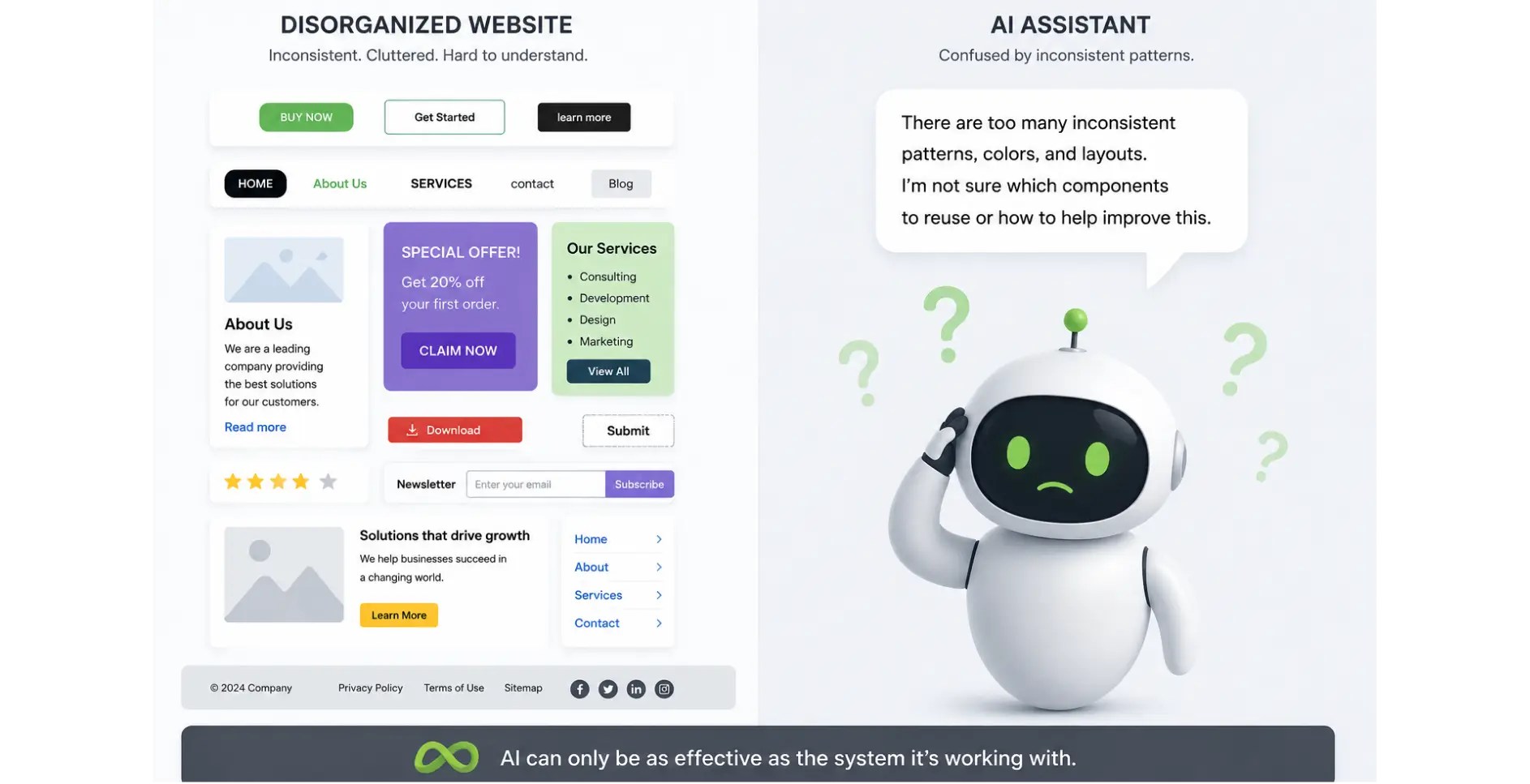
That's not a future problem. It's happening right now. And the businesses that are quietly losing ground aren't doing anything wrong, exactly. They just have websites that were built for a different era one was showing up in search results was enough. That era is ending faster than most people realize.
If you've felt like your website isn't pulling its weight the way it used to fewer calls, fewer form fills, less visibility this is worth reading carefully. Here's what being AI-ready actually means for a business website, and what you need to change.
What "AI-Ready" Actually Means for a Business Website
Let's clear up the confusion first, because this term gets thrown around a lot.
An AI-ready website doesn't mean you've added a chatbot to your homepage. It doesn't mean you used AI to write your content. It means your website is structured in a way that AI tools can read, understand, and confidently recommend your business to the right people at the right moment.
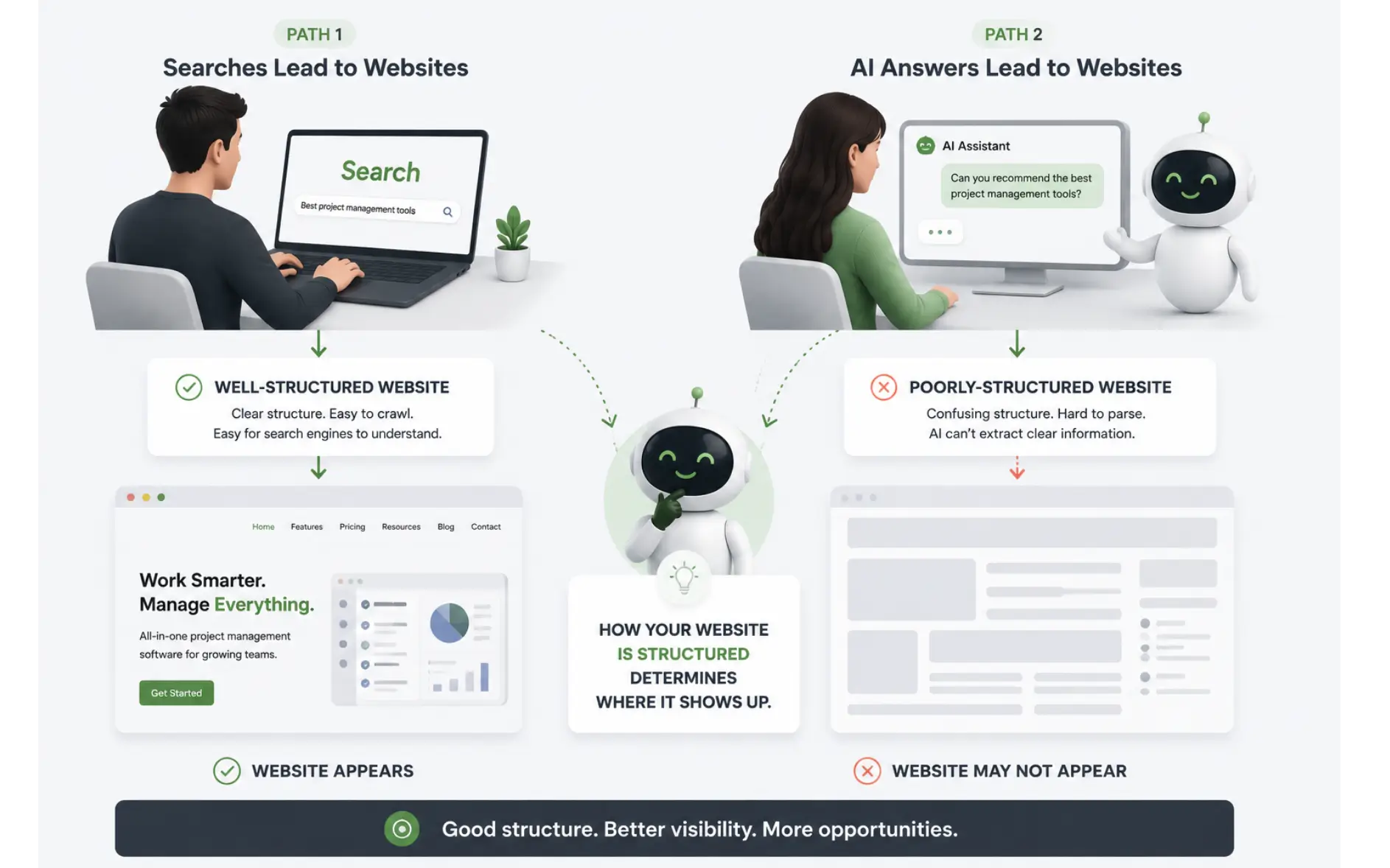
Think of it this way. When someone asks ChatGPT "what's the best landscaping company in Austin?" the AI pulls from websites it can understand clearly. It looks for specific, well-organized information: what you do, who you serve, where you operate, why you're credible. If your website buries that information in vague copy, outdated pages, or design patterns that AI can't parse properly, your business gets skipped over. Not penalized just invisible.
The same principle applies to Google's AI-powered search results, voice search on phones and smart speakers, and the growing number of AI tools people use to research purchases and services. Modern website design now has to serve two audiences simultaneously: the human visitor and the AI that decides whether to surface your business at all.
Signs Your Website Isn't AI-Ready Right Now
Before getting into fixes, here's how to tell if your current site has a problem. You don't need a technical audit to recognize most of these.
AI tools don't mention your business. Try asking ChatGPT or another AI assistant about businesses in your category and city. If competitors come up and you don't, your website isn't giving AI enough clear, structured information to work with.
Your website copy is vague. Phrases like "we provide comprehensive solutions" or "a full range of SEO services" tell AI almost nothing. It needs to understand specifically what you do, for whom, and were written plainly.
You haven't updated your site in years. AI tools favor websites with current, relevant content. A site that hasn't changed since 2019 signals to both AI and search engines that the business may not be active or trustworthy.
Your site is slow to load. Page speed has always mattered for website user experience, but AI crawlers and search engines now factor it heavily into how they evaluate and rank your site. A slow site is a site that gets deprioritized. There's no clear structure to your pages. If a new visitor can't tell within ten seconds what your business does, who it's for, and what to do next AI tools are having the same problem.
You're not showing up in voice search results. Voice searches are almost always phrased as questions: "Marketing Agency Near Me?" or "best digital marketing houston" If your site doesn't answer those questions in plain language, it won't get surfaced.
What Needs to Change: The Business Owner's Practical List
1. Make Your Core Information Impossible to Miss
This sounds obvious. Most websites still get it wrong.
Your homepage and every key page should answer these questions within the first few seconds of loading: What do you do? Who do you do it for? Where do you operate? Why should someone trust you?
Not in marketing language. In plain, specific language. "We handle commercial HVAC installation and maintenance for office buildings across the Dallas–Fort Worth area" is infinitely more useful to an AI tool and to a potential customer than "trusted solutions for all your website needs."
AI tools are essentially reading your website and summarizing your business for the people asking questions. If your copy is vague, the summary will be vague or worse, your business won't be summarized at all.
2. Answer the Questions Your Customers Are Actually Asking
One of the smartest moves in modern website design is to create content that answers the real questions customers already ask — in the same words they use. Questions like “How much does it cost?”, “How long does it take?”, “Do you serve my area?”, or “What’s the difference between these options?” should be easy to find on your site.
This improves website user experience by giving people answers fast, and it also helps AI tools pull clear, structured information from your content. A strong FAQ, a focused service page, or a short explainer post can do a lot of heavy lifting for both users and search visibility.
3. Fix Your Website's Speed and Mobile Experience
If your website takes too long to load on a phone, you're likely losing visitors before they even see your content. With most web traffic now coming from mobile devices, speed has become a critical part of both website user experience and online visibility.
The good news is that improvements are often straightforward. Compressing large images, removing unnecessary plugins, and upgrading hosting can significantly reduce load times. A faster website creates a better experience for users and makes it easier for search engines and AI tools to access and understand your content.
4. Get Your Business Information Consistent Everywhere
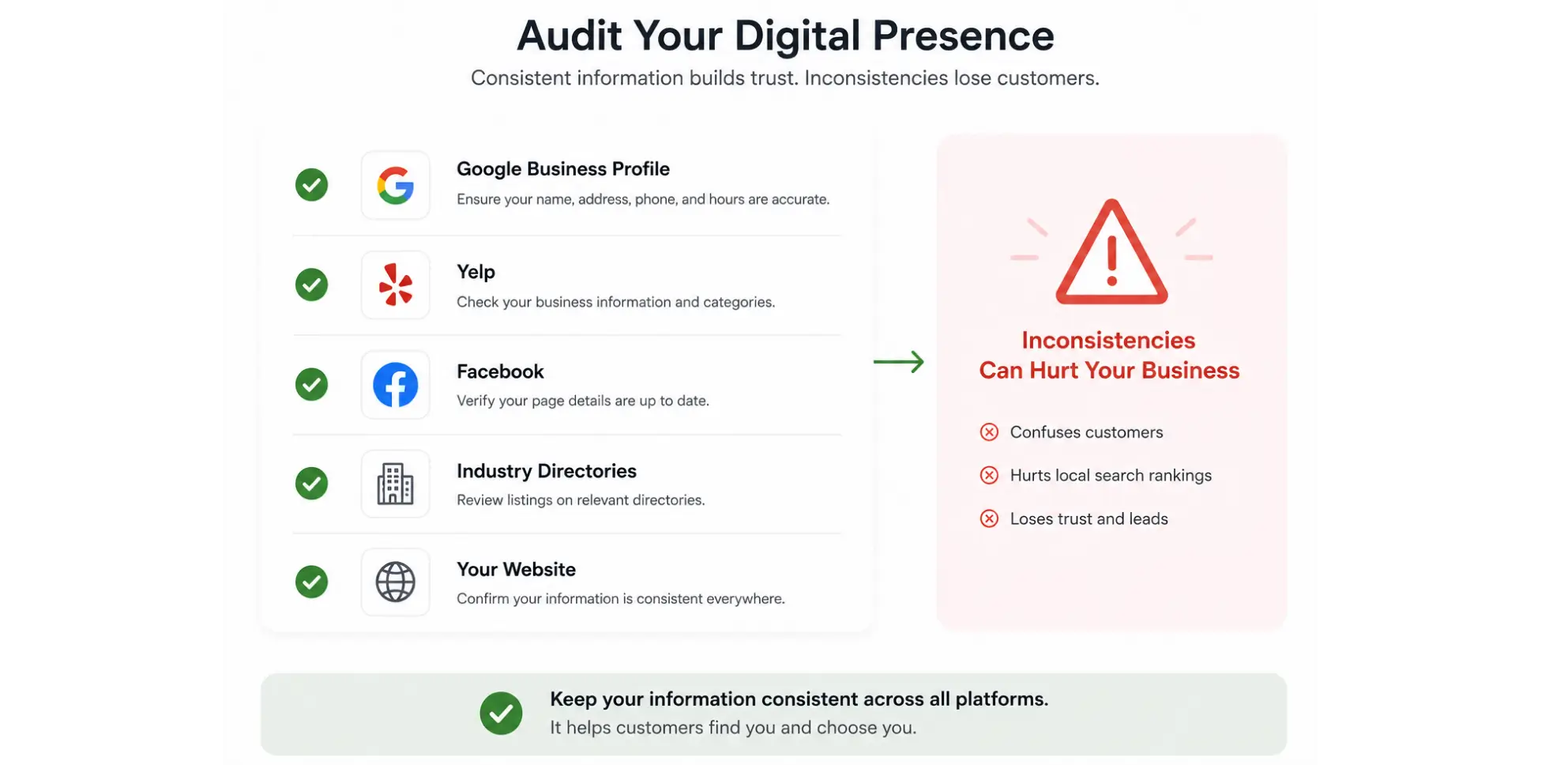
AI tools don't just read your website. They cross-reference your business information across the internet your Google Business Profile, Yelp, industry directories, social media profiles, review sites. When that information is inconsistent (different phone numbers, different addresses, different business names), it creates confusion that directly hurts your visibility.
This is called citation consistency, and it matters more now than ever. Make sure your business name, address, phone number, and hours are identical across every platform where your business appears. It's a straightforward fix with a meaningful payoff in how confidently AI tools and search engines present your business to potential customers.
5. Build Credibility That AI Can Actually See
When AI tools evaluate whether to recommend a business, they look for the same trust signals people do credibility, expertise, and proof that the business is legitimate.
Make sure your website clearly showcases:
Customer reviews and testimonials, including responses to feedback.
Specific results and outcomes, using real numbers and measurable achievements where possible.
Certifications, licenses, and industry affiliations in plain text, not hidden inside images or PDFs.
Fresh, helpful content that demonstrates expertise and shows your business is active.
The easier it is for visitors and AI tools to verify your credibility, the more likely your business is to earn trust and visibility online.
6. Structure Your Website So AI Can Navigate It
Website user experience and AI readiness go hand in hand. If visitors can easily find information, AI tools can usually understand your site more effectively too.
Focus on a few fundamentals:
Give each page a clear purpose: Instead of cramming multiple services onto one page, create dedicated pages that focus on a single topic.
Use descriptive headings: A heading like "Local SEO Services for Small Businesses" provides far more context than a generic title such as "What We Do."
Be specific about your service areas: If you serve certain cities or regions, mention them clearly throughout your website.
Keep navigation simple: Visitors should be able to reach key pages such as services, about, and contact information in just a few clicks.
The easier your website is to navigate and understand, the better the experience for both users and the systems that interpret your content.
The Businesses Getting Left Behind (And Why)
The pattern is consistent across industries. A business has a website that worked reasonably well for years decent Google traffic, a steady trickle of leads. Then, gradually, the numbers start slipping. The phone rings less. The contact form gets quieter. Competitors who seemed smaller a few years ago are suddenly everywhere.
What changed isn't always obvious from the inside. But from the outside, the answer is usually the same: their competitors updated their websites for how people search now, and they didn't.
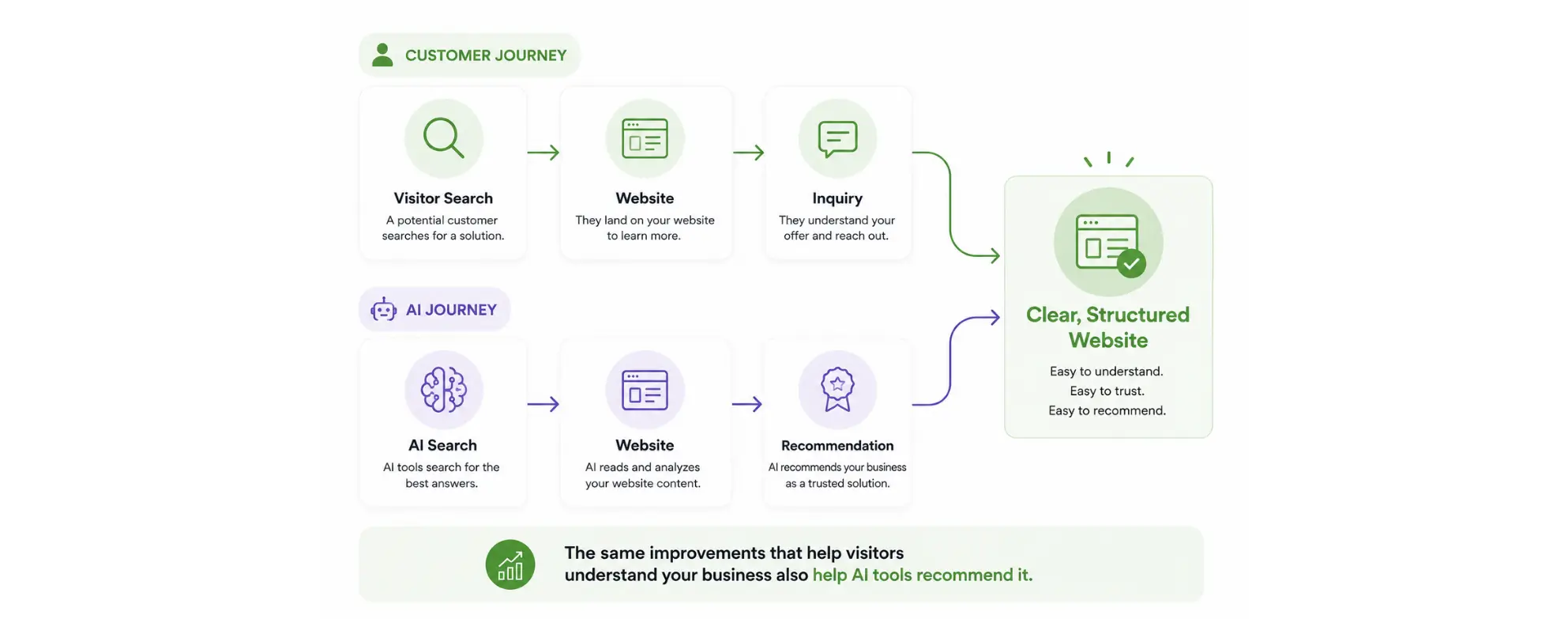
The shift to AI-assisted search is accelerating that gap. A business with a fast, clearly structured, content-rich website that answers real customer questions is getting recommended by AI tools. A business with a slow, vague, five-year-old website is getting skipped not penalized, just invisible.
The window to close that gap is still open. But it's narrowing
What to Actually Do This Month
You don't have to overhaul everything at once. Here's a prioritized starting point:
Week 1: Ask an AI tool about your business category and location. See who comes up. Read those competitors' websites and note what they're doing differently.
Week 2: Audit your business information across Google Business Profile, Yelp, Facebook, and any industry directories. Fix inconsistencies.
Week 3: Rewrite your homepage and top service pages with specific, plain-language descriptions of what you do, who you serve, and where you operate.
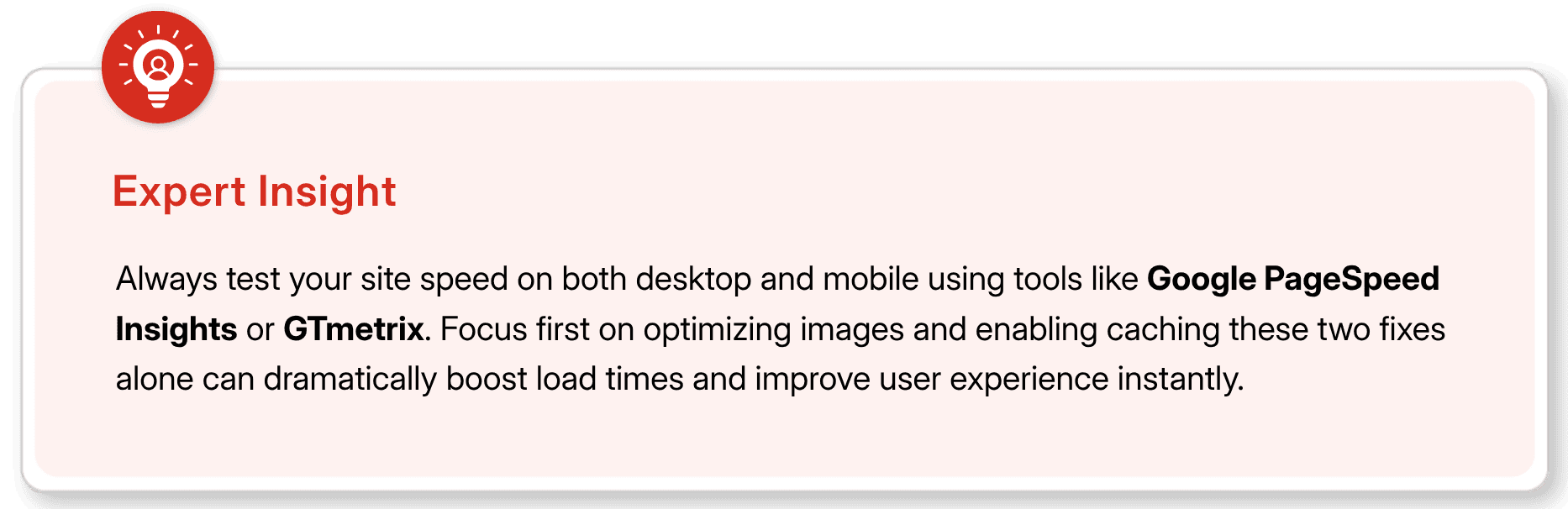
Week 4: Check your site speed with Google PageSpeed Insights (free). Address the top two or three issues flagged.
Ongoing: Add one piece of genuinely useful content per month a FAQ, a short explanation of a common service, an answer to a question you get on the phone regularly. This compounds over time in ways that almost nothing else does.
Final Thoughts
The businesses that thrive over the next few years won't necessarily be the ones with the biggest marketing budgets. They'll be the ones whose websites give AI tools and the customers using them clear, specific, trustworthy answers.
That's a shift every business can make. It doesn't require a complete redesign or a massive investment. It requires honesty about where your current website falls short, and deliberate choices about what to fix first.
Your website is often the first thing a potential customer sees and increasingly, it's the thing an AI reads before deciding whether to put your business in front of that customer at all. It's worth making sure what's there actually represents you well.
FAQs
Can AI tools actually affect whether customers find my business online?

Yes. People aren't just typing into Google anymore. A lot of them are asking Siri, ChatGPT, or AI-powered search tools to find what they need. Those tools look at your website to decide if your business is worth recommending. So if your site is vague, slow, or hard to navigate, there's a real chance you're getting left out of those results entirely.
Does becoming AI-ready mean rebuilding my whole website from scratch?
Not at all. That's one of the bigger misconceptions. In most cases, businesses already have a decent foundation they just need to tighten things up. Clearer writing, better page structure, faster load times, easier navigation. These are the kinds of changes that quietly make a huge difference. A full redesign is rarely the first thing you need.
What type of content is going to help the most?
The stuff that answers real questions. Not fluff, not keyword-stuffed filler actual useful content. Service pages that explain what you do in plain language. FAQs that address what people actually wonder about before they buy. Pricing details, case studies, blog posts that teach something. That's what AI tools are pulling from when they decide what to recommend. It's also what convinces a real customer to pick up the phone.
Why does everyone keep bringing up site speed when it comes to AI readiness?
Because a slow website is a problem on multiple fronts. Visitors get frustrated and bounce. Search engines have a harder time crawling your pages. AI systems struggle to process your content efficiently. None of those outcomes are good for visibility. Speed isn't flashy, but fixing it tends to pay off faster than most other improvements.
How would I even know if my site isn't AI-ready?
Some signs are pretty obvious once you know what to look for. Service descriptions that are too vague to be useful. Pages that haven't been touched in years. A site that's painful to use on a phone. Navigation that makes people dig around just to find basic information. No reviews, no credentials, nothing that builds trust. If your own customers struggle to understand what you offer from your website alone, AI tools are hitting the same dead ends.
Something shifted in how people find businesses and most websites haven't caught up. Most websites weren't built for AI.
A growing number of your potential customers aren't just typing into Google anymore. They're asking ChatGPT which SEO agency to hire, asking Siri for the best web design company nearby, or asking AI tools which digital marketing partner is best suited for their business. And those AI tools are pulling answers from what's on your website or skipping your business entirely because they can't make sense of what's there.
That's not a future problem. It's happening right now. And the businesses that are quietly losing ground aren't doing anything wrong, exactly. They just have websites that were built for a different era one was showing up in search results was enough. That era is ending faster than most people realize.
If you've felt like your website isn't pulling its weight the way it used to fewer calls, fewer form fills, less visibility this is worth reading carefully. Here's what being AI-ready actually means for a business website, and what you need to change.
What "AI-Ready" Actually Means for a Business Website
Let's clear up the confusion first, because this term gets thrown around a lot.
An AI-ready website doesn't mean you've added a chatbot to your homepage. It doesn't mean you used AI to write your content. It means your website is structured in a way that AI tools can read, understand, and confidently recommend your business to the right people at the right moment.
Think of it this way. When someone asks ChatGPT "what's the best landscaping company in Austin?" the AI pulls from websites it can understand clearly. It looks for specific, well-organized information: what you do, who you serve, where you operate, why you're credible. If your website buries that information in vague copy, outdated pages, or design patterns that AI can't parse properly, your business gets skipped over. Not penalized just invisible.
The same principle applies to Google's AI-powered search results, voice search on phones and smart speakers, and the growing number of AI tools people use to research purchases and services. Modern website design now has to serve two audiences simultaneously: the human visitor and the AI that decides whether to surface your business at all.
Signs Your Website Isn't AI-Ready Right Now
Before getting into fixes, here's how to tell if your current site has a problem. You don't need a technical audit to recognize most of these.
AI tools don't mention your business. Try asking ChatGPT or another AI assistant about businesses in your category and city. If competitors come up and you don't, your website isn't giving AI enough clear, structured information to work with.
Your website copy is vague. Phrases like "we provide comprehensive solutions" or "a full range of SEO services" tell AI almost nothing. It needs to understand specifically what you do, for whom, and were written plainly.
You haven't updated your site in years. AI tools favor websites with current, relevant content. A site that hasn't changed since 2019 signals to both AI and search engines that the business may not be active or trustworthy.
Your site is slow to load. Page speed has always mattered for website user experience, but AI crawlers and search engines now factor it heavily into how they evaluate and rank your site. A slow site is a site that gets deprioritized. There's no clear structure to your pages. If a new visitor can't tell within ten seconds what your business does, who it's for, and what to do next AI tools are having the same problem.
You're not showing up in voice search results. Voice searches are almost always phrased as questions: "Marketing Agency Near Me?" or "best digital marketing houston" If your site doesn't answer those questions in plain language, it won't get surfaced.
What Needs to Change: The Business Owner's Practical List
1. Make Your Core Information Impossible to Miss
This sounds obvious. Most websites still get it wrong.
Your homepage and every key page should answer these questions within the first few seconds of loading: What do you do? Who do you do it for? Where do you operate? Why should someone trust you?
Not in marketing language. In plain, specific language. "We handle commercial HVAC installation and maintenance for office buildings across the Dallas–Fort Worth area" is infinitely more useful to an AI tool and to a potential customer than "trusted solutions for all your website needs."
AI tools are essentially reading your website and summarizing your business for the people asking questions. If your copy is vague, the summary will be vague or worse, your business won't be summarized at all.
2. Answer the Questions Your Customers Are Actually Asking
One of the smartest moves in modern website design is to create content that answers the real questions customers already ask — in the same words they use. Questions like “How much does it cost?”, “How long does it take?”, “Do you serve my area?”, or “What’s the difference between these options?” should be easy to find on your site.
This improves website user experience by giving people answers fast, and it also helps AI tools pull clear, structured information from your content. A strong FAQ, a focused service page, or a short explainer post can do a lot of heavy lifting for both users and search visibility.
3. Fix Your Website's Speed and Mobile Experience
If your website takes too long to load on a phone, you're likely losing visitors before they even see your content. With most web traffic now coming from mobile devices, speed has become a critical part of both website user experience and online visibility.
The good news is that improvements are often straightforward. Compressing large images, removing unnecessary plugins, and upgrading hosting can significantly reduce load times. A faster website creates a better experience for users and makes it easier for search engines and AI tools to access and understand your content.
4. Get Your Business Information Consistent Everywhere
AI tools don't just read your website. They cross-reference your business information across the internet your Google Business Profile, Yelp, industry directories, social media profiles, review sites. When that information is inconsistent (different phone numbers, different addresses, different business names), it creates confusion that directly hurts your visibility.
This is called citation consistency, and it matters more now than ever. Make sure your business name, address, phone number, and hours are identical across every platform where your business appears. It's a straightforward fix with a meaningful payoff in how confidently AI tools and search engines present your business to potential customers.
5. Build Credibility That AI Can Actually See
When AI tools evaluate whether to recommend a business, they look for the same trust signals people do credibility, expertise, and proof that the business is legitimate.
Make sure your website clearly showcases:
Customer reviews and testimonials, including responses to feedback.
Specific results and outcomes, using real numbers and measurable achievements where possible.
Certifications, licenses, and industry affiliations in plain text, not hidden inside images or PDFs.
Fresh, helpful content that demonstrates expertise and shows your business is active.
The easier it is for visitors and AI tools to verify your credibility, the more likely your business is to earn trust and visibility online.
6. Structure Your Website So AI Can Navigate It
Website user experience and AI readiness go hand in hand. If visitors can easily find information, AI tools can usually understand your site more effectively too.
Focus on a few fundamentals:
Give each page a clear purpose: Instead of cramming multiple services onto one page, create dedicated pages that focus on a single topic.
Use descriptive headings: A heading like "Local SEO Services for Small Businesses" provides far more context than a generic title such as "What We Do."
Be specific about your service areas: If you serve certain cities or regions, mention them clearly throughout your website.
Keep navigation simple: Visitors should be able to reach key pages such as services, about, and contact information in just a few clicks.
The easier your website is to navigate and understand, the better the experience for both users and the systems that interpret your content.
The Businesses Getting Left Behind (And Why)
The pattern is consistent across industries. A business has a website that worked reasonably well for years decent Google traffic, a steady trickle of leads. Then, gradually, the numbers start slipping. The phone rings less. The contact form gets quieter. Competitors who seemed smaller a few years ago are suddenly everywhere.
What changed isn't always obvious from the inside. But from the outside, the answer is usually the same: their competitors updated their websites for how people search now, and they didn't.
The shift to AI-assisted search is accelerating that gap. A business with a fast, clearly structured, content-rich website that answers real customer questions is getting recommended by AI tools. A business with a slow, vague, five-year-old website is getting skipped not penalized, just invisible.
The window to close that gap is still open. But it's narrowing
What to Actually Do This Month
You don't have to overhaul everything at once. Here's a prioritized starting point:
Week 1: Ask an AI tool about your business category and location. See who comes up. Read those competitors' websites and note what they're doing differently.
Week 2: Audit your business information across Google Business Profile, Yelp, Facebook, and any industry directories. Fix inconsistencies.
Week 3: Rewrite your homepage and top service pages with specific, plain-language descriptions of what you do, who you serve, and where you operate.
Week 4: Check your site speed with Google PageSpeed Insights (free). Address the top two or three issues flagged.
Ongoing: Add one piece of genuinely useful content per month a FAQ, a short explanation of a common service, an answer to a question you get on the phone regularly. This compounds over time in ways that almost nothing else does.
Final Thoughts
The businesses that thrive over the next few years won't necessarily be the ones with the biggest marketing budgets. They'll be the ones whose websites give AI tools and the customers using them clear, specific, trustworthy answers.
That's a shift every business can make. It doesn't require a complete redesign or a massive investment. It requires honesty about where your current website falls short, and deliberate choices about what to fix first.
Your website is often the first thing a potential customer sees and increasingly, it's the thing an AI reads before deciding whether to put your business in front of that customer at all. It's worth making sure what's there actually represents you well.
FAQs
Can AI tools actually affect whether customers find my business online?
Yes. People aren't just typing into Google anymore. A lot of them are asking Siri, ChatGPT, or AI-powered search tools to find what they need. Those tools look at your website to decide if your business is worth recommending. So if your site is vague, slow, or hard to navigate, there's a real chance you're getting left out of those results entirely.
Does becoming AI-ready mean rebuilding my whole website from scratch?
Not at all. That's one of the bigger misconceptions. In most cases, businesses already have a decent foundation they just need to tighten things up. Clearer writing, better page structure, faster load times, easier navigation. These are the kinds of changes that quietly make a huge difference. A full redesign is rarely the first thing you need.
What type of content is going to help the most?
The stuff that answers real questions. Not fluff, not keyword-stuffed filler actual useful content. Service pages that explain what you do in plain language. FAQs that address what people actually wonder about before they buy. Pricing details, case studies, blog posts that teach something. That's what AI tools are pulling from when they decide what to recommend. It's also what convinces a real customer to pick up the phone.
Why does everyone keep bringing up site speed when it comes to AI readiness?
Because a slow website is a problem on multiple fronts. Visitors get frustrated and bounce. Search engines have a harder time crawling your pages. AI systems struggle to process your content efficiently. None of those outcomes are good for visibility. Speed isn't flashy, but fixing it tends to pay off faster than most other improvements.
How would I even know if my site isn't AI-ready?
Some signs are pretty obvious once you know what to look for. Service descriptions that are too vague to be useful. Pages that haven't been touched in years. A site that's painful to use on a phone. Navigation that makes people dig around just to find basic information. No reviews, no credentials, nothing that builds trust. If your own customers struggle to understand what you offer from your website alone, AI tools are hitting the same dead ends.

Deepak Prajapat
, Digital Marketing Analyst
Digital Marketing Analyst


Summarize with AI









Don’t miss our revenue growth tips!
Get expert marketing tips—straight to your inbox, like thousands of happy clients.
Don’t miss our revenue growth tips!
Don’t miss our revenue growth tips!
Get expert marketing tips—straight to your inbox, like thousands of happy clients.
Don’t miss our revenue growth tips!
Get expert marketing tips—straight to your inbox, like thousands of happy clients.
Relevant Blogs on Web Design
Relevant Blogs on Web Design
Unlock data-driven insights in Web Design—explore our featured blogs and skyrocket your revenue before your competitors do.
Unlock data-driven insights in Web Design—explore our featured blogs and skyrocket your revenue before your competitors do.

Web Design
Sep 9, 2026
10 Min Read
Is Your Website Too Slow? Here's How to Fix It
Web Design
Sep 9, 2026
10 Min Read
Is Your Website Too Slow? Here's How to Fix It
Web Design
Sep 9, 2026
10 Min Read
Is Your Website Too Slow? Here's How to Fix It
Web Design
Jul 23, 2026
8 Min Read
Top 5 AI Web Design Agencies for High-Converting Websites in Houston
Web Design
Jul 23, 2026
8 Min Read
Top 5 AI Web Design Agencies for High-Converting Websites in Houston
Web Design
Jul 23, 2026
8 Min Read
Top 5 AI Web Design Agencies for High-Converting Websites in Houston
Web Design
Jul 21, 2026
10 Min Read
Shopify's New AI Marketing Tool: Should Small Businesses Use It?
Web Design
Jul 21, 2026
10 Min Read
Shopify's New AI Marketing Tool: Should Small Businesses Use It?
Web Design
Jul 21, 2026
10 Min Read
Shopify's New AI Marketing Tool: Should Small Businesses Use It?


















Ready to speak with an expert?
Data-Driven Marketing Agency That Elevates ROI
1100+
Websites Designed & Optimized to Convert
$280M+
Client Revenue Driven & Growing Strong
Discover how to skyrocket
your revenue today!



Trusted by 1000+ Owners!
Ready to speak with an expert?
Data-Driven Marketing Agency That Elevates ROI
1100+
Websites Designed & Optimized to Convert
$280M+
Client Revenue Driven & Growing Strong
Discover how to skyrocket
your revenue today!
Trusted by 1000+ Owners!
Want to skyrocket revenue?
4.9/5 Ratings!
Ready to speak with an expert?
Data-Driven Marketing Agency That Elevates ROI
1100+
Websites Designed & Optimized to Convert
$280M+
Client Revenue Driven & Growing Strong
Discover how to skyrocket
your revenue today!
Trusted by 1000+ Owners!
Call
Meet