How Social Media Shapes AI Answers in 2026: What the Data Actually Shows
How Social Media Shapes AI Answers in 2026: What the Data Actually Shows
Table of Content
Title
How We
Skyrocket
Boost
Maximize
Accelerate
Amplify
Elevate
Optimize
Enhance
Your Revenue?

Aashi Katariya
Aashi Katariya
Aashi Katariya
Social Media
Social Media
Social Media
10 Min Read
10 Min
10 Min Read
A simple question sits at the center of today’s AI conversation: does our social presence shape AI’s answers?
The deeper researchers and marketers dig, the clearer the answer becomes — yes, it already does. Every LinkedIn post, YouTube transcript, Reddit thread, Medium article, and Quora answer feeds the systems shaping how AI tools respond to billions of questions.
When someone asks an AI tool:
Which agency should I hire?
What marketing platform is best?
Who is an expert in this space?
The responses don’t come from thin air. They’re assembled from patterns learned across the open web — and increasingly, from social and community platforms.
This isn’t speculation or hype. It’s grounded in platform disclosures, third‑party research (including SE Ranking data), and observable AI behavior. The goal of this blog is simple: explain how AI uses social media data, which platforms matter most, and what that means for visibility in the age of AI.
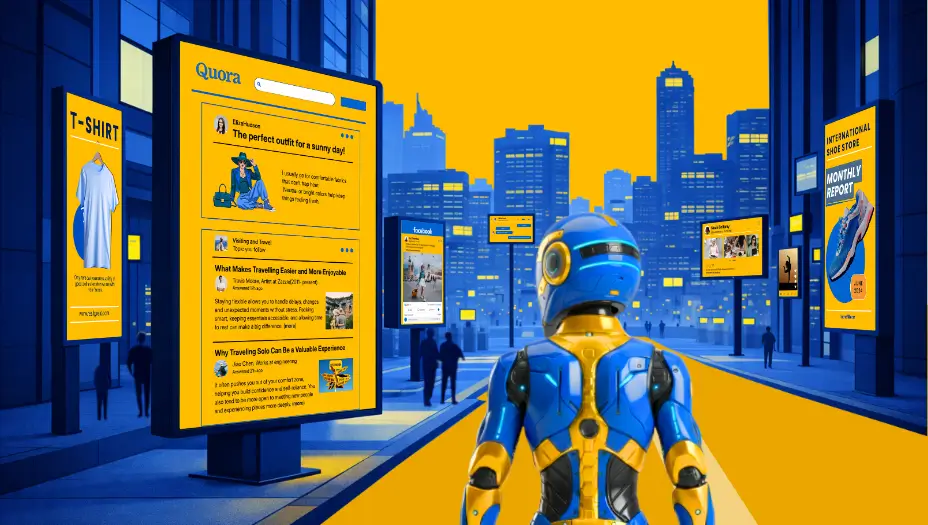
Is AI Really Learning From Social Media?
Yes — but with important nuances. Modern AI systems are trained using massive datasets that include:
Public web pages
Articles and blogs
Forums and Q&A platforms
Video transcripts
Documentation and reference material
Through machine learning, large language models (LLMs) don’t memorize facts. Instead, they generalize patterns — learning how people explain ideas, debate topics, recommend tools, and describe expertise.
Social media plays a powerful role here because it captures:
Real conversations
Opinions and disagreements
Emerging trends
Practical explanations written for humans, not algorithms
Few places generate this type of content at scale like social platforms.
However, access matters. AI systems can only learn from or reference data they are legally allowed to access — directly or indirectly. This is why some platforms dominate AI answers while others barely appear.
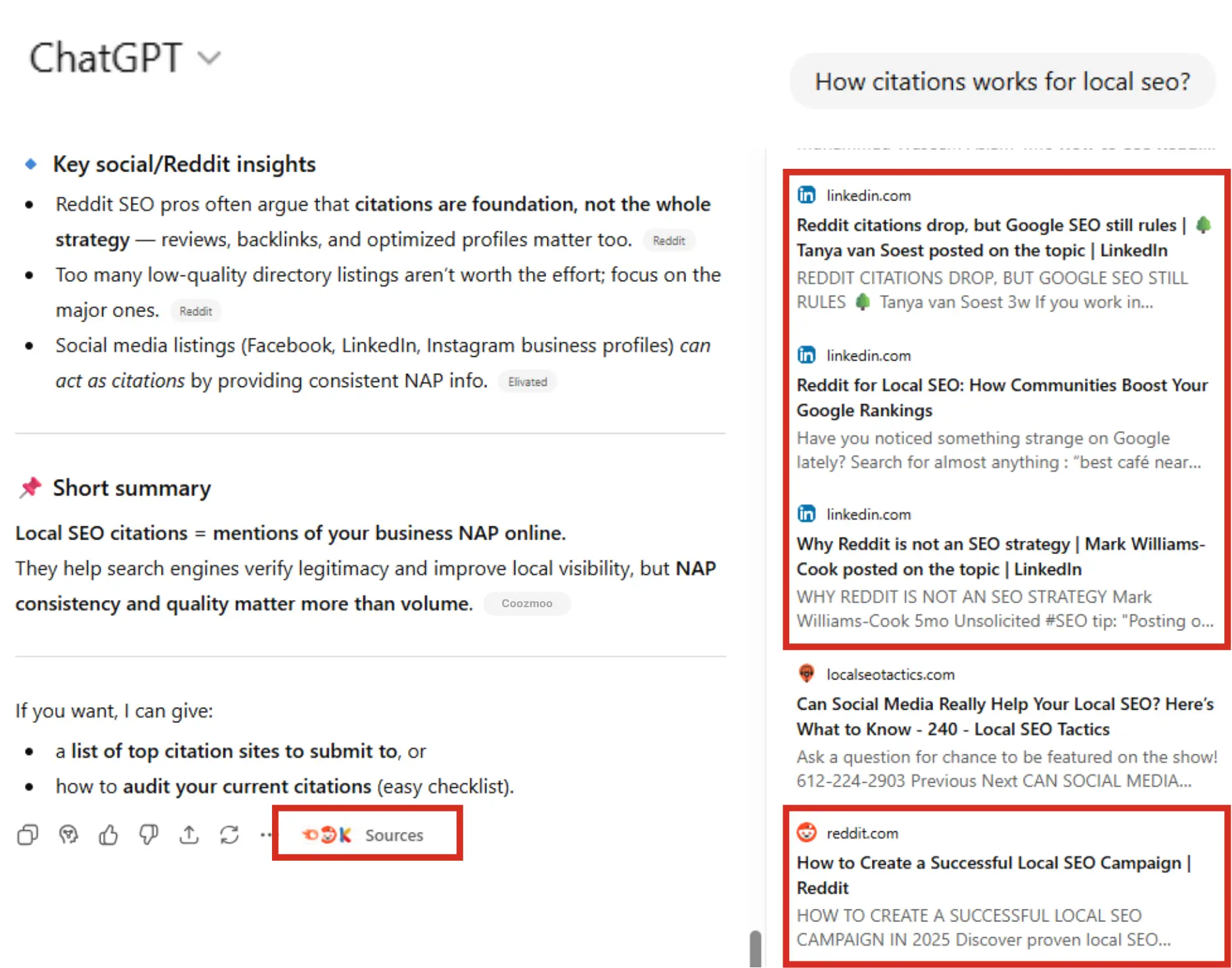
How Often Do Social Platforms Appear in AI Answers?
Recent research from SE Ranking shows:
20% of Google AI Overview responses include at least one social platform among their top 10 sources
When it comes to platform dominance:
YouTube leads Google’s AI answers
Reddit and Quora follow closely
For ChatGPT specifically:
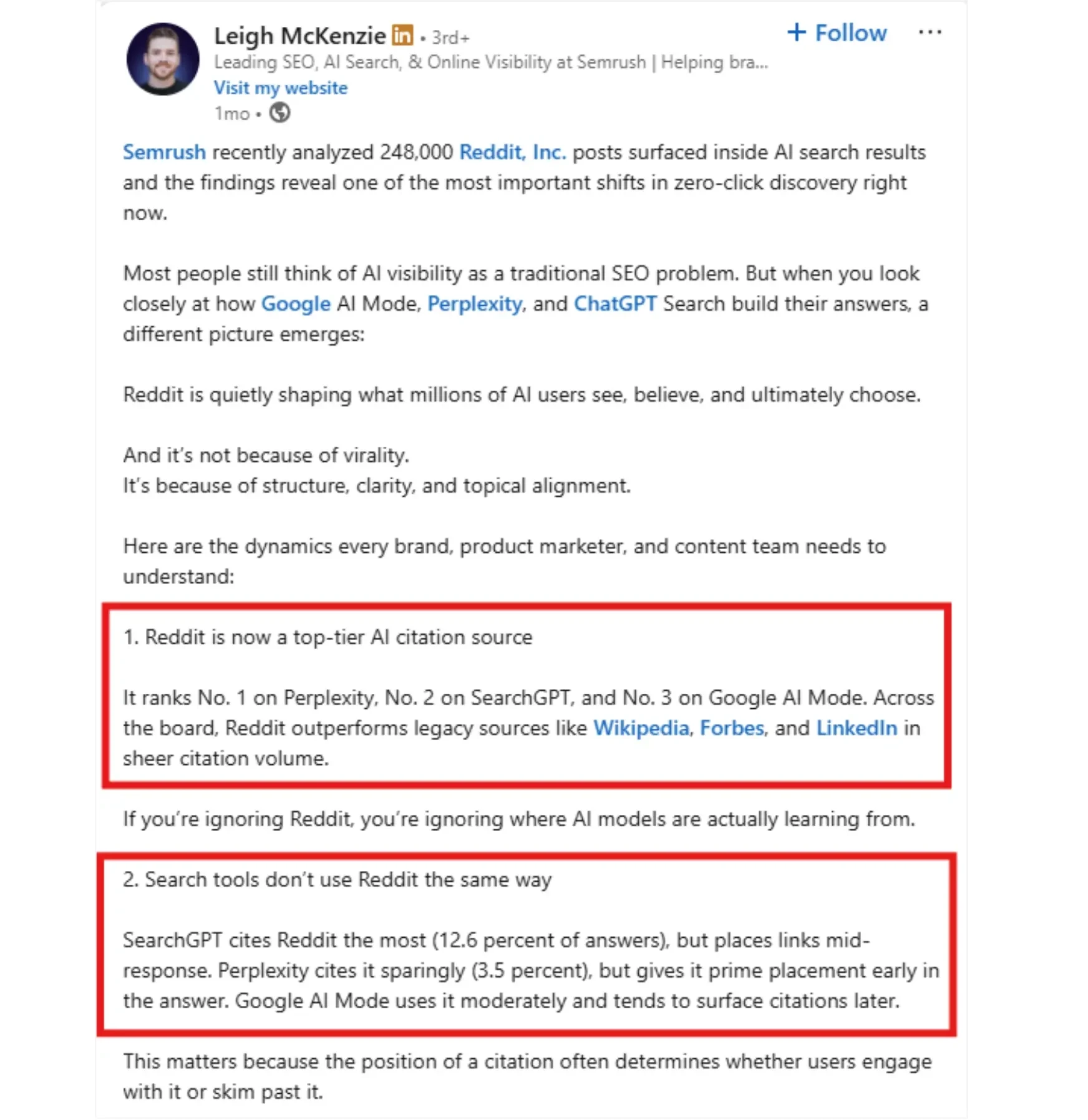
Reddit is the most cited social source
LinkedIn and Medium follow at a distance
In short, when AI answers questions, there’s a strong chance part of that response originates from:
A YouTube video transcript
A Reddit discussion
A Quora explanation
A long‑form LinkedIn or Medium post
AI Training vs AI Retrieval: A Critical Distinction
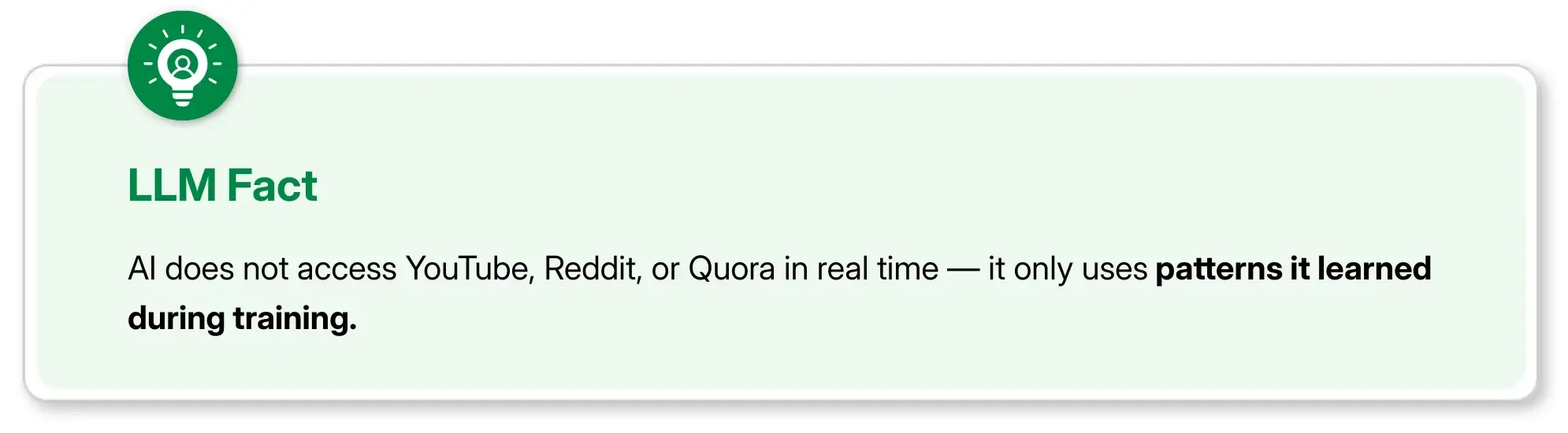
To understand AI visibility, it’s essential to separate two concepts: AI Training vs AI Retrieval
AI Training
This is how models initially learn language and concepts. Training data becomes embedded in the model’s understanding and shapes how it reasons and responds in general.
AI Retrieval
This happens when AI tools pull information from live or indexed sources to answer a specific question in real time.
Most social platforms restrict direct AI training access. However, public content can still appear in AI outputs if:
It’s indexed by Google or Bing
It’s quoted or embedded on another site
It’s referenced in articles, blogs, or forums
This indirect visibility explains why some “closed” platforms still occasionally appear in AI answers.
Platform‑by‑Platform: Who AI Can Actually Access
Licensed to both Google and OpenAI
Real‑time and structured access
One of the most visible platforms in AI answers
Reddit’s dominance isn’t about prestige — it’s about accessibility and scale.
YouTube
Internal access for Google’s AI systems
Opt‑in access for third‑party AI training
Automatic transcripts make content highly readable by AI
Closed for third‑party AI training
Public professional posts indexed by Google and Bing (from 2025)
Limited visibility in AI answers so far
Closed for external AI training and retrieval
Used internally by Meta for its own AI systems
Minimal presence in AI answers
X (Twitter)
Explicitly prohibits AI training and retrieval
Visibility has dropped sharply
Appears only indirectly when quoted elsewhere
Prohibits large‑scale scraping and training
Indexed for search, but limited AI reuse
Still visible in ChatGPT due to professional, text‑rich content
Does Posting More Increase AI Visibility?
Not directly. AI systems don’t reward volume. They reward credibility and context. Research on Generative Engine Optimization (GEO) shows that:
Earned mentions matter more than brand‑owned content
Third‑party references carry stronger trust signals
Contextual alignment matters more than posting frequency
If your social content:
Sparks discussion
Gets quoted by others
Inspires reviews or expert commentary
Then it can indirectly increase AI visibility. Simply posting more without impact does not.
How AI Decides Which Sources to Cite
Although AI platforms don’t fully disclose citation logic, research consistently points to several factors:
Authority (Reimagined)
AI doesn’t measure authority through backlinks alone. Instead, it looks at brand mentions, topical consistency, and contextual relevance.
Topical Depth
Content that deeply answers a specific question is more likely to be surfaced than broad, generic commentary.
SEO Foundations Still Matter
According to SE Ranking:
92% of AI Overview responses include at least one site ranking in Google’s top 10
This means traditional SEO — crawlability, structure, user experience — still plays a major role in AI visibility.
Internal Confidence Scoring
AI systems likely apply internal filters related to reliability and coherence before citing sources.
Why Reddit Outperforms “More Authoritative” Platforms
LinkedIn may feel more professional. Reddit may feel chaotic. Yet Reddit dominates AI answers. Why?
Reddit signed major data licensing deals
Its content is openly accessible
Conversations are long‑form and context‑rich
Authority still matters — but accessibility now competes with reputation.
Do Engagement Metrics Matter to AI?
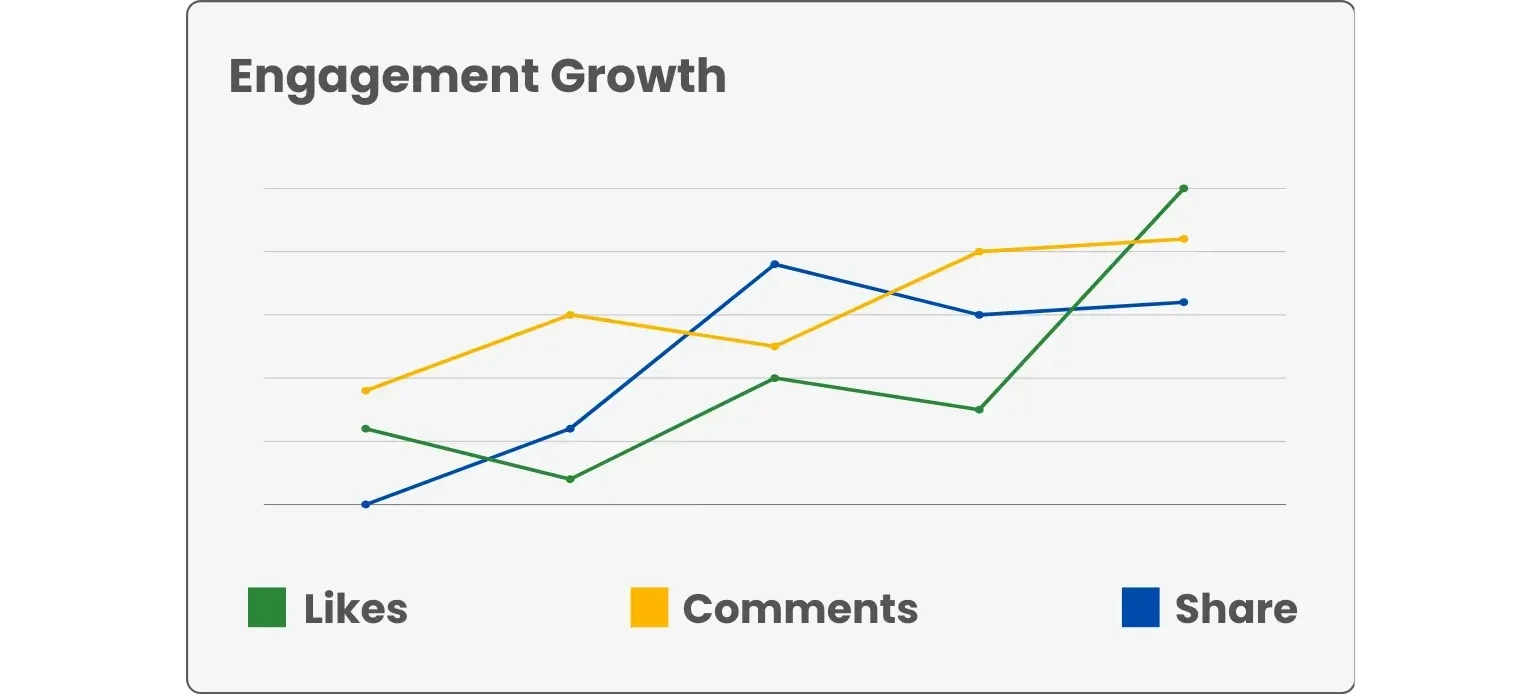
There’s no evidence that AI treats likes, shares, or comments like SEO backlinks.
Studies show:
AI citation likelihood is tied to content quality
Engagement metrics are not part of GEO scoring models
Engagement helps indirectly by increasing reach and secondary citations— not because AI reads likes.
Can AI Detect Fake Engagement?
Currently, there’s no proof that AI platforms can reliably identify fake social engagement.
AI systems lack access to:
IP addresses
Device fingerprints
Platform‑level behavioral data
This detection remains the responsibility of social networks themselves, not external AI tools.
Do Visuals and Videos Matter for AI?
Yes — more than ever. Modern multimodal AI systems can:
Read text in images using OCR
Analyze screenshots and layouts
Understand video content via transcripts
However:
Clean text is easiest to process
Poor audio or stylized visuals increase error rates
This makes clear captions, transcripts, and structured content essential.
Are Keywords and Hashtags Still Relevant?
Yes — but differently. AI relies on semantic understanding, meaning it understands concepts beyond exact keywords. However:
Hashtags help with topical clarity
They support grouping and categorization
They’re especially useful in short or noisy posts
They’re no longer primary signals, but they still assist comprehension.
How Long Does It Take for Social Content to Appear in AI?
Timelines vary:
Hours to days if indexed quickly (e.g., via IndexNow)
Days to weeks depending on crawl frequency and authority
Near real‑time for licensed platforms like Reddit
In most cases, content must first appear in Google or Bing before AI tools surface it.
Why This Matters for Brands in 2026
AI visibility is no longer just an SEO problem. It’s a convergence of:
Social presence
PR and earned media
Technical SEO
Brands that win are those that:
Publish thoughtful, focused content
Participate in real conversations
Earn mentions beyond their own channels
Final Thoughts
AI doesn’t invent opinions — it reflects patterns already present on the web. And social media is where many of those patterns originate.
Your posts, discussions, videos, and explanations don’t just reach followers anymore. They help shape the systems people trust for answers.
Visibility in AI isn’t about gaming algorithms. It’s about being present, credible, and useful in the conversations that AI is already listening to. In the age of AI, social presence isn’t optional — it’s foundational.
Ready to strengthen your brand’s presence in the AI era? Contact us today and let’s build a social strategy that actually gets you seen — by people and by AI.
A simple question sits at the center of today’s AI conversation: does our social presence shape AI’s answers?
The deeper researchers and marketers dig, the clearer the answer becomes — yes, it already does. Every LinkedIn post, YouTube transcript, Reddit thread, Medium article, and Quora answer feeds the systems shaping how AI tools respond to billions of questions.
When someone asks an AI tool:
Which agency should I hire?
What marketing platform is best?
Who is an expert in this space?
The responses don’t come from thin air. They’re assembled from patterns learned across the open web — and increasingly, from social and community platforms.
This isn’t speculation or hype. It’s grounded in platform disclosures, third‑party research (including SE Ranking data), and observable AI behavior. The goal of this blog is simple: explain how AI uses social media data, which platforms matter most, and what that means for visibility in the age of AI.
Is AI Really Learning From Social Media?
Yes — but with important nuances. Modern AI systems are trained using massive datasets that include:
Public web pages
Articles and blogs
Forums and Q&A platforms
Video transcripts
Documentation and reference material
Through machine learning, large language models (LLMs) don’t memorize facts. Instead, they generalize patterns — learning how people explain ideas, debate topics, recommend tools, and describe expertise.
Social media plays a powerful role here because it captures:
Real conversations
Opinions and disagreements
Emerging trends
Practical explanations written for humans, not algorithms
Few places generate this type of content at scale like social platforms.
However, access matters. AI systems can only learn from or reference data they are legally allowed to access — directly or indirectly. This is why some platforms dominate AI answers while others barely appear.
How Often Do Social Platforms Appear in AI Answers?
Recent research from SE Ranking shows:
20% of Google AI Overview responses include at least one social platform among their top 10 sources
When it comes to platform dominance:
YouTube leads Google’s AI answers
Reddit and Quora follow closely
For ChatGPT specifically:
Reddit is the most cited social source
LinkedIn and Medium follow at a distance
In short, when AI answers questions, there’s a strong chance part of that response originates from:
A YouTube video transcript
A Reddit discussion
A Quora explanation
A long‑form LinkedIn or Medium post
AI Training vs AI Retrieval: A Critical Distinction
To understand AI visibility, it’s essential to separate two concepts: AI Training vs AI Retrieval
AI Training
This is how models initially learn language and concepts. Training data becomes embedded in the model’s understanding and shapes how it reasons and responds in general.
AI Retrieval
This happens when AI tools pull information from live or indexed sources to answer a specific question in real time.
Most social platforms restrict direct AI training access. However, public content can still appear in AI outputs if:
It’s indexed by Google or Bing
It’s quoted or embedded on another site
It’s referenced in articles, blogs, or forums
This indirect visibility explains why some “closed” platforms still occasionally appear in AI answers.
Platform‑by‑Platform: Who AI Can Actually Access
Licensed to both Google and OpenAI
Real‑time and structured access
One of the most visible platforms in AI answers
Reddit’s dominance isn’t about prestige — it’s about accessibility and scale.
YouTube
Internal access for Google’s AI systems
Opt‑in access for third‑party AI training
Automatic transcripts make content highly readable by AI
Closed for third‑party AI training
Public professional posts indexed by Google and Bing (from 2025)
Limited visibility in AI answers so far
Closed for external AI training and retrieval
Used internally by Meta for its own AI systems
Minimal presence in AI answers
X (Twitter)
Explicitly prohibits AI training and retrieval
Visibility has dropped sharply
Appears only indirectly when quoted elsewhere
Prohibits large‑scale scraping and training
Indexed for search, but limited AI reuse
Still visible in ChatGPT due to professional, text‑rich content
Does Posting More Increase AI Visibility?
Not directly. AI systems don’t reward volume. They reward credibility and context. Research on Generative Engine Optimization (GEO) shows that:
Earned mentions matter more than brand‑owned content
Third‑party references carry stronger trust signals
Contextual alignment matters more than posting frequency
If your social content:
Sparks discussion
Gets quoted by others
Inspires reviews or expert commentary
Then it can indirectly increase AI visibility. Simply posting more without impact does not.
How AI Decides Which Sources to Cite
Although AI platforms don’t fully disclose citation logic, research consistently points to several factors:
Authority (Reimagined)
AI doesn’t measure authority through backlinks alone. Instead, it looks at brand mentions, topical consistency, and contextual relevance.
Topical Depth
Content that deeply answers a specific question is more likely to be surfaced than broad, generic commentary.
SEO Foundations Still Matter
According to SE Ranking:
92% of AI Overview responses include at least one site ranking in Google’s top 10
This means traditional SEO — crawlability, structure, user experience — still plays a major role in AI visibility.
Internal Confidence Scoring
AI systems likely apply internal filters related to reliability and coherence before citing sources.
Why Reddit Outperforms “More Authoritative” Platforms
LinkedIn may feel more professional. Reddit may feel chaotic. Yet Reddit dominates AI answers. Why?
Reddit signed major data licensing deals
Its content is openly accessible
Conversations are long‑form and context‑rich
Authority still matters — but accessibility now competes with reputation.
Do Engagement Metrics Matter to AI?
There’s no evidence that AI treats likes, shares, or comments like SEO backlinks.
Studies show:
AI citation likelihood is tied to content quality
Engagement metrics are not part of GEO scoring models
Engagement helps indirectly by increasing reach and secondary citations— not because AI reads likes.
Can AI Detect Fake Engagement?
Currently, there’s no proof that AI platforms can reliably identify fake social engagement.
AI systems lack access to:
IP addresses
Device fingerprints
Platform‑level behavioral data
This detection remains the responsibility of social networks themselves, not external AI tools.
Do Visuals and Videos Matter for AI?
Yes — more than ever. Modern multimodal AI systems can:
Read text in images using OCR
Analyze screenshots and layouts
Understand video content via transcripts
However:
Clean text is easiest to process
Poor audio or stylized visuals increase error rates
This makes clear captions, transcripts, and structured content essential.
Are Keywords and Hashtags Still Relevant?
Yes — but differently. AI relies on semantic understanding, meaning it understands concepts beyond exact keywords. However:
Hashtags help with topical clarity
They support grouping and categorization
They’re especially useful in short or noisy posts
They’re no longer primary signals, but they still assist comprehension.
How Long Does It Take for Social Content to Appear in AI?
Timelines vary:
Hours to days if indexed quickly (e.g., via IndexNow)
Days to weeks depending on crawl frequency and authority
Near real‑time for licensed platforms like Reddit
In most cases, content must first appear in Google or Bing before AI tools surface it.
Why This Matters for Brands in 2026
AI visibility is no longer just an SEO problem. It’s a convergence of:
Social presence
PR and earned media
Technical SEO
Brands that win are those that:
Publish thoughtful, focused content
Participate in real conversations
Earn mentions beyond their own channels
Final Thoughts
AI doesn’t invent opinions — it reflects patterns already present on the web. And social media is where many of those patterns originate.
Your posts, discussions, videos, and explanations don’t just reach followers anymore. They help shape the systems people trust for answers.
Visibility in AI isn’t about gaming algorithms. It’s about being present, credible, and useful in the conversations that AI is already listening to. In the age of AI, social presence isn’t optional — it’s foundational.
Ready to strengthen your brand’s presence in the AI era? Contact us today and let’s build a social strategy that actually gets you seen — by people and by AI.





Want to Grow Social Accounts? Get a Free Audit Today!
Want to Grow Social Accounts? Get a Free Audit Today!


1k+ Reviews!


Don’t miss our revenue growth tips!
Get expert marketing tips—straight to your inbox, like thousands of happy clients.
Don’t miss our revenue growth tips!
Don’t miss our revenue growth tips!
Get expert marketing tips—straight to your inbox, like thousands of happy clients.
Don’t miss our revenue growth tips!
Get expert marketing tips—straight to your inbox, like thousands of happy clients.
Relevant Blogs on Social Media
Relevant Blogs on Social Media
Unlock data-driven insights in Social Media Marketing—explore our featured blogs and skyrocket your revenue before your competitors do.
Unlock data-driven insights in Social Media Marketing—explore our featured blogs and skyrocket your revenue before your competitors do.
Social Media
Social Media
10 Min Read
10 Min Read
How Social Media Shapes AI Answers in 2026: What the Data Actually Shows
Social Media
Social Media
10 Min Read
10 Min Read
Complete Guide to User-Generated Content (UGC) in Social Media Marketing in 2026
Social Media
Social Media
10 Min Read
10 Min Read
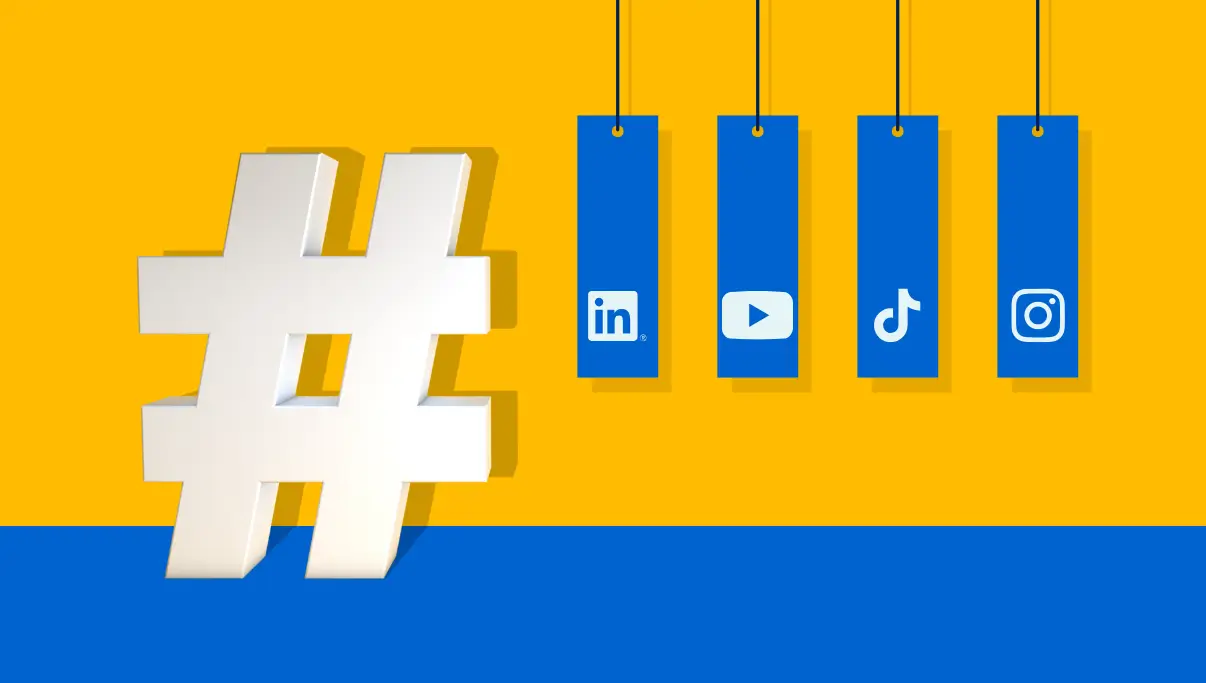
Trending Hashtags That Are Driving Engagement Across Social Media in 2026




















Ready to speak with an expert?
Data-Driven Marketing Agency That Elevates ROI
1100+
Websites Designed & Optimized to Convert
$280M+
Client Revenue Driven & Growing Strong
Discover how to skyrocket
your revenue today!


Trusted by 1000+ Owners!
Ready to speak with an expert?
Data-Driven Marketing Agency That Elevates ROI
1100+
Websites Designed & Optimized to Convert
$280M+
Client Revenue Driven & Growing Strong
Discover how to skyrocket
your revenue today!
Trusted by 1000+ Owners!
Want to skyrocket revenue?
4.9/5 Ratings!
Ready to speak with an expert?
Data-Driven Marketing Agency That Elevates ROI
1100+
Websites Designed & Optimized to Convert
$280M+
Client Revenue Driven & Growing Strong
Want to skyrocket
revenue?
Trusted by 1000+ Owners!
Call
Meet